This essay examines the subjective perception of time during the performance of long musical forms from the perspective of the performer. The starting point is the composition "Haltezeit", which works specifically with the stretching of time. Two improvisational performances without an audience will be used to explore how the perception of time changes in the course of performances lasting several hours and how this influences improvisational behavior. Practical experience is combined with concepts from the fields of philosophy, performance studies and musical improvisation research. The artistic experiments show that physical states such as tiredness or tension as well as external disturbances significantly influence the subjective perception of duration. While inner restlessness led to an extended experience of time and more frequent improvisational interventions, calmness and concentration favored a condensed, meditative experience of time with less frequent changes.
Artistic practice thus becomes an experiential space for a qualitative perception of time beyond measurable structures. The essay sees itself as an open research gesture that invites us to perceive time more consciously as a flowing continuum in a performative context.
This article explores the shifting temporality of John Cage’s 4’33” as it propogates through the digital landscape of YouTube. Originally conceived as a timed, almost site-specific performance of shared presence and ambient listening, 4’33” can function surprisingly well online in an environment dedicated to speed, repetition, and distraction. Drawing on seven diverse video performances—ranging from the historically grounded to the amateur and experimental—I examine how silence and time are embodied, marked, framed, and performed in online space. These performances inhabit a paradox: they are situated within a system designed to fragment attention, yet they demand stillness and duration. In doing so, they unsettle the assumptions of immediacy that govern digital spectatorship.
Rather than treat 4’33” as a fixed score, I argue that each video becomes a site of temporal negotiation. The performers use silence as a gestural and visual act, creating tension between embodied time and platform time. They foreground listening not only as acoustic attention but as a durational stance—an insistence on presence within an artwork that privileges absence. The result is a form of quiet resistance to algorithmic rhythm, the embracing of non-playing, a reclaiming of boredom.
These online performances suggest that 4’33” has not lost its edge. Instead, it has adapted, becoming a mirror for contemporary conditions of time, presence, and attention. Silence here is not absence, but an expanded field—where listening, duration, and performance are reimagined in and against the temporal asynchronicities of the digital.
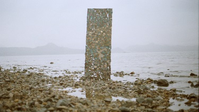
(painting by Morna McGoldrick, 1964)
This article examines an expanded conceptualization of time-based art beyond artworks that unfold consecutively over measurable durations. Typical time-based art was characterized with clear beginning and ending such as performance, cinematic art, moving image, sound art, and computational installation. In contrast, this analysis investigates how static art possesses temporal qualities through alternative means. With the incorporation of “time-based materials” - substances that transform their external forms over time – we establish an alternative time-based art characterized by an imminent temporality.
Historical paintings like Goya’s "The Third of May 1808" and Bruegel’s "The Fall of the Rebel Angels" reveal early attempts to the depiction of time through compositional arrangement and juxtaposition of events. The author extends this tradition by exploring how certain materials possess intrinsic “temporal directionality” – a predictable but fluctuating transformation process. Examples include oxidation of metals that undergo the process of rusting and patination, creating visual changes that occur gradually and unpredictably, embodying what the author terms an imminent quality - known to happen but uncertain in exact duration.
The author makes use of his own artworks as case studies: "Simulacra" (2015), a juxtaposition of photographs of copper armors against the actual deteriorating objects; "The Fall of the Rebel Angels" (2022), a translation of Pieter Bruegel’s painting into an installation using patinated copper; and "Public Cemetery" (2023), an incorporation of natural phenomenon like rain and typhoons as temporal agents. These works demonstrate how materials that vulnerable to intrinsic transformation can create temporal experiences that transcend conventional time-based art definitions, offering new possibilities for expressing time through the interplay of possibility, impossibility, and imminence.
This project is about zero time, which is no time, but can also mean the time of change or a new beginning. The phantoms in question are not ghosts or spectres, but placeholders; they stand for something absent, like the mathematical concept of zero.
An important example for such a phantom is phantom pain. This term refers to the perception of painful sensations in a part of the body that is no longer there, for example because it has been surgically or traumatically removed. The key point is: The limb, organ or eye is missing, but the pain is still there, and the pain felt there is real.
The reality of pain is essential in the context of this work.
Not just phantom pain, but the broader concept of phantom experience is the subject of Phantomology. Phantom experiences are experiences that were not really experienced, such as traumatic events in early childhood; events that were not integrated into the ego system and therefore did not become part of our – accessible – memory.
The aim of the Phantomology project is to develop artistic strategies for dealing with these phantoms, guided by the question of how to grasp and investigate them as something absent.
The challenge is that it is ultimately about nothingness, timelessness, and our striving to fill voids as a basic human desire, this desire to give content to the gaps we are constantly confronted with in the timelines of our lives.
This exposition proposes revisiting as a method for engaging with long term artistic research. The method was developed while returning to a series of twelve year-long works based on repetition called Animal Years (2002-2014) in the context of the Academy of Finland funded research project How To Do Things With Performance (2016-2020). The same method was further explored as an artistic tool in the project Pondering with Pines (2022-2024). The method could be generalised into revisiting understood as return and repeat, recycle and recombine, reflect and reconsider and adapted to many types of artistic practices.
When does the singer become an artist?
We ran an opera laboratory at the Department of Opera at Stockholm University of the Arts, during the years 2017-2020.
With the searchlight focused on the creativity of the singer, we wanted to explore the borderland between the rehearsed and the spontaneous, in the art of performing opera.
Our basic questions were:
-when does the performance of the opera singer, which requires a high level of technical perfection, open up towards the unpredictable, creative moment?
-Where is the border line between interpretation and improvisation, does it even exist?
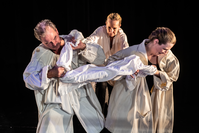
We commissioned a mini-opera to use as working material;Camilles irrfärder & äventyr, composed by Petter Ekman to a libretto by Tuvalisa Rangström. Windows for improvisation were included in the score, where the performers can play with text, rythm, melody or structure in different ways. In the work we alternated between artistic experiments and reflection. The ensemble reflected on how the different games and methods opened or closed the creative flow, and how the improvisations affected the performers' relationship to the material. A parallel focus was how the singers were inspired to change or expand their voices. We have found new methods in the work of developing the creative ability and force of the opera singer. We have applied the methods in different ways in higher education for Opera singers, developing new pedagogic approaches in the process.