Bus Stop
(2025)
author(s): Julija Jonas
published in: FFA BUT – Faculty of Fine Arts, Brno University of Technology
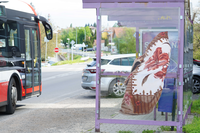
This exposition reflects on the phenomenon of the public transport stop as a metaphorical framework for the condition of migration and the figure of the waiting individual. By centering the act of waiting, this research examines how mutual understanding and cultural translation unfold within intercultural encounters. The bus stop serves as both a physical site and a symbolic threshold, a space of transition, suspension, and projection toward an uncertain future. Within this context, the project traces the transformative phases of subjectivity experienced during emigration, emphasizing the temporal dimension of waiting, expectation, and the tension inherent in moments of immobility. The final installation is situated directly within the public sphere, specifically at bus stops, where the object destabilizes the everyday rhythm of transit. By oscillating between staged intervention and authentic environment, the project foregrounds the paradoxical beauty of stillness, alongside the latent unease of anticipation.
Soittaa omaa mahtia - An Experimental Approach to the ‘Inner Power’ Improvisation in 19th‑Century Karelian Kantele Tradition
(2025)
author(s): Arja Anneli Kastinen
published in: Research Catalogue
This exposition introduces an experimental framework for acquiring the “inner power” improvisation associated with 19th‑century non-literate Karelian kantele players. While their precise thought processes remain unknowable, it is clear they did not focus on finger control. The method emphasizes internalizing traditional plucking patterns without sheet music, allowing subconscious decision‑making to guide improvisation. Stepwise learning of increasingly complex patterns enables musicians to combine and vary them freely, creating a continuous flow of tones in which the player becomes part of the sound field. Contemporary practice thus reconnects with what kantele players once described as “playing their inner power” (“soitan omaa mahtia”), a style later termed “Quiet Exaltation” by folk music researcher Armas Otto Väisänen.
Editorial: The possibility of having time to have a world
(2025)
author(s): PÁR-A-GEM
published in: HUB - Journal of Research in Art, Design and Society
We are pleased to announce the release of HUB - Journal of Research in Art, Design and Society, Issue #5 Duration? Dur(action)!. Guided by the collective of guest editors PÁR-A-GEM, this edition offers in-depth explorations of the intersections between media, temporality, and embodied artistic research.
Emergent Patterns in Cultural Entrepreneurship: Navigating Tensions, Building Networks, and Cultivating Care
(2025)
author(s): Christer Windeløv-Lidzelius
published in: Research Catalogue
This exposition explores emergent patterns in cultural entrepreneurship, grounded in empirical reflections from a cohort of early-career cultural practitioners. Drawing on anonymized theses and defense feedback from the Arts and Cultural Entrepreneurship master’s programme at Stockholm University of the Arts, the article identifies three core themes: tensions between artistic practice and entrepreneurial imperatives; the role of networks in sustaining practice; and the emergence of care as both method and ethic. Situated within the fields of artistic research, pedagogy, and cultural theory, the exposition offers a multi-layered reflection on what it means to navigate uncertainty and create meaning in contemporary cultural work. The piece integrates theoretical perspectives on effectuation, narrative and embodied knowledge, slow design, and behavioral insights to illuminate how cultural entrepreneurs build viable, sustainable practices in volatile environments.
DESERT DWELLING
(2025)
author(s): Christine Hansen
published in: Faculty of Fine Art, Music and Design, University of Bergen
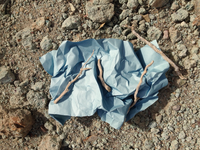
Desert Dwelling is a research project conducted by Associate professor Christine Hansen and Independent Artist Line Anda Dalmar. The desert is used as a site and framework to reflect on landscape, environment and time. In addition, Desert Dwelling endeavor to explore the act of observation and documentation. The project uses common documentation/observation methods such as photography, video and sound. In addition, we employ more obsolete and time-consuming observation means such as drawing, casting and watercolor painting. This is to stress that different observation methods render the world differently, and provide noninterchangeable information about the world. Much of the visual material is from a field study in deserts in California in spring 2018. The study took place mainly in Death Valley and Joshua Tree and had a processual method. We selected a place in the desert and stayed there until we found something interesting to work with. Every day, we made experiences that we built on the next day. The working method focused on the fluid relationship between process, work and documentation.
In a Place like this
(2025)
author(s): Johan Sandborg, Duncan Higgins
published in: Faculty of Fine Art, Music and Design, University of Bergen
In A place Like This sets out to investigate and expand the issues and critical discourses within Sandborg and Higgins' current collaborative research practice. The central focus for the research is concerned with how art, in this instance photographic and painted image making and text, can be used as an agent or catalyst of understanding and critical reflection.
The research methodology is constructed through photography, painting, drawing and text. This utilises the form of an artist publication as a point of critically engaged dissemination: a place for the tension between conflicting ideas and investigation to be explored through discussion.
The research question is focused on how the production of the image and the act of making images can communicate or describe moments of erasure or remembering in terms of historical and personal narratives with direct reference to moments of violence and place.
This is seen not in terms of a nostalgic remembrance of the past; instead as one that is rife with complicated layers and dynamics where recognition is denied the ability to locate a physical representation. Embedded in this is an exploration of particular questions concerning the ethics of representation: the depiction of ourselves and other? In this sense it brings into question an examination of the act of remembering as a thing in itself, through the production of the image and text, contexts of knowledge and cultural discourses explored through the form of an artists publication.