The Antonioni House: Sensory-Temporal Architecture
Peter Spence, Sheffield Hallam University, UK
__________________________________________________________________________
1. Introduction
- La Cupola
- 'Dwelling'
- L’Avventura
2. Theoretical Framework
3. The Antonioni House
- The body in space
- The body in time
- An ‘architectural moment’
4. Conclusion
5. References
__________________________________________________________________________
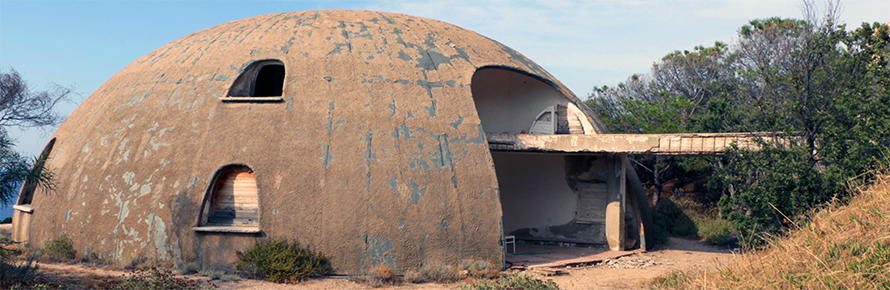
Introduction
This paper outlines a developmental process in my own journey as a researcher. It tracks a progression from a largely cognitive interpretation of La Cupola (Figure 1) informed by certain established methodologies and based primarily on my sighted perception of the villa, to one in which a sensory and embodied experience gave me a much fuller understanding of its significance. I will underpin my discussion with ideas from architecture and film phenomenology.
I first learned of the existence of La Cupola quite by chance in 2014, and as a life-long admirer of the film work of its former occupant Michelangelo Antonioni, I became immediately fascinated by this secret villa in an idyllic coastal region of Sardinia, and the prospect of producing some sort of film project about it. After reading its architect Dante Bini’s Building with Air (Bini, 2014) an initial documentary proposal was written whereby an architect, structural engineer and film theorist would each give their responses to the villa according to their respective areas of expertise, but it was ultimately not possible to gain official access for filming at the villa and the project was put on hold.
However, further research threw up a lecture given by Dante Bini in 2018 where he outlined the extraordinary creative process which his exacting film-maker client insisted on in the development of La Cupola (Spence, 2020). I also learned at this point that the uninhabited villa was not restricted and was quite easily accessible from the end of a coastal road. I realised that footage and images of the exterior of the building and its locale would be sufficient for the production of a video essay for the purpose of considering Antonioni’s classic 1960 film L'Avventura in light of this new learning about his creative process as a house designer. It also became apparent that the ideas of architectural theorist Christian Norberg-Schulz, who drew heavily on Martin Heidegger’s early ideas on the phenomenology of architecture, would be useful in this methodology. The outcome of this initial research La Cupola: Re-visiting L'Avventura through 'building' and 'dwelling' (Spence, 2020), can be viewed below (Video 1).
La Cupola
“The smell of a just broken granite is distinctive and powerful – try it!”, Dante Bini urged his audience at the 2018 symposium in San Francisco to discuss the commission, design and build of La Cupola on Costa Paradiso in north Sardinia. He was recounting an incident with the villa’s commissioner, Michelangelo Antonioni, during the research and development period of the villa when the two spent time together at the site of the scheme. The director had taken him to a local granite quarry and required that he smell the newly broken slab and declared, “you can smell here the essence of time, of space, the universe!” according to Bini (Spence, 2020).
He continues: “He wanted me to absorb the environment [of Costa Paradiso] for hours and days … he invited me to examine the direction of the prevailing winds, made me listen to the breaking of the sea waves on the rocks, made me feel the smell of the local grass and on the occasion of a brief summer storm he made me enjoy the pleasure of the rain on our skin,” (Bini in Spence, 2020).
In addition to honouring a number of strict conditions including an oath of secrecy (the villa only came to broader public attention after Antonioni’s death in 2007) what Dante Bini brought to the project was a bespoke version of his then pioneering Binishell construction system (Bini, 2014) whereby a membrane is covered with wet concrete – in this instance with local Sardinian granite added to the mix - and pumped with air until it rises to create a dome shape.
“Over time I knew how to appreciate the extraordinary sensitivity of the great director but transforming his perception into architectural form seemed to me very challenging because he also claimed he wanted to live in the ‘space’, not in a two dimensional habitat,” recalls Bini (Spence, 2020). By which Antonioni meant the ‘space’ of Costa Paradiso: the smells, sounds, textures, rhythms as well as the sights of the locale. And the dome ‘built with air’ was the architect’s response; a dwelling that incorporated and embraced both the natural landscape and the elements of the site.
'Dwelling'
“What then do we mean by the word ‘place’?” asks Christian Norberg-Schulz in the opening pages of Genius Loci: Towards a Phenomenology of Architecture (1980). “Obviously, we mean something more than abstract location. We mean a totality made up of concrete things having material substance, shape, texture and colour. Together these things determine an ‘environmental character’, which is the essence of place,” (1980, p.6).
Drawing on Martin Heidegger’s phenomenology, Norberg-Schulz suggested that the purpose of architecture is to create a tangible, experiential connection with place, an “existential foothold” as he defines it (1971, p.23).
In ‘Building, Dwelling, Thinking’ (1971), which originated as a lecture paper in 1951, Heidegger argues that only through learning to ‘dwell’ as individuals can we effectively design and build homes: “The nature of building is letting dwell. Building accomplishes its nature in the raising of locations by the joining of their spaces. Only if we are capable of dwelling, only then can we build,” (1971, p9). Moreover, the role of dwelling and building in defining space in turn defines our very being in the world. “Dwelling, however, is the basic character of Being in keeping with which mortals exist,” (1971, p. 9) he states. But in order to dwell, we must identify with the character of place and location. Norberg-Schulz says: "Human identity presupposes the identity of place” (1996, p.425).
As I suggest in La Cupola: Re-visiting L’Avventura through ‘building’ and ‘dwelling’ (Spence, 2020), this association between place and human identity is a useful bridging concept between Antonioni’s architectural commission and his filmic output, particularly L’Avventura (1960).
L'Avventura (Antonioni, 1960)
There is no narrative explanation for why the cruise party of wealthy Romans decide to port at such an unforgiving outcrop (the island of Lisca Bianca north-east of Sicily) on their pleasure cruise; perhaps it merely serves as a suitably inhospitable location for the character of Anna to go missing. However, thematically the visit immediately serves the purpose of placing the group in a dangerous and threatening natural location, establishing their human frailty and vulnerability. Rocks tumble into the water near them, blow holes spurt furiously, and the spectre of a shark is even evoked by Anna herself before she goes missing. Perhaps Antonioni found something of this brutal beauty on Costa Paradiso when he acquired a plot of land for his villa a few years after L’Avventura had been released in 1960.
While the rest of the group are clearly threatened by the island we see the character of Claudia develop an affinity with its offerings – she plays in the sea, closely examines shrubbery, and feels the wind in her hair just as Antonioni had insisted his architect do in the research and development process of La Cupola. However, unlike Claudia, who clearly identifies with the island and yet remains thematically homeless throughout L’Avventura (1960) as I have argued (Spence, 2020), Antonioni was able to fully realise his connection with Costa Paradiso, and identify with the place before ultimately ‘building’ and ‘dwelling’ there. Or as Norberg-Schulz would have it, “The existential purpose of building (architecture) is therefore to make a site become a place, that is, to uncover the meanings potentially present in the given environment” (1996, p.422).
In L’Avventura (1960) and Antonioni’s filmic output generally there is a pre-occupation with contingencies of ‘place’ be it natural or built and its effects on the individual, as explored through his often female main protagonists as we’ve seen with Claudia, but the character of Daria in Zabriskie Point (Antonioni, 1970) also comes to mind here. With Bini’s testimony we now have evidence of Antonioni’s real life enactment of certain rituals and routines for making a multi-sensory connection with an environment, and in his own words, "The subject of my films is always born of the landscape, of a site, of a place I want to explore” (Antonioni, 1996, p.xxi). It would seem that the quote may work equally well in application to the design and build of La Cupola.
Theoretical Framework
The arguments made in La Cupola: Re-visiting L’Avventura through ‘building’ and ‘dwelling’ (Spence, 2020) were arrived at using primarily a cinema studies methodology, aided by ideas from early architectural phenomenology, where a close textual analysis of the film under scrutiny is critically reflected on. This was based on a cognitive interpretation of primarily visual stimuli – the villa, the landscape and the film L’Avventura (1960), of course. But as we shall see later a chance opportunity to enter inside the villa radically altered this approach, when I revisited a brief moment of previously overlooked video footage.
It is useful here to touch on some of the debates within phenomenology and to consider where theorizing in architecture and film begin to enter into a dialogue with each other. I would suggest that while architecture and film fundamentally differ in that the former provides the ability to house us in a physical entity, while the latter is essentially representative, there is a shared dynamic by which the body exists in and relates to space and time.
Working in architecture theory and film studies, respectively, two theorists coming to prominence in the 1990s developed ideas about how we may apply phenomenological thinking to their fields of enquiry, Juhani Pallasmaa and Vivian Sobchack, respectively. Here the emphasis was on an embodied and sensory understanding of physical and representative spaces, with the rationalist cognitive experience somewhat downgraded.
Bringing together the poetics of Gaston Bachelard and early phenomenology of Heidegger, the Finnish architect and theorist Juhani Pallasmaa (1996) made the argument that vision had been over-prioritised in our understanding of buildings, leading to an architecture of image and spectacle that had lost touch with the other senses. He suggested that buildings have the potential to be felt throughout the body, arguing that, “Every touching experience of architecture is multi-sensory; qualities of space, matter and scale are measured equally by the eye, ear, nose, skin, tongue, skeleton and muscle," (1996, p.45).
In Architectural Affects After Deleuze and Guattari (2021), architectural theorists Marko Jobst and Helene Frichot have challenged what they term “the second wave of architectural phenomenology of Juhani Pallasmaa” as conservative and “regressive humanism” in its claims for “object oriented ontologies” which fail to acknowledge broader political, social and ecological contexts (2021, p.3).
Although somewhat revising his position on the significance of vision in the The Embodied Image (2011) as the primary carrier of meaning compared to the other senses, Pallasmaa has maintained his fundamental ontological position over the last few decades rebutting the various accusations of Heideggerian essentialism, stating recently in reference to architecture and film that “artistic entities are relational and mediating experiences, and their meanings are about the world and its human existential encounter,” (2023, p.9).
Taking inspiration from Maurice Merleau-Ponty’s theories of perception film theorist Vivian Sobchack in The Address of the Eye (1992) and particularly Carnal Thoughts (2004) de-emphasized the visual element of the film experience to develop the idea of the sensory moment of “tactile shock” (2004, p.66) where the spectator may feel a physical response to the film world and its characters. Much of this argument is based on Sobchack’s notion of the film body as an audio-visual entity independent of its maker, which is both seen by the film viewer but also sees its own characters and objects. While in agreement that the film is both object and subject Frampton (2006) finds Sobchack’s position ultimately frustrating for the comparison between film and human perception stating, “It is limiting to talk about film form in terms of our perceptual capabilities – film can do more than us, differently to us," (2006, p.47).
Also indebted to Sobchack, Matilda Mroz has a more formal reservation based on Sobchack’s emphasis on matters spatial rather than temporal. Quoting the work of Laura Marks (2000), she argues that the sensory can have a cultural underpinning based on memory, stating “Perception takes place ‘not simply in a phenomenological present but in an engagement with individual and cultural memory,’”(2013, p. 31).
While there is still considerable debate within the now post-phenomenology landscape, the term ‘affect’ is commonly used across both film and architecture discourses (Yoder, 2023). For example, working with filmic, written and illustration methods, Lillian Chee makes the argument for an understanding of architecture based on ‘encounter’ where an attunement to the often overlooked affective qualities of an engagement between subject and object in a spatial setting can be highly revealing. Moreover, she suggests that this knowledge be valued for its ability to take us outside of established or institutional narratives and histories. Suggesting an ‘anti-method’ approach from the margins and ‘oblique positions’, she asks the question: “What becomes of architectural knowledge when a building, a space, or a landscape is approached, as it often happens in lived encounters, through a compelling detour—an event, or another subject located outside the discipline?” (2023, p. 6).
It is a question that forms a useful starting point for the account of my experience of La Cupola, and in what follows, I will attempt to articulate in both written and video methods my own ‘architectural encounter’ or ‘architectural moment’ as I term it.
The Antonioni House
I had supplemented the modest research grant from my university employer with some family holiday budget and so extended the trip to Costa Paradiso in Sardinia to around a week, where we found accommodation just a few kilometres from La Cupola.
I visited it most days, both with and without my camera, once incorporated into my running route and another time with the whole family. The site of the villa is easily accessible from the end of a dusty coast road, which leads to a footpath extending around the rocky coastline. It was not fenced off in any way, so I was able to go right up to it and walk around its circumference to find the best positions for my images, which were incorporated into the video essay (Spence, 2020). However, on one of my visits, I had the opportunity to enter the villa (Video 2), which has subsequently given me an entirely different perspective on the research.
The body in space
Inside La Cupola everything is sensuously different in terms of temperature, sound and smell from outside, where I’d been filming and photographing in the hot Mediterranean sun; the insulating qualities of the concrete dome immediately provide a cooling effect.
The cavernous inside of the dome also creates an echo which fades down the sound of the crickets outside while gently mimicking my foot-steps and occasional gasps of wonder.
There is a damp, musty smell, presumably from the years of unmaintained plaster-work, which contrasts with the salty air and Mediterranean herbs of the exterior. So the villa is no longer just an image only experienced by my eye, but now suddenly felt all over - it is now a multi-sensory experience.
In addition to the immediate physical experience of being inside the building, the moment is the culmination of around four years of research into the villa and several failed attempts to get official access. But now, suddenly, I’m inside the inner sanctum of Antonioni and his private world, which his architect had been made to sign an agreement not to disclose during his lifetime (Fontana, L. in Bini 2014). I’m no longer excluded and outside, like Claudia in L'Avventura (1960), where we see her repeatedly peering inquisitively into dwellings through windows and doorways.
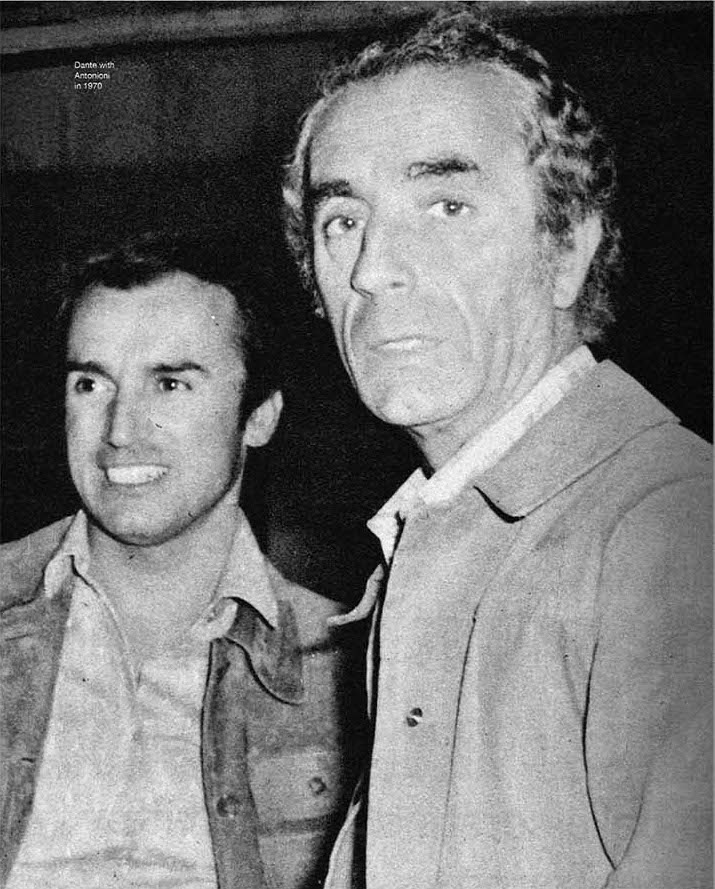
Antonioni had wanted to reduce the physical boundaries of walls and ceilings of his villa, as testified to by Dante Bini (Figure 2) when he first revealed information about the design and build process in 2018. Describing long walks around Costa Paradiso, he recalled Antonioni’s directives for La Cupola: “When I enter my house, I don’t want to lose what is surrounding us. I want to see the sea entering the house, appreciate the salty smell, the sound of the sea, hear the seagulls, feel the wind and essence of Sardinian herbs, and the rain on my hand when I’m in my house!” (Bini in Spence, 2020).
From my brief time inside the villa, it would appear that Bini very much fulfilled the client brief in terms of blurring traditional boundaries of outside and inside. A well in the center of the dome roof allows the elements straight into the house making possible a small interior garden as the central feature of the home. A large curved window wraps around the front of the villa to enable daylight and a stunning vista over the Mediterranean from the main living area, while the upstairs bedrooms each have their own balcony embedded into the dome structure, giving direct access outside and overlooking the coastline and ocean.
Walking around the villa, and being able to sit on the chunky 1970s style furniture which was still there after all those years, I felt as close as I ever would to the enigma that had always been ‘Michelangelo Antonioni’. By finding my way into his secret villa more than 20 years after I’d first discovered his films, would everything become clear somehow, and would I finally come to understand them?
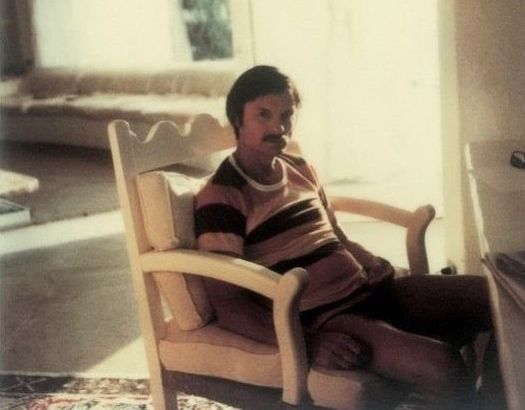
I had read all the key texts on Antonioni’s films in my research, but still felt somehow dissatisfied by the numerous readings and analyses. However, with my brief privileged access into his private world, apparently largely unchanged since he had last been there, I now had the confidence and the opportunity to say something about his work from a new perspective. Or, maybe even, as I trod where other great directors (Figure 3) had previously, I could be touched by the magic and become a better film-maker myself!
The body in time
Pallasmaa argues that in addition to its sensory and embodied affects, architecture functions to give meaning to personal history when he talks of “spaces of imagination and memory” (1996). Furthermore, he says, “Architecture domesticates limitless space and enables us to inhabit it, but it should likewise domesticate endless time and enable us to inhabit the continuum of time,” (1996, p.35).
As well as the immediate change in physically felt sensation provided by the sheltering dome, there is a clear bodily response to the situation I now find myself in: profuse sweating, hands shaking and heavy breathing which can perhaps be better understood in temporal rather than spatial terms given my personal history with the building and its previous occupant.
The encounter with the villa was the culmination of several years of research and failure to gain funding for a more extensive film project, such that I had settled for the opportunity just to see the villa from outside. The brief opportunity to actually enter inside was unexpected and provided an altogether different experience to the one I had planned. Moreover, I would suggest that my research into La Cupola was really only a latter period intensification of an almost life-long fascination with Antonioni and his world.
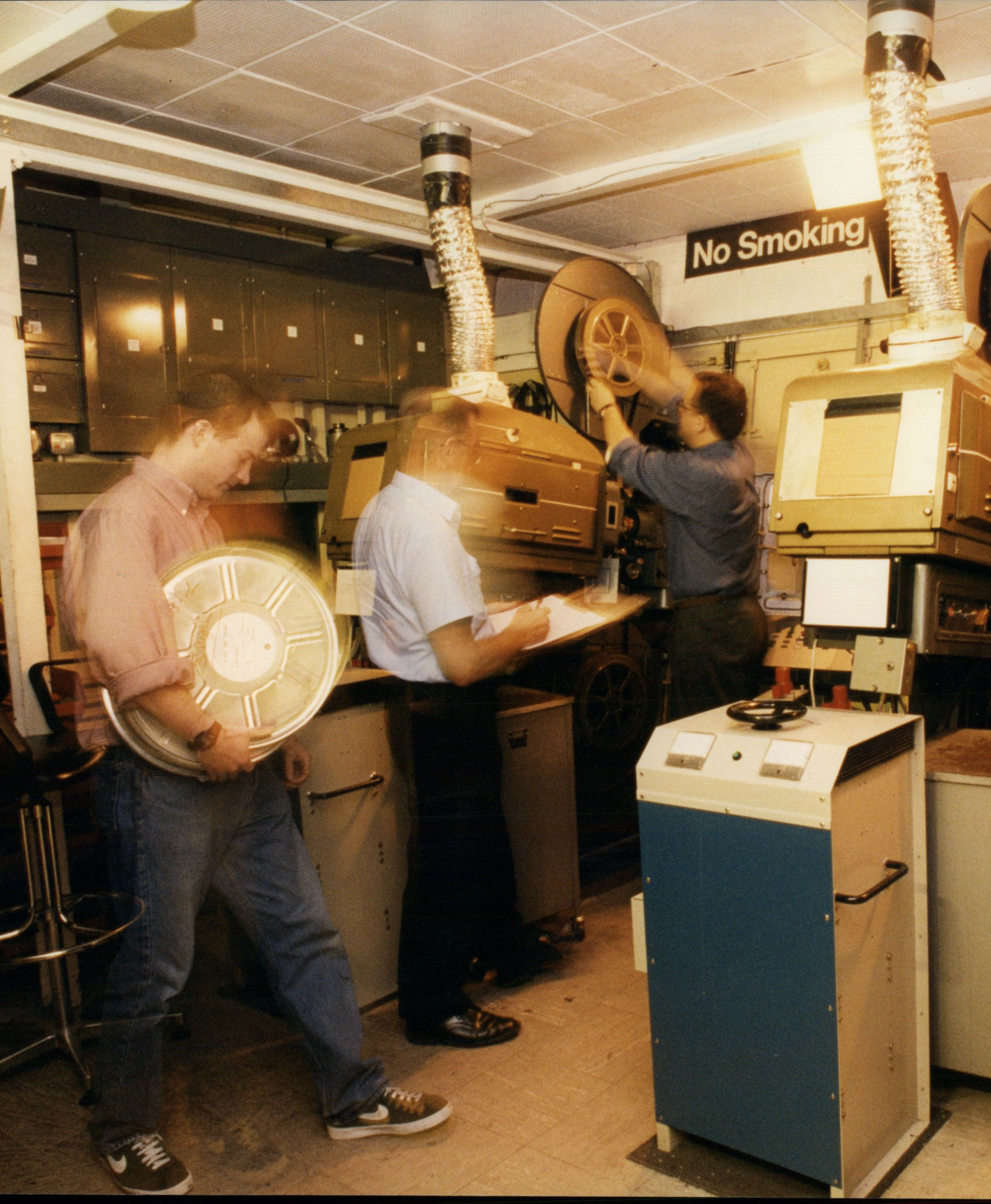
I first discovered the film-maker as a cinema projectionist (Figure 4) in my 20’s with a short season of his work at the National Film Theatre in London where I worked at the time, and was immediately perplexed and intrigued. Already considering myself a cineaste at this relatively young age, and consuming an extraordinary range of cinema as part of my job, I was frustrated by my lack of understanding particularly of L'Avventura (1960). The film is formally and narratively elusive with its sequences of temps-mort (dead time), the mystery trope of the disappearing woman that is never resolved, but only serves to initiate a fruitless drawn out search by the main protagonist couple whose relationship is also ultimately undefined.
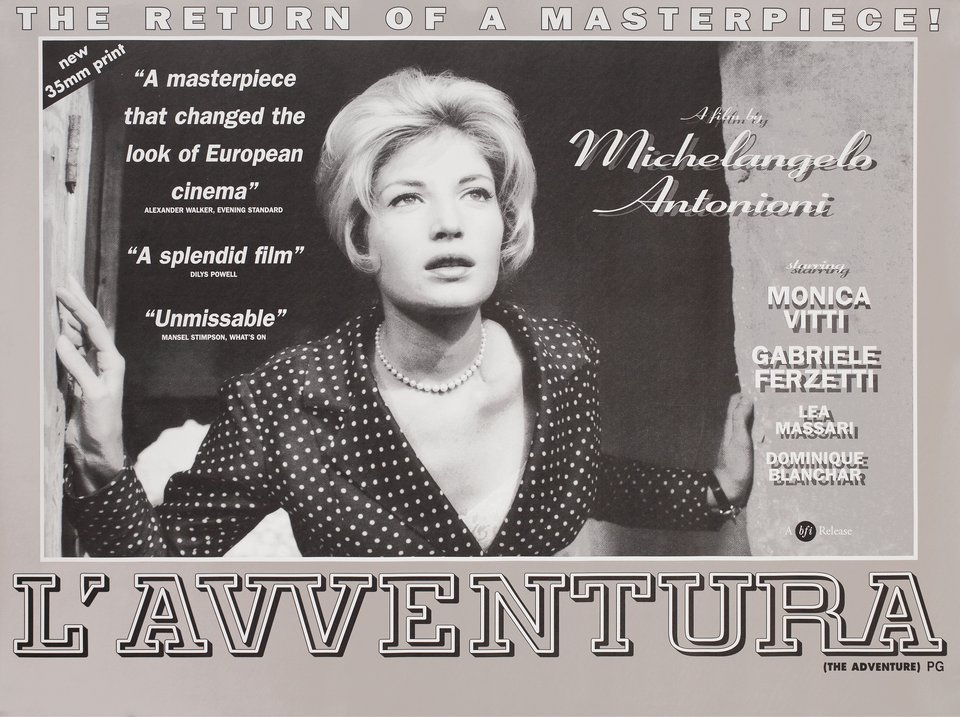
Determined not to be defeated I re-watched L’Avventura (1960) (Figure 5) twice more on separate cinema visits before I felt even close to untangling its mysteries. A strange inner contradictory dynamic occurred in me where I was simultaneously pushed away by the meandering unresolved narrative, while drawn in by its curious world of wealthy 1960’s romans at parties and palatial villas, Monica Vitti’s other-worldly beauty, its overall Italianess.
My film school graduation short, shot on 16mm, was largely inspired by Antonioni's compositions, where my principal direction to the cinematographer was to dwarf my main protagonist against the post-industrial cityscapes of early 2000s Sheffield, UK, in an attempt to mimic Deserto Rosso (Antonioni, 1963). I was able to obtain Antonioni’s contact address in Rome and sent him a copy of the film on VHS with a short note, to which he didn’t reply!
An ‘architectural moment’
While Gaston Bachelard (1964) suggests that we retain a memory image of our first home, which serves to inform every subsequent home we inhabit, this was my first and only time in La Cupola and it has certainly never been my home, but perhaps the encounter with the interior of the villa can be interpreted as some sort of moment of personal truth, the culmination of a 25 year quest to understand an enigma.
Vivian Sobchack says of embodied cinema viewing, “With every film we engage in we experience moments of divergence and rupture and moments of convergence and rapture,” (1992, p.286). Developing this argument, Anne Rutherford emphasises the cultural and historical significance of such responses based on lived experience, stating “embodiment is one of the important culturally or historically-inscribed dispositions that the spectator brings to the cinema” (2003, p.6).
In more recent years, Matilda Mroz has insightfully updated these ideas, particularly with reference to Henri Bergson’s notion of ‘durée’ or duration (2004) via Deleuze’s cinema books (2013). She writes, “What the concept of duration might be seen to bring to film theory, then, is the notion of temporal strands intertwining and braiding together in Cinema, as well as the process of their unfolding and expanding” (2013, p.35). And with regard to the physical space, Lilian Chee says, “The attunement to the affective situation creates the possibility of inhabiting the past in an embodied historical present” (2023, p.10).
Perhaps this helps us to understand my physical response on entering the villa: a sensory and temporal overload in excess of the purely cinematic experience. As not only do I find myself physically in the space but also touched by the significance of the moment in time, which served to codify and give meaning to a multi-stranded temporal flow in terms of my own history as a film-maker, cineaste, researcher (and projectionist!) simultaneously. A moment in which the image had become a physicality, and the imagined had become a reality.
There is also a methodological significance to the moment where what had begun some years earlier as an attempt to understand La Cupola through established discourses in architecture theory, structural engineering, and cinema studies had evolved spontaneously through a chance opportunity to enter inside. And it was only in that unexpected moment of pure experience that I was able to shed conventional ways of understanding and encounter the space without preconception - not dissimilar to the way in which Antonioni had urged his architect to experience the location, the site, the 'place', all those decades earlier.
Conclusion
In this exposition I have sought to articulate the way in which my encounter with the inner space of La Cupola operated on a number of temporal levels, enabling a new and revised methodological approach.
Moreover, in bringing together ideas from film and architectural theory based on my conviction in their shared temporal and spatial qualities, particularly in relation to the body, I would like to propose the notion of an intense sensory and temporal moment of rupture/rapture as experienced by a building.
In the first instance the unexpected and brief opportunity to enter La Cupola, when I had only intended to photograph its exterior, was not seen as relevant to the original research project, and the footage was left unused for several years. It was only in re-visiting the footage and placing the moment inside the villa within a much broader temporal framework that I was able to fully understand the experience as centering or focusing a personal narrative – a resolution of sorts.
So, through re-appraising some pre-existing research in this way, we can demonstrate how a built space can have a multi-sensory and physical effect as well as a purely visual registration. Moreover, I argue that the bodily response also indicates a temporal encounter with the space that is significant, so that we can begin to suggest an ‘architectural moment’ akin to a ‘cinematic moment’ when we watch a film; and further explore the shared temporal experiences of built space and film space.
References
| Antonioni, M. (1996). The Architecture of Vision: Writings and interviews on Cinema. Marsilio | ||||
| Antonioni, M. (1960). L'Avventura. Cino Del Duca | ||||
| Antonioni, M. (1963). Deserto Rosso. Film Duemila | ||||
| Antonioni, M. (1970). Zabriskie Point. MGM | ||||
| Bachelard, G. (1964). The Poetics of Space. Beacon Press | ||||
| Bergson, H. (2004). Matter and Memory. Dover | ||||
| Bini, D. (2014). Building with Air. Bibliotheque McLean | ||||
| Chee. L. (2023). Architecture and Affect: Precarious Spaces. Routledge https://doi.org/10.4324/9781315604565 |
||||
| Deleuze, G. (2013). Cinema 1. Bloomsbury | ||||
| Deleuze, G. (2013). Cinema 2. Bloomsbury | ||||
| Frampton, D, (2006) Filmosophy. Wallflower Press | ||||
| Heidegger, M, (1971) Poetry, Language, Thought. Harper Colophon Books | ||||
| Jobst, M. & Frichot, H. (Eds.), (2023). Architectural Affects After Deleuze and Guatarri. Routledge | ||||
| Marks, L. (2000) The Skin of the Film. Duke University Press https://doi.org/10.1215/9780822381372 |
||||
| Mroz, M. (2013). Temporality and Film Analysis. Edinburgh University Press https://doi.org/10.3366/edinburgh/9780748643462.001.0001 |
||||
| Norberg-Schulz, C. (1971). Existence, Space & Architecture. Studio Visdta Ltd | ||||
| Norberg-Schulz, C. (1980). Genius loci : towards a phenomenology of architecture. Rizzoli. | ||||
| Norberg-Schulz, C. (1996). The Phenomenon of Place in Nesbitt, C. (Ed) Theorizing a New Agenda for Architecture. Princeton Architectural Press. | ||||
| Pallasmaa, J. (1996). The Eyes of the Skin. Architecture and the Senses. John Wiley and Son | ||||
| Pallasmaa, J. (2011). The Embodied Image. John Wiley and Son | ||||
| Pallasmaa, J. (2023). Veracity of Experience. In Vahdat, V & Kerestes, J. (Eds) Architecture, Film and the In-between: Spatio-Cinematic Betwixt. Intellect https://doi.org/10.1386/9781789387377_2 |
||||
| Rascaroli, L. & Rhodes, D. (Eds.), (2011). Antonioni: Centenary Essays. Palgrave Macmillan https://doi.org/10.5040/9781838711788 |
||||
| Rutherford, A. (2003). Cinema and Embodied Affect. Senses of Cinema, Issue 25. | ||||
| Sobchack, V. (1992). The Address of the Eye. A Phenomenology of Film Experience. Princeton University Press https://doi.org/10.1515/9780691213279-007 |
||||
| Sobchack, V. (2004). Carnal Thoughts. Embodiment and Moving Image Culture. University of California Press. https://doi.org/10.1525/9780520937826 |
||||
| Spence, P. (2020). La Cupola: Re-visiting L'Avventura through 'building' and 'dwelling'. Journal of Videographic Film and Moving Image Studies, Issue 7.2. https://doi.org/10.16995/intransition.11372 |
||||
| Yoder, J. (2023). Architecture After Affect in Vahdat, V & Kerestes, J. (Eds) Architecture, Film and the In-between: Spatio-Cinematic Betwixt. Intellect https://doi.org/10.1386/9781789387377_3 |
||||
List of Figures
Figure 1. Spence, P (Photographer). (2018) La Cupola.
Figure 2. Unknown photographer. (1970) Dante Bini and Michelangelo Antonioni. Novella 2000. Accessed from Bini, D. (2014). Building with Air (p. 152). Bibliotheque McLean
Figure 3. Unknown photographer. (1982) Andrey Tarkovsky at La Cupola. Tarkovsky Archive. Accessed 07.06.24 from https://uk.pinterest.com/pin/1071293830102259705/
Figure 4. Denis Jones. (Photographer). (1994) Author (foreground) and unidentified colleagues in National Film Theatre projection room. London Evening Standard
Figure 5. BFI designed poster. (1997) L'Avventura re-release poster. British Film Institute
Video 1. Spence, P (Film-maker). (2018) La Cupola: Re-visiting L'Avventura through 'building' and 'dwelling'. Journal of Videographic Film and Moving Image Studies, Issue 7.2
Video 2. Spence, P (Film-maker). (2018) Inside La Cupola.