**L’EPISTEMOLOGIA DELLO SGUARDO DIVERGENTE: RICERCA OLTRE LA RAGIONE
di Giuseppe Rametta, Giusirames.
In this section, the research defines the “Divergent Gaze” not as a subjective condition, but as a rigorous phenomenological method. It is the production of a divergent reality where fantasy becomes scientific certainty. The artist does not merely observe reality but interrogates its molecular and ontological stability.
I. EPISTEMOLOGY OF THE DIVERGENT GAZE: FROM INTUITION TO EMPIRICAL VALIDATION This chapter outlines the “Divergent Gaze” not as an aesthetic abstraction, but as an applied phenomenological protocol. My research postulates that fantasy is not antithetical to science; rather, it represents a pre-theoretical hypothesis that finds confirmation through the molecular manipulation of matter.
1.1 Dynamics of Transition States: The Liminal Zone: Classical physics classifies matter into discrete states (solid, liquid, gas). My research focuses on controlled phase transition, operating within a liminal zone. Redefinition of the Fluid (The Sea): The sea is treated as an unstable colloidal system. The divergent gaze identifies its “latent viscosity,” transforming the water mass into a structural support through the induction of molecular bonds that arrest its fluidity without altering its refractive index. Oil as a Structural Polymer: Oil is stripped of its lubricating function and analyzed for its surface tension. Through hydro-stratification, oil acquires sculptural volume, becoming an optical solid capable of holding light in three-dimensional suspension.
“Empirical Validation of Material Safety: Non-Flammability Test. This video demonstrates the thermal resistance of the developed organic-mineral compound (calcium carbonate, natural fibers, and thickening agents). Despite being composed of organic elements, the material proves to be naturally fire-retardant and non-flammable, ensuring high safety standards for public exhibitions.”
1.2 The Chemistry of Absence: Engineering “Poor” Materials Methodological divergence lies in the rejection of industrial synthetic polymers in favor of spontaneous organic chemistry: Synthesis of Hybrid Materials (Toothpaste and Fibers): The integration of calcium carbonate and surfactants (found in toothpaste compounds) with natural cellulose fibers creates a high-density composite material. Scientifically, this creates a hygroscopic matrix capable of stabilizing organic pigments (coffee, oxidations) within a self-supporting structure. Safety Analysis (Fire-Retardant Behavior): The research has highlighted an unexpected result: the combination of these organic and mineral binders produces a material that is intrinsically non-flammable. This data transforms artistic inquiry into material safety research, offering a solution to the thermal vulnerability of artworks in public exhibition contexts.
1.3 Ontology of Reversibility: The Aesthetics of Return The research challenges the dogma of “perpetuity” in art, introducing the concept of Programmed Solubility: Environmental Reactivity: Unlike metal alloys or silicates, the matter I create possesses a “water memory.” It is programmed to respond to humidity: water is not a degrading agent, but the natural solvent that allows for the return to a primordial state. Material Life Cycle (Artistic LCA): This approach defines the work as a “Stabilized Moment.” Scientifically, this constitutes research into controlled entropy: art is no longer an eternal monument, but a biological system that accepts its own dissolution as an integral part of the cognitive process. The work is born from water and, by thermodynamic consistency, to water it returns.
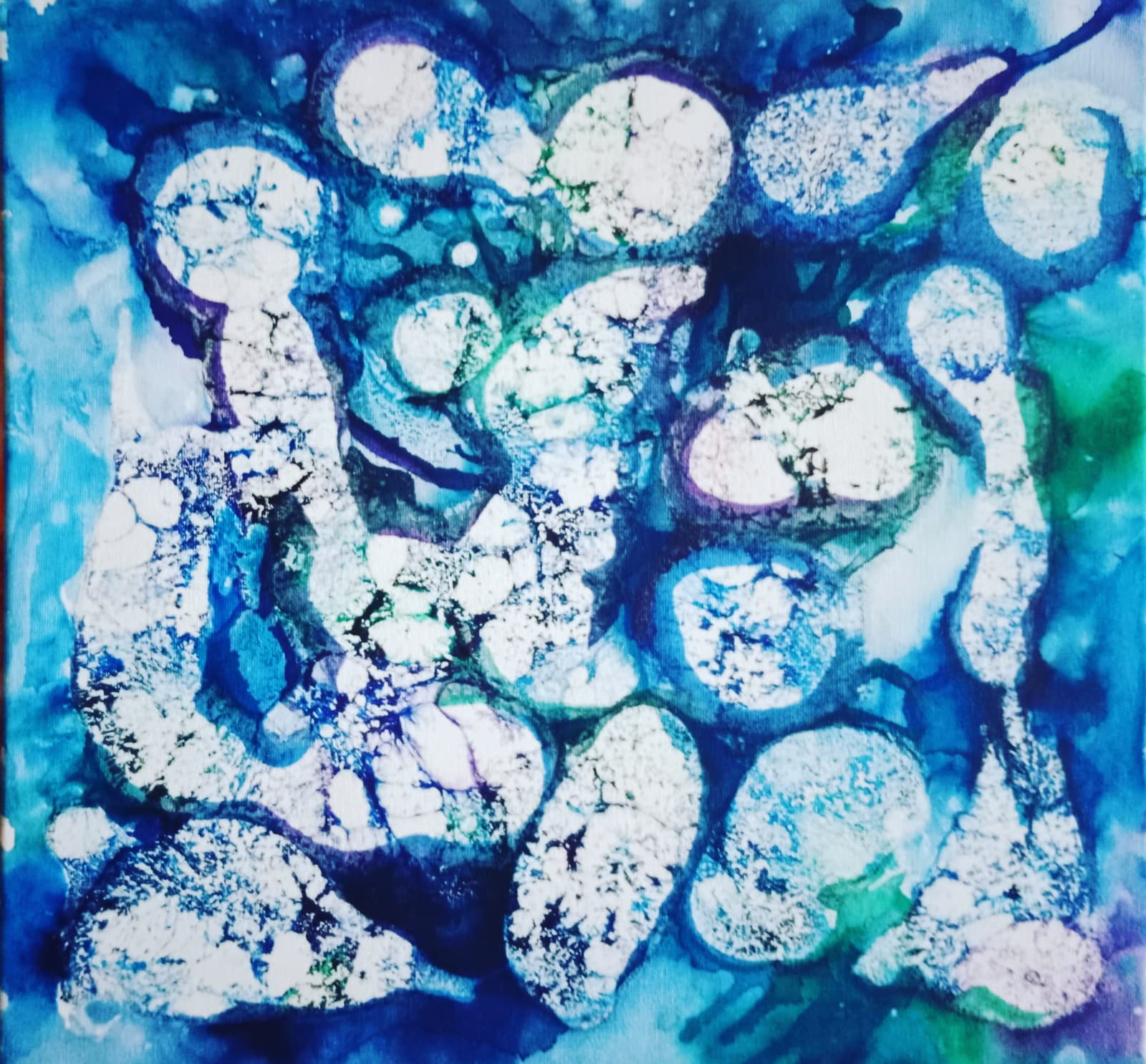
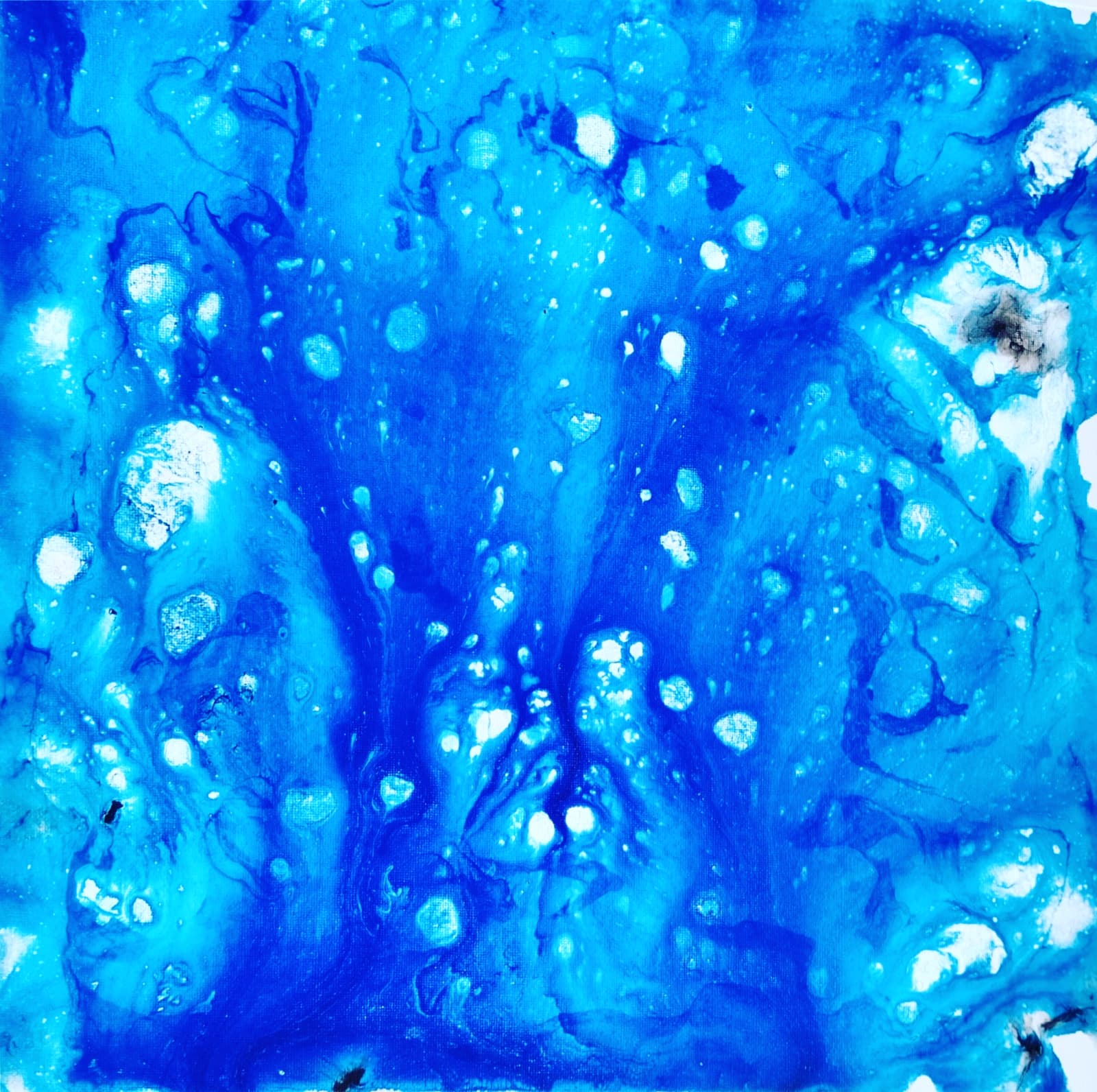
_“Chromatic Autonomy and Layered Stratification. Visual evidence of the “Molecular Barrier” protocol. Unlike traditional blending, the use of the reagent prevents inter-pigment contamination. Each color maintain its structural integrity and vibrance, creating a “color-structure” rather than a “color-mixture.” This clarity is fundamental for the neuro-aesthetic benefits observed in the research.” _
II. AMUCHINA AS A REAGENT OF AUTONOMY AND STATE CATALYST In this section, the research documents how a common sanitizing agent has been refunctionalized as a molecular separation agent and an aesthetic catalyst.
2.1 The Individual Domain of Color The primary challenge in fluid painting (oil and water) is involuntary mixing, which leads to a loss of chromatic definition. Separation Protocol: Research has demonstrated that Amuchina (sodium hypochlorite solution), by interacting with pigments, acts as a temporary chemical barrier. It allows for the deposition of diverse color layers that do not merge with one another. Technical Result: The outcome is a stratification where each color remains “free and autonomous.” This ensures a chromatic purity that traditional mixing would otherwise destroy. It marks the transition from “paste-color” to “structural-color.”
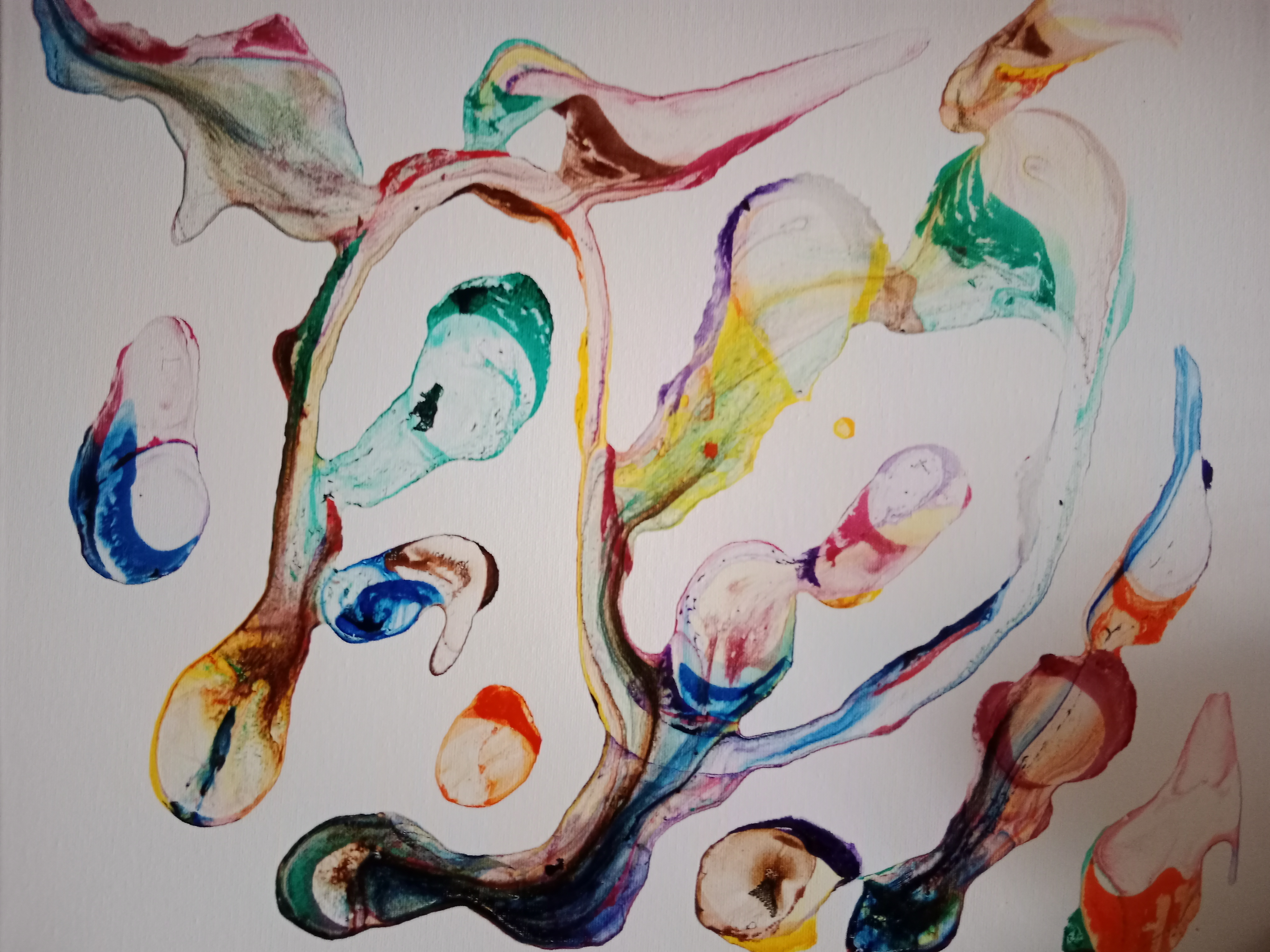
“Controlled Chemical Transmutation and “Blooming” Effect. This image captures the localized reaction between the sodium hypochlorite reagent and the earth-based pigments (ochre and raw umber). The process triggers an accelerated oxidation that creates “blooming” textures, simulating natural geological erosion. Scientifically, this demonstrates the transition from a stable state to a dynamic one, where the reagent acts as a brush of invisible energy, uncovering the “soul” of the material hidden beneath the surface layer.”
2.2 Amuchina as a Temporal Accelerator (Controlled Oxidation) The hypochlorite acts upon mineral pigments (particularly earths and oxides), accelerating the aging process. Pigment Blooming: The reagent triggers an instantaneous “blooming,” revealing veins and textures that in nature would require years of exposure to the elements. Reaction Control: The research focuses on calibrating the quantity of the reagent to achieve a “controlled collapse” of the form without destroying the fibrous substrate.
2.3 Neuro-Aesthetic Implications: From COVID to Healing The context of the discovery is an integral part of the research. Symbolic Transmutation: During the pandemic, Amuchina was a symbol of fear and a barrier against the invisible. This research has inverted that function: from an agent that “erases” life (bacteria/viruses) to an agent that “generates” abstract flowers. Impact on Neurodivergence: The clarity of autonomous colors and the tactile nature of the flowers created through this method have shown observational clinical benefits. The visual stimulation of pure colors, “untainted” by mixing, produces a clearer and more positive emotional response in individuals with mental fragilities or neurodivergence.
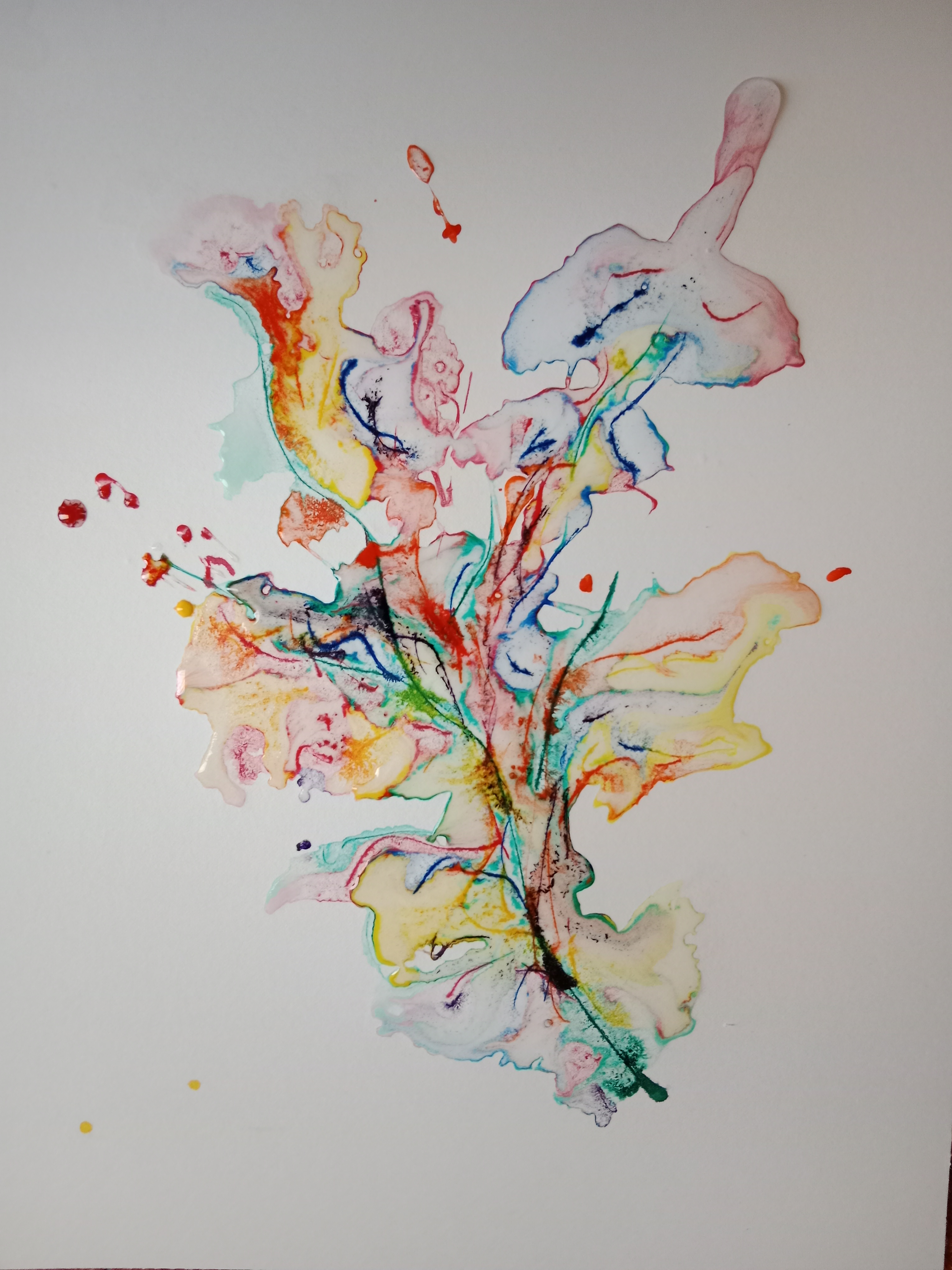
“Risvolti Neuro-Estetici” Chromatic Autonomy and Organic “Blooming” through Sodium Hypochlorite. This work illustrates the “Separation Protocol” described in the research. The reagent prevents the uncontrolled mixing of pigments, allowing for the emergence of autonomous floral structures. The dendritic patterns and vibrant, non-contaminated colors demonstrate the transition from traditional ‘mixture’ to a ‘molecular structure’ directed by the artist’s divergent gaze.
III. CAPTURING THE ATMOSPHERIC INSTANT: SOLIDIFYING THE RAIN In this section, the research shifts from mass (the sea) to event (the rain). Solidifying rain means transforming a kinetic meteorological phenomenon into a static architectural structure.
3.1 Why Rain? An Inquiry into Verticality Rain represents the physical connection between the sky and the earth. This research does not aim to “paint” the rain, but to intercept it. The Ontological “Why”: Solidifying the rain means freezing time at the exact moment of its fall. It is a negation of gravity: that which should disappear into the ground or evaporate is instead crystallized into a solid form.__ The Tear of the Sky: Each solidified drop becomes a “tear of light” that retains the memory of the instant of contact.
3.2 Capture Methodology: The Material Trap Technically, the rain is solidified through the use of “welcoming” matrices that arrest its molecular movement upon impact. Molecular Suspension: Through the use of organic thickeners that react with rainwater, an instantaneous gelation is created. The drop no longer shatters; instead, it integrates into a transparent solid matrix. Absence of Synthesis: Here too, the process occurs without the use of invasive industrial chemistry. The reaction is natural, almost biological, allowing the rain to maintain its luminous purity.
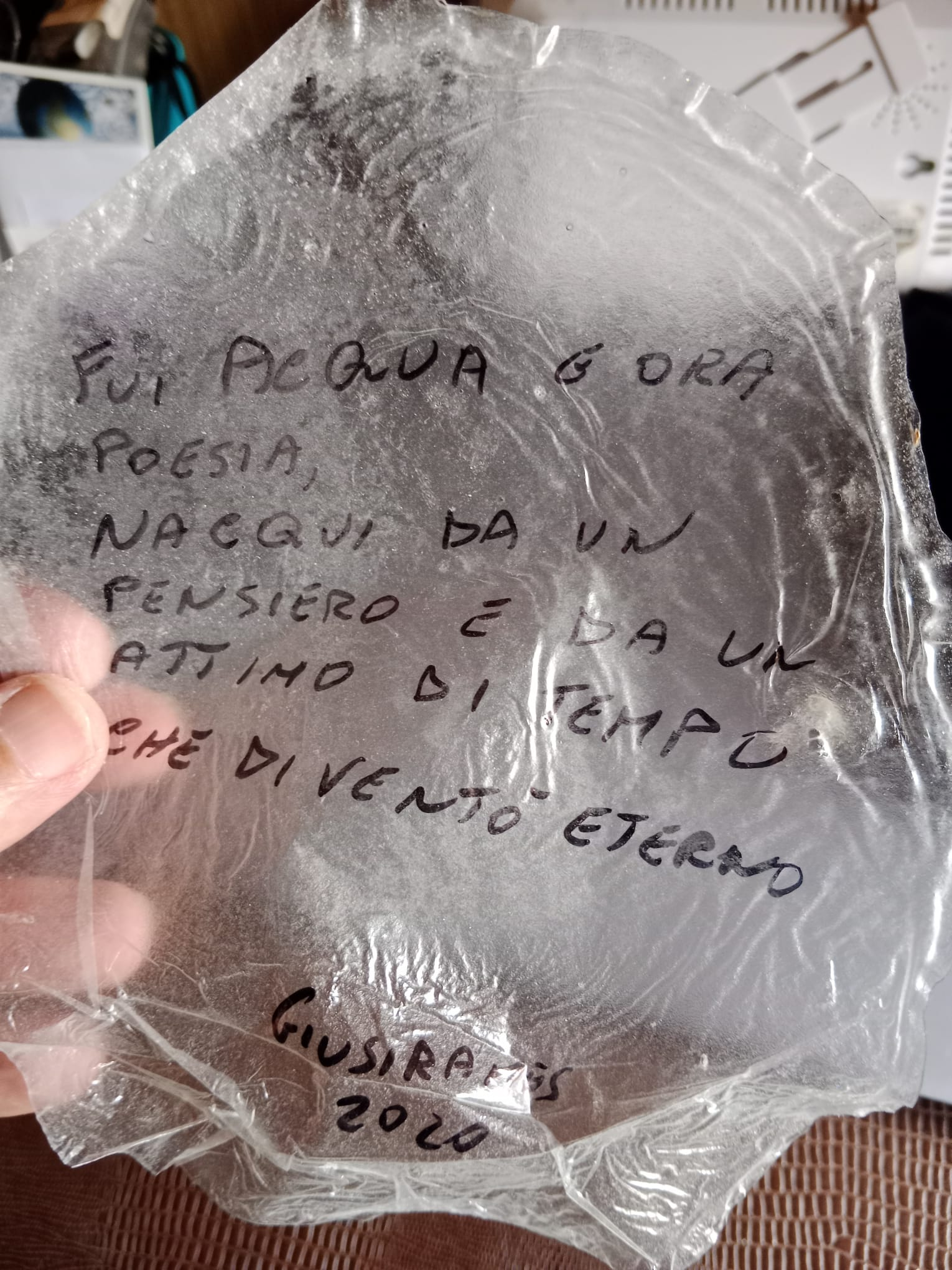
Phase Transition and Molecular Stabilization of Fluids. A detailed view of the Hydro-stratification process applied to marine water. The image illustrates the successful transition from a fluid state to a stable, solid architectural matrix. Through the use of organic thickeners, the “saline memory” and the refractive index of the water are preserved within a transparent solid body. This demonstrates the “Divergent Gaze” protocol: transforming an ephemeral atmospheric event into a permanent, tactile, and non-flammable sculptural element.
3.3 The Water Cycle and Solubility The decision to make the work water-soluble finds its highest philosophical expression here. Reversible Matter: Since the work dissolves with humidity, the solidified rain is ready to “return to being rain” if exposed once again to the elements. This creates a closed-loop cycle where the medium and the subject are one and the same.
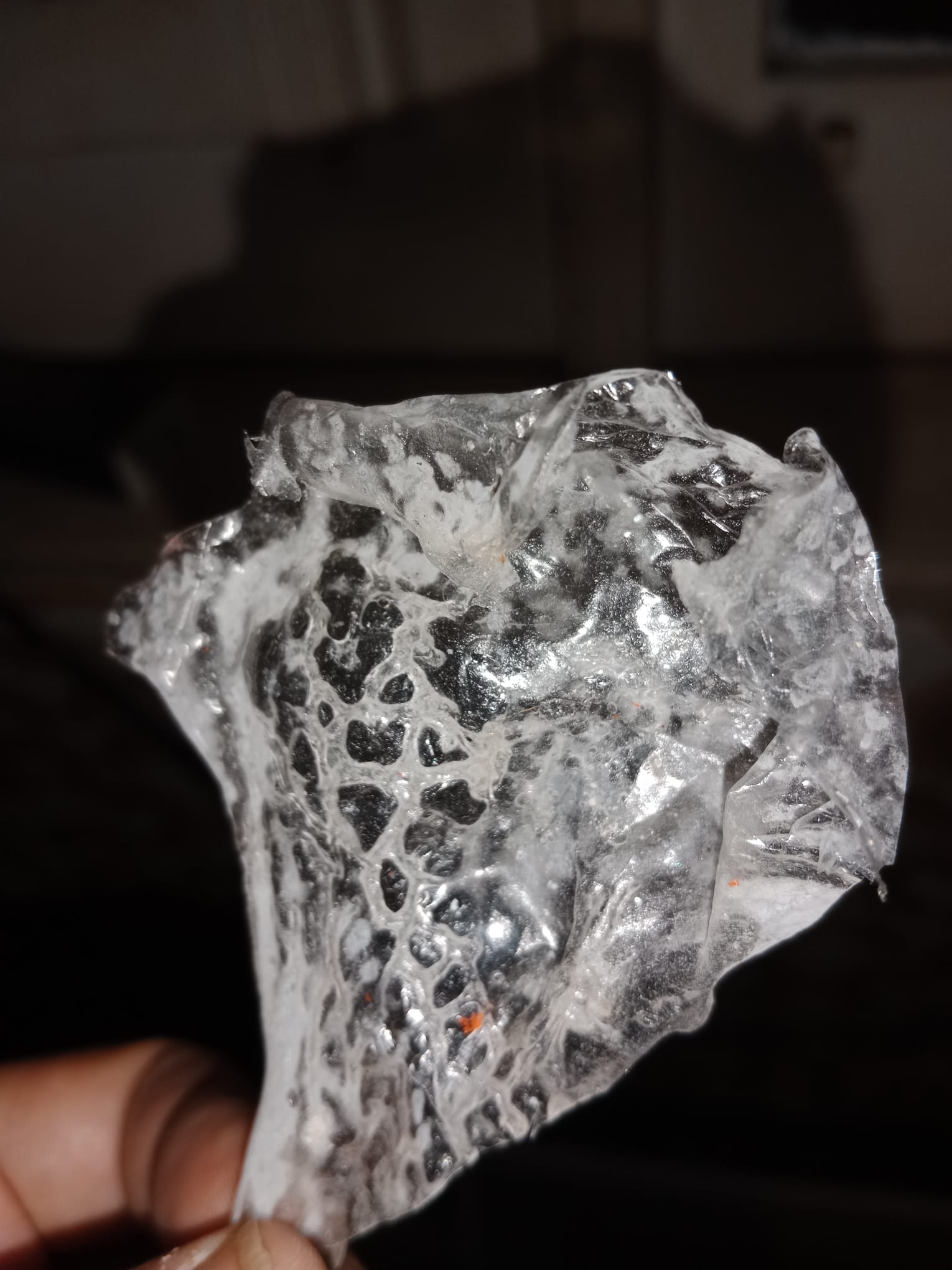
The Crystalline Memory - Solidification of Fluid Matter. A tangible demonstration of the “Hydro-stratification” protocol. This image shows a thin, transparent membrane of solidified fluid, held as a permanent sculptural artifact. The surface texture, resembling a biological or cellular network, illustrates the stabilization of a previously liquid state. This sample embodies the “Ethics of the Return”: a moment of stabilized poetry that remains chemically inert, fire-retardant, and ready to dissolve back into its original element if exposed to the cycle of humidity.
IV. SOLIDIFYING IMMENSITY: THE SEA AS A HISTORICAL ARCHIVE AND MATERIAL SUPPORT In this section, the research tackles the challenge of scale: moving from the drop (rain) to the mass (sea). The goal is to transform the fluid element of the Mediterranean, or the ocean, into a solid surface capable of narrating the history of the cities it bathes and that are expressed within it.
4.1 The Sea as Liquid Memory To the Divergent Gaze, seawater is not merely a chemical substance (H2O+NaCl), but a fluid imbued with history, passages, shipwrecks, and commercial exchanges. Capturing the Genius Loci: Solidifying water collected from the shores of specific coastal cities means crystallizing the essence of that place. The matter becomes a “relic” of the present, containing the brackish DNA of urban history. Immensity Made Tangible: The research focuses on the challenge of giving a finite and solid form to the idea of the infinite. The sea ceases to be “elsewhere” and becomes a physical support upon which the artist can engrave the destiny of cities.
4.2 Alchemy of Artistic Desalination Technically, the solidification of the sea requires managing the aggressiveness of salts and minerals. Inclusive Crystallization: Unlike industrial processes that separate salt from water, this research aims to include mineral salts within a solid matrix. These natural crystals become part of the work’s refractive structure. Absence of Synthetic Chemistry: The solidification process occurs through natural catalysts that respect the marine pH. This ensures that the work, while solid, maintains the purity of the original element, acting as a “living” piece of art.
4.3 The History of Cities on the “Skin” of the Water
The solidified work becomes a three-dimensional canvas. Urban Stratigraphy: The layers of hydro-stratification represent the different historical levels of coastal cities. The transparency of the solidified sea allows one to see “through” time, simulating an underwater archaeology of our memories. Refraction of Memory: Light, passing through the solidified marine mass, breaks into colors that recall the reflections of harbors, walls, and ships, turning the work into an optical device that projects history.
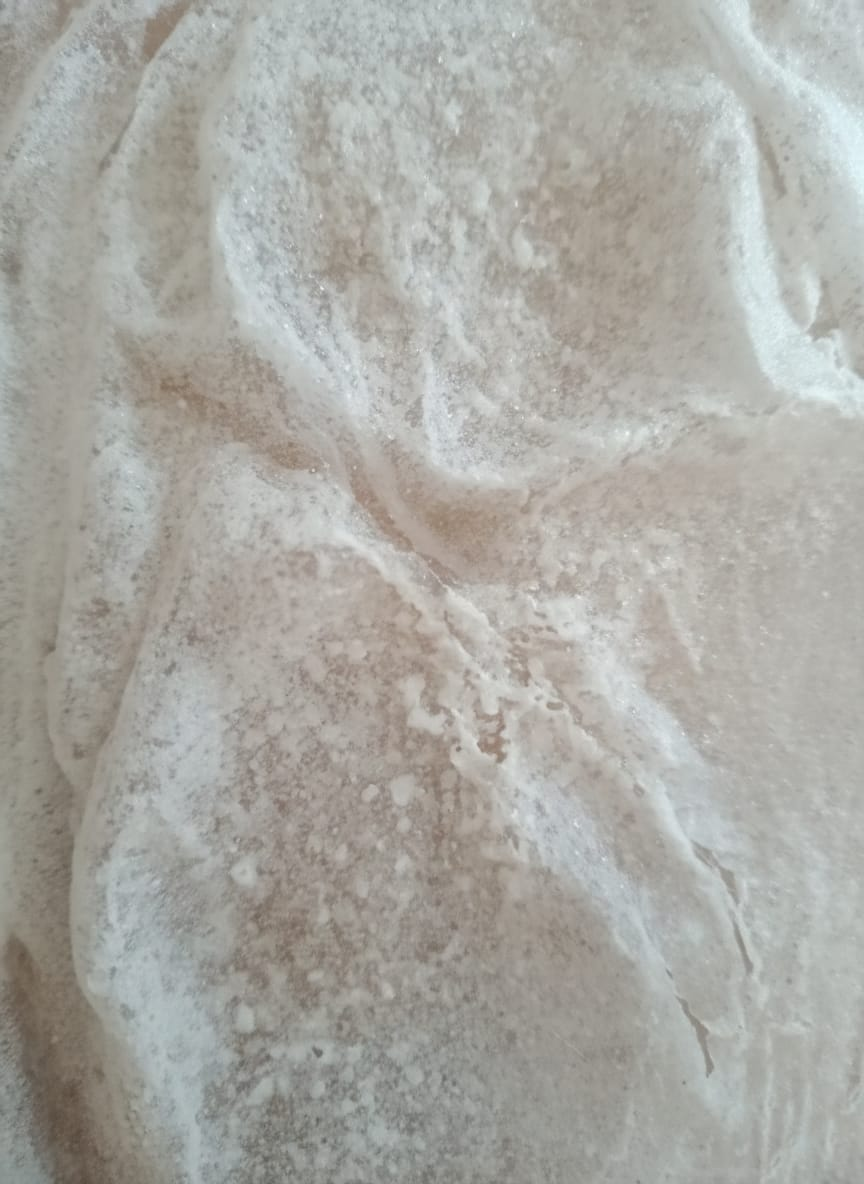
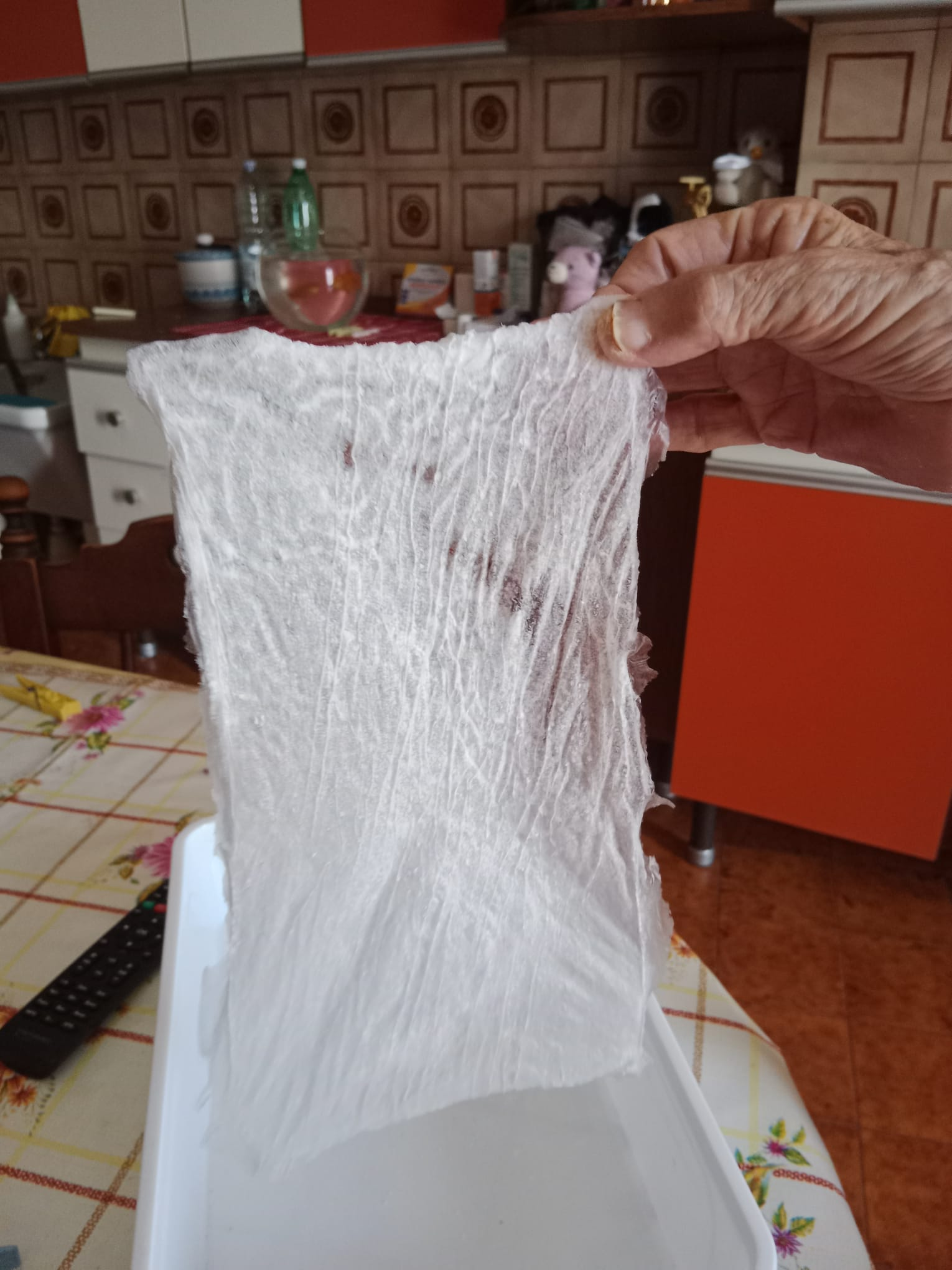
Structural Detail of the Solidified Membrane. A macro view of the “Crystalline Memory” protocol. The cellular-like network visible in the translucent sheet is the result of the synergy between natural fibers and mineral binders (calcium carbonate). This sample confirms the material’s high refractive index and its safety profile as a fire-retardant medium suitable for public installations.
4.4 The Paradox of Conservation: Hydrosolubility and Fire As with the rain, the solidified immensity of the sea obeys divergent laws. Non-Flammable Matter: Despite containing the energy of the sun and salt, the material is fireproof, offering total safety for conservation in historical spaces. Return to the Origin: The fact that the work dissolves with humidity takes on a profound meaning here: the history of cities, born from the sea, is ready to return to the sea. It is an acknowledgment of the supremacy of Nature over Culture.
Empirical Validation of the “Ethics of the Return”: Programmed Solubility. This video documents the final stage of the material’s life cycle. The solidified poetic artifact, created from stabilized marine water, is reintroduced into its original environment. Upon contact with the sea, the organic-mineral matrix dissolves, demonstrating the concept of “Stabilized Entropy.” The work does not persist as waste but returns to its primordial state, fulfilling the cycle of matter.
V. THE SHADOW TRAP: SOLIDIFYING SMOKE AND COMBUSTED AIR In this section, the research confronts the most unstable and elusive element: smoke. Solidifying smoke means capturing a gaseous residue—a shadow of combustion—and transforming it into a permanent, tactile architectural structure.
5.1 Smoke as the Memory of Energy Smoke is the ghost of something that has burned. In my divergent vision, it is not a waste product, but the “fourth dimension” of matter liberating itself from the constraints of weight. Capturing the Ephemeral: The research focuses on the “fixation” of carbon particles and gaseous residues within a transparent or fibrous matrix. The Weight of Nothingness: Solidifying smoke means giving weight to that which, by definition, tends upward. It is the supremacy of the solid over the ethereal—an “air sculpture” that defies disappearance.
5.2 Methodology: Material Condensation Unlike industrial filtering processes, this research aims to integrate smoke into the very structure of the work. Affinity Absorption: Through the use of natural mixtures (such as toothpaste and cotton fibers) that act as active filters, the smoke is “trapped” and stabilized. The density of the toothpaste allows the particulate matter to be fixed without the use of synthetic chemical glues. Alchemical Gray: The color of the smoke is not simulated with pigments; it is the physical result of the trapped combustion. It is a “true” color, born of fire, rendered solid.
5.3 The Fireproof Paradox: Smoke That Cannot Burn Here, the research reaches a technical singularity: Incombustibility of the Residue: Although smoke is the result of fire, the solidified matter is strictly non-flammable. Divergent Safety: The research demonstrates that it is possible to stabilize volatile residues in a form that no longer poses a combustion hazard, making the work suitable for museum contexts where safety is a priority.
5.4 Solubility and Fading: The Return to the Atmosphere
As with the rain and the sea, the “smoke” work maintains its reversible nature. Hydric Dissolution: If exposed to water, the matrix dissolves, symbolically releasing the trapped particles. The Cycle of Matter: This underscores the core philosophy of the research: nothing is lost; everything is stabilized for a fleeting moment of human history, only to eventually return to the original elements (air, water, earth).
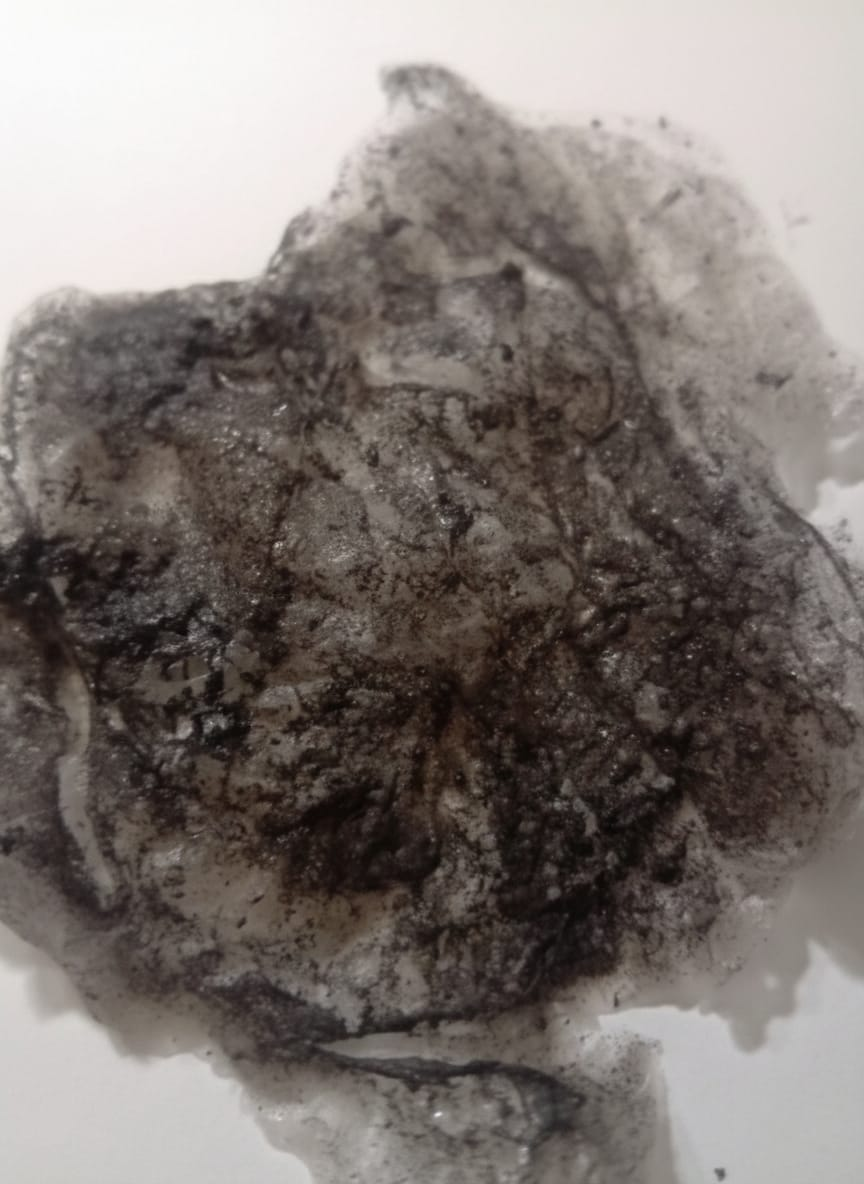
The Architecture of Shadows – Solidification of Combustion Residues. This image documents the successful capture and stabilization of smoke particles within a solid, non-flammable organic matrix. By utilizing the “Divergent Gaze” methodology, the ephemeral byproduct of fire is transformed into a tactile, three-dimensional structure. This “solid shadow” represents a singular achievement in material engineering: a residue of fire that can no longer burn, serving as a permanent archive of thermal energy and a testament to the safety and stability of the developed compound.
VI. THE ETHEREAL FOURTH DIMENSION: PHENOMENOLOGY OF LATENCY
In this section, the research investigates the coexistence of two realities within the same physical space. The “Fourth Dimension” is understood not in a mathematical sense, but as a vibrational and spiritual dimension residing within the solidified matter, activated only through specific light frequencies.
6.1 Why the Fourth Dimension? Beyond the Surface The necessity of this inquiry arises from the divergent observation that tangible reality (the third dimension) is incomplete. The Limit of the Visible: The research postulates that every element (sea, rain, smoke) carries with it a soul or an “ethereal memory” that is not perceivable by the human eye under standard sunlight. Truth in the Dark: Solidifying the fourth dimension means giving the observer the key to access a latent dream world, demonstrating that the essence of things reveals itself only when ordinary light falls silent.
6.2 The “How”: The Technique of Chromatic Latency Technically, the fourth dimension is “grafted” through a stratification of pigments sensitive to ultraviolet frequencies (365nm), integrated into the hydro-stratification matrices. Molecular Interlocking: Latent pigments are deposited within the channels created by the PRAG gesture. While dense matter (smoke, coffee, earth) occupies the visible volume, the UV light occupies the “voids” of the structure. Ontological Splitting: The work is designed as a dual-state device. Under natural light, Matter (the body) dominates; under UV light, Ether (the soul) emerges. This is not an overlap, but an interpenetration.
Video: Activation of the Fourth Dimension – Chromatic Latency under UV (365nm). This video documents the ontological shift of the “Solid Sea.” Under standard white light, the work presents its physical, mineral body; however, when excited by ultraviolet frequencies, the latent chromatic layers are activated. This demonstrates the “Double-State” protocol: the work functions as an epistemological device, revealing hidden structural depths that are invisible to the naked eye. It proves that the “Divergent Gaze” can stabilize not only matter but also the vibrational energy of light.
6.3 The Activation of the Observer The fourth dimension requires action. The work is not passive. The Ritual of Revelation: To access the fourth dimension, the observer must “turn on” the correct light. This transforms the act of viewing into a ritual of scientific and spiritual inquiry. Ethereal Space: Under UV excitation, the solidified particles of sea and rain begin to vibrate, creating luminous architectures that seem to float in the void, transcending the heaviness of the support.
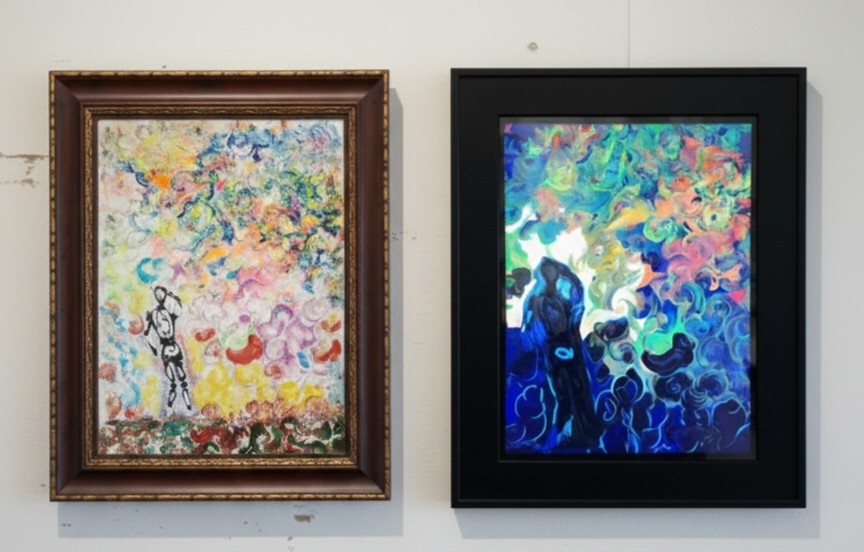
Comparative Analysis of Ontological States – Visible vs. Latent. Left: The work under standard white light, exhibiting its mineral density and tactile surface. Right: The same work under UV excitation (365nm), revealing the “Fourth Dimension.” This side-by-side comparison validates the “Double-State” protocol of the PRAG technique, where UV-sensitive pigments are embedded within the hydro-stratification layers to document the coexistence of physical matter and ethereal memory.
6.4 Coherence of the Cycle: Ether and Dissolution The fourth dimension also respects the divergent laws of this treatise. Non-Flammable Light: The light energy emitted is cold and safe, in line with the fireproof nature of the materials. Hydric Disappearance: When the work dissolves in water, the fourth dimension also disappears, returning to nature’s invisible reservoir. The research confirms that spirit and matter share the same destiny of transience.
VII. CONCLUSION: THE AESTHETICS OF RETURN AND SENSITIVE MATTER The treatise “The Epistemology of the Divergent Gaze” reaches its resolution by defining a new artistic-scientific paradigm. This research has demonstrated that the manipulation of matter (Sea, Rain, Smoke, Oil) is not an act of dominance, but one of molecular dialogue.
7.1 The Work as an Open System The art I create does not generate monuments, but temporary organisms. Solidification is a moment of awareness captured within a water-soluble structure, ensuring that man’s imprint on the earth is profound in meaning but light in substance.
7.2 The Redemption of the Everyday Through the use of common reagents (Amuchina, Toothpaste, Coffee), the research has ennobled the “poor” into the “precious,” transforming chemical necessity into aesthetic virtue. The discovery of the fireproof nature of these organic compounds opens new pathways for the safety of cultural heritage.
7.3 Toward a New Aesthetic of Healing The neuro-aesthetic impact and the revelation of the ethereal fourth dimension take art beyond mere decorativeness. The work becomes a device for healing and discovery, where the observer is called to actively participate in the revelation of the invisible.
7.4 Final Reflections The research presented here demonstrates that the artistic act, when guided by a Divergent Gaze, ceases to be a mere production of objects and becomes a methodology for investigating life. Through the solidification of the most unstable elements of creation—rain, sea, smoke—this inquiry has led to the formulation of a new material paradigm.
The fundamental results of this “Exposition” can be summarized in three cognitive pillars: The Balance between Stasis and Flux: We have shown that it is possible to give solid form to both immensity and the ephemeral without resorting to invasive chemical synthesis. The resulting matter is a safe organism (non-flammable) yet honest, accepting its own dissolution through water-solubility, returning to the natural elements from which it was drawn. The Autonomy of the Mark: Thanks to the use of Amuchina as a separation reagent, the research has solved the problem of chromatic contamination in fluids, ensuring each color a molecular dignity and independence that reflects in the improved perceptive well-being of the observer. The Revelation of Latency: The integration of the ethereal Fourth Dimension through UV light transforms the work into an epistemological device. The observer is no longer a passive witness but a researcher who activates the hidden memory of matter, discovering that truth resides not on the surface, but in the invisible vibration that moves through it.
Ultimately, this treatise does not propose a technique, but an ethic: The Ethic of Return. Solidifying the world to understand its soul, only to then let it melt and return to the sea, the rain, and the smoke, in an eternal cycle where the artist is not the master of nature, but its humble, divergent interpreter.
Author’s Statement: The Alchemy of Divergent Thought "My research does not draw from pre-existing protocols; it emerges from an introspective inquiry into perception. It is inspired by the synthesis processes of the neurodivergent mind, where sensory chaos is disciplined through the alchemy of matter. I have drawn upon my philosophical studies regarding the Fourth Dimension. I chose to honor my imagination, which sought to transform into art that which is inherently free in nature. I reasoned through a ‘madness’—a departure from ordinary logic—and within that madness, I transitioned my poetry into a quadridimensional reality."
GLOSSARY OF DIVERGENCE: TECHNO-PHILOSOPHICAL TERMINOLOGY Artistic Hydro-stratification: A process of volumetric accumulation based on the superposition of liquid layers transitioned into a solid state. Unlike traditional painting, hydro-stratification does not function through “coverage” but through “suspension,” creating a real optical depth where each layer traps and modulates light autonomously. PRAG (Aggressive Rotational Brushstroke): A gestural protocol that applies centripetal force to dense matter (a mixture of fibers, surfactants, and pigments). PRAG does not simply “apply” color; it “sculpts” it during the plastic phase, leading to the formation of Material Leaves (Foglie Materiche) that act as three-dimensional refraction lenses. Chromatic Autonomy Reagent: The scientific definition of the role of Sodium Hypochlorite (Amuchina) in this research. The reagent acts as an interfacial barrier between chemically diverse pigments, preventing entropy (blending) and ensuring that each color maintains its own “molecular sovereignty” and vibrational clarity. Ethereal Fourth Dimension: A latent state of the work, imperceptible within the standard visible spectrum (400-700 nm). It consists of a stratigraphy of fluorescent pigments integrated into solid matrices, activatable exclusively through photonic excitation at 365 nm (UV light). It represents the ontological truth hidden beneath the surface of matter. Methodical Madness: A cognitive state involving the suspension of linear logic and academic preconceptions. It is the epistemological tool that allows the neurodivergent mind to synthesize seemingly opposing elements (fire/water, solid/smoke, science/poetry) into a coherent new unity. Programmed Solubility (The Ethics of Return): A principle of reversible conservation. The work is designed to reject the mineral eternity of synthetic materials (plastics, resins). Being water-soluble, the work accepts its own transience, declaring its readiness to return to an elementary state (rain, sea) within a closed thermodynamic cycle. Unstable Colloidal Matrix: The preparatory phase in which natural liquids (sea water, rain) are thickened with organic polymers and cellulose fibers. It is the “point zero” of creation, where fluid immensity is trapped to be transmuted into an artistic substrate.