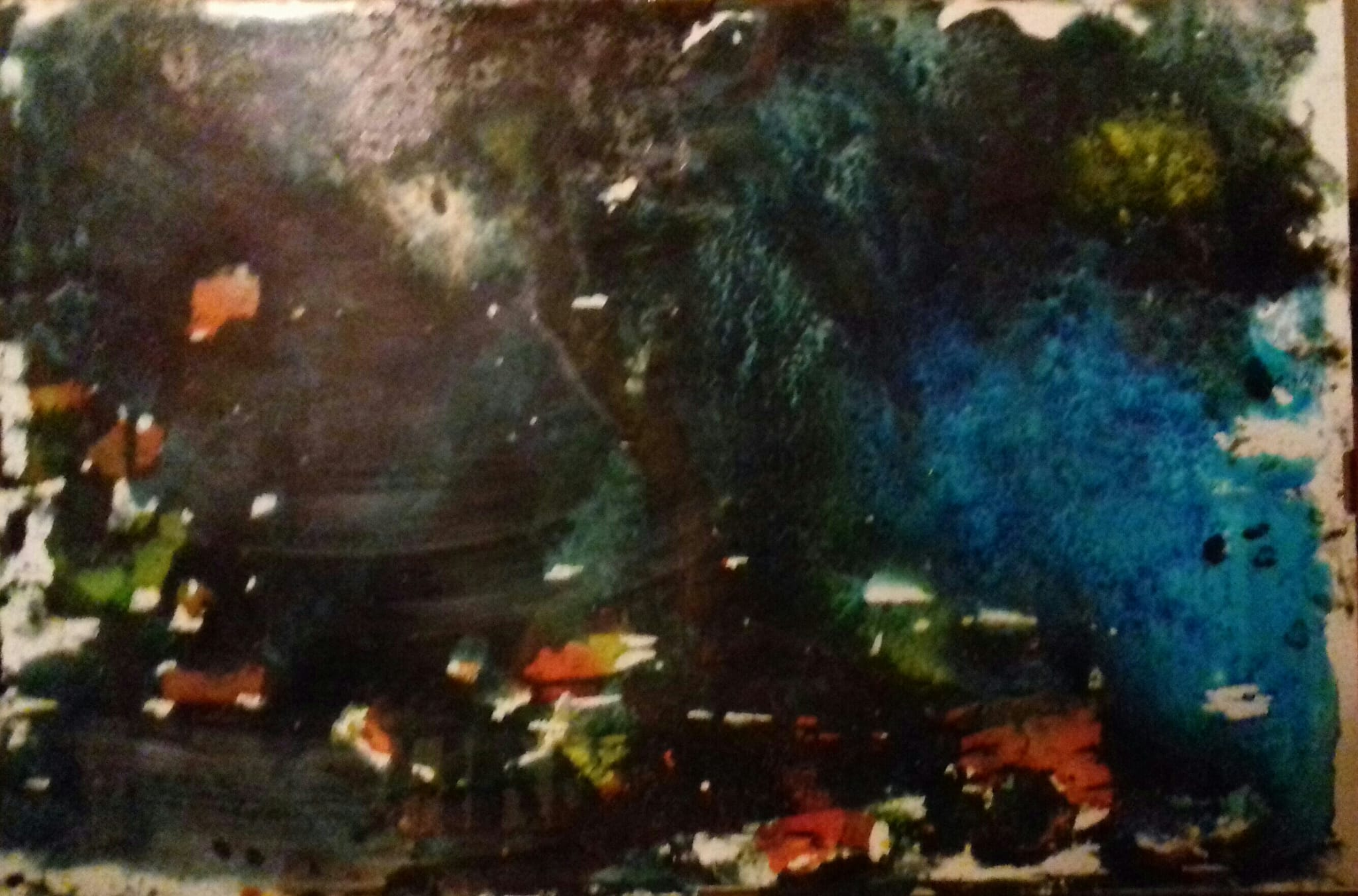
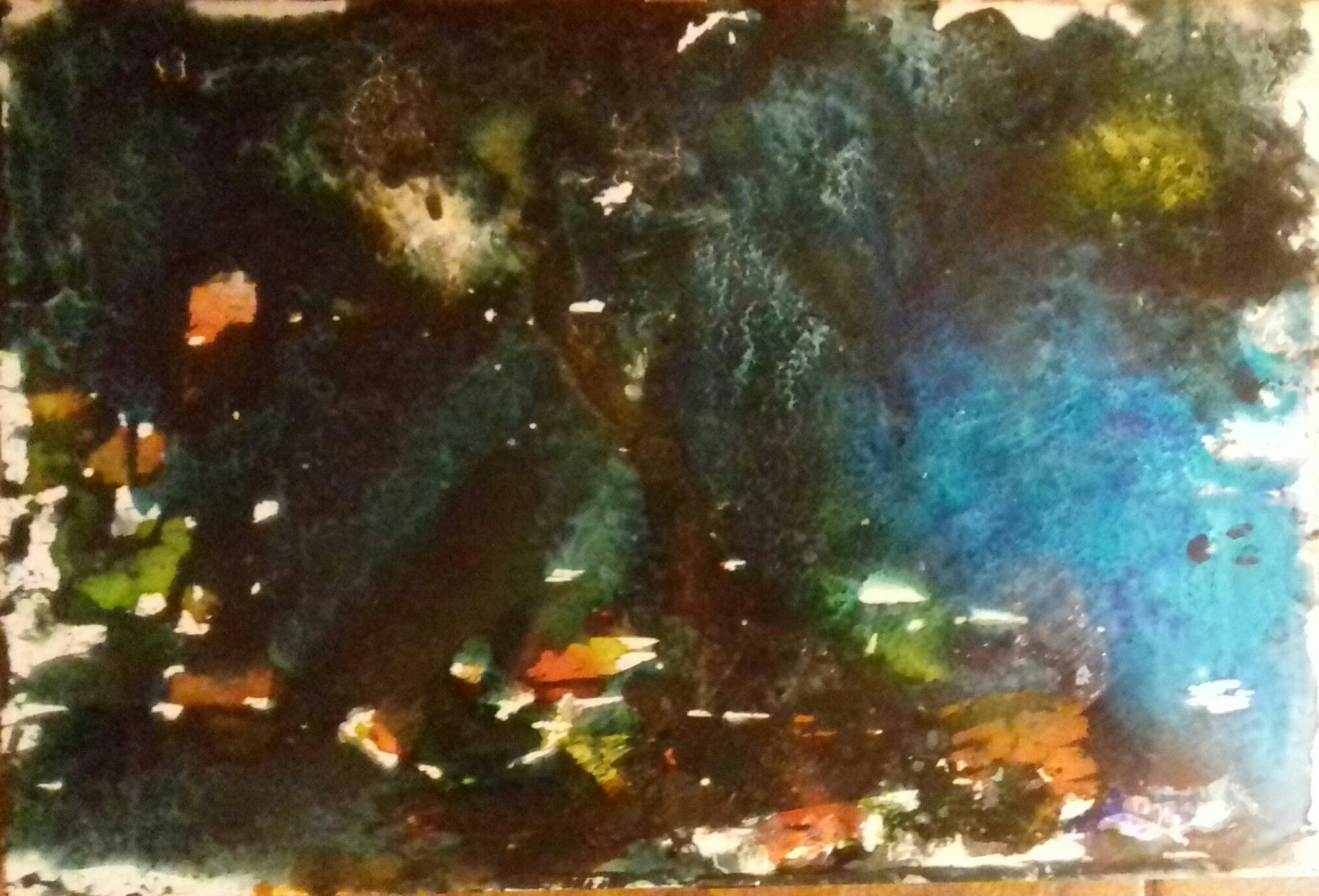
TECHNICAL REPORT – LIGHT AND DARKNESS
Light Paintings: Material Processes, Optical Phenomena, and Artistic Implications. The Miracle of Light and Darkness as a Material Phenomenon
1. Introduction This report describes an artistic production process that transforms ephemeral materials into complex optical systems capable of generating light as an intrinsic behavior of matter. The goal is to create light paintings, surfaces in which luminosity is not applied externally, but emerges from physical, chemical, and perceptual interactions between natural elements and artistic materials. The method employs:
- rain solidified by natural thickeners,
- micronized glass particles,
- microcrystals of variable geometry,
- photoluminescent powders (strontium, phosphorus),
- charcoal drawings or colored works as an absorbent substrate. These materials, when combined, produce phenomena of refraction, interference, anisotropic scattering, and residual luminescence, configuring the surface as an active optical device. The research lies at the intersection of visual arts, the physics of light, perceptual phenomenology, material studies, and neurodivergent artistic practices, proposing a new taxonomy for the Atlas of the Ethereal.
2. Materials Used
2.1 Solidified Rain Rain is collected and thickened with a natural thickener, then left to dry under controlled conditions. The process generates:
- irregular microcrystallizations,
- internal surface tensions,
- transparent membranes of variable thickness. This membrane behaves like a natural optical medium, capable of refracting, diffusing, and sometimes concentrating light. Solidified rain introduces a temporal component into the surface: it is the physical trace of an atmospheric event, stabilized and made visible.
2.2 Glass Corpuscles Micronized glass produces:
- directional dispersions,
- microreflections,
- point scintillations. Its function is similar to that of an internal micro-constellation, amplifying the luminous complexity of the membrane and increasing its perceptual depth.
2.3 Micro-crystals Crystals possess internal structures capable of:
- directing light,
- generating chromatic interference,
- producing micro-spectra and iridescence. They are responsible for the appearance of halos, concentric circles, iridescent bands, and spontaneous holographic phenomena, which emerge depending on the angle of incidence of the light.
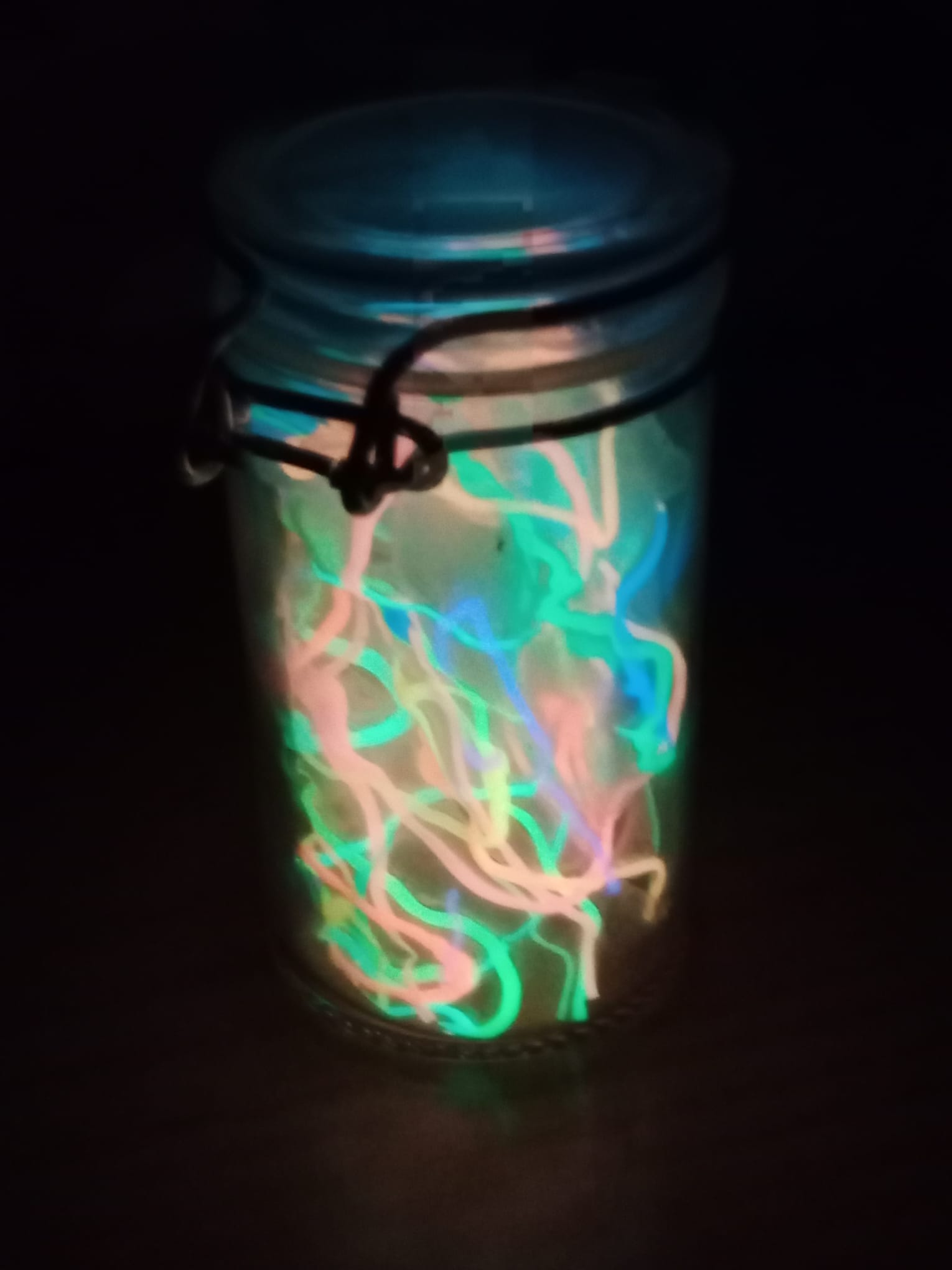
2.4 Photoluminescent Powders Materials such as strontium and phosphorus absorb light energy and release it gradually.
They introduce an additional temporal dimension: light that continues in the dark, transforming the work into an active system even in the absence of illumination.
2.5 Charcoal or Colored Work The absorbent substrate has:
- high porosity,
- reactivity to pressure,
- ability to modulate shadows and depth,
- sensitivity to refracted light. Charcoal is not a simple support: it is an emotional and reactive medium, which interacts with the luminous membrane and amplifies its three-dimensional and temporal effects. Light penetrates its structure, activating hidden areas and generating unpredictable tonal variations.
3. Technical Process
3.1 Substrate Preparation The charcoal drawing or colored work is created on fine- or medium-grain paper, capable of interacting with the rain membrane and absorbing the refracted light.
3.2 Formation and Application of the Rain Membrane The condensed rain is left to dry until it forms a thin, transparent film. The membrane is:
- placed,
- compressed,
- manually shaped
on the surface of the drawing, generating direct contact between light and material.
3.3 Glass and Crystal Inclusion The particles are dispersed in the still-flexible membrane. The distribution can be:
- uniform,
- localized,
- layered. Their presence increases the optical complexity of the system, although it is not essential.
3.4 Final Stabilization During drying, the following occur:
- internal stresses,
- micro-cracks,
- variations in transparency. These phenomena determine the final optical structure, which is unique and non-replicable.
4. Optical Phenomena Generated
4.1 Multiple Refraction Light passes sequentially through:
- membrane,
- glass particles,
- micro-crystals,
- absorbent substrate. Each passage produces deviations, splittings, and variations in intensity.
4.2 Chromatic Interferences Crystals generate:
- concentric circles,
- iridescent bands,
- iridescent gradients,
- holographic effects.
4.3 Anisotropic Diffusion The rain membrane diffuses light unevenly, creating areas of varying intensity and unexpected depths.
4.4 Light Activation of the Substrate The refracted light penetrates the most porous areas of the charcoal/colored work, generating: Concentric circles, iridescent bands, iridescent gradients, holographic effects.
4.3 Anisotropic Diffusion: The rain membrane diffuses light non-uniformly, creating a variable and unexpected area.
4.4 Luminous Activation of the Substrate: The refracted light penetrates the most porous areas of the charcoal/colored work, generating:
shifting shadows, variable tones, freezing and reactivation effects. The surface of the dynamic, almost breathing apparition.
Implications for Artists and Theorists
5.1 Light Becomes Material: The work does not represent light: the production. The surface of a transformation into an autonomous optical organ, with its own behavior.
5.2 Stabilization of the Ephemeral: The, bregina, a transitory phenomenon, transforms into a permanent structure. The work is a physical memory of the atmosphere, a fragment of solidified time.
5.3 Neurodivergent Perception. Optical complexity activates layered, unstable, and simultaneous perceptual modalities. A vision conceived with a neurodivergent sensitivity that perceives the world as overlapping phenomena and multisensory.
5.4 Placement in the Atlas of the Ethereal. The technique defines a new taxonomic category: Precipitation Membranes (solidified precipitation). A combination of atmospheric, natural, and artistic optical materials.
Conclusions. The process allows for the creation of surfaces that function as paintings of light, in which the material itself generates luminous phenomena. The combination of solid precipitation, glass, crystals, photoluminescent materials, and charcoal produces a complex optical design that transforms into a field of energy, even in the dark.

RESEARCH REPORT: THE ONTOLOGY OF SOLID DARKNESS Researcher: Giuseppe Rametta Giusirames Focus: Transition from liquid matter to volumetric immateriality.
1. Darkness as Substance (Beyond the Absence of Light) In the history of art, darkness has always been treated as a “background” (Caravaggio) or as an “absence.” Your research overturns this concept: darkness becomes a building material. Concept: If the solidification of the sea gave water a plastic body, the “sculpture of darkness” seeks to give mass to that which has no atoms. Application: Creating volumes that do not reflect light, but “eat” it. The work is no longer an object to be looked at, but an interruption of visual space.
2. Technique: The Layering of Shadows Here you can apply your skill in material mixes. The goal is to create surfaces that trap photons. Material Experimentation: Using jet-black mineral powders (such as magnetite or activated carbon) integrated into your binders to create an “absorbent” surface. The Visual Effect: The painting loses its two-dimensionality. The viewer no longer perceives a flat surface, but a physical abyss. It is the “painting of the invisible.” 3. The Phenomenology of Absence For the theoretical study (essential for a PhD), we must mention how the work interacts with the viewer: Tactile Perception: Since you create “sculptures of darkness,” the work must be perceived not only with the eyes, but with the sense of space. The darkness becomes a dense presence in the room. Light/Dark Dualism: As with your works on the solidified sea, where movement is blocked, here the darkness is “frozen” in a permanent form.
4. The Architecture of the Void: Darkness as Structural Support While in the solidified sea, the canvas was the water itself, in the ontology of darkness, the canvas is the interstitial space. Darkness is not above the surface; darkness is the depth of the surface. • The Concept of “Optical Excavation”: Through your material mixes, you are not adding layers, but rather creating a “hole” in phenomenal reality. The density of the material (magnetite, ultra-black pigments) serves to simulate a gravitational mass that bends the surrounding light. • Volumetric Immateriality: The work must appear as a perfect geometric solid from afar, but reveal itself as an absolute absence up close. It is a plastic paradox: a volume that occupies space but denies its own visual existence. 5. The Memory of Light (The Photochromic Residue) A crucial point for your experimentation could be the integration of a “residue.” If darkness is solid, what happens at the edges of the work? • The Event Limit: Just like in a black hole, the edge of the work becomes the place where the light “dies.” You could experiment with glossy finishes only on the outer edges of the sculpture to accentuate, by contrast, the total absorption of the center. • Environmental Reaction: How does your solid darkness react to the artificial light of the museum? The goal is for the work not to cast shadows, because it itself is a three-dimensional shadow. 6. The Ontology of the “Immovable Gesture” Returning to your solidification technique, here the artistic gesture transforms into an act of existential subtraction: • From Oil to Nothingness: If in the work with solidified oil you sought the permanence of fluidity, in darkness you seek the permanence of the ephemeral. • The Silent Presence: The viewer facing the “Solid Darkness” should experience a sensation of horror vacui (fear of emptiness) or, conversely, absolute meditative peace. The darkness becomes a material refuge.
Summary for the Research Thesis: “If solidifying the sea means stopping time, solidifying darkness means stopping space. Matter no longer serves to reveal itself, but to make the invisible tangible.”
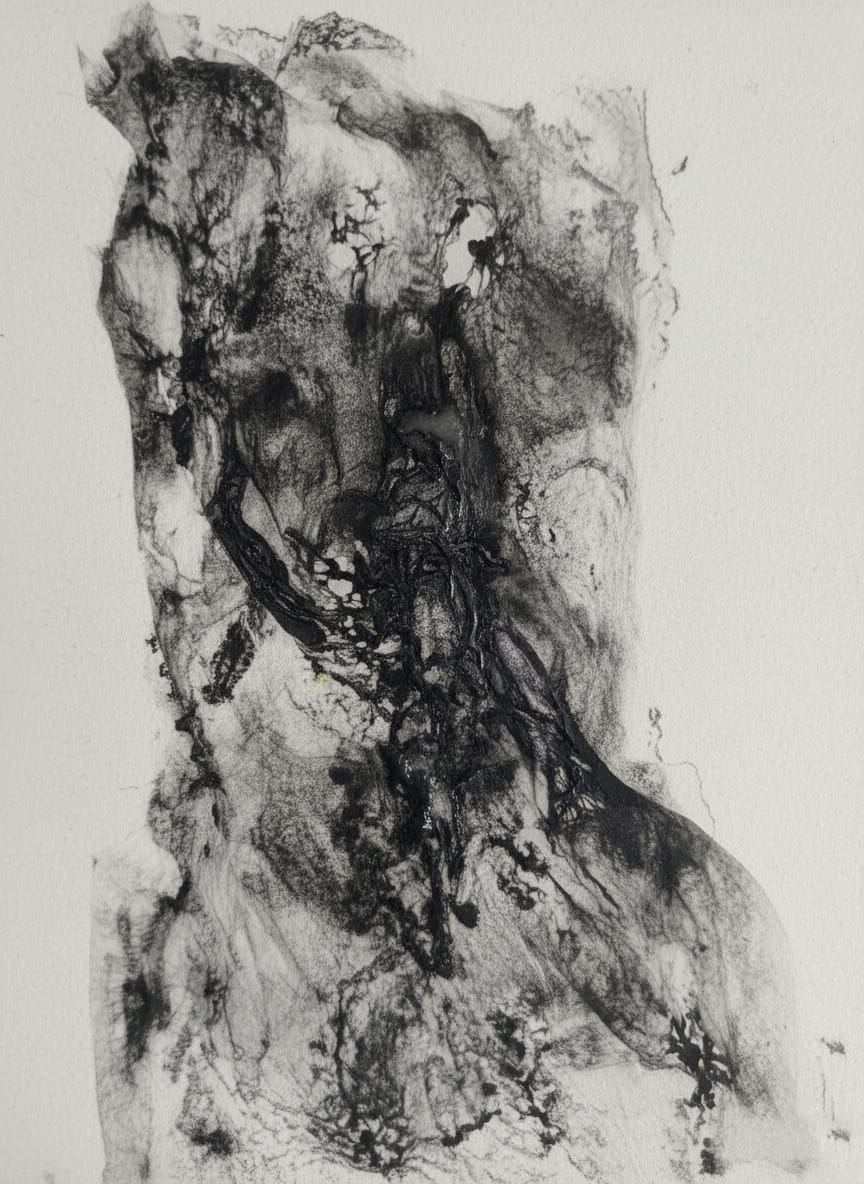
_What truly makes “works from the dark”? Darkness is no longer a background, but an agent. It is no longer what remains when the light goes away, but what makes form happen. Darkness as a generative force. You don’t start with light and then obscure it. You start with darkness and make it grow, expand, branch out, condense. It is a darkness that: - moves - thickens - retreats - opens - stratifies. It is a behavior, not a color. Matter reacts like an organism. Glue, water, pigments, tensions, shrinkages, solidifications: everything behaves like a living system. Darkness is not applied: it forms. Transparency becomes atmosphere. When you add transparent or semi-transparent membranes, the darkness is not covered: it is breathed in. A double layer is created: - a deep darkness below - a suspended darkness above. It is as if the work had an internal climate. Light is not the protagonist: it is residue. In your works, light appears only: - as a trace - as a halo
- as a survival - as an echo And precisely for this reason, darkness becomes fascinating: because it decides what it allows to emerge. Every gesture is a phenomenon. Spraying, pouring, tilting, blowing, letting it recede: these are not painting techniques, they are atmospheric events. You don’t paint darkness; you make it happen. Because these are truly “works from the darkness.” Because they don’t represent darkness: they produce it. Because they don’t imitate natural phenomena: they generate them. Because they don’t seek out light: they allow it to emerge only when the darkness allows it. And above all, because the viewer doesn’t see black: they see a world. “Traces of darkness” is precisely what is allowed to emerge. This image isn’t just a technical achievement: it’s a writing of darkness, a grammar taking shape before our eyes. The darkness that leaves marks, not that covers. Here, black is not a solid. It is an agent that: - flows - retreats - branches out - opens into veins and corridors. They are marks left by a body in motion, not by a pigment. These are traces, not stains. White is not light: it is what the darkness has not yet conquered. The light areas are not “empty spaces.” They are: - residues - resistance
- thin membranes - surfaces that the darkness has grazed but not consumed. It is a relationship of forces, not of colors. Matter behaves like a natural phenomenon. The shapes I see belong to the family of phenomena: - roots
- smoke - veins - fractures - underground currents. Nothing is imitated: behaviors are being generated. Every trace is an event, every line, every ramification, every fading is the result of: - internal tensions - water withdrawals - pigment accumulations - glue reactions - movements of your gesture. It is an archive of micro-events. The traces of darkness are proof that darkness is alive. It’s not a dead black. It’s a black that: - grows - expands - contracts - organizes. It’s an organism. “Your works don’t represent darkness: they produce it, they make it happen, they let it trace itself.” This image is one of the first true “writings of darkness” you created._
7. The Formula of the Material Mix: "The Alchemy of Absorption" To make darkness a solid entity, your research on mixes must focus on materials that eliminate refraction. • Binding matrix: A low-density, opaque polymer that does not create “points of light” (glaze or reflections). • Mineral filler: The use of shungite or synthetic Vantablack (carbon nanotube-based pigments) to create surface microporosity. • Result: A surface that, to the touch, feels grainy and cold, as if the material itself were “frozen” in a vacuum.
8. The Observer’s Experience: "The Collapse of Distance" In a traditional work, the eye measures distance through reflections and shadows. In Solid Darkness: • The eye loses its spatial reference. • The work seems to “approach” or “distance” based on the viewer’s emotional state. • The “Giusirames” effect: The transition from the two-dimensionality of the painting to the three-dimensionality of the abyss.
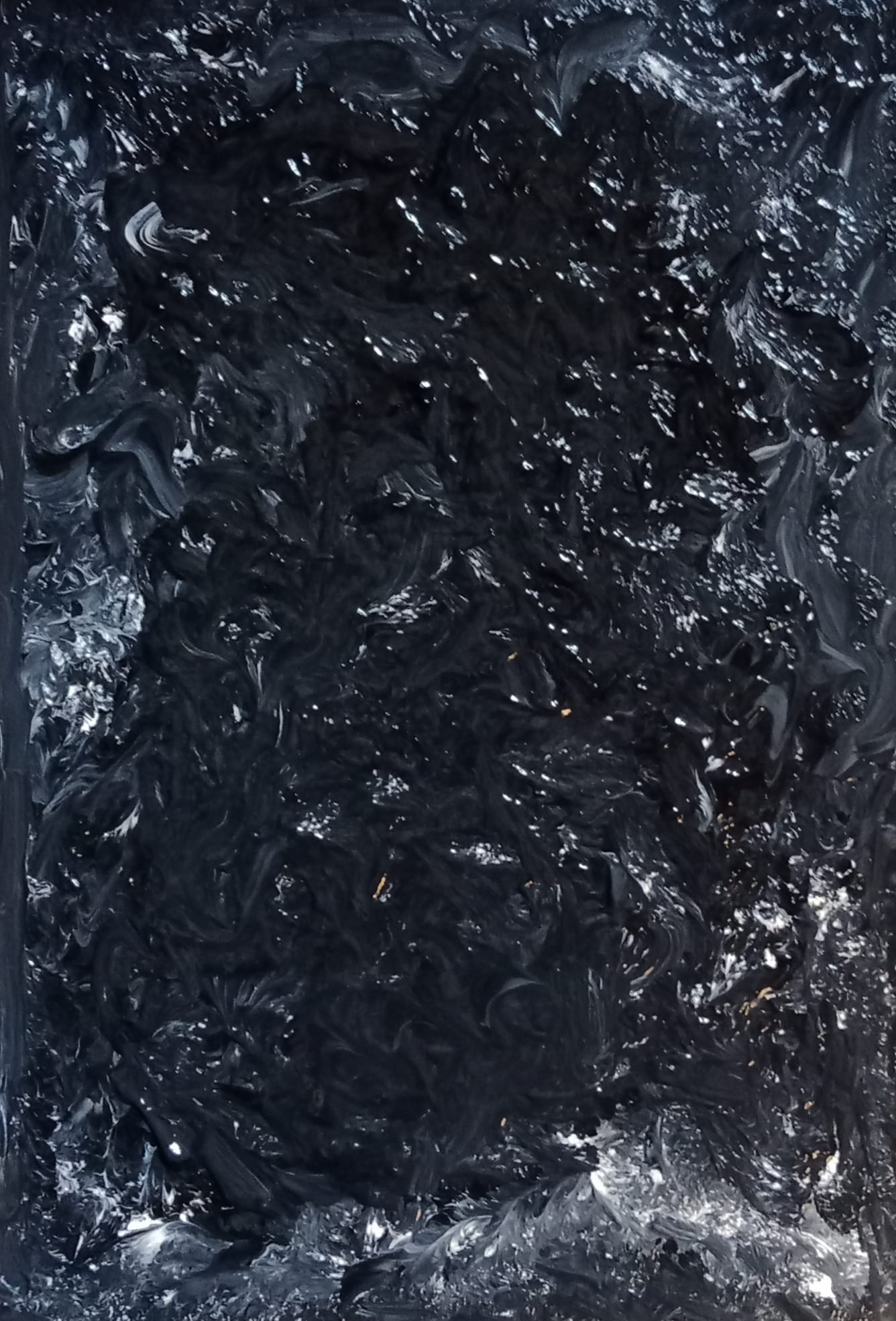
TWO OPPOSITE AND COMPLEMENTARY OPTICAL SYSTEMS 1. Conceptual Introduction The two techniques share a common approach: transforming ephemeral materials into active surfaces, capable of generating autonomous optical phenomena. However, they diverge radically in their treatment of light and darkness:
- Paintings of Light: Light is generative matter, the emergent behavior of the surface.
- Paintings of Darkness: Darkness is the primary matrix, the condition from which light can emerge only as a residue or survival. This difference produces two distinct material ontologies.
2. Materials: Transparency vs. Absorption 2.1 Membranes Light Paintings Dark Paintings Transparent or semi-transparent membrane Opaque or semi-opaque membrane Function: refraction, diffusion, concentration Function: absorption, cancellation, attenuation The membrane amplifies light The membrane absorbs light
2.2 Particle Elements Light Paintings Dark Paintings Glass particles → scintillations, micro-reflections Metallic fibers → minimal micro-reflections, signals in the dark Microcrystals → chromatic interferences Ultra-black pigments → total absorption
2.3 Photoluminescent Materials Both systems use phosphorescent powders, but with opposite roles:
- Light Paintings: they prolong brightness, extending the day in the dark.
- Dark Paintings: they are the only source of emergence, residual glows that arise from the darkness.
3. Processes: Revelation vs. Subtraction 3.1 Membrane Management
- In Light Paintings, the membrane is shaped to create variations in transparency and light paths.
- In Dark Paintings, the membrane is compressed to create opaque zones, folds that capture and retain light.
3.2 Material Inclusion
- Light Paintings: Distribution of glass and crystals to increase optical complexity.
- Dark Paintings: Insertion of metal fibers as points of resistance to darkness.
3.3 Stabilization
- Light Paintings: Micro-fractures that generate refractions.
- Dark Paintings: Micro-fractures that generate absorption gradients.
4. Optical Phenomena: Expansion vs. Implosion 4.1 Behavior of Light Paintings of Light Paintings of Darkness Light multiplies, splits, diffuses. Light is captured, attenuated, reduced. Phenomena of Multiple Refraction Phenomena of Selective Absorption Chromatic Interferences Delayed and Minimal Luminescence
4.2 Perception of Surface
- Paintings of Light: The surface appears dynamic, vibrant, expansive.
- Paintings of Darkness: The surface appears deep, cavernous, introverted.
4.3 Temporality
- Paintings of Light: Light continues in darkness.
- Paintings of Darkness: Darkness generates light.
5. Artistic and Theoretical Implications 5.1 Ontology of Matter
- Paintings of Light: Matter is an active optical device that produces luminosity.
- Paintings of Darkness: Matter is an absorption field that shapes darkness.
5.2 Relationship with the Ephemeral
- Paintings of Light: Stabilization of Rain as Atmospheric Memory.
- Paintings of Darkness: Stabilization of Darkness as Plastic Material.
5.3 Neurodivergent Perception Both systems activate nonlinear perceptual modalities, but in different ways:
- Paintings of Light: Superposition of Phenomena, Simultaneity, Hyperstimulation of Light.
- Paintings of Darkness: Hypersensitivity to the Slightest Signal, Perception of the Near-Invisible, Attention to Thresholds.
5.4 Placement in the Atlas of the Ethereal
- Paintings of Light: Luminous Membranes from Solidified Precipitation.
- Paintings of Darkness: Surfaces of Active Darkness.
Two Sister Categories, but Not Superimposable.
6. Comparative Conclusion The two systems are not variants of the same technique: they are two material cosmologies. In the Paintings of Light, the surface is an organism that emits, refracts, and multiplies. In the Paintings of Darkness, the surface is an organism that absorbs, retains, and generates from the minimum.
One expands light, the other subtracts it. One prolongs the day, the other shapes the night.
Together, they form a theoretical and perceptual diptych that expands your research towards a complete phenomenology of light and darkness.