

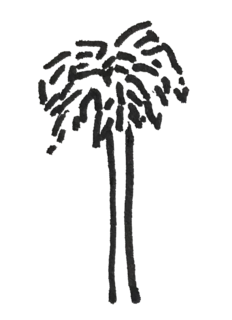
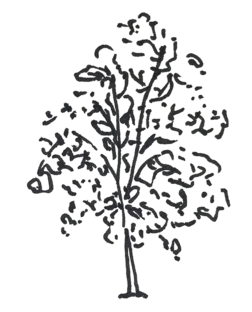
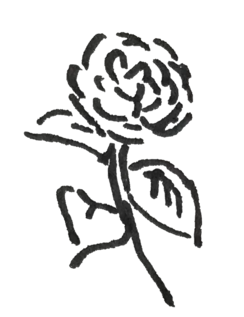
Filmed from a boat, the footage below is accompanied by a voice-over sharing local stories about the shoreline flora seen in the images.
- an unknown plant, widely spread, native to an ideal landscape?
- banano native to Southeast Asia, in the jungles of Malaysis. Indonesia or the Philippines.
Portuguese sailors brought bananas to Europe from West Africa in the early fifteenth century.
- palms native to India, Northern Africa, regions of Southeast Asia, and the South Pacific Islands.
Some species are native to Sicily.
- oleander native to Mediterranean region, including northern Africa, southern Europe and South East Asia
- birch native to Europe and parts of Asia.
- bamboo, native to every single continent in the world, except for Antarctica and Europe. (Fossils in Europe).
- poplar, native to the Northern Hemisphere.
- agave, native to arid and semiarid regions of the Americas, particularly Mexico and the Caribbean.
Agaves were brought to Europe by Spanish and Portuguese explorers and colonists beginning in the sixteenth century.
- Oranges, the orange originated in a region encompassing Southern China, Northeast India and Myanmar. The earliest mention of the sweet orange was in Chinese Literature in 314 BC.
Citrus fruits — among them the bitter orange — were introduced to Sicily in the 9th century during the period of the Emirate of Sicily, but the sweet orange was unknown until the late 15th century or the beginnings of the 16th century, when Italian and Portuguese merchants brought orange trees into the Mediterranean.
Ilaria Biotti
Affiliation: PhDArts, ACPA Leiden University and Royal Academy The Hague.
Troubling the Ideal Landscape - A Visual Narrative
This project critically explores how imagination and physical landscape interrelate in the construction of the ideal. Drawing from my practice-based doctoral research at PhDArts, a collaboration between ACPA, Leiden University, and the Royal Academy of Art in The Hague, I critically explore this tension through and in my practice-based project, Troubling the Ideal Landscape – A Visual Narrative. The project investigates how the contemporary landscape is imagined as ideal. It seeks to expose the power structures that shape, sustain, and are reinforced by such representations. I approach this research through and in spatial montage, both as a methodological tool and as an artistic outcome.
This research asks: how is the ideal landscape imagined and constructed through a dynamic interplay between imaging, affect, and local forms of knowing in resonance with broader global dynamics? In doing so, it addresses urgent questions within contemporary artistic research: how can image-making practices unsettle entrenched visual regimes and open a speculative space for more reflective, critical imaginaries of place?
The exposition unfolds across three sections, intentionally non-chronological in structure. One section situates the research within the context of Cannero Riviera; another traces the process of decomposing the visual narrative of the site through filming; a third explores the spatial composition of sequences, where fragmented elements are juxtaposed into a dynamic tableau. These sections are conceived as interrelated fields of inquiry, inviting the visitor to navigate them non-linearly, reflecting the layered and mutable nature of the ideal landscape itself. Together, they enter into dialogue with the tableau, contributing to the development of a critical, practice-based framework.
- camelia, native to southern Japan, Asia, and Indonesia.
Robert James of Essex, England, is thought to have brought back the first live camellia to England in 1739
- daisy, 2,200 B.C., the ancient Egyptians grew them in their gardens and used them as herbal medicine.
It's European.
- lemons, thought to have originated in north-western India. It is known that lemons were introduced to southern Italy around 200 AD and have been cultivated in Egypt and Iran since 700 AD. Arabs spread lemons throughout the Mediterranean area during the early 2nd century.
The first substantial cultivation of lemons in Europe began in Genoa in the middle of the 15th century. The lemon was later introduced to the Americas in 1493 when Christopher Columbus brought lemon seeds to Hispaniola on his voyages.
Drone footage: Cannero Riviera, time and weather, one view (Midnight. August 2023; Evening. September 2023; Dawn. August 2023 ); Cannero Riviera, the church at 12:00 (Noon, September 2023); The Rio Cannero (Morning. August 2023)
- an unknown plant, widely spread, native to an ideal landscape?
- wisteria, native to China, Japan, Korea, Vietnam, Southern Canada, the Eastern United States, and north of Iran.
The first wisteria was brought into Europe by an English man named Captain Welbank in 1816.
- rhyncospermum, native to China, Japan, Korea, Vietnam.
The garden historian John Harvey has said, "surprisingly little is known, historically or archaeologically, of the cultural life of pre-Norman Sicily"
- agave, native to arid and semiarid regions of the Americas, particularly Mexico and the Caribbean.
Agave was brought to Europe by Spanish and Portuguese explorers and colonists beginning in the sixteenth century.
Drone footage, kaleidoscopic montage: Cannero Riviera, il Bosco delle Camelie / The Camelia Woods (Morning. May 2020); Drone footage: Cannero Riviera, the shape of the beach (Morning. August 2023); il Parco degli Agrumi / The Citrus Park (Morning. August 2023);
Drone footage: Cannero Riviera, the shape of the beach (Morning. August 2023); Cannero Riviera, the mountain (Noon. August 2023).
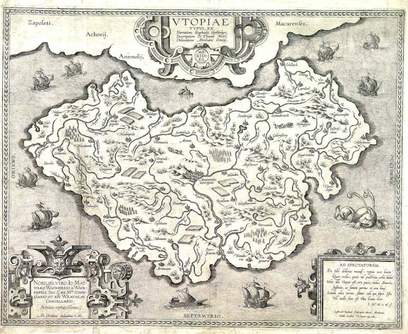
Abstractions: drawing by Abraham Ortellius for Thomas More Utopia, (1595-1596) a technical drawing by the townhall village of Cannero Riviera, a screenshot of Google Earth.
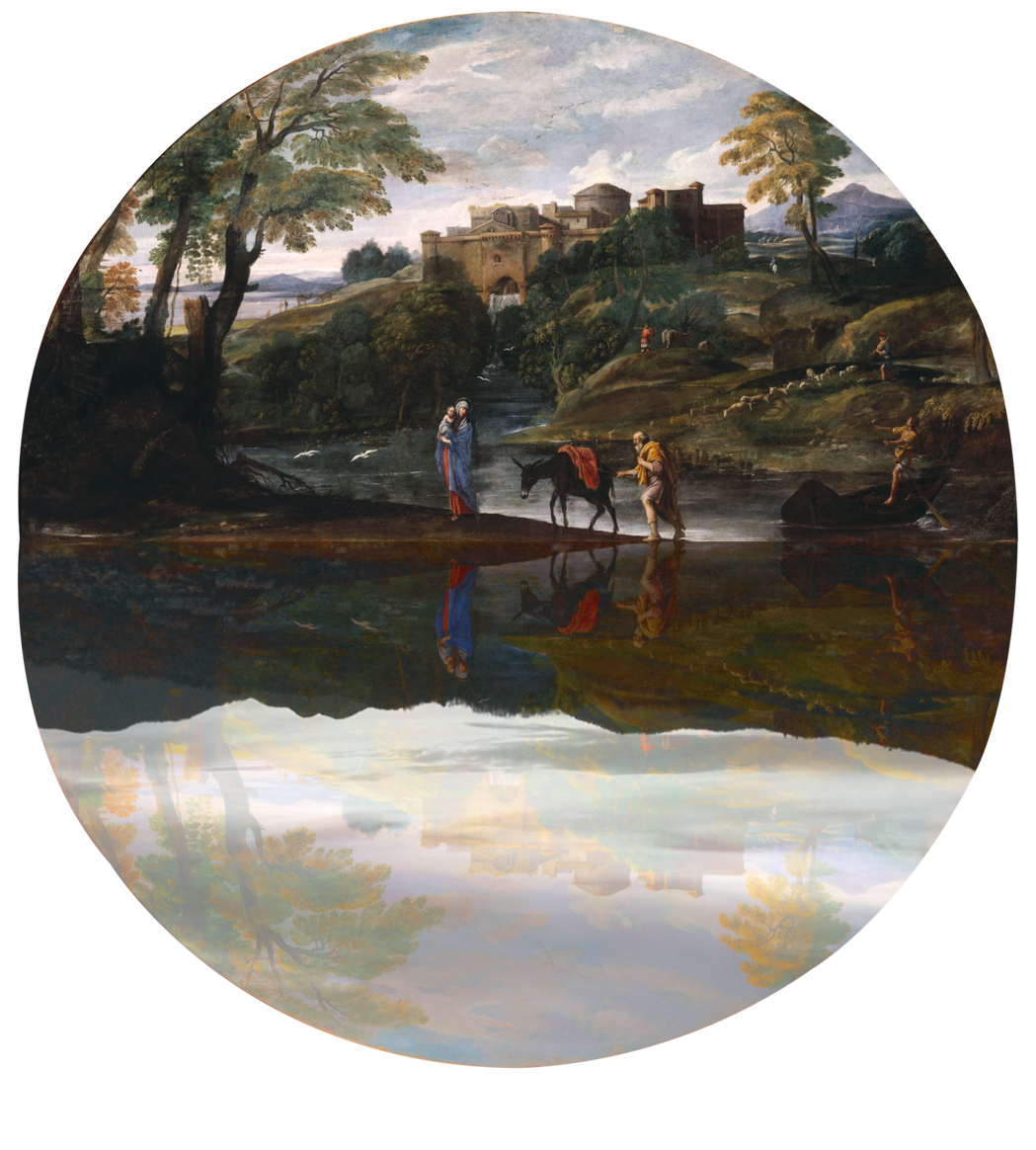
The wings of “Fuga in Egitto” are trees belonging to a species that is not easily identifiable
(so says Mr. Prati, the botanical expert who I asked to help me recognise the plants within
the painting. "Those are imagined trees, you know?" He said.)
Could the trees that grew spontaneously but remained unnamed in the oral accounts describing the flora along the shore of Cannero Riviera be the same as those depicted on the wings of Carracci's painting?
Drone footage: filmed by Blu Drone. Cannero Riviera, il Bosco delle Camelie / The Camelia Woods (Morning. May 2020)
Camera footage: Cannero Riviera, il Bosco delle Camelie / The Camelia Woods (Morning. August 2020)
To what extent can the flora of an ideal landscape take me beyond the surface of an ideal landscape?
In many traditional cultures, among which the Shamanic mythology, there is a long and extensive use of trees as portals to initiate journeying. The tree may lead to the upper and lower worlds, either through its branches or the roots.
To what extent can an ideal landscape be addressed as a “time-image” in Deleuzian terms from the perspective of how the characters, in this case, the landscape itself, sit with their memory and feel the time passing?
- hydrangea, first cultivated in Japan, but ancient Hydrangea fossils dating back to 40-65 million years ago have been discovered in North America.
It was introduced in European countries around the mid-1700s, almost simultaneously. In England, the hydrangea was mentioned in 1736.
- camelia, native to southern Japan, Asia, and Indonesia.
Robert James of Essex, England, is thought to have brought back the first live camellia to England in 1739.

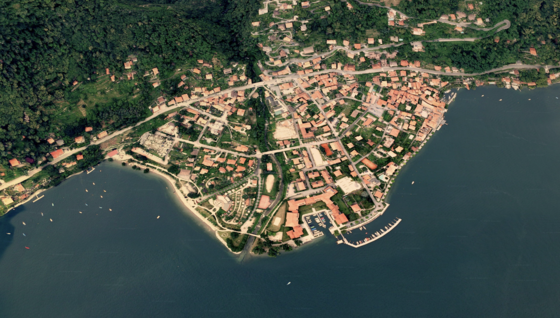
Drone footage: Cannero Riviera, lake view (Morning. August 2023). Boat footage, collage: Cannero Riviera, lake view (Afternoon. August 2022)
SITUATING THE INVESTIGATION: CANNERO RIVIERA AS AN IMAGINED IDEAL LANDSCAPE
To ground this investigation, I chose my hometown, Cannero Riviera, a village on the Piedmontese shore of Lake Maggiore in northern Italy. Imagining Cannero Riviera as an ideal landscape is not a campanilist gesture, that is, an expression of local pride toward one’s hometown; rather, it seeks to contribute to the critical interrogation of the aesthetic and ideological mechanisms through which landscapes are idealised in a Western context.
Though small, with fewer than 900 inhabitants, I argue that Cannero Riviera can serve as an example of an imagined ideal landscape. One manifestation of this is its marked seasonal transformation: during the summer months, the population quadruples due to tourism. Yet this idealized image is not solely the product of contemporary dynamics; it has deeper historical roots.
In the late nineteenth and early twentieth centuries, Cannero Riviera underwent deliberate aesthetic transformations, with the introduction of ornamental species such as camellias. These interventions were closely tied to patterns of local emigration, particularly to England, where many residents sought economic survival (Pisoni, 2003). The camellias, emblematic of the British imperial floral landscape and colonial botanical exchanges, such as those commemorated by the so-called Silk Road (International Camellia Society), came to evoke what I refer to here as a visual language of exoticism within the landscape.
Although my aim extends beyond the local, this inquiry begins from a personal connection. I grew up imagining Cannero Riviera as an ideal landscape. I did not question this belief. When I began to critically think with this imaginary, I searched for documentation that articulated it–and found nothing. Except for a short anecdote explaining the addition of ‘Riviera’ to the name of the village due to the alleged healing power of its landscape in the 1960s (dell’Oro, 2015), I found no explicit references in the local literature, no museum exhibits, and no traces in official archives.
Eventually, I realised I had been searching in the wrong places. I contacted the local tourist information office with the usual polite opening: “I hope this message finds you well.” The response was nearly offended: “Of course I am well. I am in Cannero Riviera—how could it be otherwise?” That sentence crystallised the belief I had struggled to locate, marking a turning point in my research method. I understood then that tracing how the ‘ideal’ is imagined and narrated within a community requires engaging not only with documents but with the community.
I began to value the many personal conversations I had. I deliberately asked: What, in Cannero Riviera, is ideal? Often, the answer was urging me to look. This imperative to see, to contemplate, invited me to engage with the landscape as an image. I therefore responded by filming.
Artworks
Carracci, A. (1604). Paesaggio con la fuga in Egitto. [Painting, oil on wood]. The Yorck Project (2002), 10.000 Meisterwerke der Malerei [DVD-ROM], distributed by DIRECTMEDIA Publishing GmbH. Public domain. https://en.m.wikipedia.org/wiki/File:Annibale_Carracci_003.jpg
Ortellius, A. (1595-1596). Drawing for the cover of Thomas More Publication Utopia. [Illustration]. Public domain. https://commons.wikimedia.org/wiki/File:Utopia.ortelius.jpg
Bibliography
Acharya, I. & Panda, U. (2022). Geographical imaginations: Literature and the 'spatial turn'. Oxford University Press.
https://doi.org/10.1093/oso/9780192869043.001.0001
Brun, E. (2020). Essay film as topography - Explorations of place through moving image thinking. (Doctoral dissertation). University of Oslo.
Deleuze, G. (1985). Cinema 2: The Time-Image. London.
Dell’Oro, A. (2015). M. Un viaggio nel ‘900. Storia di una donna e di un paese: Marisa a Cannero Riviera. (p. 65). Gravellona Toce.
Gombrich, E. H. (1983). Aby Warburg: An intellectual biography (p. 217). London. The Warburg Institute.
Ings, W. (2014). Into the realm of unknowing: Immersive drawing, imagination and an emerging fictional world [Abstract]. In M. Mäkeä, P. Pantouvaki, M. Guerin, & C. Groth (Eds.), Proceedings of the 5th Art of Research Conference (AOR14) (pp. 1–14). Aalto University.
https://designresearch.aalto.fi/events/aor2014/papers/WelbyIngsforAOR.pdf
Lagerlöf, M. R. (1990). The Ideal Landscape: Annibale Carracci, Nicolas Poussin, and Claude Lorrain. Yale University Press.
Litvintseva, S. (2022). Geological Filmmaking. Open Humanity Press.
Mitchell, W. J. T. (1994). Landscape and Power. University of Chicago Press.
Pisoni, C. A. (2003). Cannero Riviera. Tra lago e monti. Storia di una terra e d'una parrocchia. Verbania.
Saxl, F. (1930). The Warburg Library of Cultural Studies in Hamburg. In L. Brauer, A. Mendelssohn Bartholdy and A. Meyer, Research Institutes, their History, Organisation and Objectives (Vol. 2, pp. 355-358). Hamburg https://www.engramma.it/eOS/index.php?id_articolo=4844.
Warburg, Aby M. (1924-1929). Mnemosyne Atlas.
https://www.engramma.it/eOS/core/frontend/eos_atlas_index.php#
Sound
ScottishPerson. (n.d.). The chimes of Big Ben 01-203986 [Sound effect]. Pixabay https://pixabay.com/users/scottishperson-16626294/ (Royalty-free)
Video footage
Note. All videos by the author, unless otherwise stated.
Note. Plant descriptions extrapolated in conversation with Marisa Piccioli, based on plants freely recognised along the shore in the following video series: Biotti, I. (2022, August). Boat footage, reviewed with local stories: Cannero Riviera, shore view (Afternoon) [Video]. Personal collection.
Web
International Camellia Society, "Europe Gardens of Excellence," International Camellia Society, accessed April 25, 2025,https://internationalcamellia.org/en-us/europe-gardens-of-excellence.
COMPOSING
Composing does not follow decomposition in a linear, chronological sequence; rather, it overlaps with and folds back into it. In this section, I reflect on how montage serves not as a conclusion, but as a method for holding open the multiple, and sometimes contradictory meanings evoked by the ideal landscape.
I montaged spatially to rethink the relationship between the ideal and the physical landscape as a dynamic negotiation. The filmed sequences—based on locations evoked during conversations with members of the local community—are composed with reference to the pictorial tradition of the ideal landscape. This genre functions as a comparative lens for reflecting on the processes of idealisation encountered on site. My intention is not to reproduce reality, but to stage a speculative composition. One that echoes the ideal landscape’s practice of holding imaginative elements in tension rather than resolving them.
In this exposition, I visually quote two artworks: 'Paesaggio con la fuga in Egitto' (Carracci, 1604), often regarded as the first ideal landscape in European painting; and the drawing of the island of Utopia by the Belgian cosmographer Abraham Ortelius (1595-1596), a cartographic visualisation of an imagined island by the English humanist Thomas More in 1516.
The tableau unfolds according to four interpretative lenses proposed by Swedish art historian Margaretha Lagerlöf: drama, metaphysics, rhetoric, and utopia (Lagerlöf, 1990). These categories do not impose a rigid framework, but guide the spatial organisation of the montage. Utopia informs the northern hemisphere of the map-based screen layout, evoking human aspirations for perfect living conditions. Drama defines the eastern region, foregrounding the staged nature of the composition. Rhetoric shapes the West, where the stories of the origin of the selected floral species in Cannero Riviera are fabulated. Metaphysics emerges in the southern zone through visual meditation experiments in which the landscape becomes a space for contemplative introspection.
The spatial montage draws from Warburg’s Mnemosyne Atlas, where images are not fixed representations but open, relational, and layered. This method resists linearity and invites epistemological movement. I draw on Warburg’s logic to articulate a framework where image relationships are associative rather than sequential. For example, in the utopian hemisphere, I juxtapose Ortellius's drawing of Utopia with two contemporary forms of landscape abstraction: a 2022 Google Maps screenshot of Cannero Riviera and the official municipal map archived by the local technical office. The visual resonance among these images suggests an echo between fabulation and documentation that may alter the reading of other moving images in the tableau.
A question that remains open, and one I intend to pursue further, is: what lies outside the social and the cultural when imagining a landscape as ideal? What constitutes the non-cultural in this imaginative process? These questions will guide the next stage of my research.
This investigation has consistently moved along a threshold—between seeing and thinking, between critically understanding and imaginative projection. Working on the landscape that raised me demands inhabiting a liminal position, suspended between the intimacy of the lived experience and the analytical distance necessary to decompose its constructed image. I occupy a position neither fully inside nor entirely outside, but rather transitory. This transitory space echoes the very logic of Warburg’s atlas: a space in which images do not settle, but remain in flux. It is within this oscillation that the tableau takes shape not as synthesis or closure, but as an ongoing movement.
FINAL THOUGHTS
This research, through and in the practice-based project ‘Troubling the Ideal Landscape – A Visual Narrative’, seeks to challenge and reframe the genre of ideal landscape within both contemporary art and scholarship. By decomposing and recomposing depictions of Cannero Riviera, I aim to expose the forces that can often become naturalized within dominant visual regimes.
This project approaches landscape not as a passive backdrop, but as a dynamic, multifaceted space shaped by personal, historical, and socio-political influences. Through spatial montage, both as methodology and artistic outcome, I explore the landscape as an ever-evolving narrative that resists fixed interpretation.
This approach aligns with broader scholarly debates in the fields of spatial theory and art history. Drawing on Aby Warburg’s Pathosformel and the spatial turn of the late twentieth century, I reframe landscape as a site of cultural negotiation and affective intensity, rather than mere aesthetic contemplation. My research challenges the notion of the ideal as static, suggesting instead that it is a contested terrain shaped by multiple temporalities and cultural imaginaries.
The project also intersects with environmental and postcolonial discourses, interrogating how ideal landscapes often mask histories of dispossession and exploitation. This critical effort aims to reconsider not only the aesthetics of landscape, but the power dynamics that inform its construction.
Through decomposition and composition, I invite both viewers and scholars to reassess their assumptions about the landscapes they encounter, whether real or imagined, and to question the power structures that shape these encounters.
By exploring Cannero Riviera as an idealised landscape, I do not seek to affirm a singular reading, but rather to decompose its visual grammar and expose the multiplicity of imaginaries embedded within it. Moving between personal memory, historical interventions, and aesthetic framings, this project interrogates the mechanisms through which landscapes are idealised, commodified, and naturalised.
This process of situating, decomposing, and composing unfolds not as a linear narrative but as a spatial constellation, akin to a visual atlas, where fragments resonate, echo, and contradict one another.
The tableau, of which this reflection forms a part, is not a conclusion but an opening: a speculative composition where ideal and real, past and present, local and global intersect and collide. In this space of encounter, the landscape no longer functions as a stable backdrop; it emerges as a site of negotiation, imagination, and affectivity.
Ultimately, Troubling the Ideal Landscape invites viewers to reconsider what it means to imagine, and to be imagined with, a landscape.
DECOMPOSING
The structure of this exposition does not follow a chronological logic. Instead, it moves across temporal layers, oscillating between the personal and the theoretical, between aesthetic experience and critical reflection. Decomposition, in this context, is not a point of departure of a linear process but a recurring method, alongside composition, throughout the research.
A central method in my research is to decompose the landscape of Cannero Riviera into (moving) images. This process involves detaching and reassembling the visual field, not as a form of documentation, but as a speculative and relational mode of thinking with the landscape. Like Australian artist and researcher Welby Ings, who draws landscapes not to explain but to attune to how other humans might imagine, I film to attune rather than to define (Ings, 2014). Decomposition, in this process, is not a neutral act: it assumes that imagining a landscape as ideal is entangled with cultural, social, and political forces. By fragmenting the landscape into sequences, I aim to trace and interrogate the visual languages that shape its appearance and perception on site.
Understanding these images as aesthetic interventions led me to engage with the visual research of German art historian Aby Warburg. In the early twentieth century, Warburg conceptualised images as expanding their existence across multiple contexts and temporalities (Saxl, 1930). His visual research underpins my argument that ideal landscapes are composed of images that function as carriers of ideology, affect, and historical entanglements. To what extent do these images perpetuate colonial and migratory histories? And how might approaching the landscape as a form of spatial montage contribute to unsettling such imaginaries?
While Warburg traced recurring human poses in artworks across time, I extend his method to filmed physical landscapes in the present as a site where heterogeneous temporalities collide and condense. I adopt Warburg’s method of juxtaposition, not solely to trace iconographic genealogies, but also to decompose the perspectival coherence of the ideal landscape. In dialogue with what could be described as a spatial montage in Warburg’s atlas, I understand spatial montage not as a sequential, cinematic editing technique, but as the simultaneous composition of heterogeneous visual fragments within a single perceptual field. This form of montage generates an unstable constellation in which each element maintains its autonomy while participating in a shared tension, much like the panels of Warburg’s Mnemosyne Atlas.
My shift to landscape aligns with the spatial turn in late twentieth-century scholarship, which reframed space not as a passive backdrop but as an active force shaping imagination (Acharaya and Panda, 2022). This spatial reorientation also reverberates within the field of artistic research. In Film as Topography – Explorations of Place Through Moving Image Thinking, Norwegian filmmaker Elisabeth Brun reflects on her native subarctic environment, using the camera as a tool to engage with memory (Brun, 2020). While I similarly explore my hometown, my focus turns toward the generative force of imagination: how it produces images, how it is shaped by them, and how these operate within the landscape.
Warburg’s notion of Pathosformel (pathos formula) offers a conceptual anchor for articulating what I perceive in the idealised landscape images. These images carry affective intensities, emotional gestures and symbolic forces that oscillate between opposing states and persist across time and context (Gombrich 1983). They do not merely form the landscape; they stage tensions. While they may convey an idealised vision, they simultaneously reveal traces of what the American scholar W.J.T. Mitchell calls radical acts shaping space: gestures rooted in socio-political and historical dynamics (Mitchell, 1994).
This understanding opens a path to reframe the aesthetics of landscape not as passive or nostalgic but as active, potentially disruptive forces. Russian artist and researcher Sasha Litvintseva expands this perspective through her concept of the unimaginable good life, a speculative framework for envisioning ecologically and socially sustainable futures. For Litvintseva, aesthetics are not representational but recursive: they generate alternative imaginaries through their capacity to reframe engagement and open pathways to alternative futures (Litvintseva, 2022, p. 17).
Mitchell and Litvintseva bring the political and the speculative into view. Filming landscape becomes a mode of thinking with and through the decompositional processes, suspending coherence, multiplying entry points into the imaginary, and challenging dominant visual regimes. I approach the camera not as a tool of documentation but as a way to interrupt habitual seeing. In doing so, I propose decomposition as an imaginative-critical strategy for reconfiguring both landscape and visual thought. Through the lens, I fragmented the apparent continuity of the idealised landscape of Cannero Riviera into dynamic sequences. The intention was not to reconstruct the landscape but to open a space where imagination, vernacular visions, and critical reflection intersect, collide and reformulate one another.