
Examples include:
- attending to the provenance and cultivation of clay practice and Horticulture
- embodied parallels in processing clay and trail running
- acts of engaging with the earth and meditation practices
- learning from clay’s transformational states in teaching to neurodiversity
- the attitude of ‘being with’ in the process of throwing and midwifery
- recognising narratives of diaspora in the alchemic change of ceramics
The legacy of the spoken word, in particular the dynamic of in-conversation, has contributed an undeniable wealth of knowledge to craft and enriched understanding of the discipline of ceramics. However, this has been historically dominated by the ‘how to’ of skill and linear biographic account – a reflection perhaps of the challenge of describing practical action, and the binary so often declared between tacit and theorised knowledge. A belief has prevailed that any attempt by critics to apply a more discursive approach could ‘distort the integrity of the very subject they profess to respect’ (Dormer, 1997).
Yet, far from imposing propositional knowledge, the organisational structures of a conversation can bring words more harmoniously into proximity with making, by containing parallels in the processing of thought as it unfolds through systematic stages of exchange (Goodwin 2007). Both activities externalise the articulation of ideas as they encounter a myriad of decisions, moving thought between points of focus, improvising, erasing and repairing (Gates, 2013). In this way, the dynamics of speech can be understood as simply following the familiar pattern of idea exchange that already takes place in the studio (Mayo and O’Neill, 2025).
It is precisely this shared mutability between making and speech that has enabled ceramics to contribute so impactfully to forums beyond conventional gallery structures, namely, therapeutic as well as educational settings. A large part of our cognition is linked to our motor system (Lakoff & Johnson, 1999) so when an artist enters the making process ‘matching, complementing, counterbalancing, and compensating for changes in material properties', those very same demands of attention and care can foster an equivalent emotional sensibility (Brinck & Reddy, 2020; Mäkelä & Aktaş, 2022). This alignment of modalities has been increasingly used therapeutically to cultivate a sense of wellbeing and emotional repair (Huotilainen, Rankanen, Groth et al, 2018) and within collective settings to encourage friendship, connectivity and belonging (Maidment & Macfarlane, 2009).
In the studio, those same psychosocial properties are at work, often leading artists to adopt a ‘second-person stance’ (Brink and Reddy, 2020) where the process of making is described as listening to the ‘voice’ of the material, regarding it as a partner in the act of making and using terms such as material dialogue and material conversation to explain the complexity of this embodied encounter. As with all interactions, this exchange of values involves an iterative and processual engagement, pulling ideas arising from the techniques and processes of clay into proximity with the life experiences that surround it, creating a complex nexus of inter-disciplinary meaning (Gates, 2013).
The following three projects explore this dialogic exchange in different ways. Each is collaborative in nature and told through the experiences of one of the artists involved, moving us from a study of the materiality of speech, to a vocabulary of clay, to a collection of embodied encounters. As we move through their respective intent, it becomes clear how their combined knowledge contributes to a fourth project, co-designed to capture the very moments of the exchange between voice, gesture and clay. Workshop exercises were devised to give focus to the process of ideas as they unfold, to thoughts ongoing, all filmed to identify key points at which ‘small stories’ start to emerge (Bamberg and Georgakopoulou, 2008).
Bringing the projects together enables us to recognise the range of sensibilities contained within these fundamental interactions. Each project demonstrates a return to clay's common language, an exploration of its porous and mutable properties, specifically the pliability of points at which its social expression starts to form. In terms of art practice, a focus on these ‘small stories’ offers a more empathic way of responding to our material surroundings, each study expanding on ways that clay practice can contribute to the growing field of relational aesthetics and its capacity to comment on wider social, community and environmental concerns.
Chapter One: Flightlines: a study of the materiality of voice through oral history techniques, encouraging discussion of wider ecologies of practice - Natasha Mayo.
Chapter Two: Haptic Tacit: a formative project to establish a vocabulary of clay from the discipline's core movements, interactions and the response of the material - Kim Norton.
Chapter Three: My Body in My Hands: a narrative collection of embodied experiences captured through the properties of material and process - Sam Lucas.
Chapter Four: Small Talk: a series of filmed passages exploring the quality of stories as they arise from the intersection of voice, gesture, clay, to identify a common language or ‘occupational folklore’ - collaboration between Natasha Mayo, Kim Norton and Sam Lucas.
All recordings and excerpts included in this publication have been approved by the artists involved in accordance with the ethics procedures of Cardiff Metropolitan University.
To identify the peripheral nature of these practices, the project adopts traditional Oral History techniques to encourage a more explorative, speculative approach to ‘practical talking’ (Gates, 2013). Artists are placed in pairs or threes to remove the hierarchy of a standard interview technique and asked to discuss their responses to a series of prompts that act as both a catalyst and an ad hoc structure for their conversation. The prompts are chosen for their metaphoric potential, to re-frame more settled positions, and to lead artists into expansive, speculative accounts (Hamilton, 2015). In this way, rote ways of articulating the making process are reframed and redirected to encompass domestic, social, and global influences, as well as themes more conventionally linked to the studio.
The basic prompts include:
an object that connects both home and studio
a significant doorway
a favoured quote or book
an evocative environment
inspirational makers
The prompts encourage an improvised conversation that extends far beyond a conventional recording of life narratives. Over the course of an hour a relationship is nurtured, that encourages overlaps between the artists' experiences (Werner-Thomas, 2022). Just as with Gwen John’s letters, dialogue is encouraged across site and status and the conditions are created for an ‘event’ in which 'the artist follows ideas, pushing and pulling thought through intensities and towards passions' (Tamboukou, 2010). This sharing of knowledge starts to play a compelling role in identifying material knowledge and sensibility found within multiple interactions and responses to the world (Mayo and O'Neill, 2025). The audio recordings capture eloquent, poetic narratives, exploring lived experiences, offering comparisons, equivalents, echoes and traces, moving between formal art practices and other more widely held sites of engagement.
Below is a short excerpt from the project, where artist Claire Loder speaks about her wider creative practice in conversation with Helen Felcey, responding to the prompt: an object that connects both home and the studio.
The Flightlines project was established in 2022 in collaboration with artist CJ O'Neill. The title is taken from art historian Maria Tamboukou, who, in researching the epistolary archive of British painter Gwen John, found within it a creative life that extends far beyond the content of her drawings and paintings. The letters reveal a complexity of connections that weave between her practice and life, building a richer, more indepth understanding of both (Tamboukou 2010).
Flightlines was devised in response to this revelatory method, with the aim of using conversation to identify the prevalence of wider creative ecologies in the field of ceramics. It took the form of searching for what Biggs terms ‘ensemble practices’, approaches to creativity that move beyond the focus of the studio to include the entanglement of interconnected demands such as those of family, society, or broader global/ecological events (Biggs, 2011). It is a multiplicity of intent familiar to women / parent artists and yet, curiously lacking in recognition for shaping innovative models of practice that demonstrate flexibility, ingenuity, resilience, and contribution in artistic terms.
The clip below is artist Mandy Parslow speaking about her wider creative practice in conversation with Sam Lucas, responding to the prompt: an object that connects both home and the studio.
So far, we have brought together in conversation artists Phoebe Cummings and Sarah Christie / Mandy Parslow and Sam Lucas / Claire Loder and Helen Felcey / Stephanie Rozene and Ina Kaur, as well as the Flightlines project team, Natasha Mayo and CJ O’Niell.
The approach has recently been applied to the Centre of Ceramic Art's ‘Wall of Women’ to uncover thinking beneath the practice of the artists involved. The ‘WoW’ exhibit is a seventeen-meter, semi-permanent display of over 250 works by more than 100 artists from the museum collection, brought together to celebrate the skill and creativity of women working with clay and women collectors, key strengths within the York Art Gallery collections.
Flightlines interweaves dialogues both from within the exhibit and reaching outwards, to support other women practicing in the field, across generations, genres and themes. QI codes are used to bring short passages from these innovative discussions within reach of an audience, even allowing the public to choose which artists are brought into conversation with each other, establishing a model for interpreting ceramic practice that can broaden accessibility to the museum. Examples of these passages can be found below, together with an introductory passage. The full recordings are available on Spotify, edited by sound artist Heledd Evans - just look for the 'Fightlines' podcast. So far, this includes Sara Radstone from the collection, in conversation with Jacqui Ramreyka and Sarah Christie. Susan Halls from the collection, in conversation with Sharon Griffin and Hannah Mc Andrews from the collection, in conversation with Emilie Taylor.
The Flightlines approach is also part of wider research exploring methods of (auto)biography and (auto)ethnography led by the London Centre for Interdisciplinary Research. This iteration involves identifying historic examples of the cross-over between ceramics practice and life narratives. The project entitled: ‘Occupational Folklore: Archiving Embodied Encounters’ is a collaboration with Dr Helen Walsh, curator at CoCA and draws on her extraordinary research into the epistolary archive of WA Ismay, a significant ceramic collector from Wakefield, UK, and his correspondence with the potter Michael Cardew in Abuja, Nigeria, from 1960 to 1983. Just as with the correspondence of Gwen John, these letters contain lines of flight between the everyday experiences of both men, and their often obsessive accounts of the making process, offering a richer understanding of their lives during this time than either account can achieve alone.
An introduction to the research with audio taken from 'Clay Fever' a production by York Theatre Royal about collector WA Ismay and his friendship with Michael Cardew. A play written by Dr Bridget Foreman with script based on Dr Helen Walsh's PhD. For the full film please visit the 'Restating Clay Conference' at the 'Centre of Ceramic Art' online.
Such a vivid and sensorial account is achieved by grounding reflection in a concrete, tangible description. Parslow's reference to a bird’s nest is not in itself important; rather, the insight is derived from both specific connections and wider values placed on its properties. It is an account that more fully articulates experiences surrounding ideas of change than simply stating that material states can alter. The specific choice of object and imagery establishes a point of view, or rather the point of view gives action wider context, and we can see, feel, recognise the motion and possibilities of what the artist is explaining, taking place from their perspective.
On the part of the artist, to identify these connections requires a complex articulation, an interweaving of seemingly disparate strands, shifting thought across knowledge positions and perspectives whilst at the same time retaining the discrete identification of the prompt (John-Steiner, 2006). Yet each artist weaves expansive reference, precisely because this is the same activity as they use in their practice, in the forging of connections between ideas and the properties of material and process.
In this way, their practices can be seen to give focus to ‘identity’, just as literary account builds ‘character’ in capturing who a person is, and as with all storytelling, the identity of a person, a place, or action is most evocatively relayed through the specific properties of sensory detail. It all sets the scene, moves action forward and most importantly, gives a reader/listener access to human experiences outside of their own.
The sensory detail encourages the artists to think and feel as deeply and as specifically as possible, to lever otherwise daily experiences out of routine and give them focus. It is this granular detail, building connections between material properties within their studio, to histories, experiences and environment, that gives poetic shape to their identity. The practice of Oral History in this regard overlaps with literary text, in the building and sharing of empathic goals (Werner-Thomas, 2022).
Below, artist Sam Lucas responds to the prompt: an inspirational environment
Uncovering an Occupational Folklore of Ceramics: The Potential of Small Stories Found in the Spaces Between Word, Gesture and Clay
I am one of the founding members of 'Haptic/Tacit', a collective that includes ceramic artists and makers Jane Cairns and Grant Aston. We met during the Craft Council 'Hothouse Development Programme' in 2012 and shortly afterwards formed this collective to be able to show and curate ambitious contemporary craft on our own terms. We believed that this would enable us to have a continued dialogue, a greater reach as a group, and provide us with an instant support network that is ever-growing as we invite other makers, writers, architects, poets to accompany us on thematic exhibitions, events and publications, that have now become known as our 'exhibition notes'.
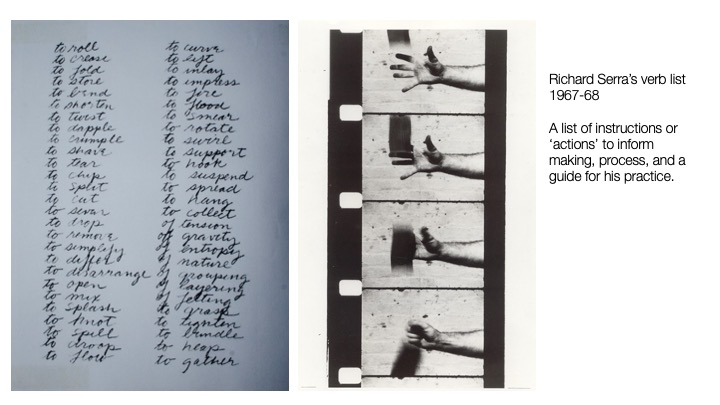
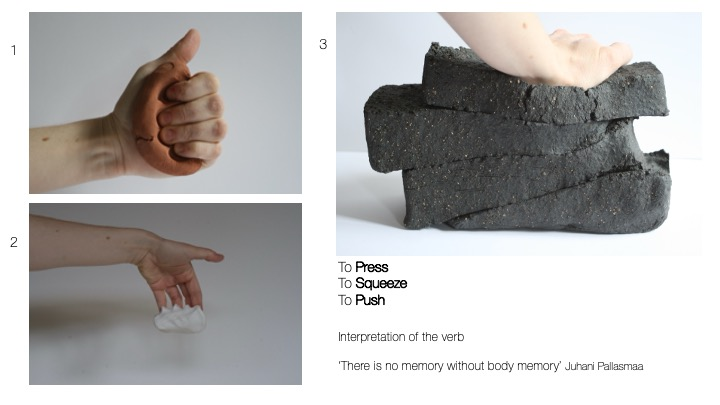
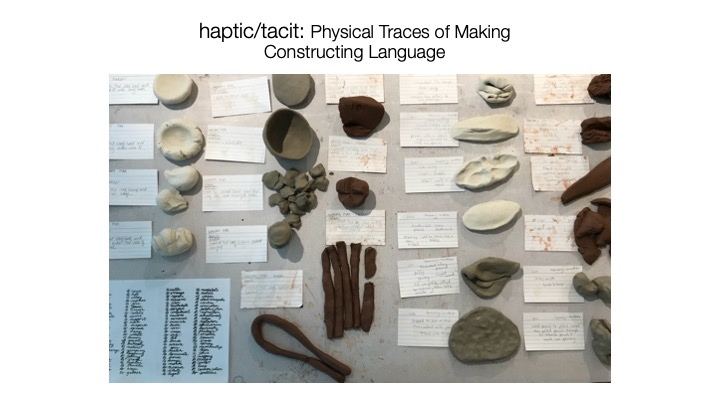
The project: Physical Traces of Making was Initiated by Richard Serra’s verb list 1967-8 and includes instructions such as:
To Open
To Tear
To Fold
To Assemble
Serra described it as a series of ‘actions to relate to oneself, material, place, and process’,born out of the very act of doing in relation to space.
It began in a period of action-based research within my own studio, shortly after my MA in 2011 and became a method for me to readjust the way I held my body in accommodating a shift in scale within in my practice. Moving from medium scale hand-building to more physically demanding work had required the use of my entire body, resulting in the redistribution of weight, position and physicality in relation to the work and the spaces being created.
This dissection and examination of movement became a mode of working, and slowly evolved into a project I believed had scope to exist within its own space but only began to build momentum around 2018, once I moved it from the confines of my own practice to the collaborative practice with haptic/tacit.
The project's development is a perfect example of the strength of the group in recognising and drawing on each other’s skill sets. Our collaboration cultivated an environment of mutual support and trust devoid of hierarchy, that enabled an idea otherwise unseen and quite isolated, to shift from the studio and into the public realm, where the work was waiting for the right context in which to exist.
Physical Traces of Making is a reciprocal relationship between:
The body and material (in this case, clay) + Language and tactility.
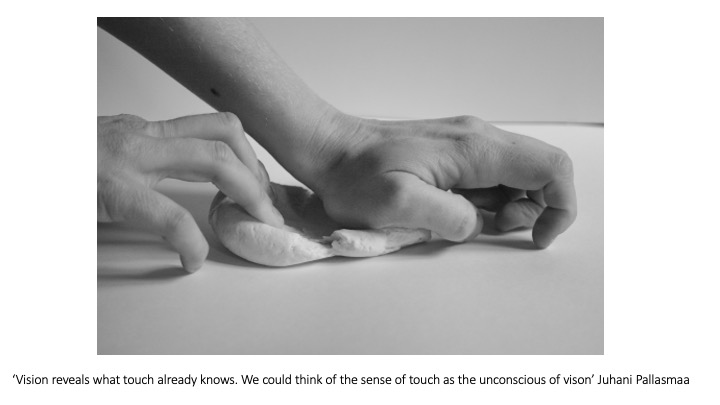
The project seeks to explore forms of communication and expression through gesture and movement, action and reflection. As a process-led approach, it aims to allow an individual’s interpretation of language through clay and in response to the verb or instruction given.
Haptic skill and kinaesthetic communication are tightly bound within the lives of makers. We often work quite instinctively so when we take a moment to examine how we move, it can sometimes be difficult to justify why we make decisions – both conscious and unconscious - when engaged with material processes.
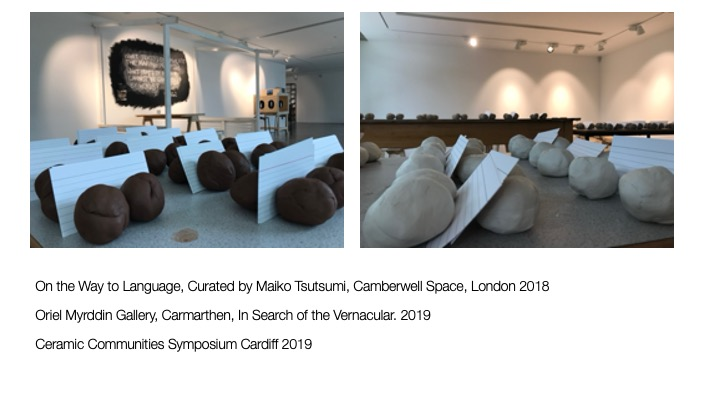
During 2018-19 we hosted 'Physical Traces of Making' as a series of workshops alongside our then current exhibition at Oriel Myrddin in Carmarthen, titled – ‘In Search of the Vernacular’ and described it as the everyday language of the built environment. Within the accompanying exhibition notes was included a short-commissioned essay written by furniture maker David Gates, also exhibiting with us, titled 'Listening to the Particular' and described by Kimberley Chandler as 'a micro study of the particularities of shared language' in workshops (2018). Access to the exhibition essay is availbable below.
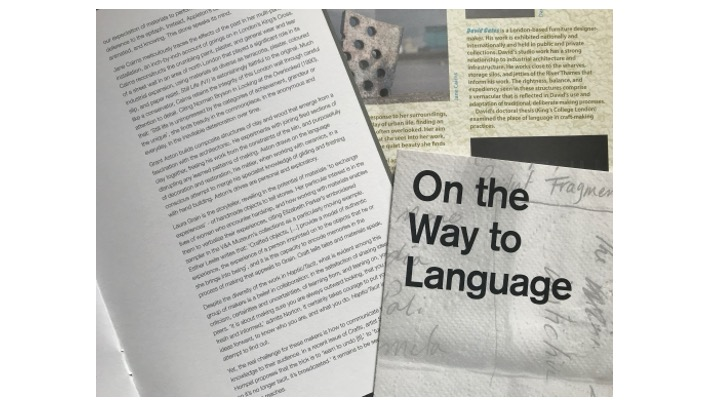
These workshops have since been adapted as a series of process led experiences, firstly at Camberwell Space as part of the exhibition ‘On The Way To Language’ (2018), and later at the 'Restating Clay Symposium, Ceramic Communities' in Cardiff (2019) in association with CoCA (Centre of Ceramic art, York Museum).
The terms of engagement initially included three different clays, usually Red Earthenware, Porcelain and Crank or in some cases Black clay. Each was chosen to deliberately create different experiences when touched and handled, as well as posing variations in material tolerances.
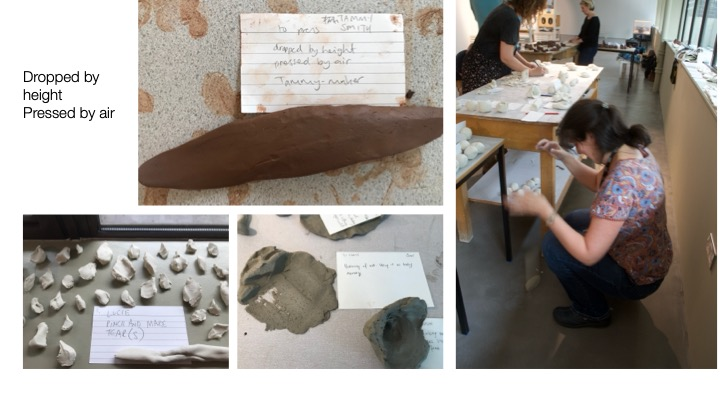
There were three tables, including balls of clay – each table was allocated to one clay - and the group was then divided into three smaller groups and given four instructions or verbs.
The performative nature these events would take as each instruction was called out created a quiet rhythm and rotation within the room, as each grouping moved from table to table, working with a different clay body. Changing clays helped to nudge or challenge any preconceived ideas or assumptions of those already familiar with the language of clay and any particular behavioural patterns that may occur. Expectations could be broken down because there was no pressure on the outcome. We even questioned whether colour would impact how the material was handled.
Initially, each ball weighed 100 g, making it easy for most people to work quickly, usually with one fluid movement. Increasing the size impacted how the material was able to be handled; the bigger it became, the more challenging it was to manipulate with a quick response to that one verb.
The hands became the primary tool here, with the option given to use one hand or both and the table. By stripping away the use of tools, the individual's weight and pressure were used to reach different outcomes and the visual language was ultimately led by the process. We provided a card with each ball of clay to be able to capture thoughts from that moment in time.
These events attracted a spectrum of creative practitioners from makers, ceramicists, artists and designers. Our aim was to dispel, or at least highlight, any preconceived ideas they may have around the clay’s capabilities and material behaviour.
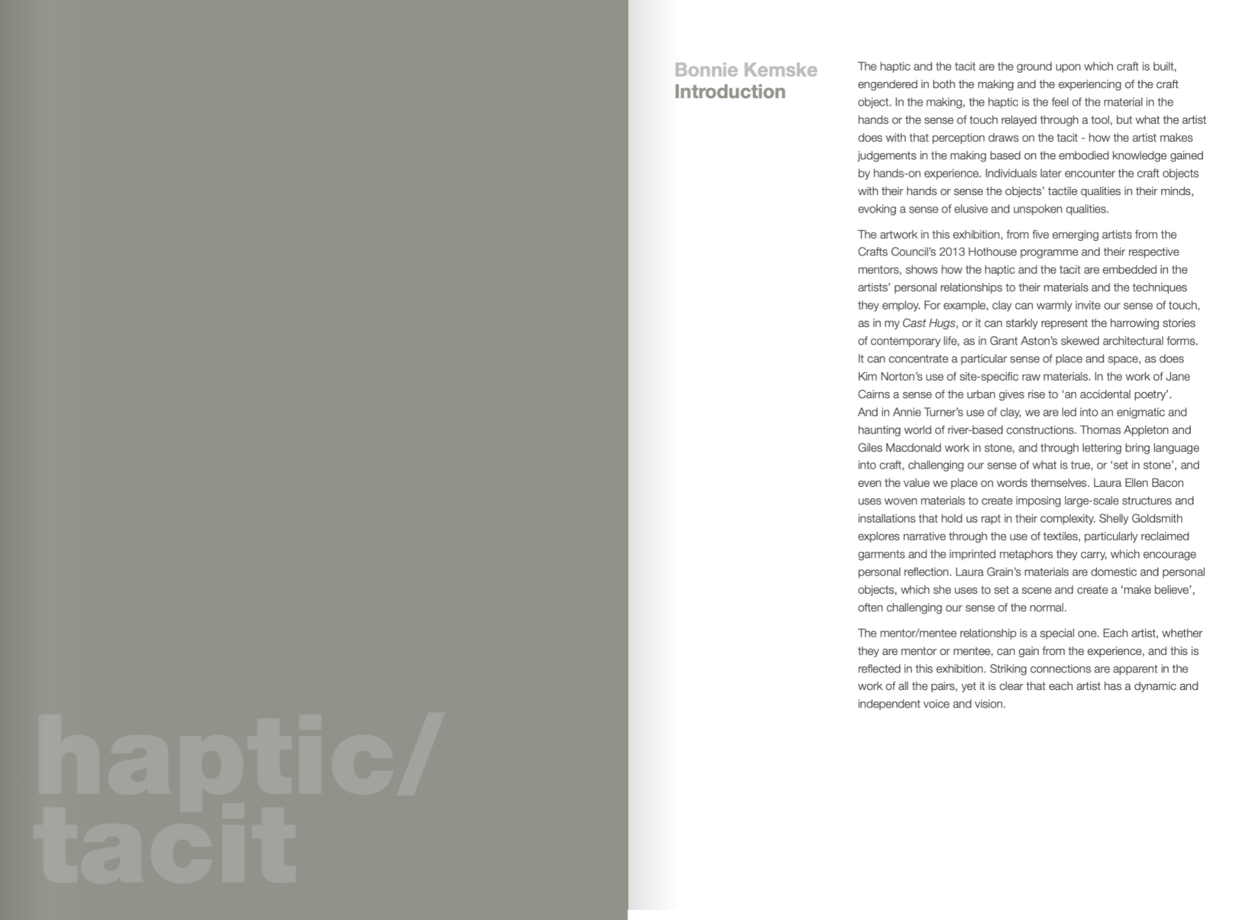
Click to open the catalogue for 'In Search of the Vernacular' with the essay from David Gates 'Listening to the Particular'.
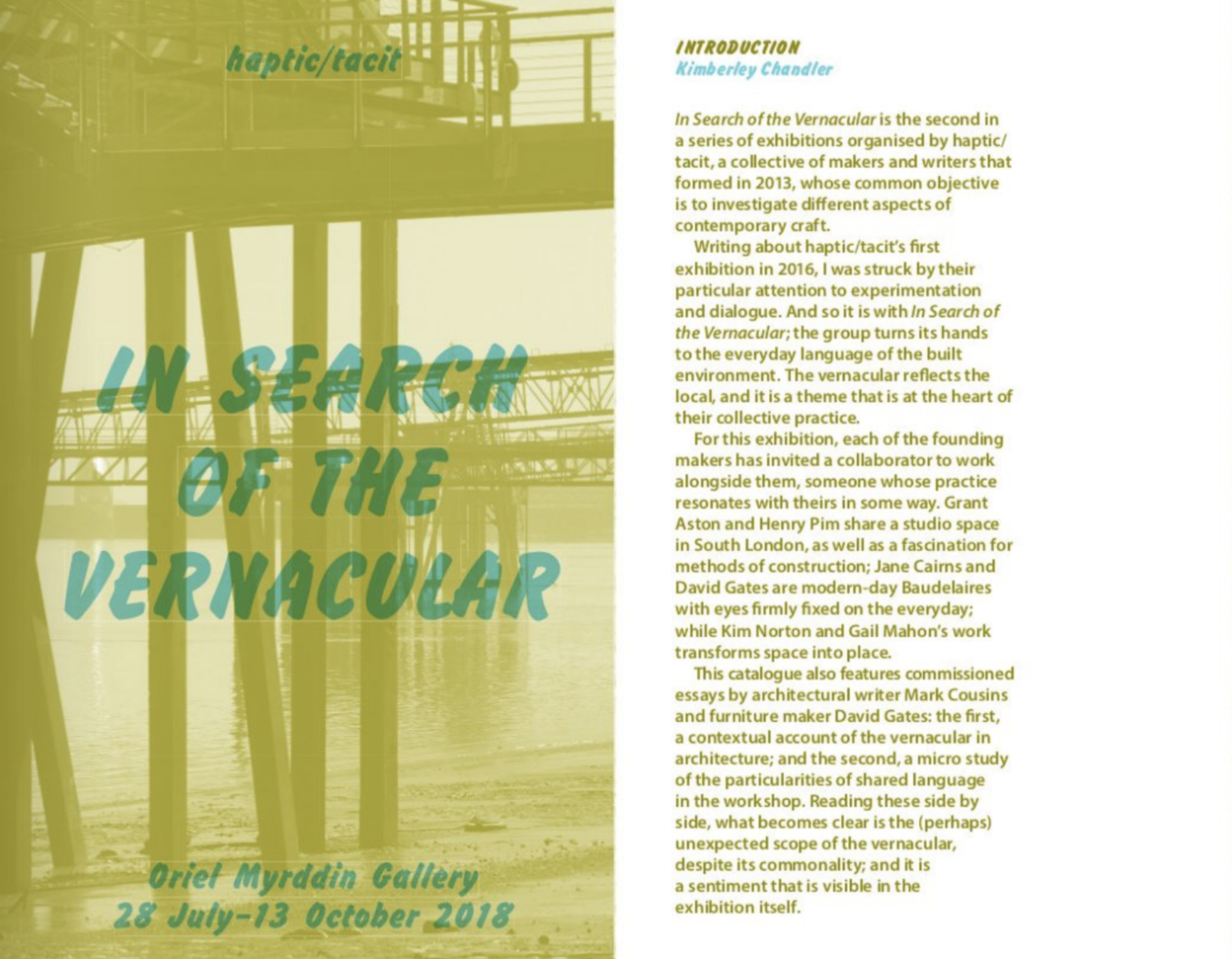
Click to open the catalogue for 'Haptic tacit with an essay from Bonnie Kemske and conversations with those artists involved.
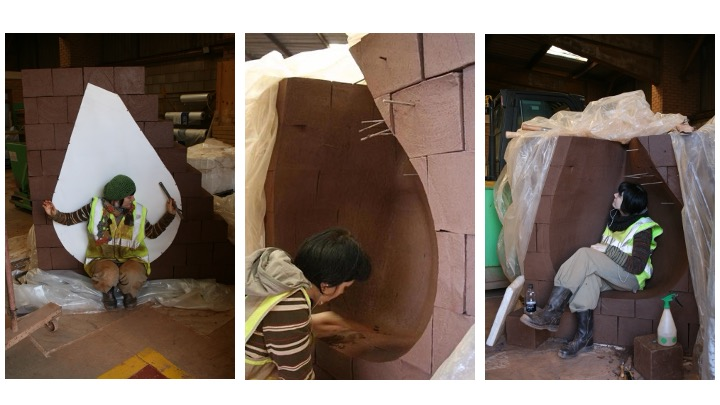
'Every body, person, fly, stone comes with a thing called conatus
or drive to seek alliances with other bodies that enhance its vitality.'
Spinoza (1677)
On a cold and frosty morning in November 2023, as I was holding a small ceramic figurative object in my hand still warm from the kiln, I had a kind of eureka moment, an intuitive urge to reach out to others and ask them to join me in a collaborative coming together through palm sized created objects. I was hoping they would join me in a shared conversation about how it feels to be in the body.
The aim was to represent those big or small personal and powerful conversations that we have with ourselves everyday about being in our bodies, and to discuss these embodied states through the materials and processes that are second nature to our creative processes. To make the intangible experience tangible in object form.
Without much further thought, I made a call out by posting the image of the object in my hand on a social media platform. I was hoping to create a collegiate response and was curious to sense, see, hear, feel and touch, how others felt, how they expressed this in three dimensions, giving voice to their internal world through the different stories that could be told, and the interplay of textures and voices, the similarities and differences.
In his essay 'Understanding the Effects of Materiality on Mental Health', Lambros Malafouris quotes from Bruno Latour and Daniel Miller stating that:
our everyday material habits and forms of material engagement
(past, present and future) are inextricably linked with our cognitive
and emotional lives – the major dynamic being the plasticity of the
brain linked to the affordances of our body and the action possibilities
offered by the things we make and use. We cannot understand human
intelligence (cognition and affect) in isolation from its changing
material and social surroundings. Material things matter and need to
be taken seriously (Malafouris, 2019).
The pandemic highlighted how vital social media platforms can be for engaging people in a shared experience. I chose a democratic and non-hierarchical platform, in the form of Instagram. This formed a novel research method, which is both visual and democratic, where participants were offered the opportunity to contribute to this ongoing research project in its different manifestations.
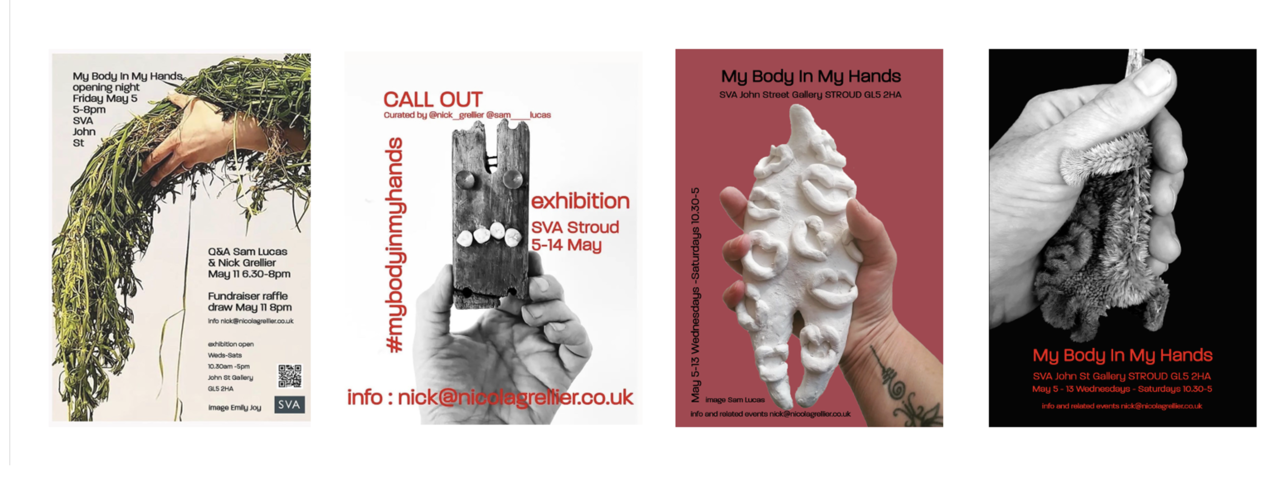
The call out encouraged those signed up to this platform to express how they felt in their body. To create a response and to photograph it in their hand, and hashtag #mybodyinmyhands. My aim in using this novel method was to throw the net out wide. I was not disappointed, and the responses highlighted the diversity within neurodiversity. During the project, a number of neurodivergent artists came forward and agreed to be interviewed further as part of multi-method, qualitative research into neurodiversity, body awareness and creativity.
The exhibition that followed in May 2023 was a collaboration with Artist/Curator Nicola Grellier. Stroud Valley Arts generously supported this project by giving us the opportunity to show a selection of the diverse images and physical objects in the SVA Gallery space at John Street Gallery, Stroud.
The basis of the project was driven by my practice-based PhD research in ceramics and wellbeing, at the University of Sunderland, funded by Northern Bridge Consortium. I am exploring how creativity can act as a coping strategy to encourage a more embodied experience in the creator, whilst exploring this through a phenomenological lens of their lived experience. As a result of the responses to this project, the research area expanded from creativity in the singular material of clay into whichever material or form the respondent chose. The ongoing project has produced conceptually broad and exciting global responses. Materially wide open, the works range from ceramics, found objects, paper, natural materials and human matter to short videos with over 500 artists from different parts of the world, including Cyprus, Malta, USA, Mexico, New Zealand and Australia.
Quotes from the students involved:
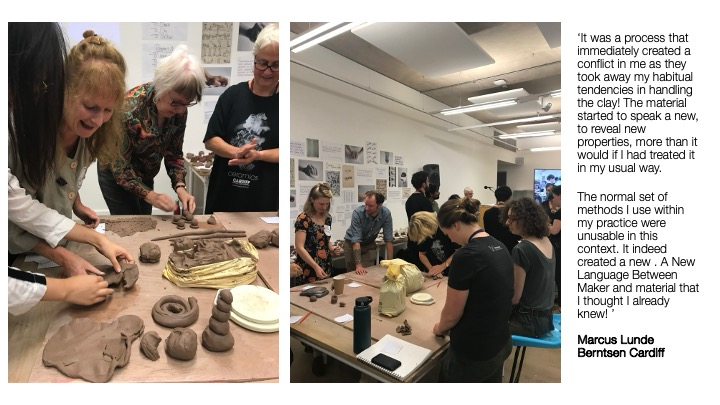
It was a process that immediately created a conflict in me as they took away my habitual tendencies in handling the clay! The material started to speak a new, to reveal new properties, more than it would if I had treated it in my usual way.
The normal set of methods I use within my practice were unusable in this context. It created a new, a new language between maker and material that I thought I already knew!
Marcus Lunde Berntsen, Cardiff School of Art and Design (CSAD)
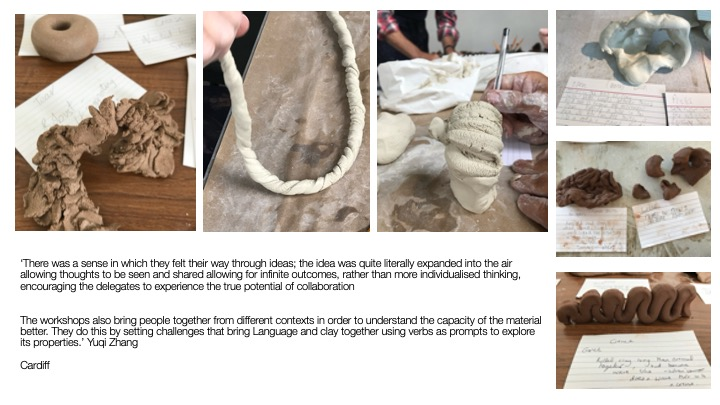
There was a sense in which we felt our way through ideas; the idea was quite literally expanded into the air allowing thoughts to be seen and shared, allowing for infinite outcomes rather than more individualised thinking, encouraging us to experience the true potential of collaboration.
The workshops also bring people together from different contexts in order to understand the capacity of the material better. They do this by setting challenges that bring Language and clay together using verbs as prompts to explore its properties.
Yuqi Zhang, Cardiff School of Art and Design(CSAD)
The other group of participants and visitors these events attracted included children of various ages and adults who had no experience or very little knowledge of clay. Entering into this environment with no expectations or understanding of the capabilities of clay meant they were less bound by rules or limitations.
It was fascinating to see how individual creativity began to emerge. Some people worked away from the table and incorporated the floor, others utilised the table as a canvas, working with 2 dimensions. At this point, we observed a shift as some of the group began to move beyond what had originally been asked of them, culminating in a rich diversity of methods and articulation.
The outcome from these events was a series of small abstract objects made quickly, instinctively and in many cases playfully as the instruction led and informed the action.
Questions asked at the end of each session:
Are we making assumptions about the material's capability here?
Did this process push the material in ways you wouldn’t necessarily believe to work?
Are expectations broken down as one clay body reacts quite differently from another?
Did the colour of the clay impact the way you handled it?
Can too much material knowledge restrict instinctive, creative doing, and how aware are we of our haptic skills and tacit knowledge?
Slide show of workshops taking place at the following events:
- On the Way to Language, Curated by Maiko Tsutsumi, Camberwell Space, London 2018
- Oriel Myrddin Gallery, Carmarthen, In Search of the Vernacular. 2019
- Restating Clay: Ceramic Communities Symposium Cardiff 2019
With each iteration we decided to tweak and change the format slightly in order to fit the context. For example, at the Restating Clay Ceramic Symposium we knew that a high percentage of participants would be makers or students studying ceramics at Cardiff School of Art and Design. So, we introduced working in pairs, using one hand each, working with eyes closed to challenge and encourage the act of collaboration with the clay itself and to heighten both verbal and non-verbal communication with the paired partner.
The neurodivergent makers body/mind and hand
Taking the theme 'The Makers Tongue' from David Gates' PhD Thesis discussing the role of oral stories in craft, I twisted it into a slightly different configuration to better fit my own purpose (2017). This, in turn, may have been influenced by 'The Thinking Hand', Juhani Pallasmaa (2009).
The root of my research is the feeling of displacement within one’s own skin, not a geographical displacement, but a feeling of corporeal disembodiment. Perhaps this feeling is caused by the trauma of living in a chaotic contemporary culture/society, or alternatively, a neurological difference. The hope was then to communicate this through the creative act in clay, which would result in tangible artefacts representing this sense of alienation, or alternatively, a connection and embodied experience.
My Body In My Hands project was an extension of this thinking. A provocation, encouraging others to create with the question of “How does it feel in your body?’
My hope was that asking others would create a reflection of my own thinking. I was curious to see, know and feel what others felt, through the creation of objects (Horvath and Carpenter 2020).
Clay is the material I have always used to explore these notions of body, through the material and the process, from my earliest experiences, whilst grappling with teenage angst in a social world that felt alien to me, as discussed in the Flightlines, Oral Histories podcast with Mandy Parslow (Mayo, O’Neil 2025).
I now understand that at school, it was not just the space in the form of the ceramics room that was offered to me as a sanctuary from the incessant mental spinning. It was through the clay that I was attempting to gain some agency, understanding and inner calm, during a period of a tumultuous change. It was the reciprocal nature of clay that created a space for me.
‘Clay is not passive matter but a material with a temporality and Life of its own that acts upon us, in and through us. Alexandra Engelfriet’s practice can be read, with Tim Ingold, as a dance of animacy in which both material and experience are transformed." – (Higgin, 2023)
Movement, music and clay among other activities can be seen as self-soothing, also known as ‘stimming’ where the body is reacting to stressful internal and external forces in the environment and creating a space to release tension. Many practitioners, including myself, use our creative processes as a form of self-soothing. Van der Kolk describes how our bodies are in constant motion, vibrating 'the heart beats as the blood is pumped around the body, and the body keeps the score' (2015).
When I am in this creative space, I feel I am dispelling the binary between my mind/body. Myself and the world melt into one, and I create the space for an embodied state, or state of flow. The internal shape of my body is imbued into the clay with my energy and vitality. The reciprocal relationship between my body and the agency of the material of clay creates a dance, where one melds into the other.
More authentic work is created when the final product is not the aim or intention. The aim is simply to transform a powerful negative, self-destructive mood, feeling or sensation into a more positive one. Jane Bennett discusses this vitality and agency between inanimate and animate bodies in her book Vibrant Matter (2010).
These first two iterations were the seed from which many other opportunities grew. What began with the staff ceramics group affectionately known as Clay Club at the National Star Cheltenham, led to the following venues:
- ‘Curio’ at Bricks, Bristol (2023), part of the International Ceramics Festival (ICF), University of Aberystwyth
- ‘Social Substance’ workshop at Airspace Gallery, Stoke on Trent (2023), alongside the William Cobbing Exhibition, part of the British Ceramics Biennial (BCB)
- The ‘Extreme Making’ exhibition (2023) at Glasgow School of Art, devised by the European Design Academy (EAD), a peer reviewed Creative Practice Arts and Communities Conference
- ‘Small Talk: Finding an Occupational Folklore of ceramics’ (2024) at the Performing Object: Ceramics as the Performance, Royal Holloway, University of London
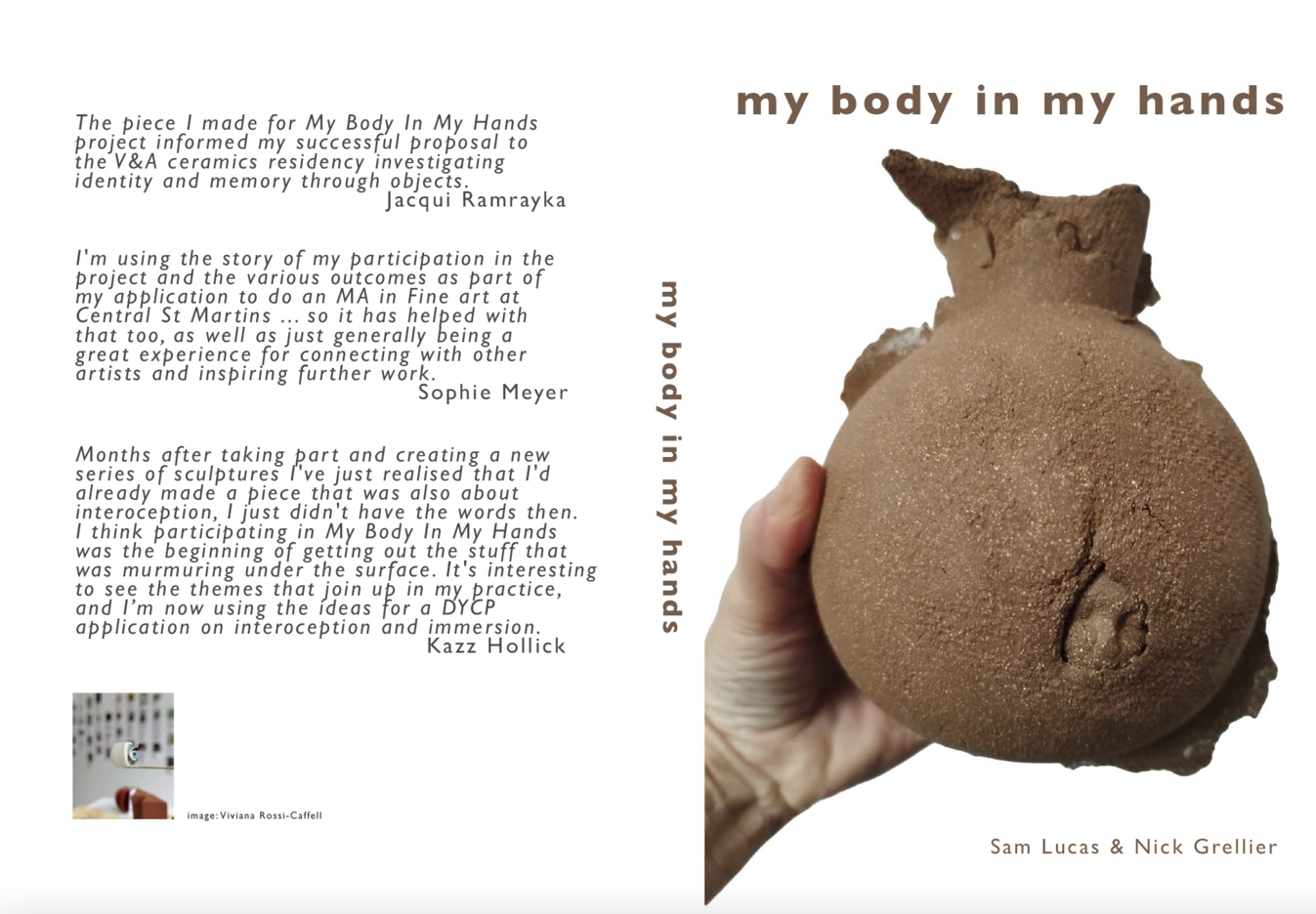
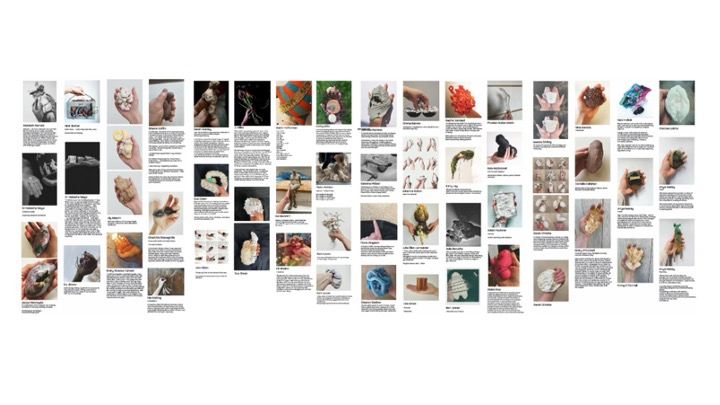
After the dust had settled in 2024, an artist book of, My Body In My Hands was created by Nicola Grellier and myself, which includes 99 of the global interpretations of ‘how it feels to be in your body' from the exhibition at SVA John Street Gallery which can be seen below.
Later in the year I applied for the Extreme Making exhibition at the European Academy of Design Conference at the Glasgow School of Art hub 2023, the project was accepted, and the response of the peer submission review was that 'The contribution of this submission is its inclusive, contemporary and fresh approach to knowledge making through co-creative making and sharing practices'.
The method of cocreation that I had adopted for this part of my research was described as 'a participatory knowledge practice involving artists, researchers and non-academic communities in the creation of collaboratively produced artefacts and shared understanding (Carpenter, Horvath, 2020).
This allowed Nicola and me to collaborate with other makers, academics, and non-academics on the project in a non-hierarchical manner. We added our creative explorations in response to the contributions in an integrated and reciprocal manner of equal value, without taking precedence or ownership of the project, other than its direction and progression from and beyond this format.
Images from the original call-out and publicity for 'My Body in My Hands' designed by Nicola Grellier
We sit together in conversation around a studio table with a variety of clay bodies and tools, and the basic instruction that over the next two hours, we will explore a diversity of ways in which the material's properties and processes can encourage parallels between making and speech. Three cameras are used to capture the event, two static - one overhead to observe ideas in clay as they accumulate on the table-top, one with a view across the table positioned as if a participant to capture the artists' facial expressions and movement of hands, and a roaming camera, responsive to the ongoing exchange of thoughts. The event begins with rolling out coils, viewing that preparation as akin to the ‘chatter’ before a more in-depth conversation takes place.
Making live video recordings aims to capture the complexity of ‘performance oriented narrative’ (Portelli, 1997), to document the multiple traits of speech, where the exact length and position of a pause can reveal emotions and indicate intention, and where a switch from one type of rhythm to another within the same conversation can indicate a change in attitude towards subject matter (Genette, 1997). The emphasis on capturing natural and unrehearsed discussion, inclusive of every wrong turn, utterance and hesitance, creates a long field-study. From the final recording, a series of passages are selected, comprising sections that retain enough of the surrounding context to make sense in isolation but otherwise give focus to how words intersect with the gestures and offerings that surround them. It is within these passages, often poetic in composition, that occupational folklore can emerge; a shared understanding of world-making that extends beyond the processes of clay, into broader ecologies of inter-practice understanding (McCarl, 1978).
Each passage captures a different example of ‘small stories’ taken from the two hour footage, and for the purposes of this exposition, attention is given to those that most clearly form the arc of the conversation both verbally and with the clay, in order to capture changes in the characteristics of the ‘Small Stories’ that take place over that time:
The mutability of speech and making:
Clip One: the social nature of clay
Clip Two: personalities, punctuation and pauses
Co-Constructed Meaning:
Clip Three: material and verbal conversation
Clip Four: collaboration
Performing Identities:
Clip Five: configurations, iterations and beginnings
The mutability of speech and making
In clip one, the basic premise of the exercise is established, and we settle into our respective roles. Even within this preparatory session the movement of thoughts between modalities can be seen to characterise the exchange. By virtue of watching the events unfold in real time, it is possible to witness a point at which there is an ‘openness to otherness’, where the properties of clay and process can be seen to contribute meaning to the words spoken (Brinck & Reddy, 2022). The film encourages this overlap, for a viewer to move beyond mere image of fingers pressing into a coil and leaving a patterned trail of marks behind, to consider that impression as baring evidence of the clay’s encounters. It is a momentary coincidence of sound and image but indicates the fluidity and lack of immediate concreteness contained in the relationship between spoken word and gesture, and the beginnings of Brinck & Reddy’s ‘second person stance’ taking place (2022).
In clip two, the complexity of embodied thinking is taken further still, as Kim draws into parallel the patterns and tendencies of her own creative approach with the distinction of her personality traits. She describes:
‘with me on a really personal note, and it is how I am led with everything I do, is through the lens of introversion, so those kind of quiet moments, and the reflective time of thinking, and the thinking through making, but this idea of again it’s that space, and breathing space, between what you’re doing, what you’re saying and listening’.
In a beautiful example of ‘performative narrative’ taking place (Portelli, 1997), she then enacts three distinct gestures to reinforce the idea ‘because I can’t always react immediately, I need to step away, think about it and come back’.
Albeit demonstrated here on a deceptively small level, ideas can be seen to arise from the occurrence of connections between material processes and experiences that surround it (McCarl, 1978). This multi-modal meaning can be called upon so quickly by the artists involved because of their familiarity with this process, the frequency with which we allow procedural and implicit knowledge to shape and direct our ideas (Huotilainen, Rankanen, Groth et al, 2018).
The transcript enables us to see how the passage constructs its own rhythm and momentum through the inter-play of individual ideas and collective or shared understanding, what Goodwin terms, the ‘organizational grammar’ of interactive practice (2007). In clip four, Kim speaks directly about the nature of working in collaboration with other artists, where an understanding of the ‘organisational grammar’ between their aesthetic values can play an essential role.
Co-Constructing Meaning
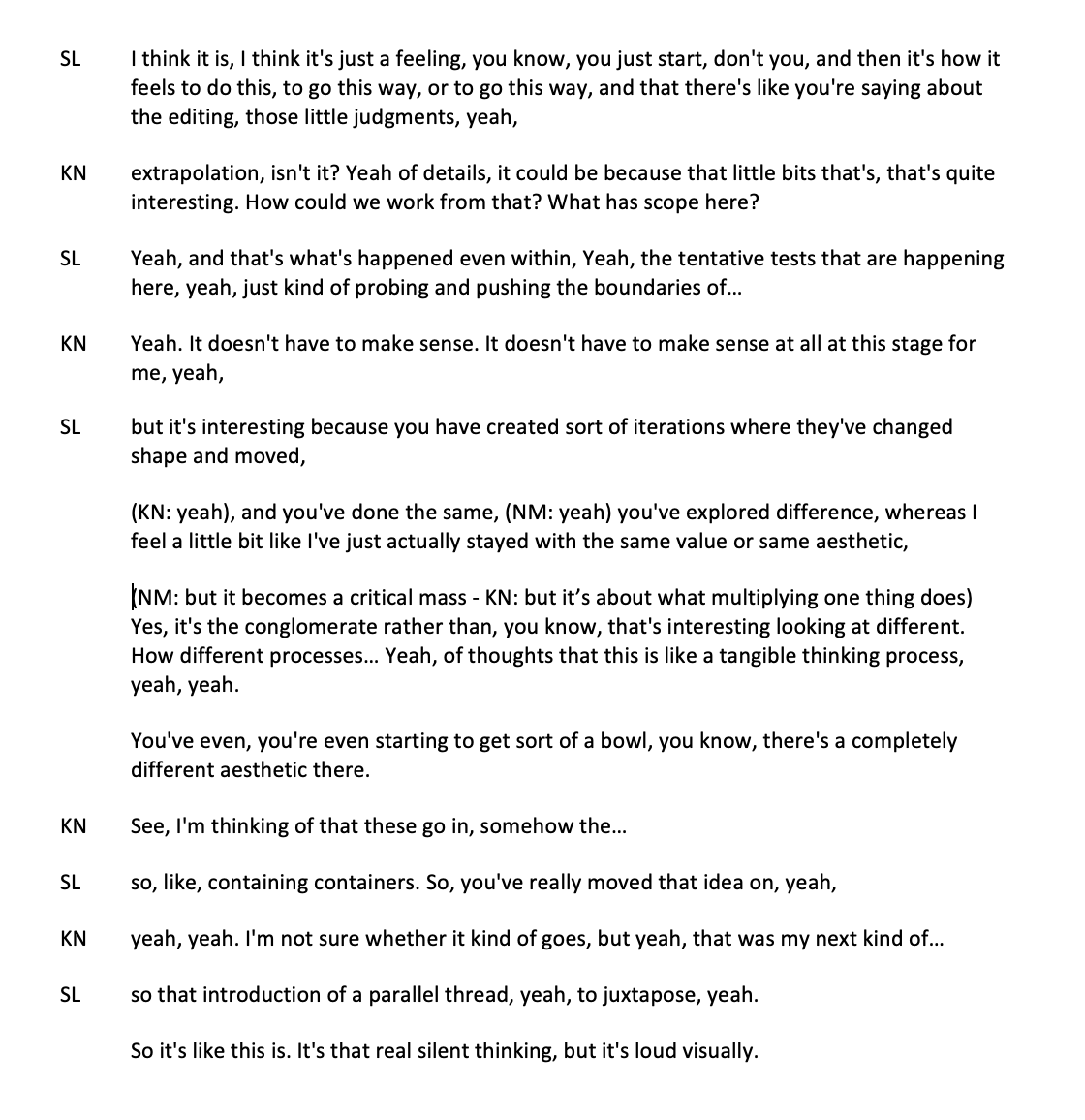
In the third clip the conversation is well underway, and through a growing familiarity with one another the conversation moves from correlations found between speech and making, to incidents where ‘shared narrative’ starts to build. The activity of ‘practical-making/practical-talking’ (Gates, 2013) tunes us into the use of the spoken word in its constitutive role, where a joint understanding of terms and points of reference take place. This co-construction is a distinct feature of ‘small stories’, where ‘a level and even an aesthetic’ is reached within a conversation, that allows for the identification and analysis of the narrative properties it contains (Georgakopoulou, 2007). A shorthand emerges, where incomplete sentences, even sounds made beneath the level of words, can be jointly understood as contributing to the discussion (Bamberg, 2007). We lose the need for fuller explanations, and a locally produced sense of meaning emerges where ideas can be explored through shorter exerts, the ‘telling of ongoing events […] allusions, deferrals, refusals to tell’(Bamberg, 2007) and we all know how to fill in the gaps.
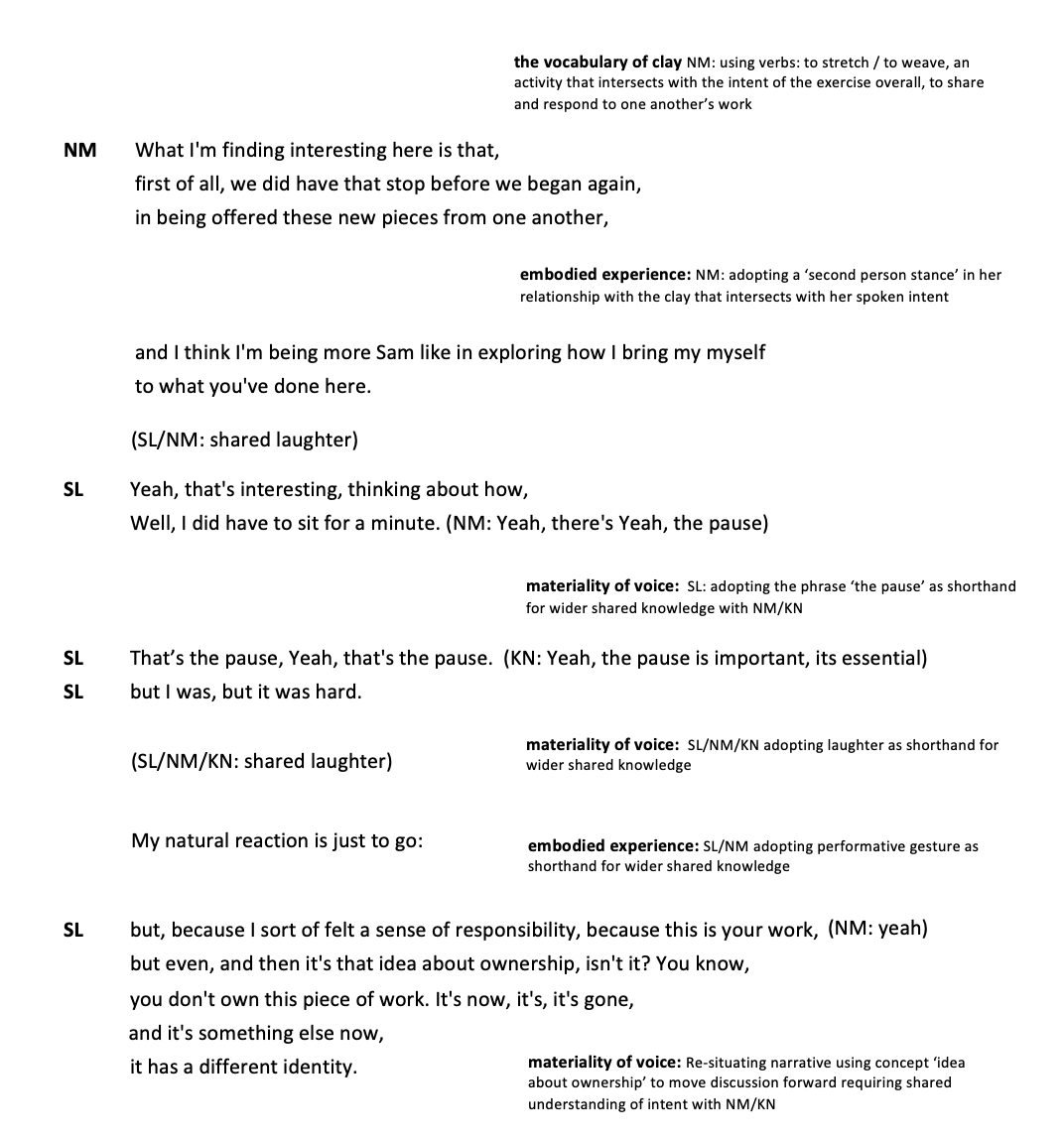
The third clip is accompanied by a written transcript to visualise how meaning is shaped and progressed through encouragement of multiple voices and performative turn-taking (Goodwin, 2013). Interspersed with the spoken words are points at which material properties and gestural movement intersect, where ‘action’ can be seen to reinforce and at times more distinctly direct the conversation.
This fourth and combined phase of the research is still in its early stages and aims to identify a model of analysis to explore the points at which stories arise between clay practice and life. To do this, it calls on the previous experiences of all three preceding projects, bringing together Sam Lucas, Natasha Mayo, and Kim Norton, to locate the conditions and key points at which voice, gesture and clay most dynamically intersect, and allow focus on the properties of storytelling their juncture presents.
To understand the mechanisms of these material based narratives, attention is given to the characteristics of ‘small stories’, an oral histories methodology that recognises communicative properties contained in the process of ideas as they unfold through speech (Bamberg and Georgakopoulou, 2008). The approach is applied to conversations that take place between the artist and material, as well as between the artists themselves, to identify common patterns in idea generation so often arising in ceramic practice, that they could characterise an occupational folklore that surrounds the discipline.
All four projects included in this exposition embrace this return to clay's common language,
to achieve a porosity in thinking, an ‘openness to otherness’, where the properties of clay and process can be explored for their susceptibility to interweave, to seek companionship and contribute (Brinck & Reddy, 2022). These are the properties of clay practice that have far-reaching, interdisciplinary consequences in connecting and contributing to society. To re-focus on 'small stories', on the occupational folklore that surrounds the discipline, can enable an artist to identify, in the details of actions and interactions in the studio, their potential to story-tell in ways that can benefit lives lived outside of it.
Performing Identities
The passages presented so far, demonstrate how the social model of narrative exchange can be seen to underpin the act of creativity, where the same ‘narrative field’ is established, inter-playing different materials with different properties. In the case of ceramics, it brings together voice/thought, gesture/body, and clay, with each element contributing to a context where their mutual elaboration creates a whole (Goodwin, 2015). The ‘story’ arises from their combined and progressive meaning extending beyond any isolated part, the ‘art’ of storytelling lies in how those characters come together and intersect.
In the fourth clip, the artists are searching for those very configurations, to find ways to progress meaning contained in the experimental pieces left behind on the studio table. It is significant how easily such rudimentary techniques and processes can be brought into a narrative framework, again demonstrating how implicit knowledge can shape intent (Huotilainen, Rankanen, Groth et al, 2018). They are enacting the narrative capacity of clay, finding characters and exploring their intersection. The exchange demonstrates a sensibility to the tone, rhythm, and gestures of 'small stories' arising; to see this clearly, a transcript accompanies the footage.
There is a beauty in these negotiations, with each move repositioning thought and revealing ideas, each decision locating personal intent in relation to context and collective understanding. Yet, the complexity of these ‘fleeting moments of narrative orientation to the world can easily be missed out on by an analytical lens which only looks for fully-fledged stories’ (Hymes, 1996). To focus on this nuanced interaction of voice, gesture and clay can serve metaphorically, and often poetically, as an antidote to the prevalence of competitive ‘grand narratives’ (Bamberg, 2007) by returning us to a fundamental understanding of what the mutability of clay can offer in terms of creative thinking - in both its procedural and implicit form. It is from these psycho-social properties of clay that occupational folklore takes shape, from a shared understanding of world-making that extends beyond the disciplines processes to enter a broader ecology of inter-practice understanding (McCarl, 1978).
These passages now contribute to a growing collection of small stories exploring the shared mutability of making and speech, with clay's mercurial properties offering a unique wealth of seemingly unending possibilities to populate a narrative field.
|
|||||||||||
|
|||||||||||
![[WorldCat (this item)]](https://archive.org/images/worldcat-small.png "[WorldCat (this item)]")