11 UNDERGROUND:
REENACTMENT, SOCIAL PRACTICE AND POLITICAL INTERVENTION
Arturo Delgado Pereira (aka Chico Pereira)
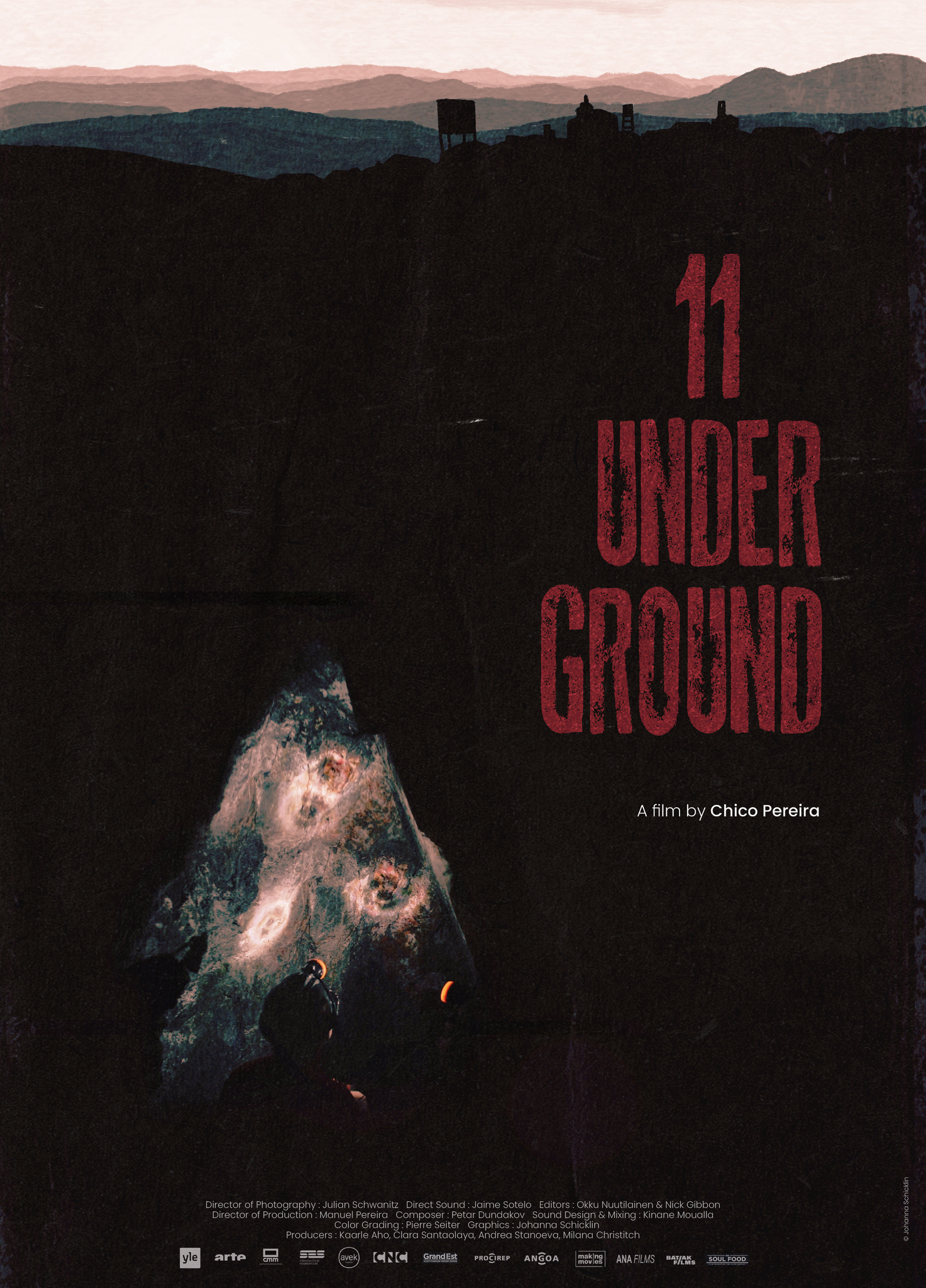
For over 2000 years, my hometown of Almadén (Southern Spain) has hosted the most fertile mercury mines in the world’s history, and one third of the total extracted mercury comes from these mines. But as it happens with many industrial towns that mostly rely on a single main industry to drive the economy, the closure of the mines in 2003 brought about the loss of over 1000 jobs, high migration rates and depopulation, and an important economic, social, cultural, and identity crisis. A re-industrialization of the area was promised but never carried out. As a result, the Almadén region (8 towns) has passed from around 31.500 habitants in 1960 to 10.521 in 2024, losing more than two-thirds of its population and becoming an aging and hard-hit community. In 2012, the EU finally banned the commerce of mercury -the last mining activity of Almaden Mining Company (MAYASA) -due to its high toxicity. The same year, UNESCO recognized the joint candidacy of Almadén and Idrija (Slovenia) to become inscribed as a World Heritage Site, turning the Almaden mines into a tourism-focused mining park. Post-industrial societies like Almadén have passed from a livelihood based on industrial activity to one that manages its industrial heritage as well as the ruins left after the end of an industry.
This exposition centres around the fieldwork and shooting process of my documentary feature film, 11 Underground (Chico Pereira, 2025).11 Underground is a reenactment film project based on a mining strike that happened in Almadén in the summer of 1984, in which 11 miners locked themselves in at 650 meters underground to protest their precarious working and social conditions. After 11 days of enduring the dark and toxic underground galleries, the Almadén Mining Company finally accepted the miners’ claims and the miners came out of the dark hole, received as heroes by their neighbours. As a local filmmaker belonging to the first non-mining generation in over 2000 years, I thought of the premise of making a reenactment film in town: what if 11 people locked-in in the underground mine for 11 days now to pay homage to the 1984 strike? Out of this rather strange proposition there was a desire to create an event -partly social, partly artistic-, that could help to collectively reflect -or re-imagine- our present by reenacting a collective action from the past.
On the one hand, 11 Underground can be presented as a loose reenactment that reproduces the form and duration of a past strike: 11 people confined inside a mine for 11 whole days. On the other hand, the speculative character of this what if scenario (what would happen if..), opens these 11 days to the unexpected, to new actions and directions that might emerge from the implementation of that speculative scenario into the town’s present reality. The intrinsic relation of reenactment with the past, together with the future-oriented nature of what if scenarios -as ways of engaging creatively with possibilities- are, in fact, representative and metaphorical of the current situation of Almadén, which tries to construct a future from the remains of the mining past, while deeply struggling with the negative consequences of the lack of structural plans after the end of mining.
Overall, the way this artistic research approaches reenactment is by using the historical referent (i.e. the past mining strike) as a documentary scenario and performing it in the current socio-political conditions, opening the possibility to intervene in the present and collectively imagine possibilities for a better future. This approach to reenactment resonates with what documentary scholar Sylvie Jasen calls ‘reenactment as event.’ Jasen argues that "reenactment as event is less interested in replicating or even representing the past than in evoking its current traces and ongoing impact" (Jasen 2011, ii). The past "is not so much represented as it is conjured in its current affects and resonances" (Jasen 2011, 22). Jasen’s concept of ‘reenactment as event’ emphasizes the process of adaptation and appropriation over the exact reproduction of the past. Instead of hiding and reducing, reenactment as event highlights and seeks after the anachronisms, jolts, and "errors" between the past and its reenactment (Lütticken (ed) 2005, 5). Jasen´s theorization builds from Fredric Jameson’s “production as an event”, a notion Jameson uses to characterize the workings of post-modern documentaries. For Jameson, these documentaries are “marked by the active intervention of the film-production-process in its object” (Jameson 2005, 262). Jameson claims that “the very operation of recording and representing it intervenes to change the outcome before our very eyes” (Jameson 2005, 259). Thus, a reenactment could not only be “a means of representing events in the historical world;” it can also be “an event that intervenes in the historical world” (Jasen 2011, 26-27).
But why this nostalgic approach to the mining past from the post-industrial present? Howard Zinn uses the term “fugitive moments” to refer to “those hidden episodes of the past when, even if in brief flashes, people showed their ability to resist, to join together, and occasionally to win” (Zinn 2006, 11-12). I understand the mining strike of 1984 as one of those brief fugitive moments in which locals came together as a community to fight for a better future. Those past moments of collective action are markedly different from the post-industrial present in Almadén - characterized by social apathy and pessimism about the future. Looking at the strikes of 1979 and 1984 became a source of inspiration, and gradually a potential model for enacting collective action in the present through re-enacting the collective memory of past struggles. My first question was whether the past workers’ struggles could resonate in people’s minds and hearts as a prompt to reflect upon the current socio-economic conditions in Almadén. However, I worried about the extent to which 11 people locking-in underground for 11 days in the present could inspire community action and even give visibility to the current problems of the area, as happened with the 1979 and 1984 mining strikes. I feared that the sense of community and the ability to fight together might have disappeared with the mining world.
The possibilities and tensions between homage to the past on the one hand, and the reenactment event as an embodiment of current social action on the other hand, are at the core of this project. The process of filming this process further complicated this tension. The cameras brought an extra layer of mediation that made even more ambiguous the nature of the event. Were the dynamics created in the village during the 11 days of reenactment merely a fiction, or was the fiction of reenacting the past catalyzing something new? This exposition, as well as 11 Underground as the resultant film from this intervention, explore the complex temporality of re-enactment practices, relating it to the complex temporality of Almadén, and presenting liminality as a feature of both the Almadén underground and, potentially, of documentary film praxis itself.
The video extract above belongs to the interviews/casting sessions with the project’s participants. From the participants’ interventions, three important aspects of reenactment can be identified. First, reenactment as a copy, a fake. No matter how much we want to approach the past in terms of action, number of people and days, etc., the reenactment lacks at its core the authenticity of the original event. Second, participants express how reenactment could be a way to connect emotionally with the past -in this case with the world and experience of the participants’ grandparents. Even though the past cannot be fully reproduced, there is a desire that repeating the action could help shorten the emotional distance between those two very different worlds. This possibility for emotional connection would happen most clearly through embodiment, or as documentary theorist Bill Nichols puts it when referring to reenactment, by going through the motions of the past in the present (Nichols 2008).The third aspect to highlight is the notion of what kind of embodied experience a reenactment like this is. As some of the participants express, it is not possible to play a role for 11 days and some dynamics between people might appear during this time. In addition, since the underground mine is both a real space and a symbolic one closely related to the collective identity of the area, there is a sense of respect and responsibility which raise the stakes of this reenactment in its relationship with its historical referent.
Rather than a series of historical episodes to be faithfully reproduced, I take the strike of 1984 as a documentary "score," which I need to adapt and perform in the current post-industrial reality. It is a process of adaptation, appropriation, and citation of a past event into a new context. The adaptation process necessitates maintaining, discarding, and transforming the historical referent, the model. A clear example is the selection of the 11 participants for the new lock-in. Apart from their willingness and availability, I selected the participants for their degree of involvement in the current social problems of the area, not for any possible acting capacities, personality traits, etc. Looking for socially engaged people was a way of adapting the concept of trade union members to Almadén’s post-industrial context. In 1984, 11 male miners carried out the strike because only men worked in the galleries, and there was no female presence in the workers' unions. Whereas in 1984 the strike was part of the workers' movement, in 2019, the reenactment needs to be understood as a broader social reclamation, not only as one tied to workers' claims. It would not make sense to restrict the casting to male participants, and the project moves away from looking nostalgically at the male-dominated mining world. Including women as participants also aims to highlight womens’ indispensable role in past mining strikes. As a method, the casting aims to embody inclusiveness regarding gender, age, race, and sexual orientation, hoping that the encounter between people with different backgrounds -and the "example" this convivial model can provide- would point to the necessity of addressing discriminatory attitudes and behaviours still entrenched in the village. In addition, the participants would not have to represent the old miners; if anything, they must be present as the area's current inhabitants. So, in considering reenactment as event, “the accuracy of the representation, the degree to which it approximates its referent, the original event, is less significant than the performance itself as an expression of a community and its collective memory” (Jasen 2011, 44). Or as film scholar and critic Ivone Margulies puts it, “reenactment does not so much demand consistent verisimilitude or authentic recreation as it calls for a deeper process of reanimation or vivification” (Margulies 2019, 28).
The video extract above presents the older mining generation and how the reenactment’s participants propose the project to them. The perceived fakeness of the proposed action also comes through strongly in the voice of the older generation. The “real” mine is gone, and the proposed action would never be anything like what they did. However, the video also shows how bringing up the topic of reenacting the lock-in provokes instances of reflection upon the current situation in the village. And even though humour is an important part of how the older generation took the reenactment idea, the video extract also contains moments in which the collective trauma of the closure of the mine is clearly felt. Interestingly, once the younger participants present the reenactment as a possibility for social reclamation, the focus moves from the inherent fakeness of the reenactment towards the possibility -and need- of becoming a form of social action itself.
So, even though we are not fully representing the past, there is a strong sense of imitation, of mimesis, at the heart of this project. Walter Benjamin describes the mimetic faculty as "the powerful compulsion in former times to become and behave like something else" (Benjamin 1978, 333). Developing Benjamin's thesis, anthropologist Michael Taussig argues that "the wonder of mimesis lies in the copy drawing on the character and power of the original, to the point whereby the representation may even assume that character and that power" (Taussig 1993, xiii).
In 11 Underground, to merely represent the past fell short of a stronger desire, the desire to intervene in reality through artistic praxis. The devastating social and political landscape after the closure of the mine has an anesthetizing effect on our generation. The collective self is extremely damaged in post-industrial Almadén, and therefore the conditions of possibility for collective actions, like the mining strikes of 1979 and 1984, hardly exist. We are faced with the precarity of the present, but we are not actively engaged in collective social action as our grandparents had been. This is where this project sought to intervene, reconsidering through artistic practices our sense of collectivity and struggle. The historical referent for this reenactment project, therefore, is also a referent in a broader sense, a model to follow for a group of people looking for social change without knowing quite how to start acting upon reality.
One of my first thoughts after deciding on this durational event was: "what the hell would we do inside a mine for 11 days?" This sense of duration, of a time "set apart" for this intervention to exist and unfold, became both a source of possibility and anxiety. As a possibility, the durational event appears as a precious opportunity to generate encounters between different people. The general view in Almadén is that we live in a hole, not the mining pit, but a sociopolitical one caused by the lack of restructuring plans after the closure of the mine. This notion of the hole symbolizes the general sense of depression, social apathy and negativity towards the town´s situation. 11 Underground takes the metaphor of living in a hole and proposes to embody it literally. First, to turn the inorganic and apparently lifeless underground into a convivial place for 11 days. But more importantly, to propose the underground as a living and symbolic space to foster a series of conversations, encounters, and social and political propositions to reimagine Almadén, which rose from a mine shaft more than 2000 years ago, as 'something else besides' a mining town.
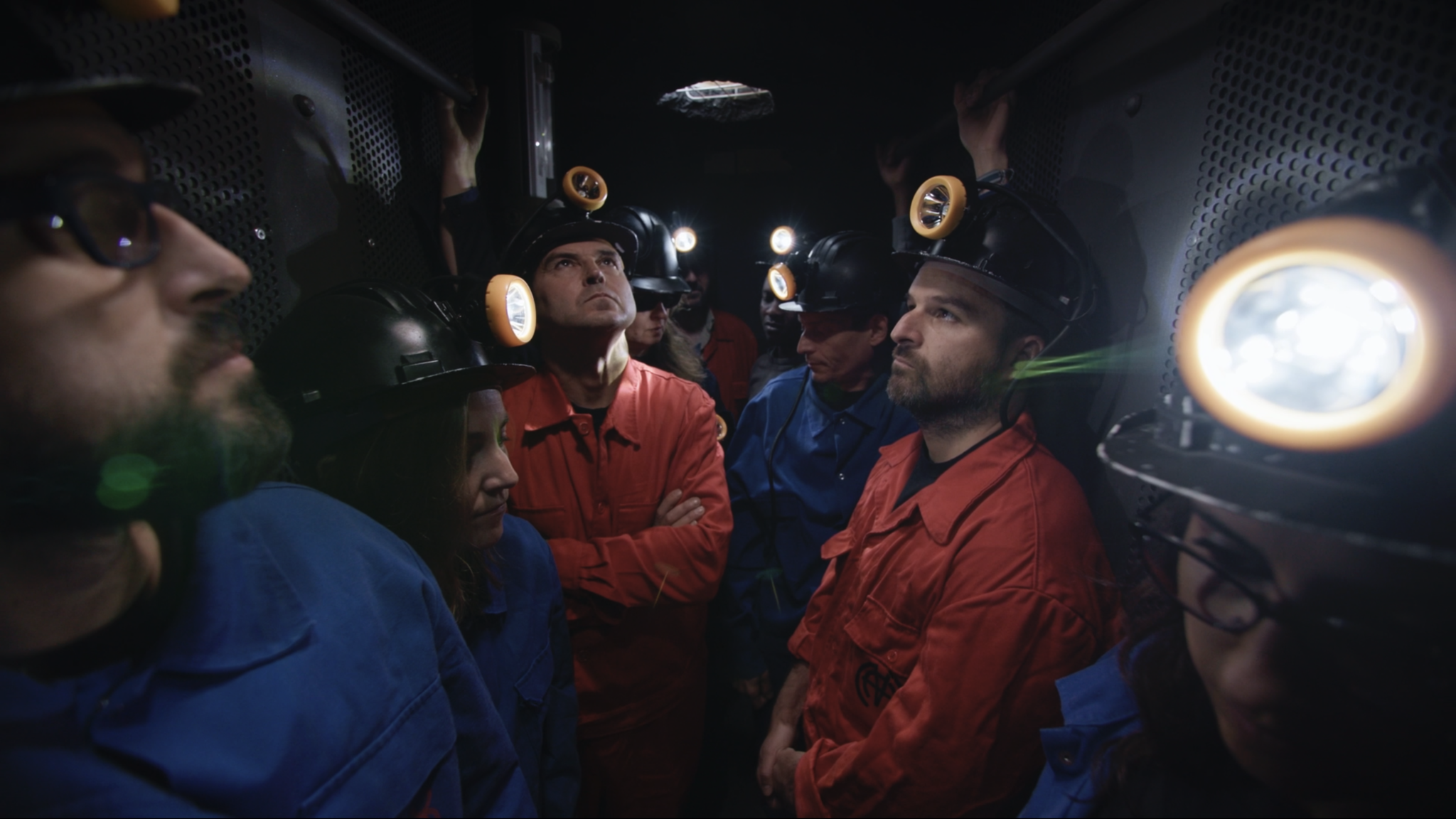
Even though the mine is closed for production, the underground is a real environment and, in fact, a potentially dangerous one. The intervention presents some risks to the participants, who have no prior experience of spending extended time inside a mine. The 11 participants descend to the cave wearing mining overalls, helmets, and a light. From then on, they are depending on people´s aid from the surface: food, water, mattresses, clothes, etc. This follows the way the strikers of 1984 entered the mine. Then, it was in order not to arouse suspicion from the mining company towards their actions; in our case, it is part of the mimetic homage to the past.
In 11 Underground, traveling to the depths of the mine becomes traveling back in time, again both in real and symbolic terms. The mine is an archive of our geological past, as well as an archive of past lives and histories. In the geological profile of the soil, the deeper we go, the older the sediments are, “depth becomes time,” as new media theorist Jussi Parikka states, eventually reaching the “deep time” of earth formation (Parikka 2015, 13). The participants’ steps through these galleries are not only through millenary rocks; they are also through years and years of exploitation, slavery, and imperialism. The past is embodied in the shape of these galleries, resulting from geological processes, human actions, work power and technologies, colonialism, etc. This underground hole can also transmit other temporalities, for instance that of the twentieth century workers’ struggle to which this project relates to. Overall, the mine galleries become a palimpsest of times, featuring a complexity of temporalities that eventually situate them “out of time.”
The combination of the real and symbolic aspects of these underground galleries invites to present 11 Underground as a ritualistic gesture, and by doing so, to contemplate the capacities of ritual, and reenactment, to do socio-cultural work. Ethnographer and folklorist Arnold Van Gennep defines the three stages of ritual as separation, transition, and incorporation (Turner 1982, 24-27). In 11 Underground, participants are ‘removed’ from their everyday life and immersed into the cave's liminal “out of time”/ “other space” until their reincorporation into society 11 days later. Ritual implies a change in the quality of time and a parallel passage in space that can be as small as opening a door or crossing a threshold (in this case, entering the lift that takes the participants underground) or as large as crossing several countries as in a pilgrimage (Turner 1982, 24-26). As religious studies scholar Barry Stephenson writes, “ritual entails engaging in specific, formalized acts, and utterances not of one’s own making,” and in this case it is the act of locking in underground in a similar way to what happened during the mining strikes of 1979 and 1984, albeit in a different context and framework (Stephenson 2015, 90). As a ritual, this descent into the underground is one of remembering and honouring the past, and also of discontent, dissensus, and desire for change in the present. This project also engages with anthropologist Victor Turner’s theorization of liminality as experimentation and plays with the cultural elements of society, with its combinations and re-combinations, defamiliarizations, dis-membering, and re-membering in a way “that invites possible and fantasized, rather than experienced, combinations” (Turner 1982, 27). For Turner, the essence of liminality is “the analysis of culture into factors and their free or "ludic" recombination in any and every possible pattern, however weird” (Turner 1982, 28). In these processes, novelty can emerge “from unprecedented combinations of familiar elements” (Turner 1982, 27).
The poems which miners wrote during the strikes of 1979 and 1984 become resonant archival elements when staged underground. Even though they are situated in the past, their call for resisting and fighting together, resonate strongly with the participants. The poem “I Can´t Sleep: To My Friend in the Hole”, expresses the necessity of awakening to political action, and positions it in opposition to the anaesthetizing nature of fantasy. In this regard, this poem embodies and resonates with the central tension of the project of whether this project should be about representing the past (i.e. fantasy) or taking proper social action in the present (i.e. awakening). Other poems from the previous local strikes staged during the filming of 11 Underground present a similar double temporality. They point towards the past when they were written; but they also resonate strongly with what the reenactment project is generating in the village, once again, in the present. For instance, having 11 neighbours inside the mine creates special dynamics in the village. Partly because of having family members, friends, and neighbours underground, partly because of the collective memory of the strike of 1984 when “the entire village was there”, the mine esplanade becomes a place for daily encounters between the members of the community.
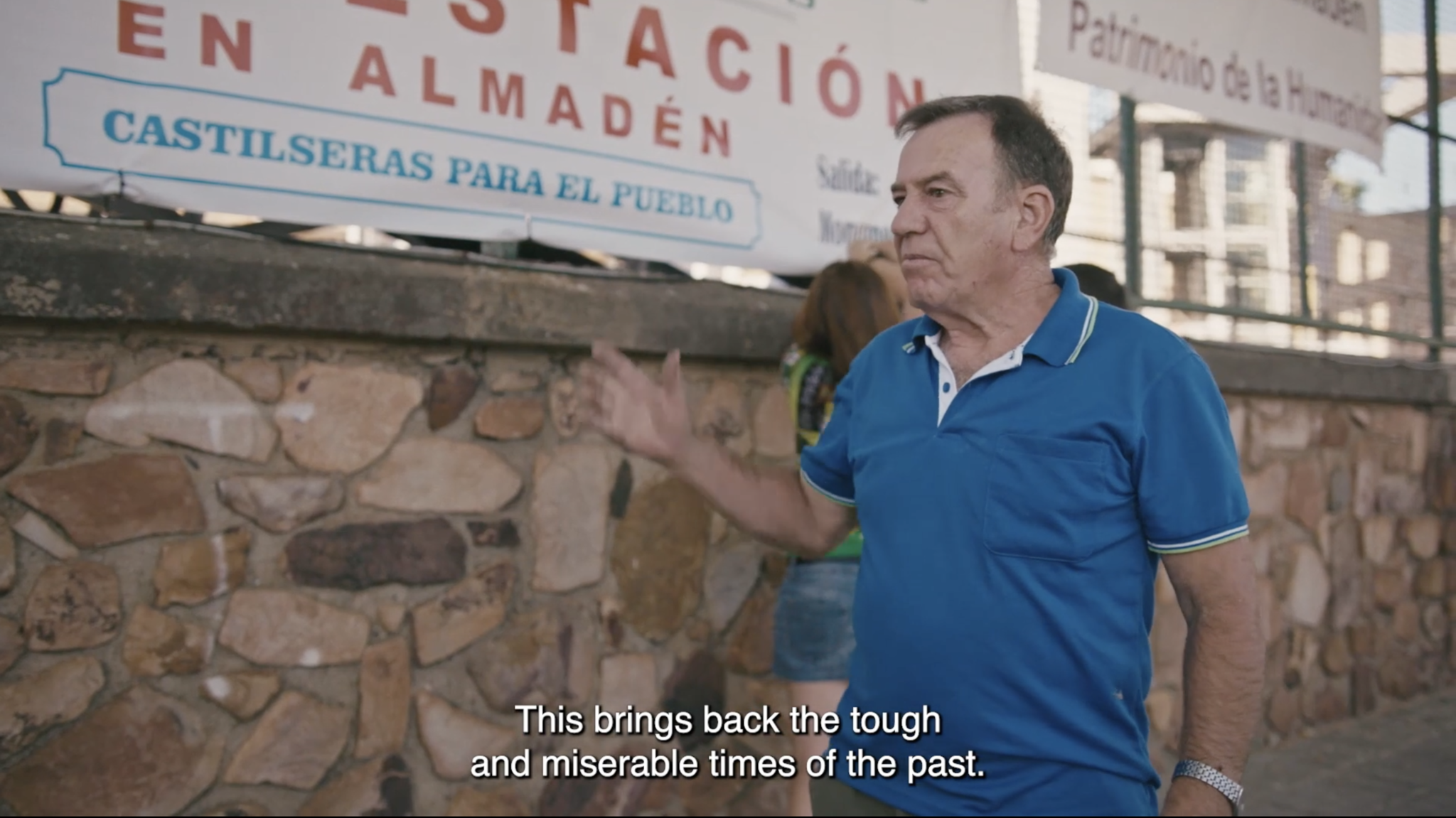
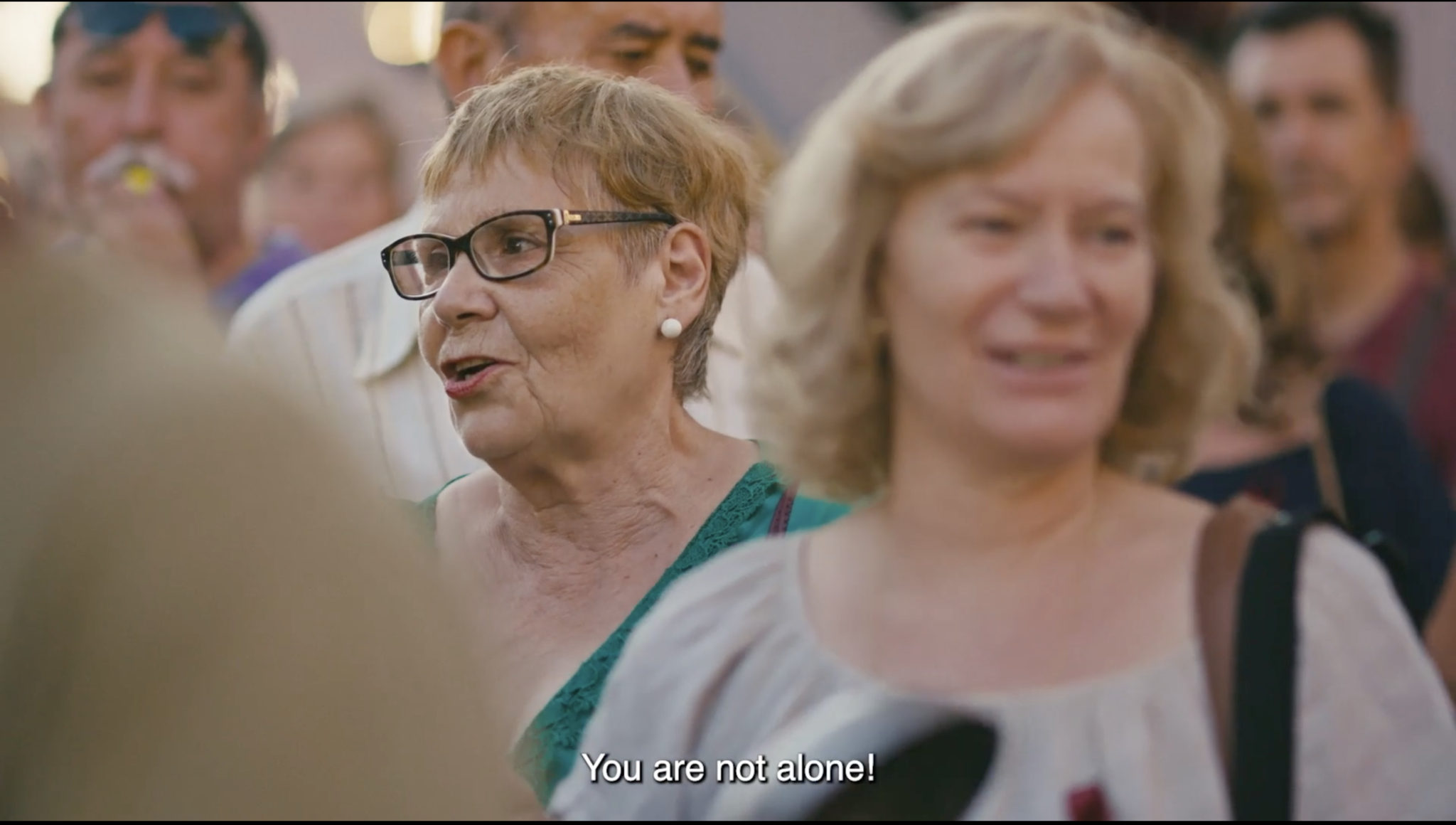
Image 3 & 4. Collective memory in action. From 11 Underground (Chico Pereira, 2025). Image: Julian Schwanitz & Gabriel Molera.
The insertion of this event in the village's everyday life also entails a rupture from such everydayness. Thus, the recreation of the strike shares some similarities with the original strike as a similar event of rupture. The words of theatre director and critical thinker Augusto Boal strongly resonate with this project as a performative intervention. Writing about the potential of theatre, Boal states,
Maybe the theatre in itself is not revolutionary, but these theatrical forms are without a doubt a rehearsal of revolution. The truth of the matter is that the spectator-actor practises a real act even though he does it in a fictional manner. While he rehearses throwing a bomb on stage, he is concretely rehearsing the way a bomb is thrown; acting out his attempt to organise a strike, he is concretely organising a strike. Within its fictitious limits, the experience is a concrete one (Boal 2008, 119-20).
A strike in the traditional context of labour is no longer possible in the present circumstances. Nonetheless, the sense of injustice, frustration, and the desire for improvements that fuelled the mining strike is still present in the community of Almadén 35 years later. The constant presence of those feelings of injustice poses the question of whether this project is in fact a reenactment, or a continuation of an unresolved issue already expressed 35 years ago. This time, the frustration is not solely focused on the Almadén Mining Company but on the general distress and historical injustice due to the continued extractive practices that this mining community, like so many others, has suffered.
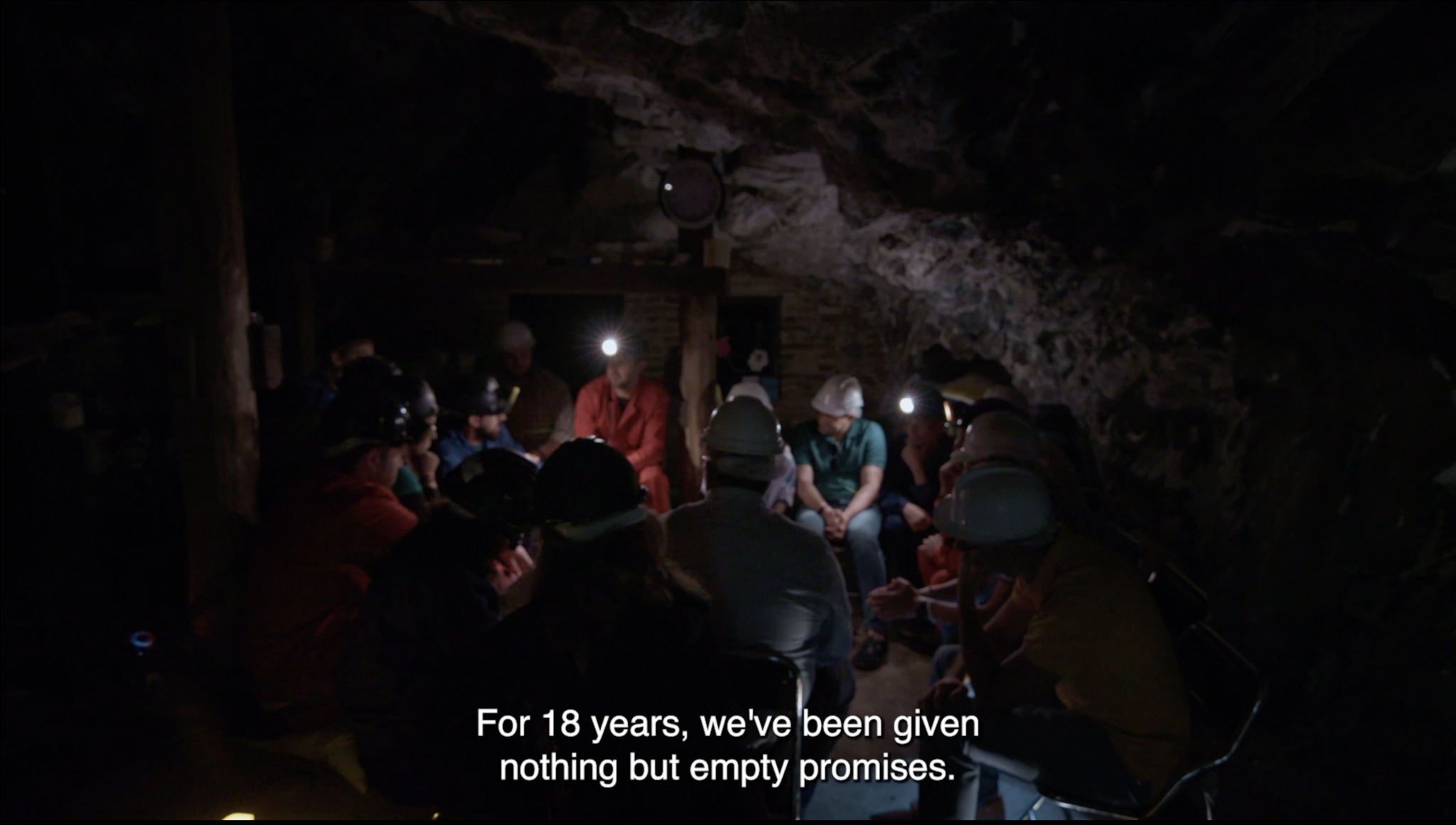
11 Underground proposes the underground darkness as a hopeful environment for discussing the different challenges of our town´s reality. This identification of darkness with hope -and not so much with the overall depression- closely relates to the concept “Hope in the Dark” that the writer, historian, and activist Rebecca Solnit has coined. Rather than equating darkness with negative connotations, Solnit uses darkness to refer to the uncertainty about the future. For Solnit, “to hope is to give yourself to the future, and that commitment to the future makes the present inhabitable” (Solnit 2016, 4). Hope necessitates action, and “action is impossible without hope” (Solnit 2016, 4). Solnit speaks about activist social transformations and reminds us that what “these transformations have in common is that they begin in the imagination, in hope” (Solnit 2016, 4). During the 11 days, we invite local politicians, experts, as well as members of the community to visit us underground and create round-tables to discuss aspects such as the lack of re-industrialization, unemployment, poor access to health services and infrastructure, tourism management, cooperation between different villages, entrepreneurship, teenage life, etc.
Around the oldest mining shaft, we openly discuss possibilities, liberating ourselves from the constraints of the present and imagining how things could be improved. As a result, we create a document, a road map, that exposes all these different aspects, and which will later have a life on its own in the regional parliament and the national senate. During the 11 days a motto emerged: “Del Pozo Se Sale”. This could be roughly translated as “We’ll get out of the hole”. The messages received from the surface during the event show the locals’ use of darkness and visibility both literally and metaphorically to encourage a sense of collectivity and hope for the future. Our journey to the darkness became a desperate call for collective action emerging from below, literally.
The role of TV, radio, and newspapers, which increasingly cover the event, also has a powerful effect on keeping both under and over ground participants engaged with this artistic intervention. It also attracts political attention to Almadén beyond the original scope of the project. As a result, both participants and the involved community members outside the galleries start realizing that this is also a good opportunity to express their discontent and to fight for this post-industrial area. As one of the locked-in participants expresses, “it is not clear for me whether this is a film about a strike, or a real strike”. Several newspaper headlines read as: “what it started as a documentary film project turns into a social movement in Almadén”.
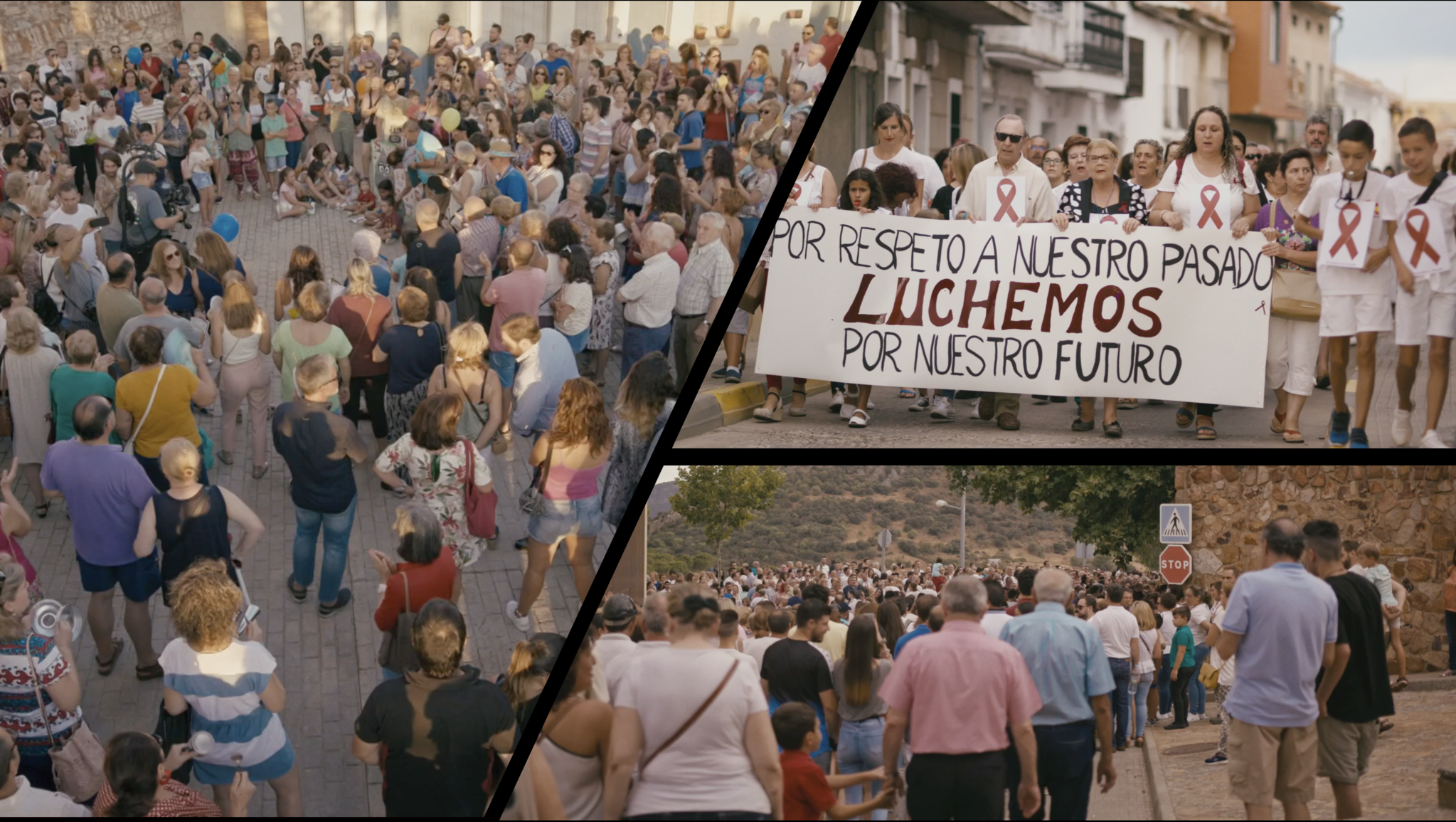
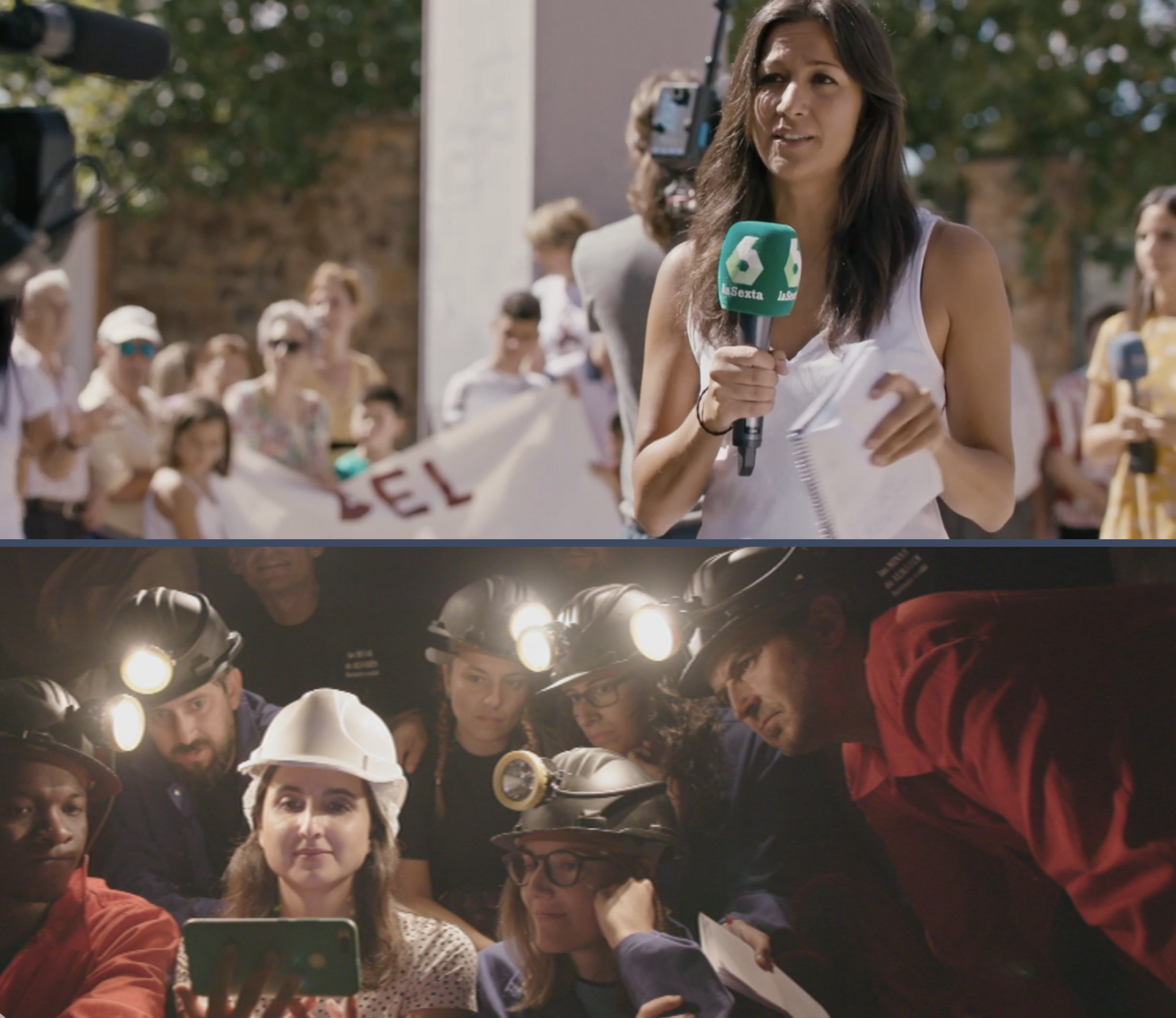
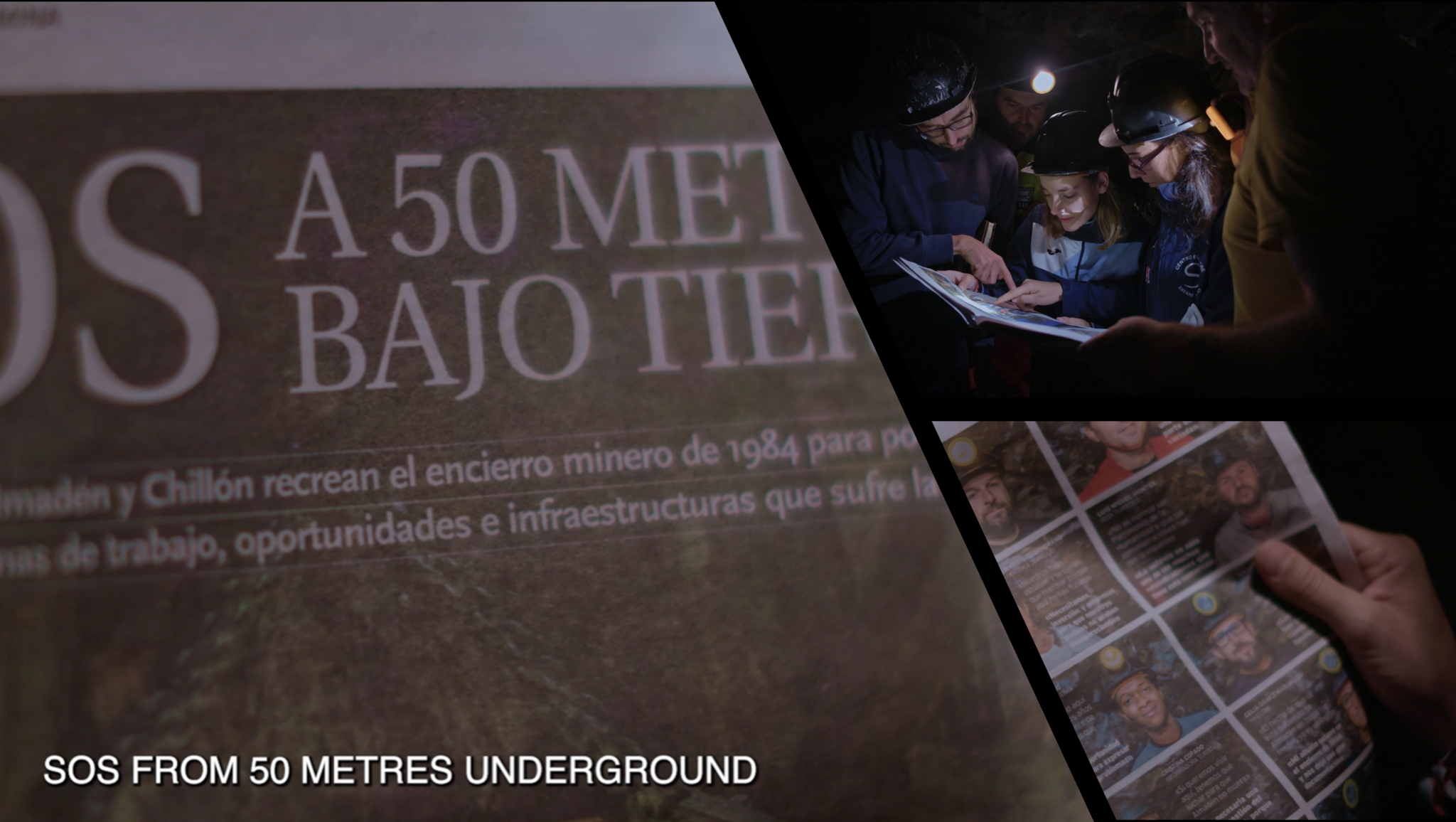
The participants increasingly identify and separate two parts in the project: the documentary film and the social intervention. They feel that presenting their lock-in as a documentary film diminishes the realness of the social movement they have now started in the area. They agree that the film is the initial force of the lock-in, but now this lock-in has been transformed into something else, a social movement. Whereas the documentary film project appropriated aspects of the mining past into the creation of the event, the participants now “appropriate” the documentary film to demand political commitment. Moreover, they start considering the possibility of staying in the mine over the agreed duration of 11 days if those agreements do not come. In this liminal state between homage to the past and present political action, tensions arise between the participants, the mine company management, and the creatives of the film, who could get into serious legal trouble if participants decide to stay beyond the originally agreed upon duration for which they have official permission. The conditional premise of what if we recreate a strike increasingly turns into we are striking, even though in post-industrial Almadén there is no more mining, no production to be shut down, and this would-be strike is not originating from labour, but from artistic action.
The resonances between the past (in which miners will not go out without political commitment) and the present (in which a similar situation starts taking place) is at its strongest at this point, and the 1979 poem “Miners in Struggle” brings this resonance of past and present to the fore. At this time, the project has taken on a life of its own. Documentation, and reenactment as representation, fall short of fully grasping what the film project has generated. We might be close to what Simon O’Sullivan means by the function of art over its power of signification or representation when he writes:
art, then, might be understood as the name for a function: a magical, an aesthetic, function of transformation. Art is less involved in making sense of the world and more involved in exploring the possibilities of being, of becoming, in the world. Less involved in knowledge and more involved in experience, in pushing forward the boundaries of what can be experienced (O’Sullivan 2001, 130)
Even if approached nostalgically, the past in 11 Underground ultimately allows for the creation of reality in the present. In 11 Underground, practices of remembering become modalities of re-membering, of re-articulating something, once again, from the remains of the past. The passionate engagement of the town during the 11 days of this film-driven intervention, and the way it fostered and ignited people's desires for a better future, transformed the past into a series of present affects, hopes, frustrations, and desires, re-imagined, re-activated and re-circulated through documentary film praxis. In other words, mimesis in 11 Underground becomes “inter(in)animation of one time with another time” (Schneider 2011, 30-31). Following Van Gennep, Stepheson argues “ritual is not mere re-enactment of beliefs, narratives, or values but enactment” (Stephenson 2015, 68).11 Underground demonstrates that this symbolic gesture of locking in for 11 days does not only contain, or represent, the political action of the past, but can indeed create it in the present. In this process, the underground as a location is fundamental. By locating ourselves in the underground mine, we are re-activating the forces that it contains and that have become inherent to the place itself. “The mine is everybody’s house,” says one of the participants. At least emotionally, there is a sense of shared ownership of the space. The mine is not only our house. It is us. Despite, or because of, everything that has happened in that underground place, it has become closer to a “sacred” place within the community.
Thus, whereas this film project actively put in motion a creative/social process in the area, the mine itself, and all the affects that it is still able to provoke, become a clear agent in the creation of the pro-filmic reality. Borrowing philosopher Marshall McLuhan’s understanding of media, we could argue that the mine is a medium as it “shapes and controls the scale and form of human association and action” (McLuhan 2013,10). That was particularly true in the mining community of Almadén, which organized their livelihood and social structure around the mine. And I argue that this was also true in this reenactment project, where the mine -as a potent presence and symbol in the area- was still able to create, foster and mediate a series of emotional, social, and political relations. Using the underground mine as a location -and the 11-day lock-in as an artistic device- re-activated collective memories and imagination, practices of care, performances of collectivity, social reflexivity and, above all, political action. Even though these aspects were catalysed within the framework of a reenactment film project, their re-emergence is closely related to the powerful affects and meanings that the mine still hold to this community.
To conclude, media theorist John Durham Peters argues that media “are vessels and environments, containers of possibility that anchor our existence and make what we are doing possible” (Peters 2015, 2). Resonating with this research’s attempt to re-activate the underground darkness as a generative living and political space, Peters argues that “a medium must not mean but be” (Peters 2015,14). Media, including documentary filmmaking, can “cease to be only studios and stations, messages and channels, and become infrastructures and forms of life” (Peters 2015,14). Promoting collectivity, proposing alternatives to social and political formations, offering historical revisions, dealing with personal and collective traumas, or experimenting - not with what “it is”- but with what “it could be”, projects such as 11 Underground consider documentary fieldwork and shooting as liminal practices, as infrastructures for life, which move beyond representation and have the possibility of becoming embodied practices of conviviality, as well as of socio-cultural and political resistance.
Jasen, Sylvie, “‘Reenactment As Event in Contemporary Cinema’”, 2011
Lütticken (ed), Sven, Life, Once More: Forms of Reenactment in Contemporary Art. (Rotterdam: Witte de With, Center for Contemporary Art, 2005)