Overview
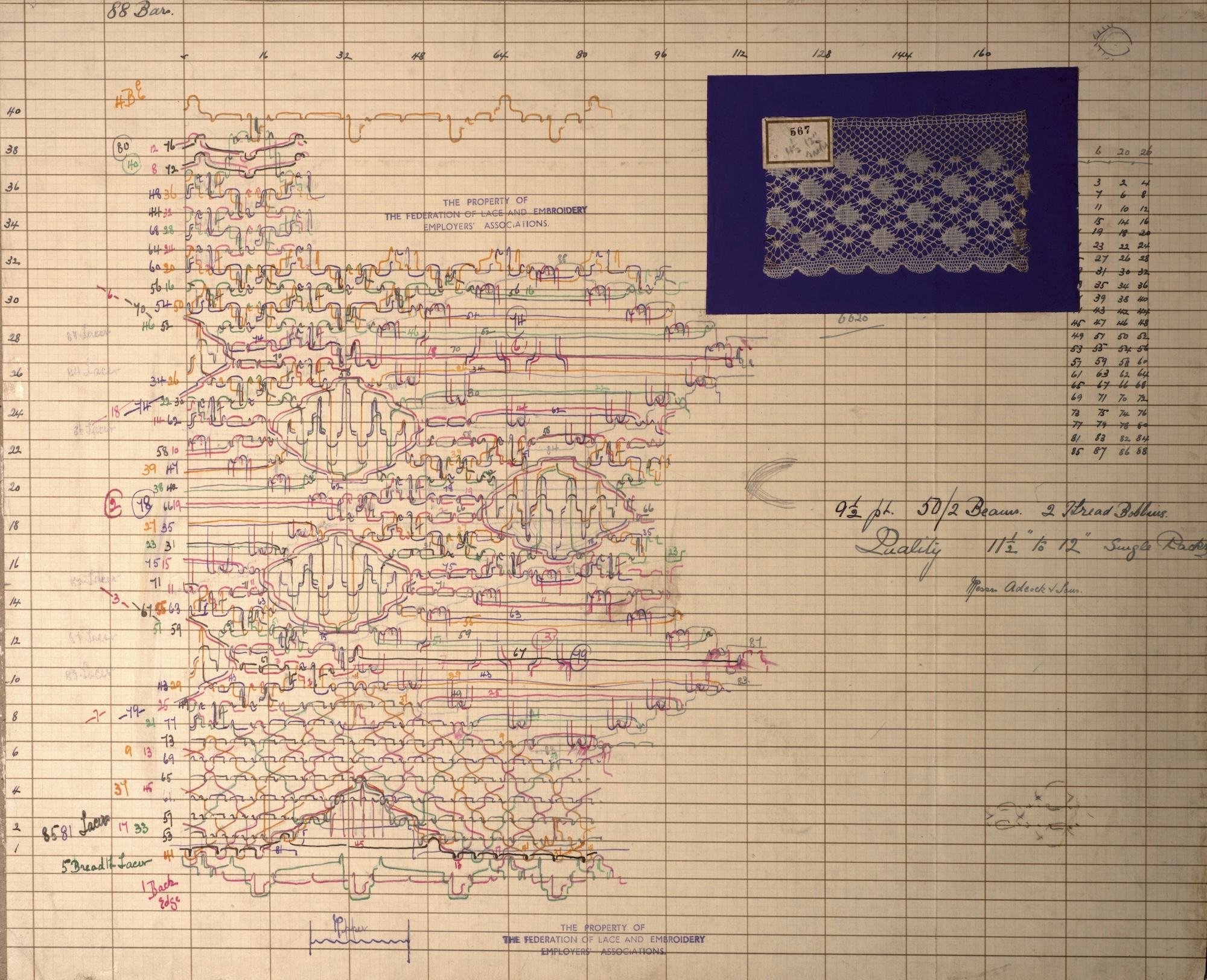
Score: Mechanical Asynchronicity was a collaborative project between visual artist Danica Maier and composer Martin Scheuregger. The project takes a single historical lace draft from the Nottingham Lace Archive as the starting point for new live and installation-based visual-musical works. This lace draft would have originally been used to programme a mechanical lace machine – it is, in essence, a set of graphical instructions. For this project, it has been repurposed to create instructions – in graphic and traditional notation – for a group of musicians. Overall, the work explores an iterative re-encoding process, embracing imperfection and glitch as an intrinsic part of its aesthetic. Key ideas of transcribing, encoding and re-encoding are explored through our compositional and graphical interventions, and through the musical interpretation of the results.
This research exposition comprises contextual information for the multi-component research output that resulted from this project. The components of the research package are listed below. Where artefacts are physical publications, open-access digital versions are linked. Authors are listed alphabetically.
- Journal article: Maier, D., and Scheuregger, M. (2023) “Score: Mechanical Asynchronicity.” ECHO, a journal of music, thought and technology 4. doi: 10.47041/NRKT8828
- Musical score: Scheuregger, M. (2024) Mechanical Asynchronicity II [four instruments and four record players] – musical scores View online
- Musical score: Scheuregger, M. (2024) Mechanical Asynchronicity III [harpsichord and recorded part] – musical score View online
- Recording: Maier, D., and Scheuregger, M. (2023). Score: Mechanical Asynchronicity – audio album. Society for Artistic Research. doi: 10.22501/rc.2375737
In addition to this exposition, there is also a second item of contextual material which is crucial to understanding the detail and context of the work:
- Book: Cascella, D., Maier, D., Redhead, L., Scheuregger, M. (2024) Score: Mechanical Asynchronicity. Nottingham: Beam Editions. Read online
Research questions and process
Score: Mechanical Asynchronicity was a collaborative artistic research project between Martin Scheuregger and Danica Maier. The project asked two interlinked research questions:
RQ1: How can fine art and composition practices be combined to generate sonic-visual works that iteratively re-encode a single visual source into sound?
RQ2: How can such works reflect themes of iteration, re-encoding and repetition in their manner and style of presentation?
Phase 1: testing and proof-of-concept
In the first phase of the project (August 2017 – May 2018), we worked together to create a ‘proof-of-concept’ as we tested ideas and refined the issues and questions we were exploring. Using public-facing exhibitions and perofrmances, we were able to test and iterate, and reflect on how to take the project forward.
2017.08–2018.01
Composing and creating Score (Maier) and Mechanical Asynchronicity (Scheuregger)
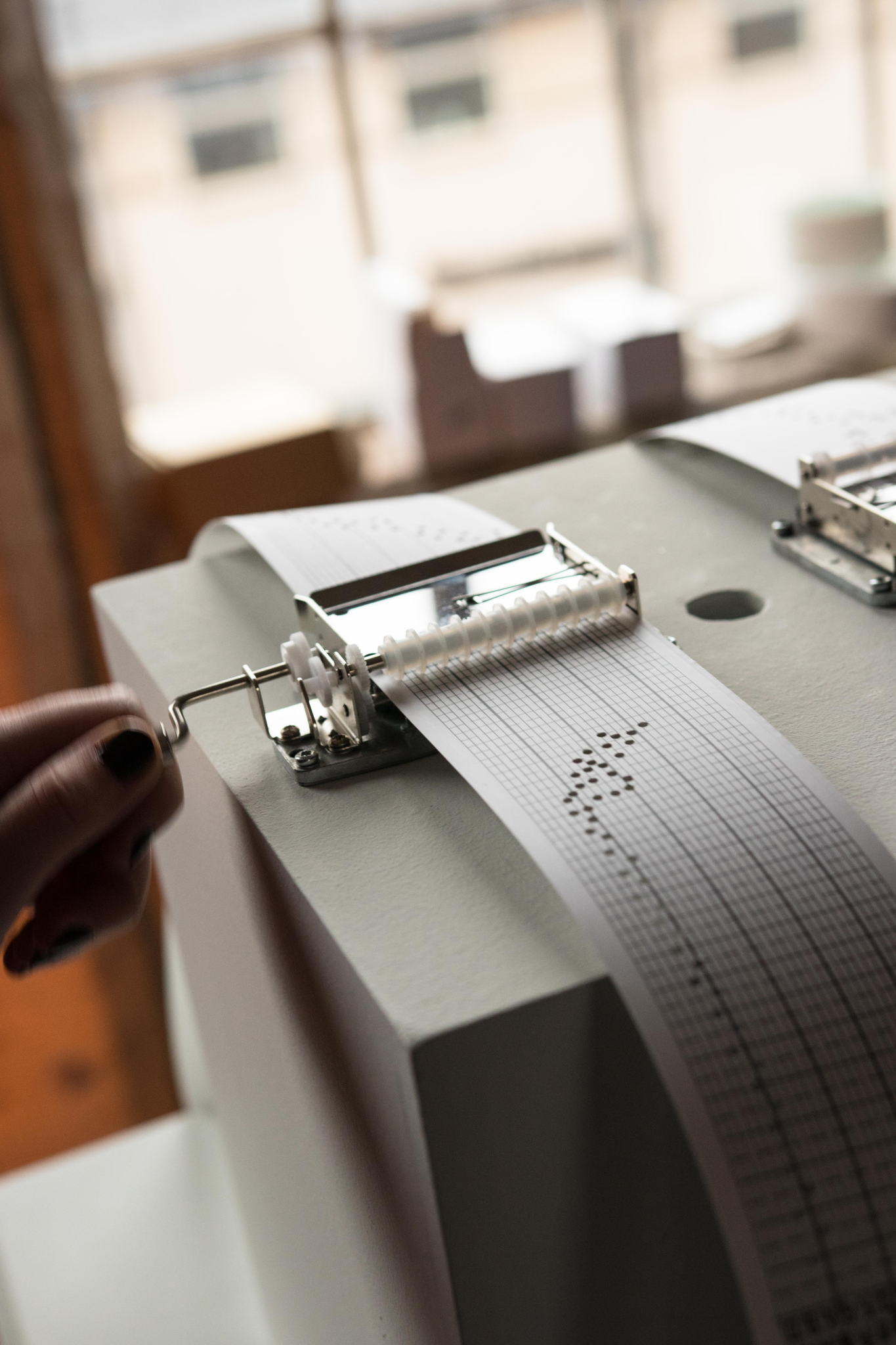
In this first stage, we worked together to scope the project, identifying the questions and methods and agreeing aims for an initial proof-of-concept work. We worked with and discussed material from the Nottingham Lace Archive, deciding on the image to use as a starting point. We worked on individual pieces: I created Mechanical Asynchronicity, in which multiple marimbas are recorded and overlaid asynchronously, and Maier made Score in which the lines of the lace draft are re-encoded on a mechanical music box punch card and played through one of two music boxes (one diatonic, one chromatic). This process is discussed in detail in the book (particularly Scheuregger, ‘Sound Making’, p. 7–9).
2018.01.26
Performance and workshop of Score and Mechanical Asynchronicity I
Part of Bummock: The Lace Archive Symposium, Backlit Gallery, Nottingham
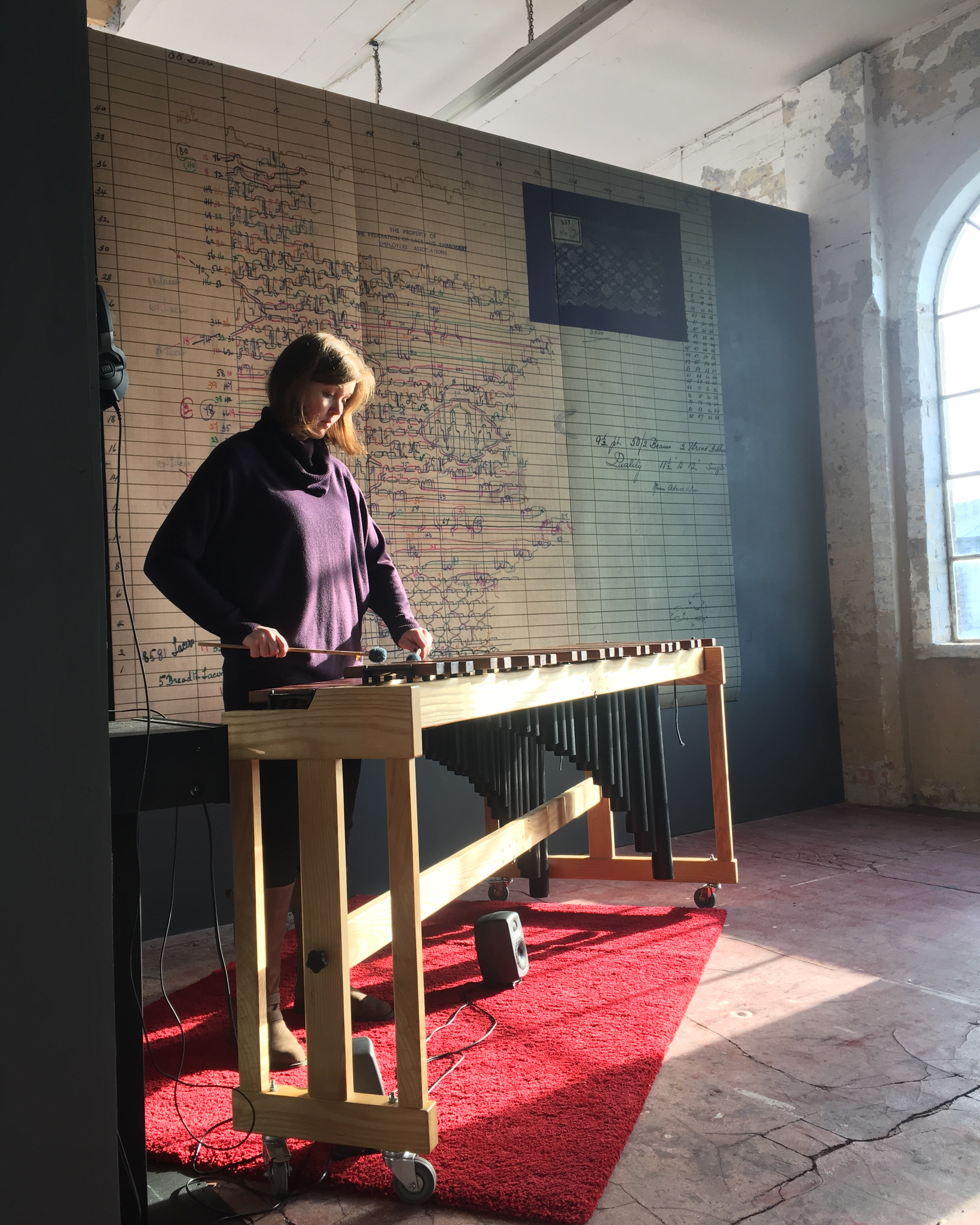
The two works were performed live multiple times across a day. They were presented in a room containing the installation version of the work (next item). With performances across the day, this event helped us explore an exhibition-performance hybrid approach. The juxtaposition of live performance and fixed audio-visual elements helped the audience engage with the project as something that intentionally crossed the two ways of working (composition and fine art practice). Both RQ1 and RQ2 were framed through this work and initial answers establshied that would warrant deeper exploration.
2018.01.27–2018.02.18
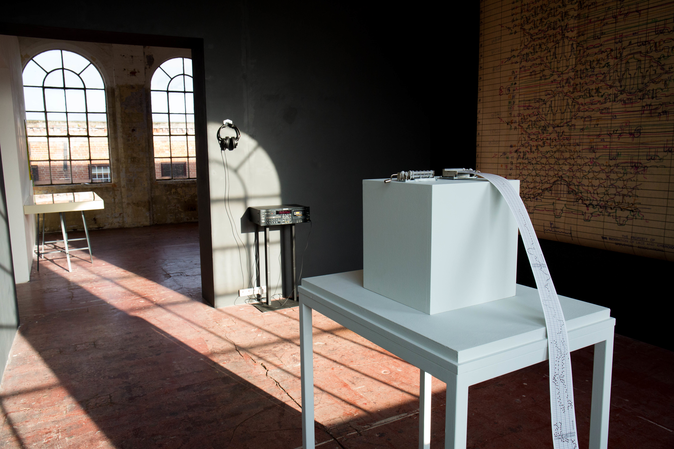
Installation of Score and Mechanical Asynchronicity I
Part of Bummock: The Lace Archive, Backlit Gallery, Nottingham
Mechanical Asynchronicity I was installed as a single, repeating audio file (c. 20 minutes), played through headphones and a prominently visible CD player to emphasise that this was recorded and reproduced sound: the use of the medium of reproducing sound was an important part of this which we took forward with vinyl in the full version of the project later on. Score was presented as a sculptural work with a single performance each day in which an invigilator would run the entire punch card through the music box (c. 20 minutes). The room contained a large reproduction of the lace draft upon which the work was based to make the connections clear: this element worked well, especially alongside the audio elements and was something we retained for future versions, although we moved to a projected image. The manner in which elements of the installation spoke to the work's themes through the juxtaposition of different re-encodings of the lace draft helped address RQ2 in a manner that was served particularly well by the non-temporal nature of the gallery format.
2018.05.31
Performance of Score at Film, Free and Easy
Primary Project Space, Nottingham
Maier performed a solo version of Score with just the music box and punch card, with a film accompaniment in which a detail of the original lace draft is shown in extreme close-up before very slowly zooming out to reveal the whole image. The presentation helped provide a distinct variation on the performance and installation environments used so far, and to explore the work in its most stripped-back form without context. It made it evident that the punch card had the advantage of visually embodying the transcription process especially when juxtaposed with imagery of the lace draft (RQ2). The visual importance of the punch card was later taken forward in the physical format of the score of Mechanical Asynchronicity II. Lauren Redhead's text in the project's book explores the materiality of the work and gives greater context to what was explored here (see Redhead, ‘Score: Mechanical Asynchronicity: notation, materiality, temporality', p. 13–15).
2018.07.06
Performance at Summer Lodge [artist residency]
Nottingham Trent University, Nottingham
A solo version of Score as above but without film: this represented a version of the work where the 'raw data' is heard with the least mediation (RQ1), as the audio resulting from the punched version of the original draft is heard alone (it is only two steps removed from the original – the closest we come to the original apart from when showing an image of it in performance/installation).
2018.10.10
Performance at Urban Soundings
POPOUT Festival, Lincoln Central Carpark, Lincoln
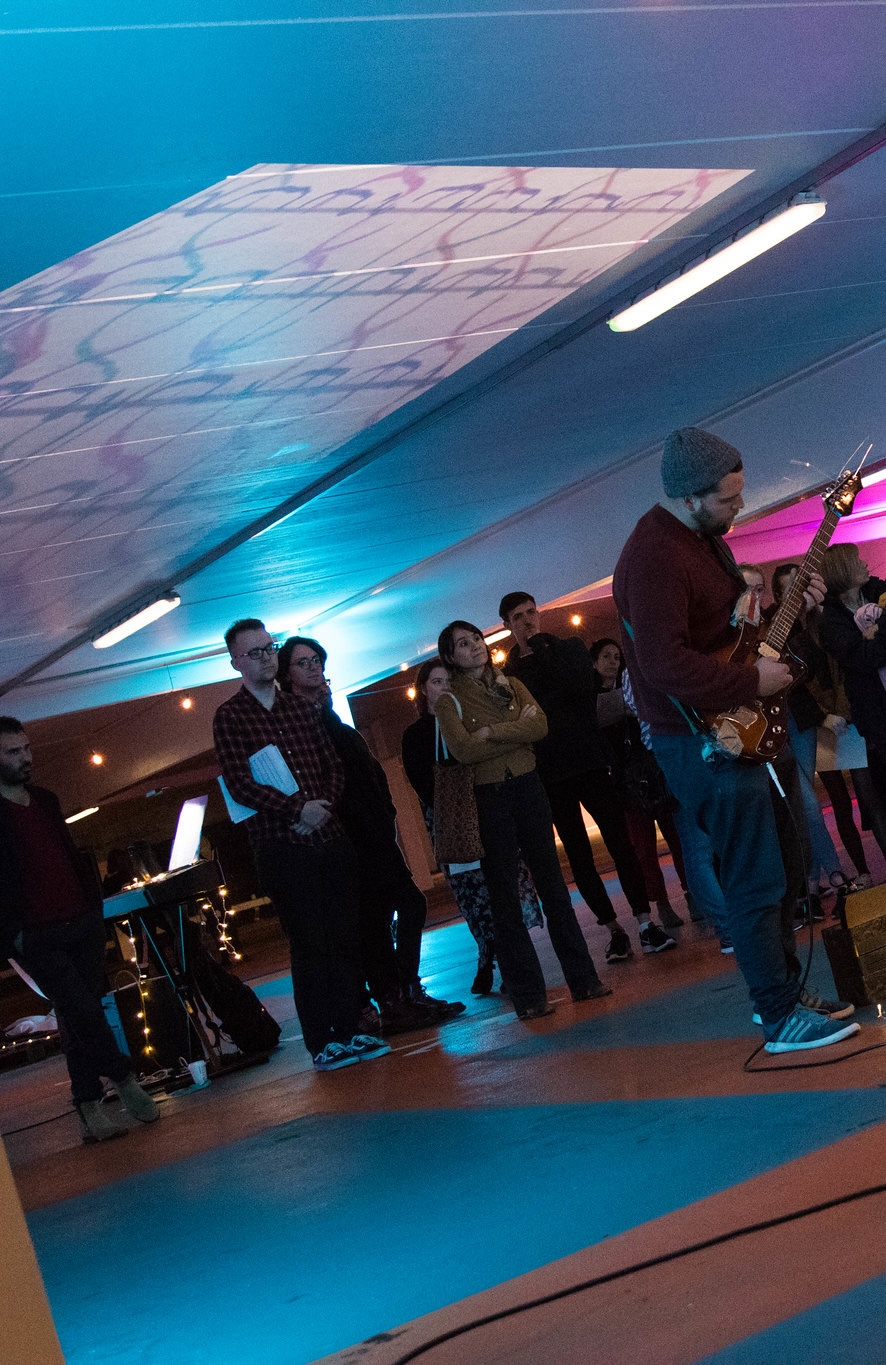
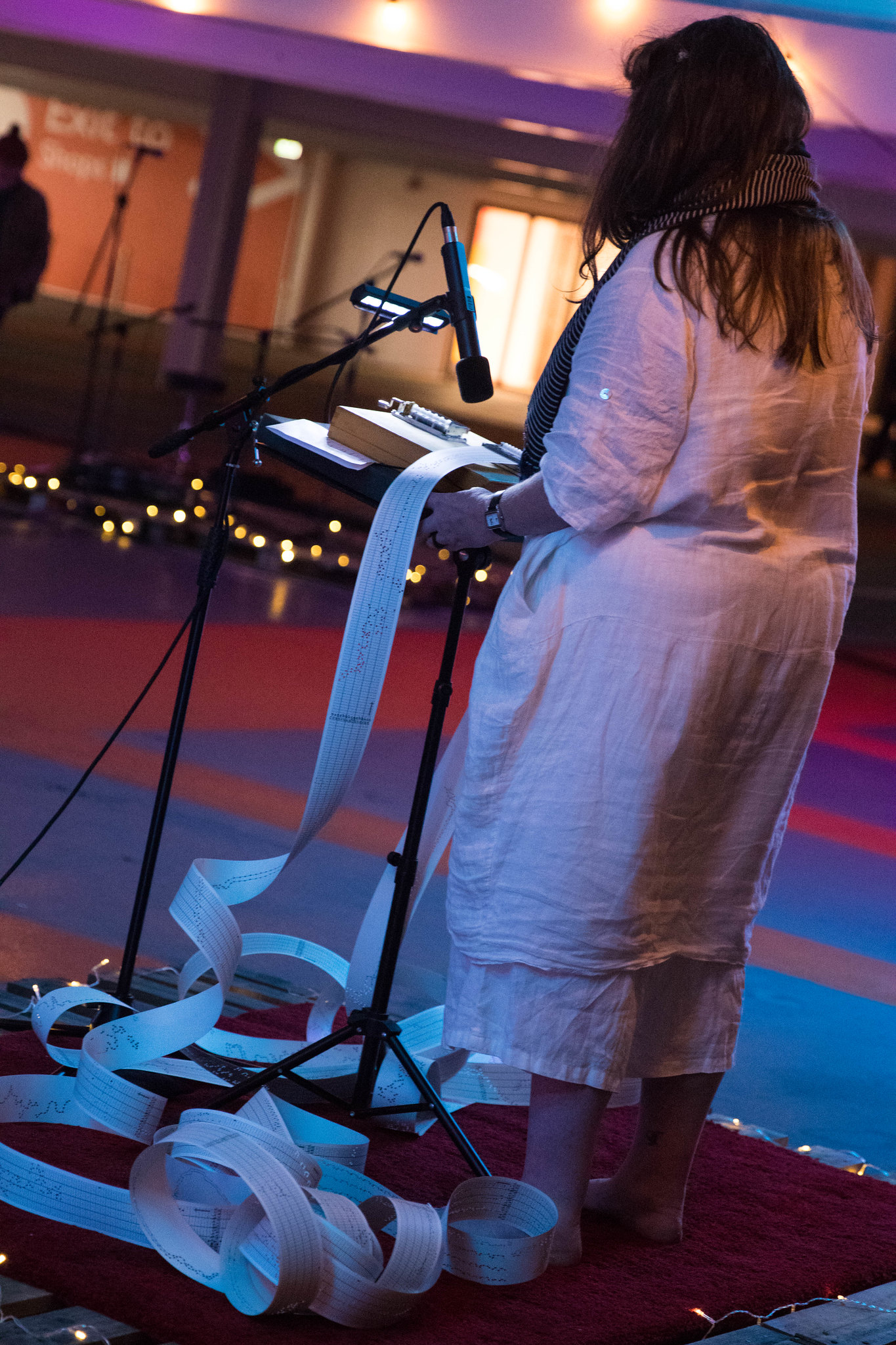
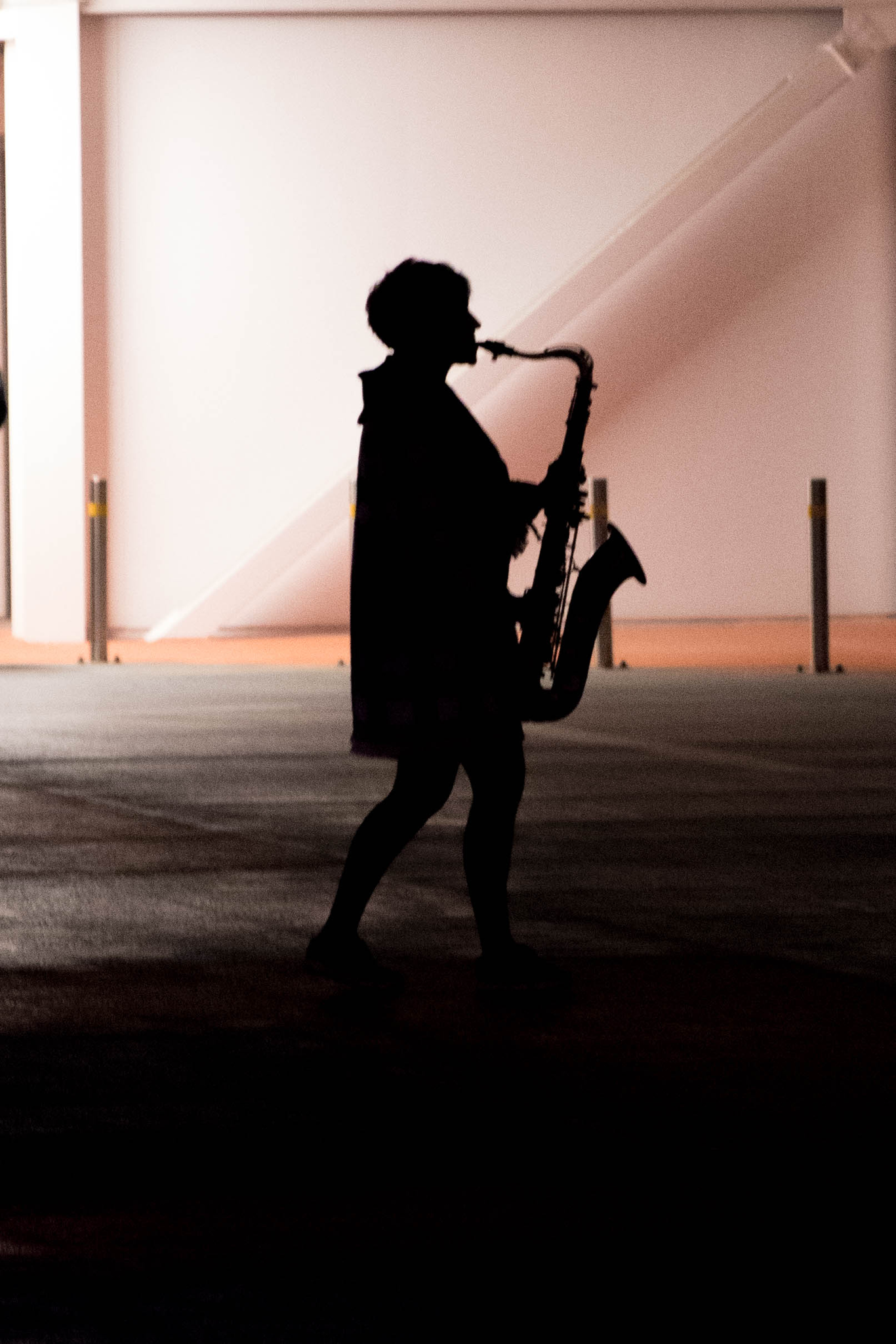
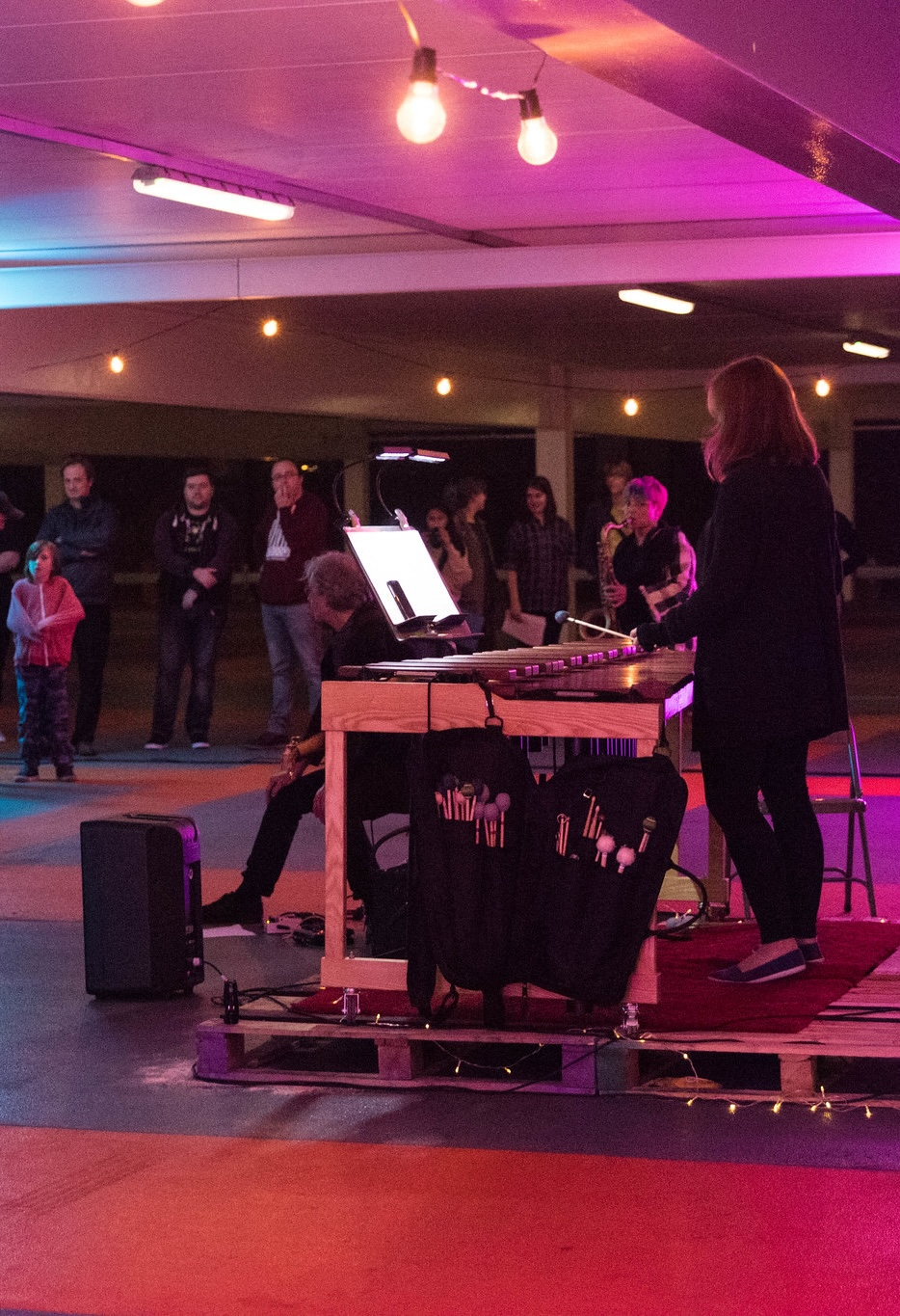
This event was curated by Scheuregger and brought together a range of visual and musical projects in a takeover of a floor of a multistorey car park. Following on from the above performance, the focus was the music box being played live, with the image of the lace draft projected on the ceiling. Two musicians improvised with the music box throughout the performance as we explored ways in which the musical translation of the original line could form a layer upon which new (improvised) material was added. This provided an improvisation-focused response to RQ1, which we took forward in the next composition and creation stage, with both Maier and Scheuregger's contributions engaging with types of improvisation.
Phase 2: iteration and experimentation
In the main period of the project (May 2018 – May 2021) we used funding from Arts Council England (£13,835) to develop the project for four musicians and four record players, as well as a further version for harpsichord and recorded sound. Performances, exhibitions and presentations acted as places for experimenting with our material and creating new iterations of it. Reflection and adaptation across the time helped us address our research questions from a range of practice-led perspectives.
2018.05–2018.12
Composing and creating Score: Mechanical Asynchronicity
During this period of creation, we reflected on work to date, putting the ideas from our two contributions together to create a flexible work which retained the duality of the two disciplines whilst integrating them further. Scheuregger took an audio recording from Score (played through a diatonic music box) and moved through a series of transcriptions and editing to create a new score; Maier returned to the original lace draft, selecting and transcribing lines to create four graphic scores. Once again, the detail of this process is discussed in the book (particularly Scheuregger, ‘Sound Making’, p. 7–9 for the process, and Redhead, ‘Score: Mechanical Asynchronicity: notation, materiality, temporality', p. 13–15 for a contextual reading of the work). This was the most sustained period of creation during which we addressed RQ1, with the results evident in the finished scores. (At this stage we conceived of the project as a singular whole (hence adding the names of the two works so far together to get Score: Mechanical Asynchronicity) and would come to refer to each of our separate elements of the work as Side A (Maier) and Side B (Scheuregger), with my work also continuing with the numbered series, and alone being called Mechanical Asynchronicity II.)
2018.12.09–2019.01.18
Recording and producing audio for Score: Mechanical Asynchronicity vinyl
We worked in the studio for a day, taking four musicians one at a time to record their parts separately for the two scores. They did not hear each other’s takes, allowing us to create asynchronicity stylistically as well as temporally. From here, we edited the recordings and had them cut onto four vinyl ‘dub plates’, one per instrument, to be used in subsequent installations and performances.
2019.01.24–2019.02.16
Workshop and performance of Score: Mechanical Asynchronicity, Dark Inventions (ensemble)
Ruskin Gallery, Cambridge
In the first outing for Score: Mechanical Asynchronicity in this full form, we hosted a day’s open workshop and evening performance working with four musicians and the four record players. The work was presented in an exhibition with the two scores as visual objects, and a mix of the vinyl audio heard through two headphone installations. The workshop demonstrated the importance of the musicians having time to work together to navigate the scores collectively despite their ‘asynchronous’ nature, and was the first time they had heard each other’s renditions of the two scores. In rehearsing the work we further addressed RQ1, deciding how to combine the eight different elements (four live musicians and four records), and made presentational considerations that we would develop further in subsequent performances to more deeply address RQ2.
2019.01.24–2019.02.16
Installation of Score: Mechanical Asynchronicity
Ruskin Gallery, Cambridge
The work was presented in the exhibition with the two scores as visual objects, and a mix of the vinyl audio heard through two headphone installations. This was the only version of the work where the scores were prominently displayed in their original forms and, as we found in the Backlit Gallery installation discussed above, the non-timebound nature of the format allowed for closer connections to be formed between the looping audio and the visuals. However, the original lace draft was not displayed, as we wanted to experiment with a presentation of the work in which only our interpretations were on display (RQ2).
2019.02.09
Presentation at Notation for Improvisers conference: 'From lace pattern to notation and back again: integrating visual arts approaches in notation for guided improvisation'
Institute of Musical Research, Senate House, London
Conference presentation by Scheuregger in which the work to-date was explored alongside plans for the next stages. Abstract as follows:
Visual artist Danica Maier and composer Martin Scheuregger have been collaborating on an ACE-funded project which takes lace patterns from the Nottingham Lace Archive as the starting point for new live and installation-based visual-musical works. This paper explores the notational strategies used in some of the work created as part of the project.
Ideas of transcribing, encoding and re-encoding are explored through work which has seen the original ‘data’ of the lace patterns first transcribed ‘naively’ into lines, then inscribed as punch cards to be used with programmable music boxes; the musical results have furthermore been transcribed into traditional notation before further graphic renditions are created. This iterative, re-encoding process has resulted in a variety of pieces, each with differing levels of improvisation yet all stemming from the same source. For these, notational and graphic elements have been used to generate notation which guides the players towards a range of potential musical ‘solutions’ that strive – in a variety of ways – to imitate the original source(s).
This paper illustrates the variety of approaches taken, focussing on issues of transcription, accuracy and intention. Furthermore, the particular role of the physical score as ‘text’ will be explored, as will issues relating to the collaborative process and the intersection of fine art and musical disciplinary norms. Context is given through reference to musical composition where the relationship between processes of notation and the act of composition are complex, in particular in the of composition/inscription process used in the composition of player piano works by Conlon Nancarrow. The resulting picture is one of a dialogue between art forms (visual arts and composition), and between composition, notation-driven performance and improvisation.
2019.01–2019.02
Creating Mechanical Asynchronicity III
Scheuregger worked with the audio recording of the music box to create another iteration of the work, Mechanical Asynchronicity III for live harpsichord and audio file, written for Jane Chapmen. The process of creation involved choosing different moments in the audio and editing them together to create the ‘accompaniment’ for the live player: as in Mechanical Asynchronicity II, the choice of these fragments was entirely down to musical decisions. In this case I chose segments that sounded particularly ‘composed’ (through, for example, suggestions of cadence, repetition, equal phrasing, and so forth). I put these fragments together to create a structure that moves between more tonal moments and periods of many repeated notes and greater chromaticism. The harpsichord part is then composed ‘around’ this audio part, with sections where the performer has a notated version of the music box part and must attempt to play in rhythmic unison: through this process, we explore a different type of asynchronicity and create a work where the underlying process of re-encoding and iteration is apparent ‘live’ in the performance of the work where one iteration is directly overlaid with another (RQ1).
2019.03.14
Performance of Mechanical Asynchronicity III
Jane Chapman (harpsichord), Lincoln Performing Arts Centre, Lincoln
This was the first performance of Mechanical Asynchronicity III as part of a programme of new and old works for harpsichord, performed by Jane Chapman. In this performance, we did not include any projection of the original lace draft in an attempt to address RQ2 through audio-only means: we hoped listeners would draw connections between the live and pre-recorded elements of the performance and 'hear' the imation in the score as re-encoding.
2019.07.26
Presentation and workshop at Music and/as Process: Living Collaborative Processes (conference)
Institute of Contemporary Music Performance, London
In this conference workshop-presentation-performance Score: Mechanical Asynchronicity was performed by players (without the record players) who had never encountered the work before. This was the first time we had presented the work to players ‘from cold’ and from this we learnt that – as we were understanding more and more by this point – the process of performers encountering the scores and working together was itself a stage of iteration or re-encoding and indeed part of the compositional process to some extent (RQ1) as discussed in the project's book (Scheuregger, ‘Sound Making’, p. 7–9 in particular).
2019.09.28
Workshop and performance of Score: Mechanical Asynchronicity, Dark Inventions (ensemble) as part of Still Undead, the Nottingham chapter of the Bauhaus Imaginista international project
Nottingham Contemporary, Nottingham
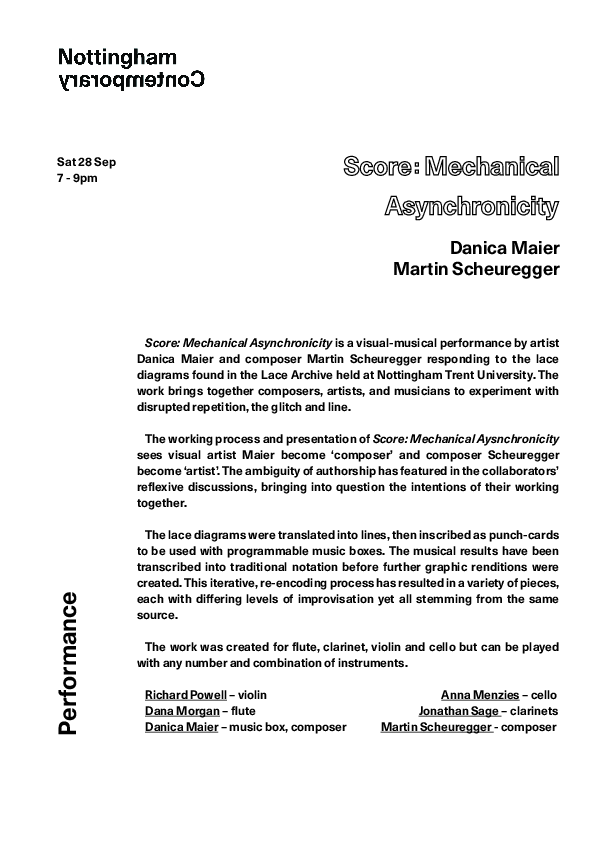
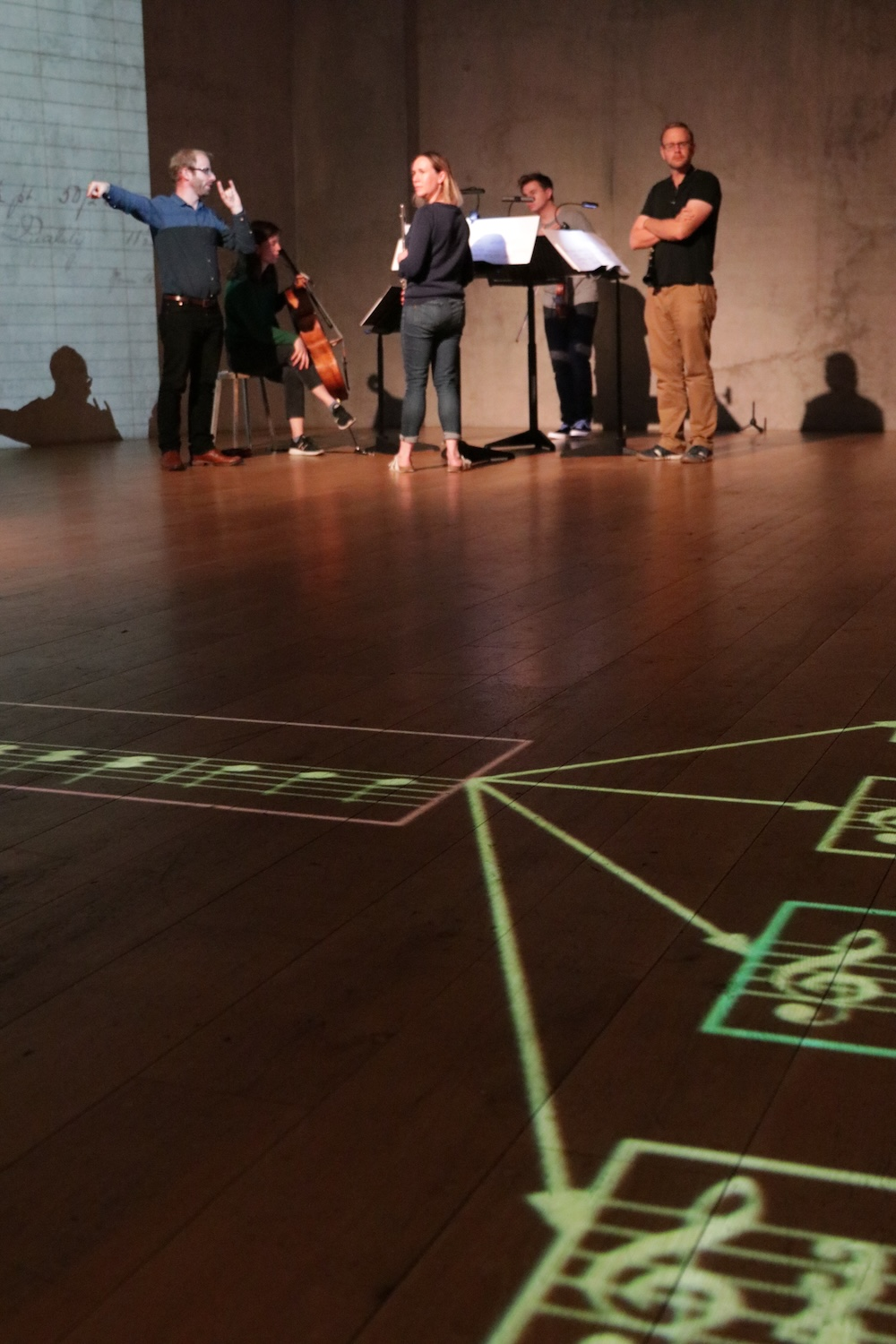
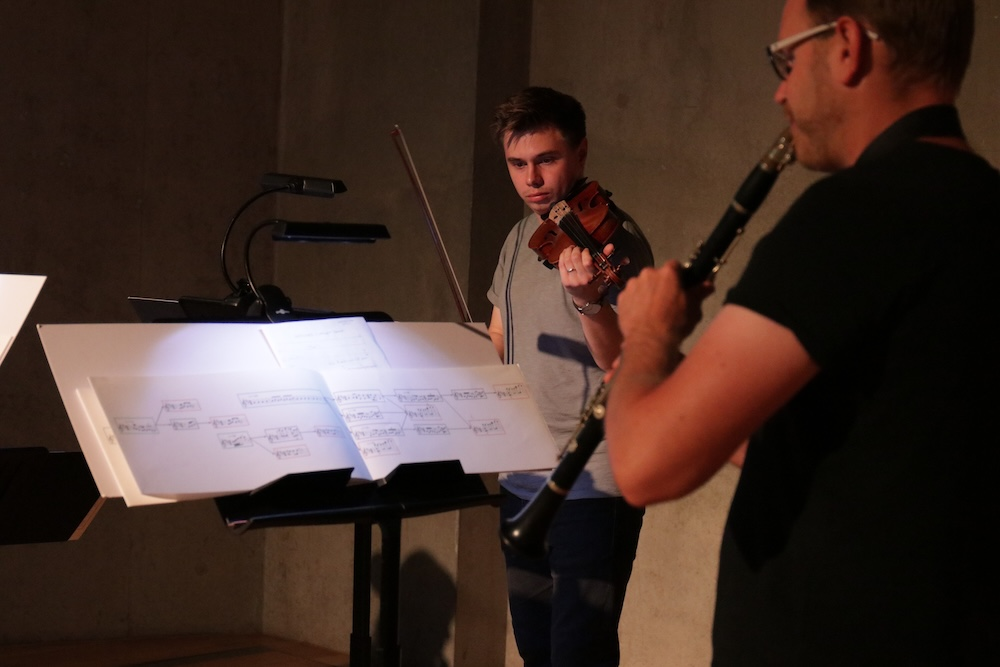
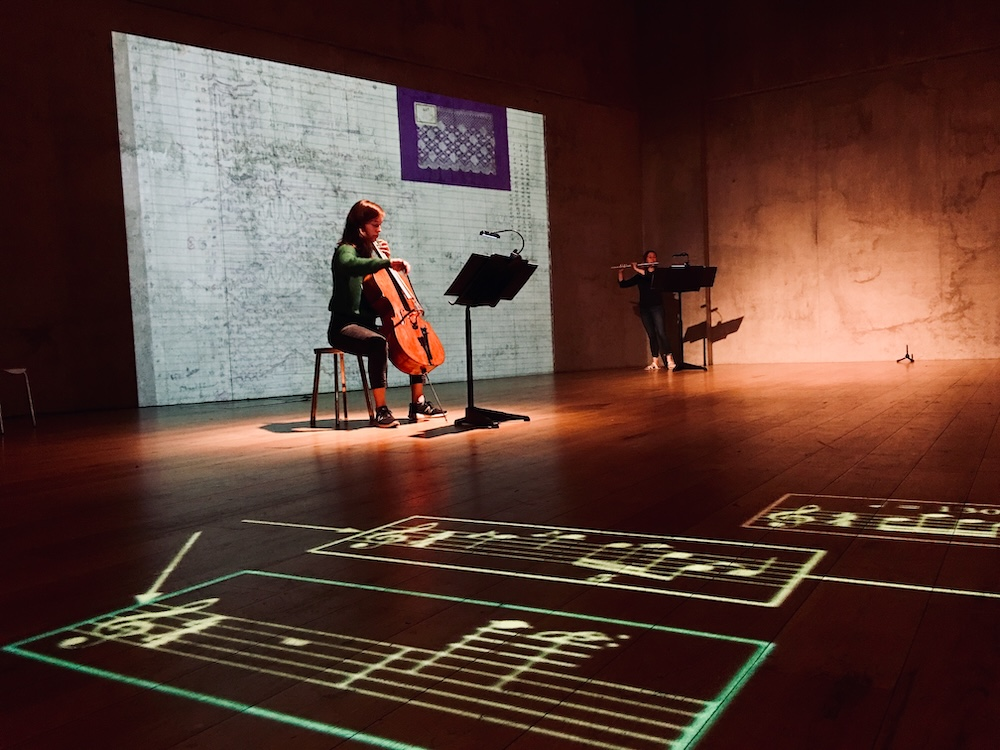
This was our first major performance of the whole work, with multiple iterations of both works forming the performance. The live event took place as part of programming for Still Undead; the Nottingham chapter of the Bauhaus Imaginista international project. A two-hour evening concert was preceded by a daylong public rehearsal during which we worked collaboratively with the musicians to develop the performance which was made up of four live performers, four record players, and two projected videos. In the performance, different combinations of instruments and record players were used, as detailed in the programme below. This event demonstrated the manner in which the work is able to create a performance environment which aspects of gallery presentation and concert performance are combined (RQ1); furthermore, the use of a projection of the music box punch card ‘dots’ (which follow the lines of Maier’s composition) and of the notated score of Scheuregger’s work gave further depth to the sense of iteration, giving greater possibilities for audience members to draw connections between the different elements of the work (addressing RQ2). This event built substantially on the work achieved at the Ruskin Gallery performance and installation, and was the most successful combination of fine art and compositional practices achieved so far (RQ1) and provided a format that would ultimately be refined in the work's summative performance (explored below).
2019.10.04
Installation of Score: Mechanical Asynchronicity as part of the Approaching Affective Zero series
Mansions of the Future, Lincoln
This small-scale installation was our first opportunity to present the work entirely as four vinyl records. With no live musicians, the fully autonomous and hermetic version of the work recorded in December 2018 was heard alone and in various combinations. With no live musicians or visuals of the lace or scores, the work was much more enigmatic. Nevertheless, in speaking to attendees it was clear that the idea of asynchronous ‘versions’ of repeated material came across even in this stripped-back format (RQ2). By highlighting the record players, the mechanical nature of these (and their slightly different playback speeds and therefore variations in pitch) added a further dimension to the idea of non-repetition and iteration.
2019.11.12
Performance of Score: Mechanical Asynchronicity, Jonathan Sage (clarinet)
Constance Howard Gallery, London
This was our first ‘duo’ version of the work, as it was presented with one record player (clarinet) and a live clarinet player. We built on experiments from the Nottingham Contemporary event, and introduced variations through playing the record at a lower speed (resulting in a lower pitch and tempo), and having the clarinettist play from a non-transposed part and playing on a basset clarinet (in A) (essentially creating a sounding result in different keys depending on the combination of instrument key and the key of the part (in C or Bb)). This highlighted the variety that can be achieved by changing the mechanism through which an iteration is generated (helping to address RQ2), and echoed the earlier experimentation of using the same punch card through two different music boxes: the same ‘data’ goes in, but it is re-encoded in a different way.
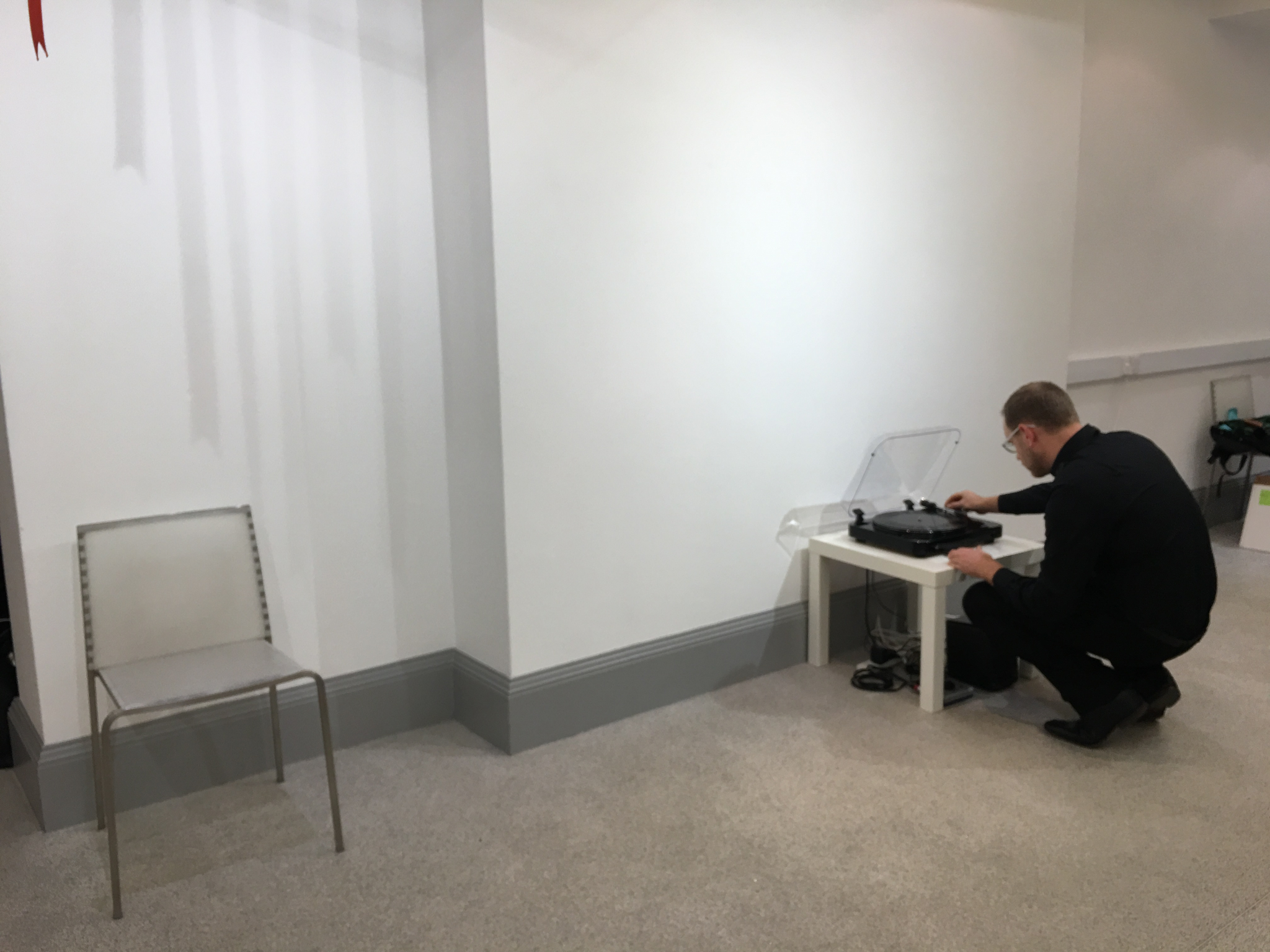
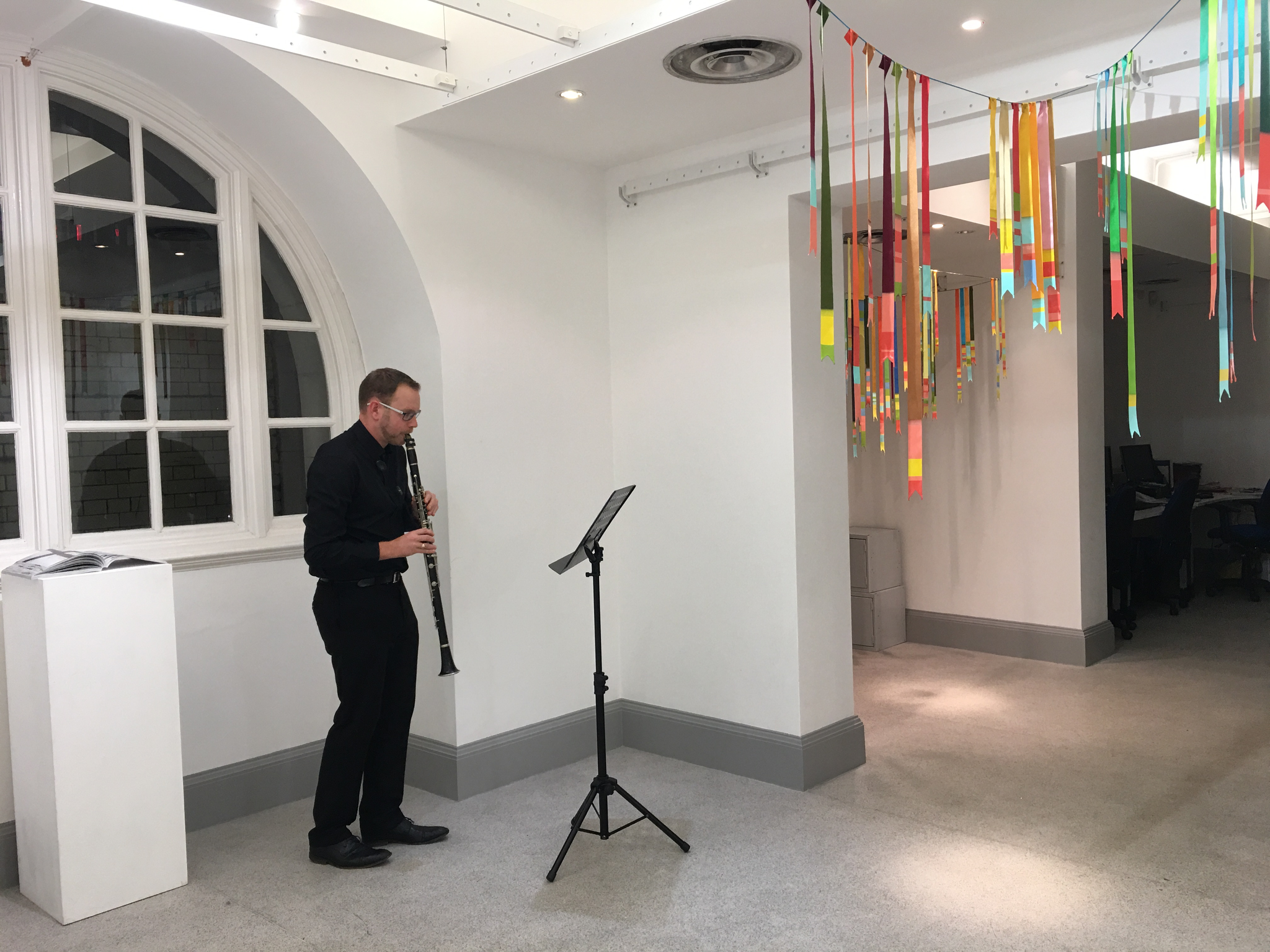
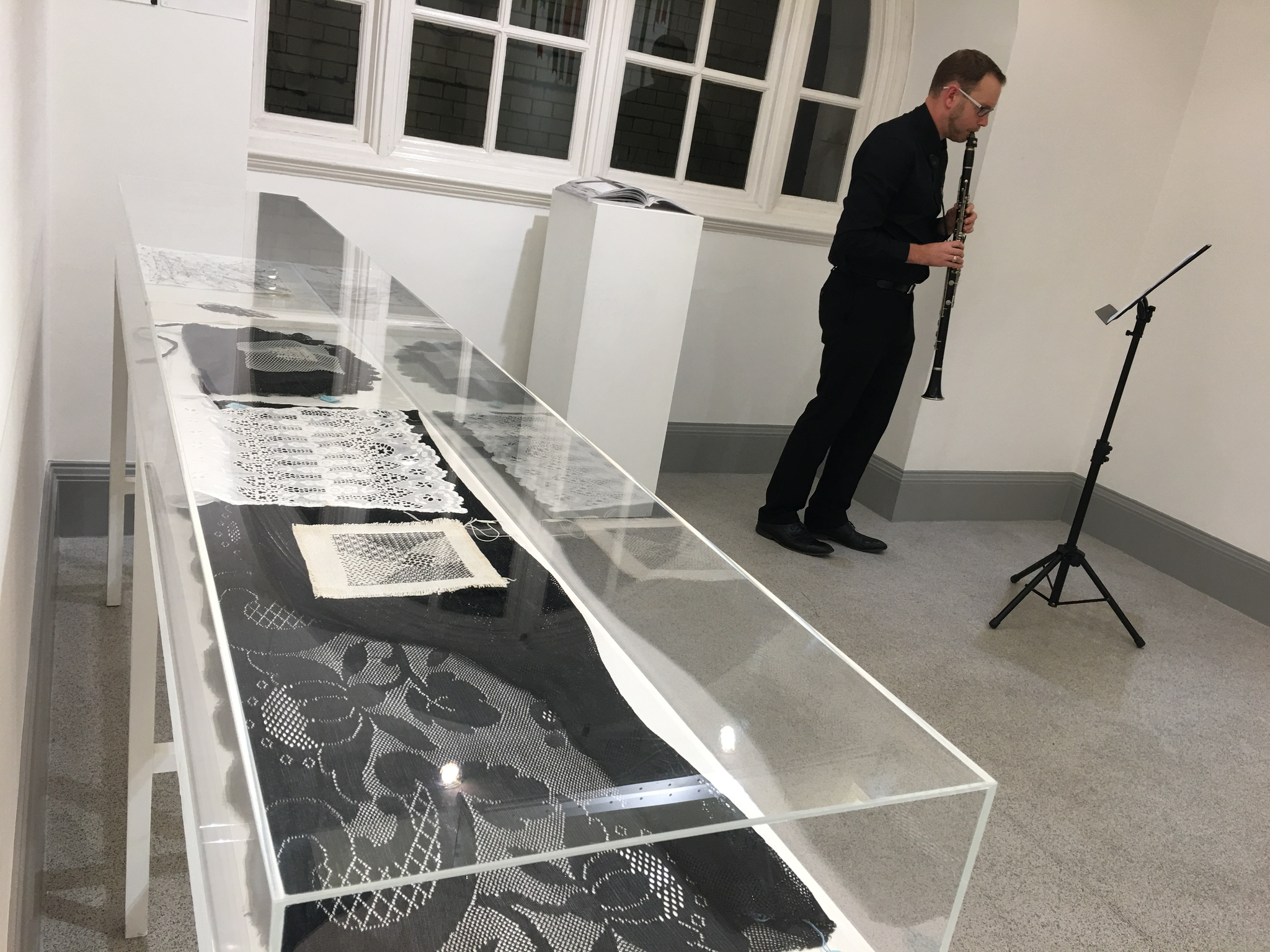
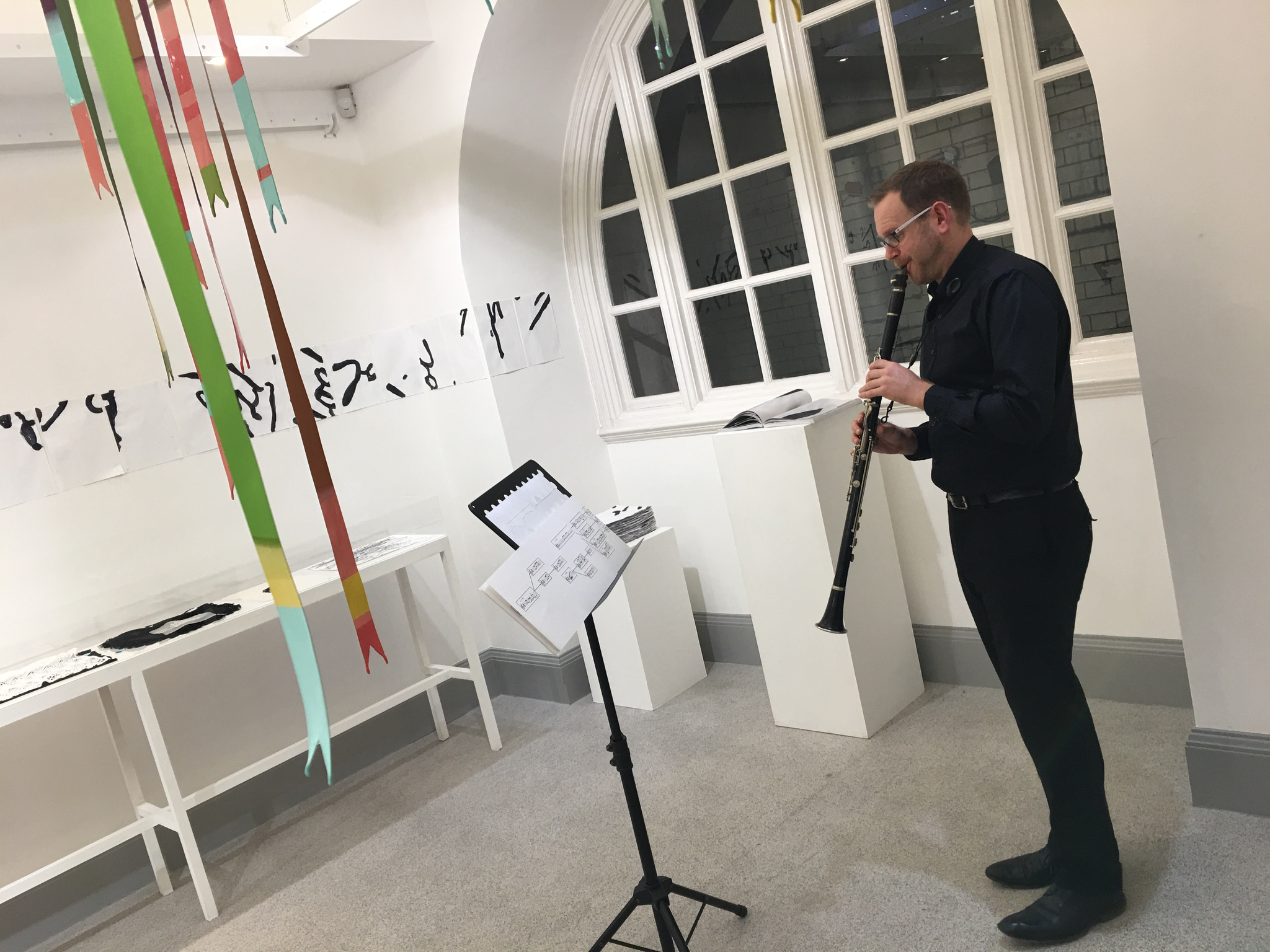
2019.11.12–2020.01.16
Installation of Score: Mechanical Asynchronicity
Constance Howard Gallery, London
The work was installed as a single record player which would be played alone at various times when the exhibition was open. This expanded on the Mansions of the Future performance but with even further reduced means and demonstrated that the work could stand alone as almost pure audio. The connections to ideas of iteration and re-encoding were least apparent in this format, but the work’s context with other visual work that responded to similar source material created a new connection. It demonstrated, however, that to fully achieve an answer to RQ1 and RQ2 more than only track of audio alone was needed.
2020.01.17
Presentation and performance of Score: Mechanical Asynchronicity [music box and marimba], by the artists
University of Lincoln, Lincoln
A small-scale presentation and performance of the work in its earlier experimental version for music box and improvising musician (first explored in the Urban Soundings event listed above). It was clear how much the intervening performances impacted the style of improvisation (Scheuregger playing the marimba part this time), as there was far greater imitation as in the full, notated version of the work.
2021.01–2021.05
Creation and sharing of lockdown performance of Score: Mechanical Asynchronicity, Dark Inventions (ensemble)
Our final period of creative work on the project was to reimagine a performance of the work in an online format. This began as a practical necessity due to the limitations of Covid lockdowns (and the need to rethink the use of our Arts Council funding in a reasonable timeframe); however, as we explored options, the natural lack of synchronicity that comes with various types of technology-mediated performance (performing together online, for example, where it can be impossible to stay in time due to delays between audiovisual feeds) chimed with the project’s fundamental themes. We did not pursue a live online performance, but instead asked our musicians to film their own parts individually (using audio from the vinyl records played through headphones) and then created a video concert by combining these new films with each other and with the original vinyl recordings. We also edited a ‘cut up’ version of Mechanical Asynchronicity (Scheuregger) in which the parts of the score are put in reverse order (the final iteration in the video). The results of creating this ‘digital concert’ were fascinating, as we found many points of synchronisation in the performances, and more generally there was a sense that the musicians were still ‘playing together’. This outcome is explored further in the book (particularly Scheuregger, ‘Sound Making’, p. 7–9). The final digital concert was released in November 2022 and featured in the publication of our article in Echo (listed above) in February 2023.
Phase 3: sharing research insights and final work
With the experimentation and iteration phase complete, we moved to a period of public presentation and dissemination of the work in its finished form, encompassing summative concerts, publications, a vinyl release, and the release of open-access digital versions of scores, performances and recordings.
2021.12.01
Performance of Score: Mechanical Asynchronicity III, Jane Chapman (harpsichord)
Prix Annelie de Man, Orgelpark, Amsterdam, The Netherlands
An international performance of the harpsichord and recorded sound iteration of the work, following final revisions of the score. By introducing projection – following the Nottingham Contemporary model – we were able to underscore the different visual and musical processes that had gone into creating the work (RQ1 and RQ2).
2022.06.28–2022.07.01
Images of Research exhibition: image of Score: Mechanical Asynchronicity summative performance
Project Space Plus Gallery, Lincoln
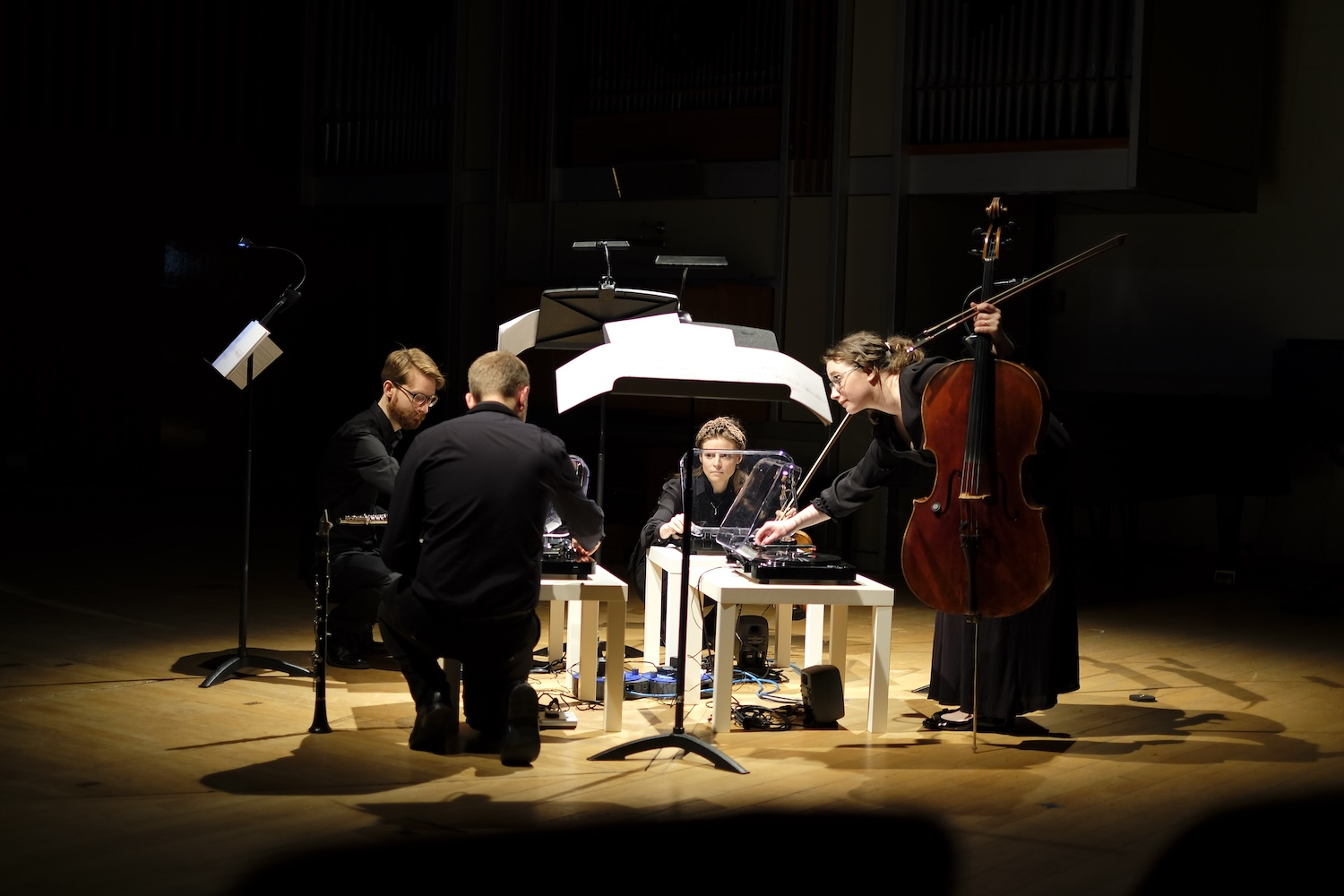
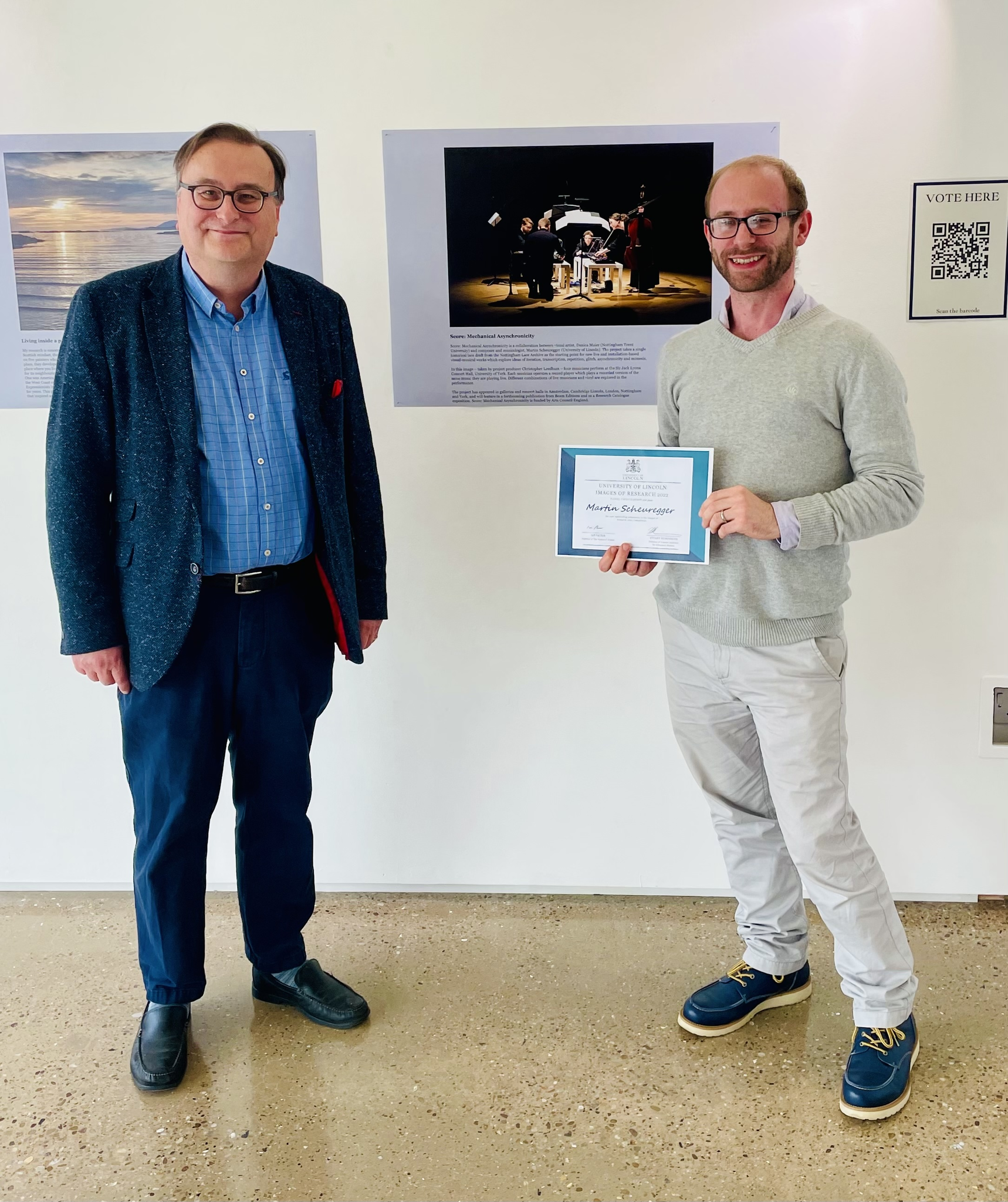
A single image of the Sir Jack Lyons performance discussed above was featured as part of an exhibition of research from the University of Lincoln. The image was awarded second place in the staff choice award.
2022.11–2023.02
Publication of lockdown performance of Score: Mechanical Asynchronicity, Dark Inventions (ensemble)
The final digital concert was released in November 2022 ahead of its featuring in the publication of our article in Echo (listed above) in February 2023. The full performance is included below.
2022–2024
Creation of final printed publication and vinyl release with Beam Editions
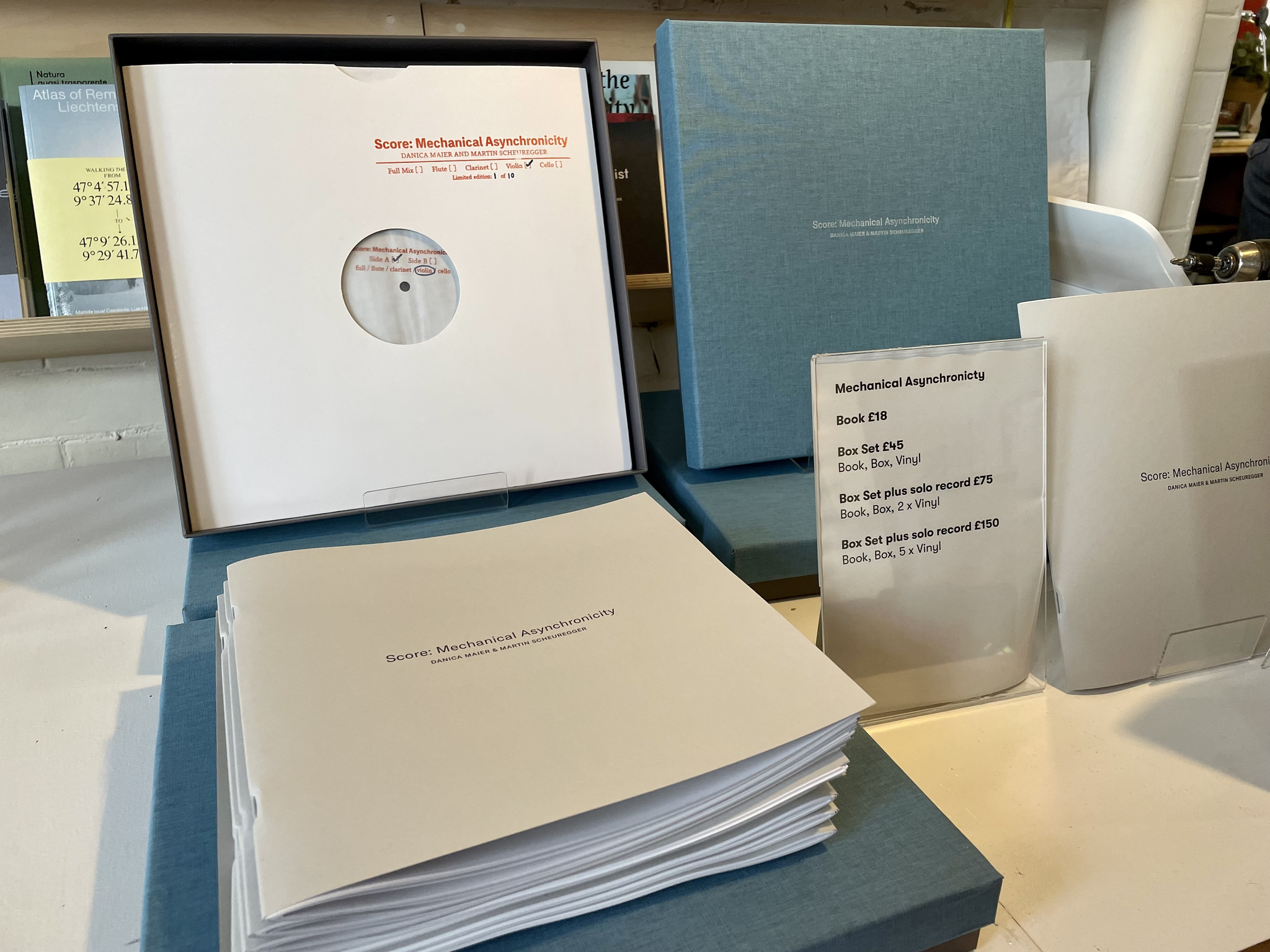
A final creative period in which Maier and Scheuregger worked with authors external to the project (Lauren Redhead and Daniela Cascella) to create a publication with Beam Editions. This book forms the second part of this research project’s contextual information, as explained above. Alongside the book, a limited-edition vinyl release was produced, with ‘full mix’ versions of both primary works available, as well as single-instrument records as used in the performances and installations discussed above. We add to, and make explicit, some of the ways the practical work has addressed RQ1 and RQ2.
2024.03.23
Performance of Score: Mechanical Asynchronicity, Dark Inventions (ensemble) and launch of publication and vinyl release
Beam Gallery and Bookshop, Nottingham
The finished book and vinyl records were launched at this sold-out public event, with an intimate performance of the work given by two musicians and two record players, and a single projection of the lace draft.
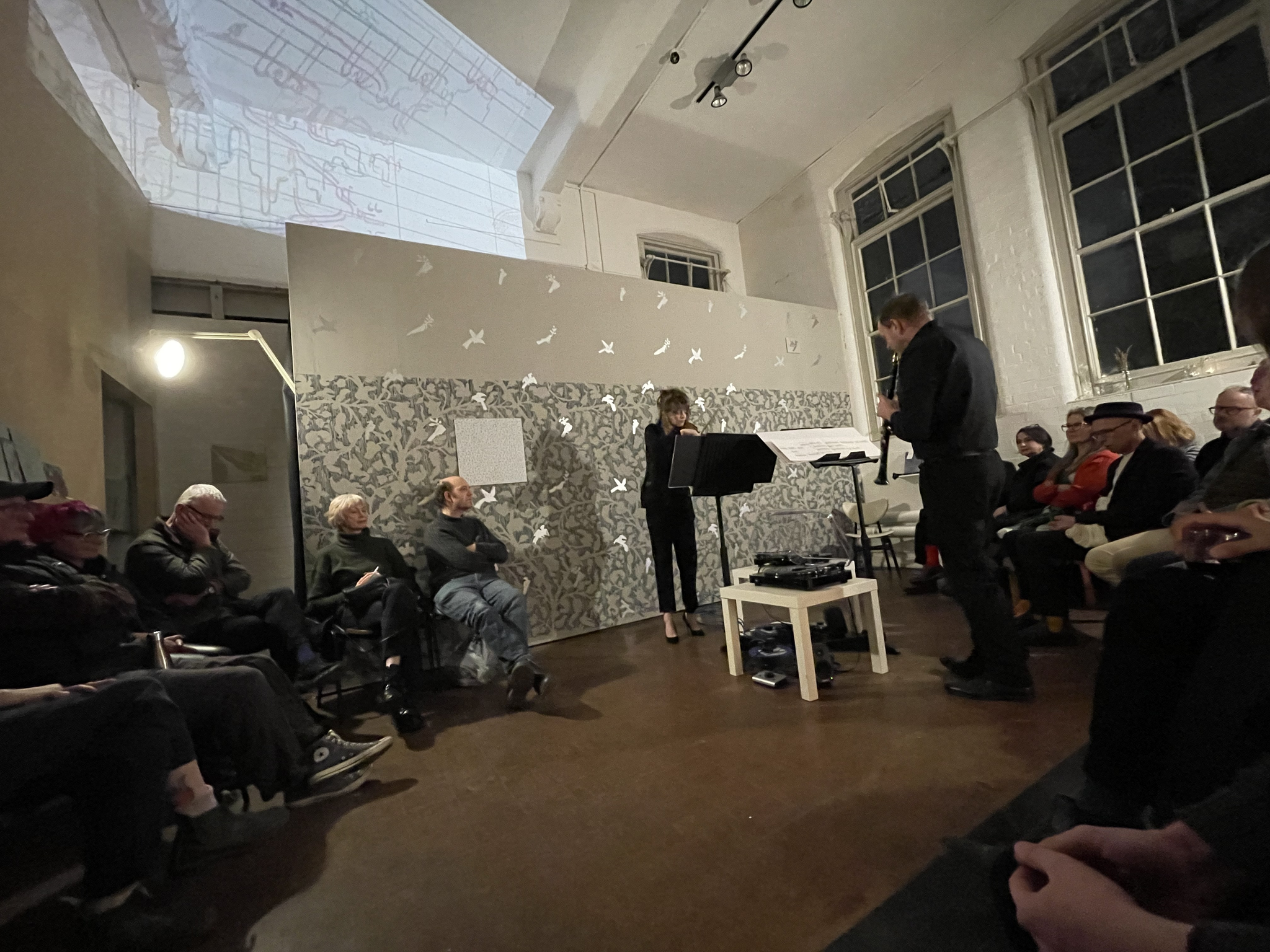
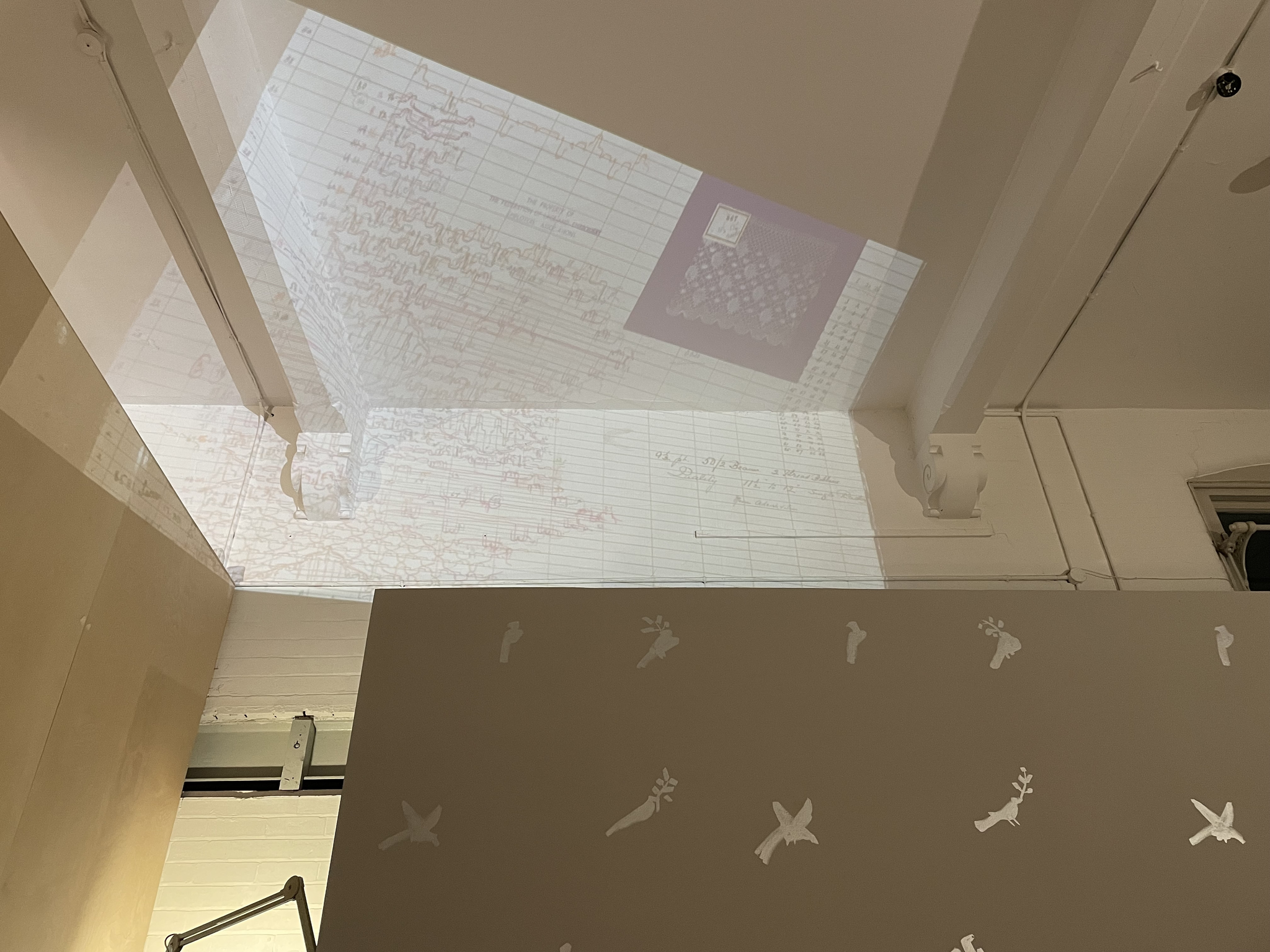
2024.08.10
Performance of Score: Mechanical Asynchronicity, Dark Inventions (ensemble)
Houghton Festival (Pinters Stage), Norfolk
The work was chosen for a performance as part of an experimental stage at the Houghton Festival. This performance demonstrates the work’s engagement beyond even concert halls and galleries.