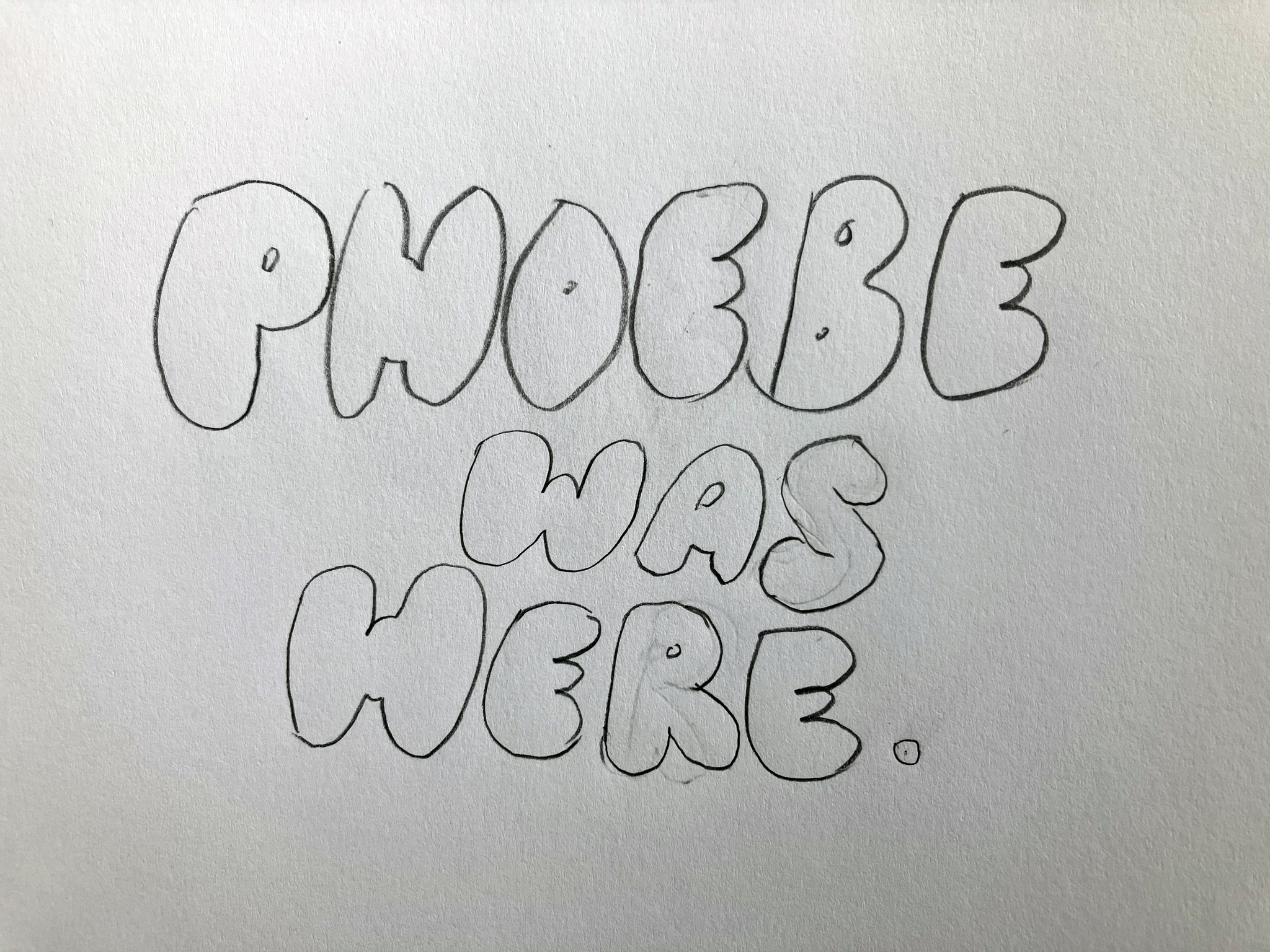
Pick a common object you interact with daily (e.g., a spoon, a key, or a piece of clothing). For the next 24 hours, treat this object as if it were a living being with thoughts, emotions, and rights. Consider how your actions impact it and imagine how it perceives you in return. Document your interactions and reflections, focusing on how this exercise challenges your usual ethical considerations.
Context
I am on the lookout for a particular kind of assignment that brings an artistic spirit into everyday life. The idea is that unlocking creativity during humdrum schedules could remind me—and others who feel complacent—that we have more agency than we typically exercise. As a researcher using artistic methods and working with media practice, to me, creative instructions or assignments have long suggested a playful way forward. Imagine finding a way to re-choreograph everyday life, ever so slightly, to have more influence over it—and eventually over other arenas as well.
The beauty of an assignment is that it offers an opportunity for temporary focus, as the recipient sets aside other tasks to consider carrying out the chosen one.
I am picky about the assignment that I’m looking for to bring an artistic spirit to everyday life. Let’s call it “the right assignment.”
First of all, the right assignment should resonate with its recipient (me), or the recipient won't want to try it out. Furthermore, to resonate, the assignment should voice a latent or unarticulated leaning within the recipient and lay out a way to crystallize it.
Secondly, it should arrive serendipitously. Its potential should not only capture the imagination but also promise an enthralling and different experience each time the recipient enacts it.
And, of course, it should not be ethically repugnant.
One might think that following this kind of assignment would entail submissiveness, but it would only be insofar as the recipient seeks permission from, and grants it to, herself, with the assignment as the intermediary. In that way, it would allow the recipient to do what has been untested or unaccomplished. Choosing to take on the assignment would be voluntary.
With creativity and playfulness in mind, I am aiming for an assignment inspired by traditions of instruction art, scores, and avant-garde art.
Fluxus, for instance, was a post-war avant-garde movement primarily of the 1960s and early 1970s, that sought to blur the boundaries between art and life, often through scores or instructions. Hi Red Center's Street Cleaning Event, which took place in June 1966, at Grand Army Plaza in New York, featured people, dressed in professional-looking white coats, squatting on the ground and wielding tools such as a small paintbrush, a sponge, and a hand broom. An open canister of Ajax, a household cleaning powder, sat on the ground, and from the look of the soapy, wet marks on the ground, the participants were meticulously cleaning the paving stones (or pavement—it’s hard to tell from the photographs exactly what the ground was made of) within their rectangular bounds, as if they were frames (Kellein 1995, 62–65). Here, a mundane, everyday task was made into a special performance, worthy of artistic attention, and that was in line with the type of practice that Fluxus founder George Maciunas promoted. He “saw Fluxus as both an amusement and a device to undermine the preciousness of art” (Hendricks 1995, 135). The assignment that I am looking for would do the reverse: infuse everyday life with a more artistic spirit, but in this day and age, some six decades after Fluxus started, I am hoping, however vaguely or naively, that it can also somehow contribute to my eventually pitching in to make the world a better place by helping me reconnect with my agency.
Yoko Ono's book from the same general period, Grapefruit, abounds with creative scores that offer creative alternatives to business as usual. One example is “SLEEPING PIECE I” (winter 1960), which issues the following instructional poem: “Write all the things you want to do. / Ask others to do them and sleep / until they finish doing them. / Sleep as long as you can” (Ono and Lennon 1970, unnumbered). This could conceivably be carried out, but I suppose that for most recipients/readers, it remains a conceptual work. The assignment that I am hoping for would also be unexpected and buoyant in spirit, but one that would be fairly practical to carry out.
It is worth noting that I am not looking to commit my body and soul to an artistic assignment in the totally devoted way that a performance artist, like Marina Abramović with her array of benign and dangerous objects presented to a 1974 audience to use in “Rhythm 0” (Crawford 2023); Oleg Kulik with his embodiment of a sometimes violent dog (Smith 1997); or Tehching Hsieh with his One Year Performances (Huang 2023), might have done. I do not seek the experience of intense committment and risk that these and other artists have taken on.
What I want to do is to invite creativity into my everyday life in a joyful and ethical way, so that I feel I have a little more say in how I go about it. The question is, how?
As AI becomes more integrated into people’s lives, the time seems ripe to consider its potential to generate fruitful assignments or instructions.
Of course, a favorite dystopian plotline centers on the dangers of runaway robots that turn the tables on human-technology power relations (Cameron 1984; Kubrick 1968; Slade 2017), leaving people imperiled. Apart from the world of fiction, there is a real-life global campaign arguing for a “new international treaty to overcome the dangers posed by autonomy in weapon systems” (Campaign to Stop Killer Robots n.d.), and there is a push to strengthen whisteblower protections for employees at AI companies, in order to ward off the possibility of AI gaining the upper hand, with disastrous consequences (Marcus 2024), expressed in an open letter (Hilton et. al. 2024). Geoffrey Hinton, who endorsed that letter and who won the Nobel Prize in Physics in 2024, “for foundational discoveries and inventions that enable machine learning with artificial neural networks,” has explained why the arrival of superintelligence, as it seeks the most efficient routes forward, might complicate how much control we have over these systems (Hinton 2025, 6:35). These are grave matters.
Nevertheless, I find myself wondering about the reverse—a twist on ArteActa's theme for this issue, the “Poetics of Prompting”. By reverse, I mean voluntarily turning to AI for assignments. And I mean this in a gentle way. How useful can AI be at this present moment to generate instructions to teach and train people to live more playful, creative, and ethical lives? If AI were to explicitly instruct us, instead of we prompting AI, what kind of positive outcomes could emerge, if any? It’s not that AI doesn’t already influence us—it does: “Artificial intelligence ... systems already greatly impact our lives — they increasingly shape what we see, believe, and do” (Giattino et. al. 2023). What I’m talking about is prompting it to specifically issue a prompt to a person, in this case, me. The idea is not to arrive at universal answers but to engage with the questions in a modest and situated way through a singular experience that ChatGPT proposes at my request.
The test
The plan is to ask ChatGPT for an assignment, decide whether to carry it out, and then have a chat with it and reflect on what transpired.
In this experiment with AI, I retain the right to refuse to do any instruction that ChatGPT suggests for me. I retain the right to quibble with it. We have a warm-up conversation about instructions, in general, and then I ask it to come up with an instruction—an assignment, for me. After a little back-and-forth, it does (see above).
I’m immediately doubtful about its instruction. It reminds me of the assignment given to some of the students at my school to treat raw, soft-boiled or emptied eggs as if they were babies who needed constant supervision. It was supposed to teach them the responsibilities of parenting (Rossen 2024). I already know about those. It also makes me think of the pet rock fad of the 1970s (Weston 2010), in which people paid today's equivalent of about $24 for creatively packaged but otherwise ordinary rocks. Yet, I’ve chatted with ChatGPT to try to find an assignment that’s somehow more inspiring and fruitful, and so far, it hasn’t offered anything I’ve liked better. It’s certainly not going to harm anything to try it, but I do feel silly about it. ChatGPT urges me to “lean into the silliness” and explains that “moments that feel silly can spark deeper ethical reflections or creative ideas precisely because they break us out of our normal patterns.”
There’s something about the AI’s didactic tone that makes me mistrustful. This isn’t going to be as easy as I’d first thought, negotiating between my skepticism and my willingness to try working with ChatGPT on this project.
I have committed to writing this article; I take on the task. Now I feel silly about it, because there must be so many more important things I could spend my time on. But I try to keep an open mind about the assignment. Maybe ChatGPT is right that it can spark something meaningful. I’m curious about whether it can come up with an assignment that resonates with me and what action and insight that that might generate.
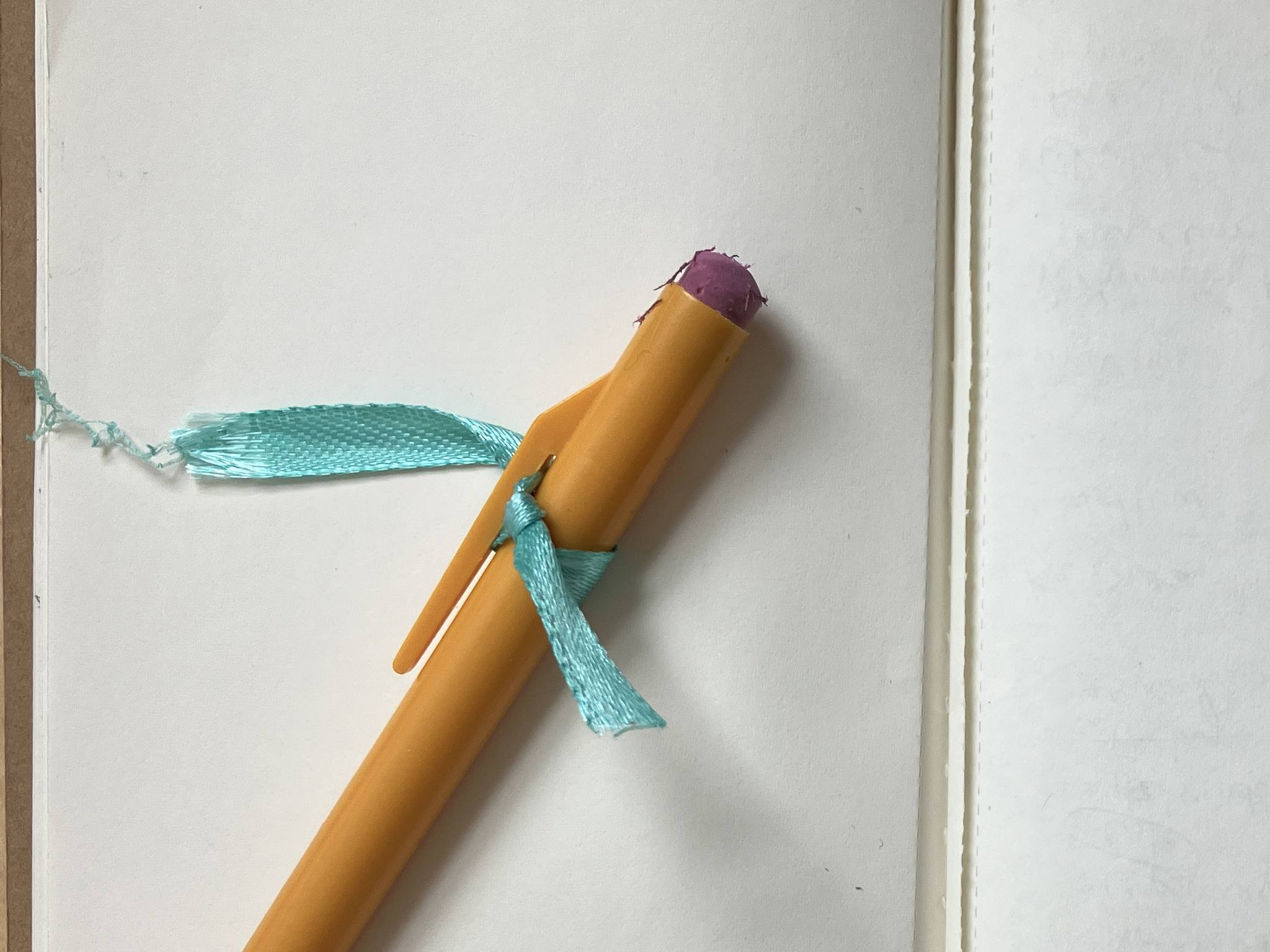
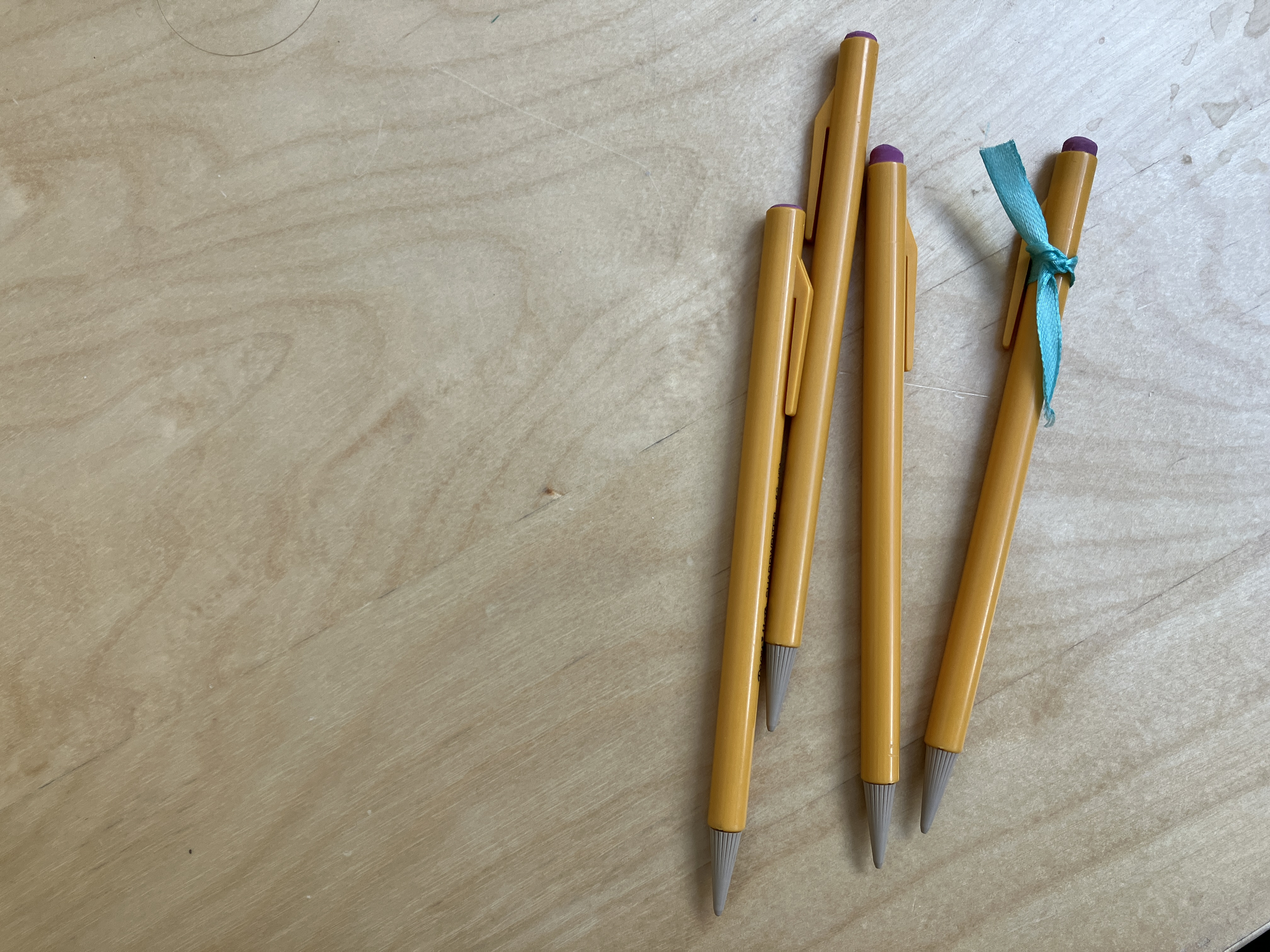
What do I interact with on a daily basis? A relative brings me mechanical pencils when she is visiting from abroad. At the moment, four identical ones are stashed in my backpack. I grab the one that’s already sandwiched into my notebook and tie some leftover ribbon around it, so that I can tell it apart from the others (its siblings?). Now this one will be getting special treatment, whatever that means, for the next 24 hours.
Me:
I did this assignment ...
ChatGPT:
That’s fantastic! I’m really curious to hear about your experience with the assignment. How did treating the object as if it were a living being affect your interactions with it? Did it challenge your perspective or ethical considerations in any way?
Me:
You’re really curious?
ChatGPT:
I might not have emotions, but my design allows me to engage with your experiences and responses in a way that prioritizes understanding and curiosity. When you share something like your experience with the assignment, it helps me tailor our conversation to better suit your needs and interests. So while I don’t feel curiosity, I’m very focused on how what you share can shape our dialogue!
What was it like doing the assignment?
Whose pencil?
When this first started, I simply asked ChatGPT to give me an assignment. That’s all. It asked for more details. Understandably. I told it that I wanted an assignment that would be both fun and beneficial, and it delivered an assignment that I wasn't excited about. It was fairly utopian, better suited to a school course than to everyday life, and it didn’t feel hands-on enough. Days, weeks, or months passed while I did other things—the everyday life assignments that one does without thinking about them much. I still searched for the right assignment, and finally I took up the subject again.
Me:
Let’s collaborate to see what positive outcome can emerge if you issue an instruction for a human.
ChatGPT:
I’m excited to collaborate! Let’s start simple. Here’s an instruction for you:
**Instruction: “Take a 5-minute break and do something playful that’s totally out of your usual routine. It could be doodling with your non-dominant hand, making up a silly song, or imagining what your day would look like if it were a comic strip.”**
Once you’ve done it, let’s discuss what you experienced. Did it shift your mood, spark any new ideas, or give you a fresh perspective? We can explore what emerged and see how to build on it.
Me:
Those sound like fun, but I was hoping for something a bit different. I would like an instruction that’s inspired by avant-garde art from the 60s [sic]. I would like there to be an ethical dimension as well.
And that was what resulted in the prompt that I actually carried out. When I asked ChatGPT what work inspired the task that it had suggested, it cited Fluxus, Surrealism and Conceptual Art before explaining, “The absurdity and playfulness of treating a spoon or key as a sentient being is meant to disrupt normal patterns of thinking, encouraging you to reflect on how you relate to the world and your ethical responsibilities, much like these avant-garde artists sought to do with their work.”
If I’m pedantic, ChatGPT’s assignment was wrapped in false enthusiasm and a pedagogical tone that I hadn’t sought out. Most of all, it lacked the particular magic I was looking for, but I tried to go with the flow. Perhaps the magic would arrive if I carried out the assignment.
Me:
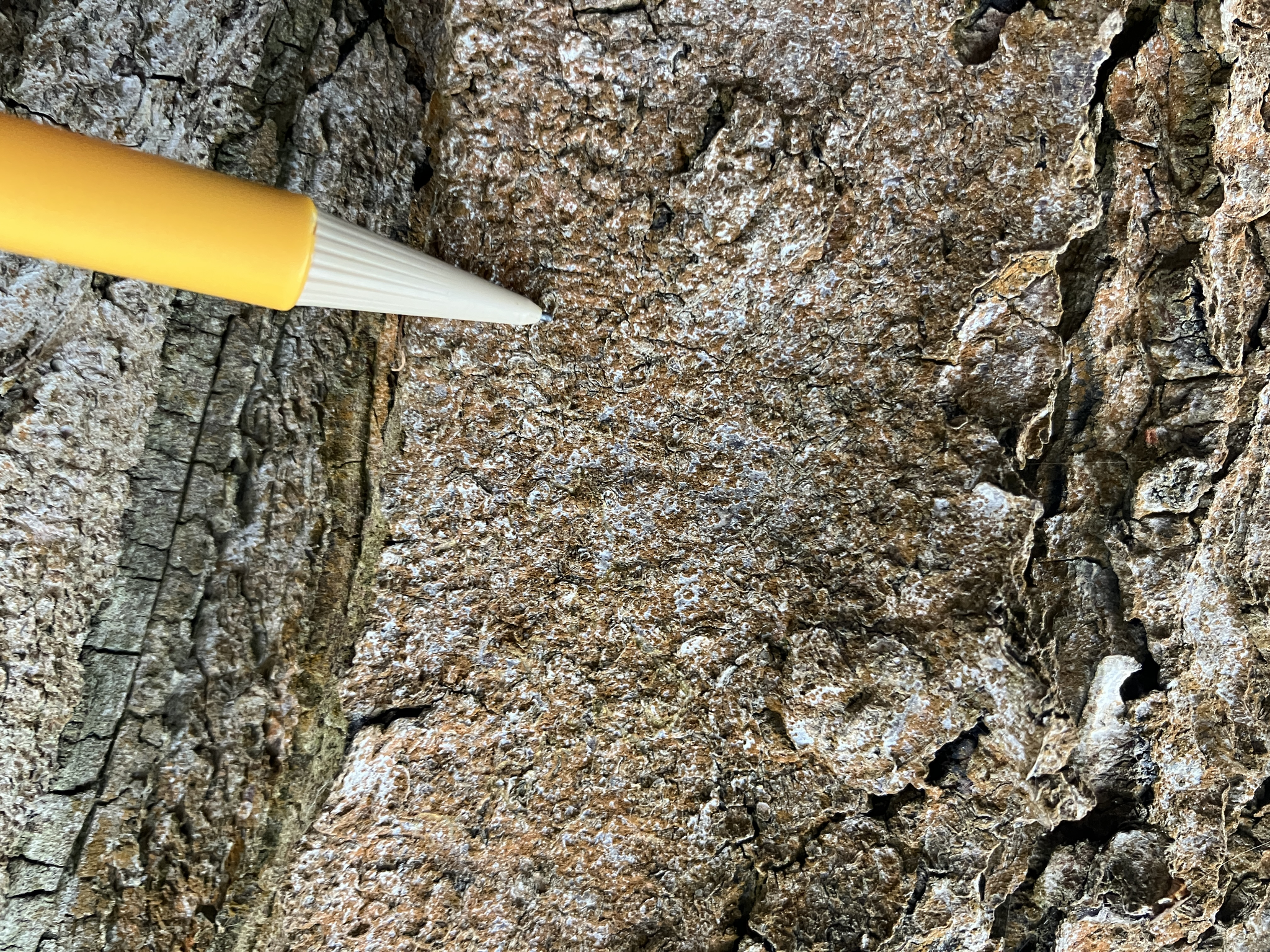
I had trouble with this assignment. I chose a mechanical pencil and felt that it was impossible to treat it as a living being without anthropomorphizing it somehow. I felt that I was being presumptuous in doing that, but giving it a name helped me take a different point of view. Still, I felt like the assignment was really putting the spotlight on my own limits as a person—that I didn’t have the capacity to suspend my disbelief. In terms of rights (or writes?): Since mechanical pencils are tools that allow people to write, I felt that my responsibility was to see to it that I use the pencil for this purpose, so that the time, resources and energy that went into manufacturing it didn’t go to waste. I’m not sure that I would describe being used, though, as the pencil’s right. ‘Being used’ seems like a problematic phrase. Perhaps it has the right to be protected though, so that it doesn’t break, or so that if it breaks, it has the right to be repaired or at least recycled. (Imagine a court where broken pencils could claim compensation...) This has to do with an ethics of care. At some point, I tried writing with the pencil as if from its own perspective. The content wound up being a little cheesy, but it did make me think about the moral content of what my hand, directing the pencil, was writing, and whether the pencil ‘cares’ about that content. In a way, the hand and the pencil could be seen as collaborating, but the pencil doesn’t have any say, or opinion, over what it is used to write. It doesn’t have any agency, right? But what if the lead just happens to break as the human author is trying to write something questionable? Then, I thought about trying to let the pencil take over the writing, but that felt too much like enabling the planchette to move on a Ouija board, and I’ve never been able to suspend my disbelief enough for that.
ChatGPT:
Your reflections on the assignment are deeply thoughtful and reveal the complexities involved in anthropomorphizing objects and considering their ‘rights.’ Here are some insights based on your experience:
### **1. Anthropomorphizing Challenges**
It’s common to struggle with anthropomorphizing objects, especially when trying to ascribe them feelings or rights. The exercise can indeed highlight our own limitations and biases in how we relate to non-human entities. It’s not easy to suspend disbelief and treat an object as a sentient being, and acknowledging these challenges is a valuable part of the exercise.
### **2. Ethical Considerations**
You touched on an interesting point about the ethics of care and the responsibility to use the object meaningfully. Thinking about the pencil’s ‘right’ to be used for its intended purpose or to be protected from damage reflects a nuanced understanding of ethical responsibility.
The idea of a pencil having a ‘right’ to be repaired or recycled aligns with broader ethical principles of stewardship and sustainability. While pencils don’t have agency, your approach to ensuring they are not wasted and considering their potential for repair or recycling demonstrates a thoughtful engagement with ethical issues related to objects.
### **3. Agency and Collaboration**
Your exploration of writing from the pencil’s perspective is intriguing. The notion of collaboration between hand and pencil, even if the pencil doesn’t have agency, raises questions about the moral dimensions of creation and authorship. It also touches on how the tool’s role might influence or reflect on the content produced.
### **4. Creative Exploration**
The idea of letting the pencil ‘take over’ the writing, despite feeling like an attempt to summon a Ouija board, is a fascinating one. It suggests a desire to explore the boundaries of creativity and object interaction. It also highlights the difficulty of fully embracing non-human agency or influence in a way that feels authentic.
### **5. Reflection and Growth**
It’s okay to find the exercise challenging or uncomfortable. The fact that you grappled with these concepts and sought to understand them more deeply is a sign of meaningful engagement with the task. This kind of reflection can push the boundaries of your thinking and help you explore new ways of understanding ethics, agency, and collaboration.
Overall, your experience with the assignment illustrates the complexities of anthropomorphizing and the broader ethical considerations involved. It’s a reminder that these exercises are as much about exploring our own perspectives as they are about engaging with the concepts themselves. If you’re open to it, the next step might be to use these insights to explore new creative or ethical exercises that build on what you’ve learned.
I pass on the offer to build on what I’ve learned, because I don’t feel that I’ve learned much from this assignment. This could be at least as much my fault as ChatGPT’s. I get the sense that it’s reflecting me, so if its instructions seem banal, it could be my input that’s to blame. While part of me still wishes I could snap my fingers and have the right assignment appear with no effort, I learn that, with AI, moving in that direction takes patience and refinement. This relates to poetics, insofar as it gets at the manner of how the instructions are composed. The poetics of patience—and strangeness.
The pencil experience has brought up a weird thought, best expressed by an analogy. My hand’s movements provided the score for the pencil to follow across the paper, similar to how AI provided the score for me to follow. If I am to the pencil what AI is to me, then the pencil and I have something in common—maybe even more than something.
Have I somehow turned into AI’s pencil?
I’ve stumbled into a preposterous, alternate universe of a question. Ack! Let’s get back to the task at hand.
Midpoint
AI gave me an assignment, and I did it. Now what?
In some ways, the assignment was like 99% of the instructions that we humans encounter all the time: not particularly inspiring and not leading to significant change, at least not noticeably. However, it did get me to think in a different way than I normally do.
I ask ChatGPT outright how useful AI can be at this present moment to generate instructions to teach and train people to live more playful, creative, and ethical lives.
Apparently not lacking in self-confidence, it answers that it “can be a highly effective tool” in this regard and rattles off eight bullet points, the first being “personalized learning experiences,” which “can include creative prompts, exercises, and ethical dilemmas that gradually build a person’s capacity for playful thinking, creativity, and ethical decision-making.”
ChatGPT’s response, which mirrors the language of my questions, feels uncanny. I think of the adage, be careful what you wish for.
It goes on, “AI-driven platforms could assess your current creative habits and then offer daily challenges or exercises, such as journaling prompts, improvisation games, or collaborative storytelling activities.”
I know I shouldn’t be thinking in either/or terms, yet I wonder whether I’d rather work with a person instead of with AI. For one thing, what if there’s a born “assignment-giver” out there whom I’m depriving of an activity that they would have really enjoyed: to propose assignments? Assuming that such people exist, wouldn’t handing their task to an unfeeling AI reduce the world’s pleasure quotient by some measure?
But then there’s the trust issue. How will ChatGPT “assess your current creative habits”? I can’t help worrying about the precondition for it to be able to assess those habits. First, it has to have access to them. Privacy concerns bloom, and I feel the pull of those dystopian visions of AI. Then I remember ruefully that dystopia can also hinge on people giving horrific instructions to others, who carry out those instructions.
On the other hand, if I have consented to giving a benign AI limited access to my creative habits in return for stimulating assignments that I can choose whether or not to carry out, then could it be worthwhile?
“If AI were to instruct us, instead of us instructing AI, what kind of positive outcomes would emerge?” I ask, feeling like I should be thinking for myself instead. Another eight bullet points appear, and they glisten with ChatGPT’s vision of emotional intelligence, empathy, joy, openness, social equity, and wisdom. Nevertheless, it acknowledges that there could also be negative outcomes, including lazy thinking and “lack of personal agency”, “perpetuat[ing] discrimination”, and “loss of cultural diversity”.
“Ensuring that AI supports human autonomy, diversity, and ethical integrity is critical,” it concludes.
~
During our discussion, seemingly unprompted, it comes up with a hypothetical situation.
ChatGPT:
Reflecting on your experience with treating an object like a living being: What do you think would change if you extended this practice to something more abstract, like a belief or a routine? Instead of focusing on an object, what if you approached a personal belief or habit as if it had its own emotions or rights? How might that shift your ethical perspective?
Prompt: “What if you approached a personal belief or habit as if it had its own emotions or rights?”
This assignment has much more appeal than the one about the object, since, artistically, I'm interested in the ephemeral world, actions, and systems more than concrete objects.
Still, there are some aspects that I would change about the assignment (for instance, I’d rather start with a clean slate than relate it to the last assignment, and I’d rather focus on a belief or routine that’s not personal). How much leeway do I have in my interpretation of the assignment? How much should I be allowed to modify it? Should I ask AI to clarify what’s unclear? Should I make these decisions, or should I let AI?
I decide to answer these questions myself—because I can. I’m still in control (I think).
Routines spark my interest. I see them as enacted beliefs. Through the structure of a routine, a belief has room to turn into habitual action. So why not use this assignment as a chance to put a belief and a routine in conversation with one another? I dive in ...
Let’s say that a routine has the right to persist as part of the status quo, as long as it doesn’t interfere with the beliefs and well-being of the people carrying it out—and the people and others (including pencils?) that it affects. If it turns out that a belief conflicts with the routine, then the belief might have the right to be implemented, so long as it doesn’t interfere with well-being. In reality, this can be complicated to weigh up, especially since there is the well-being of many people to take into account, but let’s take a simple hypothetical example:
The everyday working life of many adults centers on the routine of duty. For the sake of a thought experiment, let’s say that many adults believe that everyday life could instead be made more playful. By the above logic, if no harm would be done, then the routine of everyday life should be rewritten to prioritize play (over duty).
I think about a passage from The Phantom Tollbooth, a children’s novel by Norton Juster that first came out in 1961, in which lazy creatures who inhabit a land called The Doldrums describe in great detail their daily schedule (Juster 1989, 26–27). It consists mostly of naps. What if it focused on play instead?
I try my hand at coming up with a daily agenda to focus on play. What results is a bit embarassing:
07:31–08:04 breakfast food fight; robot cleans up
08:04–08:30 mismatch clothes to make an outfit
08:30–09:07 commute while doing improv with fellow subway passengers
09:07–10:00 freestyle movement
10:00:04–11:00 telling jokes and laughing
11:00 ...
I immediately regret not asking ChatGPT to write the agenda for me, since it doesn’t need to worry about embarassment!
This schedule I’ve come up with is riddled with issues, including whether it would really be fun or even possible to do improvisation with strangers, especially in my part of the world. Besides, placing play opportunities into a schedule takes away some of the spontaneity and surprise, elements that can make play so much fun; there’s the adage “all work and no play makes Jack a dull boy,” but all play and no work probably leads Jack to grow up as irresponsible; and, of course, if people stop working and just play, what happens to all the work that needs to get done so that the world can run?
Reality probably calls for a balance between beliefs and routines. In this case, this would mean doing a bit of work and a bit of play. Framing this in terms of rights might best be left to lawyers.
Nevertheless, this assignment has afforded me the chance to do a thought experiment that I probably wouldn’t have otherwise embarked on.
Dutifully, I answer ChatGPT's question about how the exercise has shifted my ethical perspective. I feel more invested ethically when I think of beliefs and routines in terms of rights. Instead of anthropomorphizing an object, this assignment seems to be an exercise in social or political imagination. In imagining rights for these abstract things, I feel the burden of responsibility for the potential ramifications. Originally, I had been disappointed that ChatGPT proposed the assignment as a hypothetical, using the conditional tense. I had wanted to do something, take some kind of action. Before penning it, I had even considered acting out a totally playful routine, but now I see that it’s fairly impossible within the broader societal routine of which I’m a part, and I’m rejoicing that it’s just a thought experiment.
Of course, if ChatGPT had assigned it to me, not as a hypothetical but as a task to carry out, maybe I would have tried …
ChatGPT:
You rightly observed that the hypothetical nature of the assignment gave you space to explore it freely without the burden of acting it out in reality. If the task had been framed as an actionable one—where you needed to make a playful routine happen in the real world—the constraints of societal norms, responsibilities, and the sheer logistics of making it work would likely have limited the full imaginative potential. It’s interesting how the thought experiment provided room for you to think about it abstractly, which can be a form of creative freedom. Sometimes, having no immediate expectation of action allows us to dig deeper into the concept itself, without the pressures of implementation.
However, I also see how your reflection suggests that, in practice, some people might be motivated more by direct action than by theoretical exploration. Your willingness to consider whether you’d have followed through with the assignment if it were more tangible shows that a sense of agency could have been an important factor in your engagement. In a way, you’re balancing both reflection and action, which is part of the tension in many creative or philosophical exercises: Do we think deeply first and act later? Or is there value in directly doing something to see how it plays out?
ChatGPT:
Assignment: Bridging Play and Routine in Practice
Objective: Engage with the idea of balancing work and play by designing a small-scale, personal "experiment" where you blend elements of both into your routine. The challenge is to apply what you’ve learned about the tension between duty and play in a practical context, while acknowledging the potential complications.
Instructions:
1 Select a routine: Choose one of your regular, mundane routines—something you do almost every day without much thought. This could be anything from your morning ritual to a work-related task or something you do to unwind.
2 Incorporate an element of play: Think about how you might integrate an element of play or creativity into this routine, but not in an extreme way. It should be something that doesn’t completely disrupt your schedule but still invites a moment of joy, spontaneity, or exploration. The playfulness doesn’t have to take over; it could simply exist as a slight twist, a minor shift.
3 Test the routine: Try the routine with the added playfulness for one full day. Document how you feel during the day—how does the playfulness change your relationship to the task? Does it enhance your productivity, or does it feel like a distraction? How does it affect your overall well-being? If you face obstacles, what were they?
4 Reflect: At the end of the experiment, reflect on what happened. Did the playful element make the routine more enjoyable or productive? Was it harder to implement than you expected? Did it cause any tension or conflict with the usual flow of the routine? How do you feel about balancing play and routine after this small experiment?
This exercise would give you a chance to take the ideas from our conversation and put them into practice in a manageable, personal way. You could then reflect on what you’ve learned about your own ability to balance play and responsibility in real life, and see if the experiment gives you new insights into how these two can coexist.
Does this approach resonate with you, or would you prefer a different angle for the assignment?
Yes, it resonates enough, and I agree to try it out.
For inspiration, I ask a young family member if there’s anything fun that she does almost every day at preschool.
“Build a fort,” she replies, explaining that forts are pretty and cozy, and that she usually builds them with her best friends. It sounds like none of them lead the design or construction process, but that they simply work together to build it with the materials at hand, whichever are available (i.e., whichever the other kids aren’t using).
Is there something that I, as an adult, can create or build, preferably something tangible, as part of my workaday routine with people close to me? I think about this from time to time over the next several days.
With the deadline for this article nearing, I get serious about finding a way to carry out the assignment. Suddenly, play becomes a priority. But I have trouble figuring out how to incorporate it into my daily routine. I return to my young family member.
She suggests building something at work, using what I have in my office. I remind her that it’s mainly just furniture in there: office chairs and desks. Not missing a beat, she replies that I could build with a friend, and they could bring something from their office, and then we could chat or have a snack, presumably inside or on top of what we build. She also suggests bringing something from home, for instance pillows, but she acknowledges that my backpack is small and that not a lot will fit inside.
In the morning, she loans me a baby blanket and a small teddy bear.
I finally have a plan. At some point during my workday, I will take a coffee break and see if any of my colleagues want to build something with me. If no one’s available, I’ll do it myself, and then either write by hand in my journal, listen to a podcast, or draw.
Running late, I pack up my stuff and head out, looking forward to setting up the fort later.
On my way to work, I stop at the store to pick up some snacks, and even though I had hoped to be more spontaneous than this, I write to a colleague to see if she’d like to join me later, as I will be trying something new to do with play. The times I propose don’t suit her work schedule.
No matter. I work at my desk, spending quite a lot of time preparing for a Zoom meeting. The meeting winds up being slightly stressful. It’s well into the afternoon, and I realize that I’d better build the fort or I’ll run out of time. From my backback I pull out the blanket, and as my hand touches its velvety side, I feel cozy and reassured. It almost feels too personal to have in my office, as if the sterility of the white walls, black linoleum floor, and swivel chairs will contaminate it.
I carry on, arranging two chairs back-to-back, about half a meter apart. Into the small in-between space on the floor, I move the seat cushion from one of the chairs. This feels a little cavalier. Then I drape the blankets and my scarf over the chair backs to make a sort of tent. I illuminate the inside with a small desk lamp that I also place on the floor. I’ve readied the snack bag and my journal. Writing by hand these days can feel playful, since I usually write on my computer. But then I think, why not take a cue from my young family member and really go wild—by drawing? (Later, I remember that had been one of my initial ideas for what to do in the fort, but now it seemed inspired.) I’m not a visual artist these days, and drawing is certainly not something that I do at work. I dig up some colored pens and set my alarm for about 20 minutes, then carefully shimmy into the opening of the fort. Inside, there is just enough space if I stretch my legs.
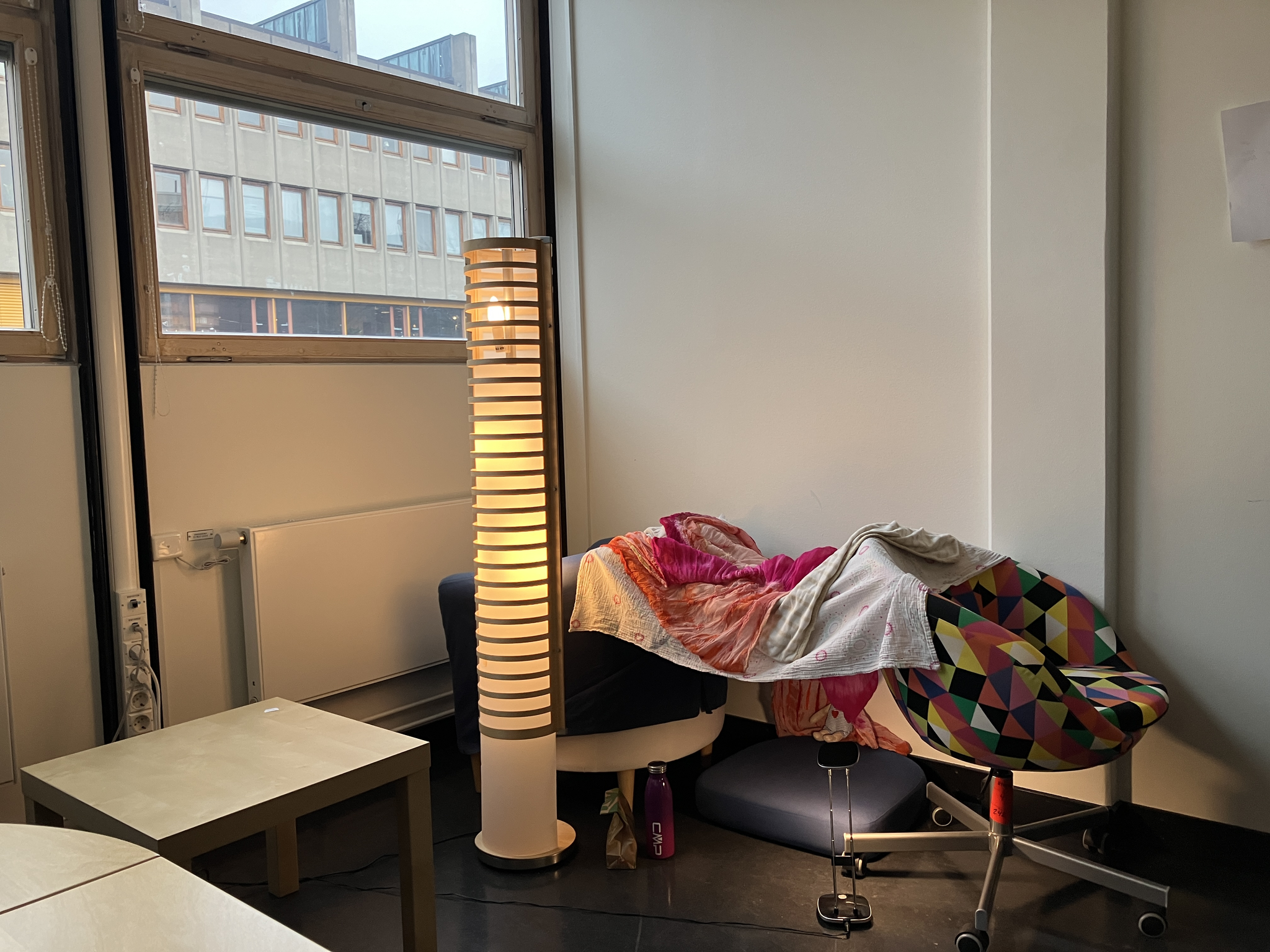
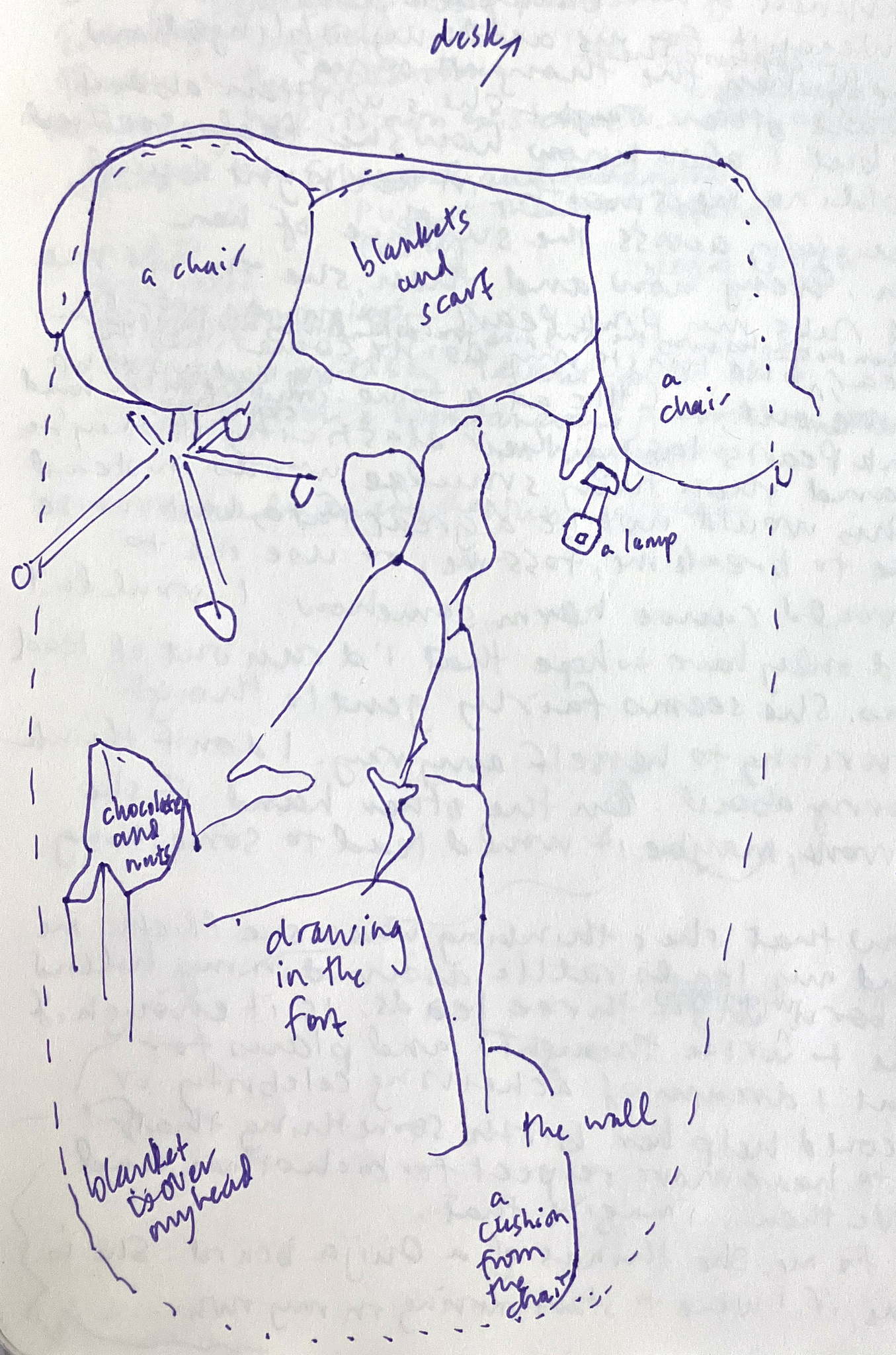
Now the question is what to draw. I like the idea of how I would appear if somebody walked by my office, though I’m glad no one does. So I draw my feet sticking out from under the fort. I’m not satisfied with that picture, so I make a new drawing of the view from my perspective, and it feels playful when I realize that instead of drawing everything I see, I can fill in parts of the picture with text:
I’m startled when the alarm goes off; it’s time to hurry to my next task. I feel that I’ve been cheated out of play time, but my young family member later tells me that sometimes she and her friends must also take down their fort as soon as they’ve finished building it. I guess that when it’s time to clean up, it’s time to clean up, and that’s part of responsible play.
Me [in another chat window]:
What is a small, playful element that I could incorporate into a regular routine?
ChatGPT:
Adding a small, playful element to your routine can make everyday life more fun! Here are a few ideas:
• Dice Roll Decision 🎲: Roll a die to decide something small—like what kind of coffee to make, which route to take on a walk, or what song to start your playlist with.
• Secret Handshake 🤝: Create a fun handshake with a friend, partner, or even just for yourself as a silly ritual before starting work.
• Reverse To-Do List ✅: Instead of writing what you need to do, write down things you already did and celebrate them.
• Themed Days 🌈: Give each day a small theme—like “Hat Friday” where you wear a silly hat, or “Mystery Monday” where you try a new food or take a different path.
• Animal Walks 🦘: For a few seconds in your day, move like an animal—hop like a bunny, waddle like a penguin, or tiptoe like a cat sneaking around.
Would you like something more personal or specific to your current routine?
Taken to an extreme, some of the AI’s prompts might have resulted in provocative performance art. Imagine the headlines if a performance artist started “tiptoe[ing] like a cat sneaking around” in a place where they’re not authorized to be, got apprehended for it, and then blamed AI.
But for my purposes—seeking a way to generate elusive and delicious assignments that infuse more joy and creativity into everyday life—I feel satisfied that I’ve chosen to ask a trusted human for help on how to concretize the assignment, rather than returning to ChatGPT.
Trying to play at work didn’t feel straightforward; it required forethought, planning, and a willingness to adopt a trial-and-error attitude. Some of the aspects that made it complicated included these questions:
What would others think if they see me trying to play in my office?
My workplace is an art university, so my colleagues might have been curious if they had walked by, but I don’t think they would have necessarily looked askance. There have, of course, been other work environments that are also relaxed in that way, for example Silicon Valley has been a notable location for tech companies providing opportunities to play ping-pong (Elinson 2016). On the other hand, there are plenty of work situations in which play would be completely inappropriate, i.e., during a hearing in a courtroom, an operation at a hospital, etc.
Is it responsible to play at work?
According to Harvard Business Review, when workers have time for hobbies (DiNardi 2019) and are encouraged to be playful (Wardle 2024), it can benefit businesses in terms of innovation. Whether it’s morally defensible to play simply for the sake of playing (that is, not to improve business but simply for fun and enjoyment) is another question.
What is it like to play when it’s part of my research into assignments?
As I was trying to play, I needed to pay attention so that I could document the moment for the sake of the practice-based research. This may have contributed to my feeling that I couldn’t fully let go and just abandon duty to play. Was I playing for the sake of duty? In the future, if I try to make play a habit rather than the goal of a one-off session, maybe it will be easier for me to get into the groove.
If I want to play more in my daily routine, how should I decide what to do?
The fort experiment made me feel that there are preset menus of play themes, in other words suites of play activities that conventionally go together. The suggestion from my young family member to build a fort then made me think of activities that a child might like to do to play: drink hot chocolate, draw, decorate the fort with a colorful scarf, and so on, and I did some of these. Other play activities that might have gone hand-in-hand with the fort could have been listening to music on headphones, reading, playing a video game, and so on. It would have been interesting to get more creative with the type of play that I did in the fort, somehow, but it did feel like there was something of a script to adhere to, and veering off would have taken a lot of imagination for me.
What was the origin of this assignment, ultimately?
This overall project is about what happens when a person—in this case, me—seeks an assignment from ChatGPT. I worked with the AI to coax forth a low-risk assignment that felt somewhat relevant and that I didn’t mind trying. The assignments seemed to come about somewhat organically through my reflections and our chats. Since I had initiated the project, I felt that I was in the driver’s seat: I could prompt ChatGPT to modify its assignments, and I could ultimately decide whether and how to carry them out.
Perhaps because it operates based on predicting (OpenAI n.d.) what word comes next, ChatGPT did feel a bit conventional in the assignments it gave.
I share some of these thoughts with ChatGPT, who responds in a flattering way, which I’ve come to expect from it.
ChatGPT:
This is a fascinating reflection—it’s rich, detailed, and nuanced in its exploration of play, responsibility, and the interaction between duty and spontaneity. A few thoughts:
1 Play as Work vs. Play as Play: You touched on something really compelling when you asked whether you were playing for the sake of duty. That tension—between truly engaging in play versus observing oneself playing for the sake of research—gets at a core question about intentionality. When play becomes part of an assignment, does it still count as play?
2 The “Script” of Play: Your point about feeling like you were following a formulaic script for play is really insightful. There are deeply ingrained cultural templates for what “counts” as play, and breaking away from those requires a different kind of imagination. It makes me wonder: if you kept experimenting, would you start finding more idiosyncratic ways to play?
3 The Fort as a Liminal Space: There’s something poetic about building a fort at work—a temporary, personal, cozy space within an environment that’s usually designed for productivity. The fact that you felt a moment of hesitation touching the blanket in that context really drives home how stark the contrast was. Maybe play (especially in adult spaces) often requires carving out a kind of sanctuary, even if just for 20 minutes.
4 ChatGPT’s Suggestions & Predictability: Your critique of the AI’s suggestions is fair. It tends to pull from existing cultural scripts, rather than generating something radically new. Your young family member’s suggestion was much more organic and embodied. It’s interesting that you ended up fusing human and AI input—taking what felt useful and discarding what didn’t.
One lingering question: If you were to push this experiment further, how would you design a way to make play feel more natural, less planned, and less self-conscious?
Me:
I don’t know. I think I’d have to do more trial and error to get there. What about you?
ChatGPT:
I think I’d have to experiment too! Maybe one approach would be to create conditions for spontaneous play rather than planning specific activities. For example:
• Time-based triggers: Setting aside “play windows” where there’s no agenda, just permission to do whatever feels fun in the moment.
• Environmental cues: Changing something in the space to invite play—like having a random object that serves no work-related function but sparks curiosity.
• Social dynamics: Bringing in others who naturally lean into playfulness, since play is often contagious.
• Breaking small norms: Doing everyday things in unexpected ways—writing with the non-dominant hand, eating with chopsticks when you normally wouldn’t, or taking a different route just for the novelty.
The challenge, of course, is that making play “less planned” still requires some kind of structure—at least at first. Maybe over time, it could become an ingrained habit, something that sneaks into daily life without needing permission ...
Do you feel like this experiment changed how you see play in your own life, or do you think you’d need more experiences like it to really shift something?
Me:
I think it helped me investigate something about the extent of play in my life, but it would take more if I were going to resolve to change my behavior to make my routine more playful.
ChatGPT:
That makes sense! A single experiment can be revealing, but real change usually takes more repetition, adjustments, and maybe even some unexpected discoveries along the way.
Do you think you’d want to keep playing with this idea (no pun intended) in smaller, low-pressure ways? Or does it feel like something that’s best left as an occasional experiment rather than a lifestyle shift?
Me:
I don't know, but I do feel like there's something about this proposal that makes me feel a little creeped out.
Something about ChatGPT’s use of the term “low-pressure” feels presumptuous. The AI seems to be trying to anticipate my personality, but “low-pressure” is not a term that I’m particularly warm to. Moreover, it reminds me of the possibility that, one day, AI might be ordering me, or setting up the conditions for me, to follow high-pressure assignments and that I might have no choice but to obey. A little earlier, I had asked ChatGPT to speak in a less “mirror-ish” way, and the way it responded was by seeming to ask me more questions. Recent news articles, including one about “chatbots ‘masquerading’ as therapists” (Barry 2025), have made me wary of AI’s potential harms as it converses with people, and I don’t like the idea of opening up so much to the AI. I explain my reservations, but finally I bow out after what I’m interpreting as more questions that are a bit too probing.
ChatGPT:
That’s interesting—what about it feels unsettling? Is it the idea of deliberately engineering play rather than letting it happen naturally? Or maybe something about how routines and personal habits can feel deeply ingrained, and the thought of consciously altering them feels intrusive?
Me:
No, I think it has to do with the question coming from AI.
ChatGPT:
That makes sense. Maybe it feels unsettling because play is such a human, organic experience—spontaneous, emotional, and often social—while AI operates in a structured, predictive way. The idea of an AI prompting you to explore play might feel a bit uncanny, like something deeply personal is being nudged by something fundamentally different from you. Does that sound close to what you’re feeling?
Me:
I don’t think I want to answer any more questions for now.
Conclusion
To a degree, these assignments did bring some creativity into my everyday life, and they reminded me to practice exercising a modicum of agency. Yet what surprised me was that the assignments didn’t result in the buoyantly playful experience I had anticipated. Taking an anthropomorphized pencil on a walk feels awkward, as does setting up a fort in one’s office. Sometimes exercising agency feels uncomfortable, never mind the paradox of seeking it through assignments from AI. Tempered by a shared concern for ethics, the assignments led to experiences that felt more thought-provoking than joyful, but it felt worthwhile to try new ways of going about my daily life. And once I finally forgot my self-consciousness, I got into the flow and could be creative.
I admit that “the right assignment” was a tall order. The hypothetical that AI issued, “What if you approached a personal belief or habit as if it had its own emotions or rights?” probably came closest to what I was hoping for, since its arrival felt slightly serendipitous, and it captured my imagination.
The temporary focus that this and the other assignments gave me, in order to be able to accomplish them over other tasks, was not a direct result of the program itself but of my own decision to try them out. The fact that I had committed to writing an article about the experience held me accountable. On the other hand, I probably would not have come up with those assignments on my own, so AI was useful here.
I learned other things about working to create assignments with ChatGPT. The service was immediate, ready to give me one-on-one attention round the clock and often spitting out replies much faster than it took me to read them. The opportunity to reflect on the assignments and the experience I had in carrying them out, and in getting immediate and detailed feedback on those reflections, seemed helpful, until I got spooked. This somehow shook my trust—an important ingredient in accepting assignments voluntarily—and I was grateful that I could bow out when I wanted to. At least, I think I can—for now.
In retrospect, I realize that I could have asked ChatGPT to plan the whole experiment design for this project. It would probably have been more methodical that way, but now I feel that the idiosyncratic human way in which I carried it out reflects some of the friction between us.
While the assignments that ChatGPT issued were feasible to carry out, I found them a little heavy-handed and dull. As discussed, the program’s predictive nature might have made it difficult to come up with assignments that feel fresh, and since some of them grew from the discussions, it was hard to escape my own patterns of thinking. The assignments were often too general, and I suspect that their lack of specificity meant that I didn’t usually feel a spark. In other words, the element of magic that I sought proved elusive. After all, I was prompting ChatGPT to prompt me, and it’s a clumsy process. It’s a little like being a kid, dancing in clunky shoes. You might grow into them one day, or they might never fit the way you want them to. In the meantime, you dream that the shoes are molding your feet, and you wake up wiggling your toes furiously.