Introduction
In the field of performance design, researchers are continually seeking answers to the questions of what scenography and scenographic practice are and what they could be. It is a complex landscape of re-understandings, where the old, the new, and the emerging coexist as knowledge and practices. This constant search is a sign of a thriving, evolving, and dynamic performing arts sector. In a time of multiple crises, it is relevant for every field of performing arts to question the relation to a more sustainable stage and the diversity of applied practices.
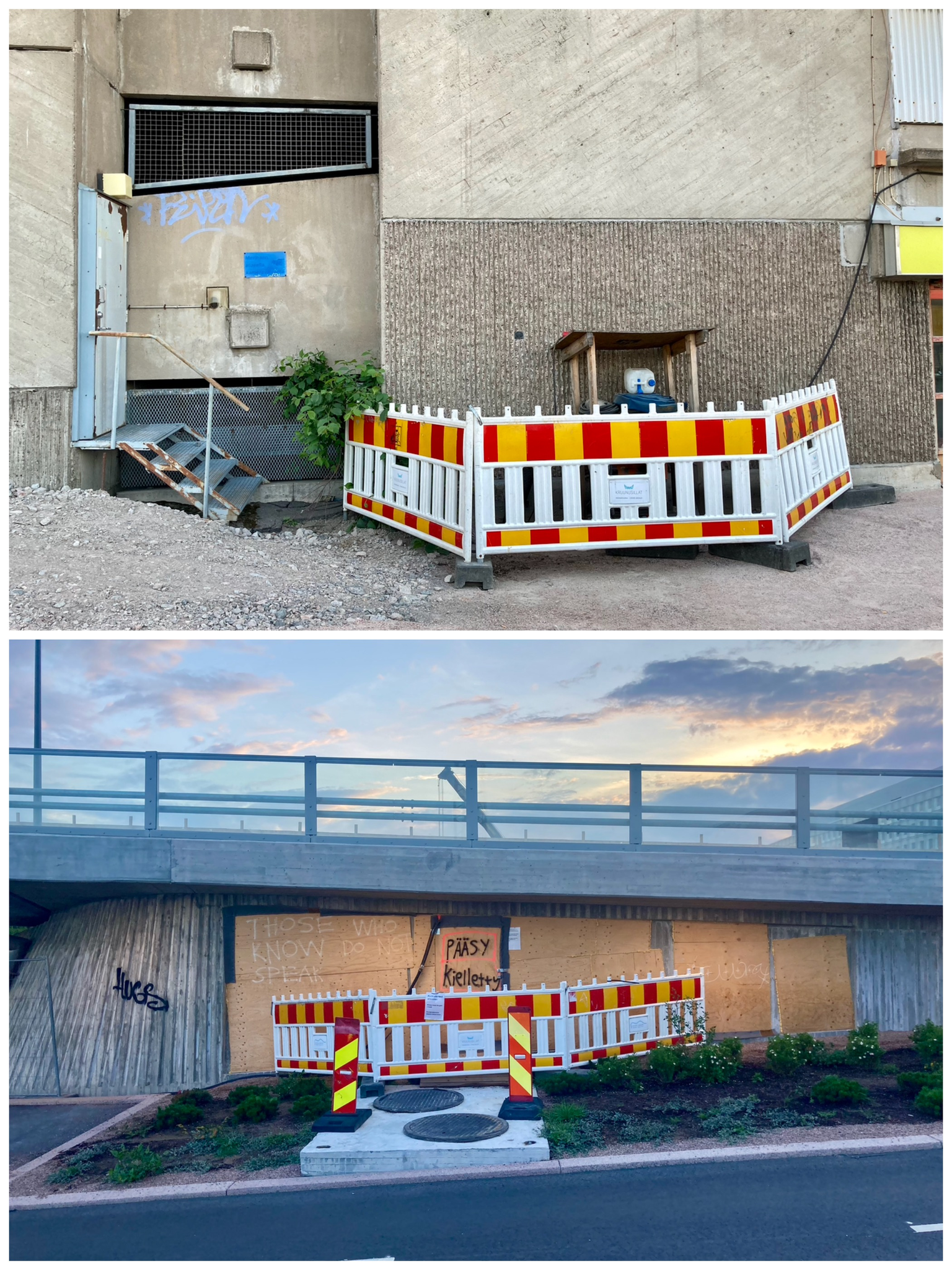
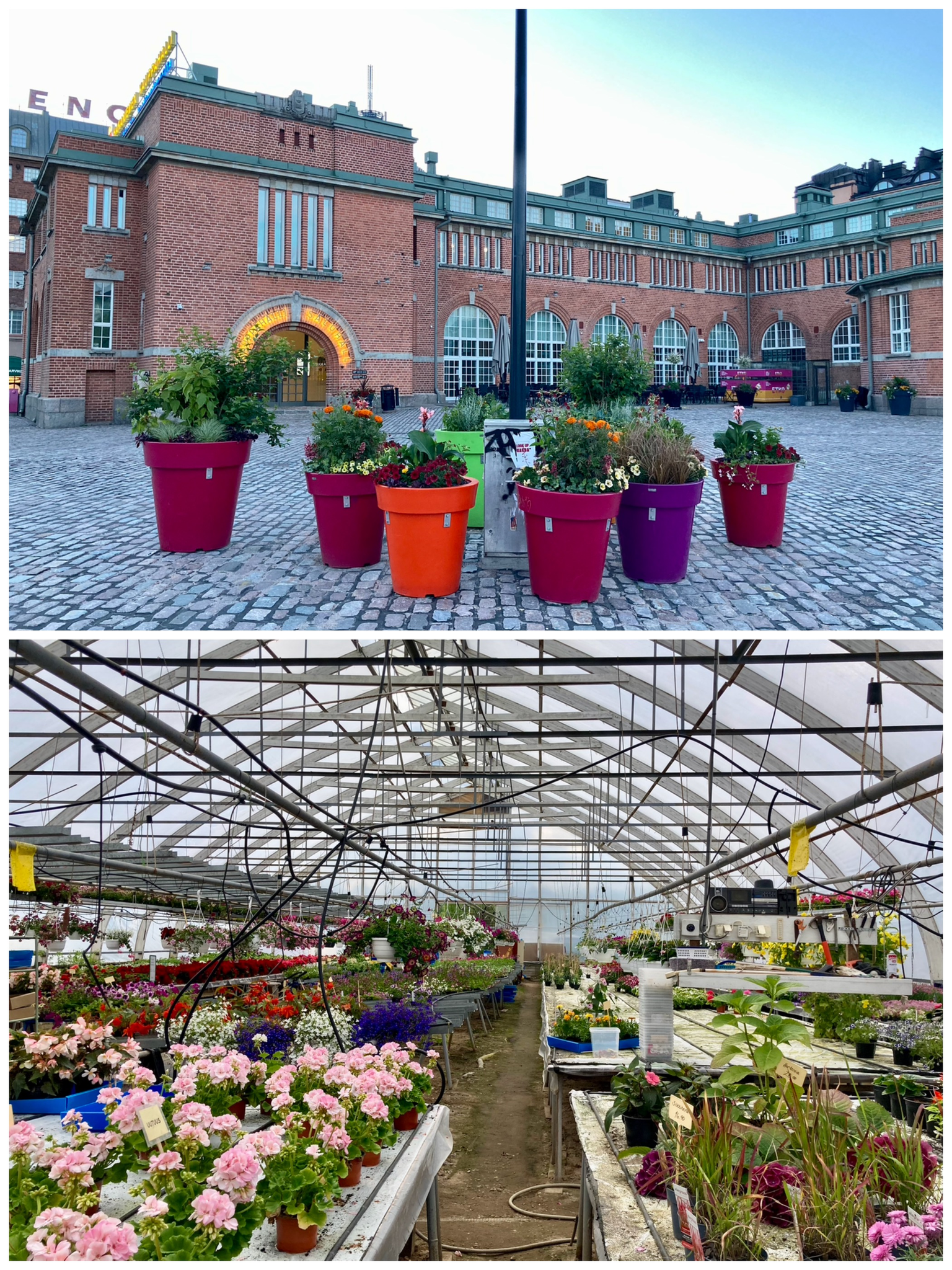
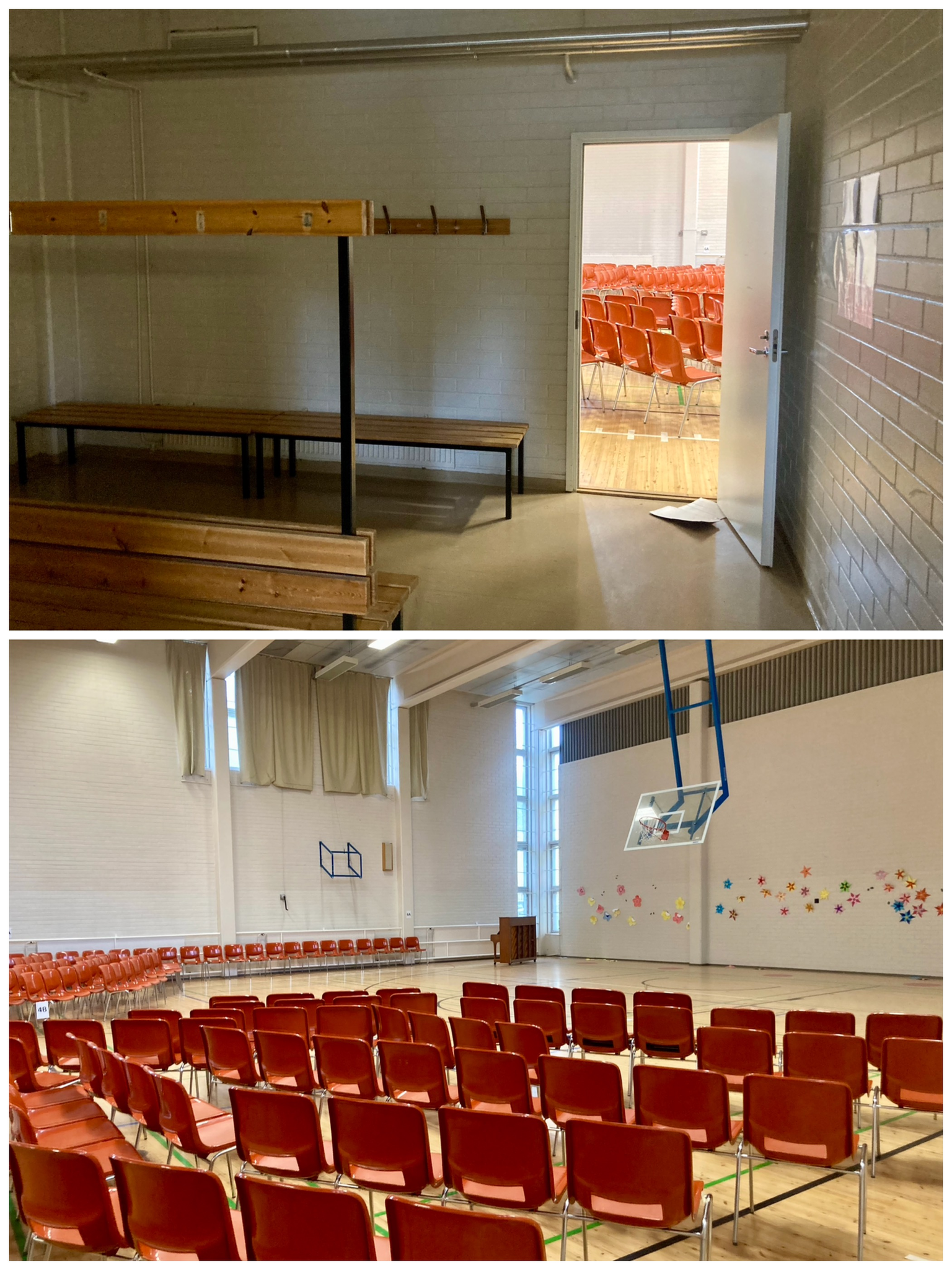
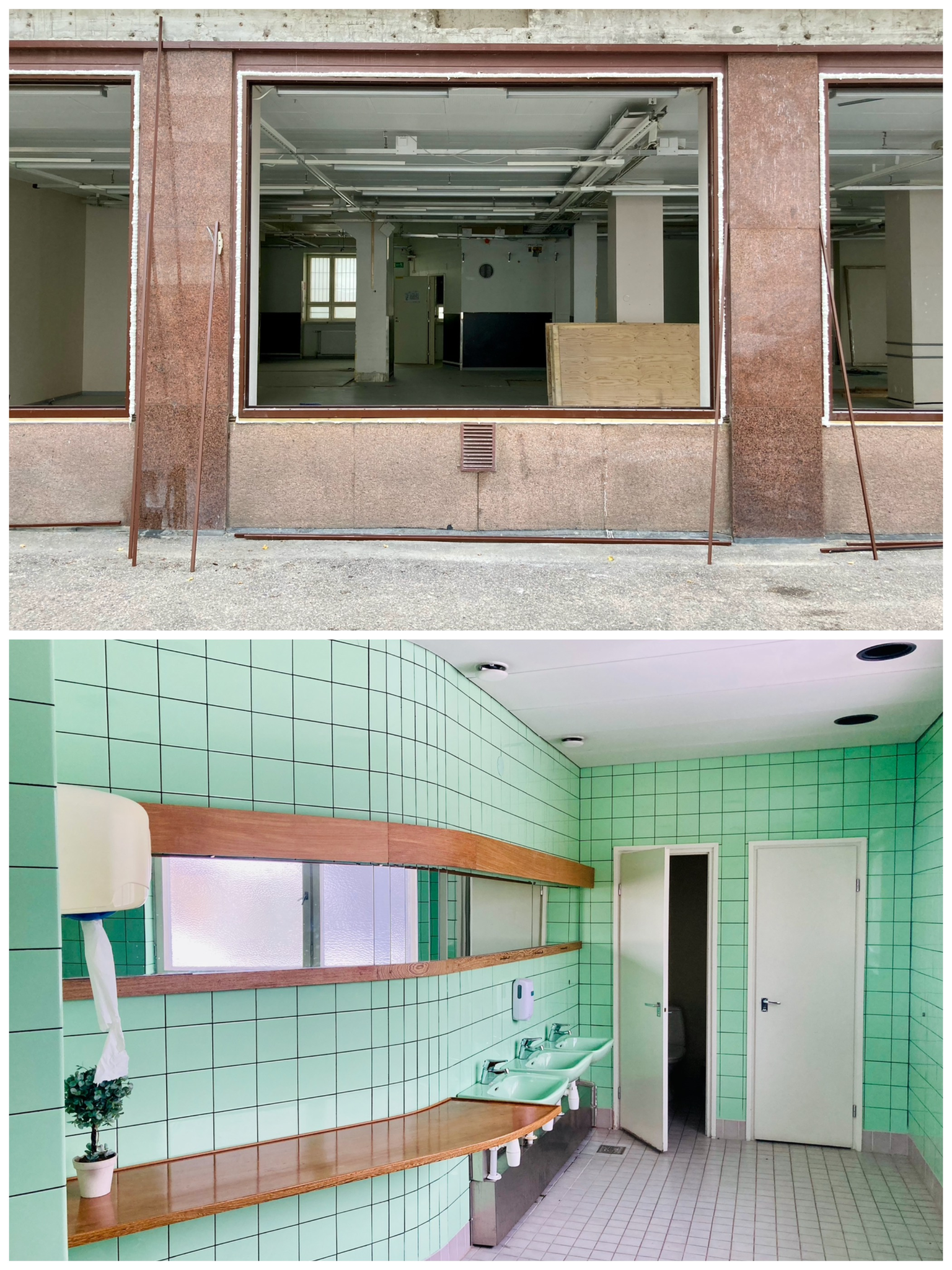
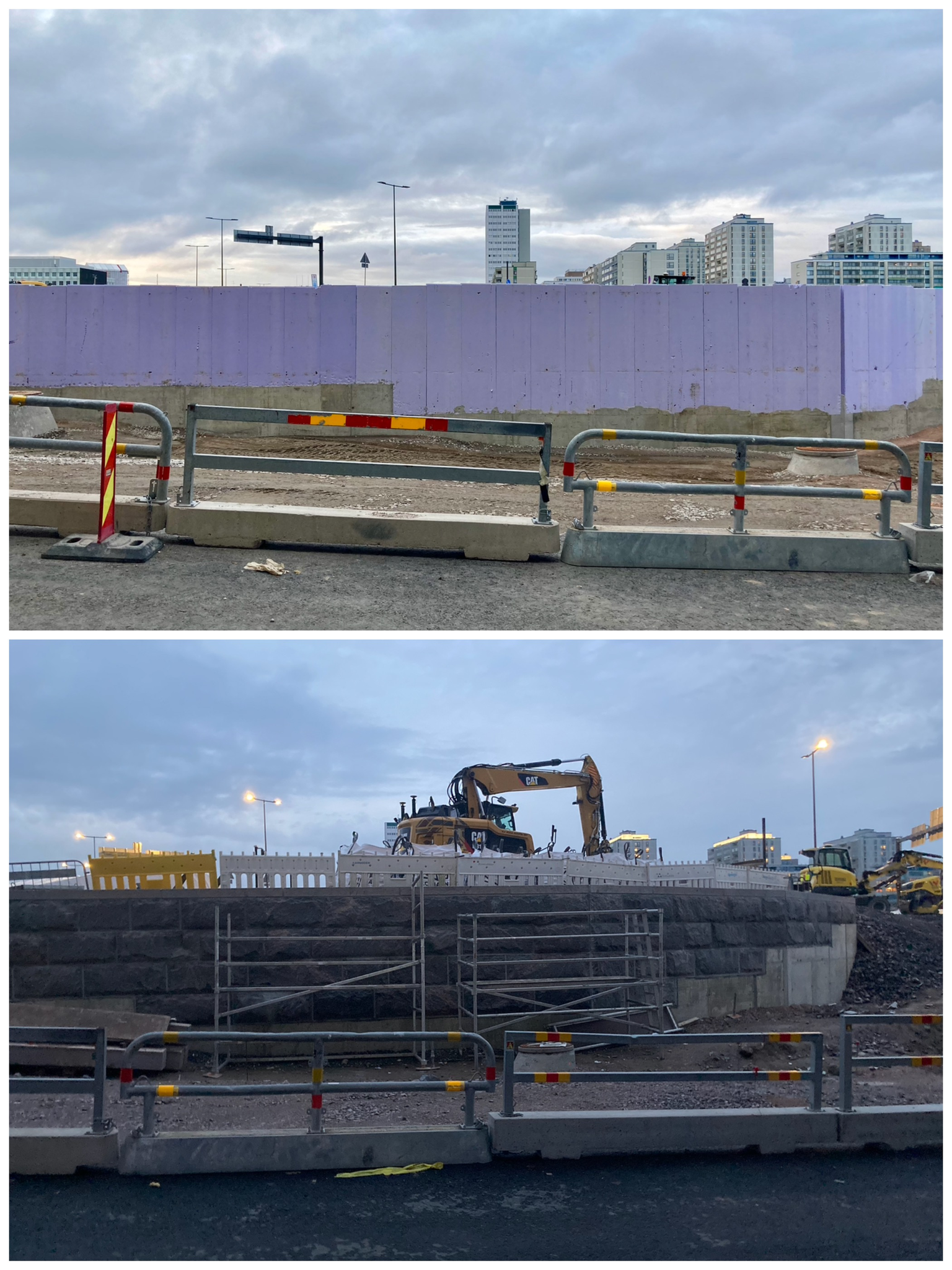
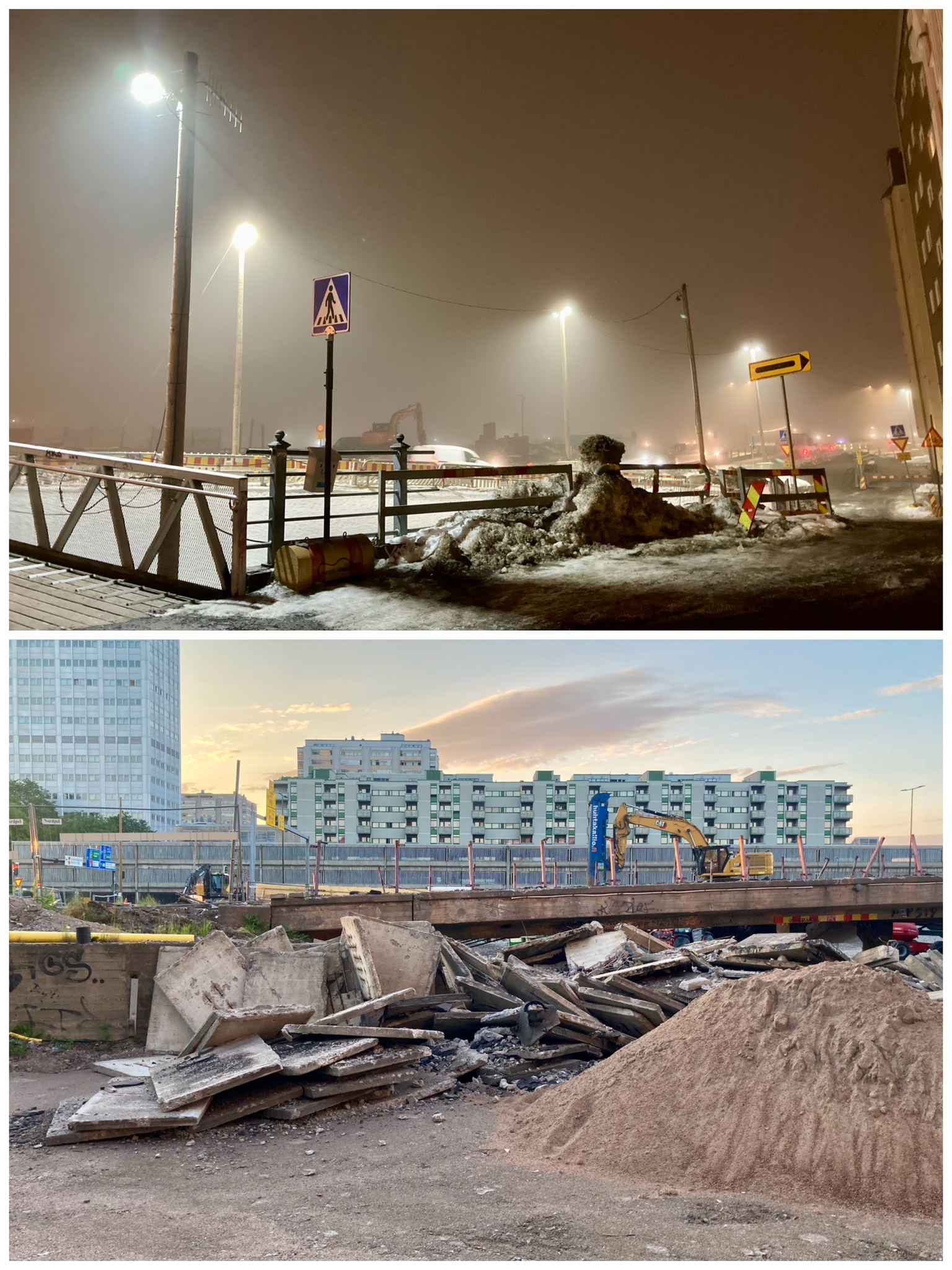
In this exposition, the found and experienced environments act as an impulse for artistic and pedagogical potentials in performance design. I will present my research approach to the urban, built environment, which I consider an impulse, a constant and ongoing potential for performances and performance designers’ work. I will contribute my topic, accompanied by photographs from my site-sensitive memos (Figures 1–6). In this exposition, I will present the photos in pairs, but they do not form a diptych. The images have emerged through scenography-oriented observation in the urban environment, and they are an example of a performance designer’s independent, site-oriented, artistic, everyday activity. This way of working relates to contemporary performance-making methods, philosophical perspectives and artistic research practices.
In this exposition, I open one of my personal nomadic, creative methods under development and reflect on current movements in performance design practices as a performance designer and lecturer at the Theatre Academy of the University of the Arts Helsinki. The exposition is a part of my doctoral research at the University of Lapland.
This exposition is a part of my artistic–practical action research that explores the transformation of performance design and the themes of sustainability. My research is situated in the field of art-based action research, with the intention of combining the performing arts, performance design, visual arts, and pedagogy. My research and artistic interventions are influenced by the contemporary performance design and its theories, sustainability, new materialism (e.g. Barad 2008; Bennett 2010; Braidotti, 2019; McKinney 2015‚ 2019), and other related perspectives.
According to Timo Jokela and Maria Huhmarniemi (2018, 2025), art-based action research is usually used in the development projects of art education, socially engaged art, and contemporary art. Art can serve many purposes in these development processes; art may be the intervention for problem-solving or gaining new knowledge and understanding,and promoting sustainable development is also often closely linked to art-based action research strategies. According to Patricia Leavy (2018), arts-based research is a creative field of research with a transdisciplinary approach to knowledge building. It can offer new insights, learning, and empathy, break barriers and cultivate critical and social consciousness.
In this exposition, I ask what kind of performance design could be created through scenographic worlding. As a researcher and a pedagogue, I am interested in what kind of change the performance designer encounters in the contemporary artistic work, and how to create more sustainable performance design and work towards more sustainable pedagogy. I aim to explore ways of understanding the present moment in performance design, as well as the movement and change that occur within it. I am a white, academic, middle-aged, female person in a Nordic welfare country, in the global North, working as an educator at an arts university. I am aware that this position shapes my perspective and offers both possibilities and limitations in how I perceive and interpret artistic processes and art pedagogy. By making my situatedness explicit, I aim to foster transparency and reflexivity in this research. In the context of artistic research, where embodied, lived experience plays a crucial role in the production of knowledge, the position can influence the relational and situated nature of performance design.
Heading Towards the World and the Urban Environment
The lived environment and the world are ongoing performances, full of found stages or potential, and endless libraries for creating theatrical realities (Figures 1–6). I propose observing the environment and documenting observations as a simple, more sustainable, and fluid way of sketching (Kilpeläinen 2023a). It is nothing new; the impermanent nature of the theatrical experience just invites the artist–designer towards the surprising impermanence of reality: lived and found stages, everyday performativity, material lightness, and the abandonment of heavy structures and conventions. If one wants to learn nomadic scenography, and to find scenographic qualities in the world, one has to observe and test the potentialities offered by the world, for example, to consider them as a kind of sketch.
Rachel Hann (2021) uses the term scenographics because of the plurality of crafts, orientations, and imaginaries framing the scenographic traits, and states that “to study scenographics is to study how world imaginaries are encountered through material cultures” (2021, p. 18). Hann proposes that “scenographics point towards a methodology for investigating the place orientating techniques and political narratives that culturally position bodies and peoples within a spatial imaginary of world” (2021, pp. 18–19). Hann introduces the concept of worlding (2020, p. 29) by defining it this way: “Ideas of worlding embrace that the thing that might be described as ‘the world’ as always in process. This approach builds directly from ideas of new materialism, which embrace the notions indeterminacy, ecological thinking, assemblage theory, and non-binary thinking.” According to Hann (2020, p. 31) “the idea of scenographic worlding opens the door to a broader discussion on how world narratives are also ‘scenographic’ in some way”. These theoretical considerations have also inspired my own work.
Art and the city are inextricably linked, artists have always gone toward urban themes; art and the city are constantly made, re-made and challenged at various scales, fixed in territories, moving in space and time (Luger 2017, p. 230). A question that performance design must also address is how we want to live in the future (Kilpeläinen 2023a, 2023b, Wiens 2024). The city is an ideal place for this action and reflection.
Observe, Do Not Assume
It is widely known that not all performances and not every theatre maker’s art takes place inside theatre buildings. Facilities of theatre institutions are too small to host all forms of performing arts and pedagogy. The situation can even worsen economically in the future, with cuts in state budgets for culture and education. It is valuable for performance designers and students to learn to harness their creativity in inventive ways, explore various forms of artistic expression, and create more art, for example, in public spaces and outdoors. In the field of the performing arts, site-sensitive and environmentally conscious practices have long been developed, and the very nature and history of the art form inherently involve outdoor performances (Carlson, 2018).
I have experienced that being site-specific and doing things differently can often be misinterpreted as primarily emancipatory activity, rather than as an integral part of the professional design process. It may also be seen as a refusal to do the traditional scenic design work or, worse still, as assuming that the designer may not be able or willing to work on institutional theatres and their structures. But let us not assume: performance design, like design in general, can mean many things and happen through many different methods and practices. In their unique ways, many artists and designers seek emancipation in artistic fields that are often defined by hierarchy, a superior way of working and spectacular outcomes. In this context, emancipation is not about liberation from all traditions or power structures, but about the experience of independence. Art does not always need a theatre house or a working group to be realised. Performances, performance design, action, performativity, narratives, time, and spatial constellations can still happen and be framed as performances or for performances. As the expanding and emerging professions of performance design and the performative turn recognised in the field of scenography show, performance designers can fluidly redefine themselves as soloists, conveners, and performance artists – you name it (e.g. Kilpeläinen, 2023a). Expanding can also be seen as looking at understanding, attitudes and behaviours from a broader perspective, and changing behaviours can also mean stopping, choosing to move away, reassessing one's values and changing one's patterns of action, even leading to activism (Hiltunen 2025, p. 31). Thankfully, understanding is growing, and the diverse and ever-changing field of performance design is better acknowledged as a professional art form.
Scenography on the Move…
In its current sense, scenography can be “understood as an inter-artistic practice and event-driven art, which does not provide mere backdrops or décor but stages (or rather composes) media, objects, and things that operate as integral elements within the performance production as well as the reception process” (Wiens, 2024, p. 354). Laura Gröndahl (2024, p. 4) says that “it seems that scenography has turned into an isolatable potentiality that merges out of intra‑actional performative processes in any space”. Gröndahl (ibid.) sees scenography as “a specific way of looking at the world as a stage, understanding the active agency of the material environment, the eventness of space, or the spatiality of events”. This has, according to Gröndahl (2024, p. 4), “led to an expansion of scenography beyond its ‘natural habitats’ of theatre performances and architecture into any place or situation in the world”.
Like scenography, the term performance design can in its broadest sense cover all aspects of scenic design (such as stage design, lighting design, sound design, costume design and video design) (e.g. Hannah & Harsløf, 2008; Palmer, 2011; Aronson, 2018; Hann, 2021; Kilpeläinen, 2023a). The concept of performance design (Hannah & Harsløf, 2008) has helped to create new connections and relations with a wide range of practices and has, via the scenographic turn, brought instead of only designing for performances, the performative nature of the scenic designers’ creative work – and designing as performances – to the focus. This allows for a more interdisciplinary, active, and performative design field which can make the designer’s role more extensive, embracing the skills of other artists and designers (e.g. Hannah & Harsløf, 2008; Hann, 2019; Kilpeläinen, 2023a).
Arnold Aronson (2018) has brought together the history and theory of environmental scenography, showing that the traditions of the stage and theatre space have been questioned throughout the ages. Aronson also compares the terms site-specific and immersive and finds both to be slippery (2018, p. 199). The essential aspect of performances that fall within their scope is the participatory and apparent agency for spectators, although Aronson questions both aspects. Aronson (2018, p. 201) defines immersive theatre as "a participatory performance event within an all-encompassing immersive environment that engages all the senses". According to Aronson (2018), in environmental theatre, the focus shifts from the text and its meanings to the signification of the physical space and the centrality of the experience in the space. Aronson also sees this as an attempt to re-activate the community in the context of performance.
… and on the Expansion
Various expressions and practices of expanded or expanding scenography have become common in performance design. Expanded scenography has originated from the reorganisation of theatrical scenography throughout the early 20th century and in post-dramatic and site-specific performance practices, which have revealed new possibilities for scenography as a cultural form. Expanded scenography represents a new way of thinking about the spatial, material and design-based aspects of performance (McKinney & Palmer, 2016). Expanded scenography includes, among other things, processes that focus on socially engaged, applied, and sited scenography and they present relationality, affectivity and materiality as core components (Wilson, 2022). As scenography is constantly expanding and changing, the term expanding scenography is nowadays preferred (e.g. Raya, 2023).
Liesbeth Groot Nibbelink (2016, p. 20) unfolds the vision of scenography through materiality, environment and the fact that “scenography mirrors and reflects this world”, and concludes that "scenography can be very performative". She (ibid.) points out that almost everything we see around us has been designed, and “the scene invites us to perceive the world around us from the perspective of design”. Groot Nibbelink (2016) mentions joint action and moments of collaborative scenography and discusses embodied, situated activity, a close link between scenography and dramaturgy, new-materialism, and mobile scenography as a nomadic concept. According to Groot Nibbelink (2019, p. 29), ”nomadic theatre invites a focus on situated practices, on processes of articulating particularity, and on the investigation of embodied relationships with the places and spaces through which we move and that through movement we create”. For example, Liisa Ikonen (2023) has proposed the concept of nomadic scenography in the context of site- and landscape-specific scenographic activities, using the phenomenon of distance as a starting point for scenographic expression and wandering as a place for making scenography. Louise Ann Wilson, on the other hand (2022), speaks of socially engaged and applied scenography. In site-specific walking performances, Wilson uses scenography to situate challenging, marginalising or missing life events in rural landscapes, creating a site of change where participants can reflect on, describe and re-imagine their relationship to their circumstances.
Kitija Balcare (2023) states that performances in natural environments are common in our time, for example in the context of more ecological performance art. According to her (2023), there is a trend in Latvia to develop ecodramaturgical performances that take place in nature, using site-specific and itinerant forms of performance. Balcare (2023) says, that the challenges posed by the Covid 19 pandemic led theatre-makers to look for alternative, safe stages, and to turn to site-specific forms of performance in nature. Finnish performances in natural environments are often collaborative projects in which, for example, nature, audience participation and, for example, natural science intra-act. The works may be about, for example, activating the public to move through the landscape, or learning from nature, land and other species, or about some historical connections to the very place and landscape. The possibilities of scenography in outdoor and nomadic work are many and relate, for example, to the orientation and choice of place, natural conditions, season, and the dramaturgy of place and audience.
Hann (2019; 2020, p. 32) has introduced the concept of beyond scenography and featured a manifesto, that offers “a working roadmap to the power of scenographics in speculating new world imaginaries”:
“Scenographics irritate the disciplined orders of world
A scenography of orientation is a scenography of feeling
Skenographia has many legacies
Scenography is not set; scenography happens
Scenography has exceeded the scenographer
There are no stages without scenographics
While all scenography is scenographic, not all that is scenographic is scenography
Whereas slow architecture pertains to monumentality, fast architecture is scenographic
Scenographics score acts of worlding.”
Hann discusses (2021) scenography as the crafting of borders. Hann (2024) also calls for rethinking and renewing the political role of scenography with the concept of pluriversal scenographics. Hann (2024, p. 18) states, that “all scenographics are pluriversal in that all scenographic practice calls attention to the performances of the world” and investigates the cosmological orientations.
Tanja Beer continues the active work on eco-scenography, the term Beer coined in 2008, discussing issues such as co-designing with materials, designing with nature and multiple perspectives of environmental responsibility. According to Beer (2021), eco-scenography looks to the living world for inspiration and strives to integrate ecological thinking into all stages of theatre production and gives value to the whole process. Beer’s (2021) proposal of the eco-scenography’s cyclical framework – co-creating, celebration and circulation – is a regenerative reimaging of the future of performance design.
Everyday Wonders and Pedagogical Approaches
The potentiality of scenes, stages and narratives of everyday performativity appears to me in the found environments. These findings inspire me to photograph (Figures 1–6), in different environments, on the paths of my everyday routes. I like the spontaneity of the action, the freedom and the ability to transpose my notes into a new composition, something else, and towards pedagogical tasks. This way of working involves letting go, not serving, being unproductive, and, at the same time, being productive. By relying on this way of working, I don't need to design fantasy but instead observe and apply, find the wonders of everyday life; everything is already here.
It is interesting to consider what the artist creates when making art. When I shoot my everyday photo series, I don't think of creating or inventing something new, but rather of framing and channelling something of what already exists, of making visible what already exists. I can reformulate this, for example, as a scenography for the stage, scenographics for a performance, or let it be a photograph of the everyday framing as such. This is one way of observing and testing the performative potential of performance design.
When I walk in different environments, I photograph my notes, so I sketch. I observe moments, situations and spatial everyday assemblages during bodily movement, and I frame and document them with my camera into photographic notes. The point is that I do not search, I find. The main thing is to move and observe, to be part of the environment and to be amazed by it. I often move together with my dog, and we take turns choosing routes. My walking and photographing activities stem from the fact that I move mostly by walking every day and see action, acts, stages, and potential stages everywhere. Some observations I manage to photograph, while others are just fleeting. I identify with the contemporary hunter-gatherer person, but I do not actively pursue prey, I walk my routes and collect notes along them for my artistic and research needs. I actively and consciously practise this culture of observation, but not under any compulsion. To follow Denise Ziegler (2023), when walking, awakening, observing, sketching and making a work of art in and of the surrounding urban space, the experience of space can be offered for discussion. This I would call being beyond scenography, making pluriversal scenographics visible, and worlding.
By practising this everyday activity in everyday environments, I experience feeling, sensing and receiving gifts, and I do not have to think about consumption, commercialism, or cost, even when I am moving in an urban environment. I find that moving freely in a built environment can also be energising, lower stress and activate creativity, such as moving in a wild environment, like in forests. However, human mobility and body capacity are always limited, no matter where one is moving, and the environment will always, in some way, limit and control one's access, even in the wilderness.
Pedagogically, with this method, I want to strengthen the artist–designers’ capacity for nomadic scenography learning and a culture of moderation; it is essential to ask what is already there, what you can already find around, what you already have, what you can give up and what you need for the art to happen. Another current, pedagogical aspect linked to this constant learning is eco-creativity, a creative engagement with sustainability (Beer & Hes, 2017). Envisioning and imagining new scenographic futures and bringing new, creative, and sustainable working methods into practice is a constant challenge for every performance designer and educator in the field. Creativity and inventiveness are qualities associated with the artistic profession, and harnessing them to work towards sustainability and creating a more ecological stage is, from my understanding, at the core of eco-creativity. In art and art pedagogy, eco-creativity can mean, for example, looking at things differently, rethinking materials, utilising what already exists, taking a broader view of the concept of agency, and, overall, adopting more ecological strategies for creating and teaching. In the spirit of nomadic scenographic learning, this may include, among other things, applying performance design in varied, unconventional, non-fixed ways, becoming physically and multisensorily sensitive to the environment and becoming inspired as a part of it. A more ecological pedagogy in performance design is based on eco-social and planetary values (e.g. Kilpeläinen 2023b). Ecoscenography is both a design strategy and a pedagogical framework, and it is not prescriptive – pedagogues must be mindful of their own biases and traditionally ingrained theatre and performance practices if they wish to nurture students in ways that challenge the norm and reject the linear (Beer et al. 2024, p. 492). It is worth noting that research on the pedagogy of ecosecography and more sustainable performance design is related to the broader paradigm shift of more ecological art and the outdoor education in art universities and higher education institutions. In Finland, since the 1990s, dialogic, pedagogic and more sustainable approaches in international contemporary art have inspired art teachers and educational researchers to seek strategies that take students outside the classroom and outdoors (e.g. Huhmarniemi et al. 2021; Stöckell 2025).
In developing the working method presented in this exposition, I have thought that it can offer the designer learning opportunities: by giving the design task to the world, and by taking on more the role of observer and documenter, the designer allows the world to perform and pluriversality to appear. This brings perspective to art-making in a time of multiple crises. As a pedagogue, I want to bring to students a wide range of examples of the work of a performance designer, so that new authorships and artworks that explore the scenographics and the performative potential of scenography can emerge. Nomadic scenographic learning and scenography-oriented observation can also be considered a form of active observation, which is a crucial aspect and phase in the work of a performance designer. My research presents an opportunity to innovate education: I hope that my work will enable me to share my method with students in a course where we can further develop it together through experimenting, reflecting and peer learning. I hope that my method will nurture the performance designers' relationship with the practices that emerge from the environment and experience.
Alongside an accelerating way of living, there are different cultures of slowing down and questioning. Nicole Rallis and Ken Morimoto (2024, p. 3) state: “In a rush to ‘get things done’, we sometimes disregard the significance of the minutia of everyday life. Perhaps, it is in the minutia, in the little steps we walk each day that we can re-learn and re-connect more deeply with the world and relationships that surround us and sustain us.” Walking, a/r/tography, mapping the environment and learning with land and place can serve ecopedagogical encounters, relationality and the love for the world (e.g. Rallis et al., 2024). “How can creative walking practices grounded in kinship and relationality transform, complicate, and help us re-imagine understandings of history, place, and self?”, are Rallis and Morimoto (2024, p. 5) asking. They rely on ecopedagogical inquiry, that “encourages one to develop art practices and narratives grounded in cultural knowledge, histories, lived experiences, local geographies, and ecologies” (Rallis & Morimoto, 2024, p. 6). According to them, “ecopedagogical walking encourages diverse perspectives and practices-encounters and walking (un)familiar paths, we may develop special relationships with trees, plants, and rivers, a favourite neighbourhood street, the local grocer, a sidewalk bench, or a public green space” (Rallis & Morimoto, 2024, p. 6). Such a similar nomadic way of working has begun to be explored in research under the concept of walkography (e.g. Lasczik Cutcher 2017).
Ziegler's (2010, p. 90) mimetic practice focuses on situations that contain everyday, unnoticed or unintentional human activity or traces of it. Ziegler refers to such phenomena as “undefinable gestures” and considers their relationship to poetic expression. She uses situations like this as the starting point for her work. According to Ziegler, such situations typically involve actions which are generally repetitive and ordinary, and by virtue of their ordinariness they are unnoticed or fortuitous, undefinable gestures. There is something about Ziegler's model of mimetic work and photographs that resonates with my own method. Ziegler (2010, p. 90) writes that when “processed into a work of art and dissociated from their everyday context, these undefinable gestures and their traces can evoke feelings of strangeness, conflict or hilarity” and these emotions “facilitate the experience of a special kind of catharsis”. In Ziegler’s research (2010, p. 90), “the object of analysis is specifically works of art that are “based on events and situations which draw attention to ordinary and often unconscious ways of acting in everyday life” and the undefinable gesture is “an expression of this mode of action”.The traces of undefinable gestures appearing in Ziegler’s work are “based on actions in our daily life which have both a concrete dimension and features that are identifiable as symbolic”. Ziegler (2022) has since focused on the relations between teaching, research and art-making. Ziegler (2022, p. 14) considers the teaching of visual arts as part of artistic practice. According to Ziegler (2022, p.19), engaging with materials or sites is an essential part of the visual artist’s work, and materials and sites can be used as resistors, teachers and learning processes in many artistic practices. We are moving towards a new-materialist way of thinking, where the human is not at the centre of everything, but only one part of ever-changing systemicity (e.g. Porkola 2022, pp. 48–49). This is especially emphasised in site-sensitive work, which has common ground with situational learning and various orientations in land-based learning.
The City as a Source of Performances and Urban Aesthetics
Kim Solga et al. (2009) have considered the relationship between the city and performance, considering the physical, political, geographical and socially embodied aspects of the city. Performance can discuss diversity, nuance, and lived experiences of urban spaces. Solga et al. also highlight the city and its stories, the privacy and publicity, and the many roles of the experiencer; “taking part in the rehearsal of a community, its rebuilding and collective restaging”. Solga et al. propose that performance “can help to renegotiate the urban archive, to build the city and change it”. (Solga et al., 2009, pp. 3–6.) According to Maiju Loukola, “the city space can be understood as a nexus of its inhabitants’ freedom, needs, interests, desires, and their estuaries” (2023, p. 55). According to Richard Schechner (2013, p. 31), performances occur in eight sometimes separate, sometimes overlapping situations, of which everyday life is one.
The performance, city, and environment can be approached through many theorists and their concepts: Gaston Bachelard (1958/1994), Michel Foucault’s heterotopia from the 1960s (e.g. Foucault 1997), Michel de Certeau (1984), Guy Debord (1987), Henri Lefebvre’s lived space (1991), Tim Ingold (2000/2011), Una Chaudhuri’s geopathology (1995), Edward Soja’s Thirdspace (2000), Nicolas Bourriaud’s relational aesthetics (2002), Miwon Kwon’s site specificity (2002), Doreen Massey's (e.g. 2005) global sense of place and alternative interpretations of place as a constellation of social relations and as a product of in-between, the avant-garde movement Situationists and their concepts of dérive, détournement and flâneur (e.g. Lavery, 2010; Sledmere, 2022), Walter Benjamin (e.g. Whybrow, 2014), or through aspects of everyday (e.g. Johnstone, 2008; Moran, 2005). For the walking, the writings of Henry David Thoreau (e.g. Thoreau, 1862), Rebecca Solnit (e.g. 2001) and the concept of walkography (Lasczik Cutcher 2017) are worth studying.
In the context of site-specific performances, Mike Pearson (2010, p. 98) ponders how complex the city is as an organism for us never to know fully and how it consists of endlessly intersecting narratives. Laura Levin (2009, p. 255) states that the site emerges in a mode of sensory perception open to the physical world and which exceeds the spectator’s ability to fully grasp it because of the exigencies and limitations of human language.
Loukola (2023, p. 49) argues that “affective processes, situational, and relative by nature, have an underused and unidentified capacity to break the normative spatial order in ways that have potential to liberate some of the urban space legal practices beyond their positivist-normative purposes and interpretations”. According to Loukola (2023, p. 49) affective processes have the potential to “enhance affective cohesion and sense of belonging through citizens’ daily practices, individual and collective, connected to their living environment and their material-architectural processes”.
It is also fascinating to think about the city through memories and representations, lived and learned history as a polyphonic, intra-active weaving and how our knowledge and beliefs influence our experience of it, or as Jelena Stankovic (2016) puts it, the city as remembered and the city as imaged, never the same and always different. Experiencing cities is challenging; we usually experience only fragments of them and build our understanding on multiple sources of information, of which one is our imagination.
Also, according to Sanna Lehtinen (2023), a city can never be experienced as a whole, no matter its size; the aesthetic dimensions of urban experience are intimately linked to the limits of human senses. According to Lehtinen (2023), there is friction between perfection and imperfection inherent in urban aesthetic experience. Lehtinen (2023) explores how the idea and representation of the city inevitably fail in experience and how perfection and imperfection are not simple opposites but multidimensional concepts that are always mixed to a varying degree in urban experiences.
According to Angela Goh and Beer (2024), contemporary performance design can reimagine the city as a dynamic stage for cultural narratives and artistic expression, and the characteristics of ecoscenography and creative placemaking can be combined into ecoscenographic placemaking, a place-responsive approach to creative processes, demonstrating how it can develop works that strengthen place-based ecological engagement. Goh & Beer (2024) state that this form of site-specific activation creates ecological aesthetics that challenge traditional understandings of beauty and repetitive working methods based on the eco-cultural narrative embedded in shared urban landscapes.
Conclusions and Suggestions
In this exposition, I have discussed and experimented on urban space as a scenographic phenomenon, exploring its material, discursive, imaginary, and potential dimensions. The ways of making and experiencing presented above are linked in our time to the histories of contemporary theatre and performance art, as well as to various visual arts perspectives, including sketching techniques, photography, community art, environmental art, relational art, participatory art, and art pedagogy. By observing scenographics in an embodied, nomadic way, and by worlding, multidirectional learning can happen. It can also create understanding of a more sustainable stage and make eco-creativity meaningful.
This artistic approach makes it possible to ask, as it were, what we already have, and whether it could be enough, whether it could appear interesting in itself, or even as something else if we want. New materialist and post-humanist approaches influence the practice. An observational, experiential, and environmentally oriented way of working may prove more useful in the future. As a pedagogue and an artist, it is essential to comprehend systemic thinking, which encompasses the multilayered and polyphonic concept of environments and their diverse, multispecies habitats. The uncontrolled nature of the environment, as well as the observation and operation within it, and the specificities of places, help us to understand different public relations and audience dramaturgy in various artistic practices. Participatory, experiential, ambient and immersive forms of performance are popular, and many designers encounter them in their careers because not all performing arts take place inside theatres or on permanently existing stages. New scenographic futures are constantly created and emerging.
Photography is a form of framing, and framing as a tool of the performing arts can be, among other things, constant embodied, multisensory experimentation of the potentials of scenographics, stage–audience relationships, and can function, for example, as a site-sensitive tool (Figures 1–6). In Hann’s (2024) footsteps: as an artist and performance designer, I keep on asking myself how I am participating in how a feeling of the world is produced through staged material cultures.
I invite readers to join me in learning: nomadically, scenographically, more sustainably, through observation, and by worlding. Try my simple technique the next time you walk through an (urban) landscape:
When you walk in an environment, whether built or wild, observe with multiple senses. Try different perspectives. When you catch the sense of place, when you hear the world speak to you when you feel like you're in performance, in a movie, or when you suddenly feel like you're in a staged space, in a staged reality, or when you see a stage or a stage image, or when the moment is just too perfect, just too weird, just too ‘set’ to be everyday life in the city, when you sense a perfect assemblage or a composition, take a picture. Frame a piece of the world as a stage, and take a note. No matter what the media is. If you document it somehow materially, it might be easier to share, in case you want to share. You can document one framing several times over a longer period to follow the change. Present the documentation as a series where the moments can communicate with each other. Apply to other media, if you feel so. The found and framed material can also be immediately transferred to performances or other artworks.
And then, my final words for this exposition. They took the form of a poem:
On this very planet,
nothing is disappearing. Materia circulates.
Thoughts fragment and merge. Are forgotten and will reappear.
Everything is here.
References
Aronson, A. (2018). The history and theory of environmental scenography. Methuen Drama.
Aronson, A. (2018). The Routledge companion to scenography. Routledge.
Bachelard, G. (1994). The poetics of space. Beacon Press.
Balcare, K. (2023). Reduce, reuse, or refuse? Pioneering sustainability in the theatre scene in Latvia.” Nordic Theatre Studies: 34(1), 109–126. https://doi.org/10.7146/nts.v34i1.137929
Barad. K. (2008). Posthumanist performativity: Toward an understanding of how matter comes to matter. In S. Alaimo & S. Hekman (Eds.). Material feminisms (pp. 112–141). Indiana University Press. https://ebookcentral.proquest.com/lib/uahelsinki/detail.action?docID=1402897
Beer, T., Rixon, T., Garrett I., & Goh, A. (2024). Embedding ecoscenography into performance design pedagogy: three practice based approaches, in Theatre, Dance and Performance Training: 15(3) (pp. 472–494). https://doi.org/10.1080/19443927.2024.2345609
Beer, T. (2021). Ecoscenography: An introduction to ecological design for performance. Palgrave Macmillan.
Beer, T. & Hes, D. (2017) Sustainability in production: Exploring eco-creativity within the parameters of conventional theatre, in Behind the Scenes: Journal of Theatre Production Practice: 1(1). https://via.library.depaul.edu/bts_journal_of_theatre_production_practice/vol1/iss1/4
Bennett, J. (2010). Vibrant matter: A political ecology of things. Duke University Press. https://doi.org/10.1515/9780822391623
Bourriaud, N. (2002). Relational aesthetics. Les presses du reél.
Braidotti, R. (2019). Posthuman knowledge. Polity.
Carlson, M. (2018). The city as theatre. In A. Aronson, The Routledge companion to scenography (pp. 290–294). Routledge.
Certeau, M. d. (1984). The practice of everyday life. University of California.
Chaudhuri, U. (1995). Staging place: The geography of modern drama. University of Michigan Press.
Debord, G. (1987). Society of the spectacle. Rebel Press.
Foucault, M. (1997). Of other space: Utopias and heterotopias. In N. Leach (Ed.), Rethinking architecture: A reader in cultural theory (pp. 350–356).Routledge.
Goh, A., & Beer, T. (2024). Ecoscenographic placemaking: a cultural approach to creating eco-sensitive site-specific work in Theatre and Performance Design: 10(4) (pp. 300–320). https://doi.org/10.1080/23322551.2024.2433355
Groot Nibbelink, L. (2019). Nomadic theatre: Mobilizing theory and practice on the European stage. Methuen Drama.
Groot Nibbelink, L. W. (2016). Mobile scenography & material thinking. In L.W. Groot Nibbelink, N. Scholts & S. van der Valk (Eds.), Current movements, future landscapes: Reflections on the exposium thinking-scenography (pp. 18–35). International Theatre and Film Books.
Gröndahl, L. (2024). The art and occupation of stage design in Finnish theatres: The rise and fall of a professional community. Routledge.
Hann, R. (2024). Pluriversal scenographics and staging world feelings: Climate crisis in SUPERFLEX’s ‘It is not the end of the world’. CulturalGeographies, 0(0). https://doi.org/10.1177/14744740241234288
Hann, R. (2021). At the borders of scenography. In A.V. Rosen & V. Kjellmer (Eds.), Scenography and art history: Performance design and visual culture (pp. xvi–xix). Bloomsbury Visual Arts.
Hann, R. (2020). Notes on beyond scenography. Revista Cena, Porto Alegre, nº 31, mai./ago. (pp. 27–33). Disponível. http://seer.ufrgs.br/cena
Hann, R. (2018). Beyond scenography. Routledge.
Hannah, D., & Harsløf, O. (2008). Performance design. Museum Tuscalanum Press.
Hiltunen, M. (2025). Kuvataidekasvatuksen laajenevat yhteisöt: arktisia aikavaelluksia nykytaiteeseen ja kosmokseen [Expanding communities in art education – Arctic time travels into contemporary art and the cosmos]. Research in Arts and Education, 2025(1), 7–36. https://doi.org/10.54916/rae.145686
Huhmarniemi, M., Jokela, T., & Hiltunen, M. (2021). Paradigm shifts in northern art, community and environment studies for art teacher education. Social Sciences & Humanities Open, 4(1), Article 100181. https://doi.org/10.1016/j.ssaho.2021.100181
Ikonen, L. (2023). Nomadic scenography and fictional space-body. In M. Loukola, M. Mäkiranta & J. Tolonen (Eds.), Figurations of Peripheries Through Arts and Visual Studies: Peripheries in Parallax (pp. 30–46). Routledge.
Ingold, T. (2011). The perception of the environment: Essays on livelihood, dwelling and skill. Routledge.
Johnstone, S. (2008). The everyday. Whitechapel.
Jokela, T., & Huhmarniemi, M. (2025). Taideperustainen toimintatutkimus kuvataidekasvatuksen käytäntöjen kehittämisen välineenä [Art-Based Action Research as a Tool for Developing Practices in Art Education]. Research in Arts and Education, 2025(2), 100–125. https://doi.org/10.54916/rae.145624
Jokela, T. & Huhmarniemi, M. (2018). Art-based action research in the development work of arts and art education. In G. Coutts, E. Härkönen, M. Huhmarniemi & T. Jokela (Eds.), The lure of Lapland – A handbook for artic art and design (pp. 9–23). University of Lapland.
Kilpeläinen, R. (2023a). On the search for a more sustainable stage – Mapping the perspectives of a performance designer. Research in Arts and Education, 2023(3), 52–68. https://doi.org/10.54916/rae.136947
Kilpeläinen, R. (2023b). Reflections on Sustainability in Performance Design. In T. Humalisto & R. Kilpeläinen (Eds.), Sustainable choices – Potentials and practices in performance design (pp. 33–54). University of the Arts Helsinki’s Theatre Academy.
Kwon, M. (2002). One place after another: Site-specific art and locational identity. MIT Press.
Lasczik Cutcher, A. J. (2017). Moving-with and moving-through homelands, languages and memory: An arts-based walkography. BrillSense.https://doi.org/10.1163/9789463512480
Lavery, C. 2010. Situationism. In N. Whybrow (Ed.), Performance and the contemporary city: An interdisciplinary reader (pp. 92–94). PalgraveMacmillan.
Leavy, P. (2018). Handbook of arts-based research. The Guilford Press.
Lefebvre, H. (1991). The production of space. Blackwell.
Lehtinen, S. (2023). Urban experience as aesthetic compromise. In P. Cheyne (Ed.), Imperfectionist aesthetics in art and everyday life (pp. 363–374). Routledge.
Levin, L. (2009). Can the city speak? Site-specific art after postructuralism. In In D.J. Hopkins, S. Orr & K. Solga (Eds.), Performance and the city(pp. 240–257). Palgrave Macmillan.
Loukola, M. (2023). Urban spaces between norms and dreams. In M. Loukola, M. Mäkiranta & J. Tolonen (Eds.), Figurations of Peripheries Through Arts and Visual Studies: Peripheries in Parallax (pp. 47–59). Routledge.
Luger, J., & Ren, J. (2018). Art and the city: Worlding the discussion through a critical artscape. Routledge.
Massey, D. (2005). For space. SAGE.
McKinney, J. (2019). Scenographic materiality: Agency and intra-action in Katrin Brack’s designs. In B.E. Wiens (Ed.). Contemporary Scenography: Practices and Aesthetics in German Theatre, Arts and Design (pp. 57–72). Methuen Drama. http://dx.doi.org/10.5040/9781350064508.0011
McKinney, J. (2015). Vibrant materials. The Agency of Things in the Context of Scenography. In J. McKinney, M. Bleeker, E. Nedelkopoulou, J.F. Sherman (Eds.), Performance and phenomenology: Traditions and transformations (pp. 121–139). Routledge. https://doi.org/10.4324/9781315752365
Mc Kinney, J. & Palmer, S. (Eds.) (2016). Scenography expanded, an introduction to contemporary performance design. Bloomsbury.
Moran, J. (2005). Reading the everyday. Routledge. https://doi.org/10.4324/9780203280409
Palmer (2011) Part 3: Space. In J. Pitches & Popat S. (Eds.), Performance perspectives: A critical introduction (pp. 52–87). Palgrave Macmillan.
Pearson, M. (2010). Site-specific performance. Palgrave Macmillan.
Porkola. P. (2022) Art pedagogy with matter – New matearialist approaches to performance and pedagogy. In D. Ziegler & P. Porkola (Eds.), Visual artist’s workbook: Essays and exercises on teaching arts (pp. 47–55). Academy of the Fine Arts of the University of the Arts Helsinki. https://urn.fi/URN:ISBN:978-952-353-435-3
Rallis, N., Morimoto, K., Sorensen M., Triggs V. & Irwin R. L. (2024). Walking in art education: Ecopedagogical and a/r/tographical encounters. Intellect.
Rallis, N. & Morimoto, K. (2024). Introduction: Encountering kinship and relationality. In N. Rallis, K. Morimoto, M. Sorensen, V. Triggs & R. L. Irwin (Eds.), Walking in art education: Ecopedagogical and a/r/tographical encounters (pp. 1–10). Intellect.
Raya, M. M. (2023). Unimagined Spatial Performativity in three Scenographic Assemblages. Aalto University, School of Arts, Design and Architecture. https://urn.fi/URN:ISBN:978-952-64-1564-2
Schechner, R., & Brady, S. C. (2013). Performance studies: An introduction (3rd ed.). Taylor and Francis.
Sledmere, A. (2022) Psychogeography: reimagining and re-enchanting the smart city. In S. Flynn. (Ed.). Equality in the City: Imaginaries of the Smart Future (pp. 220–259). Intellect Books Ltd.
Soja, E. (2000). Thirdspace: Expending the scope of the geographical imagination. In A. Read. (Ed.). Architecturally speaking: Practices of art, architecture, and the everyday (pp. 13–31). Routledge. https://doi.org/10.4324/9780203468791
Solga, K., Hopkins D. J. & Orr S. (2009). Introduction: City/Text/Performance. In D.J. Hopkins, S. Orr & K. Solga (Eds.), Performance and the city (pp. 1–9). Palgrave Macmillan.
Solnit, R. 2001. Wanderlust: A history of walking. Penguin Books.
Stankovic, J. (2016). Mapping the city as remembered and the city as imaged. In S. Hawley, E. M. Clift, K. O'Brien, S. Hawley (Eds.), Imaging the city: Art, creative practices and media speculations (pp. 75–94). Intellect Books.
Stöckell, A. (2025). Kestävää muutosjoustavuutta talvitaiteesta. Research in Arts and Education, 2025(1), 55–77. https://doi.org/10.54916/rae.145647
Thoreau, H. (1862). Walking. In The Atlantic, May/1862. https://www.theatlantic.com/magazine/archive/1862/06/walking/304674/
Whybrow, N. (2014). City. In B. Reynolds (Ed.), Performance studies: Key words, concepts and theories (pp. 304–313). Palgrave.
Whybrow, N. (2011). Art and the city. I.B. Tauris & Co. Ltd. https://doi.org/10.5040/9780755604081
Whybrow, N. (2010). Performance and the contemporary city: An interdisciplinary reader. Palgrave Macmillan.
Wiens, B. (2024). Sharing spaces: The art of scenography - some European perspectives. In A. Mancewicz & R. Remshardt, The Routledge companion to contemporary European theatre and performance (pp. 352–359). Routledge. https://doi.org/10.4324/9781003082538-57
Wilson, L.A. (2022). Sites of transformation: Applied and socially engaged scenography in rural landscapes. Methuen Drama.
Ziegler, D. (2023). Kävelty kaupunki – kirjoitettu tila. Teksti taiteellisen tutkimuksen tilallisena hahmottajana. [A walked city - a written space. Text as a spatial framing of artistic research]. Synteesi, 2023(4) (pp. 67–81).
Ziegler, D. (2022). Teaching sharing learning. In D. Ziegler & P. Porkola (Eds.), Visual artist’s workbook: Essays and exercises on teaching arts (pp. 13–23). Academy of the Fine Arts of the University of the Arts Helsinki. https://urn.fi/URN:ISBN:978-952-353-435-3
Ziegler, D. (2010). Features of the poetic: The mimetic method of the visual artist. Finnish Academy of Fine Arts. https://urn.fi/URN:ISBN:978-952-353-419-3