ZWISCHEN STRASSE UND TANZ
(between street and dance)
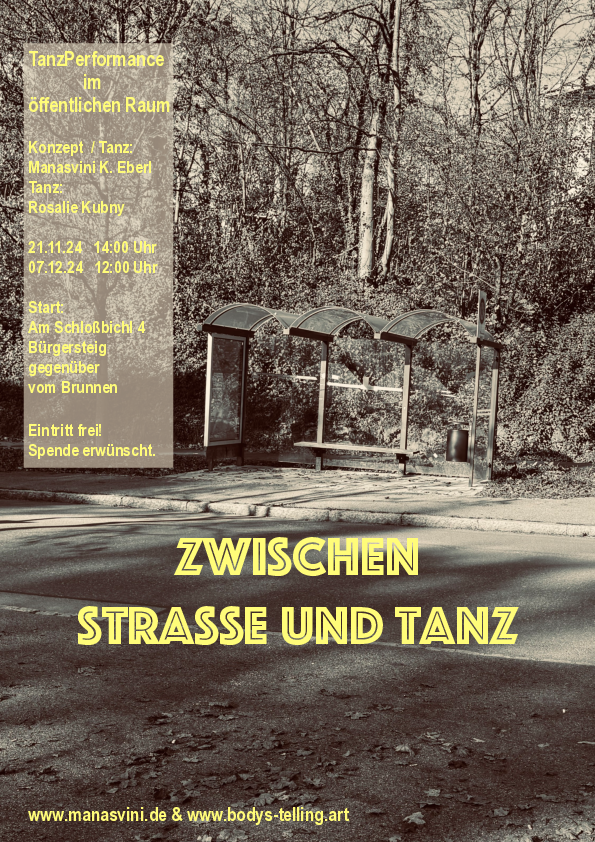
A dance performance in public space
by Manasvini K. Eberl
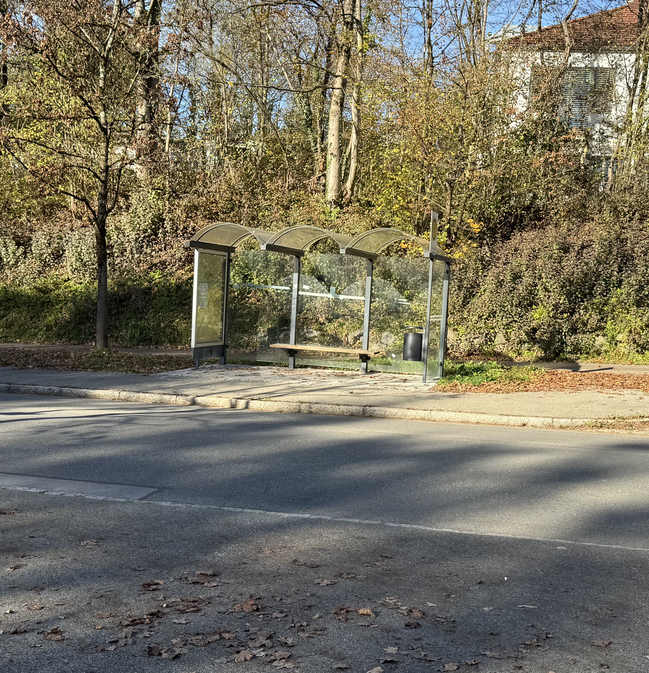
The bus stop as the end point of the performance. We worked with synchronisation and slow motion tempo.
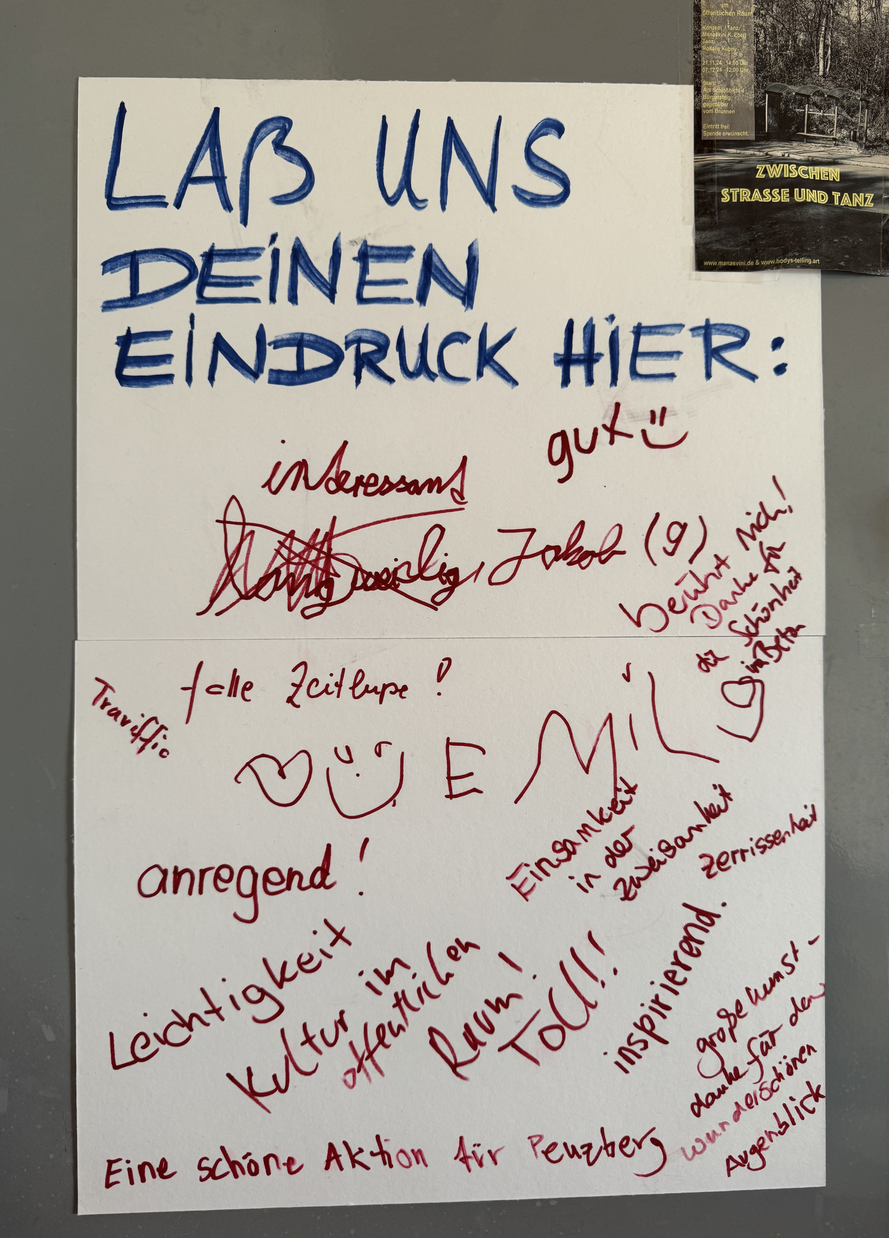
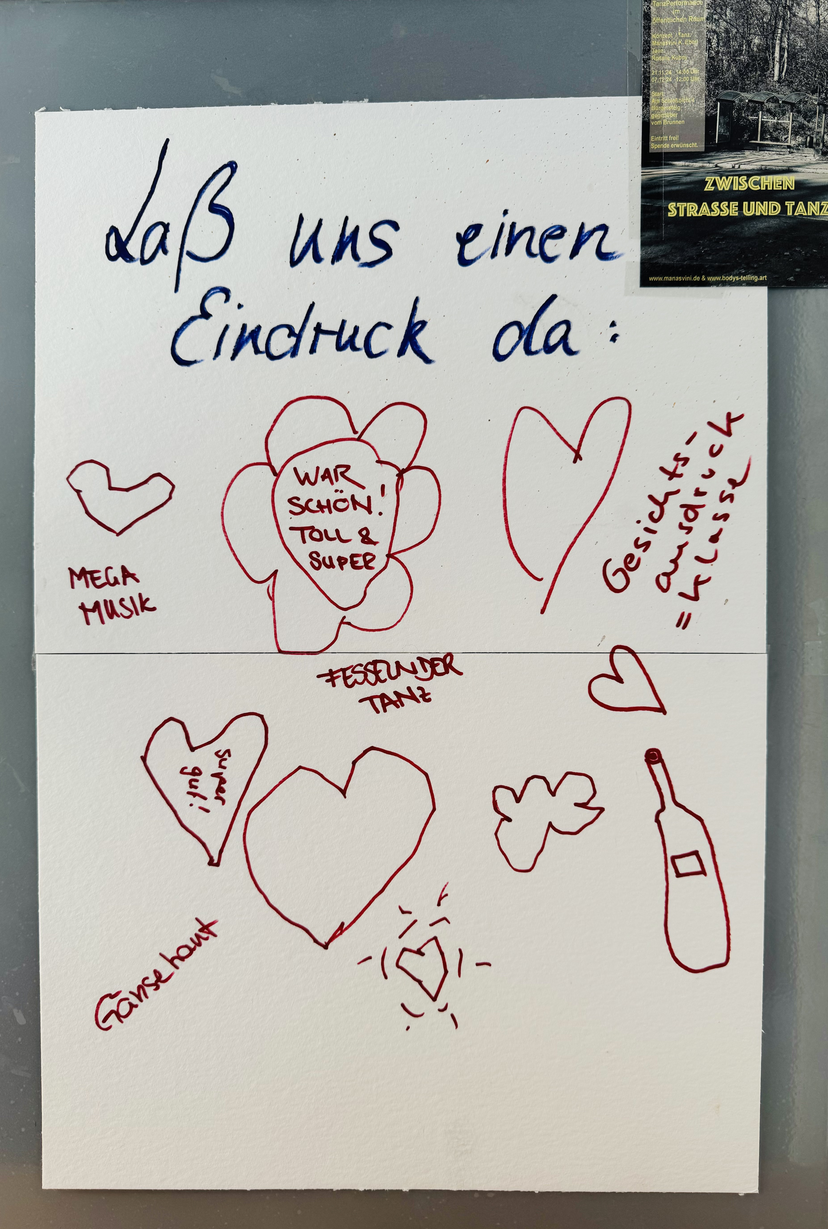
(Translation: Great slow motion / stimulating / good / interesting / touches me! Thank you for the beauty in the concrete / lightness / culture in public space! Great! / solitude in togetherness. Torn / inspiring / great art - thank you for the wonderful moment / a beautiful action for Penzberg)
In addition, a few nice details came to us afterwards:
‘My son still talks about your performance from time to time. He thinks you danced like Superman on the stone cubes at the beginning’.
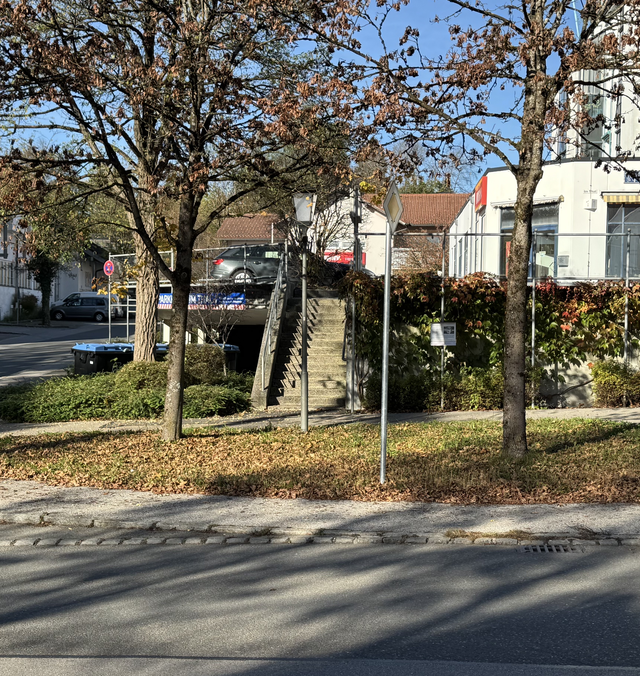
‘So impressive. The children were also totally inspired and danced on the way home. Your performance on the stairs in particular really stuck in their minds.’
‘It was cool with the stations, because then the stage set didn't change in one place, but the performers went to a different stage set.’
How it all began
My basic aim for this Performance in Public Space, was simple but clear:
to bring dance to my town of Penzberg (G), a small town in Upper Bavaria where contemporary dance is barely represented and certainly not in public spaces. So far. What I had taken away from the themed week of Public Space during the Intensive in Rotterdam was that when planning a performance in public space, it is important to take a close look at the public space beforehand, to scan it and recognise which flow, which people, when, where and how they act. So I set off to perceive spaces in Penzberg. And as I walked my daughter and her best friend from primary school to after-school care, as I often do, and the two of them were dawdling as usual, I put on my headphones, listened to soft music and looked around. And there it was, my stage in the public space, a bus stop, and then the inconspicuous staircase that everyone overlooks, the long path and the posts around the fountain. My idea was born:
Zwischen Strasse und Tanz (between street and dance).
Concept of the project
My basic concept was to create a procession along the street, with the performers on one side, turning their everyday bodies into performative bodies in public space, and the audience on the other side, in close proximity to the sound and music.
The performance walk had a clear route with three stations and two transitions. The audience watches the performance from the other side of the street.
Here I was interested in the interweaving of different levels, such as everyday sounds like car noise, voices and music from the surroundings, which change constantly and unpredictably with special sounds, music and small spoken texts, as well as letting the different qualities of time meet at the same time.
One of my aims was to create a moment of zooming in, a surprising moment of dance in an everyday public environment, a theatrical moment.
What has become of it
The basic concept remained the same and formed the basis of the co-creation process with Rosalie. What was new was the text level on the subject of time. We wanted to give a small hint to pay attention to the perception of time. But this could also be understood as a social interaction between the two of us performers.
Each of the three locations and the two transitional places had different qualities as well as sound and text.
The following video excerpts are in order of the performance, which lasted 25 minutes. Each video can also stand alone and represents a small ‘story’ in itself.
On the fountain, the first station, we worked with four different qualities, which we used alternately, such as a slow, continuous tempo, from pose to pose, repetitions and extensions, standing and perceiving. This was accompanied by the sound of a heartbeat and with the text:
‘Do you know me? I move on and on, on and on. Sometimes it seems as if I'm standing still, then an encounter takes place.’
On the footpath we played with running away and coming together to do something together. The text ‘Are you coming?’ was also intended as an invitation for the audience to move along the street.
In between, the question sounds:
‘Do you see me?’
At the end of this sequence (not visible in the video), we stand facing the audience and look at each other.
This was a brief but touching moment for both sides.
How it developed
It was important to me to do this in collaboration with professional artists from the neighbourhood, an area where there are few professionals in this field, and not to bring the ones I know from Munich to the countryside.
So I asked the few professional dancers and performers I know locally if they would like to participate in my project (I was embarrassed to ask them to do so for no fee) or if they knew anyone who might be a good fit. So I was introduced to Rosalie Kubny, a friend of an artist friend from the neighbouring village, who had just moved here and had been working as a freelance dancer, performer and choreographer for many years. As she was interested in making new contacts, it was fine for her to take part in this project without a budget.
So there were already two performers. And it turned out that Markus Kunas, a performer, photographer and videographer who had put Rosalie in touch with me, was also interested in filming the project.
www.manasvini.de / www.body-telling.art /
I enjoyed inviting people to the performances. I knew it would be something new and unusual for many of them. Not for a big city, but here in Penzberg, as far as I know, no one has ever held a dance performance in a public space before. So I was excited.
And here was my research question: how would a small town like Penzberg receive our dance performance in a public space?
Conclusion
When I reflect on the project in retrospect, I am very glad that I initiated it and how we created it together under the conditions that were there. In addition to the feedback mentioned above, there were also some personal conversations about the project, which show me that yes, for some people it raised questions or there was a need for clarification about what we were doing. The answer to my research question is that Penzberg received the piece very well and was very interested in what they were seeing. This inspired me so much that I am toying with the idea of starting more small performances in public spaces in Penzberg, to make contemporary dance more and more accessible to Penzberg.
I would like to close with a quote from Cathy Marston, choreographer, artistic director and Clore Leadership Fellow, from her provocation paper, CHOREOGRAPHERS AS LEADERS: AN OPPORTUNITY, who describes that she feels it is important to encourage choreographers to take the lead, not only for their own work, but for our art form as a whole (Marston, p.3).
Reference
Cathy Marston (2014): CHOREOGRAPHERS AS LEADERS: AN OPPORTUNITY in: Provocation Paper for the Clore Leadership Programme Fellowship 2013-14, p.3, published under: Creative Commons.
I drew up the following schedule for three rehearsal days and two performances:
Concept discussion
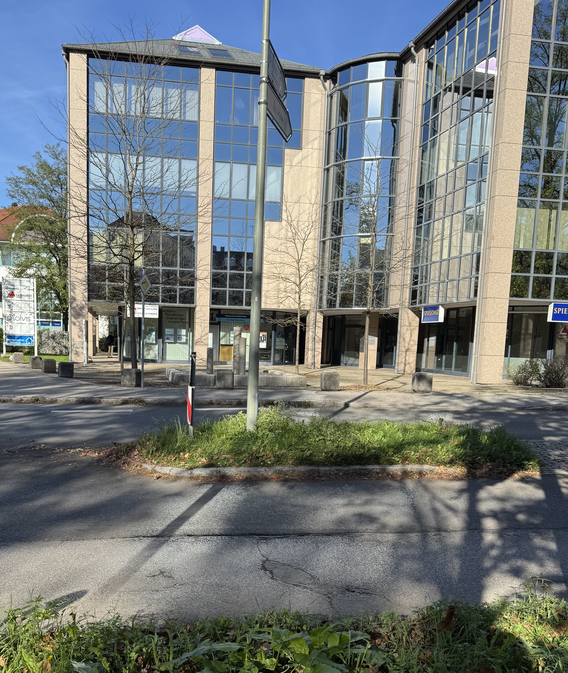
Inspection of the premises
Finding/defining material (movement, sound, text)
Performance
Obtain feedback
I used the following tools to find material, from the everyday body to the performative body:
Repetitions / rhythmically defined movements / mirroring, contrasting, synchronising, canon / enlarging a movement in a duo
We run together to the stairs. This sequence is divided into 4 sections in which we play rhythmically with walking together and slowly find our way into a dance. In between, a question is audible:
‘Can you hear me?’
How it was received
We set up a board at the end of the procession and asked the spectators to give us their impressions.
On the second path, we let fade out our dance to the ringing of the bells and find ourselves together and synchronised at the bus stop.
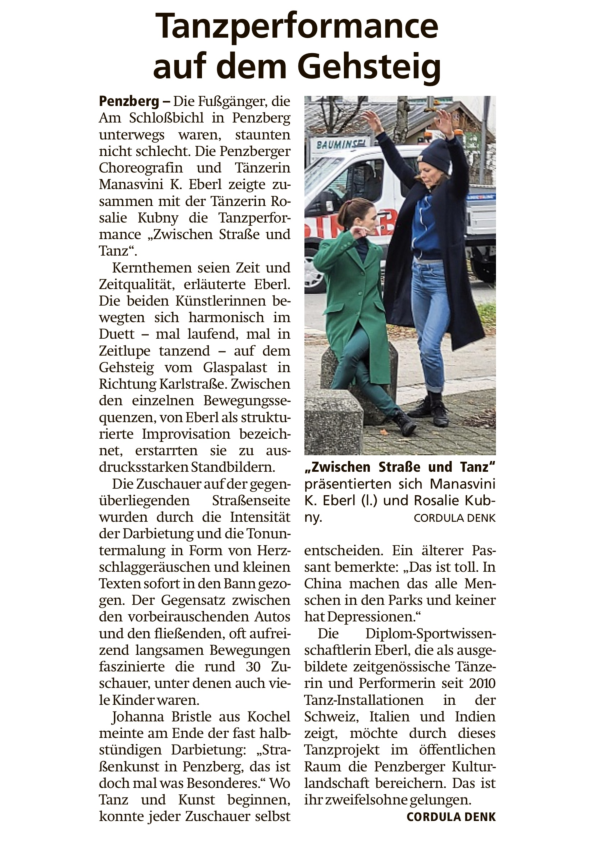
(Translation: Penzberg - Pedestrians walking along the Schloßbichl in Penzberg were quite astonished. The Penzberg choreographer and dancer Manasvini K. Eberl showed together with the dancer Rosalie Kubny the dance performance ‘Between Street and Dance’.
The core theme was time and the quality of time, explained Eberl.
The two artists moved harmoniously as a duet - sometimes running, sometimes dancing in slow motion - on the pavement from the Glaspalast in the direction of Karlstraße. Between the individual movement sequences, described by Eberl as structured improvisation, they froze into expressive still images.
The spectators on the opposite side of the street were captivated by the intensity of the performance and the sound of in the form of heartbeat noises and short texts immediately captivated them. The contrast between the cars rushing past and the flowing, often excitingly slow often slow movements fascinated the audience of around 30 spectators, many of whom were children. Johanna Bristle from Kochel said at the end of the almost half-hour performance: ‘Street art in Penzberg, that's something special.’
Each spectator could decide for themselves where dance and art begin. An elderly passer-by remarked: ‘That's great. In China, everyone does this in the parks and nobody has depression.’ Eberl, who has a degree in sports science and is a trained contemporary dancer and performer who has been showing dance performances in Switzerland, Italy and India since 2010, wanted to enrich Penzberg's cultural landscape with this dance project in public spaces. She has undoubtedly succeeded. CORDULA DENK)