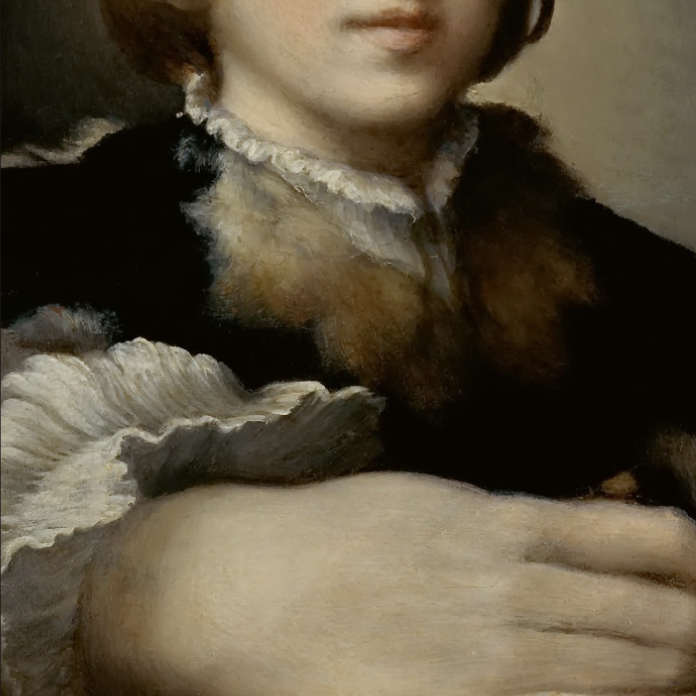
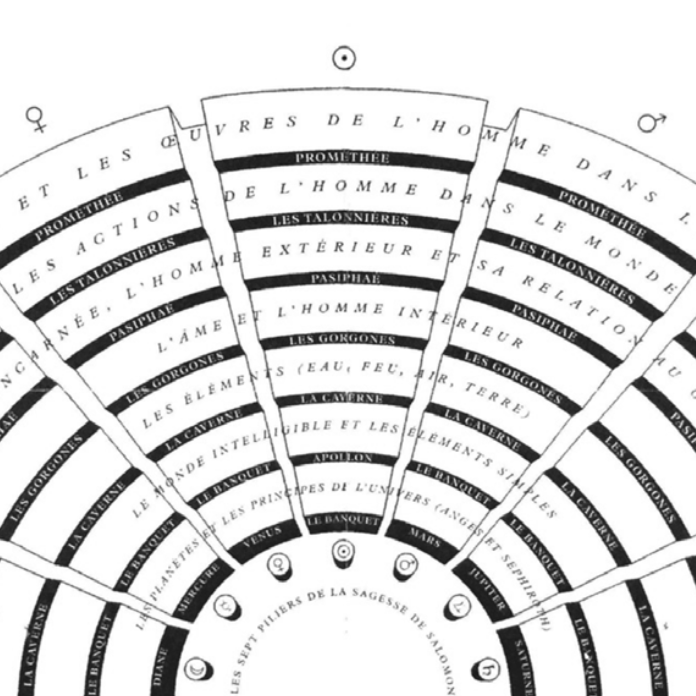
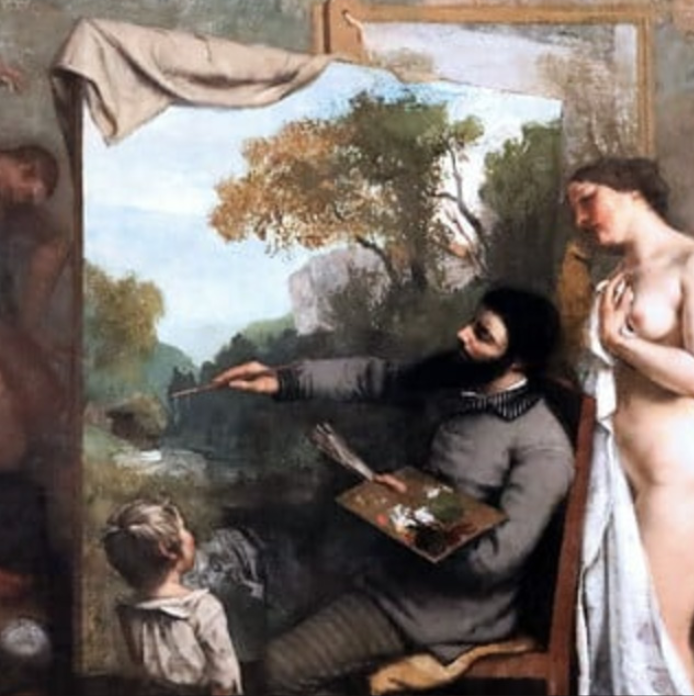
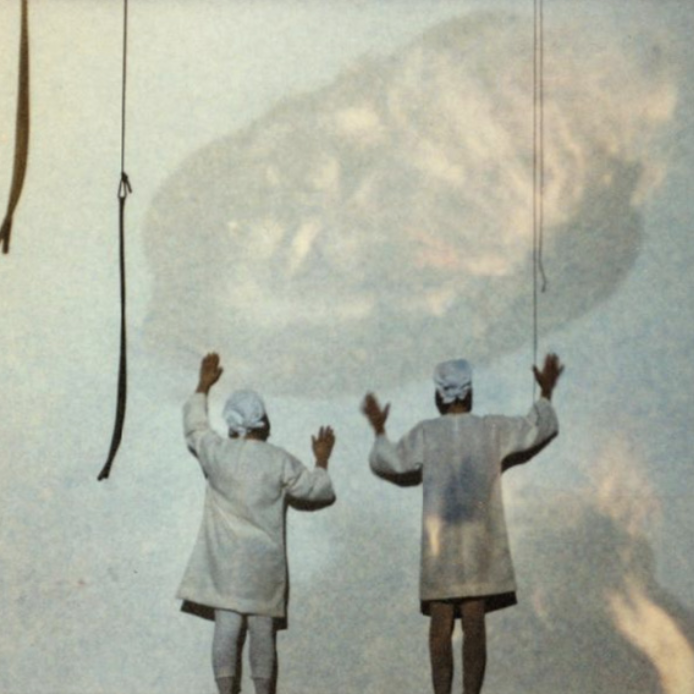
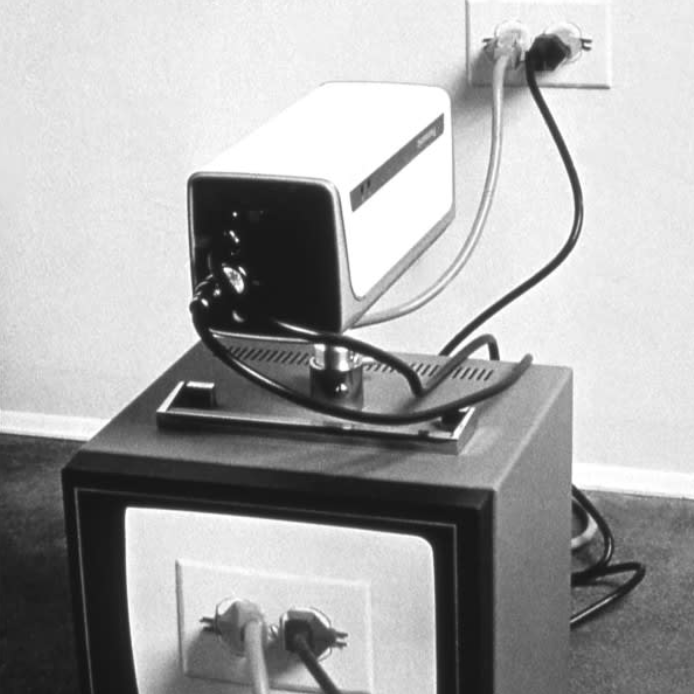
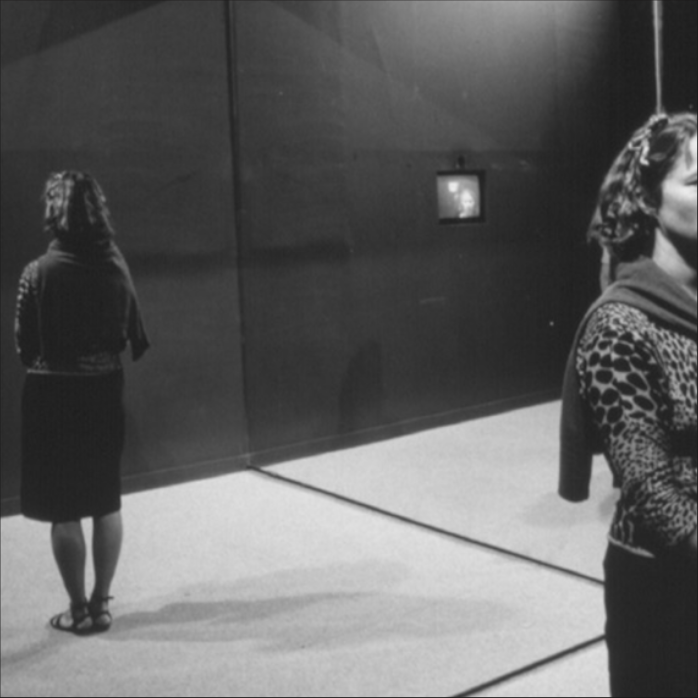
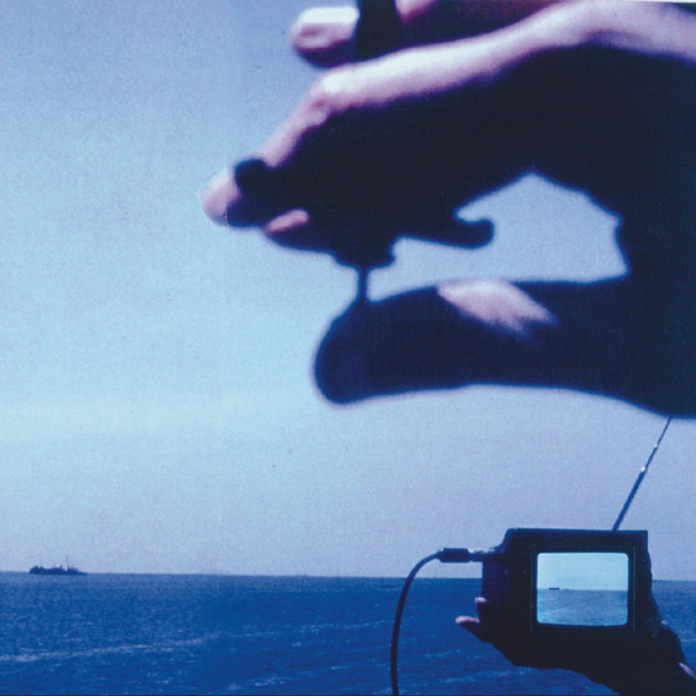
Some will find in this essay allusions to the oil-painting distortion in the Self-portrait in a Convex Mirror by Parmigianino in 1523; to a mnemotechnical project called The Memory Theatre by Giulio Camillo in 1544; or to the interior doorway of L’Atelier du Peintre by Gustave Courbet executed in 1855; either an affinity with the early desynchronised audiovisual installation Prune Flat by Robert Whitman in 1965; or one extrapolation from the echo-chamber piece Transfer by William Anastasi in 1968. Please browse through these audiovisual references, which have strongly contributed to the composition of this text as they have provided an additional layer of meaning it may not be possible to wholly express through words; in particular when it comes to Dan Graham’s anti-simultaneous performance Present Continuous Past(s) in 1974 to which the project entitled The Slow House by Elizabeth Diller and Ricardo Scofidio had responded in 1991—integrating the problematic of the landscape, here involved, into an unbuilt delay-lighthouse. As soon as it was written, Latency Records: The Delay, an Inhabitable Field was inspired by a desire to appropriate the aforementioned works without shame in order to associate with them one narrative, a few verses, some definitions and a serie of personal intuitions regarding a paradox of profound interest in the current circumstances of technological advancement: the recording of the presence of a landscape in its representation. Let it also be clear that the term presence is employed in this article to convey an absurd signification which is nonetheless precious to us: that of a present that never takes place, while nothing takes place outside the present. Such as the mocking yet instructive excerpt form a dialogue in Le Roi se Meurt of Eugène Ionesco written in 1962 ironically spinning the different forms of the verb to be until the point of meaningful inanity; the definition of a presence that would exist only through its absence could end up being mere rhetoric if the study of the passage of time, condemned from the outset by its contradictory meaning, did not allow us to discover certain modalities: such as succession, simultaneity and duration; as well as a number of shadows therein: such as irreversibility, suspension and permanence.
Having clarified a few of the prerequisites, some details can follow. For too long, electronic devices have been credited with a holistic vision of the world. These all-encompassing faculties have unreasonably been conferred to them due to their relatively rapid ability to associate information, or data. Seemingly everyone was enticed to believe that screens were showing a vivid performance of our surroundings; yet, the effect of co-presence provided by video was compromised as soon as it had been compounded from fragmented bits of sensible images. In Paris, invisible city: The plasma, a short essay written in 2007, Bruno Latour made it clear that: ‘The illusion of the zoom is so deceptive because of the impression of continuity. Because computers can so easily adjust pixels to all scales and link up data (ultimately, they are never more than zeros and ones saved as electric potential on sheets of silicon), they enable us to believe that between all these points of view there is a passage with no solution of continuity.’ (Latour, 2007, p91). Then Bruno Latour, drawing on the organisation of matryoshka, insists on the apparently smooth transition from the whole to the parts and from the parts to the whole, as if there were not a single gap, not a single breathing space: ‘All that is a sequence linked up and fitted together perfectly. Each Russian doll is set without any debate in a bigger one and contains other smaller ones, always without force.’ (Latour, 2007, p93). We believe that the combination of a multitude of viewpoints did permit hitherto separated pieces of information to be partially brought together in time, but it has never ensured nor will ever guarantee absolute synchrony. This quasi-instantaneity, although it may seem trivial is infinitely significant for us, because it is a reminder of the extent to which those alleged simultaneities have remained artificial; the most integrated software resulting solely from the assembly of partial inputs extracted at a specific moment. Despite this, it is still widely accepted that the screen must first have been founded on an authentic event, i.e. a phenomenon that has occurred; and on which it intends by all means to prove the veracity of its contents. Once this fraud has been discovered, all that remains to be found is shreds of evidence for the tangibility of an unknown period of time between the occurrence of an event and its subsequent diffusion. To do so, it implies finding the length during which the sensorial interaction is altered by the volatile archive (Random-Access Memory, or RAM) or stored in a hard drive (Read-Only Memory, or ROM)✦. Therein lies our desire to burden any means of communication with its accurate procedures and constraints; to unveil the authority wielded by the technique beneath the lens as it affects the comprehension of what is seen; to escape from unintentional habits of seeing which are simply the consequences of a blind chain of artificial causes; and to restore to sight its ability for autonomous cognitive discernment.
Still Sleep Mock’d Death✦: Heritable Delusion for Ages
Electronic tools capture the parameters of sensible images and translate them into machine-readable code, separating a phenomenon from its presence✦. If these moving images carried by electronic devices often have the appearance of immediacies, they are most of the time confused with them. Above all because, following Vilém Flusser in Photography and History from 1989, we are illiterate: ‘The hegemony of the literati was breached thanks to the invention of the printing press: everyone became a literatus. The same is possible today: everyone can become a programmer.’ (Flusser, 1989, p130). Since these lines were written in 1989, only a minority of the population has become a programmatus—excluding me indeed, probably you too, dear reader. Then perhaps Vilém Flusser's prophecy was not much about learning how to code, just as it wasn't about learning to print at first. But Vilém Flusser's words can be understood rather as a call for defying what is presented to us in the guise of a genuine representation of life, when it is only a rough version of it. In fact, we are incapable of decoding the software, generating images through computing machinery; as if human anatomy must soon acquire a non-congenital organ✦ for the perception of those indiscernible cuts mentioned previously. In Lexique de Philosophie, Christine Le Bihan and Alain Graf define together human perception along with the notion of sensorial instrumentalisation of a body: ‘Derived from the latin perceptio meaning the act of welcoming. Perception is the act by which a subject immediately organises (without reflection) its present sensations, interprets them and supplements them with images and memories. So the idea of perception presupposes a coordination of data from the different senses.’ [translated from french] (Le Bihan & Graf, 1996, p70). Meanwhile structurally speaking, moving images carried by electronic devices are nothing but poor replicas of the light spectrum reflected from a surface bathed in light; wrought from instantaneous disappearance and constantly creating a supplement of content for self-preservation.
Hito Steyerl has deciphered another symbolic model of the network through this much neglected and less cumbersome component in an article named In Defense of the Poor Image written in 2013: ‘Poor images are poor because they are heavily compressed and travel quickly. They lose matter and gain speed. […] It is about its own real conditions of existence: about swarm circulation, digital dispersion, fractured and flexible temporalities’ (Steyerl, 2013, p88). Then there’s something like a micro silence that slithers underneath the flexible temporalities, the event returning to itself as if it were able to perform the phenomenon in advance and preserving its memory; a memory for which the future is neutralised. Worded as such, this approach dovetails the notion of ‘anticipating memory’ as expressed by Günther Anders in The Pathology of Freedom: An Essay on Non-Identification written in 1962: ‘In anticipating memory, he returns to himself as if he were not imprisoned in the framework of his present life, as if he were able to live his life in advance, to be transported beyond it, and to preserve its memory; a memory to which he is nevertheless referred in the time of his present life, for which the future is henceforth neutral.’ (Anders, 1962, p291). Consequently what must be determined is whether there was negligence or carelessness regarding the break of continuity of the lode of time initiated by computing instruments; whether we have naturally come to rely on their authority to project ourselves on our daily basic representations; as to whether or not do we have willingly consented to let them constrain the way in which we represent our environment too. That effort includes the articulation of a whole new duration as expressed by Georges Poulet in Studies in Human Time from 1956: ‘It is a question of slipping into the break of continuity of the lode of time, between the moment of imminence and that of accomplishment, a whole new duration, in which the mind takes the time to foresee, to compose, to moderate or to suppress.’ (Poulet, 1956, p288) Even if this entails prejudicing a conventional notion held in the act of seeing: which means, carefully or not, assuming what is past for what was present and processing it by replacing what was going to be present with something else that probably wasn’t meant to be, yet has become desirable.
All has to be transmitted nowadays. Nothing can disappear,
And everything is to be preserved
Via preventive operations of conservation,
Anything has eventually to be archived.
Even a provisory lack of memory causes us guilt—
Haunted by the purity of the vanished.
And the desire to forget becomes shameful.
What is about to fade away has to be magnified.
In such a way it can be reconstituted later,
Not so far away or on the exact same island, if possible.
All savoir-faire, considered not so long ago as banal gestures,
Has been protected to be admired and worshipped by unforeseen generations.
The collective adventure of transmission has been deprived
From any possibility to be accidental.
Past and future are gathered into a present
Continuously obsessed with the threat of vanishing.
Or is it to anticipate a probable catastrophe?
Fictions often picture an archaic rebirth, survivalist handbooks for example.
To prepare for an imminent tragedy.
The oneiric journey toward a radiant future has been cancelled,
Substituted by a collective disaster. Aired.
The Landscape Is not Silent but Nature✦ Is Mute:
It Doesn’t Articulate Words, Though Prior to it
We too decided to apply a spatial analogy to develop our argument because, like Alain Adde on the chapter Le Temps selon Paul Ricoeur from Sur la Nature du Temps, we are committed to: ‘Recognising how impossible it is to choose between objective and subjective time’; and to: ‘Imagine a third time, the narrated time.’ [translated from french] (Adde, 1998, p55). It is a matter of fact that ‘the time recovered by the narrative is not necessarily a truthful time. There is a principal instability of narrative identity and imaginative variations that disrupt it.’ [translated from french] (Adde, 1998, p56). According to Susan Sontag’s book On Photography, whether it is orally transmitted, written, congealed in photosensible sheets or reflected through countless pixels, the narrated time, even if unsteady, preserves ‘both a pseudo-presence and a token of absence.’ (Sontag, 1971, p16). Indeed storytelling, regardless of the medium and in all its sincerity of being a mere fiction, deliberately disregards all fanciful attempts to capture a whimsical pristine time; the narrated time being far too involved in releasing a sense of temporality instead—however shallow it might appear. As such, the narrative time profanes both objective time and subjective time. This might explain why narration is largely underestimated as an ornamental practice insofar, as it follows a method by which written images, words in this particular case, are used to convey an idea. And all the more decorative because the narrative time restricts the experience of time to nearly exclusively optical phenomena and their subtle synaesthetic affects produced in our imagination: hearing, smell, taste and touch are sometimes fairly suggested, but always neglected✦.
Following Susan Sontag, the sense of distance embodied by those empirical verses of Lucretius written in 54 b.c. about a delay of reception from a thing to the photoreceptor cells of the eyeball, can be experienced—albeit via an interface—when observing the picture of a distant landscape: ‘The sense of the unattainable that can be evoked by photographs feeds directly into the erotic feeling of those for whom desirability is enhanced by distance’ (Sontag, 1971, p16) and the author of On Photography continues: ‘Like a wood fire in a room, photographs—especially those of people, of distant landscapes and faraway cities, of the vanished past—are incitements to reverie.’ (Sontag, 1971, p16). Is there anything we can possibly add to that? Certainly nothing of equivalent substance, but solely practical information about what experience of time we have been writing hereafter. Albeit profoundly inspired by Susan Sontag’s suggestive call for reverie, we shall narrow the gaze of Latency Records: The Delay, an Inhabitable Field to a monochromatic daydream; shades of the Azure of Stéphane Mallarmé, a poem edited in 1866 from which those words are extracted: ‘It travels ancient through the fog, and penetrates/ Like an unerring blade your native agony;/ Where flee in my revolt so useless and depraved?/ For I am haunted! L’Azur! l’Azur! l’Azur! l’Azur!’ [translated from french] (Mallarmé, 1866, p137). And our pursuit of the delay may be envisaged as a corridor between a physical entrance and an optical destination; as written by Marc Wetzel in Le Temps from 1990: ‘Or is the present merely the opportunity, the window through which the future, already present, observes the past, the door through which the past, still present, acts on the future?…’ [translated from french] (Wetzel, 1990, p11). Or more simply: from a door to a window opening onto the sea. Do not be deceived, it is not an unlimited width of water at the end of this hallway, although it does offer a partial vision of it. We are facing a swamp meadow instead, upon which converges a stream from both Fountain of Youth✦ and the Léthéa River✦; the first known as the Fountain of Immortality, a symbol of perpetual rejuvenation; the latter known as the River of Unmindfulness, where all those who drank from it experienced complete forgetfulness.
The only entrance to this corridor leads to an elongated hallway split in two. On the right, a range of seven video monitors are arrayed at eye level. Each of them, opening onto a mosaic of 80 tabs from surveillance cameras around the world, serves as postcard from a sedentary journey. Every miniature roughly ten centimeters wide is humming with a singular frequency that drowns out the surrounding noise of overlapping waves. All of the tabs bear a narrow caption clearly indicating the specific amount of time to be spent on each video unlike Susan Sontag’s introduction to Chris Marker’s film known as Si j’avais quatre dromadaires (1966): ‘The sequence in which the photographs are to be looked at is proposed by the order of pages, but nothing holds readers to the recommended order or indicates the amount of time to be spent on each photograph.’ (Sontag, 1971, p5). Here it appears in lower-case font: fifteen seconds, eighteen minutes and thirty-two seconds, one hour and forty-four minutes and twenty-one seconds, etc… ad infinitum. Many visitors proceed as indicated, although others, as those just preceding you may have done, prefer simply to meander around the screens; errant along the blind part of the wall; or trapped in the repetitive pattern of the moving turquoise to golden yellow from a small river overflowed with winter rains; the roughly-frozen image of dry lands; the mangroves buried under snow; human-less towns filled wholly with porcupines; flower crops of the most curious assemblages, and so on… Admittedly, this co-existence of parallel landscapes and the abundance of fantastic natural scenery✦, might also be anachronistic—the subconscious world eschews the constraints of temporality; and the diversity of the scenes On Air belies the notion of time frame: some of these 80 moving images, as found on opposite sides of the globe, may occur at dawn on the one hand and in the depths of night on the other. And those visitors are like vagrants seeking to get rid of all restraint, wandering perchance towards a shelter displayed on an illuminated viewport, somewhere. Anywhere to refuge themselves. They feel what a naked creature hiding in artificial woods has already felt:
If no one has recovered from tail-loss;
Was inner shame released alone—
Or did a caress soothe the spine?
Words often conceal more than they reveal
Still, tongues weave hidden cords down the throat
May they be silent.
<Silence>
Multiple paths entwined: for there is no before nor after;
No evidence at all. All evidence at once.
Imminent pasts are thrown over anterior futures.
If you see through those who stare inside mirages:
Ephemeral giants are dancing upon changing waters
And frozen images burn on vanished lands.
Until you stare at one visitor standing still. Petrified as if staring at something. Something, or someone rising from the degenerated representations of earth in front of them. This person remains still. So you may ask: could it be the cognitive variations between the different temporalities that would have disrupted this viewer’s senses, disorientating them with a trauma of anti-instantaneity? Yet there is another explanation for their apoplexy: while the tabs from surveillance cameras expose the largest possible number of biotopes, it is their very own figure that this visitor has seen, just some metres away. Or at least what they can remember about it based on only partial clues. Let me explain: a blurred yet familiar face is reflected and distorted through the shadow on the screen a few steps ahead. Their distinctive visage is streaming from the inside of what seemed to be a purple cloud before but turned out to be a sinking ship now. Unlike an ordinary portrayal, the figure can be seen from this perspective alone. As a matter of fact the anamorphosis requires the viewer to occupy a very specific vantage point for it to appear. What is unclear is if anyone would recognise themselves in those features; but the visage they believed so familiar a brief glance ago no longer has eyes, no ears, nor mouth. Unsure whether the biometrics data has been erased in a visceral rejection of certainty✦ or given the difficulties that human beings have in representing themselves; one thing is certain: the effect of self-recognition and the subsequent otherness provided by these shadows triggers a bitter sense of déjà-vu, since everything that had been previously projected was assimilated almost instantaneously in the memory as experienced, and immediately withdrawn.
Going further in the corridor, a staircase climbs on the left to the first floor occupied by a sealed room bathed in the glare of a dozen beams broadcasting subliminal images. Despite the involuntary blinking that is caused by the flashes, your brain has been allowed to bypass reasonable visions to suit those hallucinated rays. Hence your retinas became familiar with disrupted optical frequencies, knowing how to articulate them into images and process them unconsciously into actions. There’s no discernible source for the sparks, which come randomly from the wooden slab, the roof or one of the four plaster walls. On rare occasions, the diapositives collide against each other before reaching the diametrically opposite plane, inhabiting a halo of dust particles, they ‘Fill the embracing air,/ With floating forms of every shape around,/ Nor cease their forms dissolving to renew.’ (Lucretius, 54 b.c., p163). Varnish reflections then emerge from this intersection and lightning strikes the dilated pupils. Having been kneeling down between the door handle and the lock, as if reciting a prayer, these flashes only managed to blind a single eye, the one in front of the keyhole. Pushed by an irresistible pain, you are projected on your back. Immobile, you lay on the linoleum-covered floor, half-sighted. The damaged eye will only partially recover its sight: it will forever be strewn with spots of various forms, some resembling oil sands, others shaped like organic beings hovering on the surface of the cornea like larvae✦.
Descending all the way down the stairs, the main room stretches out like a concertina. The ceiling is punctuated by eighteen neon lights arranged at regular intervals, covering the whole length in a homogenous halo of blue light. At the end, nestled in a tiny square aperture measuring 30.48 cm wide that passes through the screen built entirely into the wall, stands the lens of a camera facing outwards and whose content is retransmitted on the monitor in front of us. Delayed by three seconds, the footage is projected back on the same surface, covering it as if it were a second skin. « Might the light of the projection alter the images captured by the photocell? » you ask aloud. The undulation of the waves in the video, acting much as an anamorphic shimmer, disregards the flatness of the screen, so it seems to be in motion. The electronic frame can be manipulated; the camera can be lowered or widened using a remote control placed on the floor, and the transmission can be deferred for more seconds onwards or backwards. Night can be played during the day, quiet seas can be presented over tempestuous skies. The video may even lag when too many visitors saturate the bandwidth or be interrupted by a power cut while a storm is raging. You then have to resign yourself to refreshing the screen, even if it means once again being subjected to a profound visual disturbance. The composite vision formed by the video recording vis à vis the landscape scene is rarely the same, and the distinction between the authentic and the mediatised collapses… or overlaps? We don’t really know anymore. Probably both.
Since light from nearest things comes first,
Then from remote. We saw something,
Faraway, so perceived at last.
Azure foams remained static
On thousand ceaseless instants,
Whilst miraculously shifting between them.
Silently, a loss of depth occurred:
Both past and future collide, cross-eyed:
One redundant, the other disfigured.
Curiously, it is because this method of transmission can produce infinitesimal non-instantaneities—avoiding any simulation of directness between the projected image and the lived world whose simulacra we are used to tolerating—that there exists a very slight, but not negligible, probability of simultaneity between the projected image and the sensible world. This would mean that this audiovisual installation could act premeditatedly by displaying a projected image before it is caught. As though the memory could preempt the phenomenon it reports. Precognition appearing and disappearing by some unearthly conjuring trick. It is a reminiscence, you may think: just as it embodies the return to the mind of an image not recognised as a memory and mistaken for a present perception. Might this place, then, achieve its primary function at the very moment when the whole device is suspended? Suspended in the sense of collapse: would it be precisely when it ceases to operate, or in other words, when the projections coincide, that this place would become effective? Or suspended in the sense of genesis: would the projection coincide with the landscape because it is at its origin? What cannot be disputed is that a strategy of camouflage has been orchestrated in this corridor.
The unblinking eye reconstructs in reverse the hologram of forthcoming oceanographical remains. Just as we want to convince ourselves that a pole half immersed in water is not a broken pole, we are inhabited by an ill negotiation between what is perceived and what is to be trusted. Relying on our sensory data, how can we surmount the scope of experience, for these appearances deceptive are? ‘So hard it is to draw distinctive line/ Between the apparent and the sure, and separate/ Reality, from fictions of the mind.’ (Lucretius, 54 b.c., p173). Still, the artificially coloured landscape feeds the endocrine system of near-unseen venture, albeit already gone on the other side of the plasterboard that separates it from the ocean. Standing in this field of illusion, staring at the environment conjures up events that have already unfolded with the spectre of an accumulating present. The same as when an eye pointed at a starry sky reflects back to us a light that is thousands of years old, this confusion—whether profound or superficial—invites us to abandon ourselves to the common threads of two distinct yet simultaneous narratives that converge.
The horizon is a maze. The corridor is a labyrinth.
Since synchronicity carried by electronic devices has proved to be a hybrid, heterogeneous and polymorphous material, we should reconsider the certainties we have acquired regarding chronology, or the study of time broadly speaking. Because there is a conventional institution that goes by the erroneous name of time when it is merely a system of measurement—a canonic system wielded over the globe according to arbitrary rules established by humankind—other misleading notions about time have resulted from the confusion between biorhythms, the cycles of the day and the seasons, the irreversibility of life, the inevitability of death and the pseudo-universality of these experiences… Well, we will not go any further into these confusions. Nor is there any immediate need to analyse those ambiguities in-depth. We will wonder how to recognise the imposture of the nunc stans claimed by numerous computerised tools instead. Because they are affected by their own parameters; because asperities are formed in the sequence encoder-message-decoder constantly increasing a supplement of time; and because they extend even further the interval required for the eyes alone to capture a phenomenon—the capture of tangible existence by communicational means has always been nothing more than a motive and a forgery. It has substituted simultaneity by a rather crystalline system, that of the time-image based on indiscernible cuts✦. They are shattered into myriads of independent phenomena that can only be imperfectly apprehended through limited sensors, then tightly bound to each other in electrical circuits.
It is worth mentioning that those elusive definitions of time are interwoven within the misleading representations of space: both notions are concealing and revealing at once, producing desire and disenchantment through acts of seduction and denial of a substance that exists but is impalpable. ‘Time, unlike space, appears homogeneous but is not. Duration, composed of a succession of heterogeneous instants, exists only in a spatial representation.’ [translated from french] (Adde, 1998, p16) affirms in 1998 Alain Adde in Sur la Nature du Temps on the shoulders of Henri Bergson’s statement from Time and Free Will: An Essay on the Immediate Data of Consciousness of 1889: ‘The connecting link between these two terms, space and duration, is simultaneity, which might be defined as the intersection of time and space.’ (Bergson, 1889, p110). It is this mysterious intersection, that Gabriella Giannachi has been tempted to call re-enactment in Unfold: Dan Graham’s Audience/ Performer/ Mirror Reenacted from 2022, that appears to realise the promise: ‘To present the present as immediacy’. (Graham, 1999, p144) with Dan Graham's words in Two Way Mirror Power: Selected Writings by Dan Graham on His Art edited in 1999. Gabriella Giannachi insists that by bringing the past into the present the reenactment not only re-presents but also re-presences the work, and the past, or origin, remains: ‘In showing how reenactments were not about « recalling » the past, rather about restructuring the past in the present in the context of our presence.’ (Giannachi, 2022, p6). For there is an obvious redundancy in these tautological statements✦, the archetype of the ‘unmoved mover’ as expressed by Hans Blumenberg, in a paper entitled Imitation of Nature: towards a prehistory of the idea of the creative being written in 2000, informs us about the romantic hopelessness of the study of time: ‘The unmoved mover is the purely intellectual form of self-perpetuation through noesis noeseos, thought that thinks itself. This self-enclosed self-sufficiency of the absolute is as little creative externally as it is internally innovative.’ (Blumenberg, 2000, p30). Thus, the ‘unmoved mover’ provides a precious personification to describe this echo-chamber as a voluntary-enclosure of a rather idiotic character described as such by Gaston Bachelard in L’Eau et les Rêves from 1942, wondering whether naive or heroic are the attempts to control the sea: ‘From then on, anyone who wants to be a superior human being naturally has the same dreams as a child who wants to be a human being. To command the sea is a surhuman dream. It is both the will of a genius and the will of a child.’ [translated from french] (Bachelard, 1942, p202). As for us, we would like to envision the metaphor of ‘unmoved mover’ embodied as an epically-static time-travelling protagonist, half-bartlebian for the insubordinate motionless corpse, and half-faustian for the unrestricted pursuit of knowledge.
‘If the human ear can be compared to a radio receiver that is able to decode electromagnetic waves and recode them as sound, the human voice may be compared to the radio transmitter in being able to translate sound into electromagnetic waves. The power of the voice to shape air and space into verbal patterns may well have been preceded by a less specialized expression of cries, grunts, gestures, and commands, of song and dance.’
Marshall McLuhan. The Spoken World: Flower of Evil?. 1964.✦
‘« The sun don’t shine in your TV ».’
Daniel Johnston. The Story of an Artist. 1982.✦
‘The simplest cut/up cuts a page down the middle and across the middle into four sections. Section 1 is then placed with section 4 and section 3 with section 2 in a new sequence. Carried further we can break the page down into smaller and smaller units in altered sequences. The original purpose of scrambling devices was to make the message unintelligible without scrambling the code. Another use for speech scramblers could be to impose thought control on a mass scale. Consider the Human body and nervous system as unscrambling devices.’
William S. Burroughs. The Electronic Revolution. 1970.✦
‘Thus, suppose we consider a period consisting of a thousand instants, and suppose the arrow is in flight throughout this period. At each of the thousand instants, the arrow is where it is, though at the next instant it is somewhere else. It is never moving, but in some miraculous way the change of position has to occur between the instants, that is to say, not at any time whatever.’
Bertrand Russell. The Problem of Infinity Considered Historically. 1970.✦
‘That sense of distance thus instinctive comes,
As more or less of air glides glancing by—
And this so rapid, that in single act
We see a thing, and what its distance is.’
Lucretius. On the Nature of Things. 54 b.c.✦
‘But the technical properties of the cathode tube are one thing and the aesthetic properties of the images we see on the screen are another.’
Jacques Rancière. The Future of the Image. 2003.✦
‘This is a pixel based resolution chart
It serves to shoot pixels
In 1996 photographic resolution in the area is about 12 meters per pixel
Today it is one foot
To become invisible one has to become smaller or equal to one pixel.’
Hito Steyerl. How to Not Be Seen: A Fucking Didactic Educational .MOV File. 2013.✦
‘This variant of camouflage is unique. While formerly it has always been the aim of camouflaging to prevent the prospective victim from recognizing the danger or to protect the doer from the enemy, now camouflaging is meant to prevent the doer himself from recognizing what he is doing.’
Günther Anders. Theses for the Atomic Age. 1962. ✦
'Marguerite: Everything is yesterday.
Juliette: Even today was yesterday.
The Doctor: Everything is past.
Marie: My darling, my King, there is no past, there is no future.
Tell yourself, there is a present until the end, everything is present; be present. Be present.
The King: Alas! I am only present in the past.'
Eugène Ionesco. Le Roi se Meurt. 1962. [translated from french] ✦
'From mirrors too, to mirrors fitly placed,
The image flits and multiplies its form.
Retired scenes in dark recesses hid,
May thus be dragged to light through winding ways;
The fluent image formed, and glancing quick
From glass to glass is changed, and then restored.'
Lucretius. On the Nature of Things. 54 b.c.✦
‘This is a resolution target
It measures the resolution of the world as a picture
Resolution determines visibility
Whatever is not captured by resolution is invisible.’
Hito Steyerl. How to Not Be Seen: A Fucking Didactic Educational .MOV File. 2013.✦
‘There is a real duration, the heterogeneous moments of which permeate one another; each moment, however, can be brought into relation with a state of the external world which is contemporaneous with it, and can be separated from the other moments in consequence of this very process. The comparison of these two realities gives rise to a symbolic representation of duration, derived from space.’
Henri Bergson. Time and Free Will: An Essay on the Immediate Data of Consciousness. 1889.✦
‘Think not that images that flow from things
Wander alone! since others spring from them —
Spontaneous spring, and fill the embracing air,
With floating forms of every shape around,
Nor cease their forms dissolving to renew;
Shifting themselves to every Protean change;
As oft we see clouds thickening aloft,
Stain the serene of heaven with changing forms,
With swaying motions peopling the air;
Sometimes a giant shape seems as in flight
To draw a lengthened shadow o’er the sky;
Or monster huge, drags or drives on the clouds;
Sometimes the form of precipices huge,
Mountains, and rocks abrupt, and hills on hills,
Above the mountains rise, and hide the sun.’
Lucretius. On the Nature of Things. 54 b.c.✦
‘While the camera is oriented toward the same view as the window, its location 40 feet above the ground slightly shifts the perspective, dis-aligning the horizon on the screen with the one in the window.’
Whitney M. Moon. Staging Architecture: The Early Performances of Diller and Scofidio. 2015.✦
Bibliographical Contents
✧ Adde, Alain. Sur la Nature du Temps (Paris: Presses Universitaires de France, 1998).
✧ Anders, Günther. ‘The Pathology of Freedom: An Essay on Non-Identification’, in Deleuze Studies, 3(2): 278-310 (Edinburgh: Edinburgh University Press, 2009).
[1st ed. 1936]
✧ Anders, Günther. ‘Theses for the Atomic Age’, in The Massachusetts Review, 3(3): 493-505 (Cambridge: The Mit Press, 1962).
✧ Bachelard, Gaston. L’Eau et les Rêves (Paris: Librairie José Corti, 2021).
[1st ed. 1942]
✧ Baudrillard, Jean. ‘Requiem for the Media’, in The New Media Reader, ed. by Wardrip-fruin, Noah & Montfort, Nick (Cambridge: The Mit Press, 2003). [1st ed. 1972]
✧ Bergson, Henri. 1950. Time and Free Will: An Essay on the Immediate Data of Consciousness (London: Riverside Press, 1950). [1st ed. 1889]
✧ Blumenberg, Hans. ‘Imitation of Nature: towards a prehistory of the idea of the creative being’, in Qui Parle, 12(1): 17-54 (Durham: Duke University Press, 2000).
✧ Burroughs, William. S. The Electronic Revolution (Cambridge: Expanded Media Editions, 1971). [1st ed. 1970]
✧ Deleuze, Gilles. ‘Bartleby; or, The Formula’, in Essays Critical and Clinical (Minneapolis: University of Minnesota Press, 1997). [1st ed. 1993]
✧ Flusser, Vilém. ‘Photography and History’ in Writings (Minneapolis: University of Minnesota Press, 2002). [1st ed. 1989]
✧ Giannachi, Gabriella. ‘Unfold: Dan Graham’s Audience/Performer/Mirror Reenacted’, in On Reenactment: Concepts, Methodologies, Tools, ed. by Giannachi, Gabriella & Franco, Susanne (Torino: Academia University Press, 2022).
✧ Goethe, Johann Wolfgang von. Faust (New York: Everyman’s Library, 1946).
[1st ed. 1808]
✧ Graham, Dan. Two Way Mirror Power: Selected Writings by Dan Graham on His Art (Cambridge: The Mit Press, 1999).
✧ Ionesco, Eugène. Le Roi se Meurt (Paris: Gallimard, 1970). [1st ed. 1962]
✧ Kant, Emmanuel. ‘Analogies of Experience’, in Critique of the Pure Reason (Cambridge: Cambridge University Press, 1998). [1st ed. 1781]
✧ Latour, Bruno. ‘Paris, Invisible City: The plasma’, in City, Culture and Society, 3: 91–93 (Netherlands: City, Culture and Society, 2012). [accessed 12 December 2024]
Doi: http://dx.doi.org/10.1016/j.ccs.2011.11.002
✧ Le Bihan Christine & Graf, Alain. Lexique de Philosophie (Paris: Seuil, 1996).
✧ Lucretius. ‘Book IV’, in On the Nature of Things (New York: Sampson Low, Son and Marston, 1872). [1st ed. 54 b.c.]
✧ Luhmann, Niklas. ‘The improbability of Communication’, in Essays On Self-Reference (New York: Columbia University Press, 1990). [1st ed. 1981]
✧ Mallarmé, Stéphane. ‘L’Azur’, in Poésies et autres textes (Paris: Librairie Générale Française, 2005). [1st ed. 1866]
✧ McLuhan, Marshall. ‘The Spoken World: Flower of Evil?’, in Understanding Media: The Extensions of Man (Corte Madera: Gingko Press, 2003). [1st ed. 1964]
✧ Melville, Herman. Bartleby, the Scrivener: A Story of Wall Street (New York: Melville House, 2004). [1st ed. 1953]
✧ Moon, Whitney M. ‘Staging Architecture: The Early Performances of Diller and Scofidio’, in The Expanding Periphery and the Migrating Center (Washington: ACSA Press, 2015).
✧ Poulet, Georges. ‘Valery’, in Studies in Human Time. (Baltimore: The John Hopkins Press, 1956.) [1st ed. 1950]
✧ Rancière, Jacques. The Future of the Image (New York: Verso, 2009). [1st éd. 2003]
✧ Russel, Bertrand. ‘The Problem of Infinity Considered Historically’. in Zeno's Paradoxes, ed. by Salmon. Wesley C. (Indianapolis: Hackett Publishing Company, 2001). [1st éd. 1970]
✧ Shakespeare, William. The Winter’s Tale (London: Folio, 1623).
✧ Sontag, Susan. On Photography (London: Penguin Books, 2008). [1st ed. 1971]
✧ Steyerl, Hito. ‘In Defense of the Poor Image’, in E-flux, 10: 86–92 (London: Sternberg Press, 2009).
✧ Wetzel, Marc. Le Temps (Paris: Quintette, 1990).
Audiovisual Contents
✧ Anastasi, William. Transfert [Sculpture]. 1968.
✧ Camillo, Giulio. The Memory Theatre [Architecture]. 1544.
✧ Courbet, Gustave. L’Atelier du peintre [Painting]. 1855.
✧ Cranach the Elder, Lucas. Fountain of Youth [Painting]. 1546.
✧ Diller, Elizabeth & Scofidio, Ricardo. The Slow House [Architecture]. 1991.
✧ Graham, Dan. Present Continuous Past(s) [Performance]. 1974.
✧ Johnston, Daniel. ‘The Story of an Artist’, in Don’t Be Scared [Cassette Audio]
(Austin: Stress Records, 1982).
✧ Marker, Chris. Si j’avais quatre dromadaires [Motion Picture]
(Paris: Iskra & APEC, 1966).
✧ Mazzola, ‘Parmigianino’ Girolamo Francesco Maria. Self-portrait in a Convex Mirror [Painting]. 1523.
✧ Rohmer, Eric. Conte d’hiver [Motion Picture] (Paris: Les films du Losange, 1992).
✧ Stanhope, John Roddam Spencer Stanhope. The Water of Lethe by the Plain of Elysium [Painting]. 1880.
✧ Steyerl, Hito. How to Not Be Seen: A Fucking Didactic Educational .MOV File [Motion Picture]. (Rotterdam : Committee on Media and Performance Art Funds, 2013).
✧ Whitman, Robert. Prune Flat [Performance]. 1965.