Introduction
In the composition and performance of long musical works, the question of time arises not only as an external structure, but also as an inner experience. This essay examines the subjective perception of time in the performance practice of compositions of long duration from the perspective of the performer. In most of my compositions I am both composer and performer, as is the case with the composition Haltezeit, on the basis of which I attempt to explore the question artistically. The starting point of this essay is a repeated, reflexively accompanied performance of the composition in a private setting without an audience, lasting two to three hours. The two performances are subsequently referred to as Performance I and Performance II. The focus was on the experience of time: How does my perception of time change in the course of a solo performance lasting several hours without an audience? Does the (possibly altered) perception of time influence my improvisational behavior? Where does my own attention wander during the performance?
In this essay, no dividing line is drawn between theoretical perspective and practical analysis. Practical experiences are in direct dialogue with central concepts from philosophy, performance studies and musical improvisation research. Within the lineage of works by La Monte Young, Éliane Radigue and Marina Abramović, Haltezeit investigates how time is not only structured but experienced as material. At the center is the assumption that the experience of time transforms with the increasing duration of a musical process—from a quantifiable time (clock-time) to the unmeasurable time described by Henri Bergson as durée. (Layton, 2022, p. 10)
„Haltezeit“ – a composition about the perception of time
The composition Haltezeit is a work of long duration whose conceptual background is the altered perception of time while waiting. Time passes more slowly in a state of waiting—it expands and hardly seems to move. This sensation is imitated musically by stretching and slowing down recorded field recordings. They repeat themselves, the music oscillates without a clear beginning or end. One wanders through sonic time periods in which the playback speed of the field recordings repeatedly shifts in relation to one another. The experience of these time and sound spaces leads to a form of non-linearity in which time is experienced not through progress but through return. According to Glover, Gottschalk and Harrison, music with strong repetition can sabotage memory and lead to a loss of linear order (Glover et al., 2019, p. 35) As described by the authors, I also experienced a constant change in the performance and listening to my composition, as an excerpt from a reflection during the performance shows:
“Music has a lot of changes of its own. There’s always something moving.”
Structurally, Haltezeit is built from layered field recordings—ambient sounds from international train stations—and a saxophone melody. These are processed in real time using self-programmed Supercollider patches that allow continuous manipulation of playback speed and filtering. The performer controls eight layers of sound, each moving at a slightly different temporal rate, creating slow phase drifts. There is no fixed score; instead, a temporal trajectory is outlined: the sound begins almost motionless and gradually accelerates to normal speed over several hours. This framework functions as both compositional skeleton and improvisational field.
research structure
Both performances took place in a private and quiet setting without an audience and lasted between two and three hours. The decision to work in a familiar space aimed to minimize social and acoustic variables so that shifts in inner perception could emerge more clearly. However, the domestic environment revealed its own interferences – digital devices, fatigue, and family rhythms – showing that isolation does not necessarily mean stillness.
A two-stage marker system was used to investigate time perception:
- Stopwatch markers: During each session, the stopwatch display remained hidden. I pressed a button whenever I felt that ten minutes had passed, later comparing these impressions with the actual time time that had passed.
- Software markers: Improvisational decisions were marked directly in the audio software. Both performances were recorded to enable later reflection on these moments of change.
An immediate written reflection followed each performance, documenting physical, emotional and musical-cognitive perceptions. The two performances were carried out under slightly different conditions shaped by everyday life. Performance I took place in the afternoon with headphones amid family tension, while Performance II occurred in the morning using loudspeakers, under the influence of tiredness caused by restless nights with a small child. These conditions revealed a complex interaction between inner state, sound environment, and the perception of time.
To estimate my time perception, I first marked ten-minute intervals while doing a puzzle – an activity inducing calm absorption – without music to avoid temporal reference. It turned out that although caught the first ten minutes exactly to the second, all the other markers fluctuated wildly between 02:21 minutes and 09:22 minutes. In retrospect, the shorter intervals corresponded to moments of deep engagement.
"In between, I had the feeling that I had forgotten the time and the task. I then thought that more than 10 minutes must have passed. I suspect that these are the very short times."
Experience duration – 1. perception of time
The practice of engaging with a composition or (performative) sound installation over a longer period of time touches on fundamental questions about the experience of time. Philosophically and performatively, time is not only understood as a measurable quantity, but above all as a subjective experience - as durée in the sense of Henri Bergson, as flow in the sense of Csikszentmihalyi, or as kairos, the right measure of the moment.
Henri Bergson's concept of durée forms a central philosophical point of reference for the understanding of subjective perception of time. Bergson understands duration as a stream of consciousness that opposes the measurable, linear time. In contrast to the time, which breaks down into even units, duration is an inner experience characterized by the compression and stretching of time. (Layton, 2022, p. 9)
Performance I already shows a significant discrepancy between perceived and real time. The marked supposed 10-minute intervals fluctuated between 04:57 minutes (right at the beginning) and 09:33 minutes, which indicates a time dilation. In retrospect, this time dilation is to my inner restlessness. Performance I was characterized by restlessness, distraction and a feeling of tension. Only two measurements lie outside the fluctuation range and show a shortening of the time (10:57 minutes and 12:36 minutes).
"I had the feeling that I was losing time, but not in a calm but rather a stressed way. Impatience probably describes it best."
I had the feeling that time was dragging and stretching.
For Bergson, duration is not a measurable quantity, but a stream of consciousness that is not structured by time, but by the interflow of sensations and memories. Time expands when the mind is restless and evaporates when the mind comes to rest and rational thought recedes. (Shalson, 2012, p. 101)
In my imagination, you reach this perception of duration when you reach a kind of meditative state. In Performance I, I did not succeed in creating a meditative space of calm. I kept consciously trying to create static soundscapes to overcome my state of inner restlessness. However, I failed. I found the playing time very tough and exhausting.
"I started the composition very calmly, no changes. I wanted it to calm me down, to put me in a meditative state. But I didn't succeed. The times at the beginning show that too. After just 5 minutes, I thought 10 minutes had already passed. Then after another 6 minutes the same. Unfortunately, the restlessness remained. I didn't manage to become balanced or calm. Only twice did I have the feeling of being calm and listening, almost achieving a meditative state. The two hours of playing felt exhausting. I had the feeling that time wasn't passing."
In contrast, performance II shows an increasing compression of time. The supposed 10-minute intervals fluctuate between 04:51 minutes and 17:52 minutes, and become longer and longer towards the end of the playing time. My impression of time in this experiment was clearly different from that of Performance I. I felt that time passed more quickly, especially from the second hour onward. I found individual moments meditative, even timeless.
"I was much calmer today, I was able to listen more and immerse myself in the world of sound. I noticed many changes that happen automatically in the music if you have the patience to listen."
This experiment showed me the durée described by Bergson.
"Now I can't remember a lot of things. I have the feeling that time has passed very quickly.
I also don't remember it felt like during that time."
This shows a dissolution of the chronometric orientation and a more meditative state. The experience is closely related to what Abraham Maslow describes as "B-cognition" - a state of being completely immersed in the moment, characterized by wholeness, timelessness and self-forgetfulness. Maslow describes these states as "peak experiences" in which the perception of time shifts radically. (Layton, 2022, p. 79 ff.)
Experience duration – 2. improvisation
The composition Haltezeit is a composition with a lot of improvisational leeway. The choice of field recordings to be heard, the playback speed of the individual field recordings and filter settings can be improvised. The only requirement is that the speed slowly develops from a very static state to normal speed over the entire duration of the performance. The improvisational decision during the composition Haltezeit changes the musical structure and the perceived period of time that is created in the composition through different playback speeds. According to Silvana Figueroa-Dreher, improvisation is not about purposeful action, but about spontaneous, often impulsive decisions that arise in the here and now. They are not geared towards a goal, but are formed out of the moment. (Kurt, 2015, p. 166) This attitude of improvisation is closely related to what Bergson describes as intuition: an immediate grasp of what is to happen now - without calculating advance planning, without rational consideration. (Kurt, 2015, p. 171)This intuition is also in the mythological concept of kairos, which is characterized by the fact that now is the right moment for a certain action, regardless of measured time. (Bishop, 2024, p. 133; Layton, 2022, p. 52) Each improvisational act thus occupies a kairotic instant – the sensed “right moment” arising from intuitive attunement rather than calculated plan.
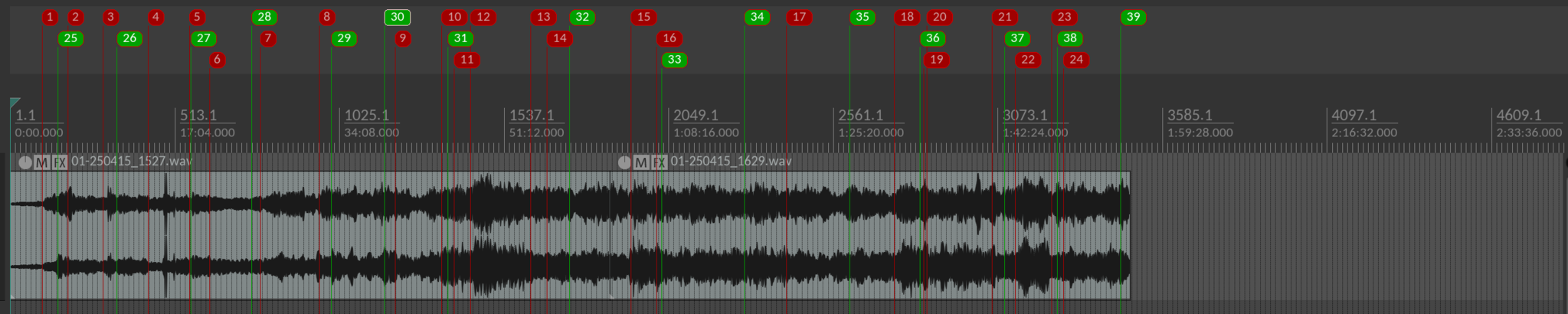
The dissolution of chronometric orientation and a more meditative state in performance II is also reflected in the number of improvisation markers. In Performance I I placed 24 markers, in Performance II (which had a longer performance duration) 20 markers. I therefore rarely changed anything in performance II.
“It feels like I'm playing more thoughtfully. I feel like I'm playing more slowly, listening more. I feel like I'm changing something now. Then I think about what I'm going to change."
This last movement shows a difference to the attitude during improvisation described by Figueroa-Dreher. In performance II, after I had received the impulse to change, I thought about what I wanted to change and then set the action. So the musical change was not spontaneous, but deliberate. The tension between deliberate and spontaneous action also recalls the duality between chronos and kairos: measured sequence versus the opportune moment. In Haltezeit, improvisation becomes less about invention and more about timing – the sensing of when to act within an unfolding continuum.
In the following two pictures you can see an overview of the markers that have been placed. The red markers show the set improvisation markers, the green markers the perceived ten minutes. The quieter improvisational structure in performance II can also be seen in the markers. It was only towards the end that shorter intervals between changes became more frequent. What is particularly striking about performance I is that the inner restlessness is also visible in the frequency of improvisation. I had the urge to change something at shorter intervals.

Experience duration – 3. performative experience
During both performances, I noticed conspicuous everyday disturbances. Cell phones, hunger, and tiredness were perceived as obstacles that affected my concentration, listening posture, and attention. These interruptions mirror Bishop’s concept of “disordered attention,” in which everyday and artistic temporalities overlap. Such hybrid rhythms shape the performer’s perception as much as the sound itself. The cell phone in particular repeatedly led to ill-considered actions - the familiar automatic reach for the cell phone. This shows that performative concentration is never absolute, as I remain embedded in social, physical, and media rhythms. This overlapping of rhythms is especially evident in a private setting, as in this series of experiments. I thus move within the tension between the artistic claim to depth and the reality of hybrid time culture described by Claire Bishop. (Bishop, 2024, p. 6)I felt that in the private setting I had a mode of attention that was situational and fluid, but highly fragmented. My thoughts jumped from my own reminders to pay attention, meditative states, to missing items on the to-do list and thoughts about what food I could grab from the fridge. These things rarely if ever happen to me during a solo performance with an audience. My attention is more focused in a concert situation, my mind feels emptier, as this excerpt from a reflection after a performance of a different piece (playing time 3 hours) with an audience shows:
“After about 1.5 hours of playing, there was a time for me when time didn't want to pass. I looked at the clock almost every minute (there was a timer on the floor in front of me), and one minute felt like 15 minutes. Otherwise, the time passed surprisingly quickly. But I was always conscious of the performance. I never had the feeling that I was in a flow or a kind of trance for a while. But I also didn't have the impression that I was thinking something all the time. I was concentrating on one point in front of me."
Paradoxically, I see a twofold cognitive value here: the disturbances reveal how fragile (performative) attention is. Inner states, external stimuli and time structures interpenetrate each other.
In both experiments, my body had the greatest influence on my subjective perception of time. Hunger, tiredness, stress, restlessness, concentration, attention. All these sensations had to be experienced. Time therefore did not appear to me as something "thought" or influenced by the music, but above all as a sequence of physical states that had an influence on my perception of time. The perceived subjective duration in the performance of compositions of long duration is therefore not just a period of time, but a relationship between body, sound and attention.
Conclusion: Time as an experiential space for performance
This essay is dedicated to the question of how subjective perceptions of time change in long-lasting musical performances and what effects these changes can have on improvisational action. On the basis of the two documented and reflected performances, it became clear: depending on the physical state, level of attention and inner state, time was perceived as stretched or compressed, forgotten or perceived as omnipresent. It also became clear that repetition and non-linearity in music are not perceived as redundancy, but can serve as an immersion in the music.
A direct connection between subjective perception of time and improvisation could be established in so far as more frequent changes in the music were initiated during inner restlessness, which led to a stretched perception of time.
Artistic practice also became an experiential space for the qualitative experience of time in its most fleeting form - duration. Future repetitions with an audience could reveal how shared attention modifies the performer’s temporal perception, potentially shifting the experience of duration from solitary immersion to a co-created sense of time.
This essay is not intended as conclusive research, but as an open research gesture. It invites us not only to measure or structure time, but to consciously perceive it as durée - in performance, in listening, in pausing.
References
Bishop, C. (2024). Disordered attention: How we look at art and performance. Verso.
Glover, R., Gottschalk, J., & Harrison, B. (2019). Being time: Case studies in musical temporality. Bloomsbury Academic.
Kurt, R. (with Näumann, K.). (2015). Menschliches Handeln als Improvisation: Sozial- und musikwissenschaftliche Perspektiven (1st ed). transcript.
Layton, J. (2022). Bergson and durational performance: (Re)ma(r)king time. Intellect.
Shalson, L. (2012). On Duration and Multiplicity. Performance Research: A Journal of the Performing Arts, 17(5), 98–106.