Redefining Time-Based Art: Temporal Dimensions in Static Media Through Time-Based Materials and Imminence
Reference
Bauckham, R. (1993). The Theology of the Book of Revelation. Cambridge University Press.
Derrida, J. (1994). Specters of Marx : the state of the debt, the work of mourning, and the new international. Routledge.
Fisher, M. (2014). Ghosts of My Life: Writings on Depression, Hauntology and Losts Futures. Zer0 Books.
Harris, B. & Zucker S. (2015, July 26). Art historical analysis (painting), a basic introduction using Goya’s Third of May, 1808 [Video]. YouTube. https://www.youtube.com/watch?v=_QM-DfhrNv8
Hashimoto, A. (2016). THE PLAY: A 49-year Journey. In A. Hashimoto (Ed.), THE PLAY since 1967: beyond unknown currents (pp. 175–180). The National Museum of Arts.
Hirsch, M., (2012). The Generation of postmemory: writing and visual culture after the Holocaust. Columbia University Press.
Hopler, W. (2019, April 11). How Did an Angel Expel Adam and Eve From the Garden? Learn Religions. https://www.learnreligions.com/angel-expelling-adam-and-eve-from-the-garden-124030
Solomon R. Guggenheim Foundation . (n.d.). Time-Based Media. The Guggenheim Museums and Foundation. https://www.guggenheim.org/conservation/time-based-media
Stephens, C. (2016, December 1). Fun house: nearly 50 years of the play. artscape Japan. https://artscape.jp/artscape/eng/focus/1612_01.html.
Tate. (n.d.). Time-based media. Tate. https://www.tate.org.uk/art/art-terms/t/time-based-media
VISITFLANDERS. (2020, April 15). The “Stay At Home Museum” – Episode 2 : Bruegel. [Video]. YouTube. https://www.youtube.com/watch?v=TaoXJUPTS0w
Conclusion
The use of time-based materials opens up possibilities to novel temporality. These materials facilitate temporal disruption and creation as significant effects, subverting fixed timeframe conceptions and replacing them with interplays between possibility and impossibility — the essence of imminence. Until the very end of an artwork, we can never determine whether this imminence will manifest as envisioned or remain perpetually anticipated. Time expressed through time-based materials transcends typical and conventional artistic media approaches. By deconstructing the meaning of “time-based”, we can access temporality beyond direct experience, incorporating it into artistic practice.
Unlike the temporality brought about by typical time-based art forms such as moving images and sound art, those created by static media like painting render an extra dimension, adding depth to the painterly plane. At the same time, this virtual depth offers space for containing an additional layer of theoretical framework. Similarly, in the examples of my own creations, time-based materials do not merely produce changes in their physical appearance; their manifestation also provides opportunities to accommodate historical and cultural narratives. Temporal theories, such as hauntology and postmemory, offer valuable insights. The former suggests that past events do not remain confined to history but spectrally haunt the present (Derrida, 1994), while haunting specters can also return from cancelled future (Fisher, 2014). The latter explores how the memory of traumatic events is passed down to the “generation after” and vicariously transmitted through narrative and mediated by the postgeneration via imaginative creations (Hirsch, 2012).
The translation and appropriation of the above theories to the proposed time-based art is possible. As these temporal theories are socio-political in nature, the time-based materials open up opportunities to utilize them in addressing political issues.
Notes
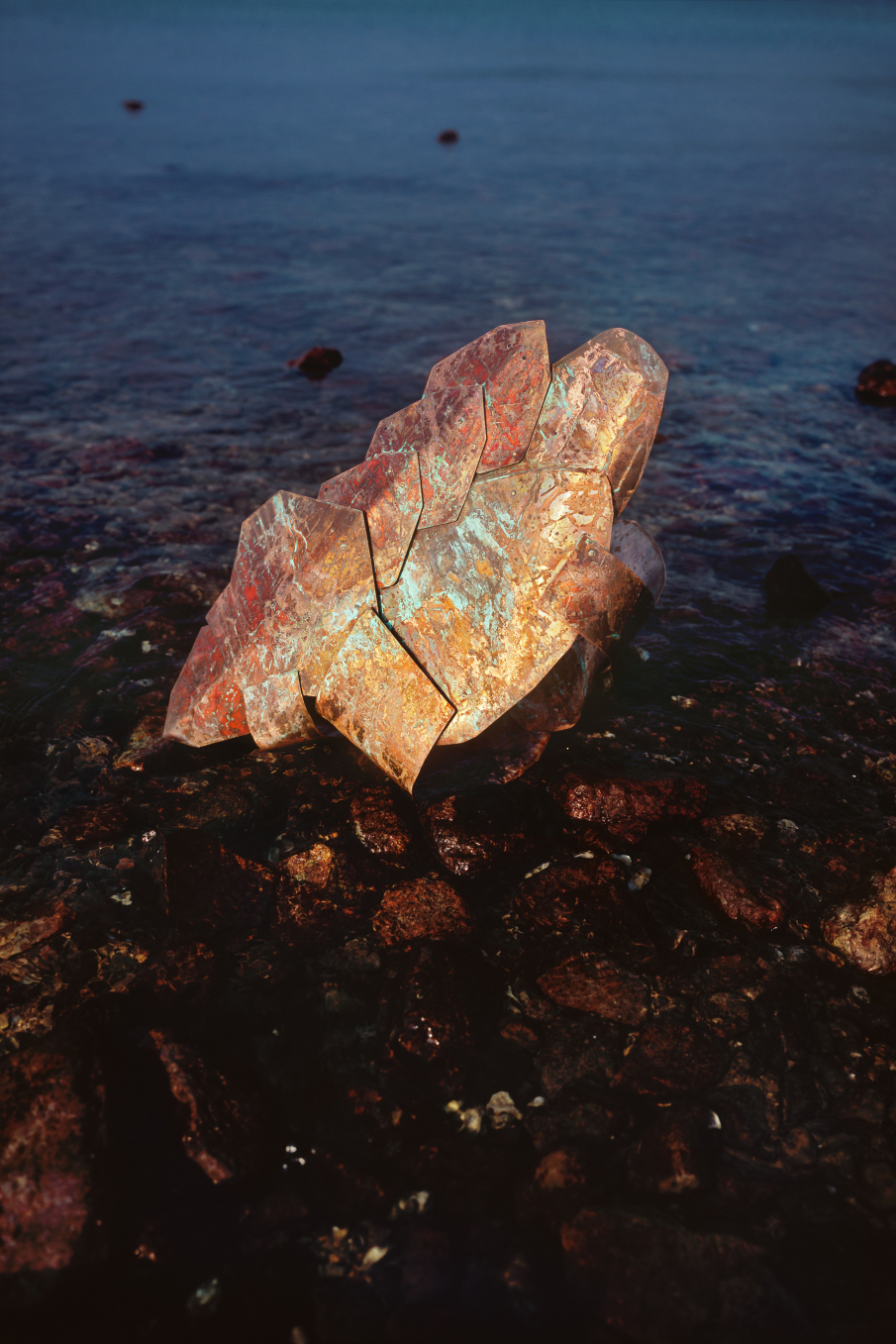
[1] I returned to the same Nam Chung shoreline where the photographic session of "Simulacra" took place to document the installation through photography and video. The resulting photograph positioned the installation at the center, with surrounding pebbles visually extending the chaos depicted between Michael, the red dragon, and rebel angels.The installation thematically addresses the eschaton—where chaos cumulates before renewal begins—appropriating this concept from the painting while using common shoreline settings to suggest eschatological universality. This universality also helps link the two distinct concepts together, while at the same time providing a consistent time and space for hosting them, turning the universality of location into an atmosphere that possesses the quality of temporal directionality.
Funding details
The author received no financial support for the research, authorship, and/or publication of this article.
Introduction
The term time-based art is linked to the notion of time, occupying a measurable segment of time (Solomon R. Guggenheim Foundation, n.d.; Tate, n.d.). Those art form that are played consecutively such as performance, cinematic art, moving image, sound loop, technological or computational installations, with their ongoing nature in defined timeframes, the works unfold to the viewers across multiple temporal points, with beginnings and endings that are not necessarily tied to content but are actions that the content initiates and concludes in the artistic process. For artworks involving looping, viewers may delve into content at their discretion, making it their own point of beginning, and the moment preceding recurrence can be perceived as the ending.
Derived from this framework, any art that juxtaposes two or more timed events possesses the quality to be read as time-based art. We come to the question: what if the temporal events are not all directly demonstrated in the artwork itself? While the definitive character of a time-based art is typically attributed to medium and content, are there other elements that contribute to temporal dimensions? In this article, the possibility of an expanded conceptualization of time-based art will be explored, firstly with a historical painting and a biblical painting, and then with my own installation projects served as illustrative examples.
The time in Painting
Traditionally, painting does not incorporate any durational elements in its presentation, nothing unfolds progressively to viewers regardless of contemplation duration. However, mingling temporality with painting is not a novel approach. Delicately composed, the paintings put together multiple temporalities into a single frame.
The composition of Goya’s “The Third of May 1808” (1814) was meticulously pondered and evokes a definite feeling of time (Harris & Zucker, 2015). Deceased figures occupy the foreground, the one in white shirt and others awaiting execution are painted in the middle ground, while those holding their heads and approaching the execution area recede into the background. Diagonal composition is used to juxtapose sequential events, creating a narrative sense of temporality within a single static frame.
A similar approach of juxtaposition of events can be seen in Peter Bruegel’s “The Fall of the Rebel Angels” (1562). The 16th-century oil painting depicts temporally separated events, creating a sense of temporal disruption. The upper central region illustrates a scene from Genesis of the Bible (VISITFLANDERS, 2020), depicting the distant past when the world and Lucifer fell (Hopler, 2019). Simultaneously, the foreground portrays Revelation 12:7-9, where Archangel Michael vanquishes the crowned seven-headed red dragon. The scenes of the first and final chapters of the Bible were painted within the same pictorial space (VISITFLANDERS, 2020), representing both disrupted temporality and a complete biblical timeline within the painting's surface.
The true conclusion of the painting extends beyond its visible elements. Notably, the Book of Revelation is in fact not a sequence of images, but a series of prophetic images (Bauckham, 1993) that do not have to be followed sequential order. This transforms the duration depicted in the painting into an uncertain element, as the scene of Michael confronting the dragon may or may not be the last event before the Eschaton. However, the eschaton is the ultimate conclusion after the unfolding of all Revelation’s events. Thus, "The Fall of the Rebel Angels" presents a distinct beginning, a variable middle progression, and an ultimate end. From the depicted "surface end"—Michael battling the dragon—to the undepicted but implied eschaton emerges the concept of imminence. This imminence brings along an extreme uncertainty: the eschaton is inevitable, but no one knows the exact timing. Imminence thus represents a temporality that is neither completely unknown nor definitively established and is translatable into contemporary art through what I term time-based materials.
The time-based materials, sense of imminence, and nature
A temporal directionality emerges if a material’s appearance transforms radically with the passage of time. Certain metals exhibit intense temporal directionality with distinct durational qualities. Metals forming rust or patina demonstrates intense temporal directionality, while alkali metals in atmospheric or humid conditions display temporal transitions in rigorous intensity. The vigorous reactions of alkali metals with water suggest rapid temporal change. Materials such as iron and copper, undergo external transformation (rusting and patinating respectively) gradually through the presence of atmospheric moisture, conveying intense temporal directionality over prolonged periods. In 2005, Richard Serra's "The Matter of Time" illustrates this through the use of weathering steel and its material properties corresponding directly to thematic concerns, at the same time introducing temporal dimensions. The irreversibility of rust formation further intensifies this directional progression.
Copper’s lengthy patination process depends on atmospheric conditions, with oxidation and reactions to environmental compounds creating changes. Such chemical progressions create impressions of extended yet variable reaction timeframes. This variable duration — uncertain temporal length — effectively expresses the concept of imminence. The sense of imminence is formed with the common knowledge of the viewers as they know copper patination requires extended time, yet remain uncertain about precise formation duration or average completion timeframes. The duration is both likely and unlikely to be exclusively long, as viewers seem both unable and able to witness the fully changes in their lifetimes. The uncertain play between affirmation and negation, constitutes the essence of imminence.
This sense of imminence can also be found in some artworks created in the late 1970s to 1980s in Japan. In Kansai area (western Japan), the art collective "The Play" created “Thunder” (1977) in an attempt to capture the sublime act of nature. The collective constructed a twenty-meter scaffolding pyramid from logs on a Kyoto mountain to document lightning striking the structure during summer in 1977 (Stephens, 2016). The failure of this first attempt led to consecutive tries through subsequent summers of the next decade till 1986. The collective stopped in 1986 but still failed to capture a strike. This perfectly exemplifies imminent qualities in artistic practice. They were told by a meteorologist that the Kinki region receives a lot of heat-induced thunderstorms (Hashimoto, 2016), suggesting favourable conditions for a lightning strike on the elevated structure. The strike seemed perpetually imminent—seemingly inevitable yet consistently unrealized. Each thunder presented possibility that ultimately went unfulfilled. The artwork remained perpetually incomplete, suspended in imminent anticipation until the project’s conclusion. "The Play" thus demonstrated how natural phenomena themselves can function as time-based materials.
1) 2) The Fall of the Rebel Angels (2022)
"The Fall of the Rebel Angels" (2022)[1] translated Pieter Bruegel's namesake painting into an installation format. The original painting evokes temporal disruption by juxtaposing together the time of Genesis and that of Book of Revelation. The idea of disrupted time was translated into installation by using copper. The installation assumed a door-like structure (200cm × 80cm) (Figure 4), comprising hundreds of artificially weathered and flame-patinated copper plates suspended from metal grid structures using copper and brass wires. The installation incorporated distinct sections using various combinations of flame-patinated and artificially weathered copper, echoing the elements that appeared in the original composition.
The temporal directionality of copper plays a key role in envisioning a time that appears outside the photograph. As weathered copper assumes a full emerald coloration when it is ultimately patinated, this symbolizes progressive movement toward inevitable eschaton, suggesting chaos would culminate in eschaton in an imminent but temporally indeterminate future.
1) 3) Public Cemetery (2023)
In "Public Cemetery" (2023), natural processes such as rainfall and typhoon were incorporated into the creation of artwork as time-based material, casting the evolution and transformation of the artwork. The outdoor installation featured chaotic composition primarily utilizing bubble wrap formed into marionette arm shapes wrapped in bandages. They were soft and light enough to be hanged between wooden supports using fishing lines. Conceptually, the work addressed resistance against authoritarian suppression of traumatic memory, with the arm structures embodying resistance.
The first viewing mode (Figure 5) involved rainfall interaction: the installation occupied an exposed lawn area susceptible to rain. Similar to The Play’s prediction of summer thunder with meteorological data (Hashimoto, 2016), I predicted heavy rainfall during the exhibition period in summer with weather forecasts. These elements together envisioned scenes where rain would impact the lightweight arms, causing them to tremble like traumatic collective memories struggling against suppression. An imminent time frame was envisioned and hoped, but not guaranteed.
Exhibition hours were ended at 7 PM while the summer sky remained bright,whereas documentation occurred at night. This created apparent disjunction between exhibition experience and catalogue representation (Figure 6).This temporal disparity between the real (physical artwork) and virtual (photographic documentation) created paradoxical temporality, with eerie nocturnal documentation representing perspectives viewers could never experience. However, before viewers could explore the real/unreal temporal disjunction or I could witness the anticipated arm movements, a third viewing mode emerged (Figure 7) when a devastating typhoon struck, turning the installation into fragments and remnants. This outcome, though expected as a summer possibility, represented time-based material intervention through environmental forces. The typhoon's imminent arrival remained unpredictable, its occurrence transforming imminence into temporal rupture. Following the typhoon's impact, I reconfigured the fragmented installation into aesthetically cohesive forms based on post-typhoon conditions (Figure 8). This continuation established temporal breaks between pre-typhoon imminent anticipation and subsequent imminent natural phenomena awaiting the reconfigured installation.
Attempts to use time-based materials in creating:
1) 1) Simulacra (2015)
My earliest exploration of time-based materials dates to 2015. "Simulacra" combined large-scale photography (Figure 1 , 2 and 3) with weathered copper, fashioning the metal into armor components with artificially accelerated patination processes. I photographed these elements on pebble shores at Nam Chung, Hong Kong, producing three large-format prints (150cm × 100cm). In the presentation, each large print was framed and hung on the wall, with the weathered copper armor parts placed beneath the corresponding prints. This arrangement emphasized contrast between images capturing specific temporal states and physically present objects undergoing continuous development. The patination of the copper objects seemed to stop at the moment captured by the camera, but in real time, the patination progressed. This temporal tension between "virtually stopped time" and "real and ongoing time" suggested a fundamental disconnection between simulacra and its referent.