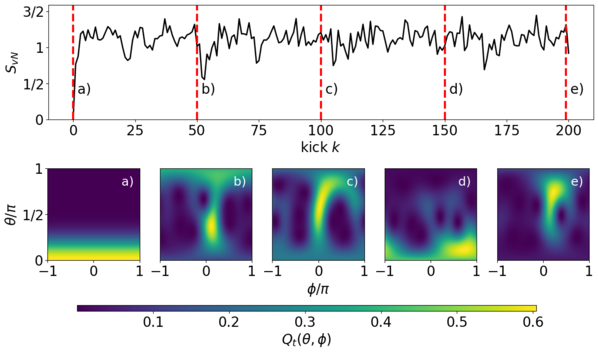
Example of kicked rotor evolution for β = π/2 and α = 10.0, with an initial state |ψ₀⟩ = |0,0⟩.
The top panel presents the time evolution of the entanglement entropy and the bottom panels (a-e) present Husimi Qₜ(θ,φ) function at kick k = 0, 50, 150, 200.
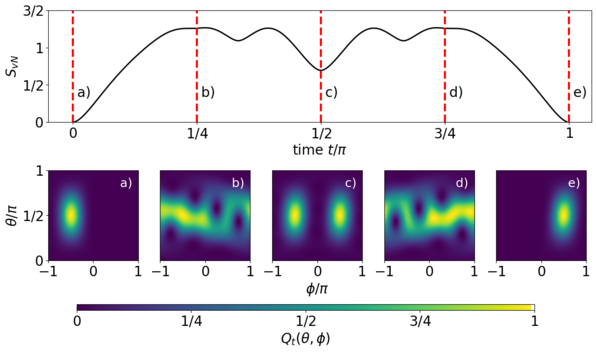
Example of OAT evolution for L=8 spins. The initial state is |ψ₀⟩ = |π/2, -π/2⟩.
The top panel presents the time evolution of the entanglement entropy and the bottom panels (a-e) present Husimi Qₜ(θ,φ) function at times t = 0, π/4, π/2, π.
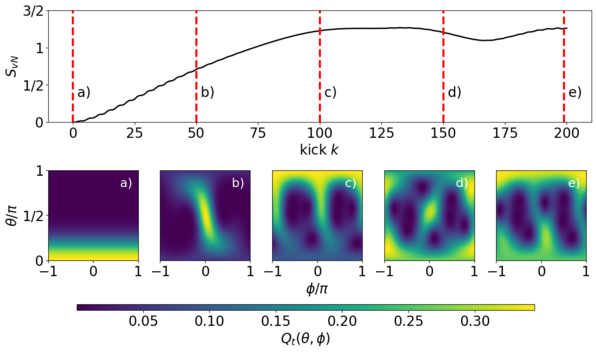
Example of kicked rotor evolution for β = π/2 and α = 0.1, with an initial state |ψ₀⟩ = |0,0⟩.
The top panel presents the time evolution of the entanglement entropy and the bottom panels (a-e) present Husimi Qₜ(θ,φ) function at kick k = 0, 50, 150, 200.
Entanglement entropy
Quantum entanglement can be quantified in several inequivalent ways, with the appropriate choice of measure depending on factors such as whether the global state is pure or mixed, the number of parties involved, and the operational task under consideration (Horodecki 2009, Bengtsson 2017, Plenio 2014, Ma 2024).
Because the states we study are globally pure and we are interested in a single bipartition of the system, we adopt the bipartite von Neumann entropy SvN(ρ).
Considering an arbitrary division of a spin-1/2 chain of length L into subsystems A and B, the reduced density matrix of subsystem A is defined as ρA(t) = TrB[ ρ(t) ], where ρ(t) = |ψ(t)⟩⟨ψ(t)| = Uₜ |ψ₀⟩⟨ψ₀| Uₜ†.
The bipartite entropy reads SvN(t) = − Σᵢ λᵢ(t) log(λᵢ(t)), where λᵢ(t) are eigenvalues of ρA(t).
The entropy is bounded: 0 ≤ SvN(t) ≤ log₂( dim 𝓗A ), where dim 𝓗A is a Hilbert space size of the subsystem A. It vanishes for separable states and is maximal for a tensor product of Bell pairs |ψ⟩ = |Φ₊⟩^⊗(L/2), where |Φ₊⟩ = (1/√2)( |00⟩ + |11⟩ )
Physically, the entropy measures how strongly information about subsystem A is encoded nonlocally across the full system.
Husimi Q function
Exact visualization of many-body quantum states is generally impossible due to exponential Hilbert-space scaling. However, an approximate geometric picture can be obtained by projecting onto spin-coherent states. A spin-coherent state |θ,φ⟩ represents an ensemble of product of L spins collectively pointing in the same direction specified by the spherical polar angles (θ,φ), and is defined as |θ,φ⟩ = exp(− i φ Sz) exp(− i θ Sy) |0⟩^⊗L, where where |0⟩^⊗L is the product state in which every spin is in spin-up configuration.
The collective spin operators Sy = ½ Σᵢ σ̂ʸ and Sz = ½ Σᵢ σ̂ᶻ, where σ̂ᵢʸᶻ are Pauli operators acting on i-th spin, generate global rotations of this product state. exp( − i θ Sy ) rotates the spins by the polar angle θ about the y-axis, and exp( − i φ Sz ) subsequently rotates them by the azimuthal angle ϕ about the z-axis.
An approximate visualization of spin-1/2 chain quantum state |ψ⟩ can be obtained via spin-1/2 chain version of a Husimi function Q(θ,φ), defined as Q(θ,φ) = | ⟨θ,φ |ψ⟩ |². The Husimi Q function represents the probability density that |ψ⟩ is in a spin-coherent state |θ,φ⟩, where all spins in state |ψ⟩ collectively point the same direction defined by angles (θ,φ).
For dynamical protocols, a Husimi function has to be specified at each time t, i.e. Qₜ(θ,φ) = | ⟨θ,φ | ψ(t)⟩ |² = | ⟨θ,φ | exp(− i t H) | ψ₀⟩ |², and its change in time provides an insight into the dynamics of the many-qubit system.
For a given coordinates (θ*,φ*), if Qₜ(θ*,φ*) ≈ 1, the state is close to a classical collective spin configuration. If Qₜ(θ*,φ*) ≈ 0, the system is far from any single coherent configuration.
The Husimi function reveals geometric structure, while SvN quantifies quantum correlations. Together they provide complementary perspectives on many-body quantum evolution.
Dynamical generation of quantum correlations
The dynamical generation of many-body quantum correlations begins with preparation of an initial product state |ψ₀⟩. The system then evolves under an interacting Hamiltonian Ĥ such that Ĥ, |ψ(t)⟩ = Uₜ |ψ₀⟩,where Uₜ = exp(− i t H) is the time evolution operator.
Interactions between spins transform an initially uncorrelated configuration into an entangled many-body state. In geometric terms, the system evolves from a localized configuration in Hilbert space toward increasingly distributed collective structures.
Models
We consider four interacting many-body models that generate quantum correlations through collective or local interactions. Each model can be interpreted as a different mechanism for sculpting quantum phase-space structure and redistributing information across the system. The initial state is taken to be a spin-coherent product state:
|ψ₀⟩ = exp(− i φ₀ Sz) exp(− i θ₀ Sy) |0⟩^⊗L ≡ |θ₀, φ₀⟩.
One-Axis Twisting Hamiltonian (OAT)
The one-axis twisting Hamiltonian is ĤOAT = Sz² = ¼ ∑{i<j} σᶻᵢ σᶻⱼ.
This Hamiltonian generates nonlinear collective phase evolution. Each spin experiences an effective rotation depending on the global spin projection, producing shear of the collective quantum state on the Bloch sphere.
OAT dynamics generates spin-squeezed states, multipartite entanglement, GHZ-type macroscopic superpositions. Physically, OAT corresponds to all-to-all Ising-type interactions. It is experimentally realizable in systems such as ultracold atoms, trapped ions, and cavity-mediated spin ensembles.
At characteristic evolution times, the state evolves from a localized coherent packet into nonclassical structures such as cat-like superpositions.
Two-Axis Counter twisting Hamiltonian (TACT)
The two-axis counter-twisting Hamiltonianis ĤTACT = Sz² - Sy² = ¼ ∑{k<l} (σ̂zₖ σ̂zₗ− σ̂ʸₖ σ̂ʸₗ). TACT can be interpreted as simultaneous squeezing along one collective spin axis while expanding along the orthogonal direction.
Compared to OAT, entanglement is generated faster, squeezing can approach Heisenberg-limited scaling, phase-space structures develop symmetrically. However, TACT interactions are more difficult to engineer experimentally, because they require balanced competing nonlinear couplings along two orthogonal collective directions.
Geometrically, TACT produces hyperbolic flow on the Bloch sphere, rapidly delocalizing initially coherent states.
XXZ Heisenberg
The XXZ Heisenberg Hamiltonian is ĤXXZ = ∑ₖ (σ̂ˣₖ σ̂ˣₖ₊₁ + σ̂ʸₖ σ̂ʸₖ₊₁ + Δ σ̂ᶻₖ σ̂ᶻₖ₊₁), where Δ is the anisotropy parameter.
This model interpolates between different physical regimes: Δ = 0 corresponds to a XY model, Δ = 1 to an isotropic Heisenberg model, and Δ ≫ 1 to an Ising-like regime.
Unlike OAT and TACT, which are fully collective, the XXZ model contains nearest-neighbor interactions. Entanglement spreads through the system via correlation transport rather than global collective twisting.
The model exhibits quantum phase transitions, integrable and non-integrable regimes, and ballistic or diffusive correlation spreading depending on parameters. It is widely realized in quantum simulation platforms including optical lattices and superconducting qubit chains.
Quantum Kicked Rotor
The quantum kicked rotor/top is a periodically driven collective-spin model that generates entanglement and quantum chaos through alternating nonlinear collective evolution and global rotation. The discrete-time evolution is defined as |ψₖ₊₁⟩ = Uα Vβ |ψk⟩, with Uα = exp( − i (α / L) Sz² ), and Vβ = exp( − i β Sy )
Each step consists of two operations:
A nonlinear collective kick Uαwhere the Sz² term produces state-dependent phase accumulation, generating nonlinear torsion (shearing) of the quantum state on the Bloch sphere. This term is equivalent to collective one-axis twisting applied for a short time interval.
A collective rotation Vβ where the global rotation redistributes the nonlinear distortion across phase space, allowing complex phase-space structures to develop over successive kicks.
Together, these two processes generate nontrivial phase-space transport and entanglement growth.
The parameter α controls the strength of nonlinear phase-space distortion, while β controls how this distortion is redistributed between kicks.
For small α, dynamics is predominantly regular: phase-space structures evolve smoothly, the Husimi distribution remains relatively localized, and entanglement grows gradually.
For sufficiently large α, chaotic dynamics can emerge: the Husimi distribution spreads across large regions of phase space, entanglement entropy typically grows rapidly before saturating, and sensitivity to initial conditions increases in the semiclassical limit.
From an information-dynamics viewpoint, the kicked top acts as a controllable quantum information mixer. Initially localized spin-coherent states evolve into highly delocalized many-body states, generating multipartite entanglement and exploring the crossover between semiclassical phase-space flow and fully quantum chaotic dynamics.