In Finnish, the word ‘mono’ refers to a skiing shoe — an object that connects the body to snow and to the ground. While the word mono partly derives from the Finnish producer’s family name (wikipedia Mononen), it also resonates with the Greek word μόνος (mónos), meaning “alone” or “unique.” It is a fitting entry point into sharing some thoughts about our terrestrial condition and connections to the Earth. Mono speaks not only to individual embodiment but also to shared systems—where everyone wears the same shoe, with the same name and purpose, forming a kind of cultural and material uniformity. This mirrors broader concerns around monoculture and globalization and their impact on our world. This seemingly mundane shoe becomes a portal into larger questions.
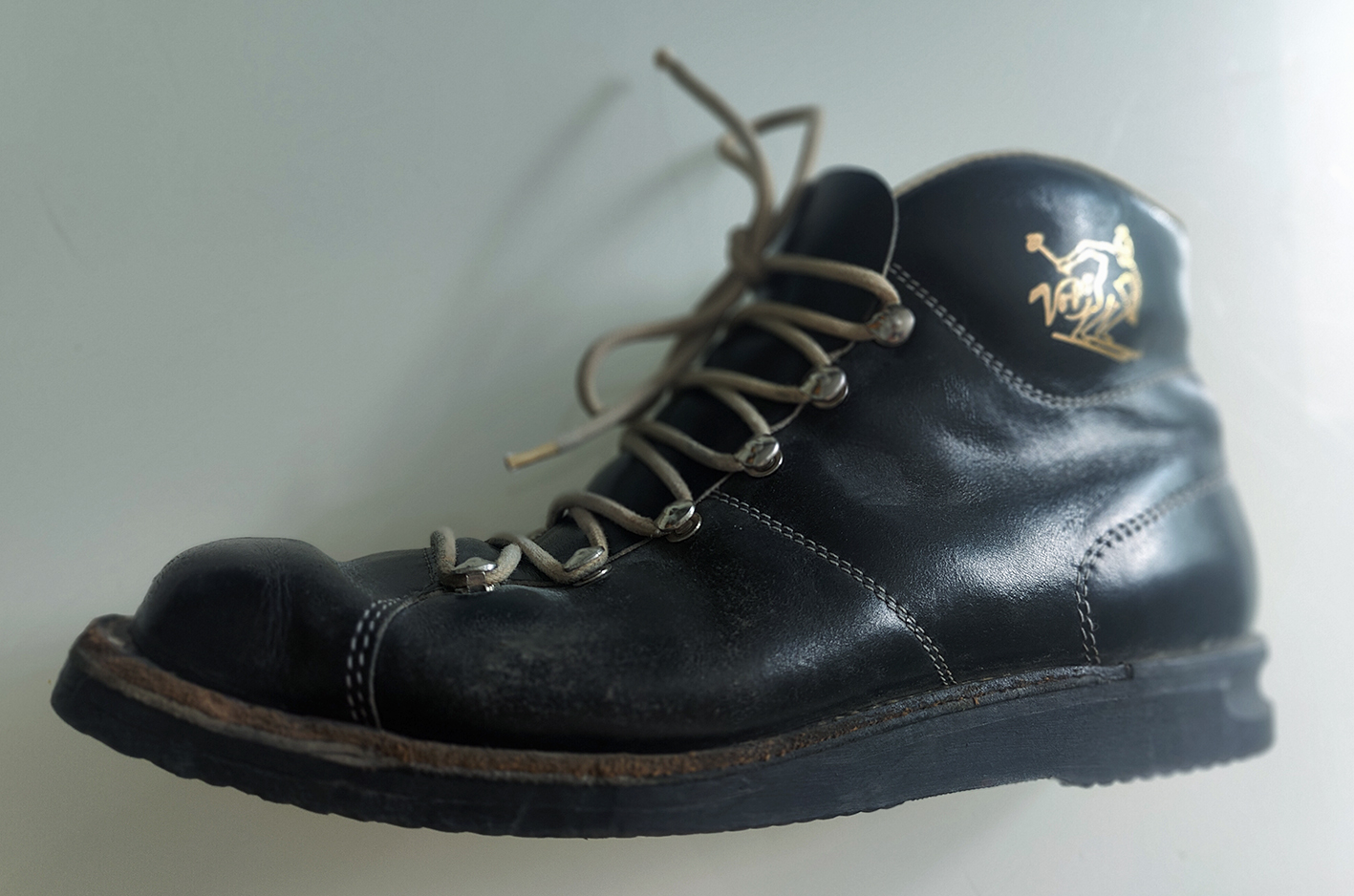
Thinkers such as Donna Haraway and Bruno Latour propose that we need to become truly terrestrial again and that we have to re-learn to live as grounded beings in our world and also to be responsive to its vulnerabilities. Haraway challenges the long-standing Western ideal of human exceptionalism and detachment from nature (Haraway 2018). Latour suggests that we are undergoing a paradigm shift—a cosmological reorientation from a detached “view from nowhere” to an embedded, viral and vital form of knowing. According to Latour the view from nowhere is a descendant of Christian theology; God which is nowhere.This view is strongly present within the natural sciences; scientists have shifted away from the practical consequences and from their own existence - they themselves are nowhere (Latour 2021; Kyoto Prize 2021.)
I understand the proposed terrestrial shift not as a metaphor but as an epistemological and ontological realignment.
Our evolving entanglement with the world impacted by developments in science and technology is central to my long-standing artistic research focusing on human-nature/environment relationships. The outcome of my research is in artworks and texts that describe the background questions and interests that have led to a realisation of the works. Many of them explore the impact of human practices in transforming ourselves and our environment through cultivation, extraction, synthetic biology, environmental sensing, and diverse uses of technology. We are also shaping the world and life itself through editing genes, crafting synthetic biology, modifying existing ecosystems, and creating new ones. These practices call into question what we consider natural, artificial, ‘real’, and living.
I have, for example, explored these transformations through the developed concept of hybrid ecology; an ecology of complex interactions between technological systems and biological processes, as well as between engineered and naturally occurring life forms. Hybrid ecology includes a wide range of situations in which artificial and biologically evolved aspects converge in our world, including in-vitro manipulation, gene editing, synthetic biology, and even the invisible modifications of organisms that remain inside biolabs due to the existing regulations. Despite their containment, these organisms integrate into our hybrid ecologies, forming a new stratum of nature shaped by human intention—and at times, by accidents.
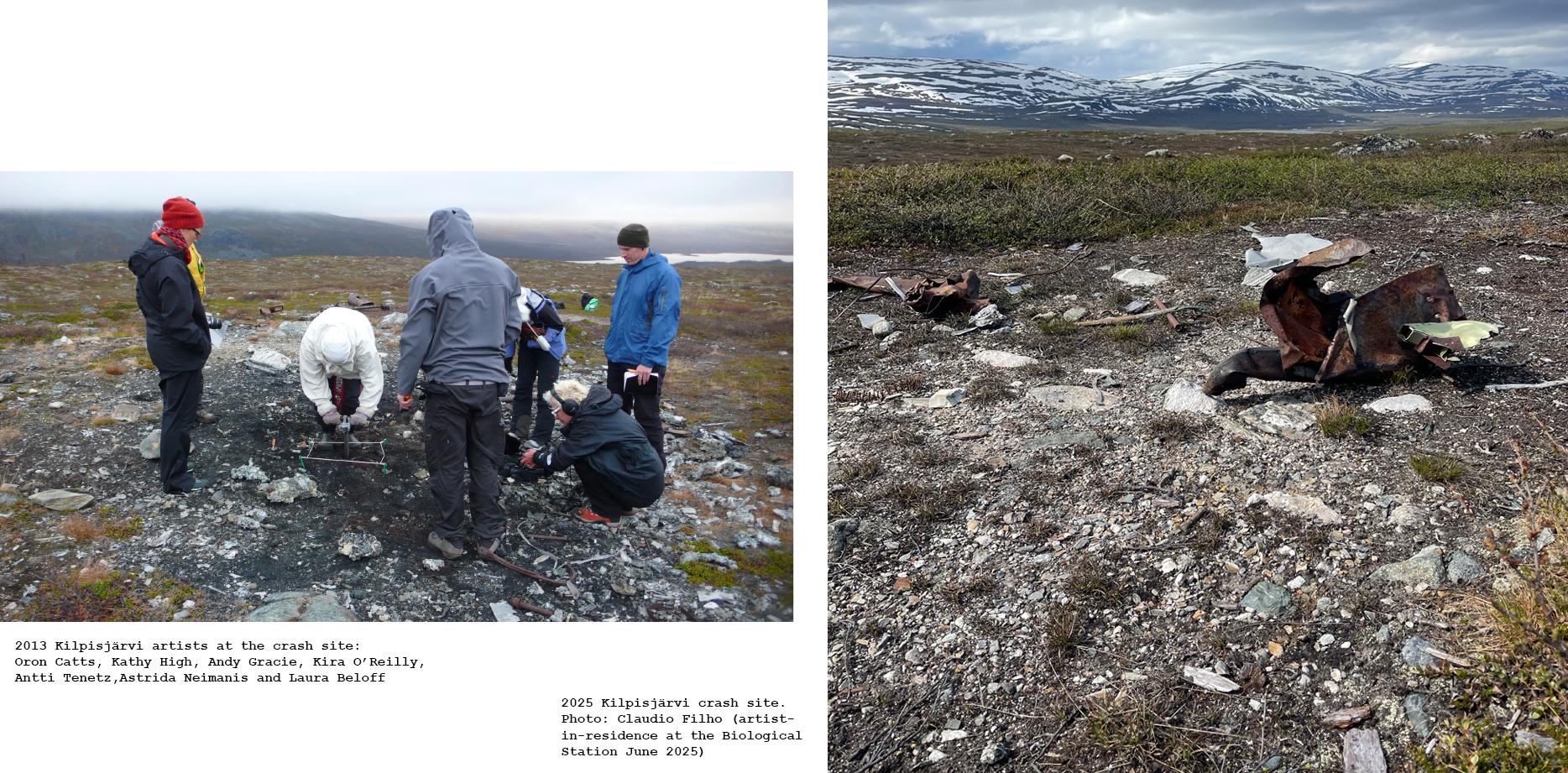
Let us consider the Kilpisjärvi plane crash of a German Junker in 1942. This crash site, still visible today, was the scene of a violent incident over 80 years ago - a collision marked by intense heat and fire. This incident can be assumed to have caused a sterilization of the ground on the site. Although forbidden, visitors have, over the years, collected and carried away memorabilia of the plane's remains. It seems clear that this human activity of collecting mementoes is currently the biggest impact on the site.
In 2013, a group of artists (myself among them) got interested in the site, especially on the evolvement of the ground after the sterilisation and its potential subsequent colonisation by new species. Our action of performing a metagenomic sampling of the soil referenced the scientific practice of bioprospecting; the search for micro-organisms for potential commercial use. Yet, while this art action reflects scientific methods, it aims to ask different questions - that concern locality, temporality, and especially what constitutes value in this site.
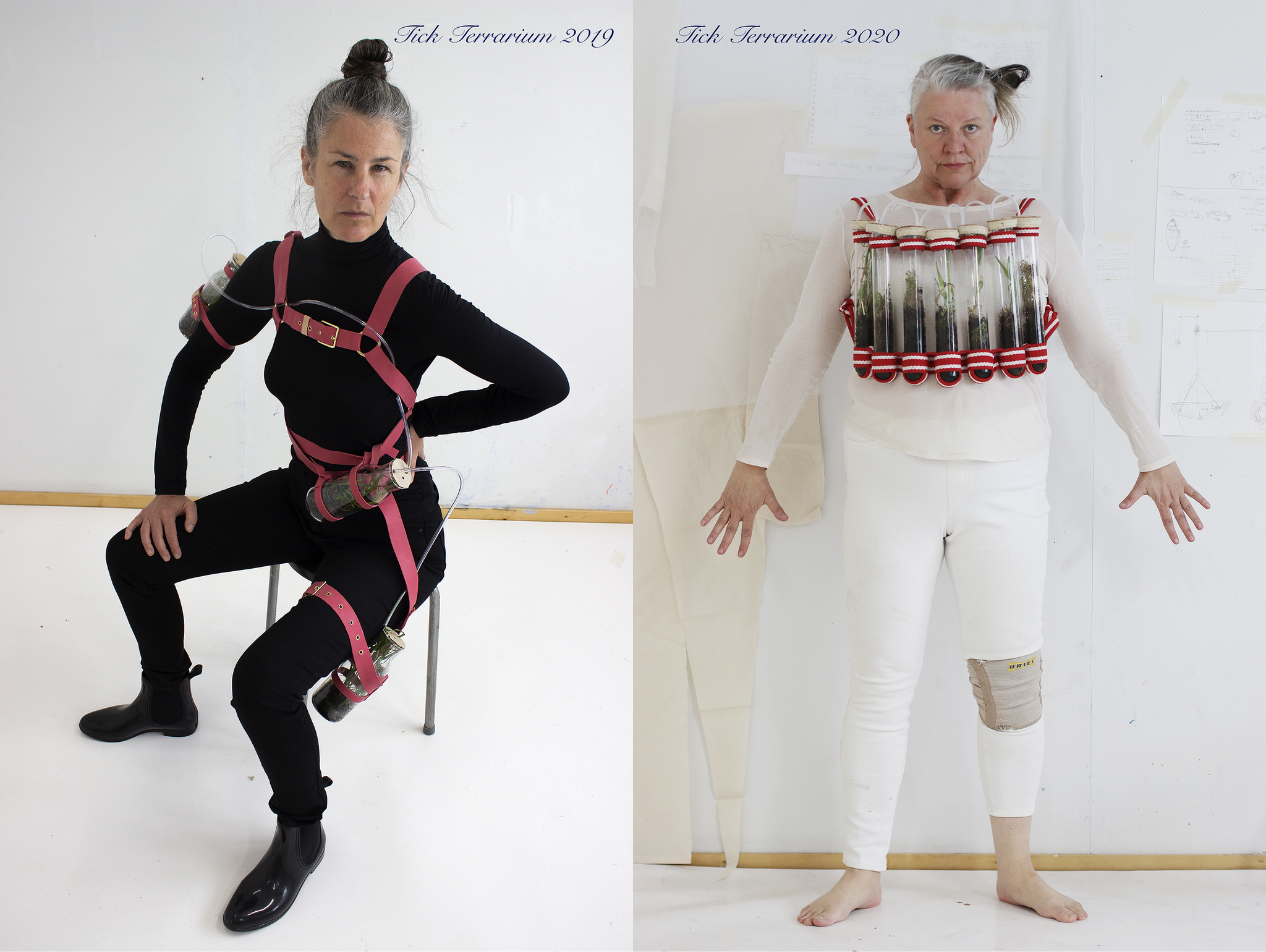
Our relationship with nature and non-human species has become one of disparity. We choose to save and protect certain species, while others we would rather erase. A tick is an example of the latter group. Ticks are considered parasites that have uninvitedly conquered space in nature as well as urban areas. According to a text by Michel Serres, who follows the thoughts of Henri Atlan and Claude Shannon; a parasite can be understood as noise within a system (Serres 2007; Søndergaard & Beloff 2022). This noise functions as a pressure for the system to reorganize itself again and again. It has become clear to me that our relationship with a tick is one of complexity. The tick is not just a threat; it is a vector in the ecosystem, a traveller using other species as its vehicle, and also, a tick is a species that reflects our anxieties about nature. The artwork Tick Terrarium (2020) is constructed as a wearable habitat for ticks. Humans wearing the terrarium become the life support system for it with their body heat, CO2 from their breathing, and their responsibility to keep the habitat humid. The glass Tick Terrarium is deliberately designed with its shape to evoke a suicide vest, referencing both intimacy and danger through its proximity to the body. This form also points to the military research conducted in the 1950-70’s on ticks as bioweapons (Newby 2019). The Tick Terrarium artwork pushes viewers and visitors to confront their fears and biases about which lives are valued, and which are expendable.
Two freeze-dried male transgenic mice are direct descendants of the first mammals to be granted a US patent, #4,736,866 dated 12 April 1988 (National Museum of American History 2013). The OncoMouse was a strain of mice created by inserting a gene from a virus into the DNA of mouse embryos. This was the first ever patented living organism. The OncoMouse marks a turning point in our perception of life as a commodity. Engineered to develop cancer, the mice were created for research, but it also marked the dawn of a new era. I believe that the fact that a living organism was allowed to be patented changed our approach and perception radically toward other organisms. From that point on, we could perceive living organisms on the level of their DNA as artifacts, and commodities. At first sight, it may seem that this is just a continuation of the same trajectory with domestication and cultivation practices, but I argue that the technoscientific methods for biotechnological modifications are much bigger and more precise. They can realize our desires in detail and answer to our imagination.
‘Nature’ is a difficult and complex term today, which has been theorized by many scholars (e.g. Descola 2014; Hui 2017; Morton 2021, among many others). One can claim that the most recent impacts on the concept of ‘nature’ have been made by the fast development in Artificial Intelligence (AI) and Machine Learning (ML) technology. There is an increasing number of examples in which the AI-generated world is blending with our biological world. For example, one can easily find online AI-generated synthetic birds that look delusively ‘real’ but which are new digital species that do not exist in the biological realm (Zhang et al 2023; Biodiversity Heritage Library 2021.) At least not yet.
The digitally generated bird species appear as a type of imitation of the ones living in the biological world. The captured images of the biological world form a base that is used for training the network to generate the new digital species (as images). The generated synthetic species inhabit a digital realm that is convincing and may appear highly attractive to us. One can say that, previously, biological cloning already blurred our perception of reproduction, inheritance and the division between the origin and the copy. Today’s methods in Machine Learning take this conceptually even further with the creation of completely novel species. The concept of authenticity is shifting and possibly disappearing.
Art can expose contradictions and tensions. Reimagining nature through art, and with an impact by science and technology, reveals that the concepts of the ‘real’, the natural and the artificial are changing. Giovanni Aloi has written about Damien Hirst’s shark in the formaldehyde tank versus a shark in a natural history museum (Aloi 2018). One is art, the other is science. But both of the sharks are ‘real’ though located in different contexts. Hirst’s shark provokes a strange emotional feeling of uncanny nature, whereas the shark in the Natural History Museum raises mainly scientific interests without emotional effect. This is an example at the heart of our contemporary confusion: are they both really ‘real’ or how does the context affect the perception of them?
Haraway calls for “response-ability”, and Latour urges us to abandon escapist cosmologies and to truly inhabit the Earth, in its messiness. He asks what it means to be human in this new cosmology (Haraway & Latour 2020) I am asking: What does it mean to be an artist? Do we (artists) have some particular accountability in today’s world, and what would that be?
Art is not a luxury or an escape. It is a practice of recalibration; our mind and senses attuned to the frictions between the synthetic and the organic, the virtual and the embodied. Artists today are navigating these diverse hybrid ecologies composed of software, data, cells, and desires. We are learning to live with organisms that have not evolved biologically but are designed and made by humans. It is a growing archive of lifeforms generated within “the view from nowhere”, but its impact is political, emotional, and planetary. We are required to develop new forms of attachment to synthetic or engineered life forms. Can our self-made organisms evoke stronger emotional responses than the organisms from the wild?
This is not a rhetorical question, but a call for practice, reflection, and reimagination.
In a time of shifting world order with unseen futures and new types of lifeforms - both biological and artificial- artists are becoming cartographers of the terrestrial, interpreters of hybrid ecologies between worlds that no longer divide into nature and culture, or life vs. artifact.
Sitting in rural Portugal (June 2025), immersed in the sounds of non-human life and the artwork-in-progress in front of me - I conclude these reflections with a glimpse into an artistic experiment exploring the phenomenon of so-called protocells.
Scientists define a protocell as a self-organized, spherical collection of lipids with internal metabolism, which is capable of movement and self-replication. It can be compared to biological cells in living organisms and their ability to uptake nutrients from the environment, expel waste, and respond to environmental changes (Hanczyc 2009).
Scholar Esther Leslie has asked: “In what ways do forms of physical matter play into the technologies of a particular time, including the modes of thinking?” (Leslie 2018) We inhabit a fundamentally aqueous planet; life, biology, and climate are embodied in liquid matter. Liquids traverse scales, from the molecular circuits of synthetic biology and microfluidic devices to the cycles of oceanic currents and the thawing of polar ice. On one hand, we engineer precise techniques to manipulate fluid dynamics at a microscale, and on the other, we are confronted with the unruly behaviors of liquids on a planetary scale. Liquid matter emerges at the same time as a substrate of contemporary technological advancements and a protagonist of ecological disruption.
My artistic experiment with biochemistry becomes a site for reimagining how material substances are not merely passive resources but active participants in shaping our epistemologies, technologies, and desires.
I return in thought to the mono—the humble skiing shoe. It is a kind of an icon for terrestriality, an artifact that makes us move forward through friction.
References
Aloi, G. (2018). Speculative Taxidermy: Natural History, Animal Surfaces, and Art in the Anthropocene. Columbia University Press.
Descola, P. (2014). Beyond Nature and Culture. University of Chicago Press.
Hanczyc, M. (2009). The Early History of Protocells: The Search for the Recipe of Life. In Protocells: Bridging Nonliving and Living Matter (pp. 3–17). MIT Press. https://doi.org/10.7551/mitpress/7590.003.0005
Haraway & Latour. (2020, June 25). Donna Haraway & Bruno Latour | Discussion of the Film »Storytelling for Earthly Survival«. ZKM Karlsruhe. https://www.youtube.com/watch?v=j-2r_vI2alg
Haraway, D. (2018). Staying with the trouble for multispecies environmental justice. In Dialogues in Human Geography (Vol. 8, Issue 1). https://doi.org/10.1177/2043820617739208
Hui, Y. (2017). On cosmotechnics: For a renewed relaton between technology and nature in the anthropocene. Techne: Research in Philosophy and Technology, 21(2–3). https://doi.org/10.5840/techne201711876
Kyoto Prize. (2021). Kyoto Prize Bruno Latour 2021. 2021. https://www.kyotoprize.org/en/en/laureates/bruno_latour/
Latour, B. (2021). Kyoto Prize Commemorative Lecture Bruno Latour. https://www.youtube.com/watch?v=V0IqItHwUA4
Leslie, E. (2017). Liquid Crystals: The Science and Art of a Fluid Form. In Liquid Crystals.
Morton, T. (2021). Ecology without Nature. In Ecology without Nature. https://doi.org/10.2307/j.ctv1n3x1c9
Newby, K. (2019). BITTEN. Harper.
Serres, M. (2007). The Parasite. University of Minnesota Press.
Søndergaard, M., & Beloff, L. (2022). Living biotechnical lives: noise, parasites, and relational practices. Artnodes, 2022(30). https://doi.org/10.7238/artnodes.v0i30.402841
wikipedia. (n.d.). Jussi Mononen. Wikipedia. Retrieved June 26, 2025, from https://fi.wikipedia.org/wiki/Jussi_Mononen
Zhang, G., Xu, N., Yan, C., Zheng, B., Duan, Y., Lv, B., & Liu, A.-A. (2023). CD-GAN: Commonsense-Driven Generative Adversarial Network with Hierarchical Refinement for Text-to-Image Synthesis. Intelligent Computing, 2. https://doi.org/10.34133/icomputing.001