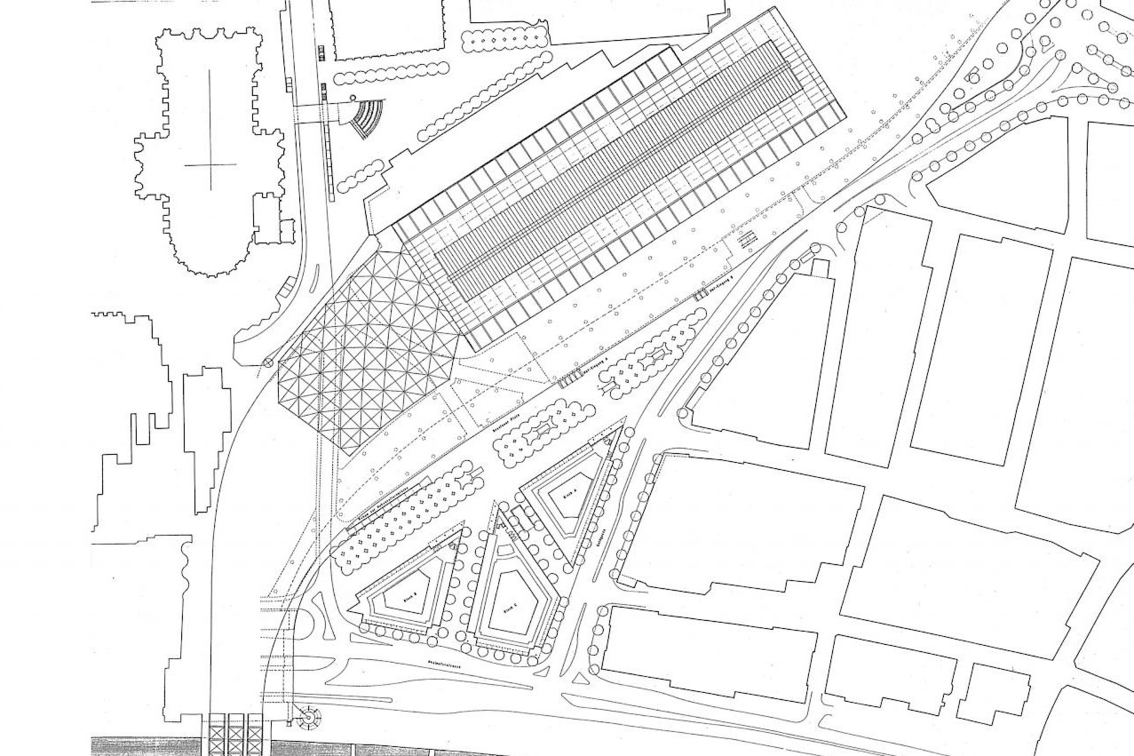
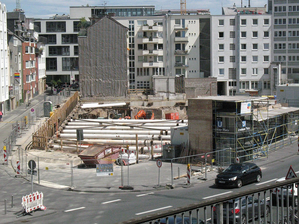
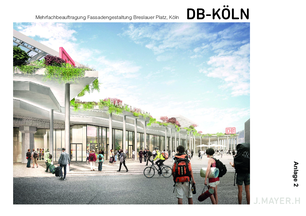
It has been a construction site for ages already. Maybe there are other measures that can be taken.
Like on the picture there is a tree, some benches, that’s already a start.
Because, ok if there is a posh building with offices maybe homeless people won’t feel comfortable hanging around, but does that solve the root cause?
No. They will move somewhere else or maybe even stay.
Okay, let’s give them credit though for wanting to make it look nicer.
Another thing that comes to my mind is that just like on the front side of hbf also on the back side people use the wide open space for protest.
The other day they were raising awareness for the situation in Iran for example.
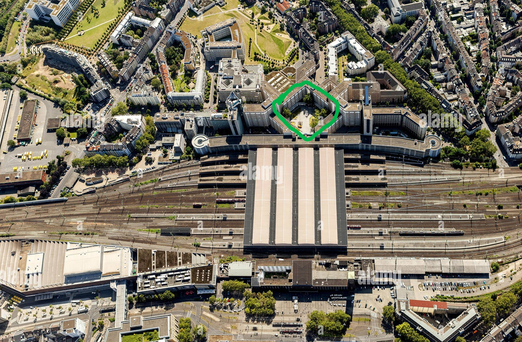
For me the most interesting thing about Breslauer Platz is that from the track above you can see down and from down you can see the people up. I think this has a huge potential for interventions. It is kind of like the balcony in a theatre. Or it could be the ceiling where the lights are hanging.
In genreal though it is not a place where people hang out (besides the homeless people), it is a place of passing through. Changing from bus to train or subway. Going home or starting an adventure. Or just going to work.
Why do the homeless people hang out there? Is it because everyone else is just passing through?
Backstage (just collecting what that means for now) - waiting for your turn, the technic behind the magic happening on stage, passing through to enter on another spot, changing costume, storing stage props, places to rest or warm up, changing rooms etc.
-nervousness, focus, adrenaline, quiet, observing, waiting for the right moment
In fact an image just arises inside of me: Actually the homeless people are waiting in the backstage area of Breslauer Platz for their moment to come forward to approach the next person.
There is the noise from trains, people, traffic. Then there is the ugliness of the space. The grey, dusty, dirty, smelly reality of why no-one really hangs out.
Is this consequence of millions of people walking through, some leaving trash, some taking a piss, not really caring because they won’t be here for long either way?
Is it possible to even clean or tidy such a space? what does it take?
„Der Breslauer Platz hinter dem Hauptbahnhof – über 60 Jahre war er das Schmuddelkind der Stadt. Bausünde mit Pinkelecken und Hinterhof‑Architektur.“ (DE)
“The Breslauer Platz behind the main station — for over 60 years it was the city’s neglected child. An architectural eyesore with pee‑corners and backyard‑style buildings" (ENG)
- Bild, 19.01.2015
„Der Breslauer Platz ist ein Ort der verpassten Chancen.“ (DE)
“Breslauer Platz is a place of missed opportunities" (ENG)
- Koelner Stadt-Anzeiger 19.06.2017
From the point on the stairs at the entrance of the station I could have observed pretty nicely the whole dynamics of the front square. In a sitting position I felt more like a witness, catching eye contact I found difficult, it was mutual only once.
Experiment 0. – 12.09.,2025
Duration: 20 min
Location: Cologne main station: entrance
Equipment required: timer (or alternatively mobile phone with timer), piece of paper/voice recorder;
Score:
Part 1: 10 min- choose a spot, stay there for 10 min and count with how many people you catch eye contact with during this time; using the phone during the experiment or any other electronic device (including headphones) is not allowed;
Part 2: 10 min- write down the result, change the location and repeat the exercise; at the end of the experiment write/record your impressions, focusing on how you felt during the experiment;


The excercise with the gaze helped me understand the difficulty of making an eye contact in the area of the train station. However, the short length of the experiment doesn't allow to collect comparable data. The same setting would need to be repeated multiple times. But for the research purpose, not this kind of data seem to be relevant.
Backstage regions are those places relative to a given performance where the impression fostered by the performance is knowingly contradicted. There the performer can relax; he can drop his front, step out of character, and express aspects of self that are otherwise suppressed
-Erving Goffmann
Experiment 1. - 15.09.2025
Duration: 20 min
Location: Dusseldorf main station
Equipment: phone with the timer/timer, sheet of paper/phone note
Score:
Part 1: 10 min - choose a spot and stay (or sit) trying to catch eye contact with the people passing by and count how many times it was successful (mutual);
Part 2: 10 min – every time the catch of the eye contact is successful (mutual), perform one movement; try to write/paint/record the combination of them in the performed order at the end of the session;
The performative mode. I mean backstage doesn't mean that you can rest and lay down, it's completely different because you're using the different energy.
I was thinking like if it's the backstage before you do something, in the middle or at the end. You know, if when you're in the backstage before you have to perform, there is this like adrenaline energy to keep you up.
I was thinking that, okay, this is the stage with the performative mode, I will get maybe more attention from the strangers, from the people. And then when I just get into this hub area, then I will be kind of, like, blend in also with the people
I would just be one of the travelers. Nobody cares, they care only, like, which platform they have to go or if they have to run. So for me, it's more, because for me, the backstage also means that I can relax, because on the stage, only for me, only just standing there, I get, my energy gets sucked.
I love that feeling, but I feel that it's getting sucked. Even when I bow after performance, my, like, cheek gets so tense, so, because of this, yeah, because of this energy. Actually, I kind of hate smiling when I bow.
So for me, it's also, like, it really cuts between the backstage and on the stage is, like, this energy, how I'm using it or if I'm spreading it or if I'm just keeping it.
So I was more imagining that this is the stage where I have to be aware with everything and then use my energy to put it out. And as soon as I get in there, I don't have to.
- Hyunsoo Auo, dancer

“If a place can be defined as relational, historical, and concerned with identity, then a space which cannot be defined as relational, or historical, or concerned with identity will be a non‑place.”
“A person entering the space of non‑place is relieved of his usual determinants. He becomes no more than what he does or experiences in the role of passenger, customer, or driver… The space of non‑place creates neither singular identity nor relations; only solitude, and similitude.”
- Marc Auge
It's kind of hard to cut their path, you know? It happens that everybody walks fast. And they are also very precise, straight to the point. They have a goal.
And also when I tried to mimic people's gesture or posture, it was either smoking, either phone, or either just walking. Or all together.
There are not so much varieties, you know?
Imagine there are no humans here and no these, all these bikes and the vehicles here. Yeah. If you think it's all clean, I don't feel like they need to change something with the architecture.
It's really, like, this kind of movie that shows, the AI people, you know? Like there's no emotional feeling. The only purpose of the life is just work and money, work and money.
The only people that stay are the homeless.
- Viola Cantu, performer
After trying to create a choreography based simply on my reactions to the encounter of an eye contact, it became clearer that I would need more specific source or structure to design movement for the "intervention". I tried to create visual representation of the dynamics of the train station's entrance and treat it as a movement score.
The final choreography/performance is about to engage participants, understood as passers-by together with the invited guests. I asked myself what might be the performative material, other than only movement, that might help to create this connection. Then the idea of the tape came. Tape, as temporary and easy to remove material, mirrors the temporal character of the train station as a non-place. It is commonly used to designate spatial borders or limits.
I interpreted numbers of arrows and dots as reference points for creating movement. Each arrow was planned as moving through the space, each dot as a static position. In the dance studio I tried to "recreate" the spatial order of the train station's entrance. However, it seems like the amount of factors that needs to be considered at once is overhelming when designed and perfomed by only one dancer.
References
- Halprin, Lawrence. The RSVP Cycles: Creative Processes in the Human Environment. New York: George Braziller, 1969;
- Klein, Gabriele. The city as a stage. Urban cultures, cultural performances and the performing arts. In Cities and Urban Spaces: Chances for Cultural and Citizenship Education (Conference proceedings, 29 September – 1 October 2010, Trieste, Italy), Workshop II: Performing Arts and Culture in the City: New Fields of Action for Cultural and Citizenship Education, 2010
- Goffman, Erving. The Presentation of Self in Everyday Life. Garden City, NY: Doubleday Anchor, 1959
Session 1. - dynamics of the place
Score 1. - observation
For 10 min observe the movement happening and make a drawing/map of what you see
Score 2. - action/interaction
10 min-walk through the space following the traces of the people;
5 min-try to cross their paths
10 min-choose a spot and try to mimic/copy the positions of the people you see around
Score 3. - intervention
After observations you made, think about the way of how to disrupt the order of the space; perform this action for about 5-10 min
Experiment 2. - 10.10.2025
Location: Tilburg harbour
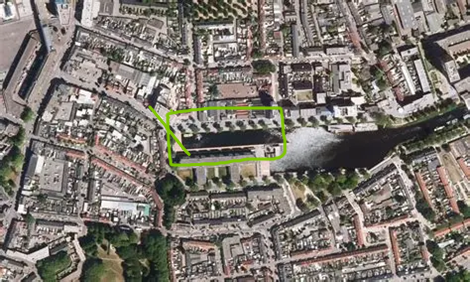
Set up: tape, paper/smartphone with the article about planned demolishing of the harbour area
Performers: 2
Action: performers tape a line between Piushaven and the modern building on the other side of the harbour; audience is located near the harbour – sitting/standing; before the perfomers start the taping, audience is given a text to read online- on their smartphones; they are instructed to read whenever during the intervention; performers go from two opposite sites and meet in the middle; possibly they also ask the audience to participate in the “taping”;
Tape could be also a material to fix, to stick things together. Its temporal character and adaptability give the chance to adjust to the space.
Altough, the temporality of the tape doesn't suit to the character of the intervention which aims to create opposite to the temporal, mobile and alienated atmosphere.
Temporality is one of the qualities of the train station's dynamics. What are the others? What kind of actions are performed and which qualities do they have?

Performers shared their insecurities regarding work on the Breslauer Platz directly- the fear and sometimes disgust they have to face in this place; the first drawing score showed the similarities in the perception of the space - the dancers gave special attention to the rhythm, positions and amount of people moving through the space; in both drawings straight lines are the dominant ones. The first score seemed accessible to perform in the space, the second one-problematic because of the fast tempo of passers-by walking and the repetitive character of their activities. Performers found difficult to find a way to ‘disrupt’ the order of the space through action.

"it is the pedestrians who transform a street (geometrically defined as a place by town planners) into a space"
Experiment 3.- 17.10.2025
Duration: 30 min
Location: Cologne main station
Material: notebook/smartphone
Actions: spend 15 minutes on the train station noting down different actions you perceive are being performed there. Pay attention to who is performing the activities you observe. Write all this down. As a next step, choose 3-5 actions from the list. If you could imagine that those actions constitute a performance of yours, what will be the preparation to them? Write 3-5 actions that will be a preparation for those you observed before. Then for next 15 minutes perform the “preparation”. Write or record your reflections afterwards.
Actions observed at the station seem automatic and repetitive, simplified: walking, reading, buying. Eveything happens either in a rush or in short moments of pause. The space is getting clearly divided between the 'waiting' zones and the 'moving' zones - by architecture and by the people themselves.
The experiment brought attention to the quality of the actions that are performed by the users of the train station. It didn't result, however, in gaining any new insights, rather in prove of the theory it was based on. The idea of the 'opposition', the opposite actions lacked a context they could have been performed in. And by whom?
Exercise/experiment/score:
Take the object that you found at the station or any other that for you relates to it: some of your notes about this place or photos etc and try to move in relation to it. Take 5-7 minutes for this exercise. You can also do a small warm-up (2-3 minutes of movement led by your breathing rhythm, grounding, bouncing etc) beforehand.
I took photos taken during the visit at the station and tried to find a way how to relate to the elements visible on them with my body. I went to the studio and improvised with movement. However, without a physical object but only with the photos of it it was hard to relate and find inspiration or reference for movement I wanted. The photo seemed to be a separating layer between the place and my body. So I could have improvised with the shapes but I couldnt build a relation between my body and the pictured object.
Session 2. - alienation
Score 1. - automatic writing
For about 10 min write, without stopping. Start from what alienation means to you.
Score 2. - site-exploration
For the next 15 minutes search for the 'places of alienation' in Breslauer Platz. Take photos or make notes about them.
Score 3. - solo-score
Take a moment to think what movement you can possibly associate with alienation. Create a short movement phrase (circa 1 min).
References
- Leigh Foster S. Choreographing empathy. Kinesthesia in performance; New York 2011, Routledge
- Breton, A. (1997). The Automatic Message. In M. Polizzotti (Ed.), André Breton: Manifestoes of Surrealism (pp. 119–164)
"But the real non-places of supermodernity - the ones we inhabit when we are driving down the motorway, wandering through the supermarket or sitting in an airport lounge waiting for the next flight to London or Marseille - have the peculiarity that they are defined partly by the words and texts they offer us: their 'instructions for use', which may be prescriptive (,Take right-hand lane'), prohibitive (,No smoking') or informative ('You are now entering the Beaujolais region')."
Experiment 4. - collective 6.11.2025
Duration: 1 hour
Location: Cologne Hbf- Breslauer Platz
Material: scores (dynamics of the place), article about the planned renovation of the Hbf
Participants: 3 performers, passers-by
Activities: performing scores, reflection-feedback round afterwards - open discussion;
"Travel [...] constructs a fictional relationship between gaze and landscape. And while we use the word 'space' to describe the frequentation of places which specifically defines the journey, we should still remember that there are spaces in which the individual feels himself to be a spectator without paying much attention to the spectacle."
The exercise of collective automatic writing went well. Both performers and a musician participated. The group was open enough to exchange and read each other’s notes afterwards. The result of the second score I proposed didn’t come out as I expected. I mentioned the ‘places of alienation’ that one can notice on the Breslauer Platz. The photos they took show mostly abandoned objects like old bikes or dishes left on the ground. I wasn’t sure if my instruction was not clear enough or it was just a matter of interpretation of the term. The third score went very smooth, performers dived into the task directly and we managed to record around 1 minute of material for each of them.
"If we linger for a moment on the definition of anthropological place we will see, first, that it is geometric. It can be mapped in terms of three simple spatial forms, which apply to different institutional arrangements and in a sense are the elementary forms of social space."
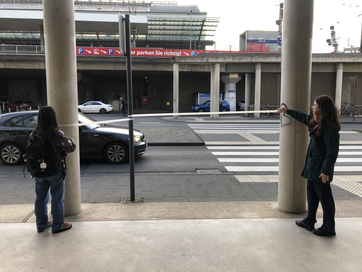
The intervention didn't evoke any stronger reaction of the passers-by. The created 'obstacle' came out not as disturbing but rather resonating with the space. Passer-s by weren't distracted by it but the tape was moving with the wind, vibrating.
Experiment 5. - collective 6.11.2025
Duration: 20 minutes
Location: Cologne Hbf-Breslauer Platz
Material: paper white tape
Participants: 3 performers, tape, passers-by
Activities: taping the space between the pillars at the entrance to the underground; observation of the site for around 10 minutes afterwards
"In the concrete reality of today's world, places and spaces, places and non-places intertwine and tangle together. The possibility of non-place is never absent from any place"
"Anthropological place' is formed by individual identities, through complicities of language, local references, the unformulated rules of living know-how; non-place creates the shared identity of passengers, customers or Sunday drive."
Experiencer - in the first phases of the research I spent much time observing the dynamics of the train station and my own thoughts in relation to it; the same task was given to the participants of the research sessions;
Experiment 6. - collective 20.11.2025
Duration: 1,5 hours
Location: Cologne Hbf-Breslauer Platz
Material: smartphones, papers and pens
Participants: 3 performers, musician, passers-by;
Activities: performing scores (alienation), feedback-reflection (open discussion);
Session 3. - studio work
Warm-up
Score 1. - collective reading
For about 10 minutes read together the proposed text. Discuss, what caught your atention during reading and possible questions related to the topic (circa 5 min).
Score 2. - movement improvisation
For about 15 minutes try to embody interruption through your body. Afterwards, find a transition between interruption and disruption.
Score 3. - solo-score
Create a movement sequence (something that you can possibly repeat, about 1 min long), based on one of the tools you dicovered during the improvisation.
Score 4. - listening score
Listen to the sounds of the train station, recorded and edited.
References
- Theodoridou, D. (2022). Publicing: Practising democracy through performance. Nissos;
- Victorian Rail Industry Operators Group. (2011). Railway station design and standards. Victorian Rail Industry Operators Group Standards;


Because of the weather conditions, focusing on the movement on the spot was difficult. Maybe it's worth bringing the work temporarily to the studio? What will be the prompts and cons?
the movement material performed on the spot didn’t evoke any specific reaction of the passers-by, they seemed to ignore what was happening anyways; performers found appropriations for their solos, created beforehand in the studio; it seemed possible to relate to the space in the meaning of objects but moving in relation to people (trying to mimic, catch eye contact) didn’t provoke their reaction; performers seemed encouraged to experiment with the objects in the space; Breslauer Platz seemed calmer than usual, pigeons somehow took over the square; the track composed out of the modified sounds of the station didn’t evoke direct memories, rather created an alternative scape that performers could have been part of; however listening to the same track at the same time created an invisible, spatial connection between participants of the experiment and somehow put the rest of the ‘users’ of the space in between the invisible “soundscape”
"a person entering the space of non-place is relieved of his usual determinants. He becomes no more than what he does or experiences in the role of passenger, customer or driver"
The session went very smoothly, I had the impression that we can continue in this setting for hours. The collective reading appeared to be challenging for the participants, the discussion afterwards was quite short. Performers brought attention towards how the text was written more than how it presented the topic that we worked with. Warm-up happened in the circle, each of the dancers (including the facilitator) focused on their own body but the sharing was happening on the inspirational level. As one of them mentioned “small stretch that you do can be already a proposal for everyone”. Dancers went into the impro score with the music played by the, present all the time in the room, musician. The music was of his choice. The improvisation revealed the multiplicity and diversity of understanding what interruption and later on disruption, could mean, when emobodied. Dancers found patterns and structures they wanted to interrupt. The exercise showed that the quality of interruption not necessarily aligns with what dancers understand as disruption. The listening exercise brought memories related to the train station into the room.
Working session. - collective 26.11.2025
Duration: 2 hours
Location: studio CCD
Material:
texts: PUBLICING: Practicing Democracy Through Performance
Danae Theodoridou, 2022; Railway Station Design and Standards by Victorian Rail Industry Operators Group Standards; 2011; pens and handy for the recordings;
Participants: 3 performers, facilitator and a musician
Activities:
1. warm-up, 2. collective reading of the fragment of PUBLICING plus reflection; 3. improvisation exercise on interruption/disruption in movement 4. solo-score
What was the aim of the studio practice in this context? What this enabled me to conclude about the research process and progress?
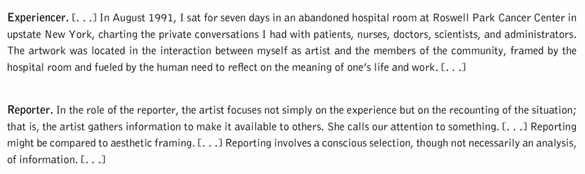
Reporter - through sketches and notes I tried to combine my thoughts about the train station as a non-place, the already existing maps of it, as well as photos I've taken. Participants of the research group have been asked to do the same
"Place and non-place are rather like opposed polarities: the first is never completely erased, the second never totally completed"
During the studio practice it was easier to observe how the given tasks affect the participants, how they react to the music and to each other's presence in the room. The focus of the practice shifted from interrupting the outside space towards interrupting the space of 'the body'.

"The link between individuals and their surroundings in the space of non-place is established through the mediation of words, or even texts."
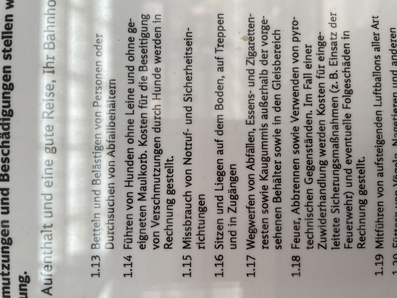
"Social etiquette written down, loose empathy and humanity. Spontaneity opposed to rule following. The rules provide the illusion of safety to those who follow them. Uniformity, conformity. Train station as a place of transit, no sitting allowed, no lying, no rest."
"that we are most likely to find prophetic evocations of spaces in which neither identity, nor relations, nor historically take any -spaces in which solitude is experienced as an overbur dening or emptying of individuality, in which only the movement of the fleeting images enables the observer to hypothesize the existence of a past and glimpse the possibility of a future"

"Architects Lawrence Halprin and Jim Burns, working closely with Lawrence’s wife, choreographer Anna Halprin, developed a collective creative workshop process they called the “RSVP Cycles” (see Halprin and Burns box,see figure 7.10).The RSVP Cycles are both a theory of the workshop process and a very useful technique:
- Resources – all the subjective and objective material used in the creative process.These include space, people, money, things, etc.; and objectives, feelings, fantasies, open and hidden agendas, etc.
- Scores – what I have termed the proto-performance: scenarios,instructions,plans. Scores can be either open or closed. A closed score controls the action; an open score allows for a variety of options.
- Valuaction – where the group considers feedback about the ongoing creative process. Scores are revised on the basis of the feedback. Halprin and Burns coined the term “valuaction” to emphasize the action aspect of the feed back. Scores are revised not just by talking about what happened but by means of new actions.
- Performance – the most optimal outcome possible using the scores within the given circumstances
In the Halprin–Burns method, the RSVP cycle is repeated several times during workshops.There is no right place to start.The group may enter the cycle at any of its nodes. Nor is the performance phase necessarily a public performance. Often the performance is for members of the workshop only. At some point, a public may or may not be invited to experience the results of the workshop.This kind of workshop is not designed primarily to find materials out of which public performances are made.The primary objective of this kind of workshop is self-discovery and/or the building and solidifying of a creative group or team."
- Schechner, R. (2013). Performance studies: An introduction.Routledge; p.264-5
"Insofar as workshops are where new ways of doing things are explored and where resistances to new knowledge are identified and dealt with, they are similar to initiation rites. [..] During initiations,persons leave their ordinary lives behind (separation), undergo ordeals by means of which old behaviors are erased and new behaviors and knowledge learned (liminal phase), and emerge reborn as new or at least profoundly changed beings ready to rejoin their society but with a new identity and at a new level of responsibility (reintegration). Workshop participants follow a similar path by isolating themselves from their ordinary lives, putting aside old habits, delving into themselves, and learning new ways of doing things emerging to some degree as “new persons.”As in many initiations, the journey is not undertaken alone. A group sustains individual efforts just as individual contributions strengthen the group. If a workshop is successful, participants re-emerge as changed beings. Sometimes these changes are minor, sometimes fundamental. For a workshop to succeed, the participants must do the hard work of not only mastering new skills (training) but opening themselves up to others and to new ideas and practices.This is not easy. But once participants are able to be receptive and vulnerable, they are ready to grow and change. Workshop and training may overlap in function, but they are experienced very differently.Training is a long, slow, repetitive, immersive process. Workshops are relatively brief,intense,and transformative.Some workshops use “ordeals”as a way of breaking down resistance to learning and as a way of incorporating new knowledge into the body. Fasting, long hours, strict discipline, and difficult psycho physical exercises are just some of the techniques used to push people beyond their ordinary limits."
- Schechner, R. (2013). Performance studies: An introduction. Routledge; p.323
Experiment 7. – solo-exercise: disruption – 6.12.2025
Duration: 15 min
Location: Cologne Klettenberg - near to the train tracks, under the bridge
Material: (optional) headphones with music
Activities: for a few minutes dance freely on a bike path
The music in the headphones provides the layer of isolation from 'the outside'. For me the area around the bike path became the space for movement instead of space predicted to be crossed by bike. I gave myself a permission to oppose what was expected to do in the space designed for a certain purpose. To go against the established 'rules' of the place.
Does the transformation of the perception of space depend on the participant/performer or the observer?
Does the change of perception of the place change the place itself?
In the project?
- Resources – collective, the area of the train station, .
- Scores – prepared by me "tasks" for the team; so both scores for the dancers and for the musician?
- Valuaction – reflection moments happening at the beginning of each session; how can they manifest through action? or do they manifest thorugh the adaptation of the movement to the space?
- Performance – ?
-> If this method is an inspiration for my creation process, what will be the ingredients that I use in my work with the train station?
-> circular structure rather than linear
-> there is a set "score" of a final performance but actually what happens in the meantime, leads to the result which might be different than the "expected outcome"
-> new ways of doing things are explored f.eg. new ways of using the train station, of experiencing this place, being there
->experiencing things as a group, not alone
->if a workshop is successfull, the change in participants is tangible
-> brief, intense, transformative process
How to bring the movement material to the space?
Can the relation to the users of the train station be build through movement?
How to develop the solos further into the choreography? How to find moments of connection in the performance?
Which role music plays in the process?
Experiment 8. - collective 7.01.2026
adapting solo material to the site
Participants: Efti, Elodie, Lea, me, Breslauer Platz;
Material: Hausordnung plus solo material created before, music sample;
Location: Cologne Hbf
Action(s): 1.writing exercise (around 20 min), reflecting together on the ‘rules’ of the train station 2.performing solo material on the spot (Lea and Elodie) 3.collective listening to the music track and reflection on it;
Experiment - methodology
analyzing the choreography to find a method of designing movement for the future intervention
Participants: me, kinovea (program)
Material: recordings of the solos from the studio and movement created on the site
Location: whenever
Actions: watching the videos in the program, noting down the elements significant for certain performers: gestures, movement qualities etc
What kind of qualities to focus on? Should the qualities mirror the personalities of the performers or rather correspond with the space?
-"dancy" solo
-inspirations from flamenco
-body cross
-impulses from the elbows/head
-curves
-going around the others
-right arm leading;
-movement in th spiral;
-turns but chest as a 'flat' surface;
-turning the whole left side;
-arm bent, running in a spot;
-head free;
-shake and jump from one leg to another;
-legs' cross;
-impulses from the shoulder;
-shoulder leading;
-triangle of the arms;
-build-up of the tension and fall;
-hands giving the direction;
-turning around the vertical axis;
-head passively folllowing;