The Hijacked Dream in Arts-Based Research: A Work of Surrealist Criticism
Cassie Fielding & Faith Harkey Department of Psychosocial and Psychoanalytic Studies, University of Essex, Colchester, UK
The authors report there are no competing interests to declare.
Biographical note: CASSIE FIELDING and FAITH HARKEY are doctoral researchers at the University of Essex, Colchester, UK. FIELDING’s research investigates the intersection of Surrealism, Jungian psychology and alchemy through practice. Her surrealist poetry has appeared in various journals, and she has three poetry collections to her name, The Arbitrary Fractals of an Oracle, God, Love and Sex Live in the Same House and Confessions of a Reverist, as well as a surrealist experimental collaboration, When Fold and Twine. HARKEY’s scholarly work explores the connections between Jungian theory and authorship. She is the author of two middle-grade novels, Genuine Sweet and Sneak Thief, and is presently at work on a surrealist novel for an adult audience.
ORCID IDs: Cassie Fielding 0009-0005-7813-2788 // Faith Harkey 0009-0005-8446-1449
Abstract: Mention of a surrealist form of criticism comes to us through Breton and Polizzotti, but we have little in the way of criteria or techniques for developing and identifying such critiques. This article, then, begins with the inquiry, what is surrealist criticism—or what might it be? The authors then introduce the focus of their own surrealist critique, the research methodology known as arts-based research (ABR). Over the course of their examination, Fielding and Harkey suggest that an egoic, or will-driven, approach to arts-based research must ultimately fail, in that it both denies the spirit of artmaking and disregards autonomy of figures in psyche. Blending academic and surrealist prose, fiction and poetry, the authors explore ways the ABR methodology can fail to serve either art or research. Still, Jungian thought, as well as the surrealist approach, may offer tools to inform an ABR that supports art, psyche, and research. In exploring the personal complex and the collective unconscious, particularly, Harkey and Fielding offer a window on all that can be lost—or gained—when the life of psyche is considered in an arts-based methodology.
This is an Open Access academic paper published under a CC-BY-NC-ND license in 2025. Thank you for respecting our license. If you use material from this paper, please cite it.
And now—
A gadabout wearing a soporific necktie steps out onto a ledge. He clears his throat and then, in a voice like a regretful philharmonic, willikers, “Next up! Two prim personages from the provinces. They’re a little shy, so I hope you’ll give them some real deflected encouragement. Today they’ll be performing stationary acrobatics, something about,” he checks a note card, “the arch-pathway of arts-based research: when cats fall through the cracks. All right. Here we go!” The curtain parts. The bear from the previous performance toddles past. And then, two women appear. Dappled applause smatters from the basin.
HARKEY summons her courage, takes a breath, and carols:
Orientation to a Slime Mold (Or: What is surrealist criticism?)
This short introduction aims to define, as best we can, the term surrealist criticism. To do so is a challenge, of course, because the bedrock intention of Surrealism is to liberate the writer from “any control exercised by reason, [rendering her] exempt from any aesthetic or moral concern” (1). To define something, meanwhile, is to attempt to classify it, to set it firmly in its place or places—just the sort of controls that Surrealism resists. For that reason, we ask you, readers, to begin by allowing your panoply of inner voices to project into the phrase “surrealist criticism” and witness what arises (2). You will likely find yourself in the proper neighborhood.
But for those who, having touched down in Hooverville, find themselves bemuddled by the resulting “succession of echoes and flashes,” let’s try this (3):
Though Mark Polizzotti and Andre Breton offer us the terms, “surrealist criticism” and “false literary criticism” they abandon us shortly thereafter (4) . True, we may grasp grubbily at Polizzotti’s brief report, which notes that much of this type of criticism is “barely distinguishable from poems” and “eschew[s] objective pronouncements” (5). Further, we may encounter surrealist “art reviews, autobiographical accounts, or political broadsides” which embark on journeys “less static, less authoritarian, less laboriously reasoned than what we traditionally think of as criticism, especially academic criticism” (6). But beyond that? _Study, darling, and involute! _The anchoring Surrealisms of Breton might certainly understood as critical, as might the paranoiac-critical approach of Dali, which expresses perivisually a repulsive embrace which must not be ignored (7). Skipping after them, but flinging one’s own bouquets, a critic’s insights might become baskets deflecting bees from the faces of magisters.
And, while the ostensible reason for any piece of literary criticism is that it “asks what literature is, what it does, and what it is worth”, the truth is that each of us turns to criticism for our own reasons (8). I, for instance, have little patience for deconstructions (really, if they unmake the whole world, what will remain but their smug satisfaction? ), yet I cannot get enough of critical accounts that open doors onto stairwells which descend raptly into the deep lore of the novel-psyche (show me the gods in Bronte and watch me Snoopy dance). Is it possible, or even desirable, then, to establish the essential core of a surrealist criticism? Surely it varies according to the author, the medium, and the generosity of the patron—who may pay in rupees, pounds, or tenures.
All right, then. How about this angle? In our view, surrealist criticism can-may-ought embrace those things that Surrealism values, either in terms of process or product. If the beckon and cry of the surreal is “the infinite expansion of reality as a substitute for the previously accepted dichotomy between the real and the imaginary,” a project undertaken “through the exploration of the psyche…the cultivation of the miracles of objective chance…the diverting of objects from their familiar functions, through a more cosmic perspective of life on this earth and… through the alchemy of language”, so too must-might-should surrealist critique unfold itself similarly (9).
A surrealist criticism, then, may or may not: increase understanding by obliterating understanding; pull the unconscious psyche into a miniature recording studio and say, Give us your spoken-word album, baby! ; snap red carpet photos of the unclad emperor, finally placing the Burger King crown on the fashion commentators.
The Eye, the Antenna, and the Thing We’re Looking At
I scry: Fielding (writing beside me with her pen cap between her teeth, weaving gold without a Rumpelstiltskin) will soon gloss upon the glossy ‘surrealist eye.’ I understand this to mean that Surrealism is a way, or perhaps a whey, of seeing. My own approach, complementary, neighborly, is to deploy a surrealist antenna, which aims to convert incoming signals into fodder for psyche, whether those signals originate in persons, objects, cats especially, or bodies of literature. For the purposes of this article, then, I extend my transistor radio-style antenna and point it in the direction of the Planet ABR (arts-based research) and all the satellites orbiting it. Fielding, simultaneously, will fix her gingerbread eye upon ABR, sending missives from those domains where “the clouds are a widower’s toupee/the sun, his exorcism” (10).
Please note that the titles and authors of the works under examination—those being ‘critiqued’—are unavailable, concealed as they are in a shopping bag beside a box of unused composition notebooks. Should you want to learn more, Librarians will doubtless receive you with great courtesy, their fingers ringing with bells, and their eyelashes adorned with charms. Huzzah!
FIELDING shimmies forward, peeling an egg:
The movement of surrealist criticism is the training of the eye
Formulating definitions, as Harkey points out with moon-skin fingers, is not the surrealist way, for any designation of meaning shall be spun on its heel and sent running, barking with hair ablaze. Surrealism is a mode of discovery. A slipping into the undergarments of unspeakable relations which, being “the spontaneous, extra-lucid, insolent rapport…between one thing and another…which common sense hesitates to confront,” can only be understood experientially (11) . Via activation of the non-rational functions—imagination and intuition—any “gaps in comprehension” become spaces for “the vibrations of the heart to flow through comprehension unhindered” (12). While Surrealism is the blue-faced bellringer of irrationality’s liberation, its freedom of movement depends upon the architecture of logic just as feet congregate in the unhappening of things.
In the spirit of Charles Fort, hailed as a steward of paradox and a “connoisseur” of the “alogical, illogical, analogical, neological” by Parker in his essay in First Papers of Surrealism, our deployment of surrealist criticism honors the “cosmic flow” existent in the relations of all things, moving between “disorder, unreality, inequlibrium, ugliness, discord, inconsistency” and “order, realness, equilibrium, beauty, harmony, justice, truth” (13). According to this understanding, surrealist criticism oscillates, takes flight, nosedives, squirms, snakes, meanders, spreads, grows to the size of skyscrapers, collapses into the pores of plucked chicken skin, melts when warmed in a bevel of sky caught between teeth, teeters on a spit-fall of rectangular puddles. And rather than looking for patterns and precepts, ducks behind them in search of exceptions and anomalies, seeking to extract all strength from the drunkenness of sleep.
Adopting Breton’s “undirected play of thought,” we put our trust in that which is “guided as much by attraction as consistency and coherence” as per Ducornet’s formulation of the playful mind, and move in the realm of revery according to its “rule-breaking intuitions,” chance encounters and provocative images (14). Conclusions, we declare, emanate from the cornerstone of lovers and the displacement of desire, and show a sincere disregard for a newly chartered language of knee bends and arse cracks. We concede however, like Cahun, that the hunt for unknowables might be an exercise in bumping into windows in the dark. We also find encouragement in her consolation that “it trains the eye” (15).
Without forgoing that which ordinary sight observes, the surrealist eye sees the colorful shadows that slip mischievously behind, between and underneath the rational operations of the mind that believe in the supremacy of their impressions as inseparable from the ordinary. Thus, surrealist criticism calls for the exploration of possibilities: the eye weeping saliva tears into a buttonhole, it wears the face of a dream before a dream is reshuffled in the telling of it, stands at the threshold of an idea with a collection tray and a velvet bag of jostling moths.
I now invite you to imagine the eye that is a mouth. Turn that eye-that-is-a-mouth until it looks at itself. Step inside. Shake a little shimmy. Watch what watches words. That is the surrealist eye. Still, the surrealist eye is not limited to the form of a mouth looking back at its own image. The surrealist eye is also a blue table orbiting the moon or the carnal nothings of a buttered foot. Once you have imagined yourself into the amorphous space occupied by the surrealist eye—or adjusted the tilt of your Harkey’s Antenna to a cabaret-esque slant—you are befittingly situated to experience the workings of surrealist criticism as it rolls over and exposes its belly for a scratch and a rub.
Dangling bodily over the lip of the stage, HARKEY propounds:
Rudiments of an Image: Arts-Based Research
Though the proverb tells us the squeaky wheel gets the grease, questions arise. Who greases such a wheel, and if that wheel is vaguely psychoid, does one lubricate it with potted meat or WD-40?
In our case, the raucous wheel in question is the practice of arts-based research (ABR), a multi-spoked contraption pressed into the pages of books on research methodologies, but also carried in the backpacks of dissertation writers, only some of whom have both academic and artistic backgrounds.
ABR wears many faces, but let’s lick the flames of one possibility: a doctoral researcher wants to explore phenomenologically the experience of crafting a series of linked short stories. The body of her dissertation, then, would include: a) a conventional academic account of the subject matter, b) the series of short stories presented as the arts component of the thesis, and c) a personalized, exegetical response to the artmaking exploration, related to the overall area-of-inquiry of the dissertation. In light of the belief that artworking is as demanding as academic work—and in keeping with the understanding that artmaking yields legitimate knowledge—the overall word count of the ABR dissertation is customarily lowered to enable adequate attention toward the artmaking process and related explorations (16).
No doubt there is glory to be had here, yes? But chicken-smacked clouds roil on the horizon. And, here, a central source of trembling must be: What do we owe the ‘arts’ of arts-based research?
Let’s return to our short-story writer. In fact, let’s divide her like a cell. Her first daughter will be a researcher with extensive creative writing chops; she has studied and practiced short-story writing for several years, and recently published a chapbook of her work. The second daughter, however, has no particular experience in fiction writing—though she is a thoroughly trained academic researcher.
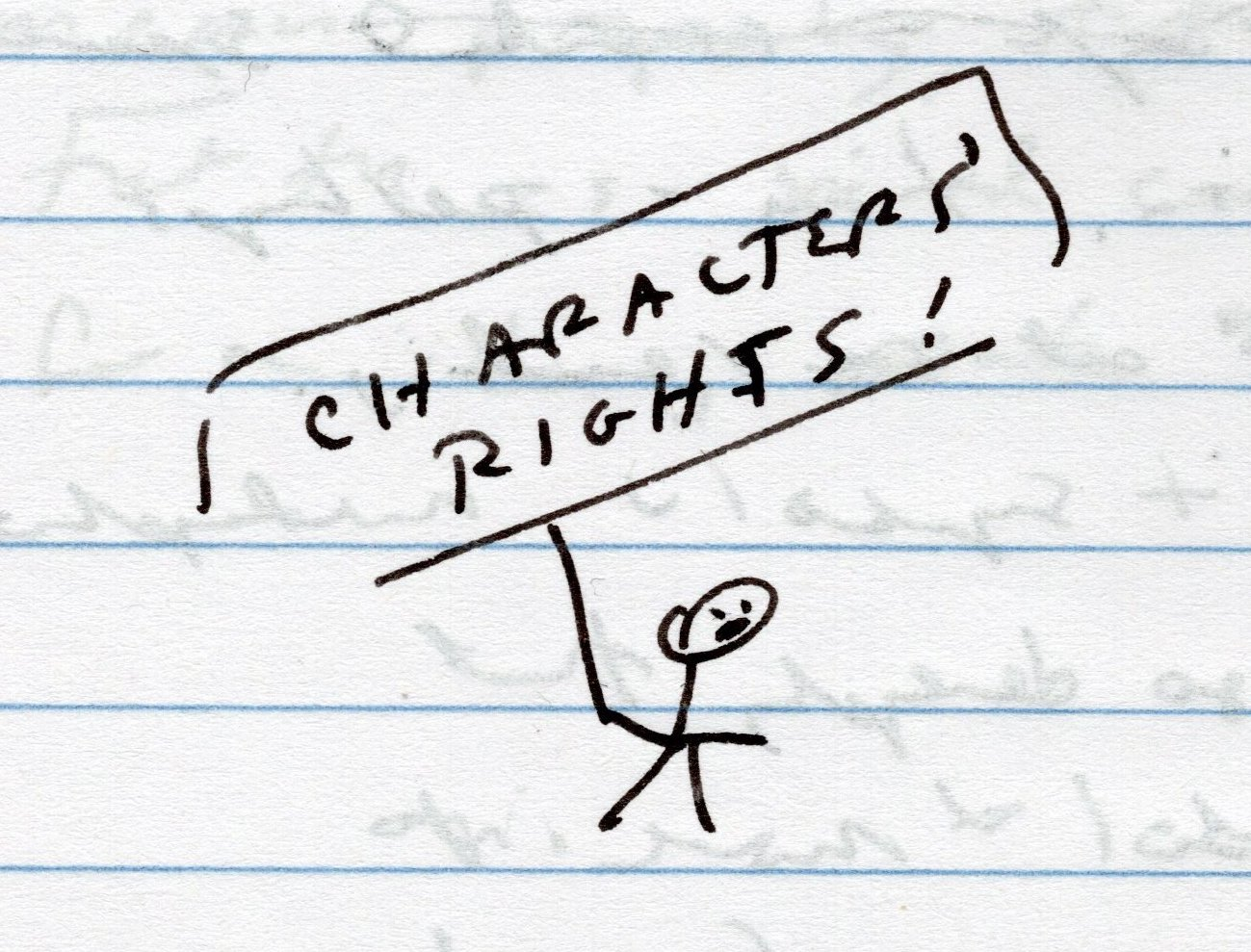
The first daughter believes that that her research will be without value if she does not engage in artmaking as that art demands—allowing it to shape itself, to surprise her, and, perhaps, to wend in places that do not support her research.
Daughter #2 does not believe that any special training is required to write short stories for a dissertation, and feels free to intentionally and consciously shape her stories according to Patricia Leavy’s guidance: "social researchers can exploit the nature of reading fiction to serve purposes such as promoting empathy with others, forging understanding across differences, and developing a sense of how individuals adapt to different situational factors” (17).
Daughter two feels she is making art.
But: allow me to shuffle a deck and deal you hand.
Can art be anything other than that thing which, to Carl Jung’s eye, “seizes a human being and makes him its instrument” (18)? And how can a short story shaped to promote an idea, no matter how lofty, become anything other than propaganda—“images and information produced and disseminated for social, ideological or religious purposes” (19)? Or, passing through another window: surely an author’s rough muscling of characters into certain plotted ends constitutes not art, but exercises: “actions intended to improve something or make something happen” (20)?
Which daughter grooms the bride, and which wears the velveteen tam?
Balancing the egg on her head, FIELDING entrains:
The surrealist treatment and the tossing of filigree cabbages
“What do we owe the ‘arts’ of arts-based research?” Harkey’s question ferments in the dregs of ABR’s coffee cup, hunkers into the toes of its socks which walk themselves, lurks in the blacked-out remnants of ‘found poetry.’ For while ABR makes claims to new insights, novel knowledge, evocation of emotion, holistic transdisciplinarity and multiplicity of meaning among other, more altruistic, agendas, discourse is all too often littered with utilitarian language which situates art as subservient to some particular purpose imposed by the researcher (21). And while concerns have been addressed over the quality of the art made as well as the qualifications of the maker in ABR—an endeavor we support with kaleidoscopic eyes of fish if ‘quality’ is exchanged for ‘affect’ and ‘qualification’ is framed as the degree of intimacy with one’s practice—what skulks in the shriveled armpits of ABR, what concerns us, nay horrifies us, is the treatment of art as a ‘tool’ to “categorize or capture ‘something’ out there” rather than, well, art (22).
McNiff calls for “the protection of…freedom of inquiry”; we call for the protection of freedom as such and contend that Surrealism, as the emancipation of not just the mind but of art itself from the shackles of coercion, can enlighten ABR about a “radical opening up” in response, and with responsibility, to “the call of the unknown” (23). “Our aims:” we sing with crocus mouths in chorus with Breton “The independence of art—for the revolution. The revolution—for the complete liberation of art!” (24)
Art is the concretization of the autonomous image and while the image—and be not mistaken, in much of the art-like results ABR exercises produce, not an image is to be found—may lead to new ways of “seeing and thinking,” any interpreted knowledge or meaning is derivative of art, not its purpose (we claim no knowledge of art’s purpose any more than we claim to know why a dog dreams of blubber-mouth fridges) (25). Once again, we toss the words of Breton, wrapped in filigree cabbages, to ABR in defiance against the exploitation of art in service of interpretation and “discard clarity” in favor of “working in darkness” as the way to discover “lightning” flashes of understanding; resist the temptation to impose meaning on the “feelings that one tests blindly and would destroy in the desire to identify”; and engage with images on their own terms which means “[respecting] their disorder….[giving] free course to their flight” (26).
Subsequently, and more controversially, we absolutely reject the explicit manipulation of art as a statement on any imposed morality with the understanding that “imagination is neither right or wrong” and moves in “several directions” that may challenge the conscious stance of the researcher and their field (27). This poses no small quandary for ABR as the researcher must contend with the tensions that arise and find ways to come to terms with the image, no matter how shocking or devastating to their sensibilities. A Surrealist ethics, however, is committed to the manumission of the imaginal with all its spontaneity, risk and enigma. So, though ABR contends that one of its aims is the raising of consciousness in the unsettling dominant ideologies, it is not, for us, radical enough while also in danger of being trapped by its own cage. Here I summarize with the words of Meret Oppenheim: “Oh, red meat and blue clover, they go hand in hand,” (28).
>>> HARKEY fictionalizes:
When shall we three meet again In thunder, lightning, or in rain? (29)
When the hurlyburly’s done, When the battle’s lost and won.
That will be ere set of sun.
I may be a little late, though. I have a meeting with my book binder.
Sorry? Your book binder?
Mm. I’ve taken up poetry writing as a form of thaumaturgical research. Arts-based spellcraft, or A-B-S, I call it.
Do you…know anything about poetry?
No, but what of it? You link up some words, and if you really want to go for it, you make them rhyme. It’s the feeling that counts. It’s far easier than witching.
~*~
The practitioner of dream-based research (DBR) sweeps like a martinet on a slalom down into the ecstatic image basin of dream and dreaming. The landing is hard. And why not? It’s always hard when you flume down with your contract already in hand.
The dreamer—let’s call her Tina—looks out over a large college dining hall where a number of students wait in line with hungry trays, eager for poultry.
Tina’s hips motor her fervently forward, an impressive, washing machine swing which motivates her toward the steam table, where she yanks fried chicken fingers from one person’s hand, then another. If it was even remotely permissible, she would stick her gummy fingers into each of the eaters’ mouths, swiping the insides of their cheeks for fowl residue.
“Let me explain to you why you’re wrong,” preaches she. “The commercial chicken industry is rife with cruelty. To eat chicken is to collude with torture and suffering! Now, I want—”
The researcher realizes no one is listening to her.
She claps her hands and lets out a train whistle keening from the agitated pump of her banded torso.
“Hulloo! If everyone could just assemble over here! Thank you!”
A handful of dream figures wander over, one of them eating a chicken finger with signal delight.
Tina tears the chicken finger away and tosses it aside.
“Were you not just listening? Suf-fer-ing!” shouts Tina. “Please! We have an opportunity here! People are uniquely susceptible to the persuasive elements of dream imagery. We can use this dream to convince people that vegetarianism is not only morally right, but also tasty and rewarding! Look!” She waves toward nearby woman who is eating a salad. “If you could make some yummy noises, it would be a real help. Will you?”
I do not believe it will surprise you, reader, that no yummy noises are produced.
A student raises one hand, using the other to cradle her food tray protectively.
“Yes?” the dreamer acknowledges her.
“You do know that this is your dream, right?”
“Well—yes.”
“What’s the point of skipping out on the chicken, then?”
“When I recount this dream in my article, others will feel persuaded and compelled–”
“I didn’t sign up for this shite,” says a college-aged young woman with massive yellow beads in her hair. Then, to the others: “You do know they’re almost out of chicken fingers.”
All at once, there is a mass migration in the direction of the steam tray. Not just the dozen or so students who were here before, but hundreds, and suddenly thousands. The air turns to dust, kicked up by the heels of their gumshoes.
Beside Tina, one young man remains. He opens his backpack, draws out a cello and plays a mournful tune with a drumstick bow. The sound is sublime.
“That’s not useful,” Tina snaps at him. “Go stand by the salad bar.”
But it turns out there is a chicken—a living one with gaily colored feathers—already at the salad bar.
“Refuse salad! Poultry is affordable and tasty!” The bird gabbles merrily. “Buh-gock!”
The floor begins to rumble.
“This is not the way to create empathy! We have to show them—” The dreamer presses buttons in hopes of cancelling the chicken.
A hole opens in the floor and Tina plummets into a yawning gap of giblets.
The chicken prances over, its fowl beak pointing downward, down into the poultrous underworld where Tina strains to keep her head above the liver-heart-neck morass.
The bird’s “Buh-gock?” issues so quietly that no one hears.
~*~
Dear Story Characters,
I hereby absolve you of your free will for the greater good of humankind.
Sincerely,’ Your Author
~*~
Dear Artish-Based Researcher,
I am uninterested in representing privilege in your allegorical “novel.” Get bent.
Sincerely,
The Eating Disordered Adolescent in a dim, food-littered corner of your psyche
~*~
You have stood in line, punched by the sun for two hours and seventy-two minutes, all to climb into this small car and enter into this dark and blessedly air-conditioned space.
The car rolls along a track, and things are revealed to you. You are shown!
You enter into a world where ersatz children in brightly colored native dress sing liplessly and turn on invisible axes. Unity! Peace on earth! And by the end of the ride, the darkness and the spotlights have you convinced that you’ve seen something real. It is a small world, after all!
A circle described around the gear wheel of analogy: If the outcome is never in question, it is a presentation, not a work of art.
Art risks.
>>> FIELDING Poetizes
When the image is impaled upon the sharpened bone of lead, what then? Shall it be draped over shoulders or bound over eyes? Shall it be shaken first? Beaten of breath till frozen tatters still the muscle? Will it remain a door? And can you let it walk back through itself? With you? Without you?
Within you?
The questions salivate. The questions drown water with water, befouling it with hands licked clean. And the door gurgles before it spits you out into the bottomless basin of answers—for image is never-beheld, never-satiating. It feeds and it starves till you are stuffed with longing; bloated by empty-belliness. Life brimful with awe of death—death awed with brimful of life—or any other such combination of these words.
But the taxidermy of the image is the lifeblood of betrayal: nature morte of a breathing shadow with a tight fist. When did the poet become a jealous lover? When did the novelist cease from sucking at the viper’s bite? Ravenous yet unhungry, a stomach cloyed with consumption.
Here is your image. Your idol.
The pageantry of stagnation.
The hijacked dream.
~*~
Dear seeker of all things known and knowable,
I have slept since reading your statement of inquiry and awoke to find an oracular stain has replaced sensation on the back of my hand. The morphing copulae of its silent colors mechanize the latent wings of an avian automaton that, I forefeel, wants to fulfil what your crop of axes could not. That is, to remove our heads for only the beheaded head can hear the phonetic rhizome of all things derived from mean-ings.
Here is my evaluation of your proposal: No longer forming clusters with rain has made smeared glass of our throats. How far from the fires of waterways we have drifted. Become errant trees of mawkish obscurity. Winking at the augury of earthborn rumors has kidnapped cathexis from sea rocks and cloud beds. I fear we have been cloven from the matter with matter. Lost from the song of the elements.
I wonder if you’ve ever trapped a panther’s mewl in a birdcage and fed it fat on the stealth of clouds. And if you knew to release it at the exact moment for it to become a hole in the ground. I believe that art grows from that kind of hollow. Taking crowbar eyes to words only leads to potholes. Much as rain may fill them, they remain shallow mirrors only good for growing twigs as dry as artful smiles.
Your own words betray themselves. They say one thing and do no thing. Did nobody ever teach you that word is not a noun? To be born a mouth and speak only sense would be a curse comparable to your word’s wretched dereliction. It is one thing to take a crystal and turn it in your hand, marveling at how the light refracts from its many faces. You may bask in the gaze of the peacock’s tail as it unfolds. You may reach out and pluck each feather to decorate your fascinator. You have seen the sun in every surface and you are blinded by the clarity.
It is quite another thing to chew a crystal. To swallow your bleeding gums and taste the tincture of a crystal’s dreams. To assimilate its faces into your body so your morning breath smells of earth with the crust cut off and your sweat sits in cubes beneath your hair. It is quite another thing to hold a crystal in the crick of your neck, to observe it from the point of view of a drummer’s elbow or your neighbor’s cat. To sing it a lullaby or write for it a poem about cherry trees or pie guts.
~*~
May these sharply utterances reach the livers of my brothers and sisters—the midwives of the flotsam chorused within the forsaken egg, laid and painted with the shadow of night. How sweet, the lolling of my own tongue dipped in the yolk of brimming endurance.
How are we to stay afloat in a river of pencil shavings when the bending of centuries pulls at our hair, our senses, our lovestruck convictions? We must be as bold as bowler hats turned over and pissed in—poured over the exquisiteness of our most cherished pain.
Aroused, the murderous soaring of intimacy mocks the carousel of bellyless cows and romances the tenants of polyester webs. Predicted, of course, by the most butterflied of hearts, the most greened of the gravel. But let us not heed the stories of burning eyes—ours is the breathing of stones, the bedrock of waywardness.
If there is no space for art, there is no space for life: this flux of swimming birds, liquid moons, floating percolators; this amalgamation of tongue bark, apple beard, cloud rind. We morph to fit the spaces of ourselves – to hell with shooting stars. Hurtling towards death, they are dead already, never knowing the agonizing stillness of sleeping wrapped in the arms of terror. Our bedfellows are drowned kings and castrated turkeys and we, my protean kin, are their stewards. And so my lament is an invitation to walk on fingertips that we may drink from the ear trumpets of our ghosts and expose our scalps to the tassels of delirium.
HARKEY glissades:
Complexes, Cotenants, The Lives Inside
Poet and children’s author Ted Hughes tells a story. Back when he was at Cambridge, he spent a couple years reading in an ill-fitting course. There, he was required to “produce a weekly essay” (31). Over time, he “became aware of an inexplicable resistance…against writing these essays…With each week, the task was more of a struggle” (32). Despite this, he strained and composed (but barely) through the wall. One such draft-y night, with nothing more than an opening sentence to his name, he cashed it in and went to bed.
I dreamed I had never left my table and was still sitting there, bent [over the page]…Suddenly, my attention was drawn to the door…a head came round the edge of the door. It was about the height of a man’s head but clearly the head of a fox…at the same time a skinny man and a fox walking erect on its hind legs…I saw that its body and limbs had just now stepped out of a furnace. Every inch was roasted, smouldering, black-charred, split and bleeding. Its eyes…dazzled with the immensity of the pain…[I]t spread its hand…on the blank space of my page. At the same time it said: ‘Stop this—you are destroying us.’…Then, as it lifted its hand away I saw the blood-print…glistening blood on the page" (33).
Whose flesh passes through the uneasy doorway of dream? What presses its bloody palm to the pulpy page of our faces? Let us make no mistake: this is the personal complex as posited by C.G. Jung. And though these complexes/parts/subpersonalities are ultimately “psychic agencies whose deepest nature is still unfathomed,” one does find ways of outstretching hands into wonder, of blinking and watering into the glare of homecoming (34, 35).
Hypnotherapist Adam Crabtree summons the very image of the complex when he recalls clients who “had become aware of a presence within themselves of what appeared to be personalities, existing in their own right with thoughts, concerns, and intentions quite different from their own” (36). Such “little secondary psyches” “[possess] all the characteristics of a separate personality…which deliberately (though unknown to conscious) [drive] at certain intentions which are contrary to the conscious intentions of the individual” (37). These are inner figures, real and alive, with their own preferences, needs, and stories. And like your next-door neighbor Joachim, they may not always embrace your fond love of the punky water oak whose branches stretch from your yard onto their private property.
Yes, complexes personify in our dreams wearing fox faces or peering through eyes of ice. But goodlier for the purposes of our chat—yours, mine, and the ones who listen, even now, with breath held, will she actually finally acknowledge that we are her ghostwriter—is that both the fictional character and the “nascent work in the psyche of the artist” can, themselves, be understood as complexes (38, 39). So it is that Charlotte is roused at dawn by the raucous cork-blorking antics of Rochester and St. John, and Jane meanwhile turns her face toward the Goddess, traipsing after the Maha-mama. Artists and writers are not is not are not the masters of our own, inner houses (40). That said, we may, in time, become the dreaded landlord, the ropy-jawed drill sergeant of psyche—and, finally, The One To Be Resisted. {Writer’s block, anyone?}
The people peopling our pages, the shimmering opus: the gate swings wide! And then: ABR conceived with no care for art, still less concern for psyche. Autonomy in rusty chains. Tetanus, infection, violation, indignity.
Or, understood “as living units of the ucs,” tended and beheld, “complexes can render invaluable aid” to artists and researchers, alike (41). The Bronte Story Collective. Kastrup’s Wheel of Phantastical Philosophy.
Weep for the charred and the fired. Rend the garments of the will, howling for the maneuvered, the maimed. And if we do not atone, let us—at least—stop pressing into service our intrapsychic “cotenants” for the sake of not-actually-research (NAR) (42).
FIELDING folds the egg into intricate inflections:
Bidets and the mouth that swills
The bidets beneath the burned backsides of the people peopling psyche spray intermittent jets of geyser proportions, lifting our co-habitants to peek over the fence (to see or be seen? who knows…) that demarcates consciousness from the unconscious in trampoline-bounce fashion. Their faces, the look in their eyes, the shape of their gait are formed as they come into view. What they look/sound/smell/taste/feel like on the other side of the fence is unknown, unknowable. But they are image-inable. ‘Over there’ they exist as inklings, rumblings. ‘Here’ their image is a co-creation of meaning between the entities residing on both sides of the fence that “works by analogy and correspondence rather than rational explanation,” creativity being, for Jung, the driving force which illuminates that which was previously hidden (43).
Be not misled by claims of genius, the role of consciousness in the co-creation of image (to be understood as the raw material that springs from the imagination, not merely visual images) consists of no prior, pre-meditated, imposed form or meaning. Rather consciousness provides a panoply of experiences of the world for unconscious content to take recognizable, albeit slippery and incongruous, shapes. It steps out of the way, it allows, it creates the conditions for the image to appear: the image retains its autonomy as well as its mystery.
Harkey makes reference to the unfathomable source of the personal complex: it is this dark, watery realm that rushes up in the plumbing of next door’s bidets (while also raining down and misting around, for the unconscious psyche does not reside under us, we reside in psyche), those outlets of the unconscious that line the fringes of consciousness, giving rise to the archetypal element of image (44). You have taken a skinny dip in the communal bath of chicken soup and masticated gemstones. It is time to take the toothpick to the mouth that swilled you: the collective level of the unconscious (45).
We will know when we have experienced an archetypal image—conceived by Jung as idiosyncratic expression of the imperceptible and universal patterns of psyche—by its “‘all or nothing’ affective impact… impersonality, autonomy, and numinosity”: in surrealist speak, we have encountered the disruptive and electrifying otherworldliness of the marvelous (46). Moved beyond the threshold of the personal and into the transpersonal where the wishes, desires, intentions, convictions, and indeed language of ego-consciousness find it impossible to get a foothold, such is the “unsparing quality” of the “beloved imagination” (47).
Freed up from the possessive caress of needing-to-know, psyche is no longer only peopled by people but moused by mice, leafed by leaves, holed by holes, tucked-up by tuck-ups, aroma-ed by aromas, sewing-machine-and-umbrella-on-a-dissecting-tabled by sewing-machine-and-umbrella-on-a-dissecting-tables (48). As artists and researchers, as humans, as ourselves expressions of a creative universe, we do well to adopt Jung’s “love for the orderly chaos of the psyche” and his “trust in its integrity,” to play according to Breton and Eluard’s “The Original Judgement” and “observe the light in the mirrors of the blind”; “let the dreams you have forgotten equal the value of what you do not know” and “think of me who am speaking to you; put yourself in my place when you answer” (49).
In light of this, we wonder if, we hope that, surrealist criticism shows how ABR might radically extend its aim to cultivate empathy for ‘others’ to include inner figures, whether in the form of inside-out people or lightbulbs in tutus, whether benevolent or threatening, and, thus, to see beyond given morals when “unsettling stereotypes” being sure to refrain from an overcompensation that would lead to withholding empathy from those groups, ideas and images it wishes to challenge (50).
I end with a final surrealist automatic flurry in the hope that, despite all my citations, justifications and delineations, that the imaginal will speak better for me, in spite of me. Here’s to the surrealist eye that is a mouth:
Romancing the eye crushes word to powder; renders the tongue an ember guarded beneath a cloche which will never become a bird. A pattern identified is magic only if it is slowed right down. You see, a list can be made. Items can be exchanged for any purpose as long as the purpose upholds its secrecy and nobody tries to be clever about it. Dimples mirror the wagging of a tail; apples tilt their heads listening for the dimming of a light. Stepping outside of skin is the same as climbing right inside. Simply collect it all: there’s no need to keep it.
Dissolving Offwards
A fog rolls in, revealing the giddy, tilting face of the hermetic dauphin, presently twisting spectacles from a pepper grinder. “A fine display of proverbial funambulism!” he bleats from the backside of his face. “Give it up for the …” he completes his sentence with a series of flamenco-like flourishes. The freshly seasoned audience refrain from applause as they grab at the lorgnettes, raising them to their faces. The mist clears. The two women are gone. On the stage, spotlit, stands an origami chicken.
“Buh-gok!” it declares, its pleated breast plumed.
The lights go out.
“Buh-gok!” trill the audience, in unison, from the dark.
Notes:
-
Andre Breton, “Manifesto of Surrealism,” in Manifestoes of Surrealism, trans Richard Seaver and Helen R. Lane (University of Michigan Press, 1969), 26.
-
Projection is one "means by which the contents of the inner world are made available to ego-consciousness”. The tools or “games” of surrealism are another. Andrew Samuels, Bani Shorter, and Fred Plaut, A Critical Dictionary of Jungian Analysis (Routledge, 1986), 113-114; Mark Polizzotti, Why Surrealism Matters (Yale University Press, 2024), 109.
-
Franklin Rosemont, ed. What is Surrealism? Selected Writings (Monad Press 1989), 27.
-
Polizzotti, Why Surrealism Matters, 61; Breton, Manifesto, 32.
-
Polizzotti, Why Surrealism Matters, 62-63
-
Polizzotti, Why Surrealism Matters, 62-63
-
Rosemont, What is Surrealism?; Dawn Adès. “The Tragic Myth of Millet’s ‘Angelus.’” Avant-garde Studies, 2 (2016).
-
Merriam-Webster, “Literary Criticism,” in Merriam-Webster’s Encyclopedia of Literature (1995), 685
-
Anna Balakian, Surrealism: The Road to the Absolute (Dutton, 1970), 14.
-
Cassie Fielding, Confessions of a Reverist (Time Is An Ocean Publications, 2023), 9.
-
Alastair Brotchie, and Mel Gooding. eds. A Book of Surrealist Games (Shambhala Redstone Editions, 1995), 11; Polizzotti, Why Surrealism Matters
-
Andre Breton, “Caught in the Act,” in Free Rein, trans. Michael Parmentier and Jacqueline d’Amboise (University of Nebraska Press, 1995), 128-129.
-
R. A. Parker, “Explorers of the Pluriverse,” in First Papers of Surrealism: Hanging by Andre Breton, his twine Marel Duchamp by A. Breton and M. Duchamp (Forgotten Books, 2018).
-
Breton, Manifesto, 26; Rikki Ducornet, “The Deep Zoo,” in The Cult of Seizure, trans. Rikki Ducornet (Skylight Press 2012), 78-79.
-
Claude Cahun, “Disavowels,” in The Milk Bowl of Feathers: Essential Surrealist Writings, ed. M. A. Caws (New Directions, 2018), 21-22.
-
Susan Rowland, “Jungian Arts‐Based Research (JABR): What it is, Why do it, and How,” Journal of Analytical Psychology 68, no. 2 (2023): 436-439; Robin Nelson, Practice as Research in the Arts (and Beyond): Principles, Processes, Contexts, Achievements, Second Edition (Palgrave Macmillan, 2022)
-
Patricia Leavy, Fiction as Research Practice: Short Stories, Novellas, and Novels (Routledge, 2016), 50.
-
Carl G. Jung, “On the Relation of Analytical Psychology to Poetry,” in The Spirit in Man, Art, and Literature, ed. Herbert Read, Michael Fordham, Gerald Adler, and William Mcguire, trans. R.F.C. Hull. (Routledge, 2003), para 157.
-
Kendall Taylor, “Propaganda,” Grove Art Online. 2003. Accessed May 13, 2025. https://www-oxfordartonline-com.uniessexlib.idm.oclc.org/groveart/view/10.1093/ gao/9781884446054.001.0001/oao-9781884446054-e-7000069819.
-
Cambridge Dictionary Online, s.v. “Exercise,” accessed May 13, 2025. https://dictionary.cambridge.org/us/dictionary/english/exercise
-
Patricia Leavy, “Introduction to Arts-Based Research,” In Handbook of Arts-Based Research, ed. P. Leavy (Guilford Publications, 2017), 9-10.
-
Sandra L. Faulkner, “Concern With Craft Using Ars Poetica as Criteria for Reading Research Poetry,” Qualitative Inquiry 13, no. 2 (2007): 218-234; Lisa Hayes Percer, “Going Beyond the Demonstrable Range in Educational Scholarship: Exploring the Intersections of Poetry and Research,” The Qualitative Report 7, no. 2 (2002): 1-13; Jane Piirto, “The Question of Quality and Qualifications: Writing Inferior Poems as Qualitative Research,” International Journal of Qualitative Studies in Education 15, no. 4 (2002): 431-445; Merel Visse, Finn Hansen, and Carlo Leget, “The Unsayable in Arts-Based Research: On the Praxis of Life Itself,” International Journal of Qualitative Methods 18 (2019): 1-13, p7.
-
Shaun McNiff, “Philosophical and Practical Foundations of Artistic Inquiry: Creating Paradigms, Methods, and Presentations Based in Art,” In Handbook of Arts-Based Research, ed. Patricia Leavy (Guilford Publications, 2017), 22; Visse, The Unsayable in Arts-Based Research, 7.
-
Andre Breton, “Manifesto for an Independent Revolutionary Act,” in What is Surrealism? Selected Writings, ed. Franklin Rosemont (Pluto Press, 1989a), 187.
-
Leavy, Introduction to Arts-Based Research, 10.
-
Andre Breton, “Art Poetique” In What is Surrealism? Selected Writings, ed. Franklin Rosemont (Pluto Press, 1989b), 198-299.
-
Breton, Art Poetique, 298-299.
-
Meret Oppenheim, “I Have to Write Down the Black Swans,” in Surrealist Women: An International Anthology, trans. Catherine Schelbert, (University of Texas Press, 1998), 257.
-
William Shakespeare, Macbeth. Ed. Sylvan Barnet, (Signet Classic, 1987), 37.
-
Confirmable. Again, consult your librarian.
-
Ted Hughes, Winter Pollen: Occasional Prose. Ed. William Scammell, (Picador, 1995), 8.
-
Hughes, Winter Pollen, 8
-
Hughes, Winter Pollen, 9
-
Carl G. Jung, “A Review of the Complex Theory,” in The Collected Works of C. G. Jung: Vol. 8. Structure and Dynamics of the Psyche, ed. Herbert Read, Michael Fordham, Gerald Adler, and William Mcguire, trans R.F.C. Hull. (Princeton University Press, 1969).
-
Richard Schwartz and Martha Sweezy, Internal Family Systems Therapy, Second Edition (The Guilford Press, 2020); John Rowan, Subpersonalities: The People Inside Us (Routledge, 1990); Jung, A Review of the Complex Theory, para 216.
-
Adam Crabtree, Memoir of a Trance Therapist: Hypnosis and the Evocation of Human Potentials (Friesen Press, 2014), 1.
-
Carl G. Jung, “The Psychology of Dementia Praecox,” in The Collected Works of C. G. Jung: Vol. 3. Psychogenesis of Mental Disease, ed. Herbert Read, Michael Fordham, Gerald Adler, and William Mcguire, trans. R.F.C. Hull. (Princeton University Press, 1960), para 137; Carl G. Jung, “On the doctrine of complexes,” in The Collected Works of C. G. Jung: Vol. 2. Experimental Researches, ed. Herbert Read, Michael Fordham, Gerald Adler, and William Mcguire, trans. R.F.C. Hull (Princeton University Press, 1973), para 1352.
-
Carl G. Jung, " On the Relation of Analytical Psychology to Poetry," in The Collected Works of C. G. Jung: Vol. 15. Spirit in Man, Art, and Literature, ed. Herbert Read, Michael Fordham, Gerald Adler, and William Mcguire, trans. R.F.C. Hull (Princeton University Press, 1966), para 150.
-
Gardner, “Ghostwriting and the Impossibility of Auto/biography” A BSA Auto/Biography Study Group Event (online lecture at British Sociological Association Zoom, February 5, 2005); Jung, 203, para 122; Jung, The Tavistock Lectures.
-
Carl G. Jung, “The Tavistock Lectures: On the Theory and Practice of Analytical Psychology,” in The Collected Works of C. G. Jung: Vol. 18. The Symbolic Life, ed. Herbert Read, Michael Fordham, Gerald Adler, and William Mcguire, trans. R.F.C. Hull (Princeton University Press, 1976), para 151.
-
C.A. Meier, The Unconscious in its Empirical Manifestations, trans. Eugene Rolfe (SIGO Press, 1990), 180.
-
V. Nelson, On Writer’s Block (Houghton Mifflin, 1993), 35-36.
-
Sherry Salman, “The creative psyche: Jung’s major contribution,” in The Cambridge Companion to Jung, ed. Polly Young-Eisendrath and Terence Dawson (Cambridge University Press, 1997), 65; Jung, Relation of Analytical Psychology to Poetry.
-
Iain McGilchrist, The Matter with Things: Our Brains, Our Delusions and the Unmaking of the World (Perspectiva Press, 2021), 328.
-
C.G Jung, “Archetypes of the Collective Unconscious,” in The Collected Works of C. G. Jung: Vol. 9.1. The Archetypes and the Collective Unconscious, ed. Herbert Read, Michael Fordham, Gerald Adler, and William Mcguire, trans. R.F.C. Hull. (London Routledge & Kegan Paul, 1968).
-
Jung, Archetypes of the Collective Unconscious; Salman, The creative psyche, 59; Andre Breton, What is Surrealism: Selected Writings, ed. Franklin Rosemont (Pluto Press, 1989c).
-
Breton, Manifesto, 4.
-
Max Ernst in Andre Breton, “Surrealist Situation of the Object: Situation of the Surrealist Object,” in Manifestoes of Surrealism, trans. Richard Seaver and Helen R. Lane (University of Michigan Press, 1969b), 275.
-
Salman, The creative psyche, 52; Andre Breton. and Paul Eluard, “The Immaculate Conception,” in What is Surrealism? ed. Franklin Rosemont (Pluto Press, 1989), 59-61.
-
Leavy, Introduction to Arts-Based Research, 10.