This exposition is published in the Proceedings of the 1st symposium Forum Artistic Research: listen for beginnings.
Tending towards each other:
between breath and inscription
Thais Akina Yoshitake Lopez
The poem, as precarious and fragile as it is, is solidary; it stands with you, as soon as you … turn toward it; it is the second in the core and casing of your desperation.
—Paul Celan, The Meridian (Final version–Drafts–Materials), p. 201
An encounter sustained amidst precarious solidarity.
The poem—its space—is the locus I explore here, looking into the words of one particular poet, Paul Celan (1920–1970), in his attention to its possibilities. I would like to extend an invitation to consider some gestures within this space of conversation through notes, speeches, and the dialogue between his poems and the etchings by Gisèle Celan-Lestrange in a publication called Atemkristall (Vaduz, 1965).
I gesture around a text, searching for possible, kindred movements:
Walking, looking up, occupying, translating, inscribing, standing…
to let the incommensurable of the other speak too: the time proper to him, the other, the space proper to him, the temporal and the spatial nearness and distance, the unknown, from which it comes toward you—like you toward this other.
—Celan 2011, p. 141
Part 1 – The temporal and spatial nearness and distance…
I invite you for a walk through texts, starting with the companion of another poet, Édouard Glissant (1928–2011). Even though Celan and Glissant lived in Paris around the late 1940s and were involved in different local intellectual discussions, the question of openness towards the other was a shared orientation – in their language and landscapes.
Glissant was a Martinique poet, and a rock, ‘Le Rocher du Diamant,’ appears increasingly often in his late writings. When he left Paris for Martinique, he lived near this rock. This image (Fig. 1) is the view from there.
The rock is in the centre of the photograph.
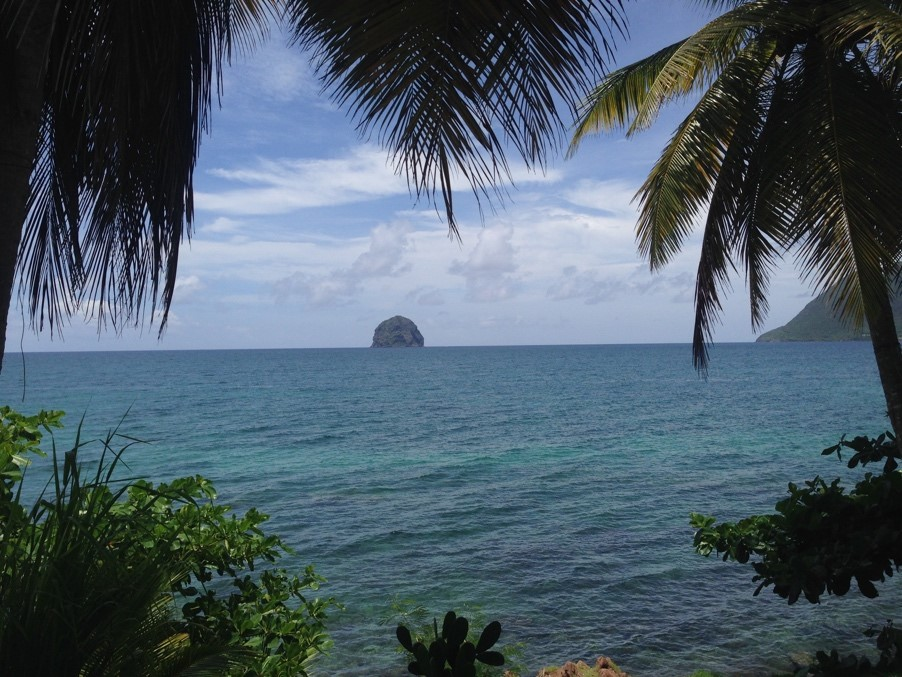
(et de ce qu’il y a encore par-dessous, lequel ne relève pas de l’examen mais de l’exultation et de la respiration)
(and what is still below, which is not a matter of examination but of exultation and breathing) (Glissant 2009, p. 147, own translation)
I imagine him walking along the shoreline, revisiting his concern about archipelagic dynamics and the forces shaping the imaginary of languages and landscapes. ‘Le Rocher du Diamant’ is a view with which he wrote about opacity around the sea that diffracts (the space where history cannot be fully delineated), the shoreline of encounters (in a quest for openness) and the land (and rocks – with which he ‘built his language’).
The reason for walking with him as an initial act lies in this image, as a reading imaginary. Not to stand in the writer’s place, as if looking at the same object and expecting to share his experience, but to consider nearness and distance by accepting the unknowable par-dessous (“from below”). To read not as an examination but as something closer to a breath-pacing, walk-listening – specifically through the frames of this photograph, of translations, of migrations…
To carry something in the ear, we leave Glissant with one of his commentaries on the effect of ‘unexamined’ experiences with language:
Also, in the Creole folk tales that I heard in my childhood, there were cabbalistic phrases that had probably been inherited from African languages, whose meaning no one understood and which had a powerful effect on the audience without anyone knowing why. It is quite obvious to me that I was influenced by this unexplained presence of languages or phrases whose meaning you do not know and which nevertheless have a strong effect on you, and it is perhaps possible that a large part of my theories on the necessary opacities of language stems from there. (Glissant 2020, p. 78)
To carry these trembling phrases.
To acknowledge they may mingle around meaning, alongside other landscapes’ rhythms.
I read Glissant and Celan through translations. I know they both were thoughtful about translation’s movements, as well as the (precarious and fragile) possibility of proximity, despite that. On a biographical note, Celan was born into a German-speaking Jewish family in Bukovina, then part of Romania. Even though he knew and translated to and from many European languages, he chose to write in German – the language of his mother, of the poetry he learned from home, and of the perpetrators of his mother’s death.
In 1948, he moved to Paris, where he continued to write in German, as well as translate and teach. There, he also met Gisèle.
In ‘Writing Reading’ (1970), Roland Barthes (who was also in Paris by the time they were writing) discusses the movement of interruption while reading a book, asking, “Has it never happened, as you were reading a book, that you kept stopping as you read, not because you weren’t interested, but because you were. In a word, haven’t you ever happened to read while looking up from your book?” (Barthes 1989, p. 29). These interruptions stem from a flow of ideas, stimuli, associations… but also from putting the body at work, “at the invitation of the text’s signs, of all the languages which traverse it and form something like the shimmering depth of the sentence” (p. 31). My first reading of Celan prompted an instinct to look up: not from an overflow of ideas, but from a spatial awareness of pace, of being traversed by it. The stimuli were respiratory. There were a few associations, but something shimmered and invited me to look up.
What kind of writing was I doing while reading? The question is not how I elaborated on it amidst references or inclinations, but rather in the brief space opened within the text. It matters that Celan was attentive to this space of dialogue. He had many notes (I looked into the ones closer to the period he was elaborating his speech known as ‘The Meridian’) on the possibility of encounters, from which it comes toward you – like you toward this other.
Part 2 – today
To read him today, as part of the Western literary canon, as one that many philosophers and artists have turned to for insights on language, testimony, trauma, and Jewish influence, brings cumulative layerings. My question is how to approach the opacity of his writing—acknowledging the effects and affects of his poetic hospitality—while remaining attentive to the conditions of reading him today, amidst the heightened historico-political violence that has occurred since the establishment of the State of Israel (which he initially cherished). Celan’s stature as a European monument to the ‘unspeakability’ of language bears a “crippling exceptionalism” that, as Charles Bernstein observes, has made his work a symbol of fate rather than an active matrix for ongoing poetic practice (Bernstein 2016, p. 115). An urge and question of reading him today traverses me when woeful suffering accompanies the writing of memories and genocides. Particularly in the case of Israel’s genocidal acts in the Palestinian territory of Gaza, the memory of Paul Celan, as a Holocaust survivor, is occasionally brought up. On May 25, 2024, Nobel laureate Herta Müller read an open letter in Sweden in defence of Israel’s position, concluding with a quote from a correspondence between Celan and Yehuda Amichai.
There is a dangerous assumption regarding the exceptionalism that approaches him ‘as a symbol of his fate’. If the Holocaust is claimed to hold exceptional authority on the writing of genocidal experiences and Celan is one of its symbols, his lean towards ‘unspeakability’ could be taken as a linguistic or poetic parameter for the writing of diverse experiences of this kind of testimony. This assumption is problematic on many levels. Its Eurocentric bias has been long criticised, and different modes of diction have been vocal as poetic testimonies. It is not the intention of this text to defend or point out ambiguities in his complex trajectory, but to question his stability as an identitarian symbol and his language’s vacancies as ‘unspeakability’. An exile, a translator…
Part 3 – hearing a ‘language-become-shape’
I would like to visit some passages he wrote about spaces of encounters.
The poem I have in mind is not surface-like [giving the example of Apollinaire’s shape poem]; rather, the poem has … the spatiality and tectonics of the one who demands it of himself; and the spatiality of his own language … not simply of language as such, but of the language which configures and actualizes itself under the special angle of inclination of the one who speaks.
—Celan 2011, p. 118
An angle of inclination…
maybe some shadow-like vulture marking the ground
or some force-like gravity, pulling consonants together
or a form of recollection (remaining mindful of each one’s dates)
or any other manner of a ‘language-become-shape’
The word in the poem is only partially occupied [from the experience of the author] by experience; … a further part remains free, occupiable
—Celan 2020, p. 94
That the word may be occupiable…
To write or to speak, in this spatiality, comprises more than the telling of the experience. It counts (or hopes) that the textual terrain in between one that speaks and one that listens/reads is able and open enough to host a double inclination – toward each other.
… to let the incommensurable of the other speak too …
—Celan 2011, p. 141
An exilic writing, using language “as if he were always translating” (Carson 1999, p. 28), as the poet Anne Carson once noted. His terrain was not German as such. His anxieties on the subject of language were fuelled by his “troubles as a translator,” he writes in a letter to his wife Gisele (Celan & Celan-Lestrange 2001, Letter 69, p. 83). What would a proper inclination be towards a writing with ‘its own 20th of January’ (Celan 2011, p. 8) inscribed from his lived experience? As a historical note, on this date in 1942, the ‘final solution to the Jewish question’ was signed by Nazi Germany officials, establishing that European Jews would be deported and murdered in Poland.
… from which it comes toward you—like you toward this other …
—Celan 2011, p. 141
Toward what? Toward something open, inhabitable, an approachable you, perhaps, an approachable reality. Such realities are, I think, at stake in a poem.
—Celan 2003, p. 35
In Celan’s spatiality, attention is paid to the inclination and the gesture of turning towards something. There is also an attention to breathing in relation to speaking. In different moments, he writes that poems are “pneumatically touchable” (Celan 2011, p. 108) and “the trace of our breath in language” (Celan 2011, p. 115). It matters that both ground and speech are thought in close relation to a deep sense of distance and proximity – that we breathe and incline towards.
The crippling exceptionalism that Bernstein problematised may relate to the disregard for the presence of these ‘approaching’ gestures (breathing and inclining). His tectonics depend upon occupation as much as vacancy. And by that, any variation of the ‘unspeakable’ or the verge of unintelligibility is touched by some kind of phenomenological pressure.
(lequel ne relève pas de l’examen mais de l’exultation et de la respiration)
Who does not expect the poem, will not recognize it either.
—Celan 2011, p. 135
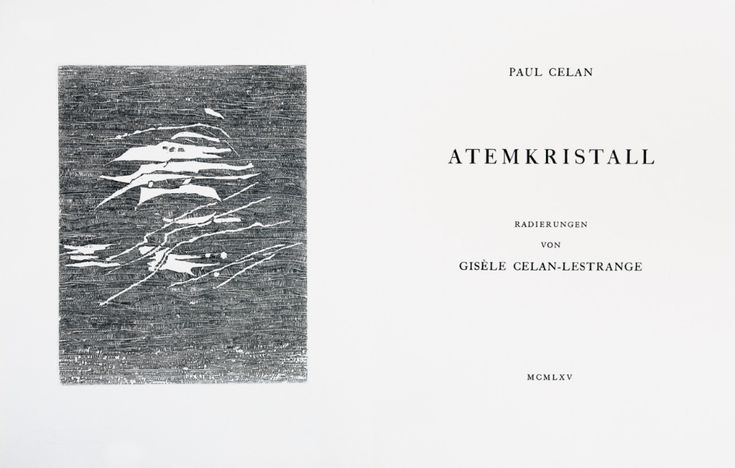
I would like to focus on the publication Atemkristall (breath-crystal) from 1965, composed of 21 poems by Paul Celan and eight etchings by Gisèle Celan-Lestrange (Fig. 2). It was a bibliophile edition by Brunidor (Vaduz, Liechtenstein) with 85 numbered copies. Atemkristall (breath-crystal) was the first Atemwende (breath-turn) series cycle. Celan’s late poems are said to be more cryptic, shorter, and difficult, featuring geological and anatomical lexicons, as well as references to his personal life and other texts.
The interest in this specific publication comes from the dynamic between text and image in the form of a book. It was their first joint publication, and Gisèle contributed to subsequent Celan works. What kind of images would appear and be inscribed in proximity to his language tectonics? Instead of subjecting the images’ visibility to the conceptual frame of this spatiality, could they be approached as an inscription (tracing a ground on paper) as much as a material pneumatic pressure?
I look up to the ‘Le Rocher du Diamant’ photograph again.
In a short text where Glissant talks about René Char’s poetic landscape, he says, “I comprehend—I mean that I love to know—this landscape (its nature), in that with him I frequent my own” (Glissant 2010, p. 74). Char was a French poet who continued writing while serving in the French Resistance, negotiating hope amidst fragility and disquiet. Glissant continues, “It is difficult to disassociate a properly ‘poetic’ body and a complementary sector of ‘ideas’. The will to knowledge and accomplishment is sealed to the way of the poem (Poetic research determines and governs the life of the mind)” (Glissant 2010, p. 75). Char was one with whom Celan corresponded, translated his poems, and was glad to have shaken his hand, as he writes in a letter in 1955 (Celan 2005, letter #5).
I would like to bring two remarks on Celan’s poetic research, made by two of his commentators, Werner Hamacher on paronomasia (1985) and Jason Groves on crystal formation (2011), that touch upon the sense of movement and the conditions of an encounter between writing and reading. A synthesis of their propositions would not fit the scope of this text, but instead of summarising them, we will pass through some details that may relate to the etchings’ inscriptions.
Regarding paronomasia, it is worth mentioning that Celan maintained an anti-metaphoric position in his notes. Metaphors (in the sense of carrying across) and paronomasia (expressing the alteration of naming) involve different movements. He asks us, briefly within a poem, to bear with it, to frequent it and not so promptly look past “with transit as primum and exit as secundum movens” (Celan 2011, p. 157).
… the image has a phenomenal aspect, recognizable through perception.—What separates you from it, you cannot bridge; you have to take a decision to leap.
—Celan 2011, p. 125
Hamacher analysed a couple of poems focusing on different concepts of inversion within the scope of the German philosophical tradition. In a moment in his analysis, he pointed out how, in Celan’s poems, the appearance of images is not stable (and so is its negativity), and the subjects are not pre-constituted as sharing a common language/ground. They “bring to language the ground for the determination of speaking itself: its property of temporization” (Hamacher 1985, p. 287). Without a pre-given ground, the poem’s word exposes itself as a figure of time. “They inscribe themselves as the script of alteration, by themselves exposed to this very alteration” (p. 292). The unity of the word appears to be brought into oscillation by the phonetic proximity of words, in which one affects the other with its semantic potential. “It is a poem that withdraws from the schematism of semantics and attains its specific gravity only by virtue of its parasemic character” (p. 302). As traces of a discourse, “something is underway along them, not to come into language but to lay open what must remain vacant in its petrification, unwritten in the poem” (p. 309).
Groves paid attention to geological references in Celan’s material imagination, which have a long-standing interest in German-speaking poets. He proposed that Celan’s ground or stones could not be read as stable place markers, as monoliths weighing their force. Instead, sliding, routing, and orbiting movements, for example, play with the temporalisation of ‘figures of time’ – as manners of speaking. In a brief section of his text, Groves focused on studies in crystallography, as Celan himself was interested in the field. He commented on a phenomenon called ‘dislocation creep’, a non-static vacancy defect. It moves throughout the rigid structure of a crystal. “As a type of vacancy defect, the range of silent mutations grouped under the figure of paronomasia clears a space for articulation. These minute vacancies are, then, the equivalent of air pockets in an avalanche or even in the structure of ice: they furnish breathing room, no matter how limited, for evocation and articulation to take place” (Groves 2011, p. 480).
The poem is aware of the erosion it exposes itself to.
—Celan 2020, p. 142
The gravity and tectonics of the textual terrain have been studied extensively in literary scholarship. I am aware of the difficulty of approaching the Atemkristall publication without considering the turbulent context of their marital relationship. Much of the nine years of correspondence I read does not concern the making of poems or even Celan’s poetic research. I am unsure if I was supposed to read them. However, there is a recurrent verb in the letters that somehow dialogues with the gestures I was interested in: to recognise.
I approach this gesture in the light of his elaborations on the possibility of encounters, alterations, and bearings. There are explicit references to the etching process in some poems from Atemkristall, from which it is possible to infer attention to the process of image-making – its traces, negatives and pressures. Even so, another point makes the relation between the poems and the etchings more stimulating as a conversation: how images (both those within the poems and those on the etched surface) come to appear and vibrate beside one another, articulating a property of temporalization.
altered pace-bite
de ce qu’il y a encore par-dessous
in minute proximity
The pictorial is by no means something visual; it is … a question of the accent; in the poem the perception of its soundpattern also belongs to the perceived image. By the breath-steads in which it stands, you recognize it, by the crest-times.
—Celan 2011, p. 107
There is a beautiful and visceral relation between the gestures of inclining towards and recognising in the poem’s space. ‘To let the incommensurable of the other speak too’, to hope that vacant/approachable/occupiable spaces remain in between. Whether attention is paid, whether a reader leaps in or whether proximity makes it ‘pneumatically touchable,’ it is up to the mystery of encounters. But it matters that what is approachable is not a symbol, a transfigured metaphor, a static past…
If approached, what would be recognisable? The attention to accent, sound patterns and crest times involves duration and the possibility of being affected by a shimmering retrospection and an open contingency (a morphology of proximity between ‘past’ and ‘future’). Could maybe the etchings be experienced as a surface where inscription is ‘weighted’ by the vacant air pockets they signal toward each other?
with acid, the poems have bitten (on) your coppers, on the trace of your hands, preceded by them, accompanied by them
—Celan 2001, letter 605, p. 626, own translation
In your copper, I recognise my poems: they go through them and are there still
—Celan 2001, letter 233, p. 228, own translation
Part 5 – An approachable reality
Celan structured his language in particular manners, not prescriptively.
In a contemporary multi-paced gravity, when so much is unintelligible, we may carry traces ‘whose meaning you do not know and which nevertheless have a strong effect on you.’
In bringing the images from the Atemkristall publication, I sought to elaborate alongside them: to wander beside them rather than examine them. Within the publication, the white space between the poems and the etchings works in affinity with the frame of the ‘Le Rocher du Diamant’ photograph (with its trees both casting shadows and blowing a breeze). Both white space and frame somehow render visible invitations, limits and solidarity.
* (diamonds are natural crystals…
it does not hold any argumentative case other than sympathetic whispering.)
Bibliography
- Barthes, Roland. 1989 [1984]. The rustle of language. University of California Press.
- Bernstein, Charles. 2016. Pitch of poetry. University of California Press.
- Carson, Anne. 1999. Economy of the Unlost (Reading Simonides of Keos with Paul Celan). Princeton University Press.
- Celan, Paul, and Celan, Gisèle-Lestrange. 1965. Atemkristall. Brunidor.
- Celan, Paul, and Celan, Gisèle-Lestrange. 2001. Correspondances. La Librairie du XXIe siècle. Éditions du Seuil.
- Celan, Paul. 2011 [1999]. The Meridian: Final Version–Drafts–Materials (B. Böschenstein & H. Schmull, Eds.; P. Joris, Trans.). Stanford University Press.
- Celan, Paul. 2020. Microliths they are, little stones: Posthumous prose (B. Badiou, E. Celan, & J. Davies, Eds.; P. Joris, Trans.). Contra Mundum Press. (Original work published in German, posthumous)
- Celan, Paul. 2003. Collected prose (R. Waldrop, Trans.). Wesleyan University Press. (Original work published in German, various years)
- Celan, Paul. 2005. Paul Celan: Selections (P. Joris, Ed. & Trans.). University of California Press.
- Glissant, Édouard. 1969. Poetic intention (N. Stephens [Nathanaël], Trans.; A. Malena, Contributor). Nightboat Books.
- Glissant, Édouard. 2009. Philosophie de la Relation: Poésie en étendue. Gallimard.
- Glissant, Édouard. 2020. Introduction to a poetics of diversity. Liverpool University Press.
- Groves, Jason. 2011. “The stone in the air: Paul Celan’s other terrain.” Environment and Planning D: Society and Space 29: 469–484.
- Hamacher, Werner. 1985. “The Second of Inversion: Movements of a Figure through Celan’s Poetry”. Yale French Studies 69: 276–311.