"The individual is a phase of a process."
—Gilbert Simondon, Individuation in Light of Notions of Form and Information, trans. Taylor Adkins (Minneapolis: University of Minnesota Press, 2020), 6.
This work brings theoretical reflection into direct interplay with embodied practice through the inclusion of a pre-recorded spoken-word text that opens the performative space. Composed and voiced by me, the text situates the audience within a cosmological and geological framework, tracing how elements forged in stars become minerals within Earth's crust and, eventually, constituents of our own bodies. This reflection on carbon, calcium, iron, phosphorus, magnesium, cycles of ingestion, respiration, mineralisation, and the Anthropocene functions not as a didactic explanation but as an atmospheric grounding for the performance ahead. It invites the audience to sense themselves as part of a material continuum in which bodily processes mirror geological ones, and in which metabolism, decay, and redox reactions resonate with the slow chemistries of the Earth, all the while being present to a still human body next to a geothermal one side by side. The spoken-word layer acts as an auditory threshold, shaping the conceptual and sensorial orientation from which the performance unfolds.
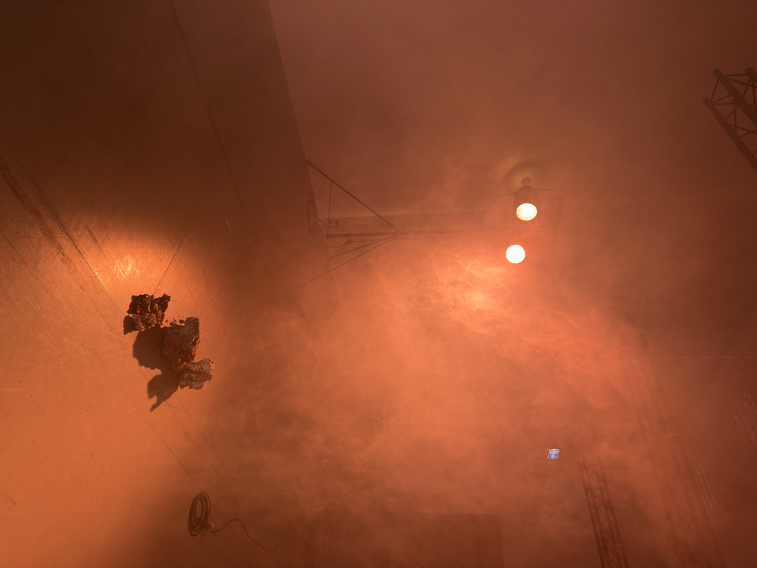
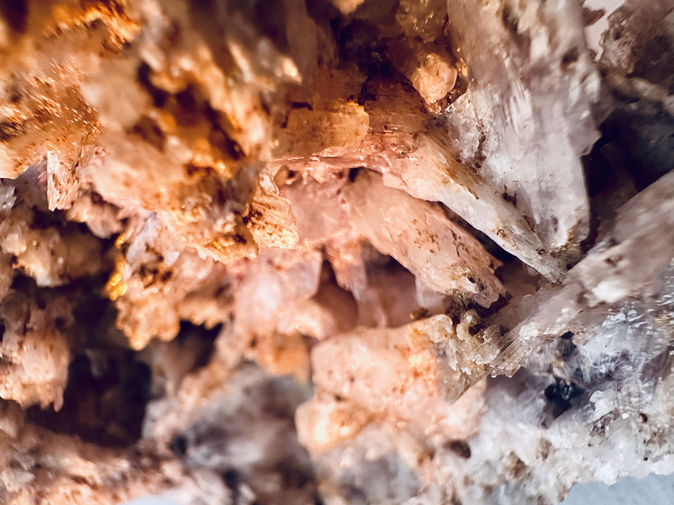
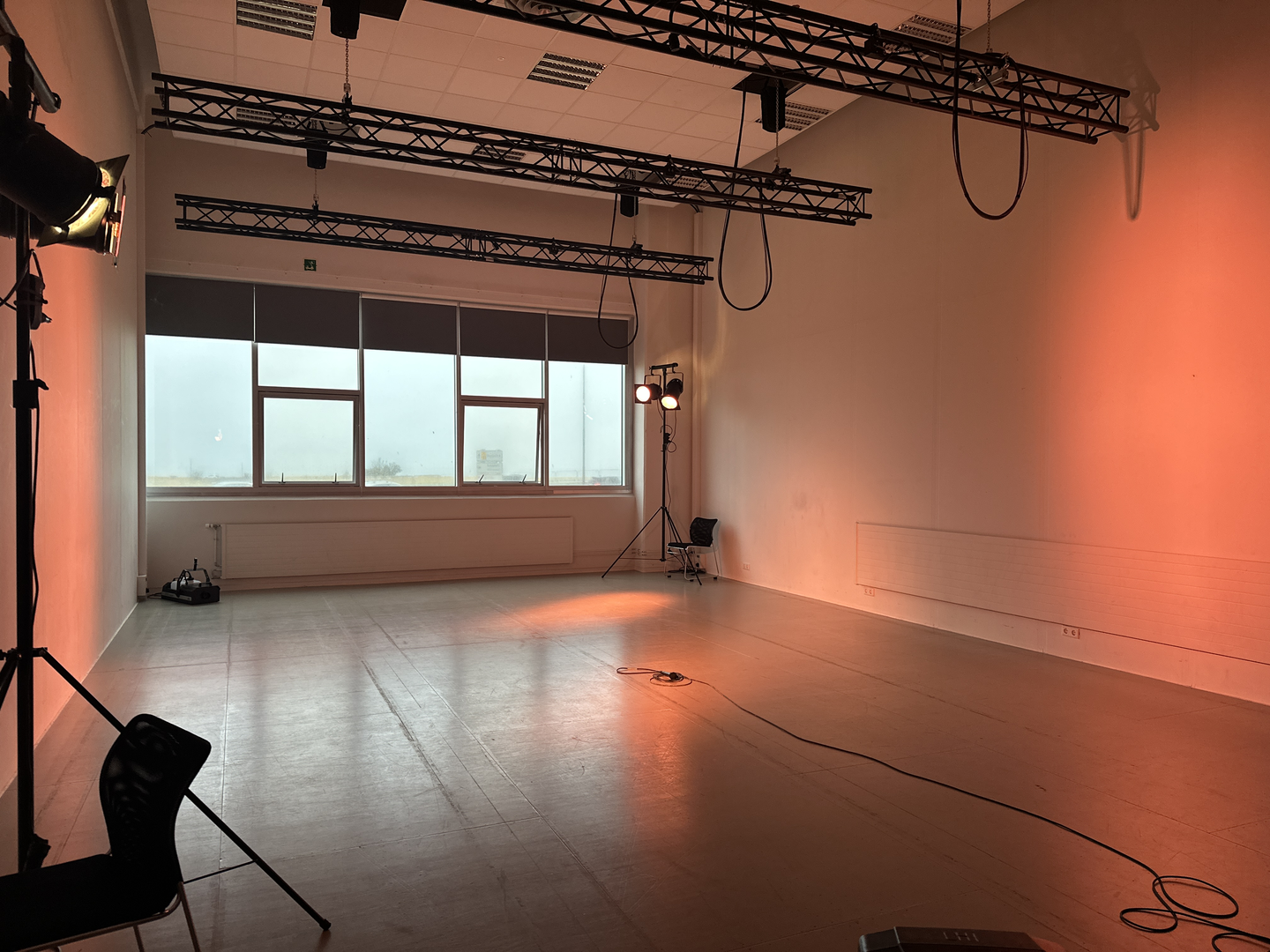
The exploration of stage lighting added to the installation. By combining multiple filters, I created a chromatic field that referenced both the tonalities of human skin and the hues of geothermal minerals. This interplay of colours emphasised the porous boundary between organic and geological matter invoked in the spoken text, while also producing a tactile visual atmosphere within which the movement could take place. It was valuable to observe how light changed depending on the stage smoke density, which was allowed to slowly dissipate during the performance, and the ambient light outside the window, therefore taking a larger participation in the overall colour hue.
Returning to the preceding choreography worked largely as a process and methodology of revision and development, where each iteration opens new possibilities. In this version, the addition of the recorded theoretical text and the considered approach to lighting introduced further layers into the performative field, testing how they integrate and change the work. The movement experimentation, informed by gestures that aimed toward the more grotesque, drew attention to the body's de-composition, without becoming overtly theatrical or exaggerated.
At the end, this performance, like others in the series, invited the audience to participate and embody the performative scores, to inhabit the material continuities between human and more-than-human worlds, foregrounding the shared elemental and energetic processes that bind bodies to geology across scales of times.
Spoken word recording
The performance was accompanied by the recorded spoken-word text composed and read by me at the start of the performance.
Elements forged in stars, such as carbon, calcium, iron, and phosphorus, became part of Earth's crust and later part of us. The calcium in our bones, iron in our blood, phosphorus in our DNA, and magnesium in our cells all originate from the Earth’s geological reservoirs. When we eat plants or animals, we’re ingesting atoms that have cycled through rock, soil, and water. In that sense, every heartbeat is powered by geology. Through respiration, excretion, and decay, we return elements to the soil, water, and atmosphere, feeding back into geochemical cycles like the carbon and nitrogen cycles. The carbon we exhale becomes part of carbonate rocks over millennia, and the phosphorus in our bones eventually re-enters sedimentary deposits. Even our waste contributes to mineralisation processes in soils. Over time, organic remains can undergo fossilisation, a geological process in which our tissues are replaced by minerals like silica or calcite. In other words, our physical bodies can literally turn into stone, becoming part of the geological record.
We are, in essence, a warm, walking hydrothermal vent, a continuation of Earth’s deep redox dance, wrapped in skin. Inside us, mitochondria manage redox reactions, transferring electrons just as geological processes do in hydrothermal vents and mineral formation. We are microcosms of Earth’s geochemistry: oxidation, reduction, crystallisation, and dissolution all happen within our cells. Redox is how energy moves in cells and in rocks. It transforms matter and releases usable energy. In hydrothermal vents, Sulfides and oxides exchange electrons; life often emerges at these interfaces. These are Earth’s “respirations”: slow, massive, but fundamentally the same chemistry as in your body.
Our collective actions, mining, building, burning, farming, have created a new stratum in Earth’s history: the Anthropocene. Even without dying, our existence and technologies are transforming sediment layers, altering atmospheric chemistry, and moving more rock than all natural rivers combined. Our bones are limestone in waiting. Our breath is a carbon cycle. Our metabolism is a micro-geology. Our species is a tectonic force.