Think-Aloud
The roots of the think-aloud method are psychological research in the early 20th century (van Someren, 1994, p. 30). The method seeks to enable the capture of thought processes without disturbances (van Someren, 1994, p. 31). The subject can, for instance, try to solve a problem while speaking out their actions simultaneously. The speaking is done without too much preparation, and the subject is not supposed to interpret their thoughts nor are they “required to bring them into a predefined form as in structured techniques. He or she renders them just as they come to mind” (van Someren, 1994, p. 31). The structured analysis is done afterwards. In a musical context, Benton (2013) suggests that music teachers include think-aloud sessions as a way of promoting their students’ reflective processes, and by that also their musical learning (2013). In this project I used the think-aloud method to gain access to the creative process of applying rhetorical figures in my performance interpretation of the score. The method was also useful in my exploration of the rhythmical qualities in the two editions of the score.
Intonation contours
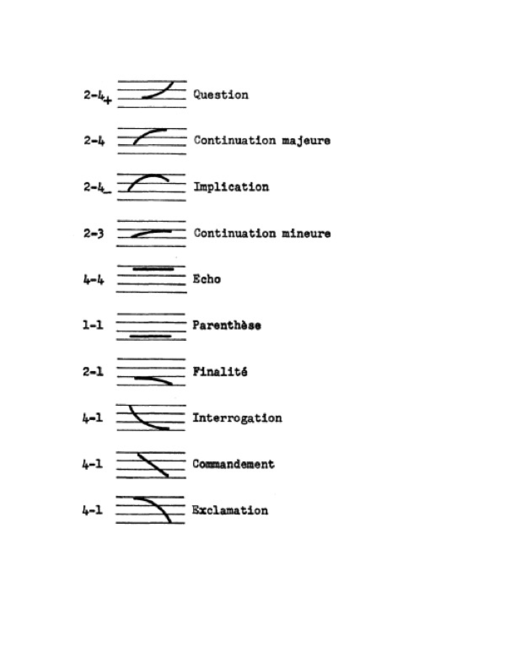
The linguist Pierre Delattre made a model for the 10 most common intonation contours in French (Delattre, 1966). The notation system has many similarities with musical notation, and uses a staff system as well as symbols similar to those found in graphic music notation.. While the intonation contours of a Swedish storyteller will not look exactly the same, I have employed Delattre’s setup (figure #3) in my analysis of storytelling in Swedish dialect, specifically also since I found its relation to musical notation both clarifying and attractive.
Rhetorical figures, and transcribing them to the scores
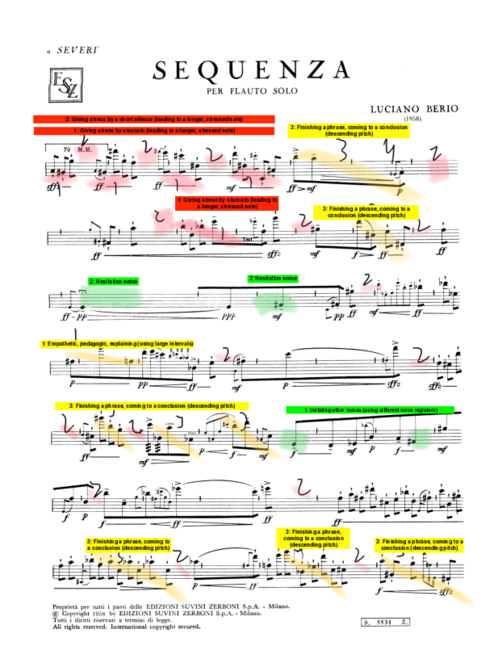
The research design involved several steps that started with explorations of the bank of rhetorical figures shaped from my listening to Wilhelm Larsson’s archival storytelling. In order to mark my score of Sequenza I with the rhetorical figures, I divided them into categories that were given different colors and numbers (figure #4), to enable their visual implementation in the score. The inspiration came from Pierre Delattre (1966), whose model of French intonation contours had graphic similarities to musical notation (figure #3). In the following phase, I annotated the rhetorical figures in the two different editions of the score (figure #5). For instance, sequences of staccato notes leading to a longer, stressed note were marked in red and labeled as No. 2. Additionally, phrases with large descending pitch drops were marked in yellow, labeled as No. 3 if interpreted as "coming to a conclusion", or No. 4, if interpreted as "expressing negative emotions". These preliminary markings represented an initial attempt to analyse the rhetorical structure of the composition. The score was also divided into the five different opera scenes suggested by Claudia Anderson (2004, p.12), to provide a large-scale structure to the story-telling.
Singing the rhythms
Robert Dick suggests singing as a method to study the complicated rhythms in the Sequenza (Dick, 2024). While it would be nearly impossible to sing the actual composed pitches, Dick argues that “scat-singing” the phrases both facilitates learning the rhythms and the musical shapes of the phrases. Given that scat-singing usually involves improvised singing, Dick’s suggestion to sing the accurate notated rhythms might come closer to the Indian classical music tradition, where students learning to play tabla traditionally practice singing the rhythms in combination with hand movements.
Comparing the editions
The two editions of Sequenza I have served as a means to identify rhetorical qualities in my storytelling exploration of the composition. By annotating both editions of the score with my Delattre-inspired rhetorical figures, I could make a comparative analysis of how the rhetorical figures work in both editions, to see if one of them was better suited for a storytelling approach.
A last annotation
Having explored the five operatic scenes in the score, sung the phrases, and compared the two editions, I made a revised annotation of the 1958 score. Here I summarised the most beneficial annotations, in order to really maximise my “storytelling playing” – the key insights to remember for the final recording of the performance. For the recording that forms part of this exposition, that annotated score was on my stand for the performance.
Examining Berio's Sequenza I through the lens of storytelling may initially seem unconventional. However, Luciano Berio demonstrated a profound interest in key aspects of storytelling—language, linguistics, theatre, and prosody. His exploration delved deeply into contemporary linguistic theories and the philosophy of language (Oliva, 2020, p. 25). Berio himself explained that his fascination with linguistics stemmed from "a very strong need to explore the eternal path between sound and meaning" (Berio, 1983, as cited in Oliva 2020, p. 26). Hence, the connections between a modernist classic flute solo like Sequenza I and storytelling are intriguing and worth exploring further. Nevertheless, there are many noteworthy storytelling traditions worldwide, and considering the Italian composer Luciano Berio at the centre of this exploration, a more logical choice would have been to explore an Italian storytelling tradition, such as the Sicilian Cuntu. However, this project focuses on my authenticity as a performer, which is why I am returning to my own background. Drawing on Kivy’s reasoning about personal authenticity (Kivy, 1995), being authentic means being sincere: “Assertions and expressions are either sincere or insincere. So they are the kinds of things that can be personally authentic. Since performances are works of art, they are either expressions or assertions (or both)” (Kivy 1995, p. 110). By revisiting the way stories were, and are still told in my “native dialect”, and analysing how a storyteller employs musical and rhetorical tools, I seek a more sincere and authentic approach to a performance interpretation of Berio’s score. Consequently, this project highlights one of the notable Scandinavian traditions from Värmland in southwest Sweden.
The storytelling perspective in combination with a comparative study of the two editions of Berio’s score for Sequenza I, constitutes the sources in this project, serving to create an oscillation between different times and artifacts, and by a re-imagining of my interpretation of the piece.
My explorations of Berio’s Sequenza I through storytelling started in 2021. During six months, I analysed Wilhelm Larsson’s storytelling to create a repository of rhetorical models. In 2023 and the early months of 2024, I applied these findings to both editions of the Sequenza while studying and practising it. I annotated both editions of the scores and entered a phase where I alternated between playing and thinking aloud, scat-singing, comparing the two editions of the score, and repeating the entire process twice. Following this, I made a final annotation of the score and recorded my re-imagined performance of the work. This chapter in the exposition further presents the results of my explorations.
Musical elements in storytelling from Värmland
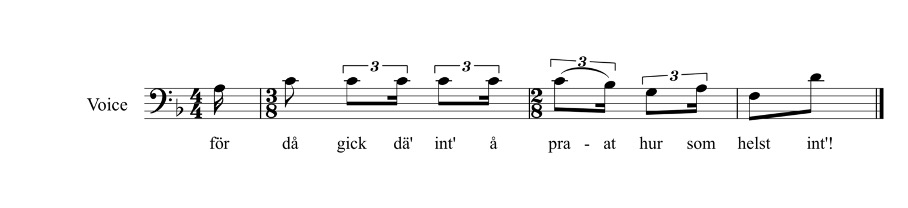
By analysing short parts of Wilhelm Larsson’s speech, I set out to look for overarching musical qualities in his rhetorical means and prosodic patterns. Could favourite intervals, recurring rhythmic patterns, or perhaps even tonal structures that were maintained throughout a story be identified? This analysis was made by ear and translated into standard musical notation. Hereby, I had to limit the material to characteristic shorter selections of the recording, since this analytical method was very time-consuming. Already at the outset, I was well aware that a machine analysis of the data would be more efficient and allow for the use of bigger data. However, I chose to work from my own listening, since the analysis also served as a way of developing my individual agency as a performer. This also allowed me to select material that I found musically interesting.
My analysis was based on repeated listening, drawing from what Diana Deutsch calls the "Speech-to-Song Illusion", where simply listening to a sentence several times makes the spoken sentence appear as sung (Deutsch, 2010). Whenever a phrase or part of a sentence from the recording caught my ear, I would stop the playback and identify the beginning and ending of the phrase. By looping that segment, the melodic content would eventually stand out, and was subsequently transcribed into music notation. When a few of these transcriptions were created, I could identify that Wilhelm Larsson's storytelling had some recurring patterns, related to rhythm, melody and timing.
As an example of the musical structures identified, Figures #6 and #7 shows how sentences would sometimes be structured to remain in one key, and audio files #2 and #3 plays Wilhelm's voice. All audio files and text transcriptions are presented in an old form of Swedish dialect. While only a few may understand what is said in the audio files, my focus is not on the content but rather on the delivery, making it possible to understand even for non-Scandinavian speakers.
Rhetorical figures in Wilhelm Larsson’s storytelling
After making these detailed transcriptions, I turned to a more overarching listening, to form a bank of rhetorical figures related to musical shaping. I listened to longer parts of the recording and stopped when I found something that caught my interest, musically. My findings show that Wilhelm Larsson has a rich toolbox of rhetorical figures that relate to musical shaping:
- Before a stressed word in a sentence, Larsson gives emphasis by a short silence before the central word or phrase, or speaking in staccato before the stressed word (audio #4)
- He uses different pitches to sonically imitate or represent other characters in the story (audio #5)
- He speaks in larger intervals within the sentence when conveying something humorous (audio #6)
- He often rests on a certain pitch on hesitation noises (audio #7)
- He uses larger intervals within the sentence when conveying either a pedagogic or empathetic tone (audio #8)
- He expresses negative emotions by making a large downward pitch drop (audio #9)
Exploring the rhetorical figures musically
During my explorations, I worked on connecting Wilhelm Larsson’s rhetorical figures to both editions of the Sequenza score. This was a process that took some time and effort, and I made several attempts where I altered between playing a short part of the score, stopped to think-aloud, sometimes re-annotated the score, and started over again. After a few rounds, I had a version that I felt confident about and made a final recording of.
I discovered that incorporating rhetorical figures into the Sequenza score significantly contributed to my interpretation process. By working with the rhetorical figures, I was able to introduce more variation into my interpretation. For example, I explored the ability to play with an "empathetic" tone (as seen in video #2). In my analysis of Wilhelm Larsson’s storytelling, I observed that his pitch range expands when he conveys empathy or explains something in a very pedagogic manner (audio #8). This "empathetic tone" could be applied to certain phrases in Sequenza I that feature large interval leaps. Interpreting these large intervals as expressions of empathy was a novel approach for me. These leaps are challenging to execute well on the flute, but keeping empathy in mind proved to be very helpful. Continuing the explorations on the “empathetic tone”, I also identified opportunities to include very short grace notes within the empathetic character. Usually, I find there is a tendency among flautists to play grace notes without enough expression, just because the goal is to play them (too) fast. Here, the empathetic quality helped give them more character, even if they were played in time.
When adding a hesitating quality to some of the long notes (video #3), as when making hesitation noises similar to Wilhelm Larsson’s (audio #7), they got a kind of open direction that I had never experienced in my flute playing before. By coincidence, some of the long notes circle around e, e flat and d, just the same pitches as Larsson’s hesitation noise often does. I came to the conclusion to try starting a long note by employing hesitation noise, then make the note turn into something else. Listening to my own playing afterwards, I think this adds a sense of anticipation to the long notes, that brings a curiosity about what may follow.
Further, the experimentation with short silences, where phrases with staccato notes lead to an emphasised note, was helped by speaking out quotes of Wilhelm Larsson loudly before playing. Even if the number of syllables was not the same in his speaking (audio #4) and in the very Sequenza phrase I was practising, the direct mimicry of Larsson’s voice still helped me to phrase the staccato notes more convincingly. At one point, I found myself in the mind-boggling situation of trying to "exaggerate a silence" but by acknowledging it is there, and trying to imitate how Wilhelm Larsson pauses before important words, I think I could make the most of it.
With the storytelling explorations, other rhetorical figures than my findings from Wilhelm Larsson’s storytelling came up. As for instance, applying the concept of “raising a question” (video #4) to a short four-note motive. In the video, I start by just playing what is in the score. After that, I try phrasing “a question”. I keep altering between these two styles, and found when I play as raising a question, I know exactly how I would like to phrase off the last note, and my playing sounds more convincing.
Implementing the five operatic scenes suggested by Claudia Anderson (2004) did make sense in these explorations. While working on the different scenes and annotating my score, I concluded that each of the five scenes also contained more of one specific rhetorical figure that I chose to focus on. This approach also resolved a problem that arose during the explorations: including too many detailed instructions in the score made it impossible to follow them all.
Scat-singing and vocal qualities
When practising rhythms by singing, hitting the accurate pitches in the Sequenza would be very challenging. However, as I began "scaffolding the phrases" through singing, I noticed that the vocal approach helped me adopt a storytelling mindset. Upon reviewing the documentation of my explorations, I realised that I sometimes sound more expressive than when playing the flute (video #5). At this point in my explorations, I recognised that the singing required a lot of bravery, and I felt comfortable fully engaging in it. This led to better dynamics and an extra percentage of expressive capacity when not focusing on playing the flute.
Further, an important aspect of playing a woodwind instrument is breathing, and in this case, inhaling air. Wilhelm Larsson sometimes uses a loud inhalation to “signal a new chapter” in his storytelling. During my explorations, I reminded myself to include the sound of the inhalation itself, just like Larsson does, and found that it brought more expressivity not only to the inhalation sound, but also for the phrase that followed.
Another vocal quality I borrowed from Wilhelm Larsson was his way of imitating other persons in his storytelling. By using a lower pitch range, he sonically imitates a harsh person telling something (audio #5). When I found a part in the Sequenza score, where phrases seem to imply “different voices” by shifts in register, I could instruct myself to try expressing the phrase through two different voices. I decided to give these voices slightly different characters; the first person being very engaged and affectionate, and the second more cautious. When listening back to my playing, I think this was a good way of creating greater expressive variation. Also, another way of conveying the idea of different voices was altering my flute sound; going for a darker sound, as Wilhelm does when imitating the harsh voice, made the phrase more convincing.
Freedom and constraints in the two editions
When comparing the two manuscripts during my explorations, I found the 1958 edition to be better compatible with the storytelling mindset. This might be due to the visual simplicity of the spatial score, where rhythms are read more linearly than in standard music notation. Even though the score has very accurately defined rhythms, this linearity "frees the performer to think of time in a different way" (Folio, 2007, p.9). This approach helped me add a storytelling or speaking quality to my playing. Additionally, in the 1958 edition, almost all phrases are visually positioned "in between beats." In contrast, the 1992 version places some phrases on the beat, which feels rigid and out of place in this piece (video #6). Upon further exploration, I realised that the "in between beats" phrasing significantly contributes to the emulation of speech and storytelling.
Storytelling is one of the fundamental forms of human communication. It helps us describe ourselves, our families, our ancestors, our history, and our place in the living world (Isof, 2023). As mentioned in the introduction, this project seeks to expand my agency as a performer, seeking a more authentic expression by focusing on a storytelling tradition that shaped my upbringing in Värmland, a rural district in southwest Sweden. Värmland is renowned for its strong storytelling tradition, which has characterised the literary work of leading Swedish authors such as Selma Lagerlöf, Gustaf Fröding, and Göran Tunström. The storytelling tradition of Värmland has always resonated with me for its expressive and musical qualities, further enhanced by the dialect. The prosody of Värmland dialects often features a very melodic, almost dramatic pitch range, with large intervals within phrases. The dialect, combined with the region’s storytelling tradition, showcases a rich use of paralinguistic qualities. In my impression, the storytellers from Värmland make the most of these qualities to shape their stories.
ISOF's archival voice recordings
The Institute for Language and Folklore (ISOF) is a governmental authority that builds and collects knowledge about the Swedish language and culture. In their archives, a rich collection of voice recordings of Swedish dialects is found. While the first recordings were made in the late 19th century, the major part of the collection was recorded in the 1940s and 50s, with the ambition to preserve the Swedish dialects for the future. The recordings were made on tape recorders in a mobile studio, built in a re-made Volvo car. The recordings are now digitised and open-access. Even at the time when the recordings were made, they had a retrospective character, as the interviewees often tell stories of earlier times. In each village they visited, the interviewers sought out the best local storytellers. This has turned the archive of ISOF into a collection of stories from the past, that today can unwrap hidden fragments of history, but also of historical prosodic qualities.
Selecting materials from the archive
After listening to many files from the ISOF archives, I chose to focus my explorations on recordings of Wilhelm Larsson (ISOF), since it was obvious that he was a great storyteller, using many typical narrative tropes drawn from Fryksdalsmål. Larsson was a teacher in Sunne, and by that a professional in delivering oral presentations. He speaks with great confidence, and it is clear that he enjoys the recording situation. While many recordings in the archives are in the form of interviews, the selected recording is instead a documentation of his storytelling, without the presence of an interviewer. He speaks in the melodic dialect from Fryksdalen in the middle of Värmland (audio #1).
Luciano Berio (1925-2003) garnered attention from a wide audience for his compositions, earning the title “a modernist for the masses” (Tommasini, 1995). Berio was articulate about his works and music in general, with several interviews published (Berio, 1985; Berio, 1997; Weisser, 1998). Luciano Berio’s interests in the arts were broad, and he kept lifelong collaborations with poet Edoardo Sanguineti, philosopher Umberto Eco, conductor/composer Bruno Maderna, and many others.
Many of Berio’s works are infused with linguistic references. For instance, the electroacoustic work Visage from 1961, dedicated to singer Cathy Berberian, was the last of a series of radio dramas he produced in the Studio di Fonologia Musicale. In general, radio dramas created around this time aimed to support a sound culture that “would promote sensitivity towards musicality of language and sound in general” (Arnheim, as quoted in Choi, 2022, p. 119). Berio himself states in the author notes of Visage that his goal was to “establish a means to find musical equivalents of linguistic articulations” (Berio, as quoted in Choi, 2022, p. 120). In Visage, Cathy Berberian explores a large range of non-verbal, vocal actions, from improvised pseudo-language to singing, sighing, laughing and crying. These vocal qualities are part of what is defined as paralinguistics; non-verbal elements of communication used to convey emotion and modify meaning. Drawing from this, the same could be said about how musical works are “designed to persuade, not simply to convey information in an objective manner” (Temperley, 2022, p.167).
Expanding on the connections between language and music, these have been scrutinised by both composers and researchers before and after Luciano Berio. Temperley (2022) provides an overview of these links that spans over centuries. Starting with music theorist Mattheson’s Der vollkommene Capellmeister from 1739, which is based on rhetorical categories, the review extends to modern studies examining resemblances and differences between language and music. The shared ability of language and music to express emotions is mentioned, where elements like higher pitch, increased temporal density, and loudness are shown to convey emotions characterised by heightened energy (Russell, 1980, as referenced in Temperley, 2022).
Further, Diana Deutsch found an intriguing connection between speech and music, and how we identify whether a sentence is spoken or sung, known as the Speech-to-Song illusion (Deutsch, 2019). When a short, spoken sentence is repeated multiple times, it transforms into a song through the simple act of repetition. Deutsch also noted that a person's native language influences their perception of music (2010). For instance, native speakers of tonal languages like Mandarin are more likely to possess perfect pitch compared to Westerners (Deutsch, 2010). In summary, if the way we speak affects how we listen to music, it probably also affects the way we perform music, which is the reason for my interest in dialectal storytelling and its bearing on my interpretation process.
The Sequenza cycle
Berio's compositional cycle Sequenzas I-XIV began with Sequenza I for solo flute in 1958 and concluded with Sequenza XIVb for double bass in 2004, spanning over an impressive six decades. The title, Sequenzas, reflects Berio’s concept of setting the works in a sequence of fixed harmonic fields (Halfyard, 2007). The Sequenzas are highly virtuosic solo pieces that explore the “capabilities of a solo instrument and its player, making extreme technical demands of the performer” (Halfyard 2007, p. xix). The technical demands might be of almost unplayable, fast passages in an uncomfortable register, or by singing and playing at the same time, as in the Sequenza V for trombone, or playing for 19 continuous minutes of circular breathing, as in the Sequenza XII for bassoon. Nevertheless, Berio did not seek to change the character of a musical instrument that had a “slow and dignified development for centuries" (Berio 1985, p.92) or use the instruments against their nature. Rather, Luciano Berio set out to expand the borders for each instrument’s intrinsic capabilities. Furthermore, a sense of theatre is inherent in the virtuosity and technical challenges of the Sequenza cycle, as noted by musicologist Halfyard (2007, p.113). According to Hansen (2010), it is this use of theatrical and linguistic elements that helps audiences intuitively understand the music.
Sequenza I
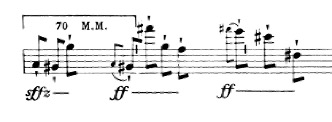
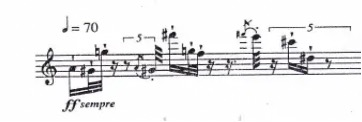
Sequenza I for solo flute, composed for the Italian flautist Severino Gazzelloni in 1958, is considered one of the most important solo flute works of the 20th century. Initially, Berio used a traditional and precise metric notation when composing, but switched to spatial notation (figure #1) without barlines to offer performers more freedom. Despite the success of the 1958 edition, Berio published a new edition in 1992 (figure #2) to address performers’ rhythmical liberties with the spatial notation:
At the time I wrote Sequenza I, in 1958, I considered the piece so difficult for the instrument that I didn’t want to impose specific rhythmical patterns on the player. I wanted the player to wear the music as a dress, not as a straitjacket. But as a result, even good performers were taking liberties that didn’t make any sense, taking the spatial notation almost as a pretext for improvisation (Berio, 1997)
When I first studied the spatial score in the late 90s, I was advised to use a ruler to accurately determine the rhythmic structure. So, at least at that time, the trend was toward the straitjacket side. In my experience, the rhythmic structure demands considerable study time in both editions. To perform the rhythms on the flute adds further complexity, due to the fast and large interval jumps.
When Umberto Eco discusses the intrinsic openness within contemporary music, in "The open work" from 1962 (Eco, 1989), Sequenza I serves as an example. Eco notes that "considerable autonomy [is] left to the individual performer in the way he chooses to play the work" (Eco, 1989, p.1). However, I did not experience such autonomy during my first encounters with the Sequenza. Rather, I would say that the level of virtuosity and demand for rhythmic accuracy probably led to my first performances of Sequenza I being quite monotonous.
Returning to the issue of the two different editions, many other flautists share my preference for the 1958 edition. Research by Folio and Brinkman (Folio, 2007) indicates that many flautists find the spatial notation more precise if studied carefully. Some flautists were sceptical of the new edition actually being made by Berio, and many, as well as Berio himself, considered the later edition to be only one possible “interpretation of the original” (Nauert, 1996, as quoted in Folio, 2007). The issue of the complex notation is a significant challenge for new performers of Sequenza I, alongside understanding the piece's ambiguous structure (Priore, 2007). However, as Berio states, complexity is not only a burden for an interpreter:
Think of Beethoven and Schoenberg: their musical thought often seems to have a positively excessive semantic depth. There’s enough for everyone, and always a bit left over which remains in the shadows, waiting for a different approach (Berio 1985, p.23)
In my opinion, Sequenza I itself also embodies the semantic depth that Berio speaks about; the complexity of the work, in addition to both editions of the score, each so highly demanding and virtuosic for the flautist that it borders on a theatrical expression. In this case, I can interpret Berio’s own statement as a blessing to explore Sequenza I through a storytelling approach.
There is extensive research on the performance-related aspects of the Sequenzas, perhaps not directly so much in the field of storytelling, but more in the neighbouring area of theatre. For instance, Sequenza V for trombone was inspired by the Swiss clown Grock (Webb, 2007; Halfyard, 2007; Hansen, 2010; Conant, 2024). However, in the literature about Sequenza I, fewer studies focus on theatrical performance aspects. An exception is the article by Claudia Anderson (2004). By dividing Sequenza I into a Rondo in five scenes, Anderson identifies a drama drawing from Italian opera, that includes "anger, surprise, frantic behaviour, secretive suggestions, and subdued lyricism" (Anderson, 2004, p. 12). Anderson suggests that dividing the Sequenza into five opera scenes aids the interpretation process. Additionally, American flautist Robert Dick has noted that there is "a lot of humor in Berio's music [Sequenza I]: it’s not all just aggressive short notes" (Dick, 2024). I strongly agree with Robert Dick—having heard performances of the piece delivered in the aggressive style he describes, I find such interpretations rather dull. One of the challenges of performing complex contemporary music is the tendency for performers to focus solely on “playing the score,” often at the expense of more nuanced musical expression.
Starting off this section with a caveat, I would like to address the fact that the rhetorical figures I identified within Wilhelm Larsson's storytelling are not necessarily unique to storytellers of Värmland and Fryksdalen. Larsson’s use of pauses and shifts in pitch range, among other things, can surely be found in storytelling traditions worldwide. However, I chose to focus on his storytelling because it felt both familiar and musically interesting to me. Having listened to Wilhelm Larsson’s voice for a long time, I look upon his storytelling as how folk musicians draw from historical musicians or singers of the past, as bearers of tradition.
Summarising the explorations, the storytelling approach gave me new possibilities for shaping music. For instance, when giving some of the long notes in Sequenza I a hesitating quality, inspired by Wilhelm Larsson's hesitation noise, I could find more colours to my flute sound. Trying to fill the large interval phrases with empathy, I found that it made them more expressive. By imitating Wilhelm Larsson's technique of employing a staccato as a way of leading to a stressed word, I was able to introduce more variation into my phrasing. This approach also allowed me to sometimes bring in a sense of humor into Berio's music, thereby avoiding the one-dimensional aggressive playing style that Robert Dicks warns against (Dick, 2024). Overall, I feel that I've significantly developed my phrasing skills and my ability for musical shaping. The storytelling approach helped me to go deeply into the performance interpretation, and also exaggerate, in that sense that what felt exaggerated then and there was just right when listening to the recording afterwards. However, the concept of exaggeration is intriguing in itself. Would it be possible to exaggerate one's expressive phrasing to the point where it becomes overly expressive?
Studying Sequenza I can be a constraining act of mastering the intricate and detailed score, which is also how I experienced my first interpretation process in the 1990s. In this project I have sought to re-imagine, not just my performance interpretation of the piece, but also, to re-imagine the process of studying the piece, as well. Along with the lines of Daniel Leech-Wilkinson’s proposal that performers should embrace more radical interpretations (Leech-Wilkinson, 2020), I have explored a storytelling approach, which I felt was innately connected to Berio’s compositional work, but would simultaneously enable an exploration of personal authenticity. Throughout my explorations, I noticed that the rhetorical figures and other storytelling features made my choices both clearer and more diverse; to play a certain phrase pedagogically, to play it as citing others, or to focus on playing with hesitation – was perfectly possible while still playing the score accurately. The storytelling approach did add a sense of freedom and was instrumental in my re-imagining of the interpretative process.
The oscillation between the editions during my practising sessions was an integrated component in my exploration of the storytelling approach, providing opportunities for cross-comparison of the rhetorical figures across the two versions. While I still prefer performing from the 1958 edition, I acknowledge, like Nauert and Berio, that the 1992 edition is indeed a “possible interpretation of the original” version (Nauert, 1996, as quoted in Folio, 2007). Here, we have to assume they refer to the 1958 edition as being the original version, or is it the previous version of the score that Berio never published? However, there are many creative possibilities in considering the 1958 and 1992 editions side by side. This oscillation between historical sources has, in the final analysis, allowed me to experience the “considerable autonomy” which Umberto Eco (1989, p.1) identified in the 1958 version, enabling a re-imagining of my performance interpretation of the piece through a storytelling approach.
Thinking about how to further expand the exploration of storytelling in flute music beyond the present study, I suggest focusing on solo flute compositions that possess an intrinsic openness, bordering on improvisation. For instance, the 12 Fantasias by G.F. Telemann (composed in 1732) and Image by French composer Eugène Bozza (from 1939). These works are ideal choices due to their rhetorical and improvisational elements. Despite their historical origins, they remain central works within the flute literature. The enduring relevance of these compositions also highlights their unique ability to serve as a foundation for artistic research.

The aim of this project is to explore how a storytelling approach can be employed to achieve a more daring and bold musical shaping of Luciano Berio’s Sequenza I. The research questions are:
- Which rhetorical figures in dialectal storytelling from Värmland can be identified, and translated into the interpretation of Sequenza I?
- How can a storytelling approach enhance a musician’s agency in the negotiation between aspects of freedom and constraints in the performance of a historical modernist composition?
- How can a comparative analysis of the rhetorical figures in the two editions of the score inform a storytelling approach to the performance interpretation of the composition?
Audio #1: Wilhelm Larsson telling stories (ISOF, Bd10765)
Permission to publish the material has been obtained from Isof.
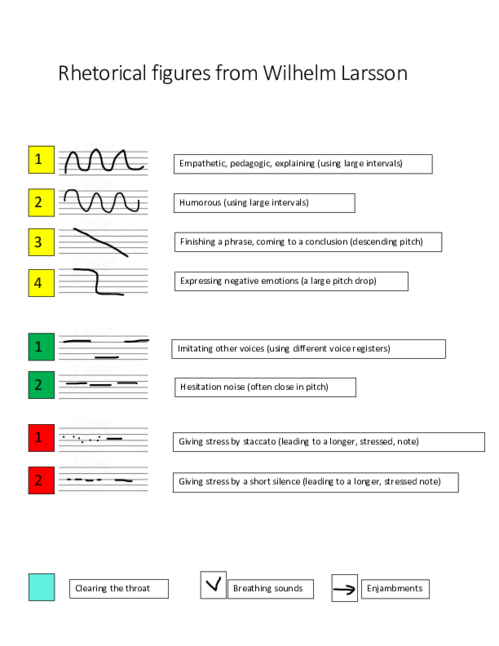
Figure #4: Rhetorical figures from Wilhelm Larsson, in a similar style as Delattre's intonation contours.