This exposition is published in the Proceedings of the 1st symposium Forum Artistic Research: listen for beginnings.
Listening to the Sounds of War
Illia Razumeiko
Every time we heard the sirens we would have rushed out of our shelters to invent new technologies equal to the threat. The inhabitants of the wealthy countries would have been as inventive as they were earlier in times of war, and, as they did in the twentieth century, they would have solved the problem in four or five years, by a massive transformation of their ways of life.
—Bruno Latour, Facing Gaia
Sounds of warning
Starting this writing, I had a vision that the text could become something like water. The flow of water can build connections and bring us to unknown lands and geographies, the blue-green lines of the great rivers: Nile, Ganges, Danube or Dnipro – rivers that are bringing life, but also death, rivers that lead to afterlife or an illusion of immortality.
In March 2022, during the escalation of the large-scale Russian invasion of Ukraine, Russian Armed Forces stopped in front of my home village Bilenke in the southern part of the country. At that time, the river Dnipro became the frontline (but also a “fortress line”), and the surrounding area the “theatre of war”, Kriegstheater, teatrum belli. On the high right bank of the Dnipro river, you can observe the active war performance: burning fields, sounds of artillery battles, nightly traces of rockets that the Russians, hiding behind the Energodar nuclear power station, are launching into Zaporizhzhya, regularly killing peaceful humans in their homes.
On the high right bank of Dnipro river, you can see and feel what is heading towards your home: hundreds of thousands of heavily weaponized Russian people who are travelling thousands of kilometres to your birthplace for very simple reasons: to kill, to take away your land, to eliminate your country, your language, your society. I call all those people “Russians”. This is not understood as “nationality” in ethnological terms. To be “Russian” in this case is a political choice (someone either made it or not), as many of the Russian troops have very different nationalities, ranging from Siberia to the Caucasus, enslaved by colonial history and ideas of Russian superiority, nationalism and imperialism, frozen in time.
The last years: 2024, 2023, 2022, travelling to my parents, to our family house. I am travelling literally inside the war, through it. But this endless war started much earlier and had already influenced, in a special way and for years, the sound landscape around us. On 17th July 2014, during the early stage of the Russian invasion in eastern Ukraine, MH 17—a Boeing 777 passenger flight from Amsterdam to Kuala-Lumpur—was hit by a Russian rocket near Donetsk. Within a few days, the whole area of Eastern Ukraine was closed for international flights. As my village is located more or less in this direction, I could observe how all the long-distance flights between Europe, the Middle East and Southeast Asia disappeared at once from the sky without trace. Pure sky and silence. This silence in the years 2014–2022 was just a big Auftakt before the following tragedy. From 24th February 2022, fighter jets, rockets, ballistic missiles, artillery shelling, and mortar fire explosions became a normal sound environment around our family home (and, with different kinds of intensity, for the whole of Ukraine).
From April–May 2022, we returned to Kyiv to continue artistic work within the opera laboratory Opera Aperta, founded in 2020 by me and my colleague, composer Roman Grygoriv. What we were supposed to create was called “opera Chornobyldorf”, a musical-theatrical performance that we conceived in 2020 in the Chornobyl exclusion zone, at that time in preparation for a tour in some European countries. We started with small vocal and instrumental rehearsals with our artists. Two to three voices, percussion, viola. At first, our meetings with artists were hard, even painful. After the shock of the start of the large-scale war, we—our bodies, our voices—literally could not work. You cannot express something, you cannot spread the joy of music, voices and movements, you are not ready to put yourself again into the Theatre of Dionysus, the festivities of art and peace.
This was a process of a few weeks, started in Kyiv and continued through a small Vienna residency, in which we could hold together, and we could give a first big public stage performance in Rotterdam. The first months and sounds of war caused a trauma that we are still living in, but this trauma can also be healed (at least partially) with time and with art practices (or, sometimes, even with just routines of everyday life practices). We continued to make music as our listening attention was transformed. What do you hear in the distance? Air-alarm sirens? Rockets blast? Anti-aircraft guns explosions?
Silence and emptiness
There are two musics (at least so I have always thought): the music one listens to, the music one plays. These two musics are two totally different arts, each with its own history, its own sociology, its own aesthetics, its own erotic; the same composer can be minor if you listen to him, tremendous if you play him (even badly) – such is Schumann.
—Roland Barthes, Image, Music, Text
In July 2022, together with my colleague Roman and choreographer Chrystyna Slobodianiuk, I visited the Khanenko Museum, the main Ukrainian art gallery. Due to security reasons and the threat of an air terror, all collections of the museum had been evacuated and stored at safer places and geographies. The 19th century neoclassical palazzo remained empty and closed for the visitors. As we stepped inside the building, it was only decorated walls and shadows of art-objects that welcomed us to an empty space (Fig. 1). In this museum, the sound of war was silence. Silence and emptiness hold within them polyphonic links to history, to the past, to previous wars and endless journeys of art-objects. A totally empty museum. We even made a joke: among all the processes of decolonisation, our empty Khanenko Museum could win the title of “the most decolonised museum in the world,” reduced to the building alone with only its workers and some archives still on site.
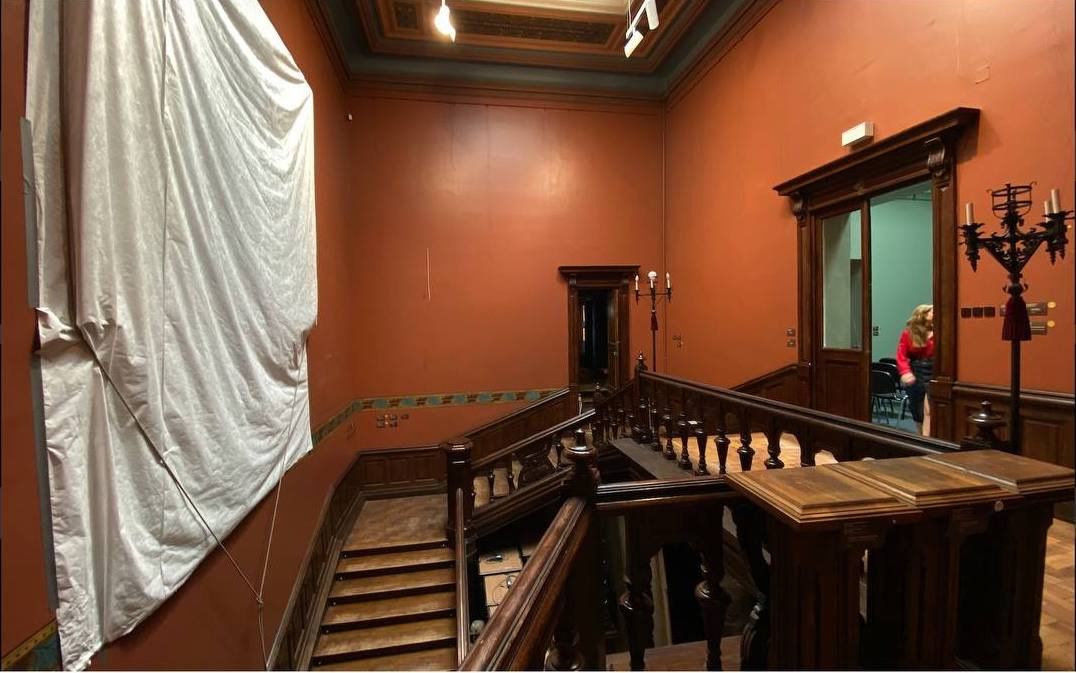
Walking through museum rooms and corridors, we started to reflect on its past and its history, also turning our thoughts to the phenomenon of Museum as an institution. Surprisingly, we were given a whole museum as a stage for the upcoming opera. The immediate idea was to create a polyphonic performance that could animate the complete space and interconnect its 13 rooms and galleries. This form gave us an opportunity to turn the museum’s interior into a sound, light and performative landscape in which each visitor would build their own dramaturgy and story, moving in space, and guided by sound waves, artist bodies and light beams. Genesis, Opera of Memory in 13 mise-en-scene was the final title of the performance. “Genesis”: as a basic link to the biblical book of Genesis (as analysed by Barthes). “Opera of Memory” as a genre referring to Julio Camillo’s mysterious “Theater of Memory” Renaissance installation. And “13-mise-en-scene” as a site-specific definition for performative spaces and the type of staging that allows us to use all thirteen museum rooms/stages simultaneously. The process of listening inside Genesis started and ended with silence. Museum silence, which is not a total absence of sound: we can hear dust falling, rays of light moving across the floor, old windows creaking under the force of the wind, the steps of museum workers on the floor below or above us.
We premiered this performance on 1st October 2022. The following week, on Monday 10th of October, early in the morning, Russia started a new wave of air terror. Hundreds of Russian missiles and drones reached Kyiv. One of the ballistic missiles hit a park ground just in front of the museum, blowing up all the windows, and damaging a roof structure of the historical building. A few peaceful humans were killed in their cars on crossroads, just between the museum and our opera studio. The silence that accompanied us for three months inside museum archives ended with a loud and cruel return to reality.
Explosion and aftermath
The first difference is that I am interested in Europe not only as an institution, but also as Europe as a territory, as a soil, as a turf, as a land, or, to borrow the German expression, as Heimat, with all the difficulties of that term.
—Bruno Latour, Is Europe’s soil changing beneath our feet?
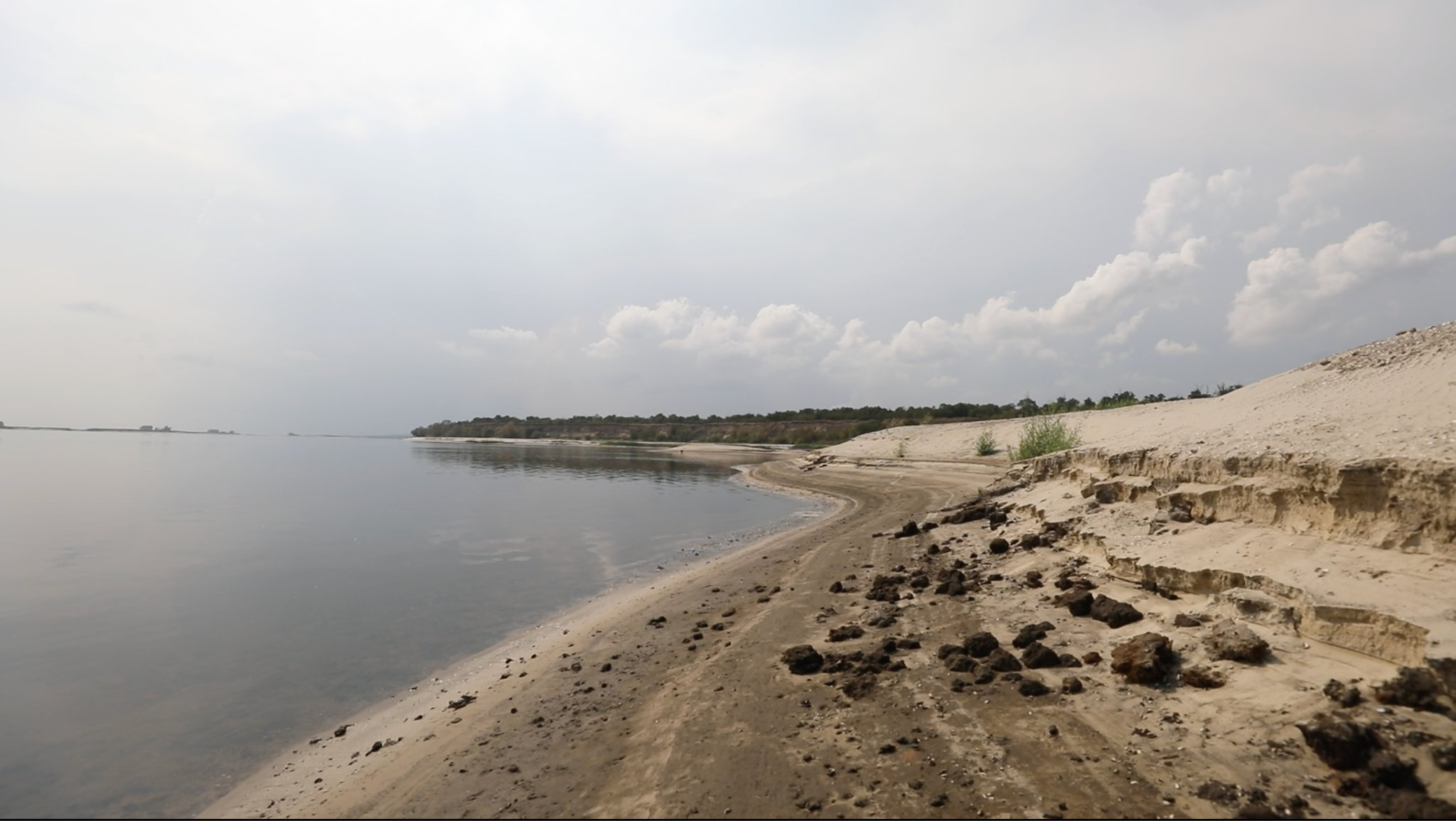
In the early morning of 6th June 2023, Russian Armed Forces blew up the Kakhovka Dam, causing extensive flooding of the lower Dnipro river. A huge human and ecological catastrophe resulted (in some sense similar to Chornobyl) from the liberation of the riverbed. An area of 2.000 square kilometres, after a seventy-year long artificial transformation into the Kakhovka reservoir, now returned to its “natural” state. This ecological catastrophe—in fact another war and eco crime—had a crucial personal dimension for me. The landscape near my home village, the place where I grew up and learned how to swim, changed dramatically (Fig. 2). I arrived at the village two weeks after the explosion, when the entire water volume of the reservoir had already flowed into the Black Sea. The twenty-five kilometre wide artificial sea disappeared, leaving deserted land, tons of dead fish and riverweed. The Dnipro river returned to its normal “natural” shape, but that return was painful. For me, as an individual, this transformation of landscape produced another shock, comparable with the start of the war.
That same month, I wrote down the name for the next opera, GAIA-24,1 inspired by two things: Bruno Latour’s Gaia-theory, and the legendary Dionysus in 69, Robert Shechner’s play-performance from 1969 at the Performance Garage in Manhattan. How can this “culturological” attempt be developed, and is it even possible to create a music-theatrical production related to ecological catastrophe? Do you think that you even have a mandate to speak on behalf of the earth, water, sand, dead fish, demolished houses, missing people? I don’t know.
-
GAIA-24. Opera del Mondo. Official trailer: https://youtu.be/giBFrGYSCnEO; official website: https://grygoriv-razumeiko.com/operas/gaia-24-opera-del-mondo/ (accessed 28 Apr 2025).
Within a few months, in our studio in Kyiv, we gathered a group of people—musicians, singers, and actresses—and built a chamber opera collective (eleven to twelve people on stage). What can we call those humans? Ukrainian artists, who are still living in Kyiv, doing art, or something we recall as art in this part of the world? Later on, I called them “artists, surviving the war”, meaning that “surviving” is not in the past, but remains an ongoing process of our everyday life. Later in my doctoral thesis, I also called them “angels”, or “angels with different colours”.
The opera would soon get the additional subtitle GAIA-24. Opera del Mondo, relating to the floating architecture of “Teatro del Mondo” by Also Rosso (Jadrić 2020). Its creation started with a big explosion, and with the text as an aftermath. With river flooding and textual flooding that tried to reconnect recent past and unknown future. Text as a water, and text as a flow of water. A few weeks after the explosion, we visited that side of Dnipro again. Once deserted soil was already regenerating itself with millions of fast growing willow and poplar sprouts, forming a special kind of young forest around the renewing river bed.
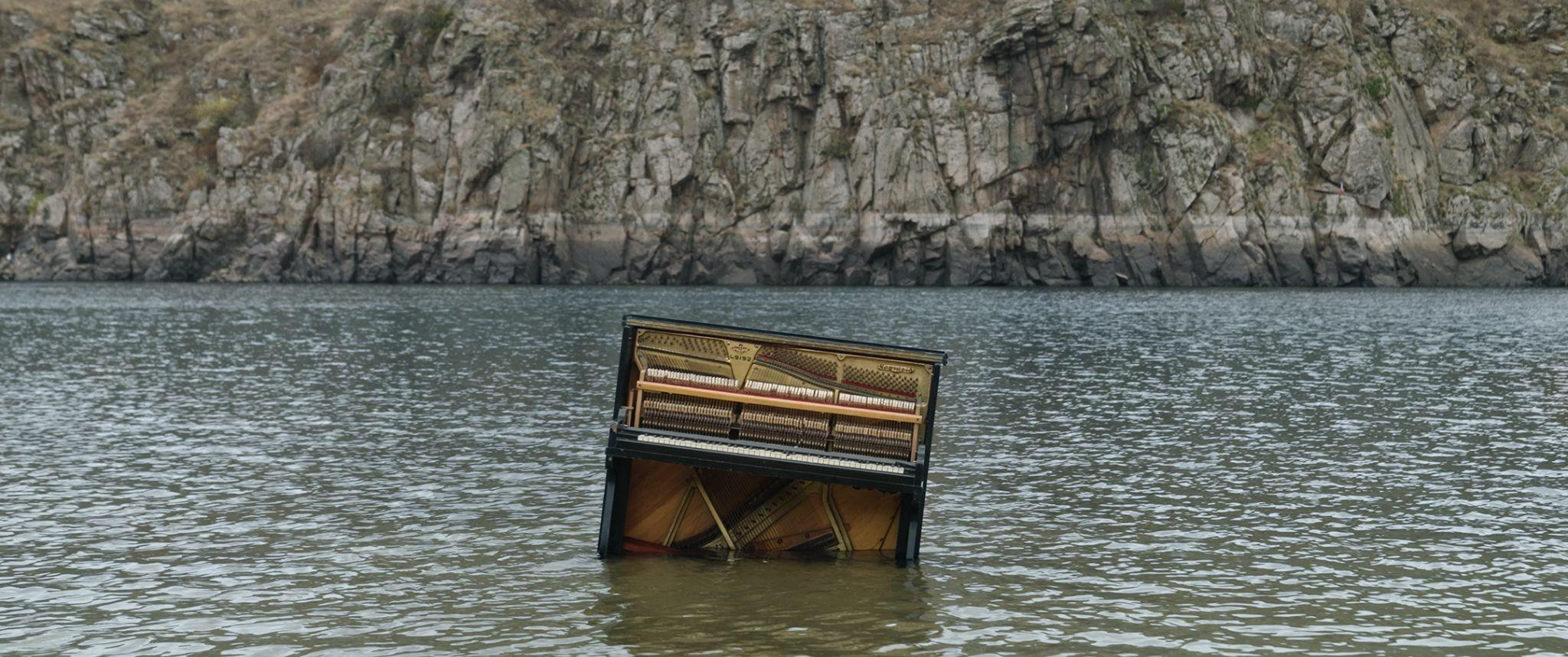
Being inside opera is also a travel between different media. Audio, video, dance, voice, body: electronic, algorithmic, analog. To find some stable position between all those lines, spheres and objects, we need something very “simple” (in a formal way), and it can always be the Text. Text as a water, a simple matter that everybody needs in order to build interconnections. The liquidity of opera text is something that can guide us. The libretto of GAIA-24 was still liquid, and we started to produce what we now call “multimedia”. In our case the “multimedia” was documentation of a landscape, sometimes along with the performance, drawing into it using bodies of performers and video/audio recording. It was something technological, yet principally nothing new, and it referred to baroque landscape scenography, using only cameras and microphones as tools instead of canvas and brushes. Our expedition was conducted inside the city of Zaporizhzhya, on the Khortytsia island, a historical and natural reserve that was also influenced by the dam’s destruction. The idea was to record water, floating around the island, accompanied by a series of simple performances: an upright piano standing on a shallow sandy bottom (Fig. 3), naked women and men lying on it, women and men trying to play music with their bare feet, with their bows, with their bodies. Filming these performances, we were around forty kilometres away from the frontline. The sounds of nature—the gurgling of the river, the birds, the wind and the falling autumn leaves—were accompanied by the low bass of distant explosions and the siren of the air alarm that sounded several times a day in the city. Starting this performance, which we call a “contemporary opera”, was a process of being with water, touching it, listening to it, drinking it. A process of putting hydrophones in the water and letting the piano and its parts float with the current river flow.
GAIA-24, the opera that we started to create on the banks of the Dnipro on the frontline, and which had its premieres in Kyiv and in the port city of Rotterdam, reached the Danube in Vienna in the middle of September 2024, at a time when the whole of Europe was covered in catastrophic floods. GAIA-24 moves on with its water routes: next time in the direction of the Venetian lagoon, the water of which is the same green-blue as in the Dnipro between Zaporizhzhya and Kherson.
References
- Barthes, Roland. 1977. Image, Music, Text. Edited by Stephen Heath. Translated by Stephen Heath. Fontana Press.
- Jadrić, Mladen. 2020. Teatro del Mondo: An Odyssey. Architectuul.
- Latour, Bruno. 2017. Facing Gaia: Eight Lectures on the New Climatic Regime. Translated by Catherine Porter. Polity Press.
- Latour, Bruno. 2022. “Is Europe’s soil changing beneath our feet?” GREEN, no. 2, 85–89. https://shs.cairn.info/journal-green-2022-1-page-85?lang=en (accessed 12 Oct 2025).