Touring Electroacoustic Musicians in 2025
Touring occupies a peculiar space in the professional lives of musicians. It has become the lifeblood of contemporary professional musicianship, particularly given the diminishing revenues from streaming. Yet, within the context of academic research, touring is often overlooked or sidelined. In the field of popular music studies, there exists a growing body of literature addressing the psychological complexities of touring, such as the works of Zendell (2021) and Ramella (2018). Similarly, studies like Risk (2022) delve into the economic dimensions of this practice.
In my own fields of mixed music and electroacoustic music, the academic discourse tends to focus on the technical, structural, and artistic challenges inherent to the genres. These include topics such as multichannel impulse responses (Tremblay & McLaughlin, 2009), fixed media spatialization (Vande Gorne, 2018), and interpretational challenges in performance (Kimura, 2003). However, the practical realities of touring within these fields remain underexplored.
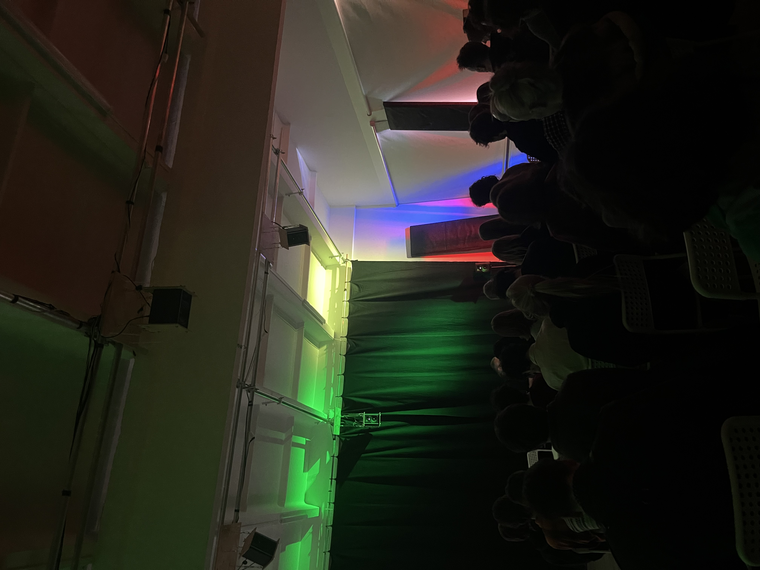
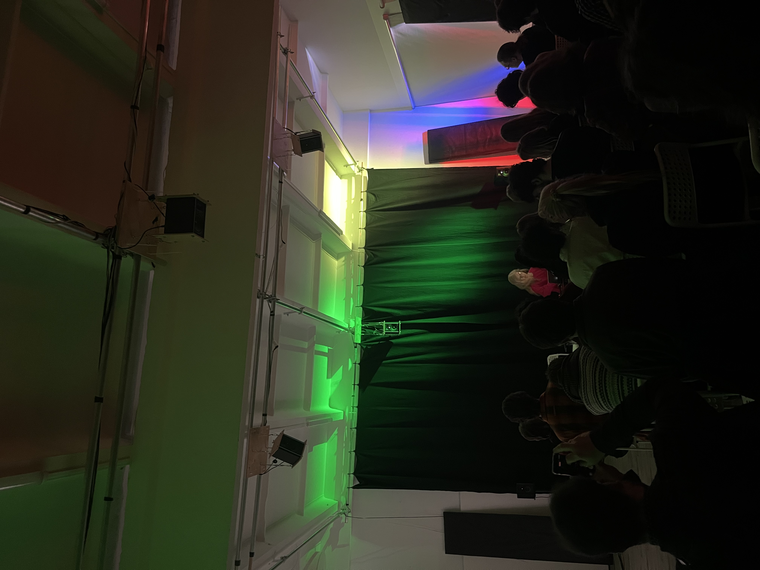
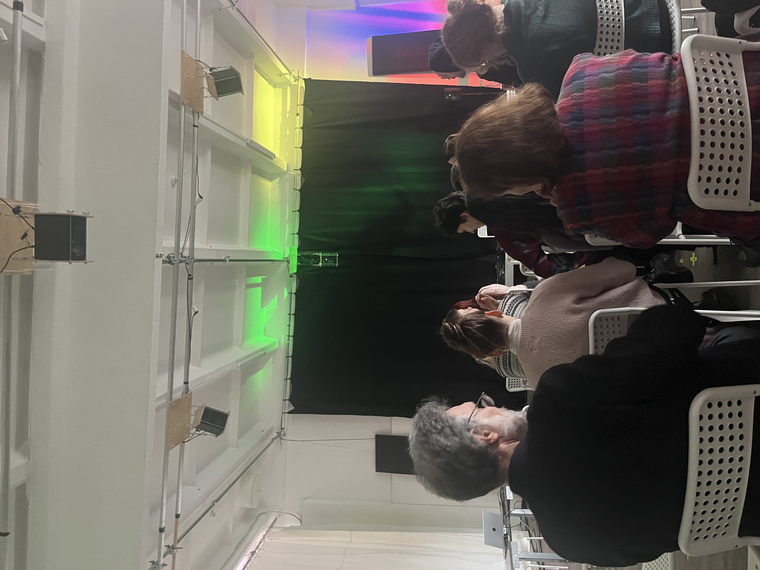
In this article, I aim to shed light on the specific challenges of touring within the context of multichannel electroacoustic music by recounting a recent example: Electric Audio Unit’s performance in Tallinn in March 2025, an event organized by the Estonian Electroacoustic Composers Association and the Estonian Academy of Music and Theatre. This will serve as a case study to illustrate the logistical, artistic, and economic dimensions of such endeavors.
Electric Audio Unit (EAU) is Norway’s only professional ensemble dedicated to multichannel electroacoustic music. The ensemble consists of three members: Natasha Barrett, Ernst van der Loo, and myself, Mathieu Lacroix. This line-up has remained consistent since 2021. Two of the members are full-time freelancers, while one also holds an academic position.
The ensemble operates primarily through funding from Norway’s public support scheme for bands and ensembles. However, this funding is typically limited to one year at a time, making long-term planning precarious. For the first time, in 2024-2025, we secured a two-year funding guarantee, which provided a rare moment of stability. As of now, we face uncertainty regarding funding for 2026.
Such precarious economic conditions are not uncommon in the cultural sector. Musicians and ensembles are often required to book venues and plan projects far in advance, without any assurance of financial support or compensation. Furthermore, the rising costs of concert halls and facilities have added to the strain.
Despite these challenges, EAU has managed to consistently deliver between five and seven productions per year—an impressive achievement, particularly when compared to other, more established ensembles with significantly larger budgets. This speaks not only to the dedication of the ensemble’s members but also to the resilience required to sustain such a niche art form in today’s cultural landscape.
Reflections on Performing in Tallinn: Preparing for a Multichannel Concert
We were invited to Tallinn to perform a concert, and I was also asked to give a masterclass, which led to engaging discussions with the master’s students present. However, this section will focus exclusively on the concert and the preparations leading up to it.
Prior to the concert, we received some preliminary details about the sound system and images of the venue. This includes the number of channels, distance, angles and height. In multichannel performance, this kind of information is crucial, as it includes the placement of the speakers, allowing us to begin preparing decoders tailored to the specific acoustics of the room. Multichannel concerts require that the music be decoded for the particular space to achieve optimal sound quality. Furthermore, different decoders influence the sonic result in distinct ways. The decoder I prefer, for example, does not allow for offline rendering. This means that exporting a 50-minute concert takes over 50 minutes, and any errors or unsatisfactory results require starting the process again. Additionally, adjustments are often necessary after hearing the system on-site, which is why we typically perform the final decoding directly in the venue.
Despite receiving information about the speaker placement in advance, it is impossible to determine the accuracy of the provided details or how the setup will sound in the physical space. These elements can only be tested and adjusted once we are in the venue. I will not delve into the well-documented trials of traveling as a musician, as such anecdotes are often humorously recounted elsewhere. Instead, I will focus on the actual work required upon our arrival at the concert hall—an arrival that is often the same day as the performance, or if we are fortunate, the day before. Even then, access to the hall is not always guaranteed for rehearsal or testing.
The first step upon reaching the venue is connecting our equipment to the hall’s sound system—a seemingly straightforward task that can, in reality, be fraught with challenges. Any musician working with technology knows how temperamental certain computer/interface combinations can be, and compatibility issues are not uncommon. This stage of preparation often involves troubleshooting that is more akin to IT problem-solving than anything directly related to music. With the increasing adoption of systems like Dante, for example, musicians are required to possess a level of technical expertise in networks and computer systems that far exceeds what is typical in most musical disciplines.
Testing the System
Once everything is connected, the next step is to test the system. In this case, the sound system had been set up for a small festival in Tallinn. However, as mentioned earlier, we had no prior knowledge of how it would sound or which types of musical material would suit the setup best (I will address programming later). At this stage, we typically divide responsibilities among ourselves: one person controls the computer and sends various test signals to check for potential issues, while one or two others listen from various points in the hall.
The first priority is ensuring that all channels are properly routed and that there are no issues in the signal chain. Next, we carefully listen to each speaker to identify any problems, such as misaligned gain levels, coloration issues, or technical faults with the speakers or cables. This process requires both technical expertise and a critical ear, as there is often no front-of-house engineer present—or if there is, they may have limited experience with multichannel sound systems. Over time, we have honed our ability to quickly identify and address such issues, listening closely to ensure that the spatiality of each speaker is functioning as intended. A key question we always ask ourselves is: "Does the sound clearly and effectively emanate from the intended direction?"
During our setup in Tallinn, we identified three speakers that exhibited slight issues. These speakers stood out due to their gain levels, which were not as smooth as the others. This could have been caused by the speakers themselves, their placement in the room, or other factors. Unfortunately, we did not have time to inspect the speakers mounted higher up in the hall, but we were fortunate that adjusting the gain resolved the problem.
Programming and Final Adjustments
Once we were satisfied with the general sound of the system, we began testing the pieces on the program. It is always challenging to predict exactly how music will sound in a specific room. At this stage, spatial elements that stand out or feel unnatural may need to be addressed, and we might also discover issues with how the decoder was programmed. There is often a significant gap between what is written in the program manuals and achieving the best possible sonic results in practice. This underscores the importance of hands-on experimentation and ongoing dialogue with other practitioners in the field.
It is important to note that different types of musical material can reveal distinct challenges within a sound system. These challenges may pertain to the frequency spectrum of the material, its density, or even the general nature of the music. For instance, it may not be ideal to include a piece with highly subtle spatialization in a concert setting such as this one, where preparation and testing time were limited. Such works are better suited to performances where the sound system is familiar, or where there is significantly more time available for calibration and testing.
The program for our Tallinn concert was as follows:
- Toxic Colour (15'20) – Natasha Barrett, 2024
- Demiurge (7'21) – Mathieu Lacroix, 2022
- Void Population (13'49) – Ernst van der Loo, 2024
- Månelandskap (3'00) – Sigurd Berge, 1971
- EAU Live Electronics and 3D Sound Improvisation (15'00)
This program was intentionally designed to include a diverse range of musical materials, while ensuring that most of the works were resilient to minor spatialization issues. The selection also provided variety in terms of musical texture, alternating between more drone-like, atmospheric pieces and those with greater dynamic activity.
We included Månelandskap by Sigurd Berge as a historical nod to the pioneers of electroacoustic music. While many in the audience were likely unfamiliar with the piece, it served as a compelling reminder of how far electronic music has evolved since 1971. The juxtaposition of Berge’s work with more contemporary compositions demonstrated the progression of the field in both technical and artistic terms.
Improvisation
Our improvisation held a significant place in the program and required careful consideration. It was only after ensuring the spatial setup was functioning optimally that we could begin exploring how to position ourselves for the improvisation. This positioning is crucial: sitting in the center of the room allows us to monitor the spatialization more effectively, but it also occupies the best listening spots, which might otherwise be reserved for the audience. As such, a compromise is often necessary, although it can impact how well we hear one another and, consequently, how effectively we interact spatially during the performance. I have previously discussed some of these challenges in Lacroix (2022) in the context of mixed music, but many of the same issues apply here.
For our improvisations, we tend to establish roles and sound sources that remain relatively consistent. In Tallinn, I played a 10-string Chapman Stick (as opposed to my usual 12-string Warr guitar), with separate outputs for the bass and melody sides, following the traditional touchstyle approach. Ernst employed modular synthesizers, which vary depending on travel constraints, alongside various self-constructed sound sources on both computer and iPad. His setup also included a library of samples, which he manipulated and deconstructed during the performance, with his signal often split into four independent streams.
Natasha’s role was primarily focused on spatialization. She managed the spatial distribution of our signals within the multichannel setup while also incorporating her own sound materials. These included pitch-based elements, samples, and a range of effects that she could apply either to her own sounds or to the signals provided by Ernst and me.
We always dedicate a brief rehearsal to gauge how we feel about playing together on the day of the performance. This rehearsal is not intended to plan the improvisation in detail but rather to establish a starting point and determine the approximate duration of the piece, ensuring cohesion within the overall program.
Our improvisations are an integral part of our performances, allowing us to explore the full potential of multichannel spatialization in real time. The collaborative interplay between our sound sources and Natasha’s spatial processing creates a dynamic and immersive sonic landscape. This flexibility, however, relies on the technical and artistic preparation described above, as well as the ability to adapt to the unique acoustics and technical setup of each venue.
Conclusion
One of the main differences between performing a concert such as this one in Tallinn and organizing our own concerts in familiar venues around Oslo lies in the variables of time and space. In Tallinn, we had limited time to prepare and were unfamiliar with both the venue and the speaker setup. These circumstances demand a distinct set of skills compared to the ones required when we have control over the rigging and organization of our concerts. For electroacoustic musicians performing in new locations, the number of unknown variables increases significantly, and these can greatly impact the final result. This is true for all musicians to some extent, but in the case of multichannel music—where spatiality is central to the artistic experience—it becomes far more critical.
Another complicating factor is the limited number of individuals who are proficient in handling the technical demands of multichannel sound. Even now, this is still considered a "difficult" skill set to master. As an ensemble, Electric Audio Unit has developed a high level of expertise in this area, allowing us to efficiently set up the 3DA system for concerts. This proficiency ensures that we can complete the setup, soundcheck, and troubleshooting processes within a single day, leaving us sufficient time to focus on the artistic aspects of the performance.
The purpose of this article is to highlight some of the challenges inherent in multichannel electroacoustic music—challenges that may be well understood within the field but can be difficult for those outside the genre to fully grasp. Despite the fact that multichannel music has existed for several decades, it remains a highly specialized discipline. Achieving optimal spatialization requires extensive trial and error, often with minimal guidance available from software manuals or online communities.
Delivering a successful multichannel concert demands a combination of advanced skills. First and foremost, it requires exceptional analytical listening to quickly identify and address spatial or technical issues. It also necessitates a deep technical understanding to troubleshoot and resolve hardware and software problems on-site. In many cases, electroacoustic musicians must take on multiple roles simultaneously, as most front-of-house engineers are accustomed to working exclusively in stereo and may lack experience with multichannel systems.
As a result, electroacoustic musicians often find themselves acting as sound engineers, stagehands, concert organizers, and managers, in addition to their primary role as performers. Balancing these responsibilities can lead to long and demanding days, but they are essential to ensuring the success of a concert. The ability to wear these multiple hats is not merely an asset but a requirement for navigating the complexities of multichannel performance.
A big thank you to Otto Iivari and Hans-Gunter Lock.
Bibliography
Kimura, M. (2003). Creative process and performance practice of interactive computer music: A performer’s tale. Organised Sound, 8(3), 289–296. https://doi.org/10.1017/S1355771803000268
Lacroix, M. (2022). Deus ex machina: Synchronization strategies in mixed music. NTNU, Norway.
Ramella, A. L. (2018). Deciphering movement and stasis: Touring musicians and their ambivalent imaginings of home and belonging. International Journal of Tourism Anthropology, 6(4), 323–339.
Risk, L. (2022). Share the arts, share the planet: Toward a “regional residency” model for sustainable touring in the post-pandemic. MUSICultures, 49, 135–157.
Tremblay, P. A., & McLaughlin, S. (2009). Thinking inside the box: A new integrated approach to mixed music composition and performance. International Computer Music Conference Proceedings, 2009, 379–386. http://eprints.hud.ac.uk/4081
Vande Gorne, A. (2018). Treatise on writing acousmatic music on fixed media (D. Vaughn, Trans.). Musiques & Recherches.
Zendel, A. (2021). “There are no days off, just days without shows”: Precarious mobilities in the touring music industry. Applied Mobilities, 6(2), 184–201. https://doi.org/10.1080/23800127.2020.1827516