Viewer Engagement: Discovering the Figure
I want the viewer to discover the figure rather than encounter it fully formed. The painting does not present a resolved subject. Instead, it requires the viewer to reconstruct what is there. This approach positions the viewer as a participant: their perceptual work mirrors my own in the studio, an active negotiation with incomplete information (Gombrich 1960; Kimchi 2015).
The figure becomes something one arrives at gradually, through searching, questioning and adjusting one’s expectations of what should be seen.
Introduction: Positioning
This exposition asks how a painting, developed through successive acts of blocking rather than linear drawing, comes to operate at the perceptual threshold between abstraction and representation. Specifically, it investigates when and how a blocked image begins to be read as a figure—despite the absence of explicit contour—and how painterly interventions such as fracture, tonal adjustment, and edge disruption can delay, suspend, or reverse that moment of recognition. Rather than treating representation as a goal to be achieved, the research examines the conditions under which recognisability emerges and recedes, and what this reveals about the relationship between painterly process, perceptual organisation, and the viewer’s active participation in meaning-making.
My painting practice begins with large blocks of colour and tone. These blocks establish direction without describing form. The image is not planned in detail; instead, it emerges through looking, adjustment and the slow negotiation of uncertainty. This method aligns with process-focused accounts of painting, such as Elkins’ argument that painting is a material inquiry into how images come to be (Elkins 1999) and with Sullivan’s framing of artistic practice as a form of research grounded in exploration and reflection (Sullivan 2010).
Context: Perception and the near Figure
Blocking delays immediate recognition. In the early stages of a painting, the image consists only of broad zones of colour. Yet these shapes already contain potential structures that perception begins to test. This aligns with Merleau-Ponty’s account of vision as an exploratory act rather than a passive reception of information, where meaning emerges only through active engagement with ambiguity (Merleau-Ponty 1964). Blocking intensifies this search by reducing the amount of information available to the eye.
My interest is in the tipping point: the moment when a blocked form begins to behave like a figure without fully becoming one. At this point, the image is both abstract and nearly representational. This tension echoes Gombrich’s description of the “beholder’s share,” in which recognition arises from the viewer’s expectations and perceptual hypotheses (Gombrich 1960).
Case Study 2: Fracturing, Obscuring, Rediscovery
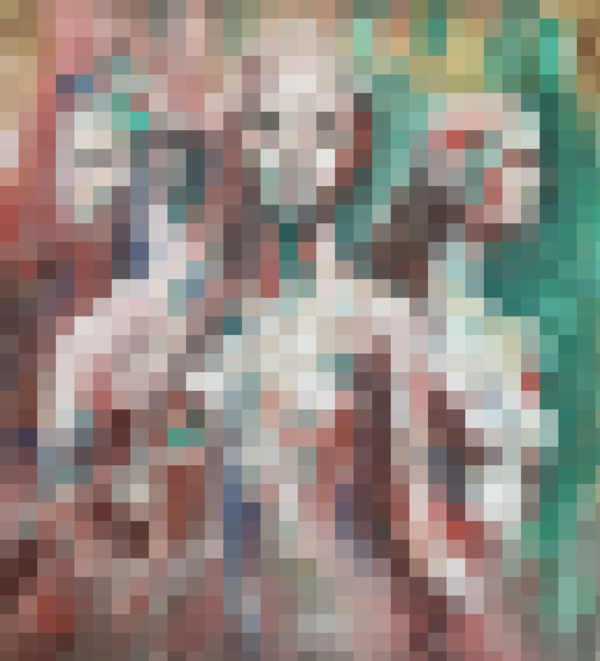
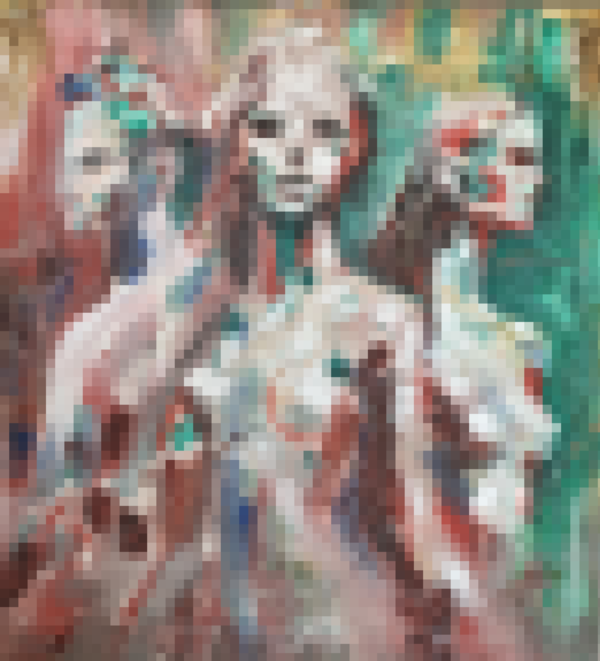
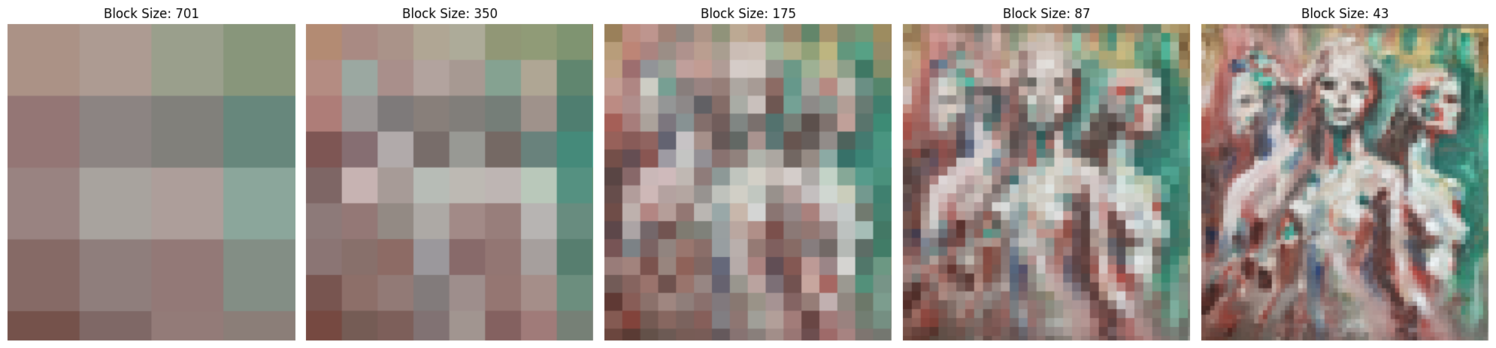
A second painting resists emergence for longer. The blocked areas remain dominant. Movements toward description repeatedly collapse and must be reworked.
Here the labour of the viewer becomes essential. The painting offers hints of structure—perhaps a torso, perhaps overlapping limbs—but these cues remain unstable. This process aligns with phenomenological accounts of vision in which the “figure” is never fully fixed but continually negotiated by the observer (Merleau-Ponty 1964).
This case demonstrates that blocking is not simply about simplification. It is a way of creating multiple possible readings. What emerges depends on where attention is directed, both in the studio and in the viewer’s perceptual experience.
Case Study 3: Still Life: Canvas 18"x16"
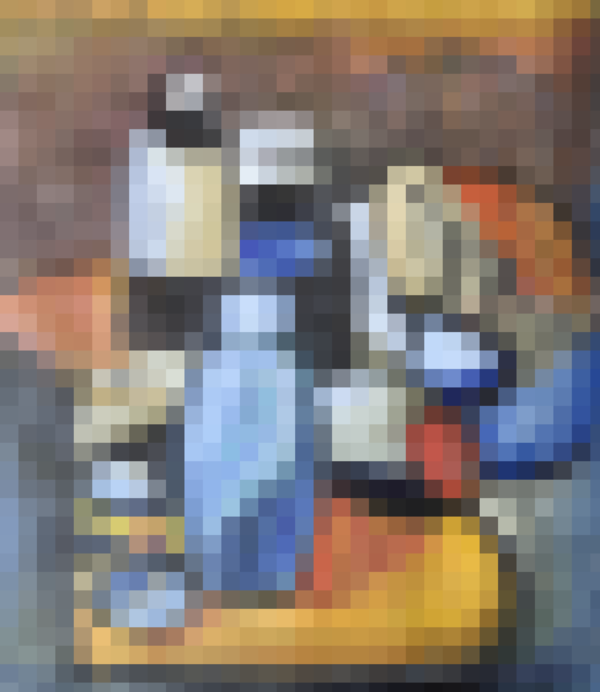
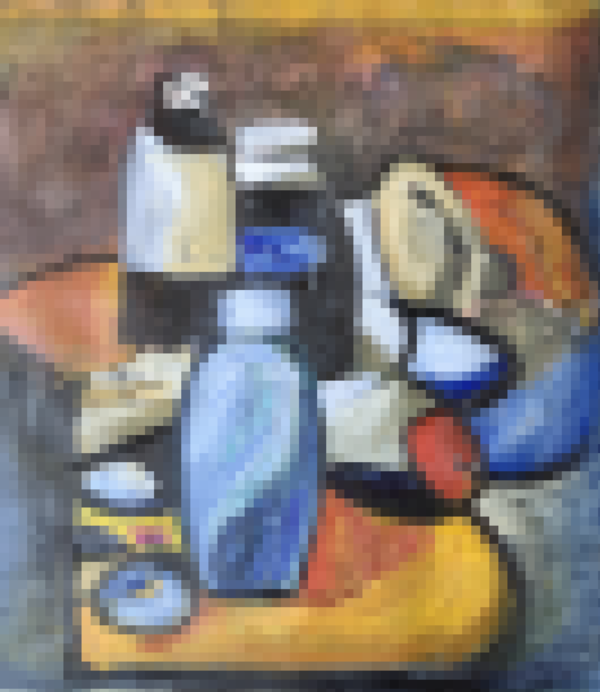
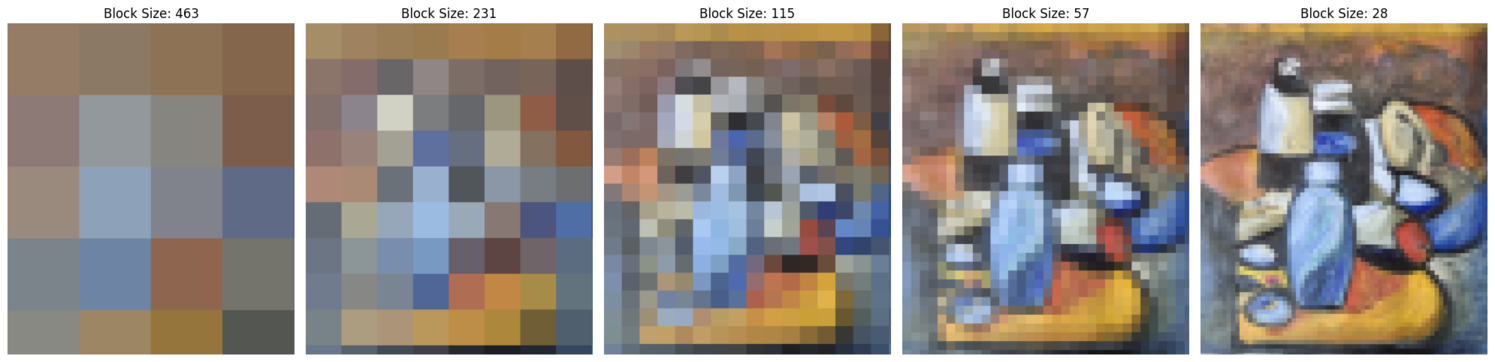
Movements toward description is shown in the video and strip photo. The first canvas in the strip shows large blocks of size 4"x$' or 403X403 pixels. The middle frame with 115x115 pixels shows the emergence of objects that are confirmed by the 4th frame with blocks of size 57x57 pixels.
The painting begins with 4" blocks and as they are halved in size the still life objects start to emerge. The painter and the viewer are confronted with the issue of when to stop reducing the size of the blocks and whether the blocks should ramain equal.
The tipping point is subjective as some viewers may prefer the middle frame while othes may prefere the 4th frame.
Method: Blocking as a Research Procedure
Each painting begins with the same constraint: large blocks of paint, placed roughly according to observed tonal relationships. No detailed drawing is made. From there, the method unfolds through repetition:
-
block in basic areas
-
step back and test what appears
-
split each block into 4 blocks and modify the tone or color
This iterative cycle becomes a form of perceptual experiment. Rather than imposing an image, I wait for it to appear. This mirrors findings in perceptual psychology: viewers assemble incomplete visual cues into provisional structures that shift as new information appears (Kimchi 2015). It also resonates with scale-space ideas in image analysis, where coarse structures guide the extraction of emerging form (Witkin 1983; Koenderink 1984).
The photographs and sequences presented here document these shifts—moments where the work pivots from abstraction toward recognisability.
Discussion: Blocking as Artistic Research Practice
Blocking functions as a research tool. It reveals how perceptual meaning arises from:
-
incomplete cues
-
ambiguous structures
-
suggestive but unstable forms
These qualities align with theories of vision as a dynamic engagement with the world (Merleau-Ponty 1964). The paintings operate as experiments that test how little information is needed for a figure to appear, and how much ambiguity can be sustained before recognisability collapses.
Blocking also produces knowledge about the conditions under which representation emerges. This resonates with Wilson’s work on thresholds and transitions, where structures at different scales reveal changing behaviour (Wilson 1975). The method foregrounds transitions rather than stable categories.
Case Study 1: Emergence of a Portrait
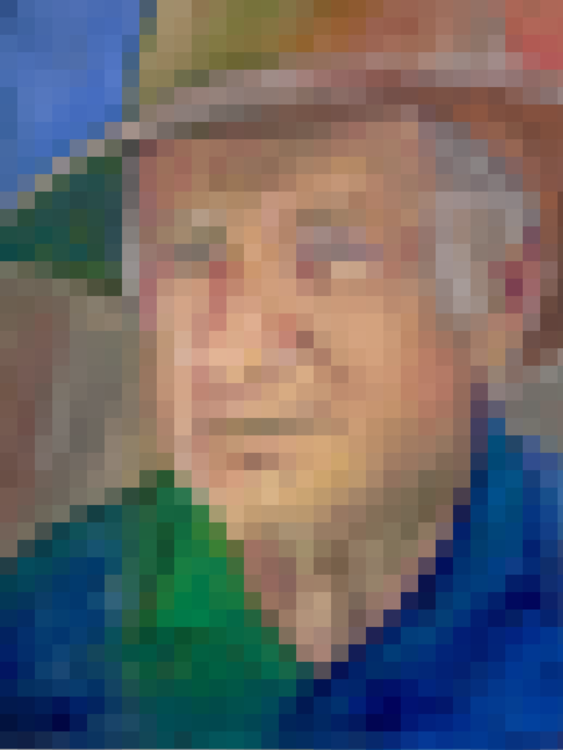
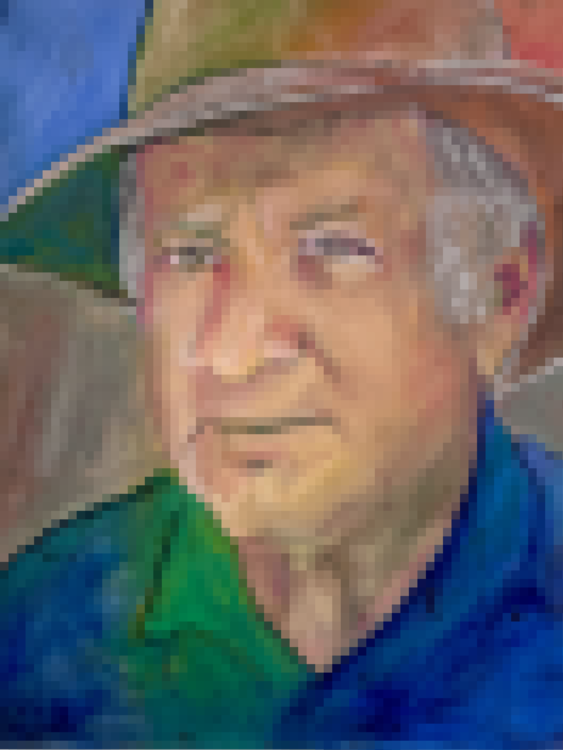
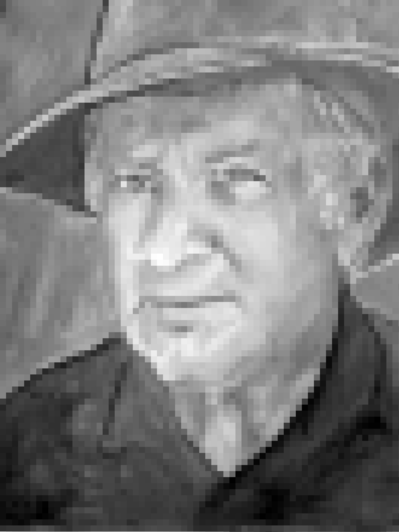
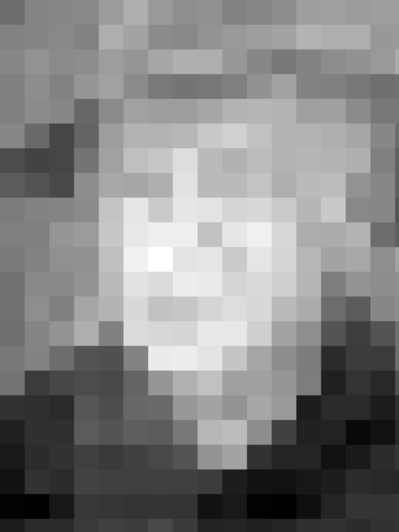
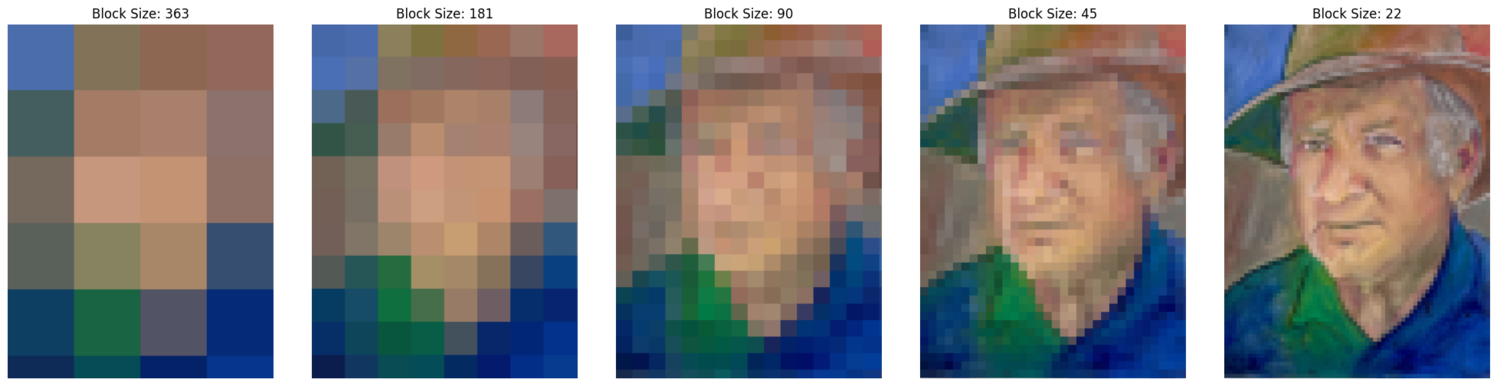
In this sequence, the first blocks suggest only direction and mass. The portrait is not present. As blocking continues, faint anatomical cues begin to appear: a bend of tone, a shadow, a contour that hints at a face and head. At the final stage the face becomes too explicit.
Painters such as Sillman and Brown demonstrate similar strategies, using fragmentation to maintain multiple possible readings of a figure (Sillman 2020; Brown 2018). Brown claims"The place I'm interested in is where the mind goes when it's trying to make up for what isn't there".
The middle paintings balance between presence and dissolution. Is it the tipping point? The portrait is discernible, but only through active looking. This echoes the process through which it was made.
Conclusion: The Threshold as Method
This exposition demonstrates that blocking is more than a technical stage: it is a method for exploring how perception constructs meaning. Working at the edge of representation allows both the painter and the viewer to inhabit a space where figures emerge slowly, partially and contingently.
Future work may extend this approach by comparing painted blocking with digital or photographic blocking, or by examining how viewers describe their experience of images at the threshold of recognisability.
References
Elkins, James What Painting Is Routledge, 2019. DOI: 10.4324/9780429453700
Sullivan, Graeme Art Practice as Research: Inquiry in Visual Arts Sage Publications, 2010. ISBN-10: 1412974518
Gombrich, Ernst H Art and Illusion: A Study in the Psychology of Pictorial Representation
Princeton University Press, 1972 ISBN 9780691094543.
Kimchi, Ruth "Perceptual Organization: The Whole and Its Parts", In The Oxford Handbook of Perceptual Organization, edited by Johan Wagemans Oxford University Press, 2015
Witkin, Andrew P "Scale-Space Filtering", Proceedings of the International Joint Conference on Artificial Intelligence, 1983
Koenderink, Jan J "The Structure of Images", Biological Cybernetics 50, 363–370, 1984 doi.org/10.1007/BF00336961
Wilson, Kenneth G "The Renormalization Group: Critical Phenomena and the Kondo Problem"
Reviews of Modern Physics 47, 1975 DOI: https://doi.org/10.1103/RevModPhys.47.773
Brown, Cecily Re (Exhibition Catalogue) Gagosian, 2018
Sillman, Amy The Shape of Shape, Museum of Modern Art, 2020
Merleau-Ponty, Maurice. 1964. The Primacy of Perception. Evanston: Northwestern University Press.