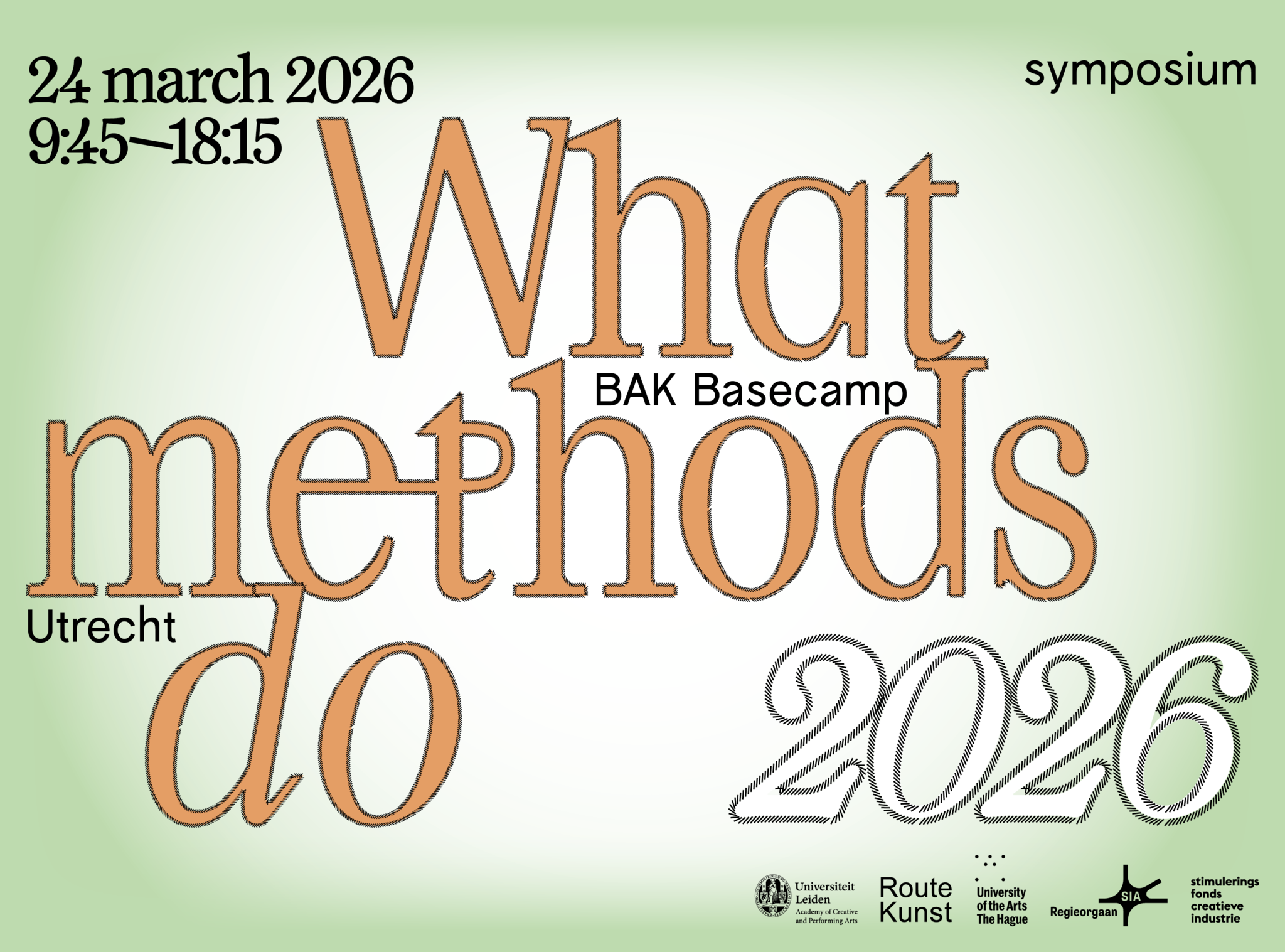
What Methods Do is an international symposium dedicated to the nature and role of methods in artistic research, their capacity to produce knowledge and to inform the agency of art in a societal context.
Building upon the insights of its first edition in 2024, What Methods Do 2026 will focus on how methods are useful for the practice of research in the arts, how they operate and what can be learned from their application across a broad range of contexts. In art conceived of as research, knowledge is assumed to be produced not only in the form of discourse but also in the form of practices. It is in this context that the question arises: what do methods do, to produce such knowledge?
The 2026 symposium poses an understanding of methods as situated and specific, rather than universal. Methods imply a who, a where, and a when, but more fundamentally, they exist within singular constellations of actors. Methods do not assume a pre-defined ground on which to act, but rather perform a re-distribution of the components they engage with. Rather than operating by abstraction, they make a research problem more tangible.
In a series of sessions spread throughout the day, internationally active artist– researchers will present the methods they have developed, will share documentation from their practices and engage in a dialogue with a group of respondents and the participating audience. This will unfold in a series of sessions organised around four different areas and forms of practice, titled: Choreographies, Genealogies, Communities and Infrastructures.
Framed as an active hub for exchange, the symposium will offer a space for collective discussion, reflection, and the articulation of multiple perspectives on the role and nature of methods in artistic research. The process of reflection will be guided throughout the day by two moderators who will be active across all the panels and will lead the discussion towards its conclusion at the end of the day.
What Methods Do is organised by the Leiden University Academy of Creative and Performing Arts (ACPA) following an initiative by the Route Kunst of the NWA (National Research Agenda).
Julia Morandeira, researcher, teacher and curator, director of studies at Museo Reina Sofia (Madrid)
Francesco Ragazzi, political scientist, filmmaker, associate professor in international relations at the Institute of Political Science in Leiden University, founder of ReCNTR
Gabriel Paiuk composer, sound artist and researcher, project leader at the Academy of Creative and Performing Arts Leiden University – curator of the symposium
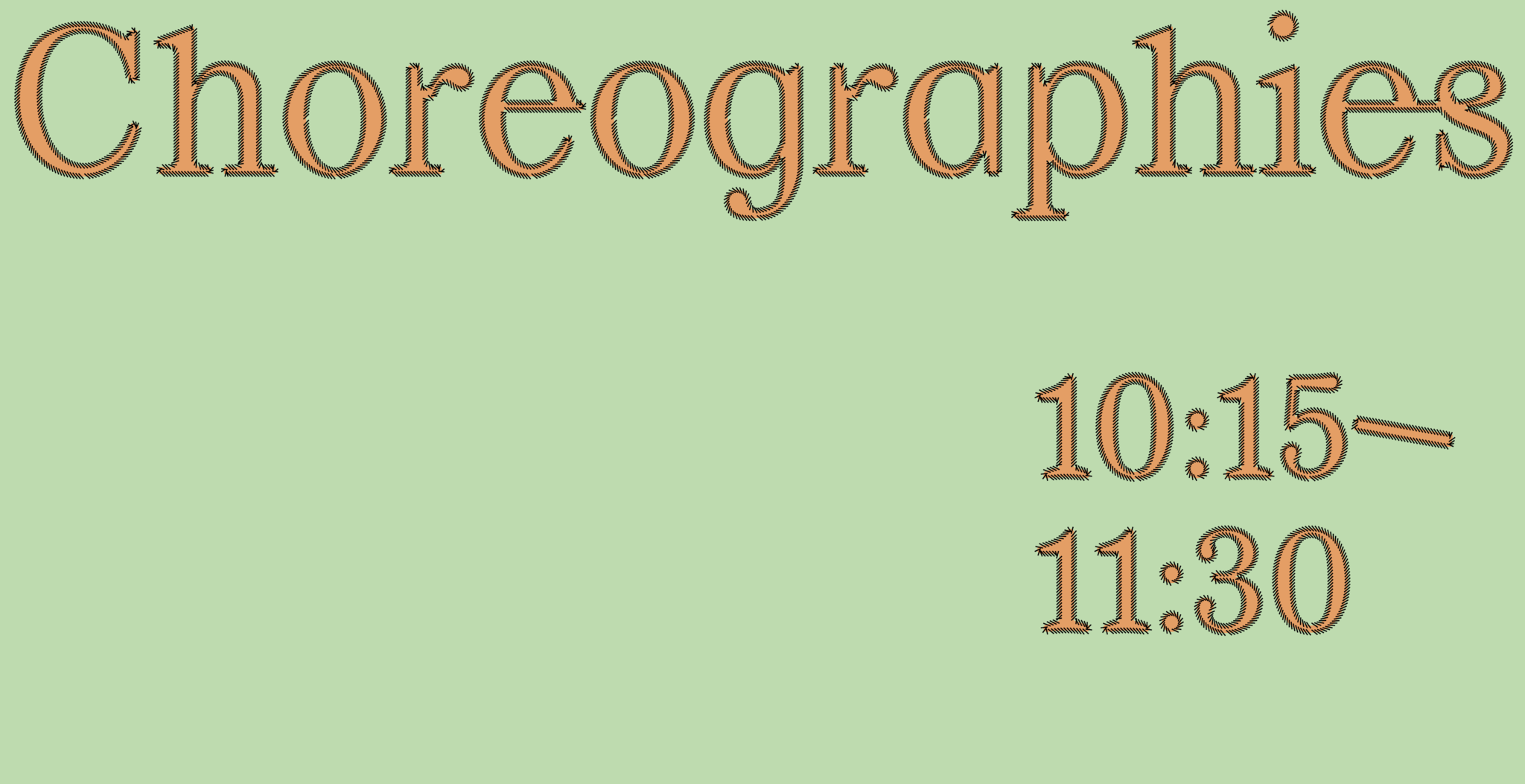
This session will address artistic research practices involving performance in a wide variety of contexts, from conventional stages to scientific environments. Three artist researchers will present on their practices which involve reenactment methods, performative ethnography and movement choreographies, among others.
Presenters:
Špela Petrič, hybrid media artist
Barbara Lüneburg, violinist and artistic researcher, professor of artistic research and director of the doctoral programs at Anton Bruckner University
Amanda Piña, choreographer and educator, founder of Nada Productions (Vienna)
This session will address practices of research that concern the malleable articulation of past and future. Two artist researchers will present their work comprising archiving, tracing and imaging practices across diverse sensorial domains and engage with historical archives, embodied perception and speculative imaginaries.
Presenters:
Raviv Ganchrow, sound artist, Institute of Sonology at the Royal Conservatoire The Hague and Humboldt University Berlin
Bettina Malcomess, photography and film installation artist, Wits School of Arts, Johannesburg.
Respondent:
Jonathan Even-Zohar, Historian and Heritage Researcher, Coordinator NWA Route Living Past and Reinwardt Academy
In addressing the nature and role of methods in artistic research, further questions arise. Among these: How is a method different from a skill? How are method and experiment articulated? How can methods and the context in which they are performed be compared to each other? and how is the autonomy of disciplines challenged by the methods of artistic research? In this discussion session a group of researchers and scholars will address this and other questions emerging throughout the day.
This session addresses artistic research practices which unfolds through the creation of social instances of participation. Three presentations by artist researchers will shape this panel and will address practices that concern community building, publication, pedagogies and relational methods more broadly.
Presenters:
Jeremy Woodruff, composer, deputy head of the Centre for Artistic Research at the University of Music and Performing Arts Graz.
Michèle Boulogne, textile designer and Márk Redele, project coordinator –Connecting Otherwise Project (SIA)
Respondent:
Laura Cull, performance philosopher, lector at the Academy of Theatre and Dance, Amsterdam University of the Arts in the Netherlands.
This session will focus on the use of technologies, material infrastructures and worlding practices. Two artist researchers will expose on the way they engage with the development of technical infrastructures and the realm of planetary computation as a research practice.
Presenters:
Victorine van Alphen, artist, director, and philosopher, Greenhouse Research project at the Netherlands Film Academy
Egor Kraft, artist, thinker and critical designer
Respondent:
Inge-Loes Ten Kate, Astrobiologist, Figurehead NWA Route The origins of life