Teaching artists: acting locally, sharing globally
Lifelong learning through a hybrid learning community
Teaching artists come in all shapes and sizes: from the art teacher who trains a violin student – whether they are 8 or 88 years old – to master the subtleties of the craft, to the participatory artist who creates an inclusive theatre performance with people of all abilities. from the community artist who creates a graffiti wall with local young people, to the artist who inspires school teachers to integrate drama, dance, music or visual arts into the curriculum. Eric Booth, widely regarded as the father of the teaching artistry profession and co-founder of the International Teaching Artist Collaborative (ITAC), argues that this diverse group of professionals has at least one thing in common: They “know how to awaken artistry. They know how to develop it. They know how to guide it toward positive results, results that matter.” (1,2)
In 2026, teaching artistry is an internationally broad and dynamic field in which artists use their expertise to stimulate artistic, educational, social and personal development in diverse participants (and groups). However, teaching artistry remains ‘largely invisible,’ says Booth: ‘Even within the arts, lots of people don’t know there is such a vocation. There are few good pathways into the field and few reliable ways to build a career that recognises and rewards increasing skill.’
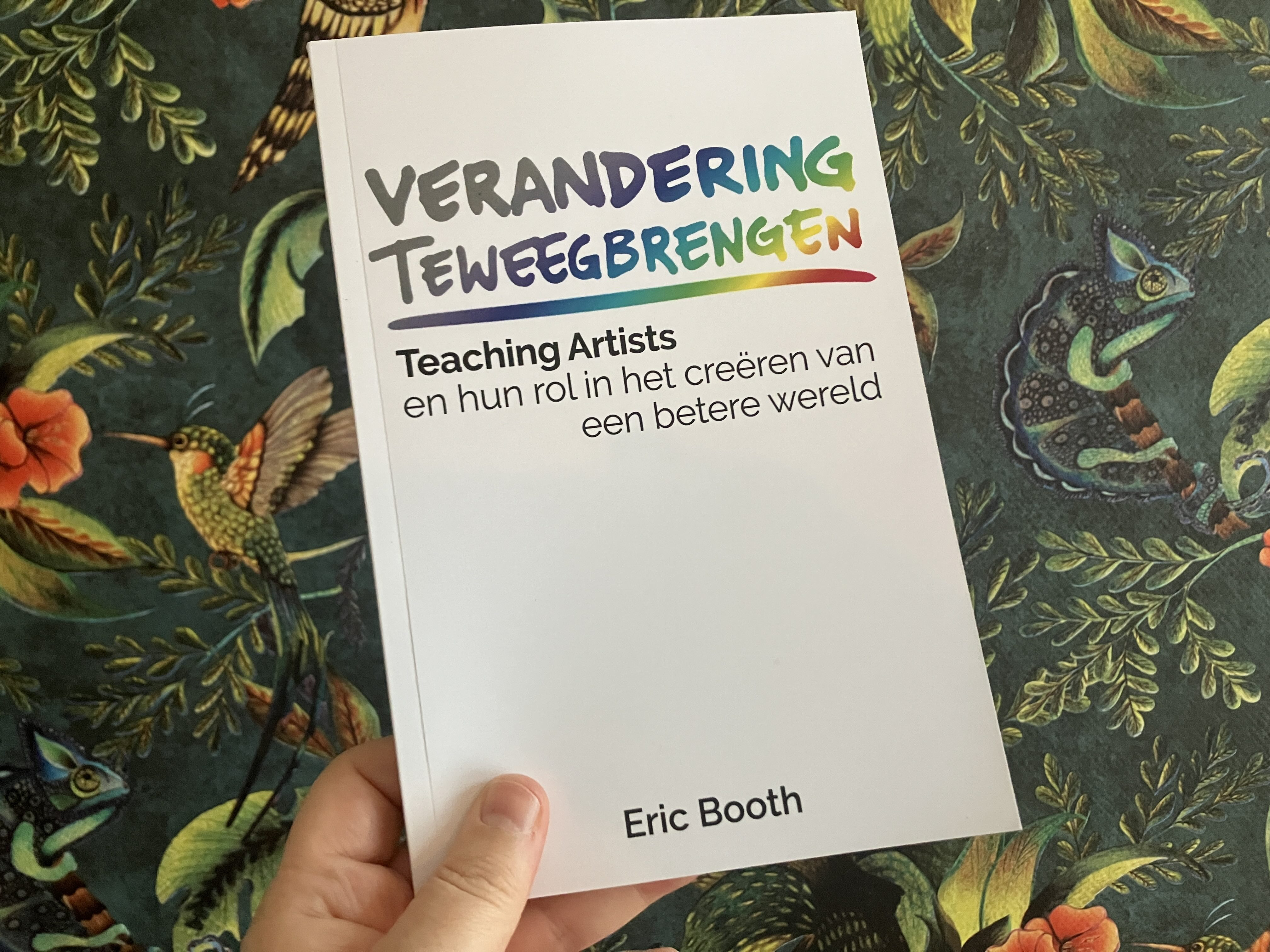
The Dutch translation of ‘Making Change. Teaching Artists and Their Role in Shaping a Better World’ by Eric Booth was produced as part of the research project. Photo by Bob Selderslaghs.
From September 2024 to September 2025, the CORPoREAL research group at the Royal Conservatoire of Antwerp and Fontys Academy of the Arts Tilburg joined forces for a small-scale research project focused on the professionalisation of teaching artists – in an international context – and their ability to integrate imagination and physical learning into diverse societies as a unique artistic practice. The project tied in with previous or ongoing research at both institutions (by Mirjam van Tilburg, Falk Hübner and myself, among others) and with their educational programmes in the arts. (4, 5, 6)
Based on a teacher development team (TDT), the research aimed to inspire teaching artists in Flanders and the Netherlands to innovate, art-based and constructively. The TDT operated as a professional learning and research community in which participants could professionalise and explore both artistically and pedagogically. The central question was: what kind of professionalisation can teaching artists achieve through an international hybrid learning community, and how can this learning community take on a sustainable form?
In the TDT, Jan Staes (for Fontys) and I (for the Conservatoire) brought professionals together and organised a “studium generale”, consisting of four hybrid lectures by internationally renowned teaching artists and three practical sessions, held with a group of ten teaching artists, composed of researchers and/or teachers from both institutions (including ourselves). This learning community served as a platform for knowledge exchange, practice-oriented learning and reflection on the professional development of teaching artists. The hybrid lectures featured speakers Eric Booth (US) on his book ‘Making Change. Teaching Artists and Their Role in Shaping a Better World’, Chen Alon (I) on the documentary film ‘Disturbing the Peace’ and his artivist practice, Tina Lenz (NL) on design anthropology and her participatory art practice, and Sara Vanhee (B) on ‘Bodies of Knowledge’, radical imagination and social engagement, were open to a wider audience of professionals and interested parties. (7, 8, 9, 10) With the exception of the last lecture (due to technical problems), the lectures were subsequently shared digitally with the international community via YouTube. (11, 12, 13).
As principal investigator, I encouraged the teacher development team to share their expertise during the practical sessions and made audio recordings of two group reflections (on 11-12-2024 and 19-02-2025). After the last lecture on 22 May 2025, I conducted online semi-structured interviews with five TDT participants who volunteered to take part. These interviews focused on four aspects:
- Their professionalisation as teaching artists;
- The international and hybrid dimension of the project;
- Embodied learning and artistic integration by the teacher development team;
- Sustainability and the future.
The interviews were recorded and transcribed together with the audio recordings for thematic analysis.
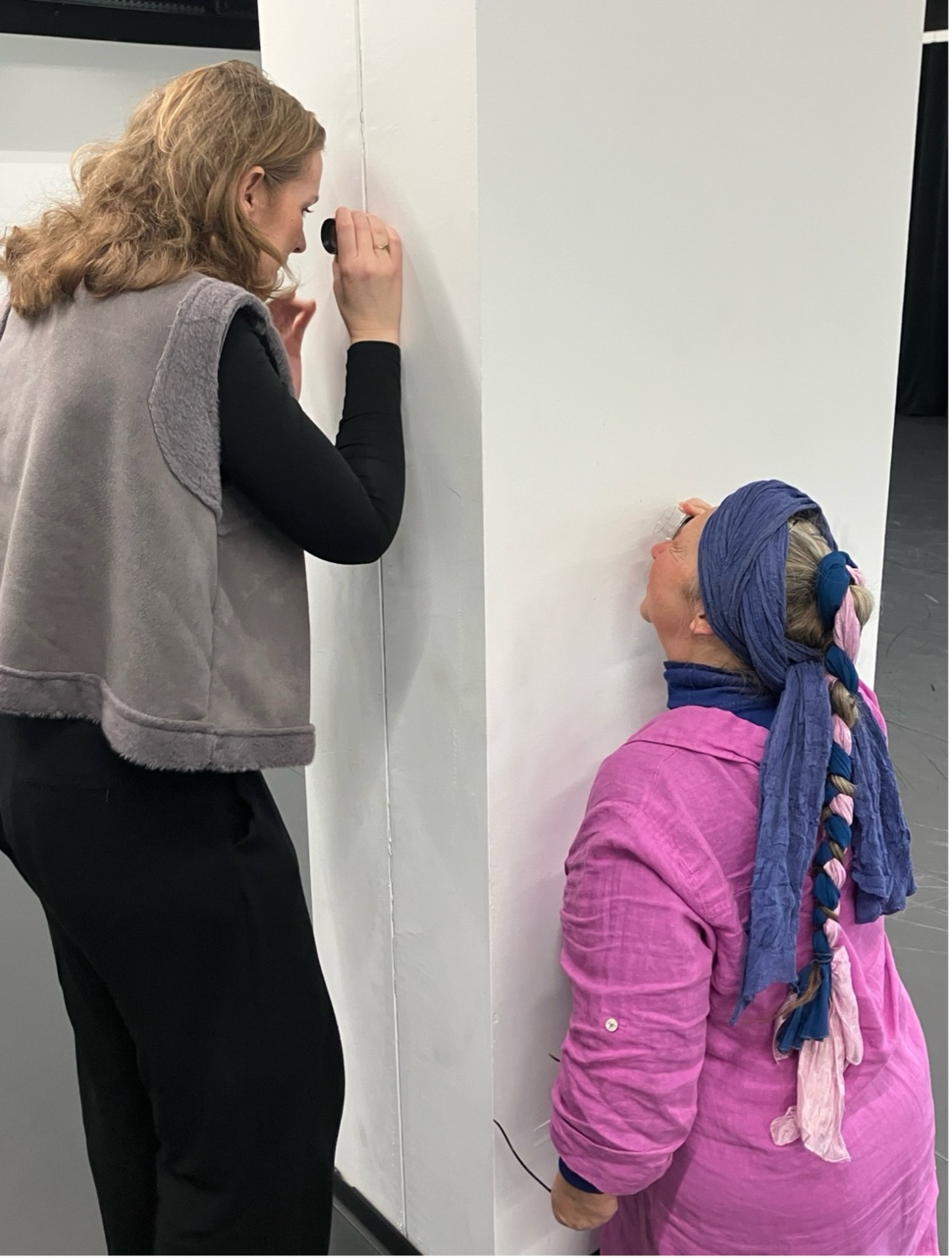
(Re)discovering the space with a pocket magnifier during practical session 3, 19-02-2025. Photo by Bob Selderslaghs.
In this article, I will first focus on the group reflections and then delve deeper into the findings from the interviews, before formulating a conclusion and looking to the future.
The power and limitations of terminology
During our first joint reflection as a teacher development team, a number of sharp insights emerged that mapped out our shared but also divergent practices. One of the most striking issues was the power and limitation of terminology. The term “teaching artist”, as proposed by Booth, was experienced by some as a connecting and strategically powerful concept, but at the same time it also provoked resistance. For example, the English term proves difficult to translate into certain local (Dutch) contexts. While some identified with it after reading Booth’s work, others perceived it as “forced” or too normative. What comes into play here is the tension between identity and practice. Many of us resist being pinned down to a single identity position and prefer to define our position based on context and practice:
“I’m actually a bit tired of the conversation about identity. […] ‘I much prefer to talk about practices than identity.’ […] ‘Not what are you, but when are you, in what context are you, and where are you coming from?’
It is not who we are, but what we do and where we work that proves to be the decisive factor. We feel more connected to approaches that describe education or encounters as artistic practice, rather than placing ourselves in a static pigeonhole. Or to quote Ann Saelens in FORUM+ in this regard: 'What’s in a name? ’ (14)
The division within the field itself also contributes to this. The multitude of terms and positions, even within a single organisation, makes collaboration complex. Although a shared framework can be strategically advantageous (for example, in communication with policymakers), we sometimes encounter resistance to sharing methodologies and working methods. Artistic “ownership” and scarce resources can hinder open collaboration between similar partners:
I had to sign contracts stating that I was not allowed to use “this” [working method or approach] “there”, for example.
Another area of tension lies between process and product. Booth approaches teaching artistry in a largely process-oriented way, but there are also voices within the field that want to focus on the artistic end product: ‘the goal should be to create a work of art together,’ argued fellow teaching artist Stefan Perceval during the first hybrid lecture, for example. This tension is not new, but it touches on fundamental questions: do we strive for encounter and participation as an end in itself, or does art – in its form, quality and aesthetics – remain the primary goal? This is related to the discussion about the meaning and usefulness of art. The discourse of impact, usefulness and measurability can be beneficial in influencing policy, but according to many of us, it should not overshadow the intrinsic value of art. Can we talk about the meaning of art without always having to legitimise it through categories of social utility?
These reflections show that no single term can ever cover everything. Nevertheless, there is a clear need for a shared frame of reference that leaves room for plurality and context dependency. We do not have a fixed identity, but move between roles and practices. An approach that recognises both process and product, autonomy and engagement, individual style and collective reflection, does more justice to the richness of the field.
What we feel most strongly is a need for structural exchange and further exploration. As practitioners of teaching artistry, we want to continue to reflect on how we develop language that connects internally and communicates externally. We want to continue to share our practices, recognise differences, and make space for conversations about autonomy, position, and impact, without resorting to simplification.
Aesthetic Perspectives
During our next reflection, we delved deeper into the position of the teaching artist, with particular attention to the role of “aesthetics” within our practices and within training programmes. It quickly became clear that aesthetics still forms a dominant lens, not only within art education, but also in the broader practice of teaching artistry. Many of us experience this aesthetic norm as limiting, especially when it clashes with the reality of contextual, participatory or socially engaged art practices.
“And yet I wonder: why can’t we shake off that dominant perspective? […] I don’t want to abandon the perspective of aesthetics, but rather the dominance of the perspective of aesthetics.
We discussed the need to redefine aesthetics: no longer as a universal standard detached from context, but as something plural, sensory and meaningful. There is a need for an aesthetic that expresses itself in authenticity, process, experience and flow, and not just in the “beautiful” or the refined end product. This broader interpretation of aesthetics is more in line with the richness of our practices, in which experience and interaction are often more important than formal or “established” aesthetic criteria. Inspiration for this can be found in the framework ‘Aesthetic Perspectives. Attributes of Excellence in Arts for Change’, which expands the concept of aesthetics with characteristics such as commitment, communal meaning, disruption, cultural integrity, emotional experience, sensory experience, risk-taking, openness, resourcefulness, coherence, and stickiness. (15)
Another important area of tension that emerged is the blending of aesthetics with activism and therapy. Quotes from Chen Alon, in which art coincides with social change and personal healing, raised questions for us. Can you be an artist, activist, and therapist at the same time as a teaching artist? And if so, what ethics, frameworks, and skills are required? This hybrid role offers opportunities, but also entails responsibilities that are not self-evident, including for educational programmes in the arts.
This brought us to the fluid but also problematic nature of the teaching artist as a role. The idea that we constantly adapt to what the group or context demands – the so-called “joker role” that Chen Alon mentioned during his lecture – seems attractive at first glance. But in practice, this creates tensions, for example regarding boundaries, sustainability and expectations. Temporary projects with a significant social impact sometimes place unbalanced responsibilities on the teaching artist. Where do our boundaries lie and who bears which responsibility?
We also recognised the power of participation in an artistic sense. The term spect-actor, coined by Brazilian theatre maker Augusto Boal, was enthusiastically embraced by us as a way of describing the active role of participants. (16) Whether it concerns babies or elderly people with dementia, the audience is not a passive spectator, but a co-creator of meaning and experience. These participatory layers also have aesthetic value in their own right.
Finally, we reflected on the art education we ourselves had experienced. We recognised that much of our own artistic training introduced us to classical aesthetic norms and that we still regularly reproduce these today, whether intentionally or unintentionally. At the same time, we also see an opportunity in this: art education can be (or become) a place where students learn to deal with multiple aesthetic perspectives, ethical issues and social relevance. This is something we ourselves want to consciously invest in within the training programmes in which we work.
We concluded this session with the realisation that aesthetics is not a fixed given, but a dynamic, negotiable concept. As teaching artists, we benefit from educational models and practices that leave room for nuance, context and fluidity. And above all: that equip us with language, frameworks and self-reflection to be able to act firmly and ethically in the multitude of roles we take on.
Professionalisation as a teaching artist
The individual interviews revealed that participation in the teacher development team led to a broadening of the perspective of several teaching artists on what teaching artistry can mean. The “purpose threads” described by Eric Booth in “Making Change” contributed to this. (17) For example, one of the participants discovered that work in commercial contexts can also be a fully-fledged part of this practice (‘partnering for non-art goals: to achieve goals that are important to other institutions’), whereas she had previously associated teaching artistry purely with community or social-artistic settings: ‘I often thought, yes, the teaching artist is someone who mainly works in a community in the ‘soft sector’, while I often worked in the commercial sector, but actually do the same work. (18) This re-evaluation gave more recognition to the social value of commissioned work, even when it falls outside the “classical” social context. At the same time, there was a realisation that this work often remains invisible due to a lack of documentation: ‘Perhaps because [in other contexts] it needed to be made public, whereas for me it was often kept internal for a particular client.’
For another participant, the hybrid learning environment also provided a learning experience and validation of her role as a teaching artist. By exchanging experiences, she gained new didactic inspiration, for example to integrate the physical aspect more strongly into her (visual art) lessons, and she learned to reflect more consciously on her approach in relation to her colleagues: “I am now able to put things into perspective better. I can reflect on how other people do things.” This combination of recognition and new insights strengthened her teaching practice and her awareness of the possibilities within the field.
A third teaching artist indicated that the lectures and practical sessions encouraged her to consciously reflect on her own artistic and educational journey. Whereas previously she had mainly been “doing”, she now realised that moments of reflection were needed to determine her direction: “You shouldn’t just accumulate all the time, but actually take time to ask yourself: OK, what is my path right now and what does this practice mean to me?” By explicitly naming methods, she gained more self-insight and the ability to better share her practice with others.
For another participant, too, the added value lay in interdisciplinary exchange. Sensory perception, a theme she had been working on for some time, took on a new dimension when she saw how other disciplines approach it: “It was important for me to see how other disciplines tackle this… that really helped me.‘ The dialogue helped to (re)appreciate qualities such as long-term commitment: ’I now also see it more as my quality that I have a kind of radical commitment for five years.”
One final participant mentioned how the meetings both offered acknowledgement and raised new questions: ‘You start to think more deeply in your own practice and formulate new questions.’ Eric Booth’s lecture gave her an immediate professional boost because she was able to translate concrete methodologies directly into her own practice. It also made her realise that explicitly naming certain objectives or working methods is a valuable addition to intuitive working: ‘Something you used to do purely on intuition.’
Together, these reflections show that the professionalisation that took place in this teacher development team revolves around three pillars: acknowledgement of one’s own practice, deepening through reflection, and expansion of the didactic and artistic repertoire. The hybrid learning environment provided a safe space for dialogue, interdisciplinary inspiration and the revaluation of each person’s unique contribution to the field of teaching artistry.
International and hybrid dimension
The international lectures within the project often served as a source of inspiration for us, sometimes even as a confrontational eye-opener. The practices of colleagues from other countries, such as Chen Alon or Eric Booth, were described as “life changing”, but in the case of Chen Alon – who, together with Sulaiman Khatib, founded a movement of Israelis and Palestinians who are fighting together non-violently for peace and security – also as far removed from our own daily reality. (19) At the same time, there was a growing awareness that we are part of a broader, global community of teaching artists, in which everyone works from their own cultural background: ‘All over the world, everyone is working in a certain way from their own culture.’
The international perspectives also gave us new insights into social and political engagement. The stories and experiences of the speakers made us think about our own practice: ‘That’s something that really made me think about how I could do that myself in my practice. Current issues, such as the situation in Israel and Gaza, also affected us deeply. While the hybrid format proved practical, the physical gathering offered undeniable added value: ‘It feels more like a learning community when you see each other in person.’
For some, the international input created a strong sense of recognition and connection. After reading ‘Making Change’, one participant said: ‘Finally, a kind of “club” where I feel I belong.’ The lectures by Eric Booth, Tina Lenz, Sarah Vanhee and Chen Alon fueled us with new sources of inspiration and confirmed the importance of international exchange: ‘I enjoyed being internationally oriented, and not just focused on “what is happening here in Belgium or the Netherlands.”’ Nevertheless, several participants indicated that they do not always feel like they are fully part of an international community, which indicates clear potential for growth.
The hybrid format of the project also had its limitations. Digital participation sometimes reduced the impact: ‘I couldn’t be there in person… I did miss something in that respect.’ The embodied aspect of live meetings proved important for connection and deepening. For some, international lectures were more confirmatory than transformative, but they did offer valuable moments of self-reflection, for example on “teaching artistry as a tourist”, where ethical questions were raised during short interventions by teaching artists in different social contexts.
For those already familiar with working internationally, the cultural diversity still offered new nuances: ‘What I find very interesting about this is that it is very culture-bound and that everyone has their own emphasis.’ At the same time, it became clear that technical quality plays a major role in the experience and impact of hybrid lectures. Inspiring lectures were sometimes watched several times: ‘They really resonated.’ Despite this enrichment, the connection with an international community is still in its embryonic stages, as mentioned above.
Overall, we see that the international and hybrid dimension has broadened the perspective of the teacher development team, deepened the reflection of the participants and made them sensitive to cultural diversity. At the same time, their experiences confirm the importance of physical meetings, good technical conditions and long-term interaction in order to build a genuine, sustainable international community of teaching artists.
Embodied learning and artistic integration by the teacher development team
The active, experience-oriented component of the project regularly put the teaching artists back in the role of participant. This provided valuable insights into the impact of certain working methods: "It’s always interesting to experience that again. Ah yes, how do the participants perceive that? And how does it affect me?‘ For some, this did not immediately lead to new methodologies, but it did lead to an evolution in pedagogical thinking: ’I have started to look differently at how I translate something to a possible commissioner. . . explain it more explicitly: […] this is my role as a teaching artist.
The process made the team (even) more aware of the physical, sensory and imaginative aspects of their practice. Working from the arts was experienced as something ‘physically magical’, shifting ‘the focus from the head to the body’. These insights translated into concrete changes in teaching practice, such as a more conscious use of space, movement and silence.
For some, experimenting physically together was a powerful driver for group connection and creativity: ‘We’re all doing this. We’re all doing it for the first time, period. And I like that: to really embark on the experiment, all from scratch.’ For example, an exercise in which participants were invited to teach each other something in an “imaginative” way was taken to work with elderly people in a residential care centre as a way “to let a group ‘thaw” or to highlight another aspect of someone’.
The physical experience was also described as enjoyable and enriching, even when the working methods were outside the comfort zone. Some experiences even found their way into domestic contexts: ‘I did that musical sound massage with my daughter… she still talks about it.’ At the same time, some members of the team made conscious choices about which artistic elements they wanted to apply themselves and when they would seek collaboration: ‘I would ask a music teacher… because that’s not my thing. But silence exercises, those I would do myself.’
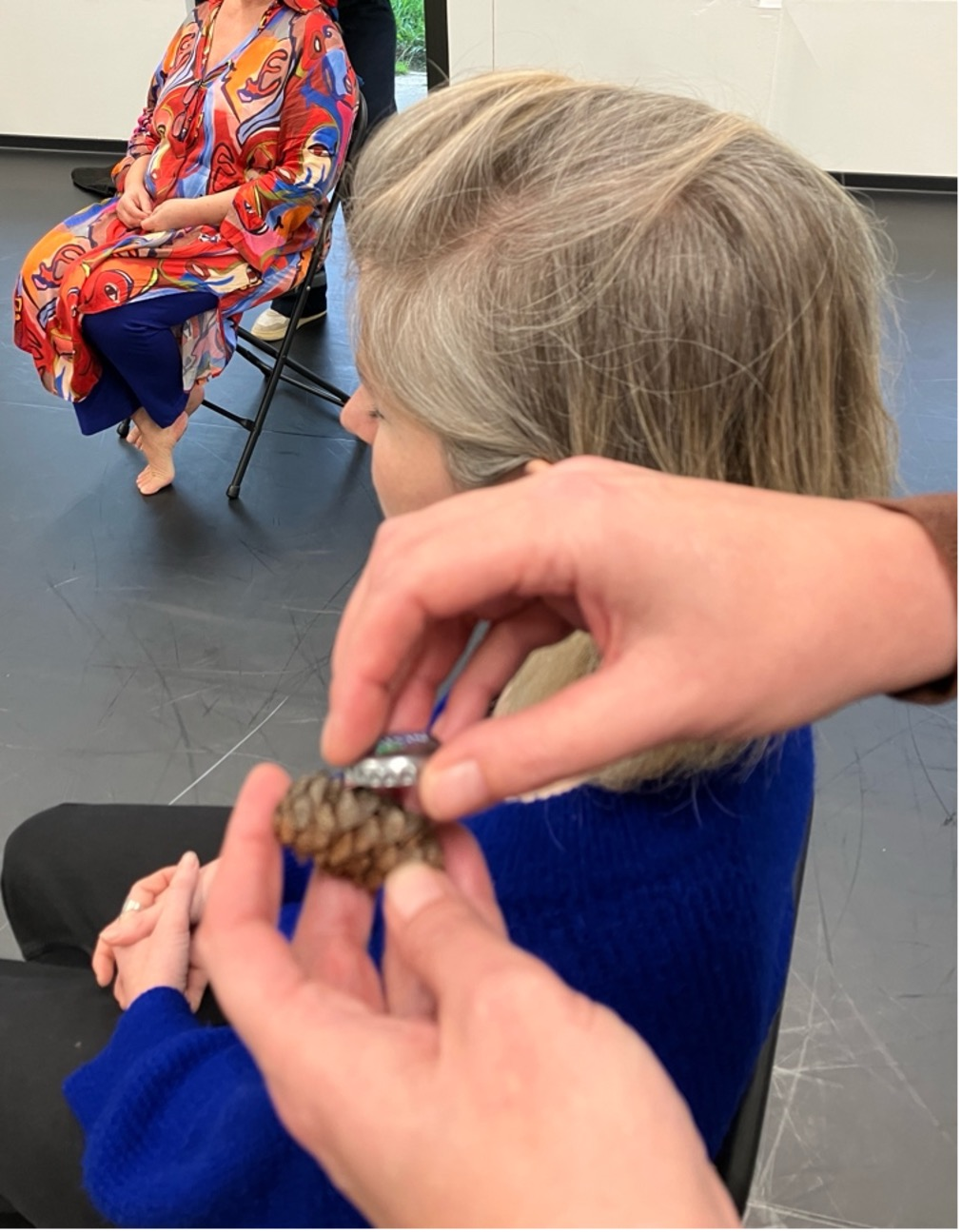
Musical sound massage during practical session 2, 11-12-2024. Photo by Bob Selderslaghs.
Several participants considered embodied learning so essential that they advocated for more practical work and fewer “obstacles” caused by group dynamics during the practical sessions: ‘For me, it could have gone further.’ The composition of the group and the tendency of some participants to “talk” rather than “do” was seen as a brake on artistic experimentation: ‘I feel that several people were putting the brakes on.’ The Mantle of the Expert methodology, for example, was mentioned as a promising area for further exploration: ‘That’s so fascinating, it has a lot of links to how I already work. […] We should be doing that much more.’ (20)
The teacher development team generally considers embodied learning to be a core component of their development as teaching artists. It stimulates imagination, creativity and connectedness, and has a direct impact on both professional and personal practice. However, in order to fully utilise artistic integration, it is important to create sufficient time, space and trust for physical, sensory and shared experiences. A more extensive, long-term joint commitment seems appropriate in this regard.
Sustainability and the future
For the interviewees, the project led to a broader recognition of the sustained impact that arts education and participatory art projects can have. Looking back on previous experiences, such as collaborations with various partners, it became clear how projects can sometimes continue to have an effect long after they have ended: ‘Perhaps I, together with my colleagues, have set something in motion there.’ This insight went hand in hand with a desire for local anchoring and long-term processes, in which collaborations at neighbourhood or city level play an important role. Future co-creations, for example with students or in nurseries, were mentioned in concrete terms: ‘Thanks to X [colleague from TDT], we are now going to run a project in my art school next year together… She [one of my part-time art students] is going to collaborate with X on a project with newborn babies.’
The importance of live contact was widely endorsed, but people also saw a future in a hybrid model in which online exchange enables international connection: ‘I would definitely keep the mix […] But I think the live element is still necessary.’
There was a strong desire to make the network and the learning community more sustainable. Some participants immediately integrated insights from the programme into the curriculum of their course(s), for example through guest speakers and content links to existing modules: ‘In my “art and care” module, I see many connections with what Sarah [Vanhee] and Tina [Lenz] said.’ This points to sustainable implementation in educational practice, with the hope of structural continuation: ‘I would certainly like to see a follow-up to this and would like to be part of it.’
Time and space for reflection were seen as crucial conditions for sustainable professional development: ‘That was a good learning experience for me: that reflection is really part of it.’ The future was ideally seen in the light of a (inter)national community, which can serve as a stimulus for engagement and activism: ‘That seems incredibly powerful to me!’ At the same time, it was recognised that structural, financial and organisational support is essential for maintaining such networks. For some, local anchoring was a prerequisite for continued engagement: ‘I would do it if it were in Rotterdam… I miss the contact with this city.’ The role of institutions was also viewed critically. In that light, sustainability was linked to radical choices and clear commitment: ‘After an initial period, I make a choice: is there enough of a basis, are there people with commitment?’
In addition, there was an awareness of the need for small-scale, sustainable collaborations, preferably embedded in existing programmes or networks: ‘We could start small […] and then make it more sustainable.’ In this context, there were calls for a clear separation between practice and reflection within future formats: ‘Then I would focus those practical sessions much more explicitly on practice.’
Together, we share a broad conviction that sustainable development in teaching artistry requires structural embedding, a solid local foundation, opportunities for (inter)national exchange and a balance between practical and reflective working methods. In that sense, a local hub, such as ITAC now has in England, the United States, Norway and South Korea, could offer a solution for the Low Countries. (21) These are centres that aim to deepen the field of Teaching Artistry, bring people into contact with each other, serve practitioners at the local level in a meaningful way, and maximise the visibility and impact of this emerging global profession in their own countries and beyond. However, structural, financial and organisational support is a crucial prerequisite for establishing and sustaining such a hub.
Conclusion
The research project involving this teacher development team demonstrated that teaching artistry in Flanders and the Netherlands is supported by a wide variety of practices, but also by shared core values: stimulating imagination, creating meaningful encounters and using artistic expertise for a variety of (art) educational, social and personal goals. Professionalisation within this field appears to revolve around three pillars: acknowledging one’s own practice, deepening it through reflection and dialogue, and expanding artistic-pedagogical skills in interaction with others. Hybrid and international exchange play an important role in strengthening mutual connectedness and increasing the visibility of this still often “invisible” professional field.
The reflections within the TDT show that the field benefits from a shared but flexible frame of reference that leaves room for multiple identities, context-specific working methods, and an aesthetic that values process, authenticity, and participation as much as the artistic end product. Embodied and sensory learning was recognised by the participants as an essential component of their artistic and pedagogical practice, which not only stimulates creativity but also contributes to a lasting connection with participants.
There is a clear task for the future: the structural embedding of professional learning communities, local anchoring and international networks, supported by stable financial and organisational frameworks. This can be linked to existing hubs and initiatives such as ITAC, which are working worldwide to strengthen the field.
In 2025-2026, the Royal Conservatoire of Antwerp and Fontys Academy of the Arts Tilburg are continuing this international hybrid exchange, including a new series of lectures with and about teaching artistry. In addition, numerous events put the spotlight on the field, such as the Roadtrip Cultuureducatie (Cultural Education Road Trip), the Nacht van de Maestro (Night of the Maestro), which will honour a teaching artist for the first time, the Dag van de Academies (Day of the Academies/parttime art education system in Flanders) and the international “congrestival” Louder Together. (22, 23, 24, 25) The highlight will be ITAC8, the International Teaching Artist Conference, which will bring together teaching artists from all over the world in Antwerp in August 2026. These gatherings are not only a continuation of the work carried out in this project, but also a launch pad for a more visible, connected and future-proof professional community.
References.
-
ITAC, The International Teaching Artist Collaborative, 2026, https://itac-collaborative.com/. Consulted 25 Jan. 2026.
-
Booth, Eric, en Bob Selderslaghs. Making Change: Teaching Artists and Their Role in Shaping a Better World. Betteryet Press, 2023, p.13.
-
Booth, p. 48.
-
Van Tilburg, Mirjam. “Studies in vakidiotie”. Research Catalogue, nov. 2024, https://doi.org/10.22501/rc.1721171.
-
Hübner, Falk. “Lectoraat Artistic Connective Practices”. Fontys.nl, www.fontys.nl/Onderzoek/Artistic-connective-practices.htm. Consulted 25 Jan. 2026.
-
Selderslaghs, Bob. “Teaching artists professionaliseren via procesdrama. Een experiment aan de hand van een community of practice met alumni van de kunsthogeschool”. Forum+, vol. 30, nr. 3, okt. 2023, pp. 16–21. https://doi.org/10.5117/forum2023.3.004.seld.
-
Eric Booth. www.ericbooth.net. Consulted 25 Jan. 2026.
-
“Chen Alon”. ITAC, itac-collaborative.com/about-itac/dr-chen-alon. Consulted 25 Jan. 2026.
-
“Tina Lenz”. Design Anthropology, www.designanthropology.nl/en/about_tina_lenz. Consulted 25 Jan. 2026.
-
Sarah Vanhee. www.sarahvanhee.com/home. Consulted 25 Jan. 2026.
-
“Boekpresentatie ‘Verandering Teweegbrengen’”. YouTube, uploaded by Bob Selderslaghs, 16 Nov. 2024, youtu.be/2KO9DOxgTzE. Consulted 25 Jan. 2026.
-
“MOVIE & TALK: Teaching Artist Chen Alon on Artivism”. YouTube, uploaded by Bob Selderslaghs, 16 Jan. 2025, youtu.be/WhJ9bWbkzY4. Consulted 25 Jan. 2026.
-
“Tina Lenz: ‘Radicale Verbeelding’”. YouTube, uploaded by Bob Selderslaghs, 26 March 2025, youtu.be/jl0D_gdbxXY. Consulted 25 Jan. 2026.
-
Saelens, Ann. “What’s in a name? Kunstenaarschap en leraarschap: een verleiding tot het midden”. Forum+, vol. 30, nr. 3, okt. 2023, pp. 6–15. https://doi.org/10.5117/forum2023.3.003.sael.
-
Borstel, John, e.a. “Aesthetic Perspectives: Attributes of Excellence in Arts for Change”. Americans For The Arts, Americans for the Arts, 2017, www.animatingdemocracy.org/aesthetic-perspectives. Consulted 25 Jan. 2026.
-
Boal, Augusto. Theatre of the Oppressed. 1974. 4th ed., Pluto Press, 2019.
-
Booth, pp. 85-100.
-
Booth, p. 56.
-
Combatants for Peace. www.cfpeace.org. Consulted 25 Jan. 2026.
-
Mantle of the Expert. www.mantleoftheexpert.be. Consulted 25 Jan. 2026.
-
“ITAC Hubs”. ITAC, itac-collaborative.com/hubs. Consulted 25 Jan. 2026.
-
“Roadtrip Cultuureducatie 2025”. Publiq, www.publiq.be/nl/projecten/kenniswerking/cultuureducatie/roadtrip-cultuureducatie-2025. Consulted 25 Jan. 2026.
-
On the ‘Nacht van de Maestro’ (Night of the Maestro), the Royal Conservatoire of Antwerp and Bolster vzw honour a person or institution that has made an indelible mark on the world of music or performing arts. At the 25th edition on 13 November 2025, teaching artist Reinhilde Decleir was posthumously honoured with the title of Maestra Honoris Causa.
-
Dag van de Academies (Day of the Academies. Flanders has an official education system for part-time arts education in leisure time, with 168 art academies spread across its region, where people aged 6 and above can enrol for a modest fee to study dance, drama, visual arts or music.): VONK. www.dagvandeacademies.be. Consulted 25 Jan. 2026.
-
“Louder Together”. loudertogether.art, www.opendoek.be/en/experience/louder-together. Consulted 25 Jan. 2026.
-
“ITAC 8 / 28-30 August 2026”. ITAC, itac-collaborative.com/home/itac-8. Consulted 25 Jan. 2026.