NOTES ON THE WINTER SEMESTER COMPOSITION CLASSES WITH REIKO YAMADA
Class 1.
- I am to start a Sound Journal, a notebook in which to write I hear and analyze them. How are they formed? How do they work in relation to the other sounds in the environment? Can I draw them? To remember the moment, to create a sound memory.
Sound memory 27/09/2025, my flat near Esmuc:
Sonido smooth de coches, chillidos de pájaros, algunos son como puertas, sillas arrastradas en la terraza, golpes sordos, hay como un reverb en los coches, va y viene. Parece que distingo voces pero están entremezcladas, vocoded con la ciudad, como si hablara ella misma. Un silbido. Un niño gritando cerca. El Sonido del árbol por el Viento, muy high end. Un cheep agudo, desconocido.
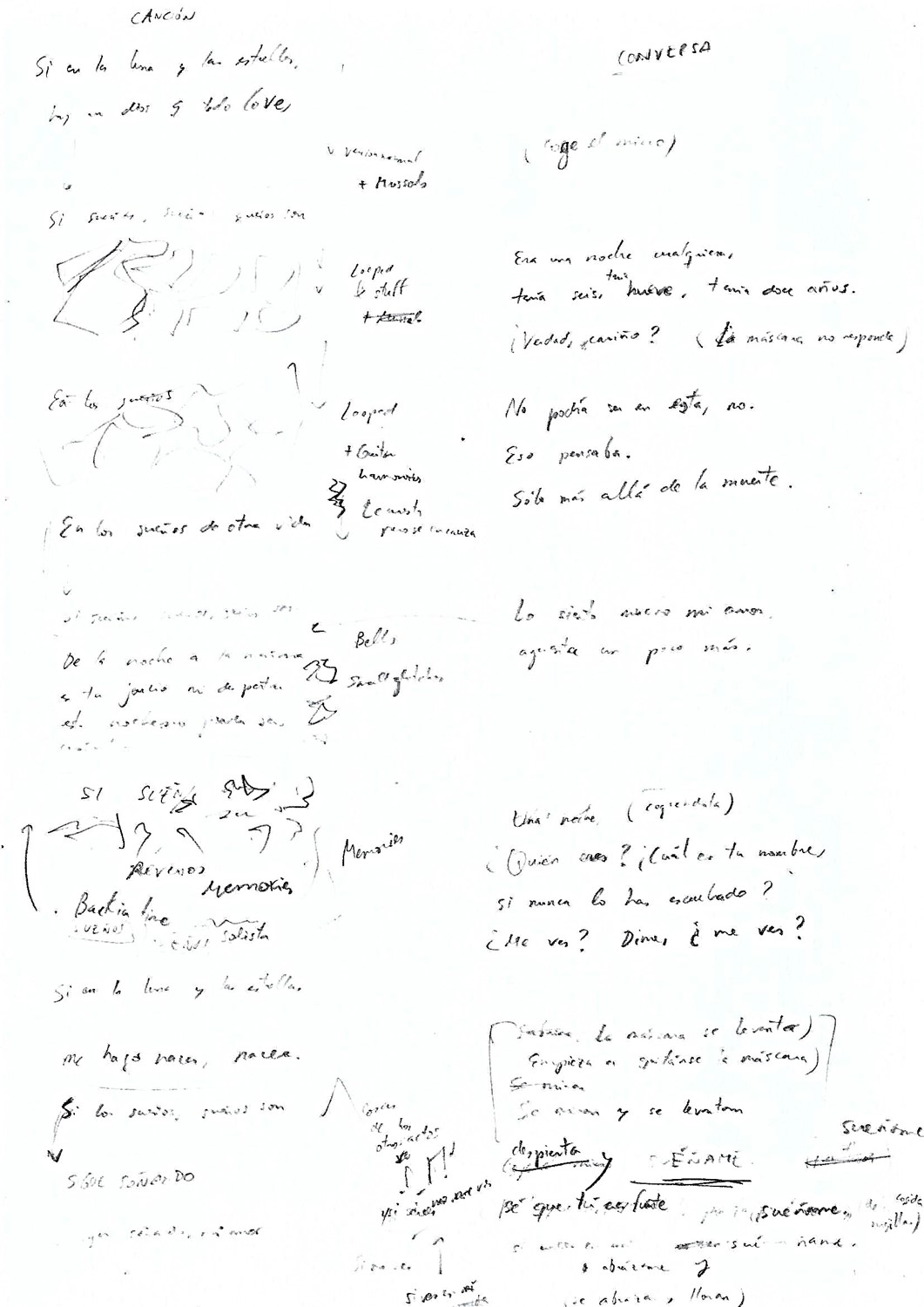
The first schematic structure of the third act of Sueños de otra vida I wrote down. It will feature a piece for choir, Si en la luna y en las estrellas, which I will record and then apply some electronic procedures on it, such as slicing, sampling, granulating, distortion, etc.
Class 2.
About Sueños de otra vida:
- To try and focus on learning to move myself for the performance, learn to recitate. Can I find someone to teach me?
- Might be interesting to use breath and mouth sounds, consonants as coloristic voice speech, maybe for the epilogue?
About Si en la luna y las estrellas:
- The piano might give too much a concert setting, we might be interested to do it a capella? With only voices it will be more flexible. Think about it.
- Work on the melismatic aspects, on sustained material. Word painting!
- If you’re not in love about any part you have to be strong and change it until you’re proud of it. Work on the bridges we’ve talked about in class.
- Play with contrast in the layers: tutti – rhythmic motives – melismas…
Sound memory 06/10/25, sitting on a bench in Montcada i Reixac
Sonidos de coches, pequeños frenos como pitidos discretos agudos, acordes mayores en glissando de los coches eléctricos, motores rugosos que aceleran y se deslizan, pasos como de suela de cuero sobre el asfalto con algo de suciedad, una rayuela lejana siendo movida, impactando contra algo, el triqueteo de una bicicleta, el exhalar de las puertas de un bus, una voz con autotune sin muchos agudos, entra el bombo, una bolsa cayendo por la basura.
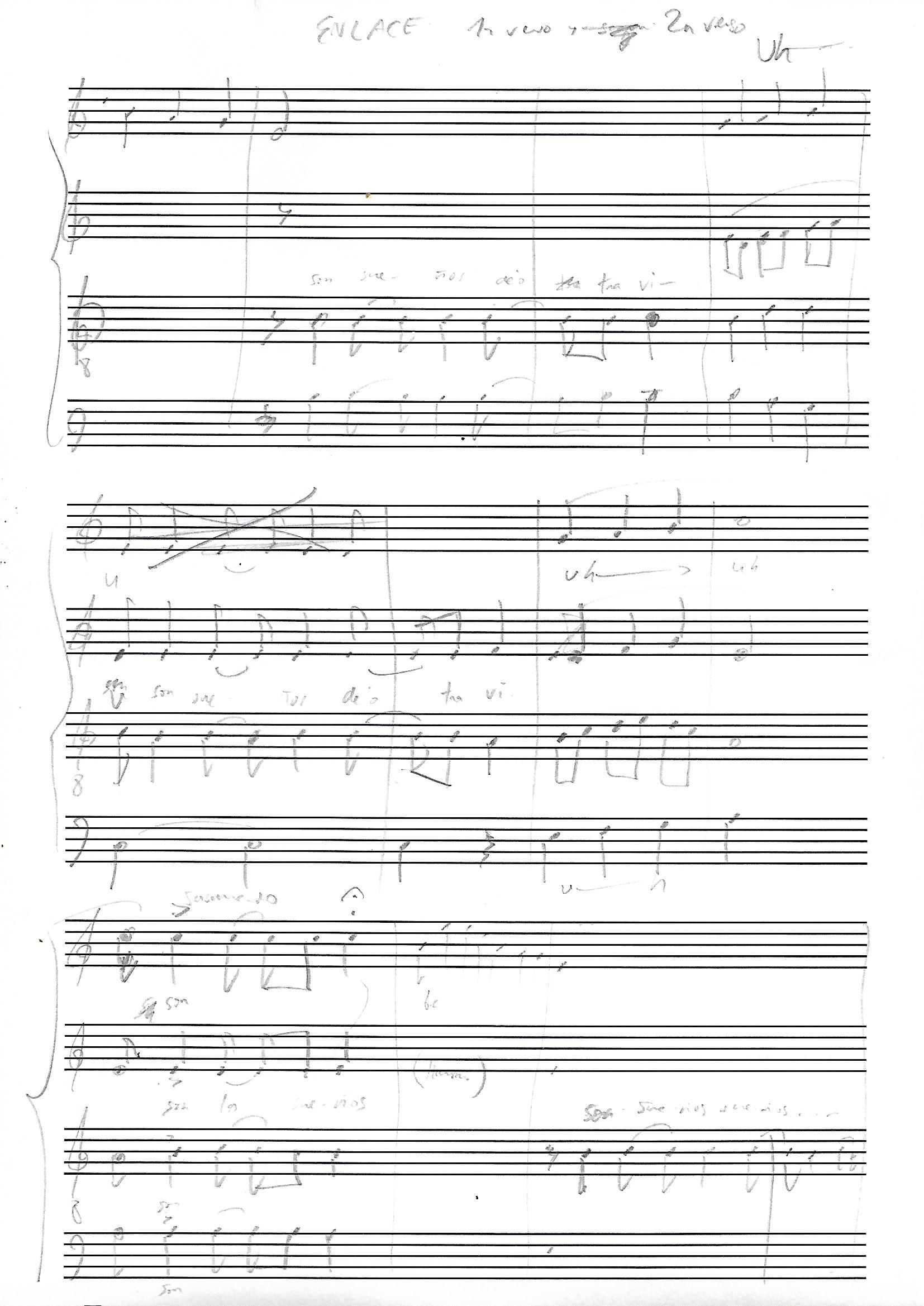
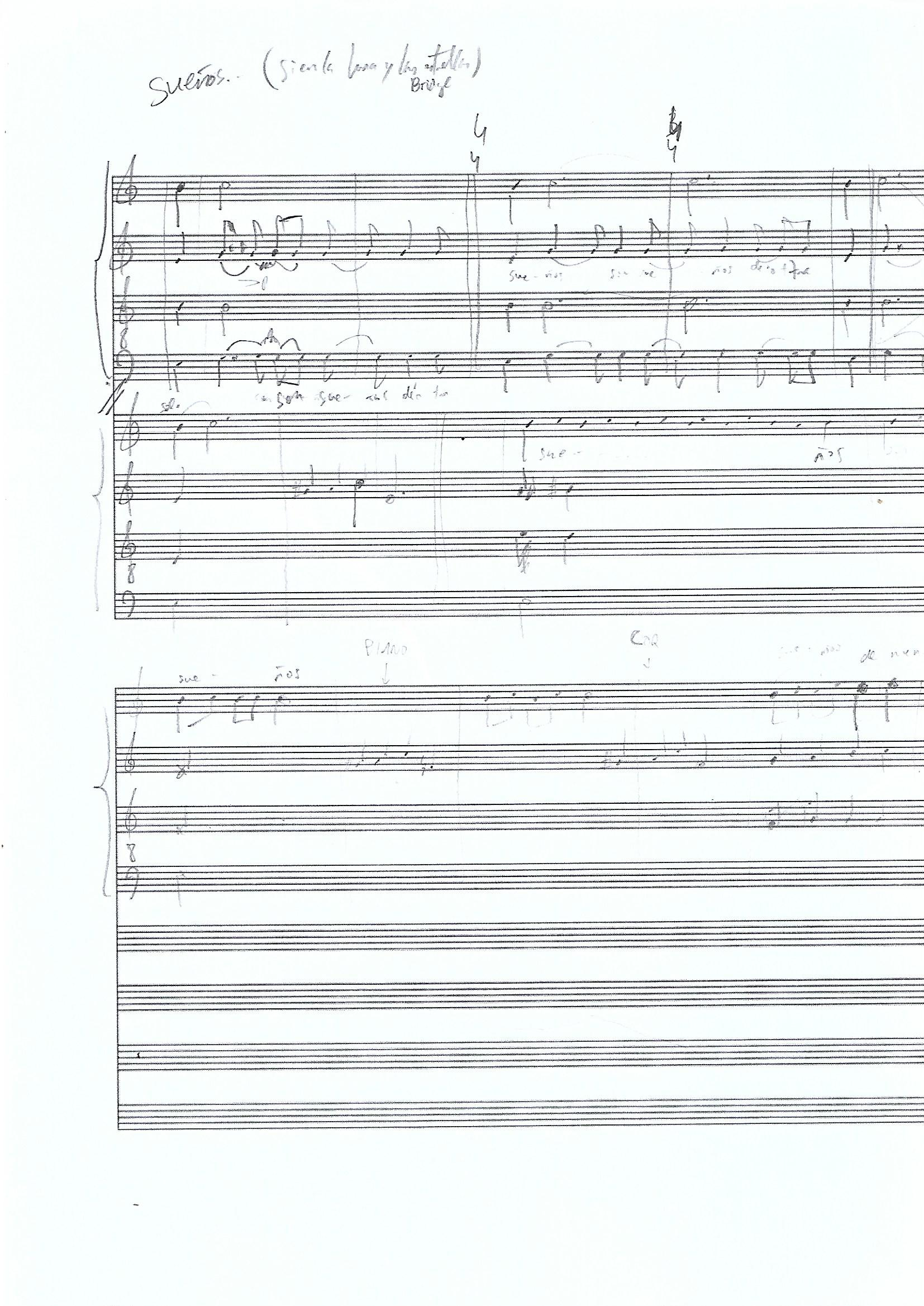
Some fragments of Si en la luna y las estrellas I began on elaborating.
Class 3.
We listen to some piano accompaniments to get some ideas, and analyze them:
- Clara Schumann, Die Lorelei.
- Franz Schubert, Die schöne müllerin
- Arvo Pärt, Fratres
Not double all the time the choir, but do it pointillistically; create contrast, sparks, use the extremes of the register, use the silence.
Sound memory 23/10/25, Algebraic Structures class, Faculty of Mathematics and Statistics:
Sillas siendo arrastradas, un pequeño glissando grave oscilante en amplitude con un ruido blanco mid-high. Voces graves, monótonas, una línea melodica plana. Voces más agudas, bastante más movimiento, notas repetidas, cambios de intervalo súbitos, puertas cerradas con algo de reverb. Un chico que proyecta bastante. Voces de fondo, risas HAHAHAHA, indistinguibles algunas. Clicks, una palmada, con cola y se escucha un poco el aire de antes. Una puerta más grave. Un tapón de una cantimplora. Otra palmada, pero desde fuera. Lápices, bolis siendo movidos.
Some sonorities for the third act of Sueños de otra vida I was working on by then.
Class 4.
Reiko gives me a list of possible reads about theatre, performance and sound art.
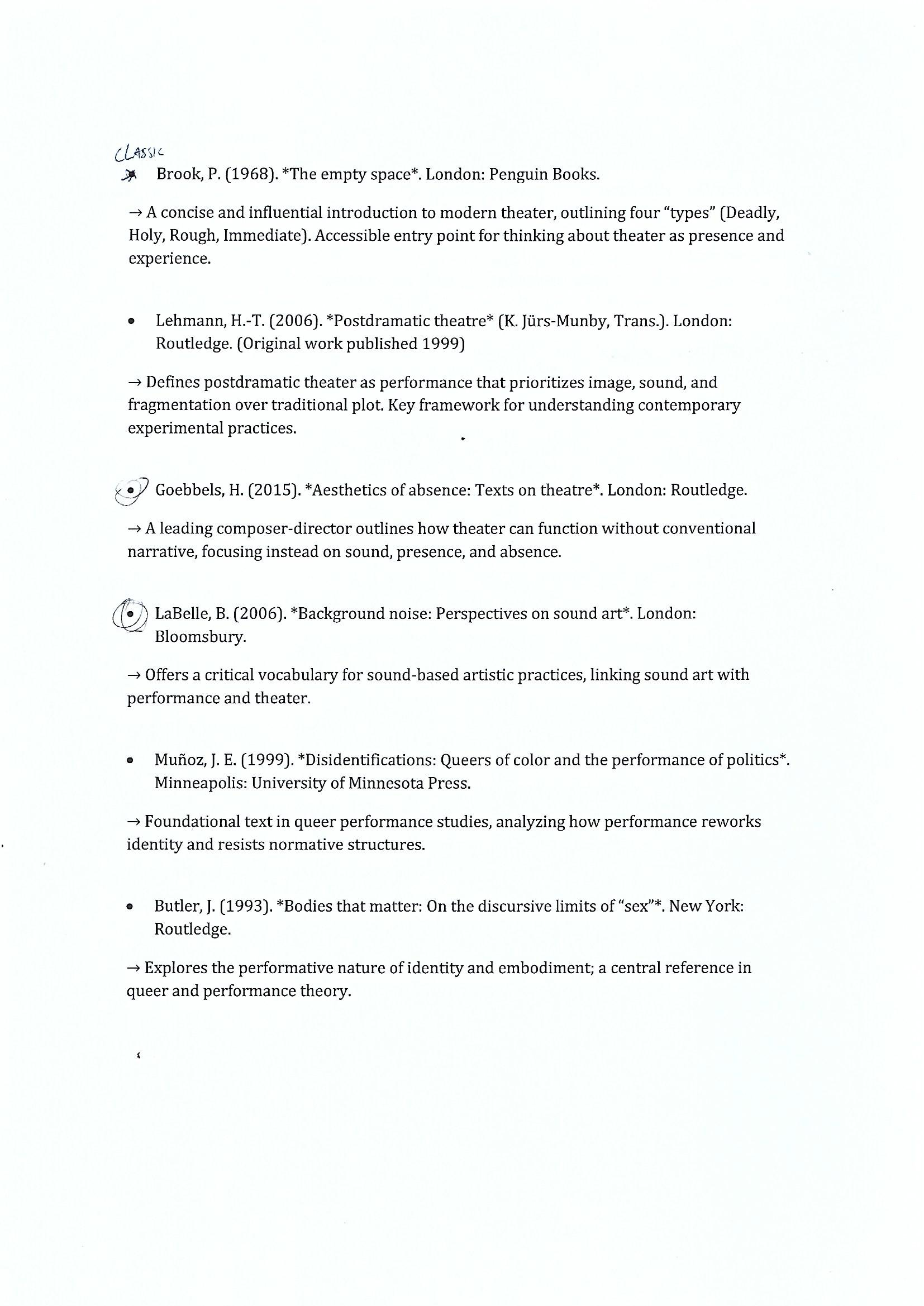
- Goebbels. H, Aesthetics of Absence
- LaBelle B., Background noise, Perspectives on sound art.
In the first one, a leading composer-director outlines how theater can function without conventional narrative, focusing instead on sound, presence and absence. The latter offers a critical vocabulary for sound-based artistic practices, linking sound art with performance and theater.
I show her some sonorities I have in mind for the third act of Sueños de otra vida.
- The segments could take more time, it’s very busy. The sound is dominating and there should be a moment where the movement can take space, so it has a depth change in terms on layers. A bit longer, stretch it.
- Don’t count on the mockup for time, but the inverse: Take the music as the mood and build the idea, then redo the music.
- About the ending and the embrace, scenically-wise: maybe don’t show everything on stage, take the time to do the ending in silence (maybe you don’t really see it).
Sound memory, 25/10/25, it’s late at a Bar in Tarragona.
Voces en la calle, alguien “hay que subir el…” y otra persona dice “venga vamos”, vasos de cristal, “ya está pagada la primera” dicho un poco arrastrao y con seguridad. Más que una pregunta es una afirmación, monedas pequeñas, siendo arrojadas, unas cinco, algo de plástico siendo arrugado, el grifo de una cerveza, una copa grande. El extractor también tiene aire, grave, un poco más bajo que un La, ominous, ha cambiado el género de las voces de fondo, vasos de plástico, pasos en el parquet. “Dame, dame tabaco.”
Class 5.
We look for some glitch-sampling approaches to electronic music:
- Electric indigo
- Brittle
- Oval, “Ovalprocess”
- Yasunao Tone
- Jean-Claude Risset, “Sud” (1985) – slicing effects
She advises me to try lots of small pieces, lots of cutting of the sample, replace the attack of bell with the decay of the voice. She says that I should look into Meredith Monk, her exploration of the body and the noise, how she uses improvisation to build the material, and how her techniques create movement from the voice.
Sound memory, 1/11/25 at the Cinema, about to watch a documentary about Meredith Monk.
Lots of voices, una chica atrás está comentando sobre una beca, a la derecha “qué jóvenes”, y una risa, unas palmadas, y una señora mayor que hace las eses sibilantes, es extranjera? El murmullo general baja un poco, olor denso y grave a palomitas, varia en intensidad, sonido de un plástico de unas flores. El sonido de la fricción de las palomitas, con los dedos que las están buscando. La vocalización general es rápida, es como granulada, la cualidad cambia a cada instante. La chica de al lado tarareando casi que no se la escucha, suspira, glissando hacia abajo “mmm”, el murmullo general es como un set de percusión. La melodía que tararea es grave, lenta pero no tanto que parezca triste. La mujer extranjera imitando a alguien-
In the rehearsals of Sueños de otra vida we begin to work on the two previous acts. We decide to search for alternatives for the red light, maybe a red balloon stretched around it, temporarily. We might need a sort of carpet for the project, for absorbing the sound when we fall on the ground.
I also began elaborating the sonorities I had in mind for the third act. As I didn’t have a recording for the choir yet, I recorded myself singing all four voices to begin experimenting with the piece. Here is another sketch I made for the third act:
Class 6.
We discuss about Monk’s pieces and work. I show her some of them that impacted me during the documentary: ATLAS, dolmen pieces and Quarry. I show her then some fragments I worked for the third act.
- Give it more space (usually it’s too short)
- Thinner if you want to talk over it
- She wants to hear the owls from Montserrat I recorded this summer.
- Think on terms of layers of Movement, Text and Music. Write an exercise with breath motifs. Think about 3 different ways of using breath as a central element.
Sound memory, 19/11/25, at the cantina in ESMUC.
“Adiós, Zoe!” silbando alguien una melodía alegre (rough notation) negra = 100. Apretando botones, es alguien dando contra un tupper con los cubiertos. Una nota grave con granitos de la máquina expendedora refrigerándose. El roce de la ropa al pasear, sonido blanco, “Ah mira están mis amigos aquí” (rough notation of the pitch) “Qué vergüenza” Está subiendo la densidad de conversaciones. La vuelta del silbido pero tan bajo que apenas proyecta, el rango escondido.
Class 7.
I show her the breathing exercises.
- Try to create a special notation of the breathing exercises. Can you create a phrase with different techniques? To use consonants as well?
- Christian Marclay, “Manga Scrolls” as an inspiration for notation, but come up with your own system.
- To make a catalogue of voice techniques, a sound palette.
For a musical translation of a mathematical definition I’ve been working on for another research project. I tell her I feel it’s a bit all over the place.
- Limit the musical variables so you have more coherence. What is your interest to translate, what’s your priority, what should be understood firstly?
- Trying different mappings and see what works and which to keep.
Sound Memory, 21/11/25, Esmuc
Un clic como de goma, puede ser de una cantimplora. Una flauta de fondo haciendo triple picat en su rango medio, está muy lejos, probablemente detrás de una pared. (rough sketch of the pitch) Un clarinete virtuoso que se escucha hacer escalas durante un momento que se abre la puerta, en el registro grave ahora. Son dos? Los pantalones de un chico se arrastran entre ellos cuando avanza el pie izquierdo. Un murmullo de un tío hablando en catalán, unintelligible a través del pasillo.
Some sketches on how to organize the choreography for the third act of Sueños de otra vida, as well how to combine it with the text and scene.
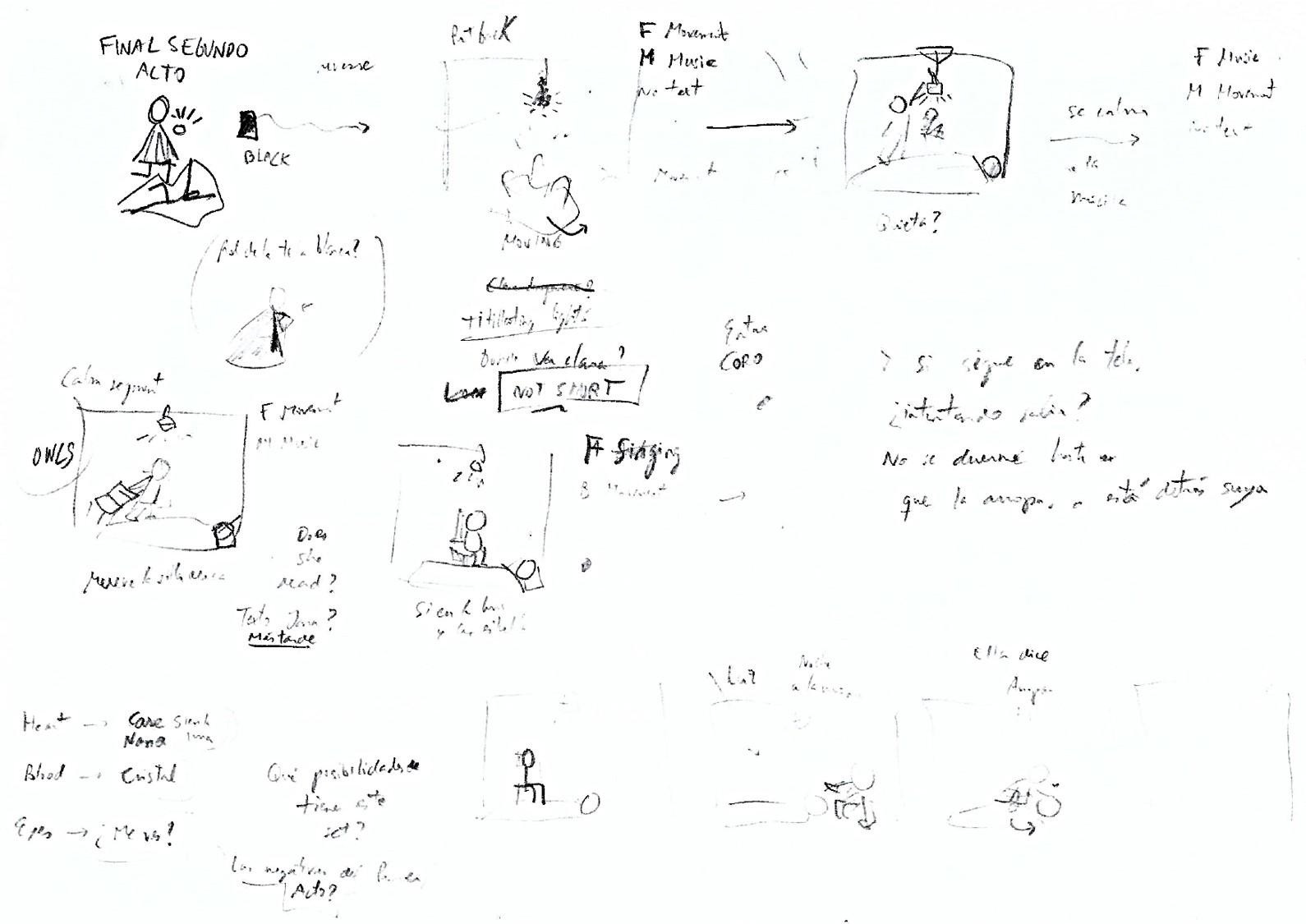
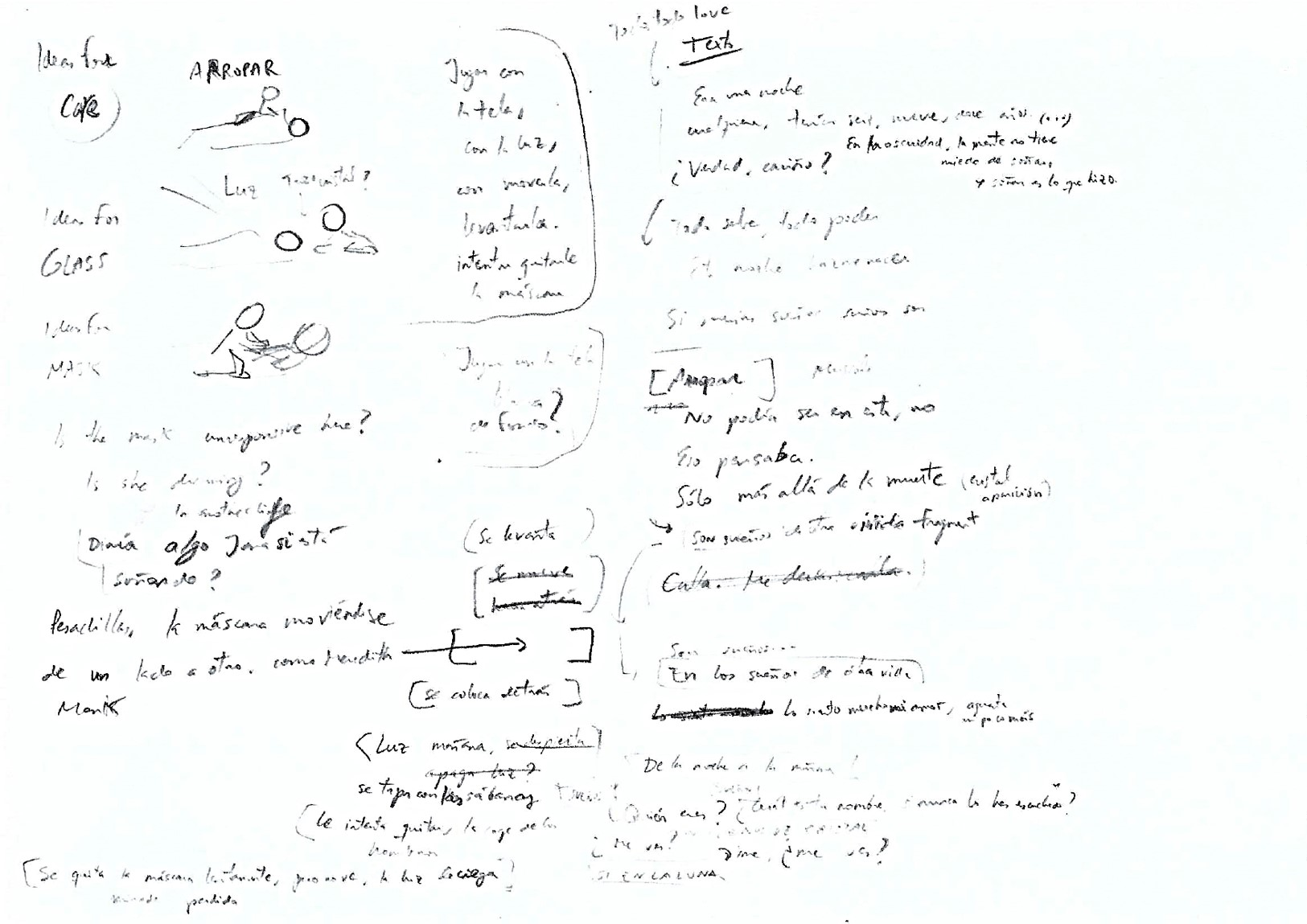
At the rehearsals of Si en la luna y las estrellas, I talk with the conductor about a great number of changes regarding silences, voicing, and accompaniment, because the acoustics I imagined while writing it are not the real ones.
Class 8.
Notate the tremolo of the voice more clearly. More questions about Si en la luna y las estrellas, especially for the piano.
Sound Memory, 9/12/25, Algebraic Structures, Mathematics and Statistics Faculty
De repente, en una sincronía inhumana, mi compañero de la izquierda y Amal en la derecha cogen un pañuelo y se suenan a la vez, en un portato cronometrado de 4 o 5 veces en total acuerdo. Una experiencia estéreo que me ha dejado sin palabras durante 10 segundos. La segunda fase de volver a limpiar la nariz, a la vez. La tercera fase, de guardar el pañuelo, simultánea. Estoy anonadada. Nunca me había sucedido. Nadie le ha dado importancia.
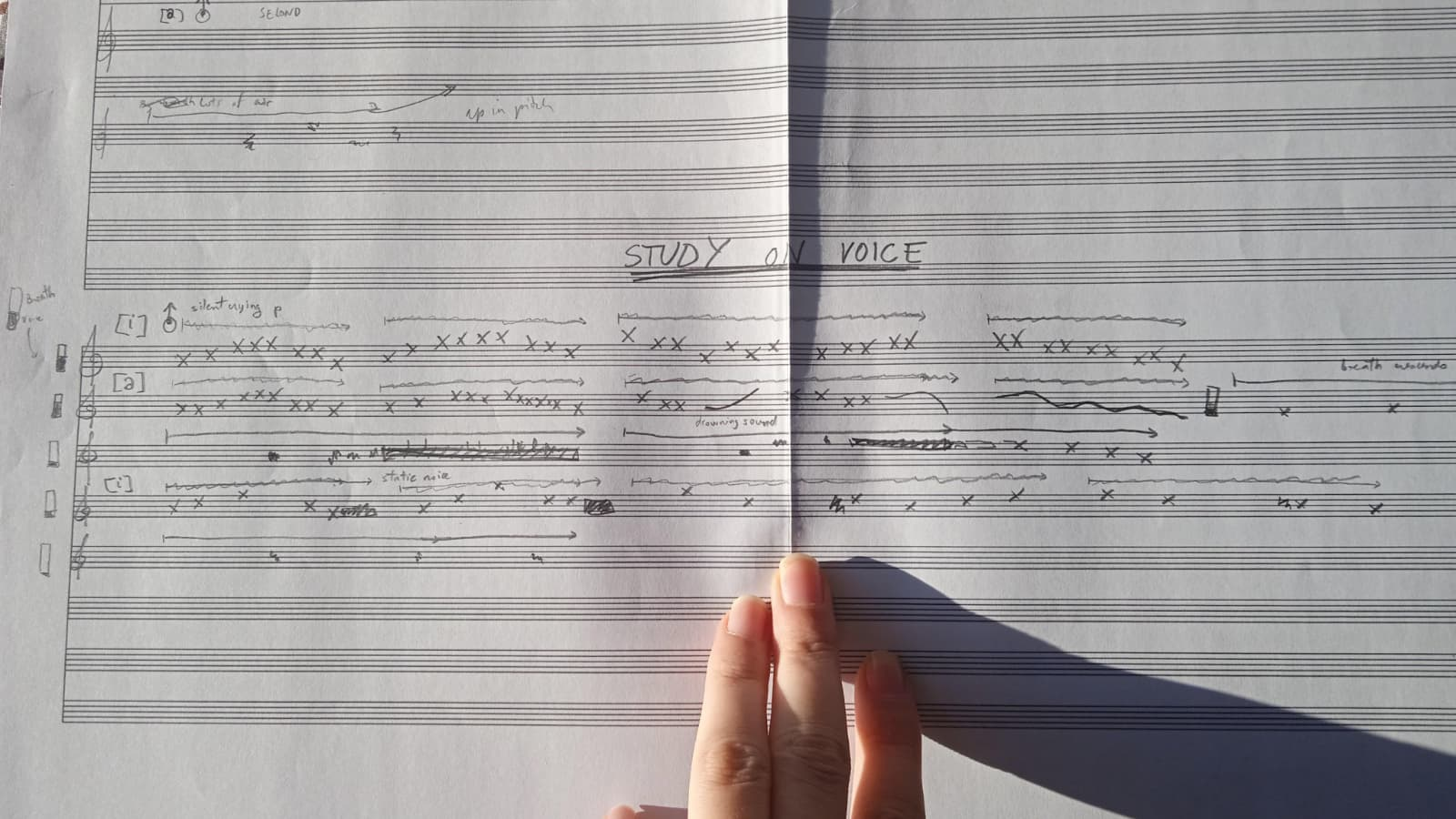
A second attempt on the study on voice:
Class 9.
Some options to take further the study on voice.
- Standard: piece for a singer and a wind instrument.
- Fixed media: Recording with a score.
It can be 3 minutes or so, small piece. I feel it could be short and narrative, maybe might fit with the other lullabies.
I read another book we found at the library, “The Science of Voice”, by Johan Sundberg. I found interesting the spectral differences they find between solo singers and choral singers, and how the phonemes affect tuning, and in which percentage.
Take notes of Aesthetics of Absence (it finally arrived at the library).
Notes on Aesthetics of Absence:
The dominance of presence has not been undermined. The majority of productions still center the performers, self-confident soloists, as assumed of their roles, characters and bodies. Background objects being brought into the foreground by absence of performer, by means of sound, light & text.
Some characteristics of the theater of absence:
- Disappearance of the performer from the center of attention,
- Polyphony of elements (light, space, sound, text),
- Collective protagonist who hide their individual significance,
- Separation of the actor’s voices from their bodies, musicians’ sounds from their instruments.
Some member of the public after seeing Eraritjaritjaka: “Finally nobody on stage to tell me what to think”. In this piece, the actor leaves the stage after a monologue, being followed by a live camera. The audience can see how he takes a cab and goes back to his apartment. There the actor begins to do chores: opens letters, makes scrambled eggs, watches TV, thinks aloud…
Landscape with distant Relatives is another piece in which the images, performers and sounds refuse to occupy the powerful and often violent center. It’s left vacant in order to be discussed, focused on. The tables as an axis, they are moved during the piece, people put scores on them, play them, they climb them and talk, they build little city replicas over them, they discuss them, they burn them playfully. People are always sitting down to discuss things. In every act you can find scenarios of the last supper. At a certain point in the opera, the 30 performers sit at a really long table, and they get served cymbals that will be played to create a big crescendo. The musicians bring their instruments to the table. They discuss Gertrude Stein.
Goebbels isn’t interested in love stories of other people, he doesn’t think they can accurately portray the social plays of power by reducing them to psychological relationship conflicts.
End of semester
In rehearsals of Sueños de otra vida we are determining tempos of the different parts of the third act, that we have already choreographed. I start to wonder about other uses of the graphic score I wrote for the first act, as a complementary piece of art and a public version and a performer version?
Some things I learned during the production and rehearsals of Si en la luna y las estrellas:
It was a very rewarding project because of the challenges I’ve got to face through it. I have learned a number of things along three differents axis: production, composition and interpretation, but I will focus on the composition part here.
-
I have learned to differentiate how to write for choir and how to write for a soloist singer. The choir voicings have to be clear and well thought of, and the piano must help whenever it gets tricky. The alterations can be really complicated if they pile up one after another.
-
Acoustics are really important. I had to change the length of the silences because of the space we were going to perform and record.
-
I have also learned that the parts I thought to be not so important, such as the bridges between verses or modulation sequences, can be as detailed (or even more!) as the main parts of the piece, and then the music will gain depth and I will be more satisfied with it. Don’t be lazy, even as you say: no, my intention is for it to be really simple. To know when that’s true and necessary, and when it is not.
-
If I write a pitch that is too low and only one of the singers can get there, maybe it is not worth it.
-
Pianistically, the subtle figurations have worked really well. To know when they are going to stand out and how much because of the register is not as easy as I thought.
-
To write if I want a melodic line without breathing, because it was important for the effect and during the recording the conductor interpreted the score in the opposite way I had anticipated it.
-
The measures are important for the conductor, think if 4/4 is the most natural way to write it, maybe it’s 2/2.
-
You cannot just write one time two layers of people saying different things and not continue with that texture. Also the text will not be understood in this situation if you don’t keep on repeating it.
-
Unison(or octavated) as a forte can feel really empty if you come from a place of elevated harmonic density. That causes tension to lower.
-
Take into account the soprano register, if it’s really high it’s going to be difficult to sound light and small. Better write for soloist in that part.
Over all, it has been an intense semester with a lot of different parallel fronts. I’m looking forward to keep working on all these projects.