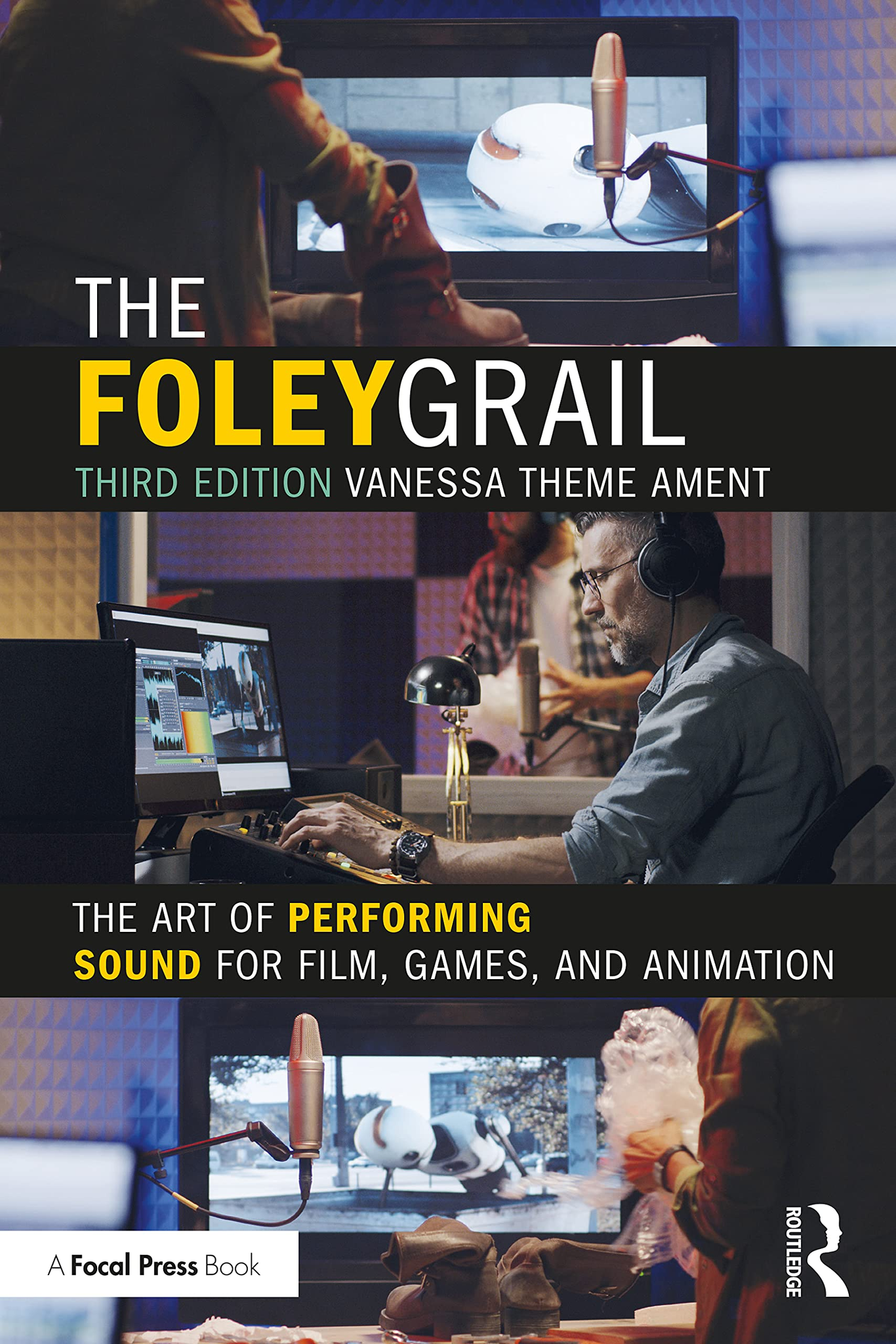
Vanessa Theme Ament’s The Foley Grail was, for a long time, the only publication to discuss in detail the art of film sound effects (foley). Although first published relatively recently (2009), the book quickly became a seminal reference in the field of film sound studies. By 2022, two editions had been published.
The third and latest edition (2022) preserves the essential qualities that made the earlier editions so valuable, while reorganising and expanding the work in ways that reflect both the diversification of media industries and the global spread of sound practices. The book retains chapters on the history of sound effects and the profession of foley artists, but its scope has broadened to provide an overview of current practices in the field. It offers precise insights into the techniques, studios, and work of artists worldwide, making this diverse expertise accessible to a broader audience, beyond academics and practitioners. It shows how foley art is a transversal field to many industries: cinema, radio, theatre, games, and so on. Readers familiar with the 2009 edition will immediately notice the continuity of the book’s structure: the detailed discussion of craft, the historical framing, the practical “recipes”, and the attention to professional protocols.
While the second edition introduced new chapters on foley for games, television, broadcasting, and animation — along with case studies and professional interviews – the third edition extends this initiative by incorporating 32 additional voices from foley practitioners across diverse geographic and cultural contexts. These interviews broaden the perspectives on the practice, which for a long time was relegated to the background. It shows that there are certain aspects of the practice rooted in its legacy for a reason, while also sharing many of its variations. More importantly, it shows that there is no single way to achieve a good result, and that foley practice is an evolving art. This is interesting in the current situation, in which there is a suspicion that every craft will possibly be replaced by AI. In this sense, I dare say that foley gains a political dimension for (among many other cases) showing that handcraft is not always replaceable.
At its core, foley is a performative art: the body of the foley artist becomes an instrument, and sound is generated live in response to action, much like the improvisational work of stage actors. Ament’s emphasis on gesture, rhythm, and physicality situates foley within a lineage of performance practices that extend beyond the screen onto the stage. For theatre scholars, the book offers a valuable lens on how sound functions as embodied dramaturgy – shaping atmosphere, character, and narrative through live performance. The third edition widens the book’s perspectives, offering a more pedagogically effective structure and up-to-date case material. For researchers and practitioners, it provides a richer, more diverse set of perspectives on the profession. The global perspectives and expanded interviews of the third edition underscore foley’s kinship with theatre’s own cross-cultural practices, highlighting sound as a site where cultural expression, bodily presence, and storytelling converge.
In this logic, the book also intersects with current debates in AI studies, particularly around generated sound, which includes automation, simulation, and creative labour. In fact, foley sits at the intersection of craft and technology. While it relies on human delivery, it is currently supported
by recording equipment, microphones, and digital audio stations that allow sounds to be captured, edited, and synchronized with the visual media. Technology facilitates precision and consistency in the work, but it does not replace the human element: automated sound libraries or AI-generated effects cannot fully replicate the subtlety and timing of a live performance. In this sense, foley illustrates how technologicaltools support and extend human skill, rather than supplant it. By framing foley as an embodied, performative practice in which artists employ physical intuition, timing, and improvisation, Ament challenges the current trend. Her reflections on sound’s believability rather than strict “matchy-matchy” contradict AI’s capacity to replace the foley artist. In addition, the book’s expanded global perspectives parallel concerns in AI ethics, reminding us that practices of sound, like datasets and generative systems, are culturally situated.
In sum, the relevance of The Foley Grail (3rd edition) extends beyond film and media sound design into the domain of theatre studies, where its insights into embodiment and dramaturgy are invaluable. It provides a counterpoint to narratives of automation in creative work. Thus, it remains indispensable for scholars, students, and professionals interested in the art and craft of performing sound. Naturally, it seems that the book speaks to the author’s own development of her practice and thoughts about foley through the years. Ament is an accomplished foley artist, with extensive experience in film, television, and interactive media. She has worked on such television shows as Knots Landing (1984–1985), Dallas (1981–1984), and Cagney & Lacey (1984–1985). She also worked on such films as Predator (1987), Die Hard (1988), RoboCop 2 (1990), Noises Off (1992), Malice (1993), A Goofy Movie (1995), Dolores Claiborne (1995), and Platoon, which won the Academy Award for Best Sound in 1986. In addition to her professional work, she is the former Edwin F. and Virginia B. Ball Endowed Chair in Telecommunications at Ball State University, Indiana. In 2014, she received her PhD in Moving Images Studies from Georgia State University. In 2023, she started hosting Whole-y Foley, a podcast on YouTube.
Vanessa Ament in dialogue with Sara Pinheiro
You have been an influential practitioner and educator worldwide and, in particular through the podcast, you have been widening the scope of foley practices. What do you think to be the major difference between how you think of foley nowadays and how you used to think of foley back then, when writing the first edition?
When I wrote the first edition, I was concerned with ensuring the reader understood the world and culture of the foley artist and post-production sound in general and those I knew in the film industry as we practised our craft. I contacted professionals I had worked with, as well as others they had put me in contact with so I could get a broader context. I also went to the Margaret Herrick Library, which is connected with the Motion Picture Academy, to research Jack Foley. I interviewed his granddaughter, Catherine Clark, to get her memories and details about Jack’s story and his contributions, as there had been so much misinformation about him in our industry. It was basically an “inside baseball” approach to the world of foley. For that reason, it is pure and honest and uses my unique view of the craft and my access to those in the industry. I use the word “we” as I was actually still a practitioner and teaching at DePaul University as an adjunct instructor and saw myself as a professional in the field and wanted to lend that knowledge.
This prompted me to get a PhD in Film Studies, which had a profound influ- ence on the second edition, for now I had learned a more scholarly approach to writing and took myself out of the story. I focused on “they” rather than “we” and saw a more ubiquitous view of the world of foley. I became more interested in other nations and their approach, since I had studied foreign films in my PhD programme and was intrigued with how other countries approached sound. I also wanted to expand this book to include games and amplify animation more. I included a “recipes” chapter to assist new artists who might need guidance on how to approach making foley sounds, since I had been teaching foley classes at Georgia State University. It is impossible to not improve a new edition of a book when you evolve your own view of your craft as a teacher. Finally, the addition of long-form shows had changed the nature of foley for many of my colleagues in the industry, so I had to investigate how that altered their work practices. I have found that the political economy puts more pressure on my colleagues with each passing year, and this does not make things easier for them.
The third edition was the most interesting for me, as I had just completed five years as an Endowed Chair at Ball State University at the time of the writing of it. Thus, I was focused on looking back at how I had designed my foley classes using a semester timeline and decided to restitute the book to best assist faculty who use it as a text.
Additionally, streaming had become a major aspect of media, which caused changes in workflow, and this meant revisiting past interviewees, and it also meant a lot of work went overseas for financial purposes. I added interviews with directors and more sound editors, more sound professionals from other nations, and more emphasis on women in sound. I had made a small documentary about women in American film sound and realised that women need to be more included. Also, I focused on specific people and companies that work particularly well together as models of good practices.
All in all, the third edition is focused more on how the flows of the practice of sound go back and forth from many places. My years in higher education and as a practitioner, as well as a writer and scholar, have collectively informed this edition. So now, as I look back, all three editions reveal a different lens through which to view the art and craft of the practice of foley and the world of sound in film, games, animation, and even radio and theatre.
Could you please share your thoughts about foley as a performative art and how that embodiment is crucial for the cinematic experience?
It seems to me that foley cannot be conceived as anything but the extension of the performative. It is not separate. It is not a “thing”. It is a live experience. So to perceive foley as an entity that exists without the human element is to misunderstand it completely. Foley began as a human being’s interpretation of an event. It was Jack Foley and his colleagues making sounds for an event in a film while the film was in motion. It is that simple. However, it makes sense to me that this can be expanded to include any movement that is sonic, as long as a human is making it. Once it is not an embodiment of a human experience, it is not foley but a sound effect that is designed from elements, which is a different kind of sound design.
Performance requires attention at the time of the event. It cannot happen at a different time and then be “placed” into the event. A singer sings with breath and sound. You cannot separate that from the human. So it is with foley. We who perform anything find it absurd that this has to be explained. When a foley artist “walks” a character, it is essential to feel what the actor is putting into the character. We do not just walk. We experience something. We try to emulate what this gifted actor was doing. Now our performance is sonic, and if we do it right, the audience should not notice what we have done at all. It should just feel like the character and not draw attention away from the character. If foley is at its best, it supports the life of the character, the vision of the director, and the words of the writer. The job of a foley artist is invisible to most but necessary to all who experience the narrative of a film, a television show, a game, an animated film – all of it. Sound tells the story just as much as visuals do. In a radio broadcast, it is even more essential to be a live interpretation that assists in the narrative to allow the audience to “see” the action, since there is no visual to follow. In theatre, when an artist uses sound to play with the theatrical performance, it alters the experience for the audience and transforms the play or opera.
Those who think foley is an “add-on” have never truly thought through what power sound has, or what performance really does to the soul. I challenge them to reconsider. In the womb, we experience sound before sight. What did that do to us then?
I know we share the same opinion about AI, but can you please share with our readers why you think AI cannot replace a foley artist?
The entire reason foley was developed was to add footsteps and prop sounds when silent films added sound. People needed to walk footsteps for the charac- ters. Characters have very specific and unique ways of walking in every film, and in every scene and in every situation. It is not easy to learn how to do this. Now, from the first time sound editors learned how to edit sounds, they tried to edit in footsteps and make them sound good. Many still do. They sound really artificial and anyone with a good ear can tell. So my answer is this. There will be projects where cheap producers will try to use AI to replace all filmmakers in some way because they are not discerning and do not care. It will not sound right. No two people handle a prop the same way in any situation, let alone in the same film. No two actors do anything the same way. AI can’t be relied upon to be perfect. But there will be people who try. However, there will never be a way to replace real performance. So, yes, I think there will be a way, and maybe even soon, where someone will use AI for synthetic foley, just like they do for voices. But I do not think it will ever replace the refined and specific foley that is required of a high-level project that wants first-rate art and specific quality. A real performance with taste and nuance and style requires a human being who is performing.
So AI, which is actually a consequence of capitalistic consolidation to some degree, will lead to some job loss in foley, but I doubt it will be substantial. A lot of content will continue to be made, and the performative is always more interesting in all forms of art. The bottom line is this: performance is unique. Storytelling requires a continual reassessment of who we are and what we are doing. When I do another edition of The Foley Grail, it will include the impact of AI, new technologies, and what I have learned from others I speak to on my podcast, Whole-y Foley. So far, most of the people I have spoken to have a sceptical view of the impact of AI, so I think we may not see as much of it as we thought we might.
That is my honest opinion. I am not an all-or-nothing thinker. I am realistic. I aim high. But I understand the world. Am I happy that technology has moved in this direction? No. I am not a fan of technology overall. I think we go too far too fast. But life is what it is, and I know that we can’t pretend that there won’t be technology or other issues, such as consolidation, that cause people to lose jobs. I am working on a musical called Holy Foley! This issue of consolidation and job loss is one of the themes in my show.
Can you tell us about this “foley musical” and how it will work?
Holy Foley! is a musical about the world of foley, set in 2019, and takes place on a foley stage at a film studio. The main characters are Genevieve, a veteran foley artist, her partner Jerome, who has been a theatre performer turned foley artist, and Anahid, her foley mixer, who was formerly a jazz trumpeter, and music engineer. I bring in another character, Samantha, as a PhD student to interview Genevieve for her dissertation, to allow the audience to learn the backstories of everyone. There is also another foley artist, Phil, who works on another stage at the studio and pops in several times, who provides an entertaining break with his antics.
This show provides insights into the backstage world of foley and the lives of the artists, as well as the drama and comedy of the characters themselves. I take stories from my own life as a foley artist, as well as those told to me by others that are included in my book, The Foley Grail, as background. I also add some fiction, such as incorporating Jerome as a Black foley artist, as that is still not normative in the United States. I also include Anahid as an Armenian female, another diversion from the norm in our industry. There is a secondary romance involved and the upsets of job loss and a broken relationship. So there are opportunities for the characters to laugh at themselves, make decisions about changing their lives, engage with new people, all while the audience watches foley artists make amazing sounds to film. I use my decades as a foley artist as a reference and my many relationships as touchstones in this show.
The journey is funny, gentle, heartfelt, and genuine, but I think the songs are the key, as my singers on my concept album keep reminding me. Since I started my career as a singer in musical theatre, and then became a songwriter before I was a foley artist, it makes sense that this is what I am working on presently.