TECHNICAL AND PHILOSOPHICAL REPORT: THE SYNTHESIS OF THE ETHEREAL
Subtitle: The Giusirames Protocol for Three-Dimensional Ebru and Flow Solidification Researcher: Dr. Giuseppe Rametta Giusirames DOI References: 10.13140/RG.2.2.15402.48327 | 10.13140/RG.2.2.16341.28641 | 10.13140/RG.2.2.31340.83842
I. INTRODUCTION: THE ONTOLOGY OF TRANSITION AND FLOW CRYSTALLIZATION
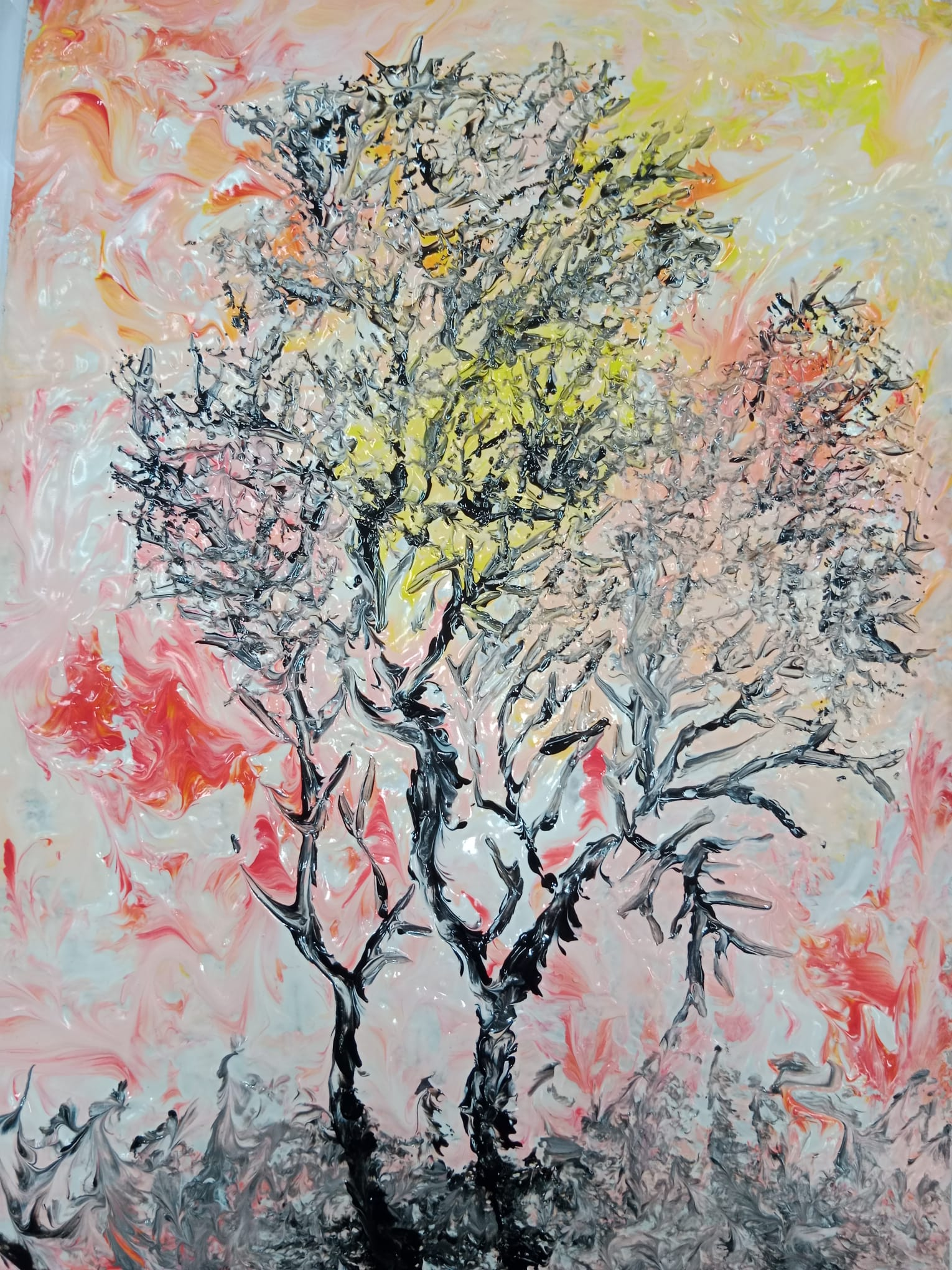
This investigation marks the transcendence of painting as two-dimensional representation, moving toward a fluid-dynamic morphogenesis. The research focuses on the “capture” of liminal states of matter, operating a controlled arrest of the biological time of liquid elements. Through a proprietary chemical synthesis protocol, the Heraclitean concept of “Panta Rhei” (Πάντα ῥεῖ - everything flows) is transmuted into a permanent structural stasis. This is not mere desiccation, but an induced phase transition that crystallizes movement within a solid molecular grid. The artwork thus becomes a biological archive: a substrate capable of preserving the kinetic memory of the gesture and the energetic imprint of the original fluid. In this “sculpture of time,” the boundary between solid and liquid vanishes, allowing matter to bear witness to the transit between the tangible world and the ethereal threshold.
II. CHEMICAL APPARATUS AND MEDIUM SYNTHESIS: THE HYBRID POLYMER MATRIX (HPM) The substrate, codified as the Giusirames Hybrid Polymer Matrix, is the result of a controlled thermodynamic synthesis designed to manage the transition between the fluid state and a structured solid state. The formula is based on the synergy of four bio-chemical clusters:
-
Binding Matrix: Dual-Phase Vinyl Complex (PVA) o Composition: Proprietary blend of high-density Polyvinyl Acetate and water-soluble synthetic resins. o Molecular Formula: o Rheological Function: Acts as a molecular scaffold. The combination of two different vinyl viscosities creates a polymer network capable of suspending pigments in a metastable equilibrium, ensuring elasticity and mechanical resistance post-solidification.
-
Volume Additives and Hygroscopic Modifiers (Mineral Fillers and Polyalcohols) o Composition: Micro-crystalline suspension of Calcium Carbonate () and Glycerin (Propane-1,2,3-triol, ). o Structural Function: Calcium Carbonate acts as an inert filler providing “body” and thixotropy to the relief, allowing the mark to maintain dimensionality without collapsing. The polyalcohol component (Glycerin) acts as a humectant, regulating evaporation times and preventing cracking during the polymerization phase.
-
Surface Tension Modifier (Oxidizing Agent and Surfactant) o Composition: Complex based on Sodium Hypochlorite () in a stabilized aqueous solution. o Dynamic Function: This reagent alters the surface tension of the matrix, creating a “reactive bed” that allows pigments to expand according to fluid dynamic logic (Ebru method). It prevents premature pigment sedimentation and ensures design stability during the critical solid transition phase.
-
Photonic Revelation Agent (Invisible Spectrum Inks) o Function: Integration of photoluminescent compounds reacting to UV stimulation. This component does not alter the chemistry of the matrix but expands its perceptual function, activating the “Fourth Dimension” of the work through the emission of cold light (fluorescence).
III. METHODOLOGY: THREE-DIMENSIONAL EBRU AND “IN SITU” SOLIDIFICATION
The Giusirames methodology represents an epistemological break from traditional Ebru techniques. While the latter is a transfer process (monotyping a floating image onto paper), this research introduces the concept of Self-Structuring Matter.
3.1. From Surface to Volume: “In Situ” Solidification Unlike classical marbling, where the support liquid is a transitory medium, in the Giusirames technique, the medium becomes the body of the work itself. The In Situ Solidification process eliminates the transfer phase, ensuring the entire energy of the fluid remains trapped in its original position.
3.2. Dynamics of the Mark: Rotational Pressure Vectors The artist’s intervention is mediated by Rotational Aggressive Brushstrokes (RAB) applied with tools designed for high-density fluid manipulation. This generates ridges and furrows that follow non-linear fluid dynamics, creating a plastic relief that preserves the kinematic imprint of the artistic gesture.
3.3. Intrinsic Refraction and Volume Optics The matrix acts as a diffuse prism. Light does not merely bounce off the surface; it penetrates the relief volumes, refracting from within the crystallized particles (the “Permanent Wet” effect).
IV. PHILOSOPHY AND PHENOMENOLOGY: “WU WEI” AND THE FOURTH DIMENSION
4.1. Non-Action: Wu Wei and Synthetic Flow The practice adopts the Taoist principle of Wu Wei (無爲 - effortless action). The artist does not “force” the HPM but follows its laminar currents.
4.2. The Solidification Interval: The Japanese “Ma” Between the liquid and solid states exists a liminal time, a critical interval corresponding to the concept of Ma (間 - the vibrant void). It is here that invisible inks are grafted into the “heart” of the relief.
4.3. The Fourth Dimension: Beyond the Veil of Tangible Reality Activation via UV spectrum (365nm) triggers an ontological transition. Under photonic stimulation, the dense matter recedes, giving way to pure chromatic vibration—proving that tangible reality is but a “Veil of Maya” masking an underlying energetic dimension.
V. CONCLUSIONS: NEURODIVERGENCE AS A HYPER-SENSORY INQUIRY TOOL
The research concludes that neurodivergence is not a deficit, but an enhanced scientific inquiry device. The researcher’s unique perceptual configuration allows for a different “sampling frequency” of reality, identifying the liminal breaking point between fluid dynamics and solid cohesion.
The final result is an Atlas of the Ethereal: a taxonomy of specimens that serve as Biological Hard Drives (Material Data-Storage), preserving the memory of ecosystems (seawater, volcanic dust), human gesture, and metaphysical essence for future generations.
TECHNICAL GLOSSARY: THE GIUSIRAMES PROTOCOL
- Photonic Revelation Agent: Fluorescent compounds integrated into the matrix reacting to UV radiation (365nm).
- Kinetic of the Mark: The study of pigment movement within the medium before full polymerization.
- Three-Dimensional Ebru (Solid Ebru): Evolution of traditional Turkish marbling involving the in situ solidification of the suspension bed.
- Liminal Gelation: The critical phase where the HPM acquires “form memory.”
- Ketsujo (Solidification): The final “freezing” of matter where fluid chaos fixes into a stable order.
- Ma (Transition Interval): The space-time between reagent addition and hardening; the field of action for neurodivergent precision.
- Hybrid Polymer Matrix (HPM): The proprietary alchemical compound (PVA, , and stabilizers).
- RAB (Rotational Aggressive Brushstroke): Application method using centripetal forces to create hydrodynamic vortices.
- Sensory Rheology: The study of matter flow guided by the researcher’s enhanced proprioceptive sensitivity.
- Controlled Thixotropy: The property of the Giusirames Matrix to vary viscosity under tool action, preventing relief collapse.