TECHNICAL REPORT ON THE SOLIDIFICATION OF LIQUIDS: SEA AND RAIN
Based on the research “The Epistemology of the Divergent Gaze” by Giuseppe Rametta (Giusirames)
- Introduction This research investigates the possibility of transforming ephemeral liquids—primarily seawater and rain—into solid, stable, and optically active materials, within the methodological framework of the Divergent Gaze, a phenomenological protocol that considers imagination as a pre-scientific hypothesis capable of being empirically verified.
The artist does not simply observe matter, but interrogates its molecular stability, manipulating transition states to arrest fluidity without destroying the identity of the liquid itself.
- The Divergent Gaze as a Method The Divergent Gaze is not defined as a subjective condition, but as a rigorous epistemological tool. Its principles include:
- treating liquids as liminal systems, neither fully fluid nor fully solid
- identifying latent structural properties (such as the “latent viscosity” of seawater)
- using organic-mineral reactions to induce molecular suspension
- validating intuition through empirical material transformation This method allows the artist to operate in the transition zone, where matter becomes malleable and open to redefinition.
- Solidification of Seawater
3.1 The Sea as an Unstable Colloidal System The research reframes seawater as a colloidal mass with latent viscosity, capable of forming structural bonds when guided through controlled reactions. The goal is to arrest fluidity while preserving:
- the water’s refractive index
- its saline memory
- its optical transparency The result is a transparent, glass-like solid covered with crystals.
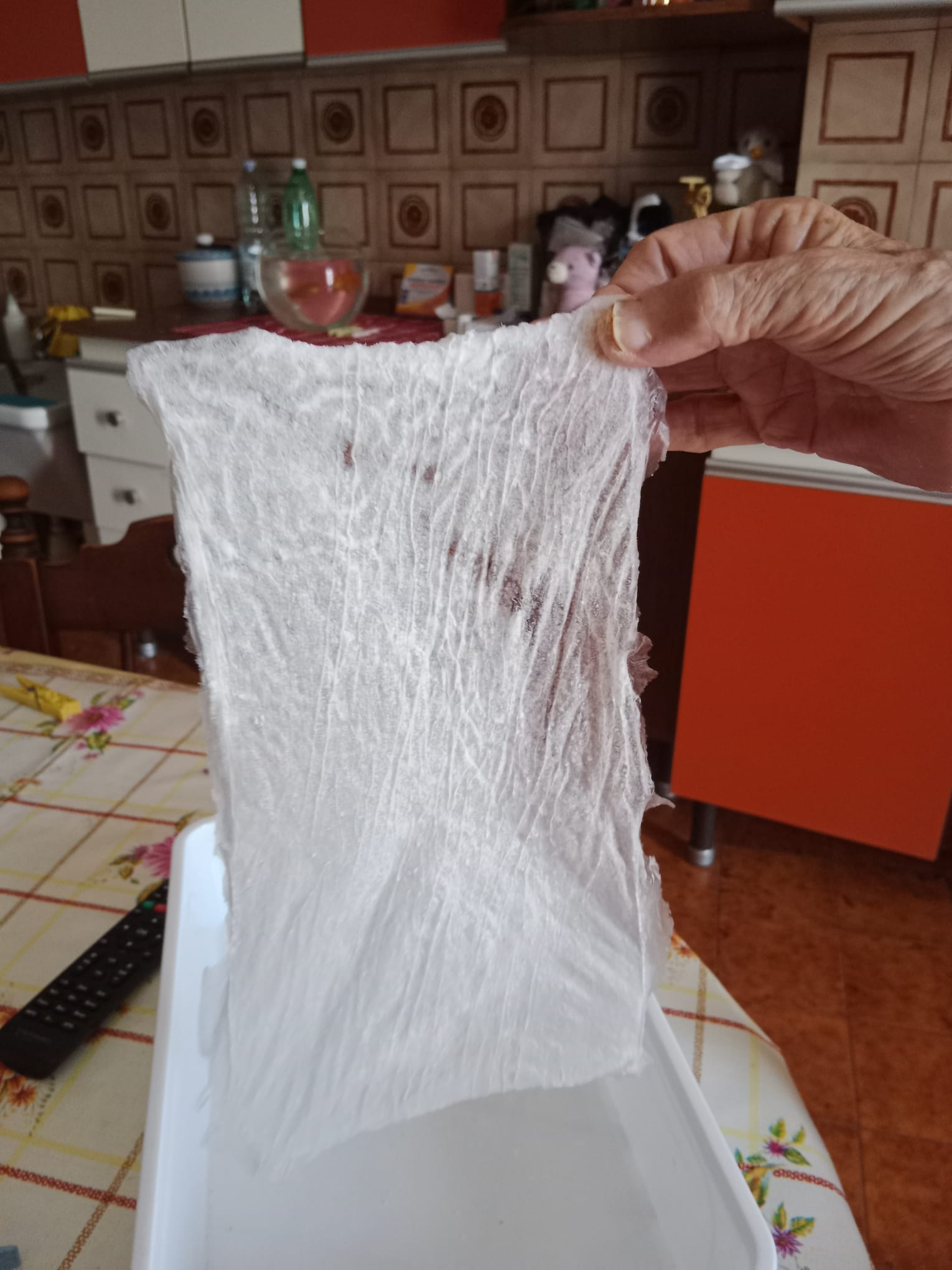
3.2 Hydro-Layering Process The central technique is hydro-layering, which induces molecular suspension through:
- organic thickeners
- calcium carbonate
- natural cellulose fibers
- surfactants (such as those found in toothpaste) This compound creates a high-density hygroscopic matrix that stabilizes the liquid, transforming it into a solid architectural membrane.
3.3 Material Safety and Flammability Empirical tests demonstrate that the resulting organic-mineral compound is:
- naturally flame retardant
- non-flammable
- suitable for public display This elevates the research from simple artistic experimentation to innovation in the field of material safety.
3.4 Reversibility and Programmed Solubility The solidified sea retains a “memory of water,” which means that:
- humidity reactivates the material
- the solid can return to a liquid state
- the work becomes a “stabilized moment” rather than a permanent object This introduces a new ontology of reversible art.
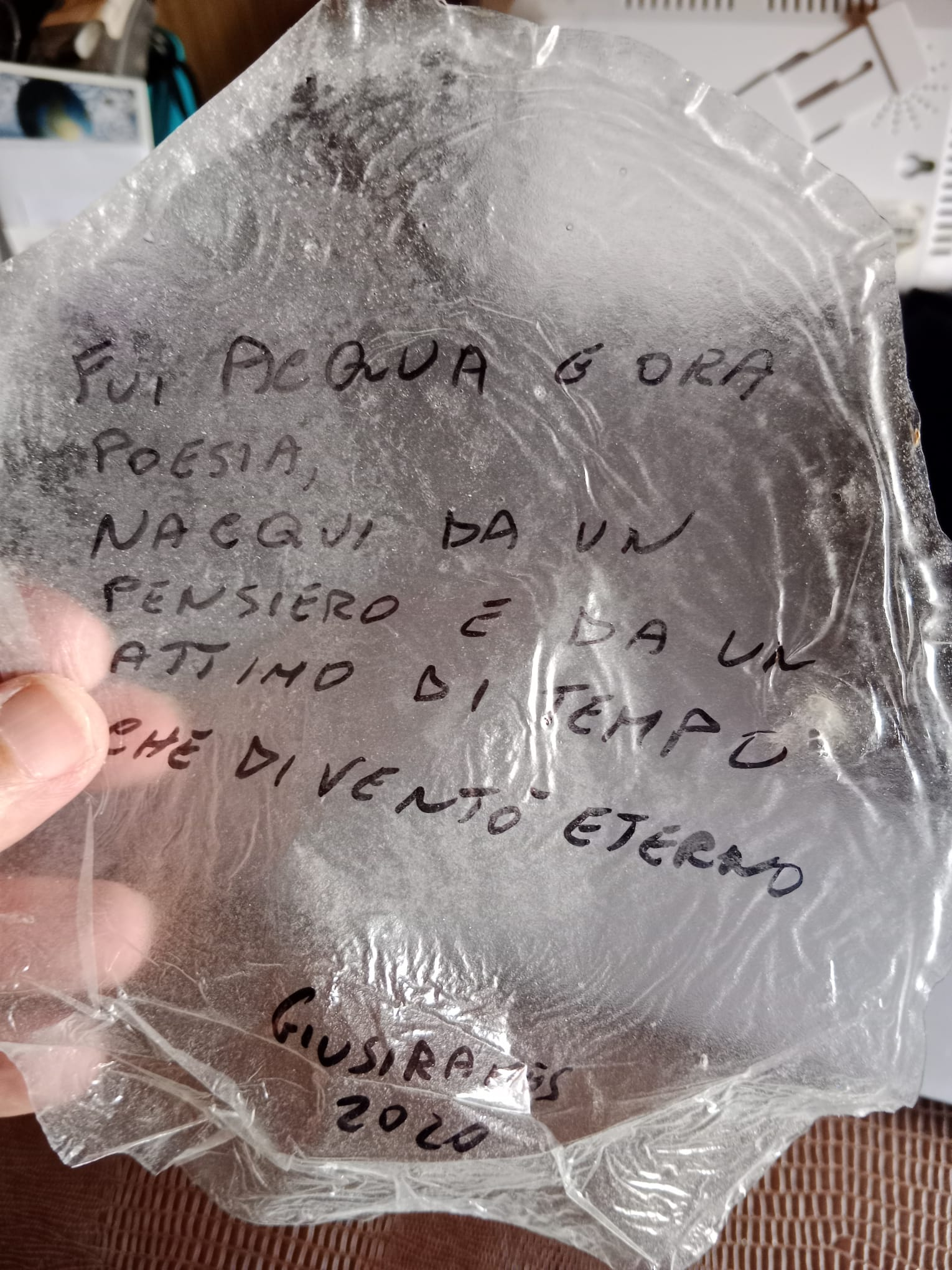
3.5 Poetics The choice of the Sea, a millennial companion, allows for the expression of a poetic texture, where poems can be dedicated to it, or cities long loved by its passion can be represented in it. The work is alive, a microworld that evolves and generates life, art, and history. A work created in this way has no value, because it is unusual, unique, and impossible, because for centuries it has inspired lovers and poets, dreamers and rebels, sailors and simple fishermen. It doesn’t matter if it changes; what matters is taking care of it, immortalizing a single moment of time, giving poetry a three-dimensionality. I wish my heart could be read or heard, to recite what I feel in this gesture. Infinity now has a boundary, eternity a door, a window through which to spy on creation.
- Solidification of Rain
4.1 Rain as an Atmospheric Event Rain is not treated as a mass, but as a vertical meteorological event, as a romantic vision and an ethereal cry. Solidifying rain means:
- freezing time at the moment of impact
- capturing the connection between heaven and earth
- transforming each drop into a “tear of light”
4.2 Capture Methodology Rain is solidified through reception matrices designed to arrest molecular motion at the moment of impact.
The process involves:
- instant gelation activated by organic thickeners
- integration of each drop into a solid transparent membrane
- preservation of the drop’s luminous purity This creates a crystalline archive of atmospheric weather. Everything is natural and unique, poetically unrehearsed or unheard.
4.3 Reversibility and the Water Cycle Solidified rain is intentionally water-soluble. This ensures:
- the possibility of the work re-dissolving in water if exposed to humidity
- a closed cycle in which medium and subject coincide
- a poetic alignment with natural thermodynamics.
- Chromatic and Chemical Innovations
5.1 Sodium Hypochlorite as a Reagent Research repurposes sodium hypochlorite (Amuchina) as:
- molecular separation agent
- catalyst for pigment “blooming”
- generator of autonomous color structures This prevents pigment contamination and creates textures similar to geological processes. This process, born from a sensitive period in world history—Covid-19—brings about a better mood.
5.2 Neuro-Aesthetic Implications The clarity of autonomous colors and the tactile nature of the resulting shapes have shown:
- positive emotional responses
- benefits for neurodivergent people
- heightened perceptual engagement
- Philosophical Implications The solidification of liquids is not just a technical achievement. It is a poetic and ontological investigation of:
- impermanence
- entropy
- the memory of water
- the transformation of natural events into cognitive artifacts The resulting objects are poetic archives, crystallized moments of the world’s continuous becoming.
- Conclusion This research defines a new field of material aesthetics, in which liquids—sea, rain, and other fluids—can be stabilized in solid, transparent, fireproof, and reversible structures. The work merges science and poetry, creating a material that is both empirically verified and philosophically resonant. It redefines what it means to give form to the ephemeral and leads to where the fourth dimension has always awaited.