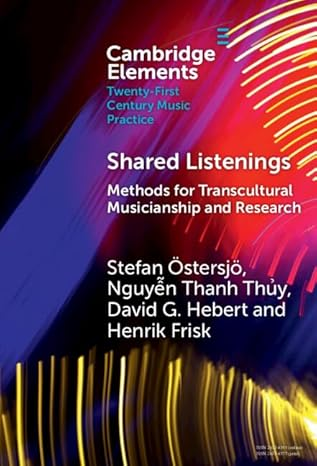
Shared Listenings: Methods for Transcultural Musicianship and Research - Stefan Östersjö, Nguyen Thanh Thủy, David G. Hebert, and Henrik Frisk. Cambridge: Cambridge University Press, 2023
By Renick Bell
Some improvisations have shaken me so hard that they still resonate in my memory more than a decade after they took place. I remember sitting in the dark at SuperDeluxe in Roppongi, Tokyo, on 9 December 2009, watching Michiyo Yagi on koto and Peter Brötzmann on sax collide on stage (EigenKino 2009). Almost a year later on 8 September 2010, it was Keiji Haino on vocals and guitar and Han Bennink on drums in that same space (Tokyo Gig Guide 2025). These memories rush back in while I read Shared Listenings: Methods for Transcultural Musicianship and Research by Stefan Östersjö, Nguyen Thanh Thủy, David G. Hebert, and Henrik Frisk.
Their project recalls historical precedents of musicians navigating culture and tradition to achieve powerful music. It is not just collaborations I remember hearing while living in Japan that come to mind. I am reminded of a concert at South Street Seaport in New York City in late 1998 or early 1999, seeing John Zorn and Naked City deferring to the Boredoms in a gesture of respect by allowing them to close the concert. Zorn made a self-deprecating comment when opening their Naked City set, saying it would be impossible for them to follow up after the Boredoms, but it was also gracious to give the final performance of the event to the band from Japan. The two performances are among the most impactful I have ever experienced.
These performances and this book – and in fact all of my experience as an improvising musician – remind me that the act of making space for others is a recurring necessity in creative music. If you have ever watched improvisers, you may share the feeling of intense curiosity that I have about if and how they are communicating, whether the signals that they transmit are being picked up and acted upon by their collaborators.
“It’s not good to just sit there and twang because you’ll reach a limit. But if you learn about other people and other experiences then you can broaden your horizons […]; the good thing about records is they bring people together and you have an experience. For instance you are in a studio. Me and Bhatt were there two hours” says guitarist Ry Cooder (Reid 2009). We should be well-acquainted with the potential that collaboration across culture presents. Cooder’s Grammy winning record with Indian mohan veena player V.M. Bhatt, A Meeting by the River, demonstrates this beyond doubt; even a two-hour recording session is enough.
Bringing people together and having an experience seem to drive Östersjö, Nguyen, Hebert, and Frisk. They make a deep dive into what happens at the particular intersection of a cohort of Vietnamese and Swedish musicians. Their book follows two main threads: a look at personal ethical considerations in musical improvisation in light of history and culture, and a very practical study of how improvisation happens through reflection on video recordings. They have turned this curiosity about the intentions and reflections of improvising musicians into a rigorous, ethical, and deeply personal study, an exploration of what happens when the lab for society that is musical improvisation meets the complexities of post-colonial power dynamics.
The authors also do not shy away from the inherent power imbalances present in such a collaboration. In this autoethnographic study, they begin with a deliberate intention to undo the power inherited by white Europeans, attempting to uncenter their own positions to learn from Vietnamese musicians and their cultural forms. This is not a simple "mutual learning" exercise; in fact, the authors suggest that such a balanced ideal might not even be feasible in intercultural collaboration. Instead, it requires the Western musicians to actively struggle to relinquish power in search of an egalitarian relationship. This ethical stance drives the experiment forward, moving beyond mere aesthetic fusion to address the tragic conditions that often bring cultures together, reminding the reader that while cultural collisions can be great, they are frequently rooted in histories of colonization and conflict.
Miles Davis understood the pragmatics of making music up to his standard, saying of musicians he hired “What difference does it make what color he is” (Maher and Dorr 2009: 202), but he regularly reminded us that “People can live together, but all that old shit hasn’t stopped” (Maher and Dorr 2009: 123). He was outspoken about the racial injustices that continued throughout his life, and we can find them still present today. The authors of Shared Listenings are aware of these injustices and document their work in the attempt to actively eliminate them from their practice, discussing concerns about the field of ethnomusicology, the writing of George Lewis, and tensions between decolonization and transculturation.
While the authors deal with these imbalances, they also examine those pragmatics of making music together by examining video recordings of their sessions. We have all experienced that cringe you feel upon hearing a recording of your own voice or seeing a photo of yourself; some of us are particularly averse to this "voice confrontation" or the "mere exposure effect." The authors of this book lean into it with a method called "stimulated recall," recording their sessions on video and then sitting down to watch and discuss them together, finding insights when the performers themselves reflect on what they were doing. They practiced this exercise repeatedly, coding specific moments in the videos, categorizing them into themes such as "seeking understanding" or "finding common ground." The book puts forward the value of repetition: carrying out the same exercises and analysis in different contexts reveals new insights. It takes a certain kind of personality or training to analyze oneself constructively, but the potential for learning here seems vast. I would love to have heard an after-the-event analysis of those Yagi/Brötzmann or Haino/Bennink sets. I would love to read a transcript of Bhatt and Cooder watching a video of their two-hour session and read them in dialogue about it. What were they thinking? Did their musical backgrounds call for one action while their partner, coming from a different culture, chose something else entirely? The authors present us with just such analyses.
The musical landscape of the book is shaped by a blend of instruments: the dàn tranh (zither), the đàn bầu (monochord), guitar, and electronics. The presence of the dàn tranh in particular reminds me of Yagi’s collaboration on koto with Brötzmann. However, the instruments and their character is less of an issue in this book than the dynamics between the performers, their reactions to their recordings, and pragmatic issues of “intercultural collaboration” (Östersjö et al. 2023: 4). Interestingly, while the Western performers brought electronic sounds, there was no electronic equivalent from the Vietnamese side, a factor that surely influenced the challenges of the musical collaboration. Though they might have felt this kind of discussion outside of the scope of the book, as an electronic musician, I feel that the impact of this difference could have been great enough to affect the cultural aspects involved and I would like to have at least seen it addressed. In my experience as a musician on both electronic and acoustic instruments, it can be difficult to navigate the differences in a cultural context that each brings to a musical performance, including historical origins, playing styles, and especially timbre. The instruments tend to evoke different ranges of affect and manifest different cultural markers. Further, it can be difficult to achieve coherent results because of the differing spectral character of these two categories: electronic instruments require amplification, and it is difficult to make a cohesive mix with unamplified acoustic instruments and amplified electronic ones. Blending them is not a simple matter. Mixing is also not just a technical issue, but culturally important, determining the aural location and weight of each performer in an ensemble.
The participants’ reflections reveal how they navigate the collaboration differently: Nguyen describes herself at one point as eventually seeking freedom beyond traditional styles of playing, while Östersjö mentions adapting his own practice to play within a Vietnamese stylistic framework. Through the process of creating their album and sessions, the musicians search for a synthesis that feels authentic. It was not always easy; for the Vietnamese musicians, the Western methods sometimes felt out of place or incapable of expressing matters of cultural importance. The Vietnamese Vọng Cổ style of songs play a central role in working towards that synthesis. Through repeated sessions across different contexts, they found that traditional forms, when reinterpreted, could become vehicles for entirely new expressions.
Shared Listenings is more than a research text; it is a guide for the "reflective practice" that every improviser should ideally undergo. The authors demonstrate that by facing the difficulty of unfamiliar contexts and sharing critical views, one reward is a deeper understanding of one's own musical behavior. This book recommends us to look at our own practices with the same scrutiny that they have employed. It asks us to consider if our learning is extractive or if it is a genuine attempt to correct unjust imbalances of power. It invites us to develop a keener sense of how to make space for others.
For anyone who has ever improvised with others and wondered "what just happened?", this book also provides some tools to start answering that question. It is a poignant reminder that while the moment of improvisation is fleeting, the lessons we can extract from it, if we have the will to listen, are enduring.
References
EigenKino, dir. (2009). Peter Brötzmann & Michiyo Yagi 01 @ SuperDeluxe “BrötzFest 2009.”
EigenKino, dir. (2009). Peter Brötzmann & Michiyo Yagi 02 @ SuperDeluxe “BrötzFest 2009.”
Maher, Paul, and Michael K. Dorr (2009). Miles on Miles: Interviews and Encounters with Miles Davis, Vol. 1. Chicago: Chicago Review Press.
Reid, Graham (2009). “RY COODER INTERVIEWED (2009): Dry, Wry and Moving Right Along.” Elsewhere, October 5.
Tokyo Gig Guide (n.d.). “Han Bennink (from ICP Orchestra), Keiji Haino.”