the SPROUT | first steps, initial ideas & insights
REDEFINITION of my trapeze as an 'unfinished entity'
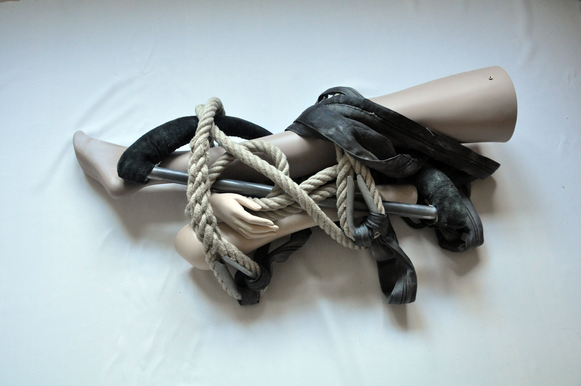
The start of this research for me was marked by my realisation that in fact the ropes and steel bar only are becoming a trapeze through the process of bringing them into certain relation to each other (craft of building a trapeze through welding and splicing) and the actual rigging – attaching it to another, superordinate (architectural) structure where it is suspended from.
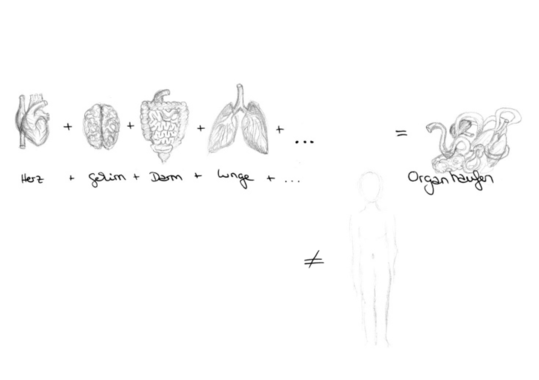
As the body is not just a mere pile of organs, but forms a greater whole through synergetic interaction (and a human is not even just material flesh and bones). Also the trapeze and the practice of trapeze acrobatics lost its soul for me when I started to deconstruct the object and the movement techniques. And there was this insight, that only the connections to a greater whole would make it what it is – a real trapeze, that which I love and I am passionate about.
KEY NOTION of INTERCONNECTIVITY
Once I had to present a solo work in a theater that was not at all equipped for aerial rigging. The technician told me the ceiling grid was approved for 75kg and added 'but you do not weight more than that, do you?'
It is obvious for every aerial acrobat, but probably also anybody else who is familiar with some basic laws of physics around gravity and dynamics, that the tiniest movement of a suspended body can multiply the gravitational force pulling down from the hanging point it is connected to.
The improvised solo I made back then was called 'how to not make the ceiling come down on us', referring to the actual danger of breaking or pulling down the metal bars lighting grid in this small theater, that also reached over the audience space.
In my attentive presence in the moment of performance I became literally 'physically aware' of how my body was connected to the aerial 'object' (I used only a suspended sling, to reduce the weight any trapeze bar or similar would have added) how the object was connected to the grid, the grid to the building, but also the risk-aspect was connected to my peers in the audience underneath the same structure.
In this way that moment was crucial for defining my key term of interconnectivity as essential foundation of this research.
>> these first findings helped to shape the further trajectory and define the RESEARCH OBJECTIVES
my SEED | or the ORIGINS
of this Artistic Research project
As initial subject matter this practice-led research is based on a far back reaching personal desire and motivation to attempt to re-define body & object relationships in my art form I am passionate about for more than 20 years – aerial, especially trapeze acrobatics.
My personal urgency resonates here with thoughts in the contemporary circus scene. Other circus practitioners and creators express in the current debates about contemporary circus as well this 'Need to Redefine' as especially Bauke Lievens articulates it exactly like this in her 'Open Letters to the Circus'.
The taming of the apparatus and the objectification of the acrobatic body through the discipline are traditionally essential features of circus performances.
In nowadays point of view, throughout socio-political debates and in various philosophical perspectives of a post-antropocentric world view those approaches do not seem to be coherent. Especially they also do not feel right, and therefore I am left with a strong desire to research other, alternative approaches how to relate to my suspended aerial partner.
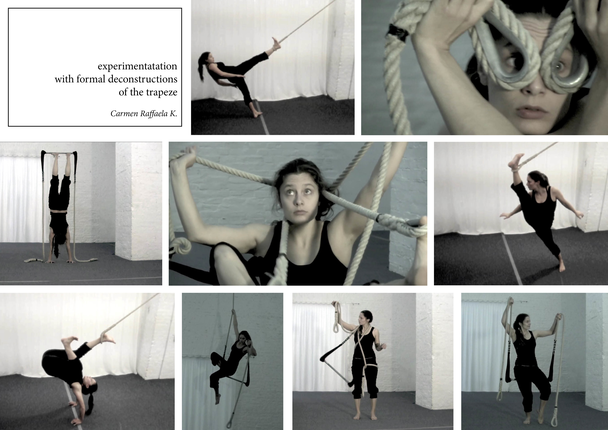
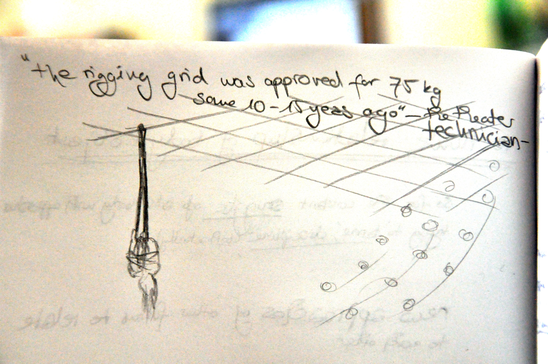
originally I worked with deconstruction, taking the trapeze as pure material – soon I realized that without the aspect of suspension I would loose the essence. Just ropes and a bar don't make a trapeze yet...
This research has the following aims on its agenda:
I am looking for Re-definitions body & object relationships in multilayered nature:
– as a human being (socio-political, ecology layer)
– as an artist (art & artistic research layer)
– as an aerial acrobat (circus context layer)
I am making attempts to Question, develop and deepen my aerial acrobatic practice
re-defining the relationship to my body and between body & object asks for a new approach to aerial technique and researching the potential of artistic expression through movement of the suspended body.
I am asking myself How to do Artistic Research? In order find my own definition and standing in this field.
I want to make efforts to stay true to my belief of content & form entwinement (design thinking context)
And therefore ask myself: how to find a form of research that suits the arts (in general, and not just adapting to traditional scientific methods) and also my personal artistic research practice in particular?
In relation to the preceding question of the how, I am elaborating on my quest of finding a suitable methodology for conducting artistic research. Actually a (non) methodology of sustainability, experimenting a new transfer and application of the permaculture philosophy.
Furthermore I want to give impulses for reflection and dialogue on Interdependencies & Complexity of the World we live in. I want to explore and experience myself and with others (research team, collaborators & audience) – with our physical bodies – in movement
For a direct connection to how these aims were met in the researchs' trajectory you are invited to explore the links to the following aspects
> new application of permaculture philosophy (Link How/methodology)
> new proposals for collaboration strategies and reflection on social structures (link Striking Roots Context)
> new understanding interconnectedness and complexities of cohabitation on our planet – of the interdependencies of human and non-human ‘elements’. (link Striking Roots Context)
> a practical application of this new awareness and mindset within an example
of an aerial acrobatics practice and performance creation (link Fruit Aerial Rooting)
> reflection on wholistic thinking, post-humanism, environmentalism, artistic creation processes & sustainability (link Striking Roots main)
Another summary and conclusion about this research is elaborated more in >> Fruits
essentially this Artistic Research
is about my own circus trained body & designers
mind – as seed (where there is already much information
inside) and the process of its growth accompanied by a (non) methodology of permaculture, which facilitated the development
of Pre-Choreographic Elements (PCE) through the basic principles
of observation and pattern recognition. These PCE then created
the basis for the development of a basic concept around
'physical lead' as a method for aerial