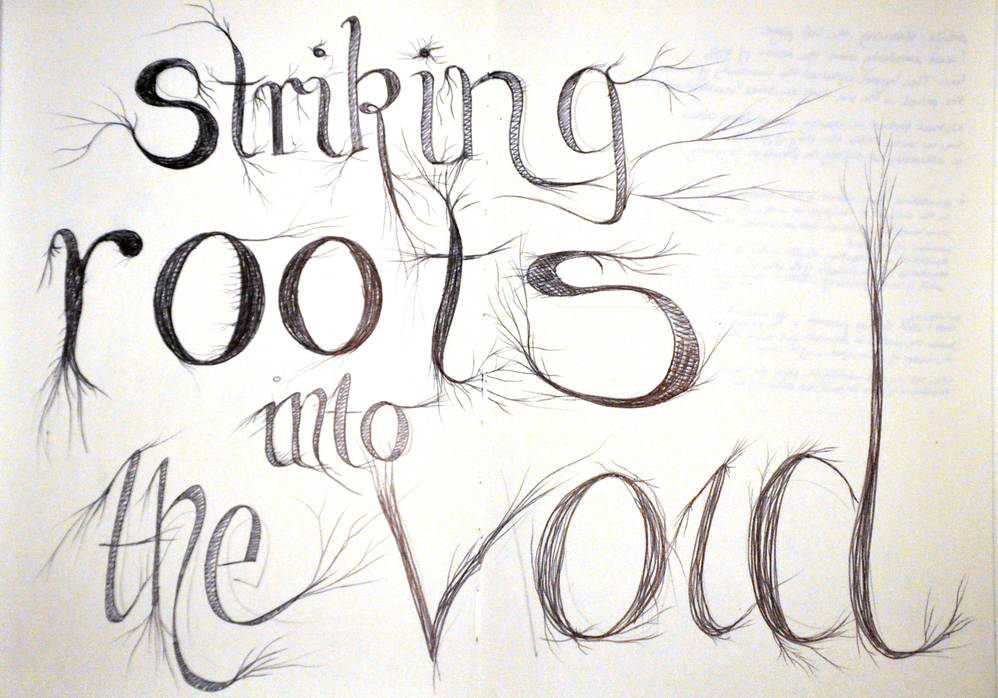
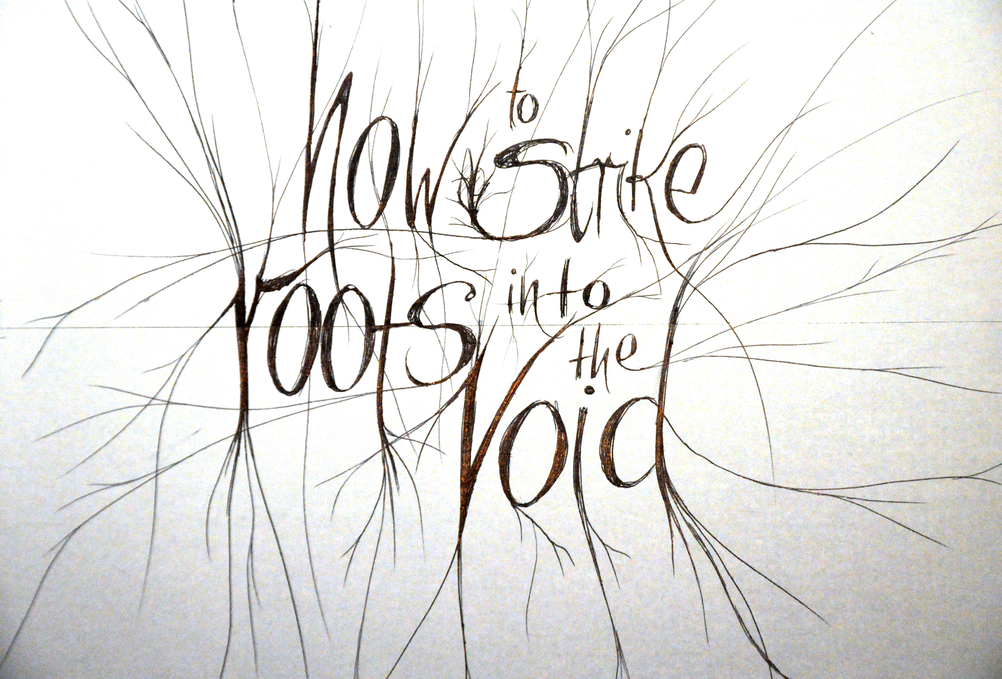
Form & content are inseperable as theory and practice are intertwined. They influence, inform and inspire each other, if we only give the space and time to let it happen. For me this is the strength and potential for innovation through artistic research.
the RHIZOMA
The key notion of interconnectivity might be threatening in its vastness and is challenging due to its general inclusivity of just 'everything' making it difficult to follow a clear pathway.
However this is what Artistic Research for me is about: an adventurous journey into the unknown. It is the work of a pioneer, the constant risk of failure and getting lost.
Furthermore this Artistic Research project about interconnectivity unfolded itself in the process as rather rhizomatic, than of any linear growth.
The Rhizoma concept was coined by the philosophers Deleuze and Guattari, denominating a multidirectional growth in a non-hierarchical structure. A famous example for this rhizomatic nature is the ginger root, but also potatoes grow in that same way, not focussing on a vertical axis to grow down roots deep into the earth and sprout a stem into the skies with the leaves and fruit hanging from the very tips of their ramified branches.
The RHIZOME is the most suitable FORM
for Artistic Research CONTENT.
Artistic Research in general, and this project in particular, often unfolds, in the emergent nature of the creative process, like a rhizome. You cannot foresee the outcome, and there will occur many surprising divergences, that could eventually blossom, if given the focus and time to do so. For this research that was the conceptual format needed to deal with the content and to keep an overview of the process as it unfolds. It helped me to structure the projects trajectory and served as a coherent concept to be transferred into many facettes of e.g. the moment of Pattern Recognition to result in a PRE-CHOREOGRAPHIC ELEMENT, as well as the research documentation, which took shape in a RHIZOMATIC BOOK OBJECT.
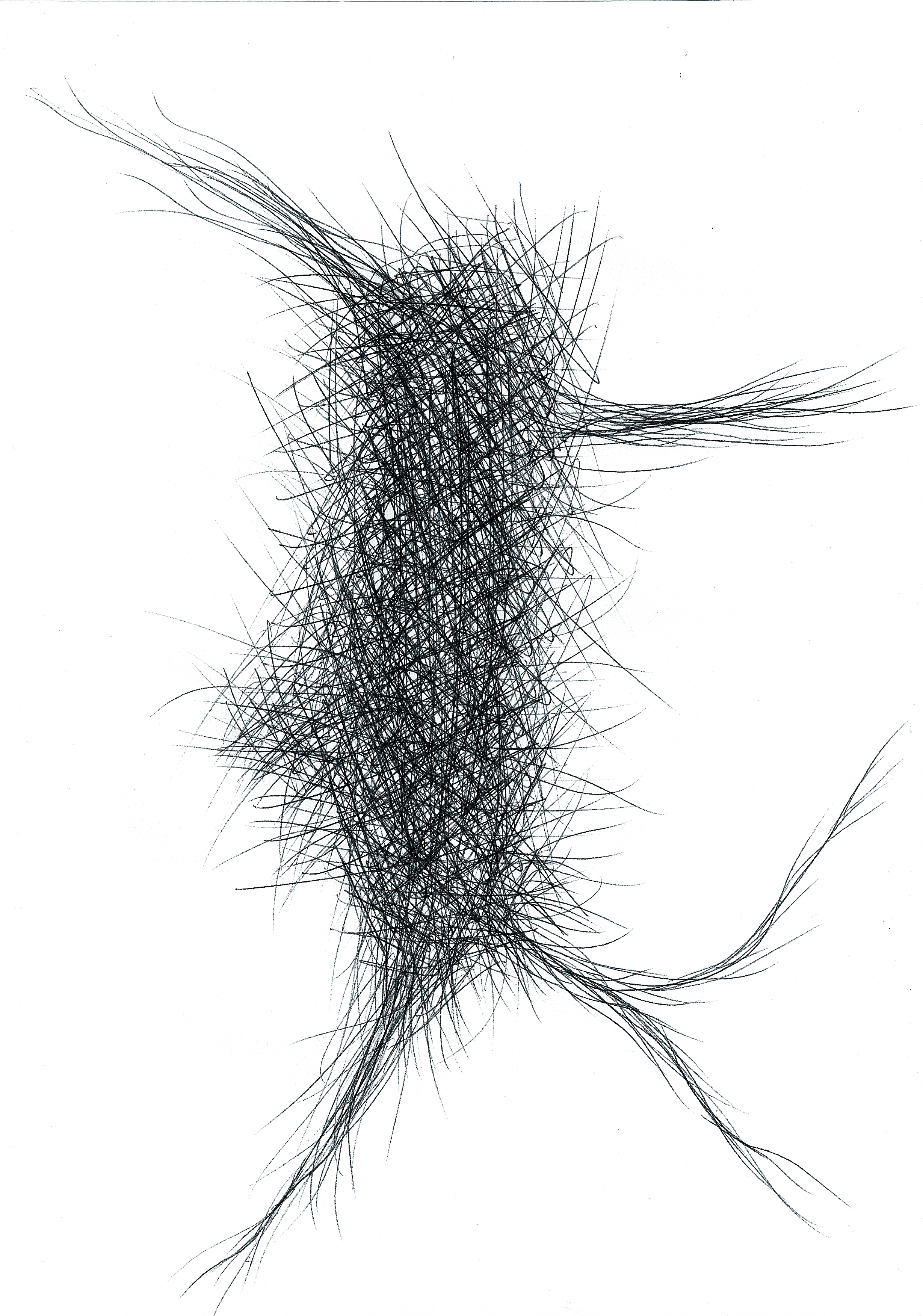
I have been drawing many versions of my research question, taking this action as a moment to observe the process of drawing in itself, circling my thoughts and processing my latest insights around thinking through making and the 'submission lead' method I started to develop. This aerial acrobatic practice is about giving more agency to the embodied physical knowledge, for a mutual responsiveness of a mind-set and a body-set on eye-level.
Furthermore the drawing practices let the typo-graphic design as a whole develop.
One of which also became the intro page of this exposition how to strike roots into the void?
CLASH between TREE & RHIZOME as analogy to
clash between hard science and artistic research
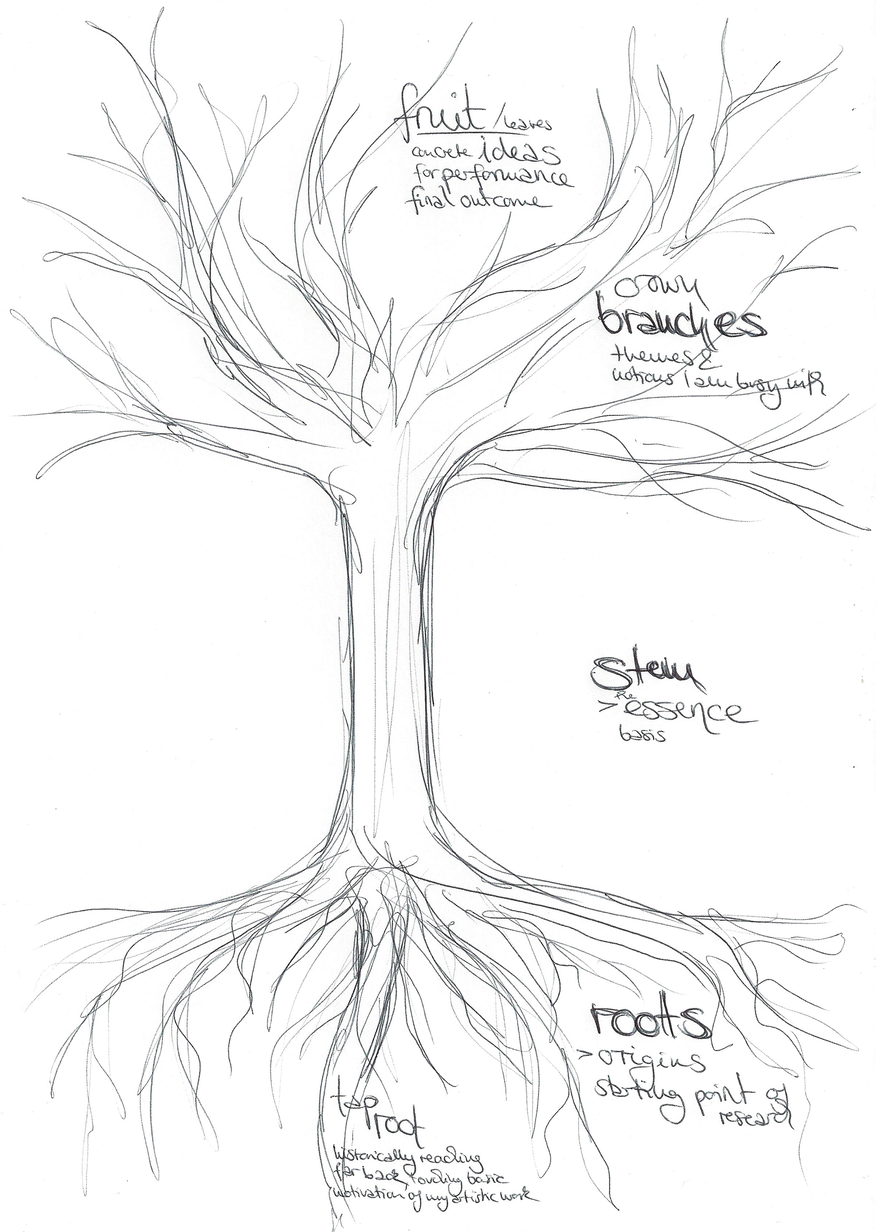
Since Artistic Research tends to follow a rhizomatic form of development it generates knowledge not only in multidirectional ways, but also multiple sorts of outcomes, maybe sometimes even not reaching a concrete final goal. Science asks for direction, a linear traceable 'forward' way and asks for fruits, productive outcomes, or actually even a proven hypothesis, which referring rather to a tree like structure.
This conflict reflects my inner struggle over the process of this research. One of my early 'Mindmaps' I drew in the form of a tree, but I realized more and more that the project has been unfolding much more rhizomatically.
When trying to structure my documentation, and also now during my writing of this final exposition document I am drawn to stay true to its rhizomatic nature. However, the contrary is asked by the academic structure, and how people are used to perceive and approach new knowledge, it is expected that the writer guides the research trajectory in linear ways, to weave one single, clear thread for the reader to follow from A to B. I haven't found a solution for this paradox challenge yet, but just did my best, to make use of both concepts where I felt the one or other is most useful to represent the specific content.
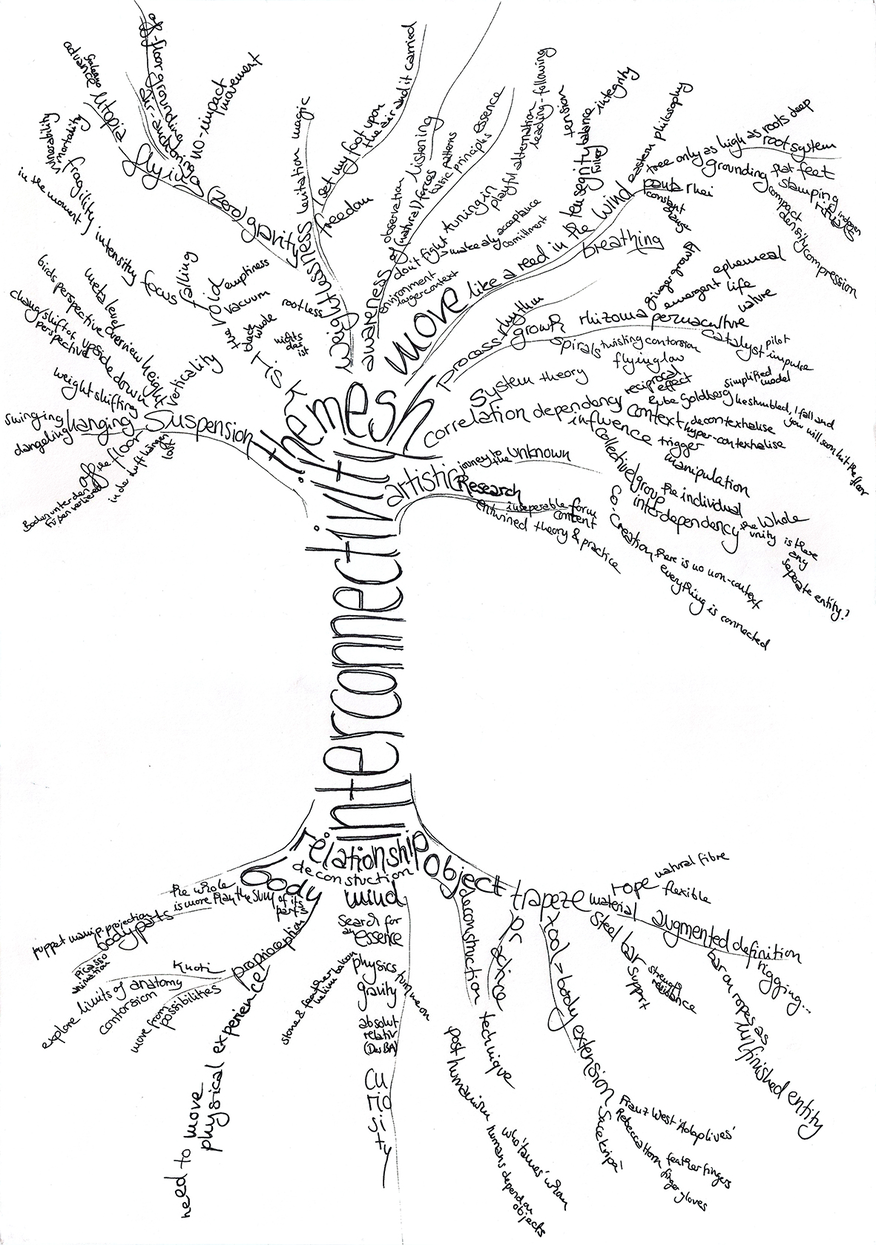
DRAWING as THINKING THROUGH MAKING
inter/multidisciplinary approach of artistic research
the act of drawing of the research question
The different media and forms of artistic expression I use in my practice inspired my thinking through the making – I rather DREW my illuminating question than just formally putting it down in my notebook. And this very process of creating that typographical illustration was strongly reminding me about the idea of ‘(bodily) submission leads, and mastery follows’ as Tim Ingold exemplifies with the very same idea of ‘drawing a line’.
»when you draw you push your pencil out. In a way that you are never quite sure where its going to go next. The line of the pencil, going like this, so where is it going? it’s always a little hesitant at the tip. Just as when you’re walking – where you put the next step? (...) its not all planned out, you are working it out as you go along.«
»I am somehow in the midst of the action. So that my agency is not something that is given up front in advance. Here is me and I am going to do that and I do it. My agency is inside the action and is emerging continually as a question.«
For me this resonantes directly with my main finding of a method for aerial improvisation within these shifting roles of leading & following.
Making art is in a way also just a certain way of communication. Although I do not agree that my aerial movement can be called a language I indeed do believe that my movements are means of artistic expression. And therefore a form of communication through the body.
For this moment in my artistic development, on the layer of 'theorizing creative processes' I was very much interested in how to deal with this genre immanent challenge of form & content entwinement, actually the merging of theory & practice – I have a strong background in Visual Communication, and have constantly been hearing the echoing voice of Marshall McLuhan: 'the medium is the message', and the design principle 'form follows function'.
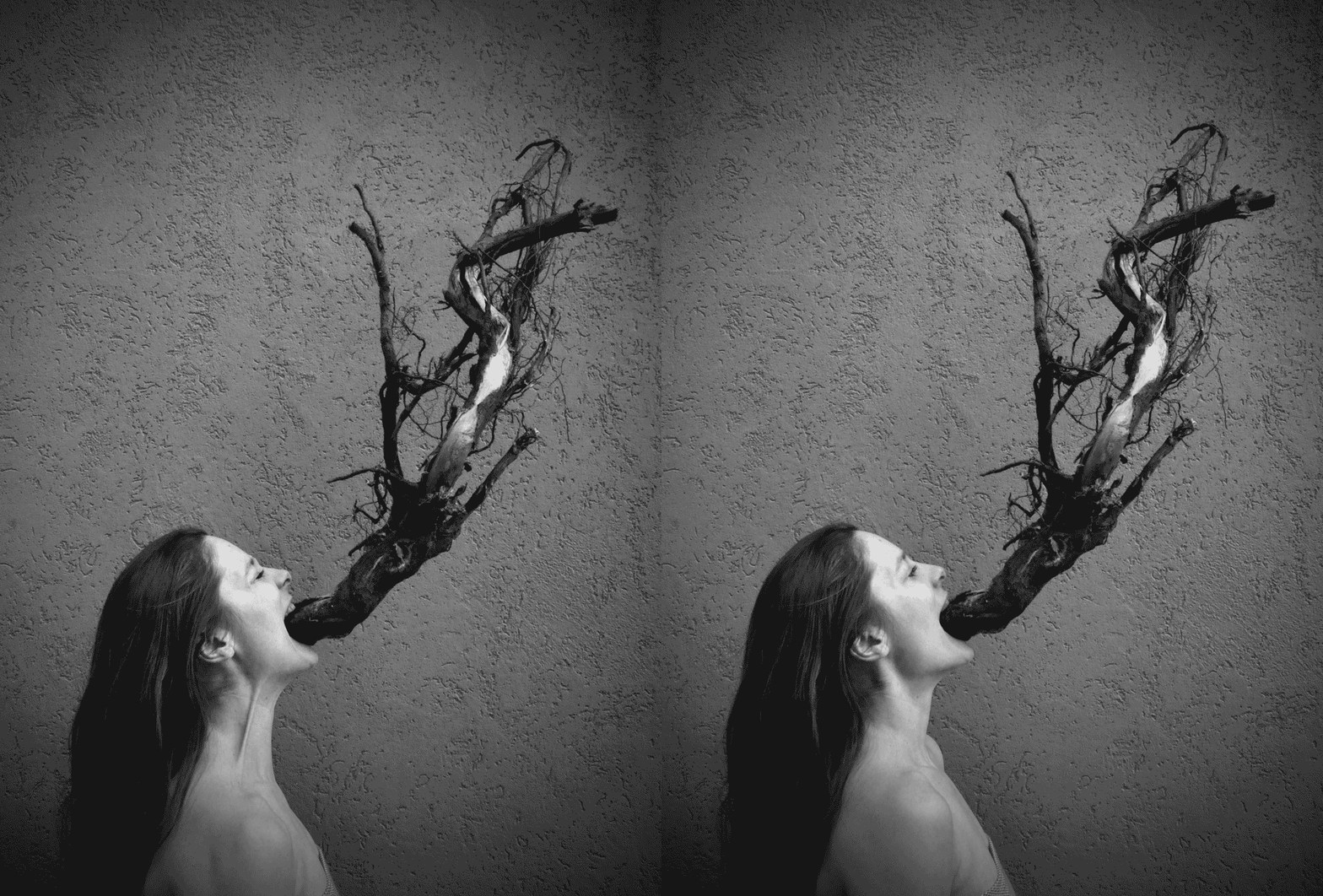
metaphoric gif-animation visualising the breath and how inter-
dependend we are within the greater whole of our environment
The tree and forest metaphor works like a fractal analogy for the bigger picture of how interconnectivity shows on our planet as a whole. In this layer, the ‘biggest picture’ I adress to, is the system of ecology in relation to the whole planet - human relationship referring to post-anthropocentric, posthuman philosophical points of view, that make an effort to shift our focus and perception.
I want to contribute my own thoughts about how to re-define human and non-human cohabitation and raise an awareness for wholistic thinking and a feeling of interconnectivity.
How a human could feel like a tree, always connected with all the rest of the whole forest, the
whole world, taking his share of support, but also serving a bigger purpose in circumspect attention. This also refers to concepts and thoughts of new materialism, like e.g. Jane Bennetts guiding question in her book Vibrant Matter: “How would political responses to public problems change were we to take seriously the vitality of (nonhuman) bodies?” (Bennett, J./2010)
Within the practical part of this research I sort of literally translated the tree metaphor and made a tree root my aerial partner. I consciously use partner instead of 'apparatus' or object, because in order to apply these ideological concepts as proposed by Bennett to my field of aerial acrobatics, the 'object' as a seriously taken nonhuman body is in fact a co-creator of my piece. The suspended tree root in contrast to a more traditional apparatus like a trapeze has a sort of individual character, a unique natural, organic form, certain features of a 'personal' dynamic 'behaviour', a special texture and form.
(more about the specific application in aerials > FRUIT – Development of a Method)
Back to the 'big dramaturgy' – the changing 'sense of self' of the human race. Historically there are many different images, that developed over time, and also still many parallel concepts exists in different cultures. Indigenous cultures mostly have a much closer relationship to nature, and see themselves naturally as part of it. The worldview and self-perception of man in the western societies, has been subject to greater changes in history.
'For a long time man was stably rooted on the ladder of life. Beneath him stood inanimate nature, plants and animals. Above him were supernatural beings, the angels and God. Man took part in both realms.' writes Werner Kogge (Koch, 2012) about the former concepts. And he continues: 'This concept of the scala naturae held through the Renaissance before giving way to a different image, that of the tree of life'. Although it was at first interpreted as though man would be represented as more highly evolved in the image of the tree of life, but this image seems to flip when 'commentators have repeatedly insisted (that the image of the tree of life) shows chronological relationships and not a logic of quality.' (Koch/Kogge, p.22)
Reflecting our presence in the world we could and should shift and flip the image of the tree of life again and again for potentially new perspectives.
As refelcted also in the imaginative structure of Artstic Research I propose to make an effort to turn the tree of life into a rhizome of life. (see Form&Content) to represent the non-hierachical order, the inseparability of matter & living beings and reflect a possible non-linearity of space and time.
'My story also explains why forests matter on a global scale. Trees are important, but when trees unite to create a fully functioning forest, you really can say that the whole is greater than its parts. Your trees may not function exactly as my trees do, and your forest might look a little different, but the underlying narrative is the same: forests matter at a more fundamental level than most of us realize.' (Wohlleben, 2015)
The living organism, for Deleuze, is a bundle of lines, a haecceity. Critically, these lines do not connect points but pass forever amidst and between. Considering the way in which this idea has been taken up in so-called actor-network theory,particularly associated with the work of Bruno Latour, I return to the importance of distinguishing the network as a set of interconnected points from the meshwork as an interweaving of lines.
(Ingold, 2011, p. 64)
POTENTIAL of CIRCUS & AERIAL to have an IMPACT on other FIELDS
The question of how to strike roots into the void? is not only essential and important within the context of aerial acrobatics, but furthermore opens up the ability to look at other fields of knowledge and different aspects of life, from various perspectives.
»It is by escaping gravity that the body can metaphorically escape the social, moral and political order« (Dumont, 2015). This is what makes the art of aerial acrobatics a particularly exciting and suitable genre to practically investigate also philosophical, and socio-political perspectives. Beyond theoretical discourses and intellectual, language based exchanges, the art of aerial acrobatics in its moments of performance bears the unique, precious potential to function as a tool for giving impulse to reflection and broadening one's horizon in a live performance experience.
As the philosopher and flying trapeze passionate Sam Keen expresses: »Under the spell created by catharsis of laughter and awe, we are transubstantiated, transformed, changed back into children whose horizons are open« In that way this phenomenon applies not only to aerial acrobatics, but in a more general sense to the circus genre as such »the circus like philosophy, invites us to question our normal judgements« (Keen,1999, p.25)
In an up to date unpublished scientific study in collaboration with Cirque Du Soleil researchers made an effort to actually proove that the awe of (spectacular) live performances »makes us fundamentally better and more open minded people, less anxious and less afraid of uncertainty« (longer excerpt of the article here > follow the 'loose ends' to the right!)
THIS IS ABOUT SOMETHING LARGER THAN (MY)SELF
Although if we sometimes forget or neglect – to more or less extend we human beings do know that our knowledge about the world, including ourselves, is fairly limited. As already the Socratic Paradox, rooted back in the greek ancient world, states : 'I know that I know nothing.' And Keen again specifies: »I am imprisoned within a psyche that limits my vision. Everything that clusters around my name and my identity keeps me from seeing what is beyond my ego. No matter how hard I try, I can't jump out of the parenthesis of my own time and space.«
Sharing this first awareness and connected feelings I can also relate to his ensuing thoughts: »But, at times, I am troubled by a feeling that is an amalgam of longing, curiosity, and dread, because even though I am horizon-bound, I know I am encompassed by a great Beyond.« »Even when I feel most solitary, I know that I am within some Web of Being that is infinitely larger than myself.« (Keen, 1999, p.29/30)
As I experienced within my own artistic aerial practice (how to not make the ceiling come down on us & the trapeze as unfinished entitiy) despite all connotations and associations of aerial acrobatics to freedom & the void, I can not perform my art in total independence. As nobody and nothing in this world can live in a vacuum, as there is no non-context, as 'One can not not communicate' (Watzlawick) and the self is always political.
I feel that resonating very much with what for me aerial art is about, and what insights the process of my own artistic development has been revealing to me lately. Therefore I was touched by the following words of Craig Weston's reaction to my portfolio: »You are one of the first aerialists I have met that is not involved with being ‘pretty’, the message you send is - “this is not about me, this is about something much bigger than me”.«
So far in this section of my exposition the context, I gave a short introduction in which ways circus, and aerial acrobatics in particular, have a significant potential to offer unusual perspectives and raise questions – that extended far beyond the borders of their own discipline. The connections of my research in a larger context could be roughly structured in layered strands, though my point somehow is that everything is linked and interconnected. In the limits of our human brain capacities it might be suitable here to ‘unravel the rope of tightly interwoven threads’ for clarification, to not get lost in its complexity.
This work of contextualising is basically about STRIKING ROOTS – it is about making connections, and is therefore, so to speak, a work of dramaturgy. You will find my thoughts on the ‘BIG DRAMATURGY’ of this Artistic Research clustered in 5 layers:
In a way this research is a all about making connections, in its form as well as in its content, it's not by chance but by close participant observation and recognition of the pattern, my own 'thinking-through-making' pattern actually, that I identified the term of interconnectivity as key to this research.
Thinking, talking and exchanging about all of these connections which are presented to me I have for a long time referred to this complexity as a sort of network. Though I had the vague feeling, that something was wrong with this term – especially because it is used so inflationary in the context of technology and digitalisation, I could not identify what kept me sceptical about it until I came across an eye-opening concept by Tim Ingold. The subtle but clear distinction he makes by differenciating the idea of a NETWORK from what he calls MESH(WORK) was very important for me, to come to a better understanding of my own work, and the nature of how I actually wanted to approach the topic of Interconnectivity:
In several interdisciplinary approaches physic perspectives begin to merge with philosophic thought. Some people are claiming that actually there is not matter and the world exists only in relationships, in the in-between of things. Lately there is a lot of research occuring around this theme, that might shift our common perceptions of the material world:
»the funny thing is, if you get to the bottom of this world that we experience then you will see that what was there in the beginning is not matter—matter does not even exist! All that exists is what is in between, not what I can hold onto. That is quite amazing, that all that exists is what is in between, but not the things you can hold onto: visible points of invisible intersecting relationships. However my wife says that my day depends on all these things I can hold onto, and she is right. Even if you say matter does not exist, roughly speaking, a whole heap of the intangible put together can create something tangible; that which we call matter. And this is the world we orient ourselves in. If I ask: “What exists?” there is no answer. All I can ask is: “What happens?” Everything is alive, so to speak.« (Dürr, 2012, p. 149)
REFERENCE LIST / BIBLIOGRAPHY
Bennett, J. (2009). Vibrant Matter: A Political Ecology of Things. Durham, NC: Duke University Press.
Boscacci, L. (2018). Wit(h)nessing | Environmental Humanities | Duke University Press. (n.d.). Retrieved from https://doi.org/10.1215/22011919-4385617
Dumont, A. (2015). Verticality, Weight and Gravity. Reflections on the concepts of verticality, weight and gravity in circus arts’ professional teaching. Retrieved from: http://www.fedec.eu/file/350/download
Dürr, H.P. (2012) Loving Dialogue. Translation of a lecture in german 17th Nov. 2012. SGI Germany Culture Centre, Munich (Presenter). Retrieved from: http://www.iop.or.jp/Documents/1323/Hans-Peter%20Durr.pdf
e-flux journal: Aranda, J., Wood, B. K., & Vidokle, A. (2015). Some Experiments in Art and Politics. In The Internet Does Not Exist. e-flux, Inc. Sternberg Press.
Grady, C. (2019, January 10). Cirque du Soleil and the neuroscience of awe. Retrieved from https://www.vox.com/culture/2019/1/10/18102701/cirque-du-soleil-lab-of-misfits-neuroscience-awe?fbclid=IwAR1oXRZW0LmZsgczdXis2U1gfgcD-RBXnK6MtVkzL9NupeVMe0c8iWd9Evg
Keen, S. (1999). Learning to Fly: Reflections on Fear, Trust, and the Joy of Letting Go (1st ed.). New York, NY: Broadway.
Kloppenberg, A. (2010) Improvisation in Process: "Post-Control" Choreography, Dance Chronicle, 33:2, 180-207, DOI: 10.1080/01472526.2010.485867
Kogge, W. (2012). Seeing aspects in the Tree of Life – Darwin, Galton, Wittgenstein. In Organisms. Nürnberg, Germany: Simona Koch, Verlag für moderne Kunst Nürnberg.
Le Guillerm, J. La Parabole Du Cercle
Lievens, B. (2015) 'First Open Letter to the Circus: The need to redefine' Etcetera (Publisher). Retrieved from: http://e-tcetera.be/first-open-letter-to-the-circus-the-need-to-redefine/
Lievens, B. (2016) 'Second Open Letter to the Circus: The myth called circus' Etcetera (Publisher). Retrieved from: http://e-tcetera.be/the-myth-called-circus/
Ingold, T. (2011). Being Alive: Essays on Movement, Knowledge and Description. Oxfordshire, England: Taylor & Francis.
Ingold, T. (2012). Ingold – Thinking through Making [transcribed fromVideo file]. Retrieved from https://www.youtube.com/watch?v=Ygne72-4zyo
Ingold, T. (2016, November 30). Tim Ingold. On not knowing and paying attention: how to live in a world of uncertainty. Gulbenkian Paris. Retrieved and transcribed from: https://soundcloud.com/gulbenkian-paris/tim-ingold-on-not-knowing-and-paying-attention-how-to-live-in-a-world-of-uncertainty
Parkinson, C., & Bigé, R. (2018). Real-time Authorship: Experiencing the work. Contact Quarterly, 19-23.
Wohlleben, P. (2015). Das geheime Leben der Bäume: Was sie fühle, wie sie kommunizieren – die Entdeckung einer verborgenen Welt. Ludwig.
the MESH or MESHWORK
“the meshwork, understood as a texture of interwoven threads.”
“...revealing, behind the conventional image of a network of interacting entities, what I call the meshwork of entangled lines of life, growth and movement. This is the world we inhabit. My contention, throughout, is that what is commonly known as the ‘web of life’ is precisely that:
not a network of connected points, but a meshwork of interwoven lines.”
“My point, however, is that the web is not an entity. That is to say, it is not a closed in, self-contained object that is set over against other objects with which it may then be juxtaposed or conjoined. It is rather a bundle or tissue of strands, tightly drawn together here but trailing loose ends there, which tangle with other strands from other bundles. For the twigs or stems to which I attach these trailing ends are themselves but the visible tips of complex underground root systems.”
(Ingold, 2011, p. 91)
Something to hold on to – here we come back to the specific case of aerial acrobatics, where a good grip, and a trained holding power and stamina are essential for holding the body in suspension off the ground. And also this is the moment where I like to draw an analogy to the metaphorical idea of the (tree) root:
One strikes roots to in a way get ‘hold’ onto something, to feel safe, and to connect. In the figurative sense this also applies to human beings as it does apply in a literally way to trees.
»when we are dazzled by the spectacle of live performance, when we are first shocked and then moved into wonder by an ambiguity our brains cannot quite resolve, when we find ourselves in the state of pleasurable overwhelm that is awe, Lotto thinks this is the result ofour brains finding a way to deal with the great existential threat of uncertainty. We are startled out of controlling our brains, pushed into divergent thinking, and then we want to step forward, into the uncertainty.
(For Cirque) the hope is that we will all be able to understand that attending a live show in general and a Cirque du Soleil show in particular will make us fundamentally better and more open-minded people, less anxious and less afraid of uncertainty. When a live show makes you cry in response to its spectacle, the thinking goes, it’s not just a weird physical phenomenon that happens regardless of your personal taste; instead, it is your mind coming face to face with uncertainty and staring it down, making you better and stronger in the process. “This could be a fundamental route to creating openness in people,” Lotto argues: “awe mediated by live performance.”« (Grady, 2019)
As in the frame of this research I refer in many aspects to the metaphor of the tree, I have been researching a lot about trees and forests. I came upon some quite recent scientific findings about how the individual tree is much more interconnected within a supportive and highly communicative ‘social system’ of a forest. Scientists even speak about a ‘WoodWideWeb’ that connects the trees, to be part in a, as I would put it in Ingolds terms, dense ‘Meshwork’ of a forest ecology. In my opinion observing and trying to understand these complex interplays and realise their interdependencies we could learn a lot about how we as humans could build a more sustainable society for us.
In his book 'The Hidden Life of Trees – What They Feel, How They communicate: Discoveries from a Secret World' forester Peter Wohlleben explains: 'WHEN I BEGAN my professional career as a forester, I knew about as much about the hidden life of trees as a butcher knows about the emotional life of animals', but he would start to question the system of forestry: 'The modern forestry industry produces lumber. That is to say, it fells trees and then plants new seedlings. If you read the professional literature, you quickly get the impression that the well-being of the forest is only of interest insofar as it is necessary for optimizing the lumber industry.'
And over time his view on the forestry changes. He tells the story of his professional life as a forester, who (re-)discovers his love for nature and develops unusual strategies of forestry management, taking into consideration the dense network of communication, collaboration and active support which exists amongst trees.
These days there is a big social changes happening, cultural groups ‘hanging in mid-air’, afraid of loosing their roots and national identity and culture – preparing breeding ground for political right-wing thoughts. The same time popstar Alice Merton sings ‘I’ve got no roots’, people are involuntarily leaving home, their roots, in one of the biggest mass-migration ‘crisis’. And others again deliberately choose for a nomadic lifestyle leaving them rather loosely connected to a single culture or geo-graphical bond.
Tim Ingold describes this very nicely in ‘On not knowing and paying attention: how to live in
a world of uncertainty’ life itself is not predictable art all. ‘You are looking where you are going,
but you are not fixing an end point. You are seeing, you are prophezying in the sense of seeing ahead, but not predicting in the sense of claiming to know exactly what is coming next’(...) ‘it deals in hopes and dreams rather than plans and predictions. But the thing about hopes and dreams is that they
can fly, they can fly off...’ (Ingold, 2016)
Life itself is always life-threatening. I guess in our nowadays society we are challenged more than ever to find safety, inner peace and grounding in a faster and faster changing surrounding. The question of ‘how to strike roots into the void’ might be present in that way in each individuals personal challenge, how to find her or his place in society, or even various different and/or fast changing social networks and contexts.
In most contexts circus is still very busy with the ‘spectacular & virtuos’ having a hard time to re-define its immanent body and object relationships and furthermore not managing to overcome the objectification of the virtuoso body caused by the highly disciplined training.
Circus dramaturg Bauke Lievens in her Second Open Letter to the Circus describes the traditional relationships of circus body and object: »They are related to each other functionally: body and object 'work together' to achieve a common aim, which is to tame and to try to overcome natural laws such as gravity« and continues with how she percieves the representations of the human body: »We also see that the circus body is not a natural body, but a highly trained and technological one. In fact it is a body that is disciplined, and the functional relationship with the object makes the body itself into an object« (Lievens, B.)
I totally see this problem of traditional body & object relationships and therefore take my share as a circus artist and researcher by making an effort to propose new concepts in this regard. In one aspect though I have to specify, and propose to see the technique as defining the relationship, or even that the technique itself IS the relationship, instead of perceiving it as an apparatus. Also the idea of 'defying gravity' is very alien to me, since especially in my practice on flying trapeze it became very obvious to me, that I had to make the laws of nature my ally, or dance partner, but certainly not my enemy.
These are two reasons why one circus-, or even aerial-specific aim of this research lies in finding out about ways and methods (a technique if you want) of how to train a ‘submission lead’ in aerial acrobatics, which means to develop a body-set that gives the embodied knowledge more agency. (see 'FRUITS | Method Development')
In the rather risky, and therefore to great extent strongly rationally controlled, discipline of aerial acrobatics this is a challenging venture. However I do believe, that such an approach would offer a new perspective to the practice of aerial acrobatics, which on the one hand relates to a current shift to a new philosophical paradigm, and on the other hand would open up potentials to integrate creativity with physical exercise, which is a constantly negotiated issue in circus educations.
One specific goal of my research certainly lies in questioning and making an attempt to re-define body and object relationships in aerials.
What if the performer does not focus on dominating and ‘taming’ the object? Which other forms of relationships could we conjure?
What if it isn’t even considered an object or apparatus anymore? But maybe a nonhuman partner, or even co-creator? What could it mean to approach the 'object' as a co-creator and active agent in the creation of movement?
How does it look and feel like to try to avoid an (obvious/conscious) objectification of the disciplined acrobatic body?
Another question related to the potential relevance for the field of circus: might this research generate new approaches for the development of new movement qualities and aesthetics of the suspended body?
It is one goal of this research project to define and raise these questions for myself, and give impulse to exchange about these amongst aerial acrobats and to contribute to actual debates in the circus community in general.
When I thought about the questions mentioned above I came to notice, that in the formulation of my research question even my 'discipline' of aerial acrobatics in itself could actually be seen as a co-author. The essence of the research question how to strike roots into the void is in a way already immanent and embodied in the discipline of aerial acrobatics. The technique and concepts, as well as the actors in this field of physical knowledge (my own body, the nonhuman partner, but also former teachers and other aerial 'apparatus') have shaped the content and process of this research.
Regarding the role of the audience I want to question the passive consumers attitude I sometimes feel is a common and very present character trait of many people coming to watch ‘shows’. I do not think that this is always the fault of the audience, but also a lack of conscious participatory features provided by the artists for people to interact, or engage in some way more fully with the performance event. It even seems sometimes, if the artist is just doing it for their own sake, not giving a shit about the audience at all. However I do not mean that one has to always please the audience, fulfill any expectations, make them feel at ease at all times and not challenge their minds – on the contrary!
What I am trying to do with this research is creating an immersive experience, that makes the audience feel part of the performance as a whole, to address not only their visual sense, but make them physically perceive an extraordinary feeling of interconnectedness. They are invited to be more than spectators, more than witnesses, but immersed WITHIN; WITH each other, WITH the performer, WITH their own physical experience, WITH the structure, WITHIN the moment.
In relation to this key word 'with' Tim Ingold proposes a "distinction between the ‘and and and’ of the assemblage and the ‘with, with, with’ of correspondence". I would like to use this distinction in analogy to the different types of audience definition and self-perception, the ways in which they approach and relate to a live performance experience. Furthermore I associate this analogy to my idea of performance creation that is synergetically using all the strands that come together in a performance to create a whole that is 'more than the sum of its parts' (Aristotle). This refers to the integration of for example movement, light, music and space, but in another level of wholistic understanding also includes an approach that (re-) defines objects, space and also the members of the audience as active co-creators in an act of 'Real-time Authorship' (Contact Quarterly, 2018, p19-23).
In order to specify Ingolds statement: he differentiates Deleuzes concept of the Assemblage that in Ingolds words has 'not a great deal of a coherence', 'no whole' and as 'contingent bringing together fairly autonomous bits and pieces'.
Furthermore Ingold links the Assemblage to Deleuzes description of the rhizome in 'Mille Plateaux' as 'and,and, and...' (Deleuze) and Ingold argues on the one hand: 'AND is conjunctive. It is linking things, bolting things together.' whereas on the other hand his concept of Correspondence would be about the 'co-participation of things going along WITH one another' (Ingold, 2012).
From my point of view I have to argue, that my idea of the rhizome, as it becomes more graspable in the rhizomatic plants like the ginger root, does form a greater whole, and is not just a collection, an assemblage and conjunction of separate parts, glued together like in a collage (it seems to me that collage would be a more appropriate word in this context).
However I feel there is a certain value in making a sensitive distinction between AND & WITH, because I do perceive essential differences in performances that form a wholistic work of art and are able to create an immersive experience, that doesn't make one disconnect by lack of coherence.
But I am afraid there is only a delicate tightrope walk between the audience as co-creative wit(h)ness or rather passive spectator, between an elaborate and artful Collage or Assemblage and a work of correspondence. I can not claim, that I can definitely get there, but I certainly aim to make an effort to practice in correspondence and invite my audience as wit(h)nesses.
A special feature of the audience role in the circus context has been articulated in 'La parabole du Cercle' by the french circus artist Johan LeGuillerm. According to him the audience member comes to the circus also to see him or herself:
“le spectateur touche un autre spectateur, et voit celui qui lui fait face, un autre homme venu voir le même homme que lui: Ca lui rappelle qu’il est là – Dans le mirroir qu’offre le rond....” (Le Guillerm, J. La Parabole Du Cercle)
The circular audience architecture of a traditional circus facilitates this percept of a concept, but maybe there are more ways to explore to make use of this circus-related aspect of ‘SELF-REFLECTION’ or ‘SOCIAL MIRROR’ to design a reflexive immersive audience experience.
LeGuillerms idea of the circus round as a (social) mirror for the audience 'strikes the root' as a link to the 'circus layer' following underneath, and also resonates with the layer of the 'individual in society' >>
"Wit(h)nessing is a word-concept seeded in ideas of co-poiesis by feminist theorist of affect, visual artist, and psychoanalyst Bracha Ettinger." (Boscacci, 2018)
»I have always believed, that the audience and the performer are indivisible... The world of illusion which the audience expects from the artist is, in fact, the world of their real selves, the image of their own world, the translation of their hopes and fears, their joys and sufferings into the magic of the stage« (Charles Weidman)
»It does not really happen on stage. It happens in the audience’s head’ Bogart says 59. (...) the audience must meet the experience and take a dynamic role in deciphering it. The making, performing and watching of dance is a dialogue.« (Kloppenberg, 2010, p.201)
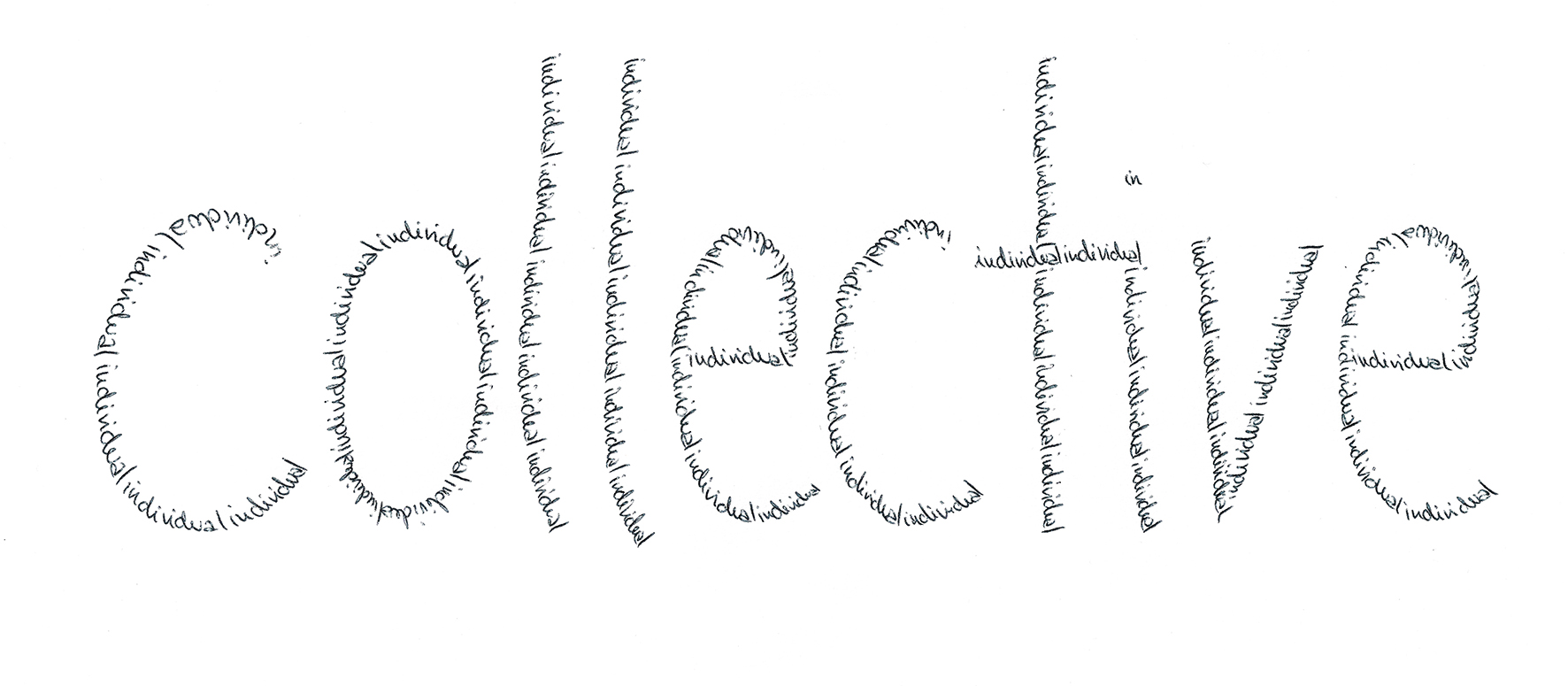
this typo-graphic illustration was my way to document my experience within the 4th Artistic Research Encounter (at Chateau Monthelon in October 2018) led by circus researcher Bauke Lievens and her team. For our group of 13 circus practioneers they simply just suggested various dialogue formats, the content was up for us to choose – the most present topic that emerged was the issue of individual & collective. I think circus does and will have to contribute a lot to this essential question of society.