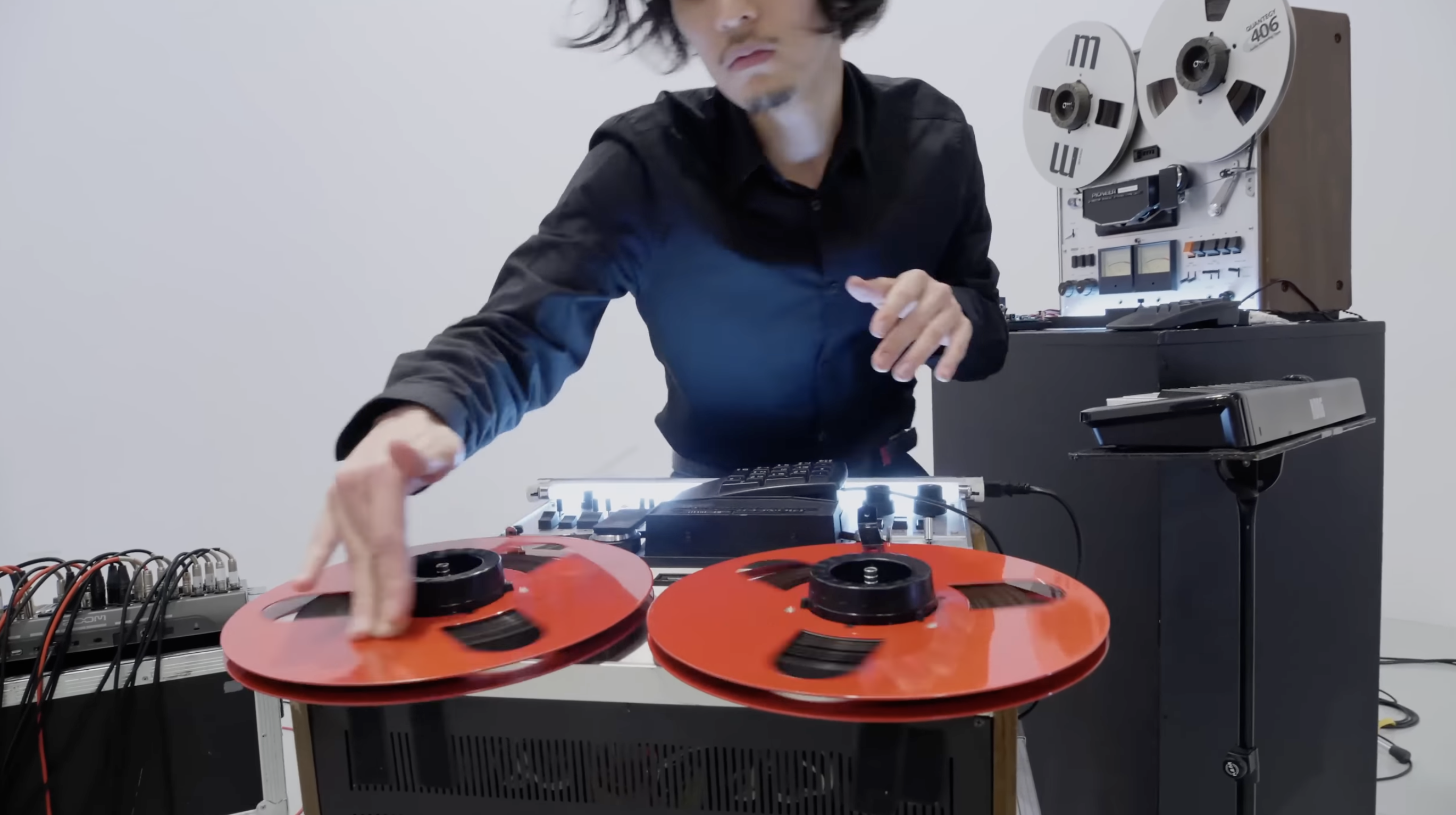
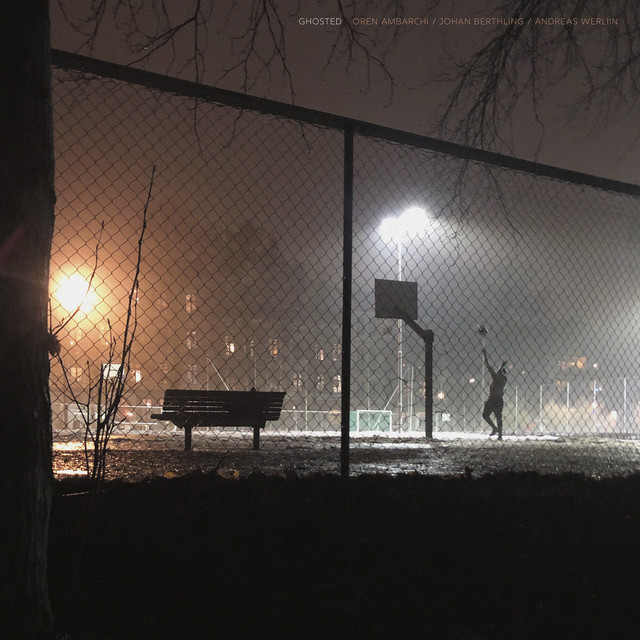


I conceived a [NONAME]-machine, or creation machine, as a prototype tool for generating new musical ideas by combining different artistic inputs in a cyclical process. Instead of relying solely on personal taste or reacting directly to others’ work, I wanted to break from familiar creative paths and uncover fresh perspectives. This theoretical device helps me disrupt habitual patterns—both in thinking and in composition—by introducing a structured sense of distance. Through this approach, various musical and personal identities can merge in surprising ways, encouraging further creation.
Although it’s still a work in progress, the creation machine’s basic function is straightforward: I gather elements (recordings, improvisations, textual fragments, or outside collaboration), layer them, and see what emerges. I can repeatedly feed new material into the system, reassembling older pieces and blending them with fresh contributions. This cyclical loop means each generation of results can become source material for the next round of experiments, creating a fluid, open-ended process.
I also view this machine as an aid to my own brain—another “physical and theoretical machine”—by disrupting familiar neural pathways. Rather than descending into chaos, I give the [NONAME]-machine just enough structure to anchor my creativity while leaving room for spontaneity. The outcome is an interplay between controlled unpredictability and directed exploration, encouraging me to keep pushing toward unfamiliar territory.
For me, this method reflects my belief that a robust creative process requires guiding constraints while also questioning what I take for granted. My [NONAME]-machine fulfills both: it shapes the environment via layered inputs yet allows for unplanned discoveries. It doesn’t generate finished works by itself but ignites my imagination, prompting ideas I might otherwise overlook.
Though the device lacks a definitive name, it owes much to the “cut-up” approach made famous by William Burroughs and Brion Gysin, who sliced and rearranged text and sound to expose unexpected connections. By repurposing and reconfiguring various materials—improvised tracks, words, sonic fragments—I often stumble on patterns that nudge me into new artistic territory.
Proto-consciousness
Consciousness as emergence from simpler processes. Connection to musical improvisation - how does awareness emerge in the moment?
The musician doesn't think about each note, but somehow knows what to play. This is similar to how consciousness might emerge from simpler neural processes.
#phd
Contribution through compositions and technology.
Avoiding unnecessary separation. Collaborating with unconscious partners (chatbots).
The constant is always the search for why. I have come to terms with the fact that I do what I do simply because I like it, and that, for me, is usually enough of a force to go somewhere.
Sometimes, though, I am moved along because I experience output from other artists, which fuels a need to reflect on that experience by creating something. Something else, or something in line.
Why is this text here?
Löffler: becoming animal // inspiration
The concept of becoming-animal from Deleuze. Not imitation but transformation. How this applies to musical identity - not copying styles but transforming through them.
#phd
Behind every kind of artistic result or output, lies an idea and a want to present that idea. Likewise, behind any interpretation and evaluation of an artistic product is a want and a need to understand that idea. Therefore, The Arts are always operating as a concept, and apart from the physical result that most often is what the interpretere watches in awe or disgust, also a concept that mainly is theoretical.
What we see or hear are only the results of a method and process, the most finalized form of documentation, which in turn means that moving the arts into academic AR makes perfect sense as the only difference is a demand for more visible documentation and more insight into the reflective processes that already exist.
#phd
Curated assembly from multiple random input
Test #1 – forced explorations, randomization as a disruptive element, not to complete, but to search for new
… the research process.
The balance between making and reflecting
How to document without disrupting the creative flow
ongoing
The distance between related fields seem to grow greater the closer you look, much greater than the impression onlookers outside the particular fields get.
That is the downside of learning, and knowledge in general. It is also something that is often misused within the arts, because many artists want to bridge the gap between their own fields and others, often forgetting the fact that there are thinkers elsewhere that may think the same thoughts, but do not have the same freedom when it comes to output and result, by which I mean freedom from the demand of "factual" result, immediate worth, and understanding. After all, "immediate understanding" cannot be said to be a fundamental value of the arts, although it probably should be, and maybe once was. Why? Well, words like "sensual understanding" appear, that is the current wordage used. So, a bodily knowledge, as opposed to a brainly knowledge. You feel it, although you do not know it. That is the common presence of arts. But then, how do you know what you feel? How do you separate mind from body in that particular situation, when it is otherwise more common to rely on mind over matter in most other situations? [ ... input: arts are difficult, understanding is difficult, interpretation is difficult, and to top this: all of it happens within one body, and the connected mind to that body. So, from one artistic output there will be as many interpretations as there are people that experience that art, and all of these will have very different levels of artistic knowledge, but still they will affect their surroundings, in one way or another... ]
Within the arts it often seems like Confusement is the goal, because even in very popular works, the amount of "art in the work" is very low, while at the same time the amount of "meaningful in the art" is very high. This is the case on many levels, from production, through dissemination, and explanation: the art field is and has always been shrouded in mystery, where the finer details of actuality are either sacrificed on behalf of immediate response, selling value, political force, or emphasized to create distance from those very same forces, although in the end the goal is the very same: to have someone listen or see what someone else has done.
These are all valid observations, and should be there, but at the same time they should be addressed and acknowledged, to allow an entry point into the matter and materials created for people outside the given sphere of influence.
#phd
After searching for interesting ways of having the facets of my artistic practice interact, conflict occurred.
The conflict arose from one facet overtaking another, more specifically, the producer came out on top of the musician, meaning that playing the music that would eventually become the Spirit of Rain-album, would prove impossible without sacrificing one or the other.
Stylistic coherence from the producer side clashed with the need to inject a performance with musical “reflection”, immediate and ongoing, as musicians do in a live setting.
Section 6: Reflections on Practice: Authorship, Memory, and Material Knowledge
Why is this text here?
“The producer is frequently perceived as being in a position of control, while the musician is cast as a performer of ideas rather than an originator.”
— Williams, A. (2007). Divide and Conquer: Power, Role Formation, and Conflict in Recording Studio Architecture, Journal on the Art of Record Production. https://www.arpjournal.com/asarpwp/divide-and-conquer-power-role-formation-and-conflict-in-recording-studio-architecture/
Every artistic endeavour comes down to work, to build on something small, and cultivate it to become something bigger. Finding a starting point, expand on it. Recognize the idea, allow it to be rearranged and reused.
Paul Auster says that “the essence of being an artist is to confront what you’re trying to do”. (https://channel.louisiana.dk/video/paul-auster-how-i-became-writer#:~:text=When%20Auster%20was%20young%20he,beauty%20%E2%80%93%20an%20unpredictable%20beauty.%E2%80%9D)
This is the work. Engage, put on the serious face, try to make it worthwhile. While doing it, it’s just pressing a key on the piano, hitting a drum or a cymbal, make a sound in a room. In the end, it’s piece of music on an album or on stage, a book, a film, or whichever manifestation you aim for.
The work is to notice something, which seems like nothing, but in reality is revealing and uncovering the world, but you won’t know that you’re uncovering the world when you’re doing it, which is why maximum effort is always necessary.
Why is this text here?
6. Reflections on Practice: Authorship, Memory, and Material Knowledge
Releasing the single «Itzama» made me want to present it differently. As the song couldn’t easily be played live, I decided to make something else from it. Because of conflict, something else happened.
First, I made a conceptual music video.
Then I put the video inside The Itzama Stalagmite, an installation that I made.
Then it was presented at Bare studenthus, before going to the Fringe festival in Gothenburg.
Then I wanted to make more installations.
Section 3: Spirit of Rain: Lyric and AI as Semantic Disruptors.
Section 6: Reflections on Practice: Authorship, Memory, and Material Knowledge
“When an artwork begins to transform in the hands of the maker, this transformation often results from dialogue with the material, the context, or the constraints of the situation.”
— Mäkelä, M., & Nimkulrat, N. (2018). Documentation as a practice-led research tool for reflection on experiential knowledge, FormAkademisk, 11(2), p. 10. https://doi.org/10.7577/formakademisk.1818
Note that the opposite of the element-idea is research through searching and a more random approach where only the art guides. For example In that Dark Night.
All music has form, and no forms are new. Why not then use standard form and look for variants there? There are ways to adjust standard form, by taking liberties for example. Skip rest bars, move faster forward, surprise intentionally.
Example:
Bla bla bla wait
Bla bla bla wait
Bla wait bla wait
Bla bla bla wait
Skip all...
#phd
What is the artist's tool? A discourse with myself, in 2023.
- AI. AI can do everything, except surrealism. Surrealism is the only logical answer to AI and works if the context is "originality", "new" and "different" or "surprising". It's clearest when it comes to visual art. They have spaces meant to surprise, after long practice. Music and sound don't have this space, because unknown sound is noise, and noise is something to avoid. Where is the surrealist sound? At the same time, sound is...
#phd
“When an artwork begins to transform in the hands of the maker, this transformation often results from dialogue with the material, the context, or the constraints of the situation.”
— Mäkelä, M., & Nimkulrat, N. (2018). Documentation as a practice-led research tool for reflection on experiential knowledge, FormAkademisk, 11(2), p. 10.
- Drums
- Bass
- Keys/synth
- Guitar
- Voice/electronics
The configuration changes based on the music needed.
#phd
Tools are simple things. They are the things I surrounded myself with. Tools are anything that can be used to manifest an idea.
When I get bored, I often look for a new tool. There is an endless supply of them, constantly being pushed by marketing departments, or enthusiasts. they come in digital form, or physical form. Sometimes they are digital creations inside a specifically designed physical unit. Electricity through valves, bytes or bits. Silicon states in a zillion chips.
The drums are a tool. So are my hands. Tools can be made. Tailored to suit specifics. Or you adapt to them, allowing the tools to influence you.
As a rule, I try to make the best of any tool, and to use it in a context where it works well. Sometimes tools are theoretical, like my machine.
Being restrained by tools has both negative and positive sides.
Section 6: Reflections on Practice: Authorship, Memory, and Material Knowledge
Why is this text here?
“Tools are not neutral—they shape the maker’s interaction with the material and can even redirect the artistic process. The documentation of this interaction makes visible the practitioner’s evolving knowledge and ways of working.”
— Mäkelä, M., & Nimkulrat, N. (2018). Documentation as a practice-led research tool for reflection on experiential knowledge, FormAkademisk, 11(2), Art. 5, p. 13. https://doi.org/10.7577/formakademisk.1818
Max 4 Live devices:
https://bloopsbloops.gumroad.com/
https://fors.fm/devices
https://elisabethhomeland.gumroad.com/
https://elphnt.io/max-for-live-curated-collection/
https://szkdevices.gumroad.com/
https://www.gourlierecords.com/store/p/melodizer-black
https://dillonbastan.com/store/index.php
https://manifest.audio/allmax
https://isotonikstudios.com/
https://nandoscheffer.gumroad.com/
https://k-teck.co.uk/iosif-interference-pattern-step-sequencer
https://zoftloud.gumroad.com/
https://isotonikstudios.com/product/alexkid-sequencer-bundle-a/
https://www.sonusdept.com/software/max-for-live/neuraloot/?doing_wp_cron=1698596150.3788840770721435546875
https://javiherreromusic.gumroad.com/
https://maxforlive.com/profile/user/ylva
https://pkpatches.gumroad.com/l/CnHZY - DIGITONE
https://monobotic.gumroad.com/?recommended_by=library
https://www.audiobulb.com/RETEXTULE.htm
https://liquidbeats.gumroad.com/l/envex
** Sequence / Generator: https://secretadmiral.com/products/chance-sequencer
https://www.ableton.com/en/packs/slink-devices/
https://nandoscheffer.gumroad.com/
#phd
I know how to use tools available to me
I know how to separate a task into subtasks
I know how to organize
I know how to focus
I know how to let things go
I know how the tools might affect what I do
I know how to figure out why
I know how to be efficient
I know how to compartmentalize
I know how to keep things separate
I know how to keep silent
I know when to stop
I know when it is enough
I know when to finish
I know what finishing means
I know what it takes
I know how to learn new procedures
I know how to implement change
I recognize self-gratification
I see value in my work
I observe from afar
I include other people
I present live
I play in my studio
I practice every day
I try to enjoy my surroundings
Low entropy is the state as it is now, high entropy is movement toward something else. Low entropy is achieved when a new goal is reached. In other words, what kind of music emerges etc. can be described as a journey from existing low entropy toward corresponding low entropy, via high entropy. So what? What does that have to do with anything? For now, just words describing something that can be shown, by for example playing and performing, either pressing play or live.
But, the question demands something new...
#phd
- Wooden boxes with speakers
- Each box plays different elements
- Spatial arrangement matters
- Audience can move between them
#phd
Criteria for being an "elementary component":
Why is this text here?
Random assembly triggers forced exploration. The goal was to access a space outside the known, and look for value in that. The assemblage is made from contributions that are based on the same reference material, ie. a track I provided. As such, I have a kind of impact on the result, and one could question the level of “random”.
On the other hand, “truly random” implies “no curation”, which to me is the difference between music and sound. Sounds are uncurated happenings, or interpretations, occurring without musical intent. Music is meant to be music. It is meant to carry an emotional value, and is, as such, curated.
4. The Drift Engine: Encounter, Agency, and Co-Creation
Why is this text here?
Transformative process when meeting the unknown.
Bouncing against the wall. Music delivers emotional value from A to B.
It begins by drawing on existing material—an established style, technique, or concept—that serves as a starting point.
The next step is to investigate by introducing a new component, which can be as simple as experimenting with a different instrument, inviting untried collaboration, or applying knowledge from another field.
When these two layers merge, the result is not merely an update of the original, but a transformation into something that stands on its own. This process acknowledges the continuity of artistic practice, while addressing a creative departure from a starting point.
The foundation is previous work, but its boundaries are pushed to find new meaning.
Ultimately, it lead toto outcomes that neither side could achieve alone.
Section 7: Toward a Theory of Machine-Musical Identity
Why is this text here?
“Music does not exist in a single unchanging state but rather requires active shaping and interaction to be experienced.”
— Lynch, S., English, H., Scott, N., & Drummond, J. (2025). Modular Composition: An approach towards structural plasticity in music, Organised Sound, 30(1), p. 4. https://doi.org/10.1017/S1355771824000256
- The role of chance in composition
- Identity as process, not product
- The machine as collaborator
- Trust in improvisation
#phd
I value originality in arts, and that is what I strive for. What makes a piece finished is when I personally am satisfied with whatever I was trying to do, or achieve, with that particular thing. It is not the same as finishing in the sense of relating to what other people think.
To exemplify, though in another field: my background as a designer, especially when me and my mother, who is a painter, discuss visual arts. Even though she rarely makes a claim of being right, it turns of that when we discuss visual arts, her paintings or my designs, we never reach an agreement on what's what, which is what we normally do in other situations.
This is because in that field, she is an artist and I'm at work. She is looking for personal satisfaction, while I'm looking for solutions to finish the task, before I move onto the next. That is the difference between art and design summed up. One is for the artist, and whoever cares to look, the other is for a paying client.
#phd
BROR kitchen island as boundary example.
Boundaries as creative funnels. The silliness of the boundary matters less than its presence.
1: Vocals = honesty / direct / poetical
2: Drums = craft / spitzgefühl
3: Studio = retrospective / transformative
Note to self, structuring (trying)
1: Vocals inform in many ways; direct-to-content.. is also poetical, of course, in the sense of conveying something subtle using words
2: Drums inform by being a craft, my spitzgefühl, open for anything and bound by everything, technicalities and heritage plays a big part; therefore it suffers a little, but is strong enough to escape the idea of “right”
3: Studio informs through its natural retrospective state, its ability to transform and cover up, or push into focus what is most important.
What Is a Musical Identity
Acknowledging I will never be Keith, Herbie, Miles, Jan, Audun, etc, nor will they ever be me, is contextualizing in an artistic sense.
Being a jazz musician is a game of always measuring against someone, whilst at the same time making a living out of making music. Or making a living in a way that makes it possible to keep exploring music, regardless of the outcome of that music.
Context is not only about standing on acknowledging the shoulders you’re standing on. It is also very much about using contextualization as a tool; explaining how you are not making it from one viewpoint, but still being able to make the claim that you ARE making it, from another.
The opposite of “new” in music is not “old”, it’s “known”. As such, the term “new” can’t be applied to musical knowledge directly, a better term is probably “unknown”. This is not news, though.
I state this because in the first phase of my artistic research, I struggled a lot pondering how to answer the requirement as it is written in Regulations for the Philosophiae Doctor (Ph.D.) degree in Artistic Research at the University of Agder, where it says that a PhD-fellow needs to “contribute to new knowledge, insight, and experience within the field”.
I was starting out with a question + specific regulatory requirements, and the task, summarized, was then to find an “answer”, and, contributing “new insight”.
At first glance, the question: “What music arise from a meeting of three artistic identities”, seems to be a good one, but as it turned out, definitions would present themselves as hurdles very quickly. As stated, “new” isn’t a good term, because, as Bread Mehldau recently wrote “The music is a safe space where self-expression is maximalized, and where an exchange of seemingly disparate ideas can result in a greater whole”.
As such, music as “maximalized self-expression”, implies that we all, listeners and creators, venture into known or unknown, not new or old. Therefore, I eventually found that I cannot contribute “new”. The best I can do is to showcase “unknown” and allow others to hear my work as conclusions drawn from that. This, in itself, was a discovery for me, but not really a thought I’m the first to ponder.
What I learned from that, however, was why the new knowledge in the context of artistc research actually is the music, and why it is “new knowledge”. It might seem silly, but I’ve spent 2,5 years figuring this out and only as I write this, experiencing a moment of glorious hindsight as I do, I see that my music appears “new” when placed in front of a musical horizon, and even though Adorno would say “in tension with the already known”.
Point being: By allowing, or forcing, yourself to venture into unknown (not new) territory, exploring and finding musical knowledge there, you might end up with a result that appears new (not unknown) when held against the musical horizon that suits the territory you’ve been exploring.
Pondering like this has been a huge part of my work, while at the same time, I have been constantly creating something. This presentation seeks to show how these two opposites have been working, and how they impact each other.
Section 1: Introduction: Why Musical Identity Now? PhD Research Summary.docx.
What does this text seek to answer? It is a prelude to the problem of “new”
"The new is that which emerges in tension with the old, and it is only through this tension that it becomes recognizable as new."
– Adorno, Aesthetic Theory (1970), trans. Robert Hullot-Kentor, University of Minnesota Press, 1997, p. 21.
“All improvisation takes place in relation to the known, whether the known is traditional or newly acquired. The only real difference lies in the opportunities in free improvisation to renew or change the known and so provoke an open-endedness…”
— Derek Bailey, Improvisation: Its Nature and Practice in Music, Da Capo Press, 1993, p. 142
As part of examining my practice, I “tried to identify identities” by clarifying which roles or perspectives I naturally occupy as an artist—composer, performer or producer, for example.
This process involved breaking down existing methods to see how each “facet” interacts with others, rather than focusing on personal traits or external labels. By uncovering distinct artistic vantage points—instrument-based, genre-based, or process-based—the idea was that I could find new relationships between them.
This shifted the research from broad notions of identity to a more precise mapping of functions, allowing me to use each facet to influence a resulting artwork.
A facet could the be broken down further, into elementary components.
Section 2: What Is a Musical Identity?
Why is this text here?
To clarify the usage of the word “identity”, which in this research is defined as being emergent, contextual, performative.
“Musical identities are performative and social— they represent something that we do, rather than something that we have.”
— Hargreaves, D. J., MacDonald, R. A. R., & Miell, D. (2017). The Changing Identity of Musical Identities. In Handbook of Musical Identities (p. 4). Oxford University Press.
- The method should be clearer
- What exactly is the question?
- How do the identities relate to each other?
- Document the process better
#phd
As theory / documentation / explanations affects practice, one could think of practice being unmeasurable in the same way as you can never measure 0 kelvin. The moment you poke into 0 kelvin with a measuring device, it will be 0 kelvin no more.
Likewise, the moment you need to press record, put up a mic, take a photo, it interferes with the practice, because the practice is rarely documentation. So, at what point are you still doing artistic practice, and at which point are you documenting?
#phd
Defining axioms:
1) Art is personal
2) Art depends on perceiver
3) Artistic identity inseparable from personal identity
The album Spirit of Rain was finalized, released and left behind. The conflict between facets was too big to make it worthwhile chasing the direction further. The realization didn’t even need reflection. I just moved on, and before I knew it, I were somewhere else. I can’t really explain why, but in summary:
Fun, yes
Rewarding, yes
Interesting, yes
Does not make me want to play live
Moving on, then, to the next phase, of complete deconstruction, searching for that spot where musical intent matches artistic facets.
Why is this text here?
Section 3: Spirit of Rain: Lyric and AI as Semantic Disruptors