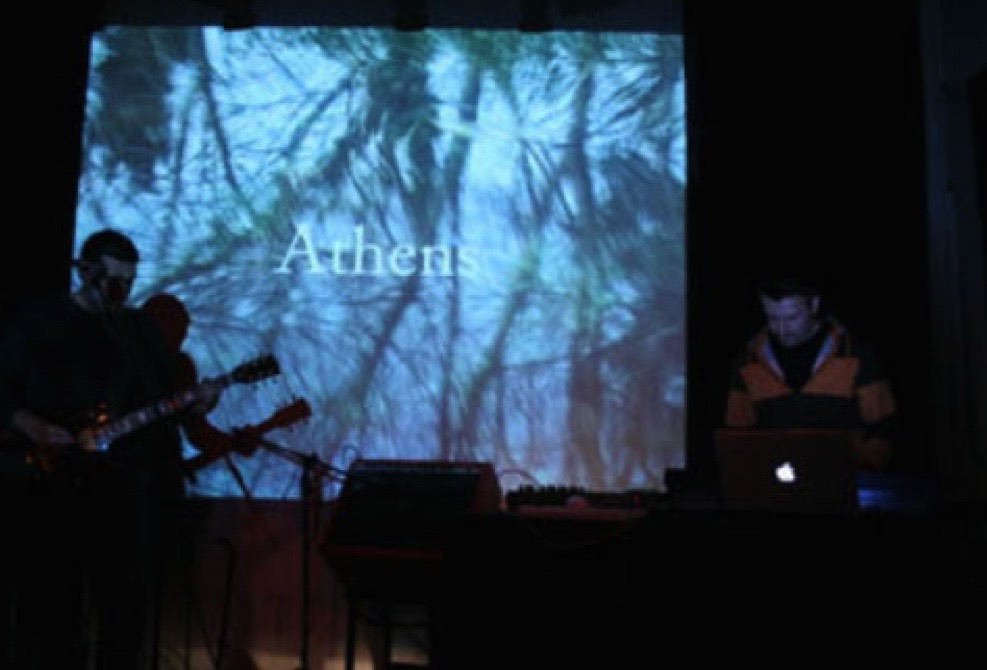

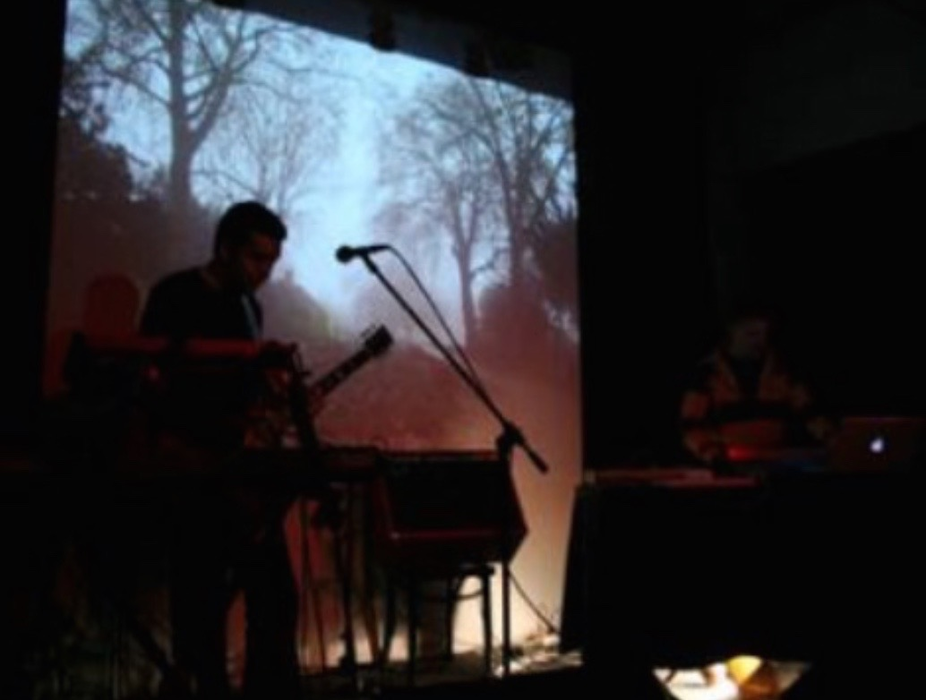
The video art was silent, projected on a screen, like a series of moving-image paintings, during the live music performance, creating a mediated visual environment for the live music event. Choosing the theme of urban landscapes, I brought together views of nature in the city, to encourage seeing the city as a landscape with its own natural and live ‘heartbeat’. I employed a lot of close-up shots of the materiality of the urban landscape, while experimenting with montage techniques to abstract and show different layers of urbanism. The installation was my collaboration with Greek music band "Elica", using my artistic pseudonym, Betty Nigianni. We met in social media, a platform called Myspace, where artists network and showcase their work.
The essay reads from Left to Right. The text in bold is intended to be read separately, as specifically explanatory to my thinking behind the treatment of the video.
Glass is made of liquid sand. Therefore, it has a composition that is essentially liquid: “even when it’s hard, it’s still a liquid”, as one of John Smith’s characters proclaims over a glass of beer in Smith’s experimental documentary Slow Glass (1988-91). Smith uses this statement as a metaphor for the process of change, which he observes over a period of time happening in his East London neighbourhood. "Dead cities" are cities that don’t change. Egon Schiele made a series of small paintings of cities on the Danube river with the title Dead City (City on the Blue River), numbered as I, II, III (1911, 1912-13). In the modernist tradition, dead cities denote urban environments that don’t adapt to changes: “Describing old cities such as Venice, Toledo, Prague or Bruges as dead or dying was a core motif in the literature and music of the Modernist period” (Fischer, 2007: 182). The river, painted in a “blackish blue” dominates the pictures, while the towns look as if they are “on the brink of submerging beneath the waters, as in the Flood” (Fischer, 2007: 60). Venice is a contemporary “dead city”: Venice is sinking, because it can’t manage the rising water levels. The Venetian Murano art glass industry has also been shrinking, partly due to a decline in demand, but also because it has to face the challenge of foreign market imitations. Glassmaking is a difficult and highly skilled craft. Murano glass is made using variations, depending on the craftsman, of a specific technique of glassblowing while heated in very high temperatures. The market influx of imitations has caused the Venetian industry to introduce a certification system for the new products; any product before the 1980s requires a specialist in order to be identified.
Besides the art historical reference to Smith's structuralist video, I refer to glass, which is a refective surface, like water, to discuss the economy of local industry. In the case of the Venetian murano glass industry, for centuries, it had kept the city's economy alive, as part of the broader Venetian arts and crafts industry. In the video of this exposition, Venice is conceived as a city of water, the natural element, and of glass, the man made, technological, element, which are both reflective surfaces. Venetian water has been managed and crafted in an engineered manner, to form architectural compositions. On the other hand, Murano glass has been produced locally, in the tradition of the arts and crafts Venetian industry, becoming Venice's trademark in the past. With the decline of the Venetian arts and crafts, there has been a parallel decline of the water management, on which the decaying Venetian acrhitecture floats. That's how Venetian buildings look like, nowadays, captured in the exposition video portraying Venice as a 'sinking' city: it is not an optical illusion, which further points at the photographic structure of film and video, capturing reality, to a certain degree, like photography does. The invention of photography and film inevitably led to the decline of classical painting, which was replaced by the new technological media in its traditional function of portraying, to a certain degree, reality; and the artist's impressions of reality.
‘Glass Cities’ are places of impenetrable surfaces, reflective transparencies, and mirrored images: water is a reflective natural element, however it does not function like a mirror. The search for what lies beneath appearances never ceases. Insight is gained through close observation of materials, details and textures.
For the two hour-long video installation, I worked with film footage and black and white analogue photography that I digitalised to insert in the video. Since I followed a painterly approach, I used black, white and grey, to point at the drawing underpinnings of classical painting, using hues of black, white and tones of grey, while at the same time pay tribute to the artistic tradition of the structuralist treatment of video. Smith, Raban and other British experimental filmmakers, worked with the physical material of the analogue video roll, as an artistic method of treating analogue video footage. For the exposition video, I animated the photographs by overlaying them and juxtaposing them with the digital film footage. Photography indicates death: indigenous tribes avoid photographs, because they think of pictures as a way to capture the spirit of the photographed. I used that anthropological knowledge as a reference to the concept of the ‘dead cities’. Black and white introduced the idea of drawing as an underlying element of the moving image, too, while colour was my painterly expression of the cities.
The exposition video is a research video, with which I intended to figure out the relationships between video footage, photography and music: the components of the video installation. This research video was not included in the final intallation piece. For the exposition, I revisited the left-out video as a stand-alone piece, but also as a research, preparatory video: more like a practice piece of music, if I were to make a comparison with musicians' work, rather than the artwork that I wanted to show at the installation, which, if it was a song or a series of songs, they would be those I would choose to perform in the show. Some visual artists will produce preparatory work that might be discarded or left aside. Going through my artistic archive, I evaluated some pieces as stand-alone work, to be presented at a later date. Revisiting this specific video, I came up with the concept of the 'lure' and applied it to the research video: neither final piece, nor solely research work, although I treated the video as research, when I was working on the video installation.
The research video revisited has three separate components: sound, music and image. I reworked the given piece of music as a film soundtrack, as soundratcks are often used in movies, excluding real-life sounds, to direct the audience's attention to the moving image. In films, live recorded sounds are reworked and extracted or included, dependent on the film director's artistic intentions. Soundtracks are also used as introductions or epiloges in narrative films. I revisited the research video as such: an introduction or an epilogue of a hypotehtical narrative film. At the start and at the end of the video, I included recorded sounds from the city in an ambiguous way, to point neither at a beginning, nor an end: it is for the viewer to decide. My treatment of music and live recorded, city sounds provides a further, methodological and conceptual, reference to the video still: neither photography, nor film. Because I originally made this video as part of the commission by "Elica" and I filmed it as research for the video installation, I reworked the given music pieces in a rhytmical manner. Hence, I draw a parallel with painting that might employ rhythm or tempo, as a compositional element, to structure the composition of the final painting.
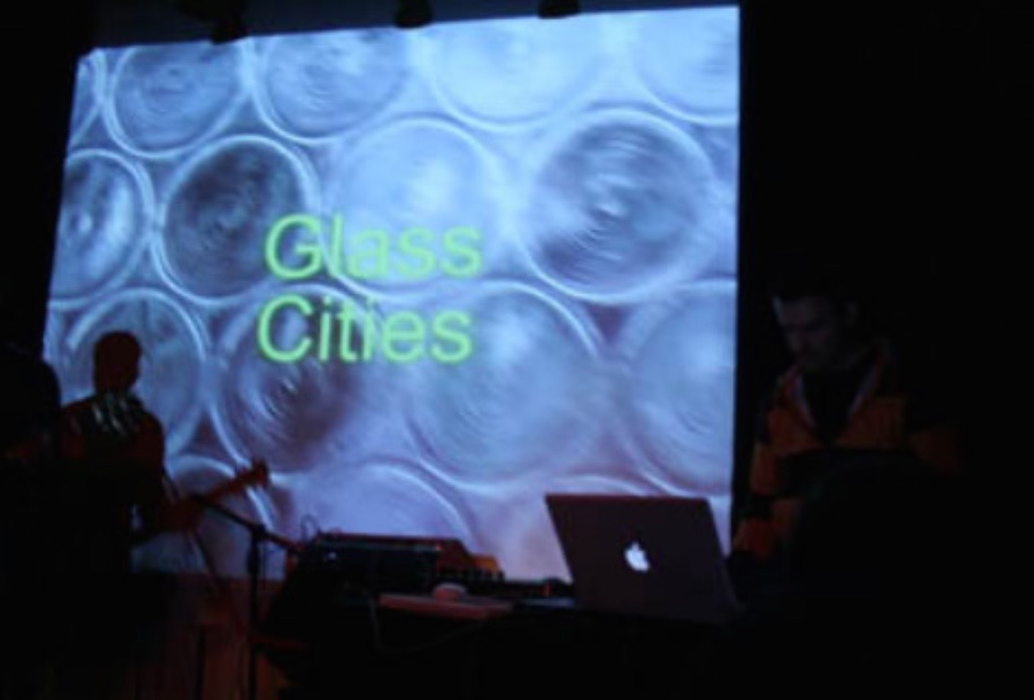

In the twilight of the Venetian glory, the eighteenth century Venetian painter Giambattista Tiepolo made frescoes in villas, palazzi and churches. Tiepolo is known for his hue of pink or red, called Tiepolo pink, that one cannot find in the supply stores today. He typically clothed his male figures in pink garments, which was avant-garde for his time led by the Rococo style. It is what perhaps, amongst other, for example Tiepolo’s drawing ability, could have led Ruskin to derogatorily characterise him as a modernist (Calasso, 2020: 27). Since Tiepolo painted in an unfashionable baroque style, another reason could be that his images are composed in a “highly novelistic manner” (Calasso, 2020: 89), not only to portray his Venetian contemporaries, but, as Calasso argues (2020: 216), to assemble “a literally ecumenical humanity, idiosyncratic and in reciprocal contact”:
“It is inevitable - and right - to see his frescoes as a novel in installments, where the same characters meet up, from one end of Europe to the other, changing - sometimes only minimally - costume and pose. They are a crowded caravan, swaying, more gypsy like than courtly.” (Calasso, 2020: 28)
With my art historical reference to figurative painting of the Renaissance, I aim to highlight the compositional element of painting, which consisted in the use of figures in paintings of that period, to construct their composition rhythmically, also by the use of colour in the figures' clothing. By reference to composition, I further draw a parallel comparison to musician's work as composers.
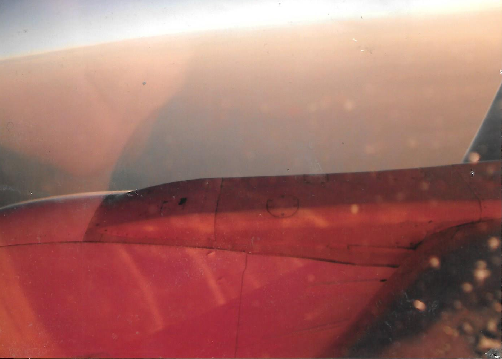
Above: Digital photograph, 2007, which is my visual reference to the music band's name, "Elica", as in the airplane's "elica", a Greek word for "propeller", indicating cosmopolitanism and the cosmopolitan style of misic of the band.

While visual art and music both have a compositional element, they also have communicative content, cultural, political, social or whatever. In the context of Rennaissance painting, one could easily say that cosmopolitanism was Tiepolo’s symbolic trademark. In his Wurzburg palace ceiling work (1750-53), depicting the four continents as females riding different animals, surrounded by other animals and a variety of figures, the exotic doesn’t exist anymore: “All was exotic - or nothing” (Calasso, 2020: 217). Tiepolo produced series of etchings in the 1730s, the Capricci and the Scherzi, which appear as if they are coming out of a “deck of cards” (Calasso, 2020: 293). In the etchings, Tiepolo shows his intention to portray a universal view of humanity in its cosmopolitan nature. The etchings included figures of what he called the Orientals, as well as semi-mythological creatures, the Satyrs, taken from the Venetians. Because the architecture here is not given as a stage set for the work, like in his frescoes, Tiepolo constructs an architecture out of simple elements: ruins, posts, tree trunks and poles that do not characterise any specific place. Calasso makes a further argument about Tiepolo’s artistic ability to articulate space’s atopia, in order to maintain the ecumenical character of his work, while at the same time mastering space’s boundlessness:
“So irrepressible is Tiepolo’s sense of the boundless, overmastering nature of space - a sense he allows to issue freely from his painting - that we are led to presume that those intrusive posts, those trunks or poles or staves that appear everywhere without any plausible explanation, serve to mark and explore the immensity of the atmosphere. They are tokens of the momentary fleeting order needed by that which happens in order to detach, isolate and confine itself in space, in order to make a lucky escape from the terror of that which contains within itself infinity - potentially, if not even actually. And this is exactly what space is. Except for the sky, an entity whose "enigmatic instability” can only be attested to by clouds - another of Tiepolo’s favourite elements. Every place is fit to be divided, wounded, etched by what - to use a generic collective - we might call poles. Tiepolo is first and foremost the painter of poles. They are his phrasing, they mark the tempo of the musical articulation of space. In a transient and irregular way, the poles serve to demarcate portions of space. Without at least a hint of a frame there is no image, but at the same time only a boundless immensity can be the background against which the image stands out.” (Calasso, 2020: 104-107)
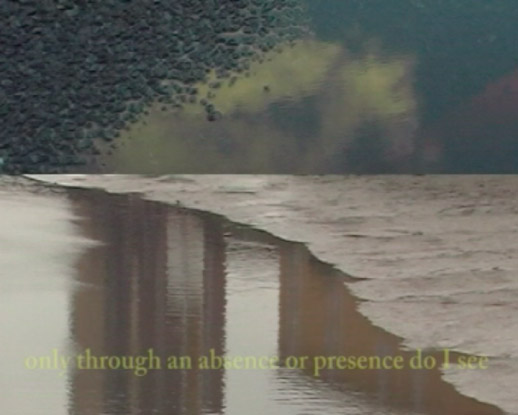
Above: Digital film still (the lure), Glass Cities, 2007.
The text reads: "Only through an absence or presence, do I see", putting forth an implicit question about how visual artists look at things, by isolating and omitting to concentrate on their subject matter: a sort of "framing", as in photography and film.
Bruno (1993) saw in the peripatetic forms of spectatorship, which are also found in academic history painting, the introduction of the cinematic view in nineteenth century Italy, when films were projected in the open air Italian shopping arcades. However, as Burgin (2004: 26) notes, there is a difference between the cinematic ‘freeze frame’ and the history painting’s peripateian moment:
“The 'peripateian moment’ of academic history painting might consequently be considered a 'freeze frame’ from a proairetic sequence, an image from an implied narrative series. But the temporality of arrest in history painting is rarely so straightforward, and may as readily imply a sequence-image as an image sequence […]. History painting routinely exhibits this characteristic attribute of the sequence-image: the folding of the diachronic into the synchronic.”
In cinema, the frame shots are set in a specific manner, similar to the perspectival view in painting, while narrative serves the function of "bridging gaps, it smooths discontinuities into a continuum” (Burgin, 2004: 27). Contemporary painters have notably emphasised the distinction between the cinematic and the painterly view. Although Luc Tuymans makes preparatory drawings, similar to cinema’s story boarding, in his paintings he subverts both cinematic techniques of setting the frames and following a continuous narrative:
“He enjoyed a reprieve from the standard height-and-width proportions of conventional cinema, setting the aspect ratio for himself […] primarily through the relation of figure to background.”
(Horrigan, in Grynzstejn and Molesworth, 2010: 61)
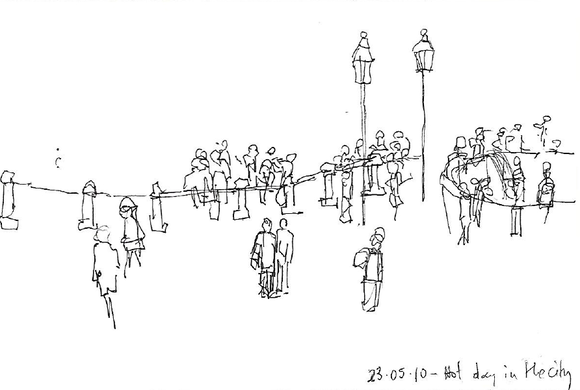
On the right: Sketches of my sequential views of the City of London, marker drawings, 2010. I was inspired by Impressionism in the arrangement of figures and landmarks, to create the picture's underlying composition, however roughly sketched in an impressionistic manner. Impressionism marked a departure from classical painting, because it used live drawing and painting, to depict the modern, sequential, experience of the urban landscape, influneced by the new technology of cinema. The sketches are also my peripatetic portraits of the City of London, at that specific point in time, as a cosmopolitan city, where people of all societal backgrounds stroll in their leisure time. The recognisable landmarks signify that it is the City of London potrayed in the sequential sketches. Where there is no landmark included, I intended to depict London, in a more generic manner, as a City of People, the Londoners, as well as to endow my sketches with a rhytmic element, as if they were separate musical pieces: a reference to Henri Lefebvre's "Rhythmanalysis" (1992).
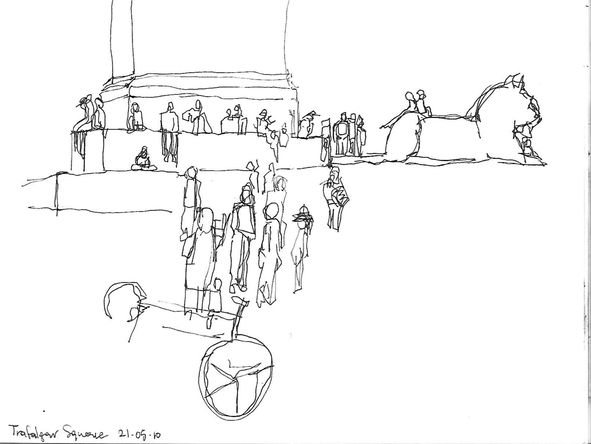
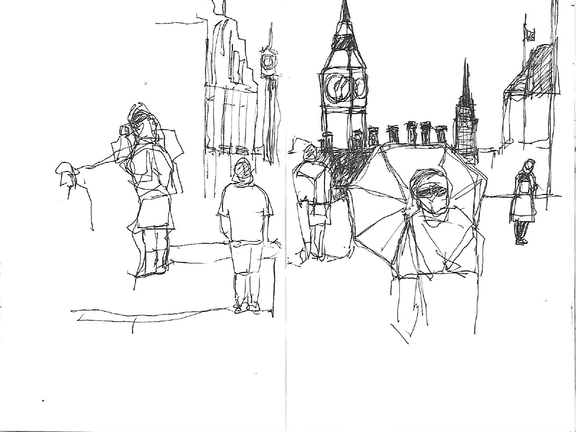
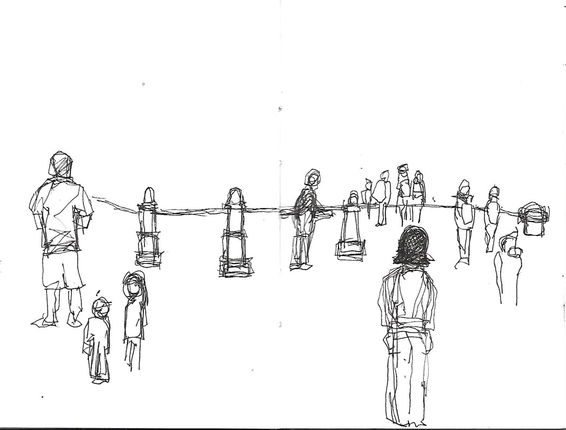
Landscape experimental filmmakers, such as Smith and William Raban, have taught us not to search for latent narratives in the fragments of the contemporary urban environment. As Burgin (2004: 26) explains, we can rather ask ourselves:
“But what would it mean to see the fragmentary environment not (or not only) in terms of an 'already read' determinate content, but in such a way that the fragmentary nature of the experience is retained?”
For contemporary artists working with film, but also for their audiences: “What is essential is the idea of discontinuity, of absences, of gaps” (Burgin, 2004: 26); that is the appropriate artistic response to the contemporary urban experience.
With the cinema industry, a whole other popular media industry was developed. Promotional film posters and trailers often show stereotypical individuals in stereotypical contexts. Roland Barthes has described these images staging the scene of lure as a lure themselves (Burgin, 2004: 39). However, so, potentially, is any other image in the so-called 'Cinema of society' (Burgin, 2004: 39), such as many of Tiepolo’s frescoes and paintings, which served a similar purpose for his contemporaries; as Burgin (2004: 40) points, we can only think of Tiepolo’s painting ’Neptune offering gifts to Venice’ (1748-1750) in the Doge’s palace. The innovation of contemporary artists working with time-based media, rather than conventional cinema, lies in their treatment of the sequence-image in correlation with academic history painting:
“[…] the sequence-image - is neither image nor image sequence, it belongs neither to film nor to photography theory as currently defined. Indeed it may be doubted whether it can ever be fully a theoretical object, at least so long as theory remains simply an affair of language. The early Wittgenstein famously concluded on the last page of the Tractatus, ‘Whereof one cannot speak, thereof one must be silent’. To which his colleague and translator Frank Ramsey added: ‘What we can’t say we can’t say, and we can’t whistle it either.’ The belief that much of what cannot be said may nevertheless be whistled is foundational not only to music but to the visual arts.” (Burgin, 2004: 27)
I want to suggest that the ‘lure' in artistic time-based media is the film still: what is neither photograph, nor film in a sequential narrative, it is the undecided; or what Burgin calls the 'sequence-image’ that needs a new way of theorising outside film and photography theory studies. The film still as the lure signals what cannot be said in words or depicted in a framed photographic image, but, as I have suggested, can be expressed and theorised within the visual arts tradition. The demonstrated undecidedness of the film still is also characteristic of the undecidedness of the contemporary artist as to whether the artist is present, as a model or a performer in the artwork; or whether the artist is absent. Painting and sculpture are examples of artistic fields where the artist is traditionally absent. However, we can think in the painting tradition of painters, such as Goya, Rubens, Tiepolo and Schiele, amongst many, who have made portraits of themselves, also in the action of painting. To depict exactly this artistic dilemma, Schiele revolutionised the notion of the artist as model, by inserting multiple self-portraits in one painting or drawing: in The Self-Seers I and II (1910, 1911), as well as in his Triple Self-Portrait (1913). This traditional search for the artist’s identity as a creator and a model of the creation can also be taken as a metaphor for the contemporary artist’s identity, social or cultural, and the artist’s role resting within; much like the sequence-image, the under-discussed and under-theorised film still.
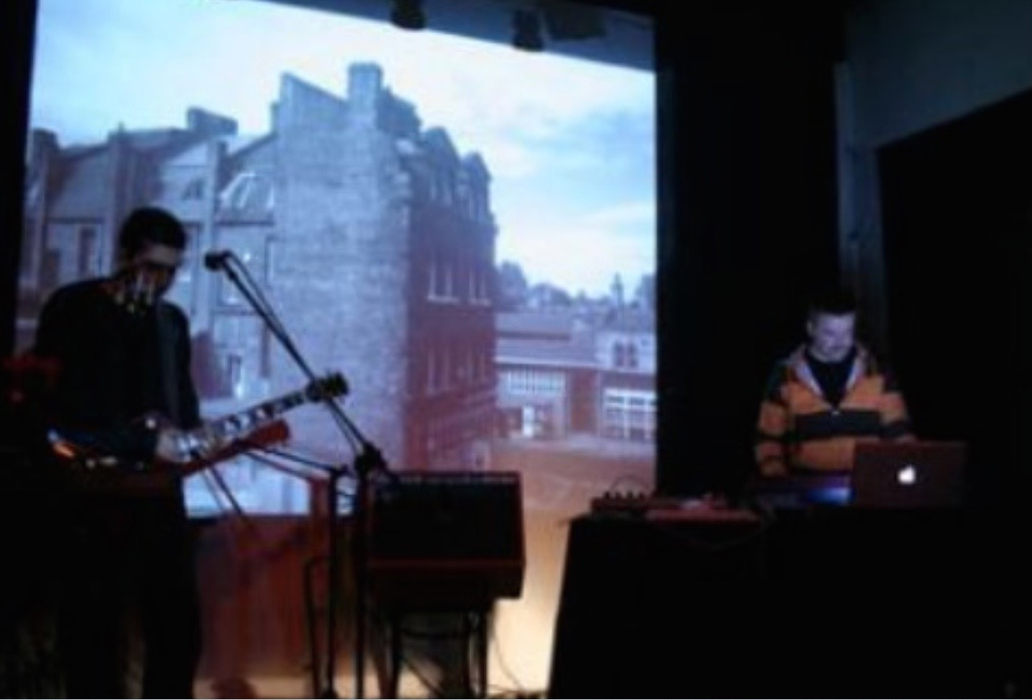
Notably, the photographs from "Elica"'s show, taken by professional photographers, document the performance, while at the same time consist of the musicians' portraits in their artistic role as live performers, who were not able to create their own self-portraits, but only in their music, which would not be not as illustrative as in the visual arts. Therefore, I draw a distinction between musicians' self-portraits, often communicated in their songs and usually through their lyrics, and visual artists' self-portraits, which can become visual elements of the artist's work itself, sometimes embedded in landscapes the artists draw, paint or sculpt. Saying this, while the musician's self-portraits provide some kind of testimony of their character, including their views and values, the visual artist's self-portraits are harder to decipher: they are rather the artist's impressions of themself, at different stages in their lives, how they see themselves at different chronological points, which, when put together, they might consistute a silent "film" of themselves, a visual testimony of their self-reflection. I argue in this essay that, In photography, video and painting, these self-portraits function like a "lure": neither film still, nor moving image.
Today’s Venetian traditional arts and crafts industries have been dominated by the contemporary international visual art ‘industries’, exhibited biannually, and alternating between art in the odd years and architecture in the even years in the seminal Venice Biennale - saying this, I am not aware of any connotations with regards to the quintessential sex for artists and architects, however, I, like other female artists, are aware of the male dominated artworld, perpetuated by the female dominated 'industry' of art critics and art dealers, who tend to promote male artists. The Venice Biennale long history goes back to 1895, when the City Council of Venice first established it as an art and architectural cultural festival, to create a new market for the modern arts. Sales played an intrinsic role in the biennale, which initially assisted artists in finding clients to sell their work, until a ban was placed in 1968, because the biennale did not possess the financial capacity to produce, transport and install more ambitious works, overtaken by art dealers. Nevertheless, the Venice Biennale has continued until the present showcasing curated artworks. Characteristically, despite the international appeal, the Biennale has received negative criticisms of its eurocentrism, at “this particular geo-political time”, because its “demographics” largely lacked works by indigenous artists, as well as underrepresented artists from the Southern and Eastern parts of the world. Moreover, the historicist approach of many exhibitions curated with a focus on the revival of past artistic movements, such as Surrealism, Dadaism and Futurism, escaped many contemporary artists that don’t overtly adhere with the old canons. Furthermore, and most importantly, the art and architectural Venice Biennales have not really solved the disjunction, or lost connection, between the declining Venetian arts and crafts, marked by the Murano glass industry, and the declining urban landscape of the city of Venice, signaling a decline in the city planning and engineering. Besides putting Venice on the map again for art and architecture, however in the exhibition manner, which is not as inclusive as it could be, as already mentioned, the biennale events have not succeeded in substantially and sustainably reinvigorating the local economy, functioning instead as a short-term touristic attraction. This contemporary phenomenon has plagued many global cities with a historic centre, which has turned into primarily a touristic attraction, at the same time decaying as a 'living' urban environment. As a remedy to the above, relevant institutions can learn from artists' methods and viewpoints.
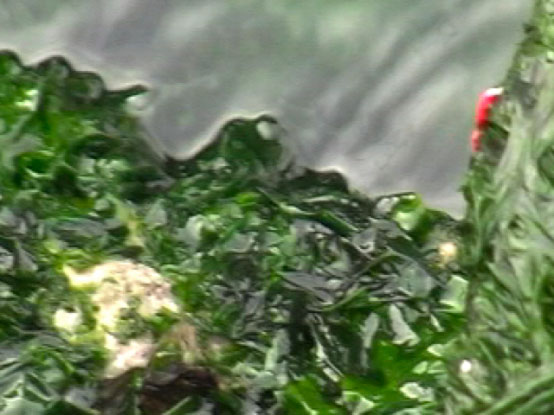
Not unlike researchers, artists tend to revisit or repeat past work, following an artistic theme, technique, approach they have already used, to create a new series of works, by giving attention to a new question and practice that has previously eluded them. In this exposition, I included a re-worked excerpt from the two-hour long video installation ‘Glass Cities’, which I was commissioned to create for "Elica"’s music live performance in Athens, in 2007. The original final work was photographed and filmed in three different cities: London, Athens and Venice. I resampled one of their music pieces to accompany the video excerpt, along with recorded sounds from the city of Venice that I visited in 2006 for the architectural biennale. I intended to communicate the rhythm and tempo of Venice as a contemporary lively city, despite the burden of history it carries and the urban challenges it has faced because of its changing natural environment. I have also included the photographic strips of Venice, which I animated for the original video, not only to show the underlying drawing qualities of the medium of photography, and laterally of video, but also as a metaphor of bringing Venice back to life: a living city, rather than a dead city. Finally, I show two film stills from the original work that could have belonged to any city, employing the close-up shot to highlight the striking, but often undetected, textures and colours of the natural that has remained and adapted to the man-made in the city: the contemporary urban ‘lure’.
References
Auslander, Philip, "The Biennale and its discontents". PAJ: A Journal of Performance and Art, 26:1 (Jan. 2004): 51-57.
Burgin, Victor, The Remembered Film, London: Reaktion Books, 2004.
Calasso, Roberto, Tiepolo Pink, trans. by Alastair McEwen, London: Penguin, 2020.
Fischer, Wolfgang Georg, Egon Schiele (1890-1918): Desire and Decay, London: Taschen, 2007.
Greenberger, Alex, "The Venice Biennale's history of Surrealism has a Eurocentric problem". ARTnews, 3 May 2022:
<https://www.artnews.com/art-news/news/venice-biennale-2022-eurocentrism-1234627071/>
Horrigan, Bill, Cinema, Belgium, Tuymans: A Note, Grynzstejn, Madeleine and Molesworth, Helen (eds.) Luc Tuymans, San Francisco Museum of Modern Art, New York: Distributed Art Publishers, 2010: 59-65.
Lefebvre, Henri, Rhythmanalysis: Space, Time and Everyday Life, trans. by Stuart Elden and Gerald Moore, London: Continuum, 2004.
'Slow Glass', dir. John Smith, 1991, UK, 40 mins.