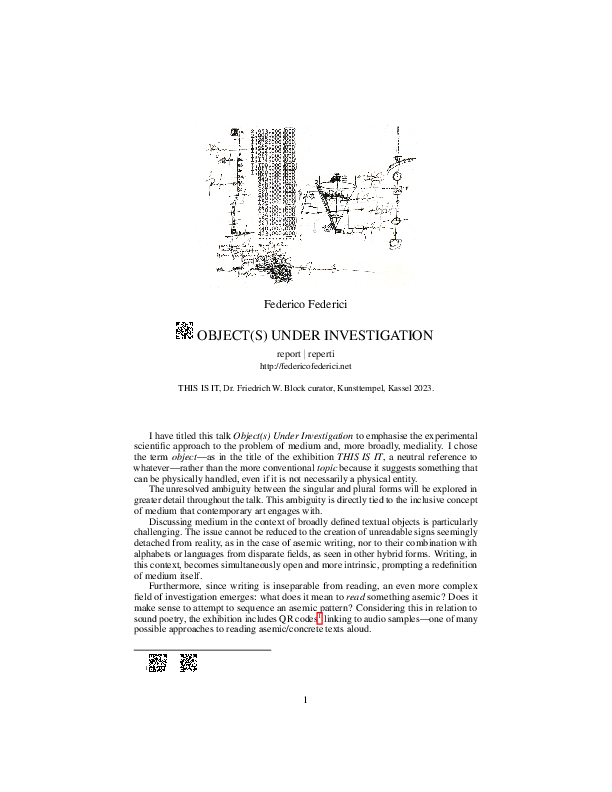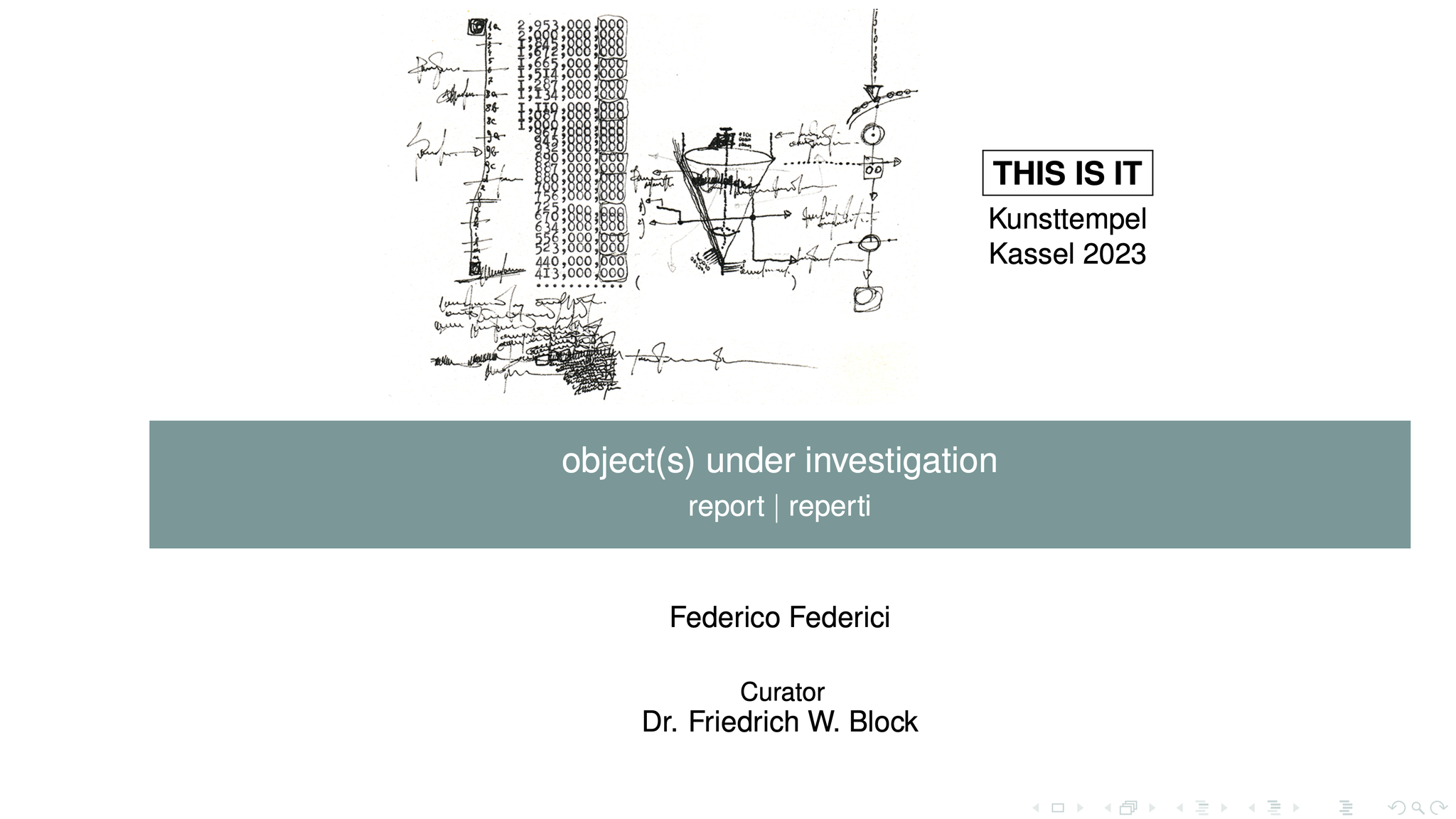
I have titled this talk Object(s) Under Investigation to emphasise the experimental scientific approach to the problem of medium and, more broadly, mediality. I chose the term object—as in the title of the exhibition THIS IS IT, a neutral reference to whatever—rather than the more conventional topic because it suggests something that can be physically handled, even if it is not necessarily a physical entity.
The unresolved ambiguity between the singular and plural forms will be explored in greater detail throughout the talk. This ambiguity is directly tied to the inclusive concept of medium that contemporary art engages with.
Discussing medium in the context of broadly defined textual objects is particularly challenging. The issue cannot be reduced to the creation of unreadable signs seemingly detached from reality, as in the case of asemic writing, nor to their combination with alphabets or languages from disparate fields, as seen in other hybrid forms. Writing, in this context, becomes simultaneously open and more intrinsic, prompting a redefinition of medium itself.
Furthermore, since writing is inseparable from reading, an even more complex field of investigation emerges: what does it mean to read something asemic? Does it make sense to attempt to sequence an asemic pattern? Considering this in relation to sound poetry, the exhibition includes QR codes linking to audio samples—one of many possible approaches to reading asemic/concrete texts aloud.
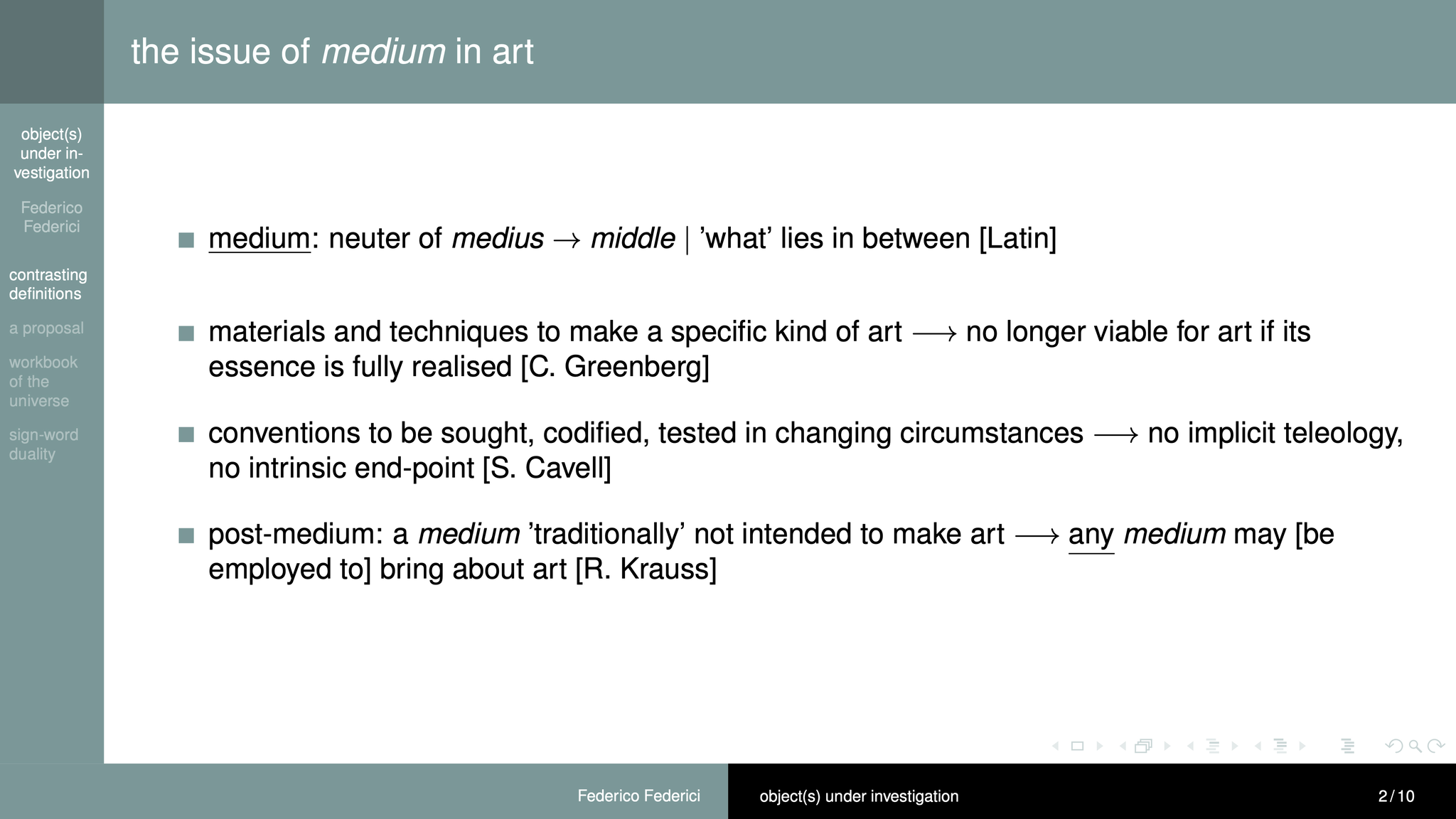
The Latin etymology of medium translates to what lies in between. The two opposing polarities of this relationship must therefore be examined.
For this purpose, I will introduce three additional definitions of medium, each seminal in its own way. Greenberg’s is perhaps the most conventional, distinguishing materials from techniques and explicitly asserting that once the essence of any medium is fully realised, the medium itself is no longer viable for art—its realisation marking the complete fulfilment of its potential. For example, a still-life painting remains artistically meaningful as long as the interplay of techniques and materials continues to modernise its immediate descriptive function.
Cavell’s and Krauss’ definitions offer a more contemporary perspective. Both emphasise the relational structures within the medium, which must be explored and tested in constantly evolving artistic contexts. The diminished focus on materiality expands what was traditionally considered a medium. This shift was inevitable, following the advent of photography and cinema, and later, digital technologies and the increasing dematerialisation of information—artworks are now expected to engage with and embed such information in new, meaningful ways.
The transition to a post-medium condition thus appears straightforward. The necessity of transcending the pure materiality of the medium—despite an initial bias toward materiality—has long been a defining challenge across multiple fields.
A brief review of the ether debate in physics may provide further insight into Rosalind Krauss’ argument in The Crisis of the Easel Picture.
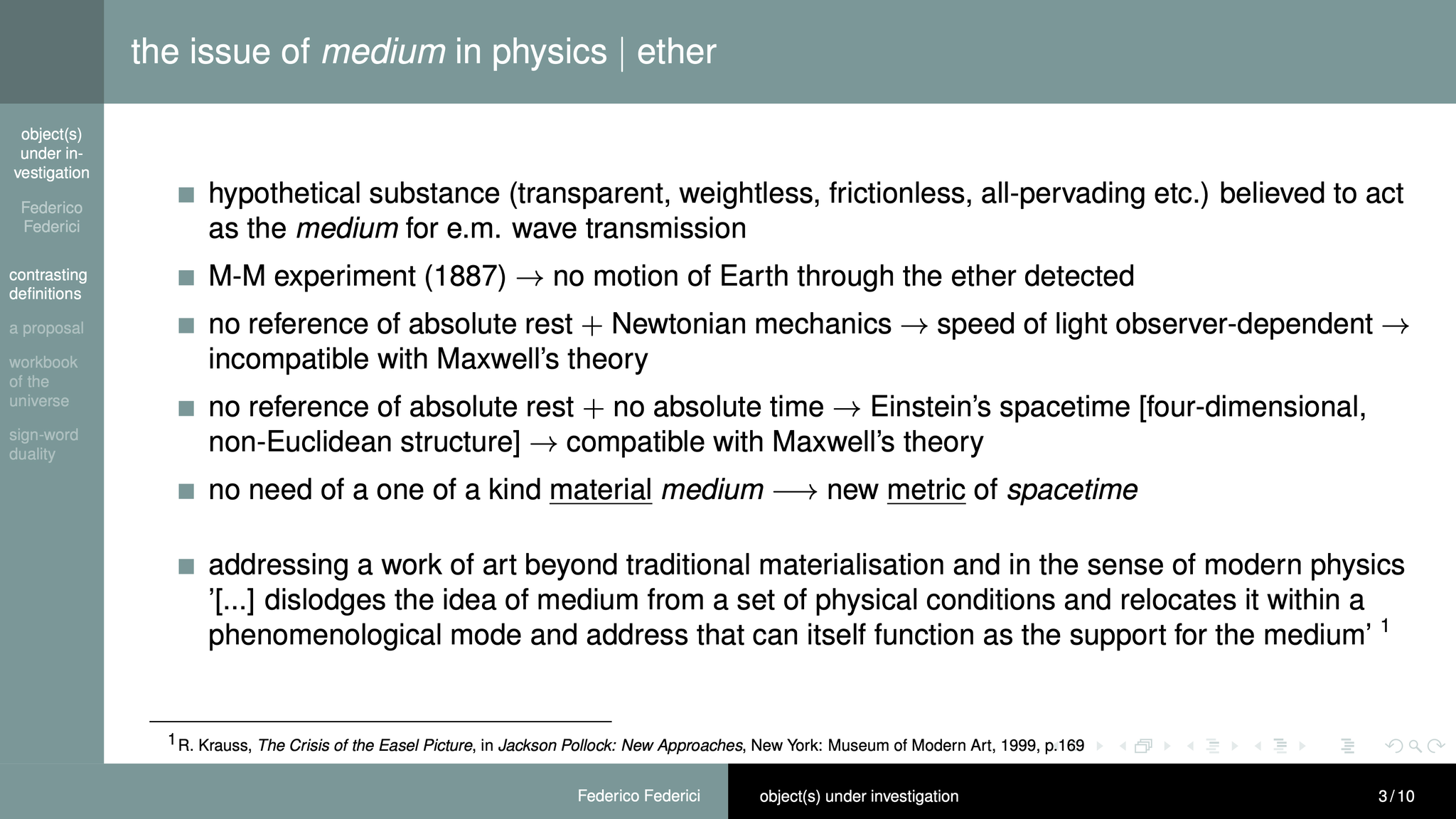
By the end of the 19th century, there was a problem concerning electromagnetic waves traveling across space. To account for the phenomenon, a hypothetical substance (the so-called ether), with specific yet rather peculiar properties (transparent, weightless, frictionless, all-pervading, etc.), was envisaged to act as the medium for this kind of wave.
An experiment with light, i.e., an electromagnetic wave, was carried out by Michelson and Morley to detect the motion of Earth through the ether. The result was surprising: the motion of Earth did not affect that of light, i.e., the presence of ether could not be detected. The experiment was later repeated several times, and all confirmed the same.
Putting together the absence of such a privileged reference frame for the propagation of light and Newtonian mechanics, the resulting theory was incompatible with Maxwell’s, which instead well accounted for electromagnetic phenomena. How to break the deadlock?
Einstein ruled out a special material medium and reframed the geometry of the universe according to a four-dimensional, non-Euclidean structure, dropping the intuitive idea of absolute time.
The new medium was, as a matter of fact, a new metric of spacetime. Not something material, but something relational.
From an artistic perspective, the tricky but tremendously inspiring point is that these kinds of metrics involve phenomena in a broader sense than the material one.
If we invoke general relativity, the curved path of light, the very idea of a curved space, must be conceived of as a relational fact, not as a physical curvature of the material the space is made of.
With this in mind, what Rosalind Krauss writes in The Crisis of the Easel Picture becomes even more sound: addressing a work of art beyond traditional materialisation and in the sense of modern physics: "[...] dislodges the idea of medium from a set of physical conditions and relocates it within a phenomenological mode and address that can itself function as the support for the medium."
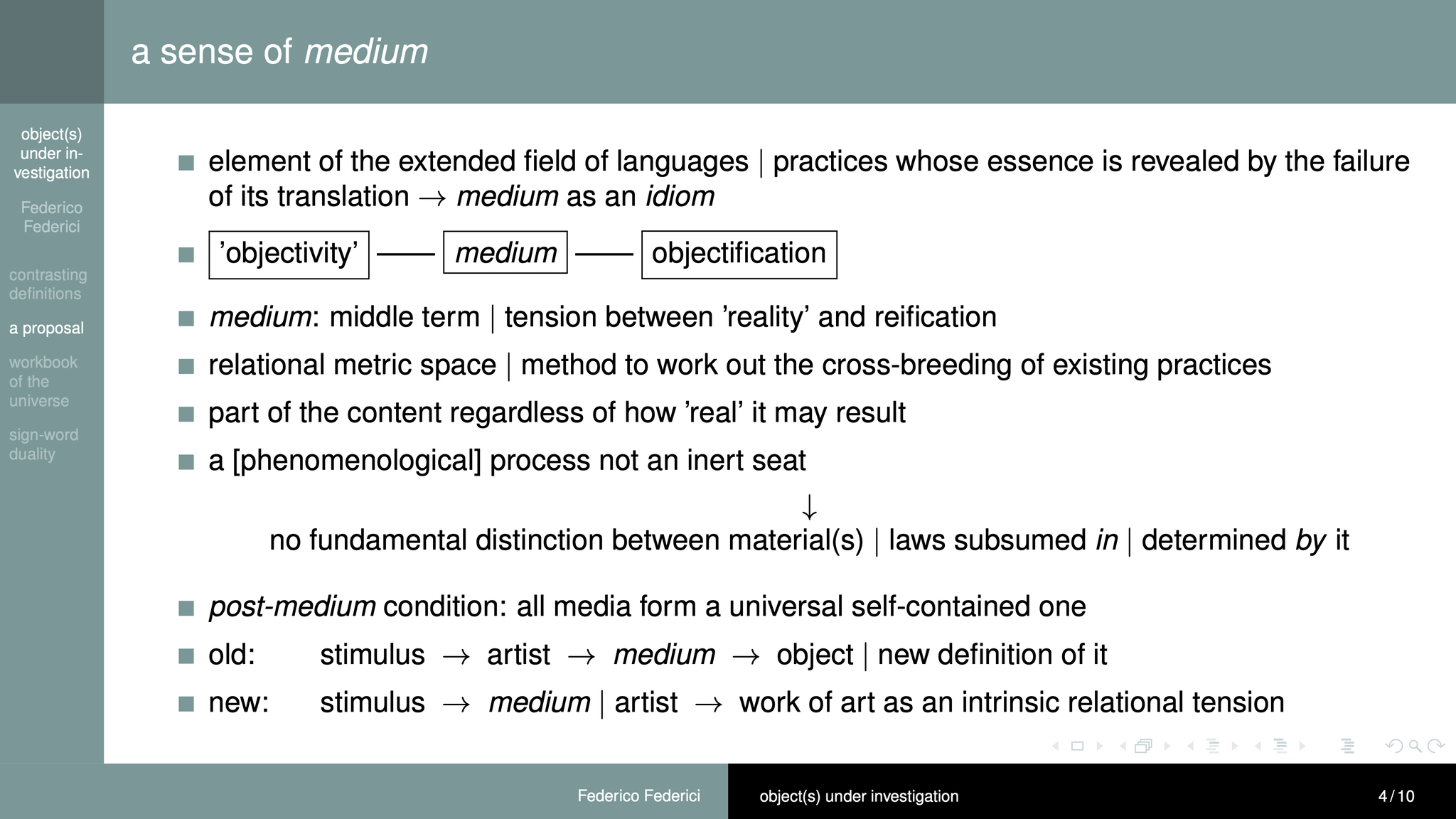
By synthesizing all these clues, a working sense of the medium can be outlined.
A medium is an intrinsic characteristic of the phenomenon under investigation (specifically, of artistic practice), whose essence is revealed through the incompleteness (or even failure) of its translation. This is exactly what occurred in the negative result of the aforementioned Michelson-Morley experiment. From a linguistic point of view, a medium functions as an idiom within a particular art practice. It is the trait that cannot be fully translated or transferred to another practice.
A medium acts as a middle term between "reality" (whatever one may define it as) and "reification," or, narrowing the scope, between the aims of an artwork ("objectivity") and its ultimate composition (‘objectification’). It is a ‘tension’ in which objectivity and objectification tend to overlap (while rarely or only partially doing so), and in the sense of the tensor, which defines the metric of the space (mathematical, artistic, and so on) under investigation — i.e., the tools that establish the proper relationships between the "objects" involved.
It is a method (a set of rules or procedures) to work out the cross-breeding of different practices, like the folding of surfaces in abstract geometry. The overpainted photographs by Gerard Richter be an example of such a problematic task. This resembles the idea of curvature that Einstein identified as the inherent property of spacetime (space and time as an inseparable entity) "responsible" for gravity: "matter tells spacetime how to curve and curved spacetime tells matter how to move." Signification no longer appears as something emanating from particular nodes (words) or well-organised clusters (lines, sentences) and propagating through the text, but as an inherent feature of the text[ure] itself. If a body's weight on Earth can be ascribed to the fact that it is traveling through a warped spacetime, why not apply the same description to the feeling of detecting signification throughout an asemic field and envision it as a sort of warped textual surface, whose words are possibly elsewhere but not far enough to be neglected?
A medium is part of the content inasmuch as it determines its representation, much like the mathematical structure of a data set, regardless of how "real" it appears. As with Einstein’s spacetime, it may be difficult to visualise its underlying relational structure, since there is a tendency to identify content with a particular, possibly material, representation.
A medium is not an inert receptacle for miscellaneous elements. It must be addressed as a process, even a phenomenological one in the case of installations or installation-driven artworks.
No fundamental distinction exists between material and the laws subsumed by it or determined within it. Metric and matter are inseparable, just as in the geometry of the universe: matter (or energy) and spacetime are, in a sense, a relational entity.
The genuine post-medium condition, as envisioned by Rosalind Krauss, proves to be particularly effective in this regard, as it is wholly inclusive: all media are accessible to art, as they form a universal, self-contained whole. This is not the etherisation (in the sense of physics) of the original concept of medium, but rather the possibility of a relational metric that allows for the intersection of different practices, contents, natural processes, and so on, making them suitable for creating art.
What about the role of the artist? Well, it somehow resembles that of the scientist in contemporary Physics.
In the old model, the artist is depicted as a talented demiurge, manipulating a medium to forge the work of art or redefine something as such. In the new post-medium condition, the roles of the artist and the medium are somewhat reversed. The medium acts as a kind of sensor, both a physical and theoretical device through which the artist is tasked with addressing, sensing, and recording a phenomenon in which the medium is often involved or inherently entangled. The work of art thus embeds and, in some form, expresses this tension. We are faced with a structural field of unprecedented formal possibilities, far beyond the bare material representation of a content, the result being the loss of specificity of the traditional delimitations of making art.
Without the proper theoretical background, any approach to post-media art—whether from the perspective of the artist or the recipient—becomes futile.
I would now like to discuss a couple of examples from my exhibition here in Kassel that epitomise the framework discussed above.
The first is titled Workbook of the universe, originally realised for CIVICO 23 magazine in a box in 2022. It outlines a typical practice I adopt when creating a series of works as an artist’s multiple.
The idea, drawn from my experience as a physicist at university, is to exploit noisy phenomena or generative stochastic procedures and experiment with them.
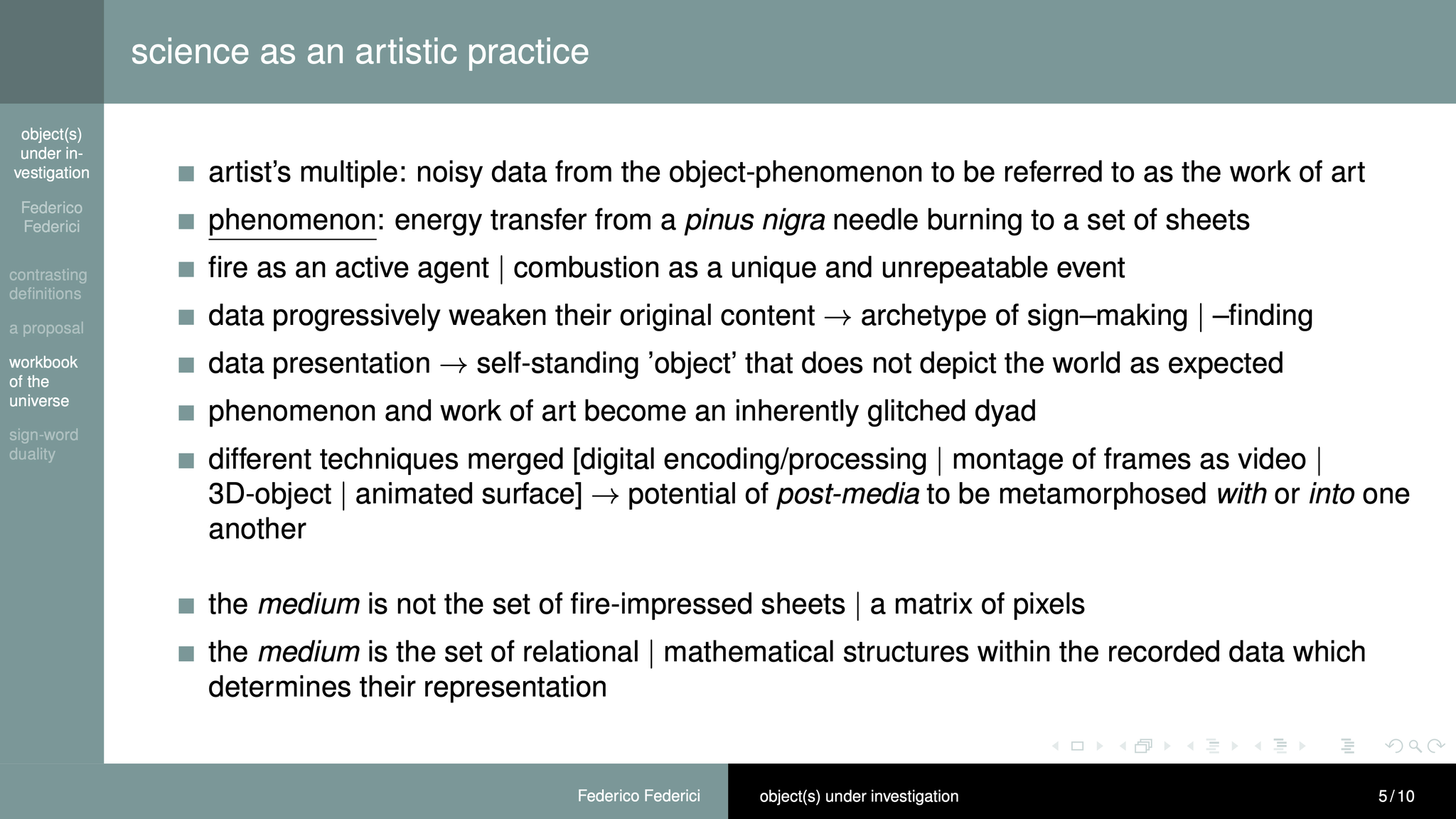
In this case, the energy transfer from a pinus nigra needle burning to a set of sheets was used as a medium to generate art.
Fire triggers the unique and unrepeatable event of combustion, which in turn depends on several unpredictable variables, such as the tree’s origin, size, age, desiccation, and the soil properties during its growth.
A detailed video report of the experiment is projected in a dedicated room in this exhibition. You are also invited to access the full archive of the experiment, hosted on the Research Catalogue platform, through the appropriate QR code. There, you will find an explanation of the project in terms of a creative juxtaposition of Feynman’s concept of energy and St. Augustine’s famous conception of time.
I would now like to discuss a few features of the project more specifically connected to my post-medial approach.
The experiment involved placing a sheet of paper near the burning pine needle for a few seconds, then quickly repeating the procedure with another sheet until the flame was extinguished. Each sheet thus stored a certain amount of energy, marked by the typical sign of burning.
The full set of used sheets was then digitally scanned for further processing.
The data presentation, organised into complementary sections, expresses the potential of post-media to metamorphose with or into one another.
Data originally collected as partially burnt sheets progressively tend to exhibit their potential as archetypes of sign-making and sign-finding, while weakening their original scientific scope. This is evident in the array I will show you shortly.
The medium is not the set of fire-impressed sheets, nor the matrix of pixels that their digital images consist of. Its relational and mathematical structures, fed into ImageJ—a tool developed for scientific analysis, not artistic purposes—allow different representations (montages of frames as videos, 3D-animated objects, or surfaces). In light of the theoretical framework outlined, the latter occupy a space between the data attached to the experimental paper and the glitched images of the dyad formed by the work of art and the phenomenon.
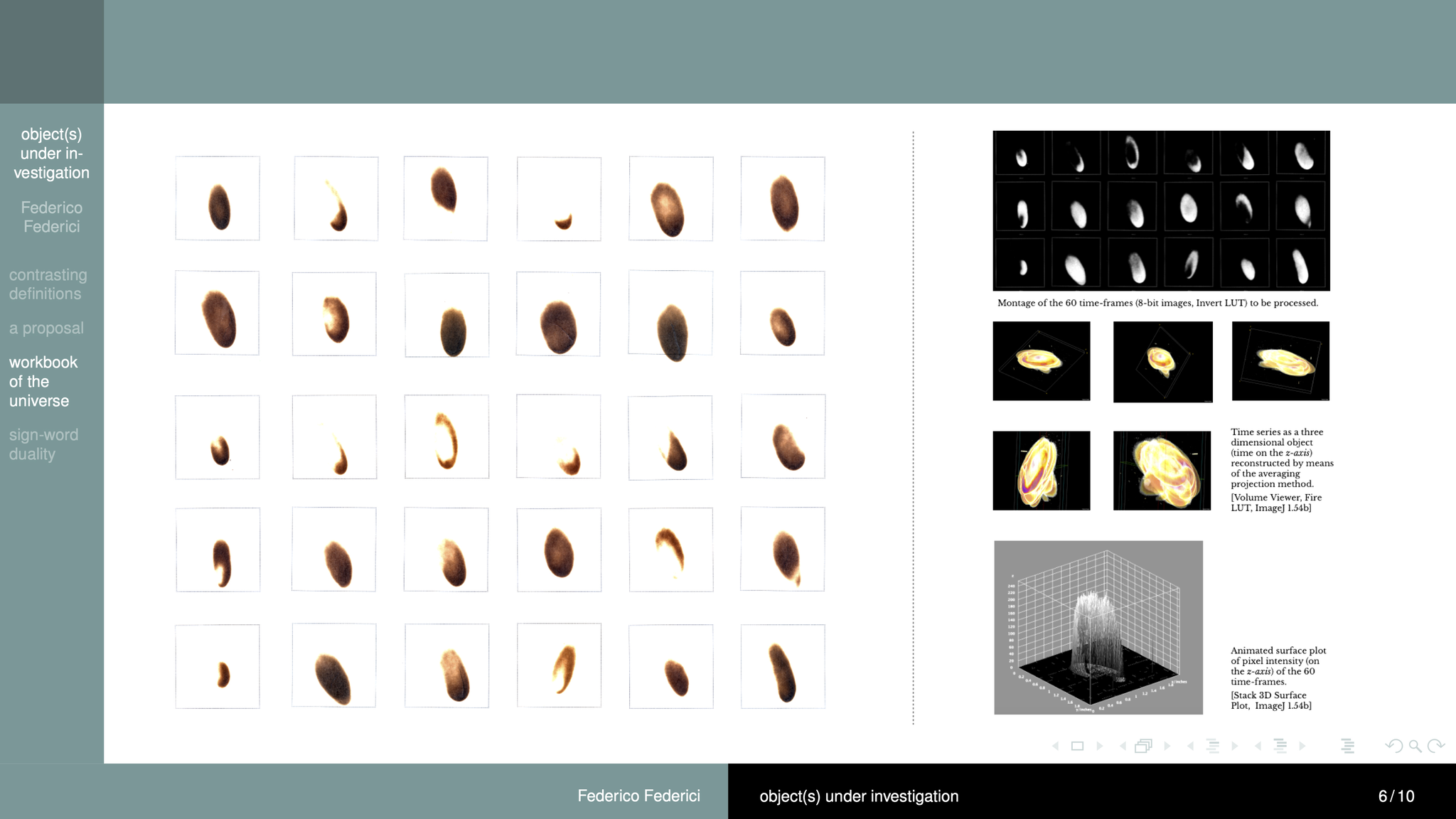
Here is an excerpt from the Research Catalogue archive. From left to right: a collection of fingerprint-like traces of the fire; a preliminary montage of the same frames as 8-bit images, to be rendered as a video; the time series as a three-dimensional object, where time is treated as a spatial dimension on the z-axis; and an animated surface plot of pixel intensity. The superposition of these different representations accounts for how the medium reacted to both the physical and artistic stimuli, depicting the phenomenon in a non-trivial way.
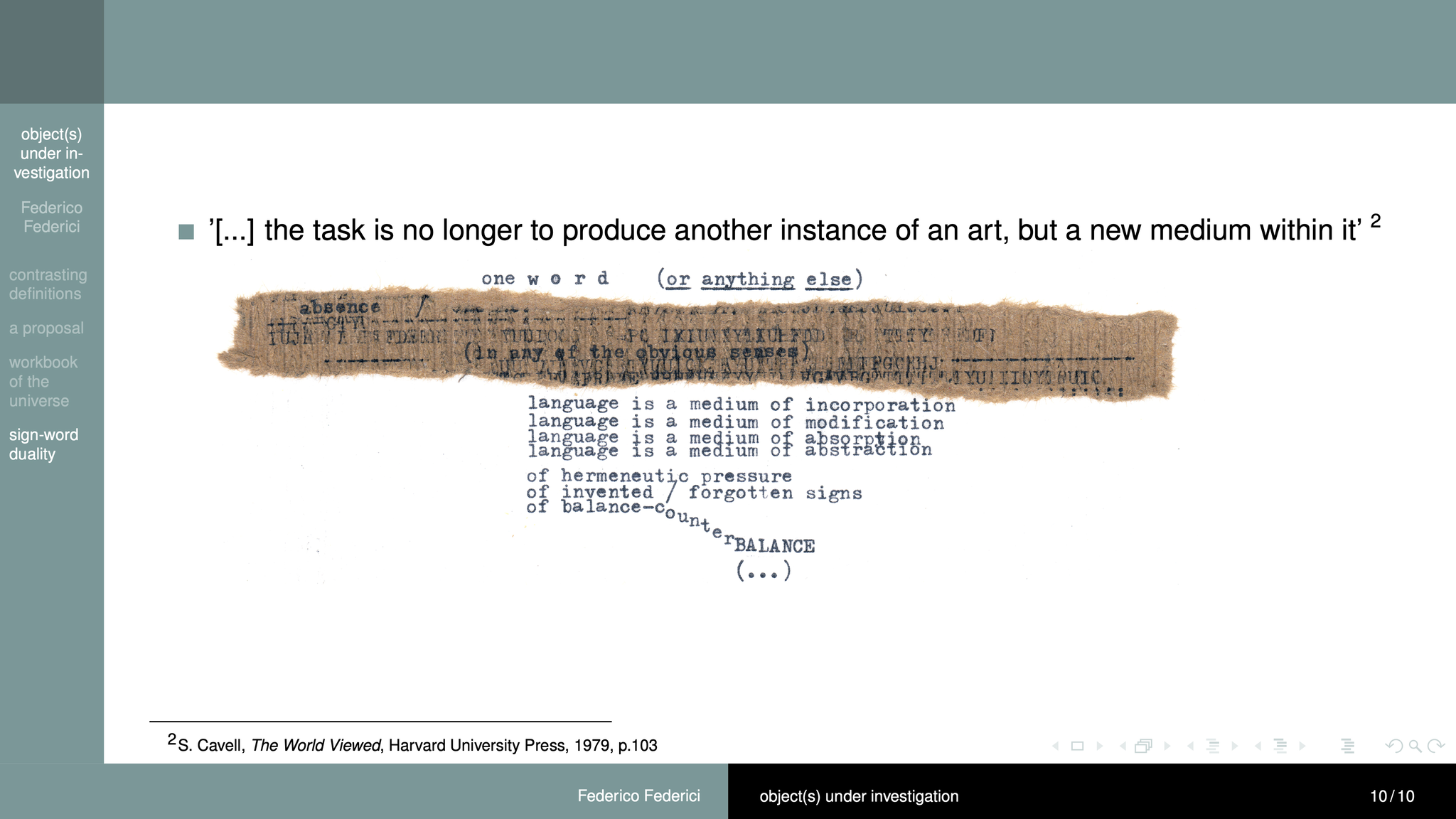
In the exhibition, you will find asemic and asemic/concrete pieces. I think it is worth discussing them briefly, as they highlight the role of mediality in expanding the textual environment. This process is twofold: on one hand, the "text" (whatever it may be) modifies itself in an attempt to focus on a topic, a phenomenon, or the object under investigation; on the other hand, the very process of writing itself modifies in an attempt to come into focus. These two phases are interconnected and inseparable.
Does that sound odd? If so, it is due to the conventional approach to languages as codes used to articulate and build signification, rather than sense. The same issue arises in painting if red colour cannot in itself be the subject of the painting, but only serves to portray lovely poppies. Consider what Ad Reinhardt did in his Ultimate Monochrome Painting (1960), consisting of thirty layers of the same colour. He treated painting as a practice governed by mysticism rather than aesthetic judgment.
That being said, quantum mechanics provides an inspiring framework to discuss and develop the word-sign duality. But before diving into that, let me first introduce a couple of widely accepted ideas: a word is a lump of signification just as a particle is a lump of matter; when you observe a sign conventionally identified as a word, you immediately access its signification.
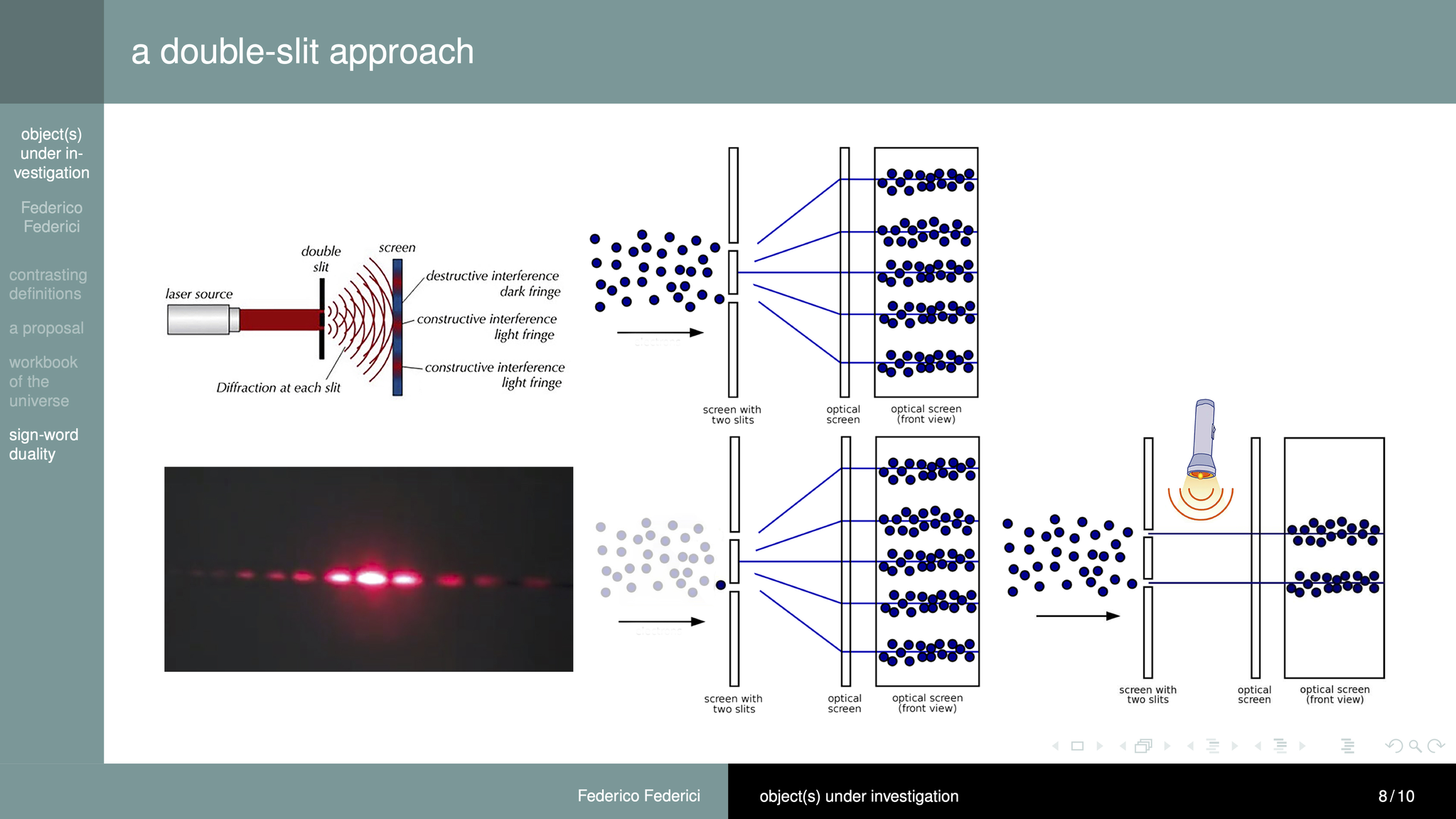
The puzzling fact about quantum mechanics is that the outcome of observing quanta depends on how they are observed. Certain types of measurements suggest that quanta behave like particles, while others suggest that they behave like waves. The manner in which they are observed does indeed alter the outcome.
The double-slit experiment, first performed by Thomas Young in 1801 to study the behaviour of light, is essential in this context.
[Top left] Imagine shining monochromatic light onto a double-slit screen, where the distance between the slits is approximately equal to the light’s wavelength. The pattern produced on the screen behind it is not two bright fringes corresponding to the slits, but the well-known interference pattern typical of waves, with alternating bright and dark fringes representing constructive and destructive interference. In the image, you can see a central bright fringe, followed by a dark one, then another bright one, and so on.
At first glance, it seems reasonable to assume that light produces this pattern because the different components of the light (whether viewed as a wave or as a swarm of photons) interact with each other, crowding around the slits and passing through either one.
[Top centre] When the same experiment is performed with other quantum objects, such as electrons (provided the distance between the slits corresponds to the wavelength of the electrons, as determined by de Broglie’s law), the same interference pattern as light is observed.
Is this effect due to particles interacting with each other and scattering across space? Not quite.
[Bottom centre] When the experiment is repeated, firing electrons one at a time through the slits and thus preventing interactions between them, the same interference pattern emerges. Claus Jönsson first demonstrated this in 1961 in Tübingen.
Can a fundamental particle interfere with itself, or pass through both slits simultaneously? How can it "know" which path to take in order to contribute to the final interference pattern? This seems physically impossible and counterintuitive. As a result, further investigations were conducted to examine the behaviour of a single electron near the slits.
[Bottom right] The same experiment is repeated, but this time with a faint beam of light directed at the slits to detect which one the electron passes through. Each electron goes through one slit, but the result is surprising: no interference pattern is detected! Instead, electrons accumulate in two bright fringes, resembling the behaviour of classical particles. This outcome suggests they followed two roughly straight-line paths, as expected if no interference occurred. It seems as though the presence of light disturbed the electrons, making them aware of being "observed" and preventing them from performing their quantum behaviour.
The act of observing a quantum system profoundly affects it.
What do we learn from this? This illustrates the famous particle-wave duality of quantum physics: depending on the method of investigation, quanta can behave either as particles or as waves.
Now that you have learnt enough quantum physics to engage with it, we can discuss its implications in the asemic and asemic-concrete context.
To begin with, from a strictly linguistic point of view, the duality of the aforementioned kind appears to be inherently idiomatic: a wave cannot be translated into a particle, and a particle cannot be translated into a wave, as the two features are quite intrinsic.
A word, as a lump of signification, recalls a particle (a lump of matter), while an asemic sign evokes a wave. However, a word is, first and foremost, a sign. To access this quality once again, one must first unlearn reading and learn how to see anew. One must, at least initially, stop searching for words, much like how an effective approach to informalism focuses on gestures and materials rather than figures as the basis of communication.
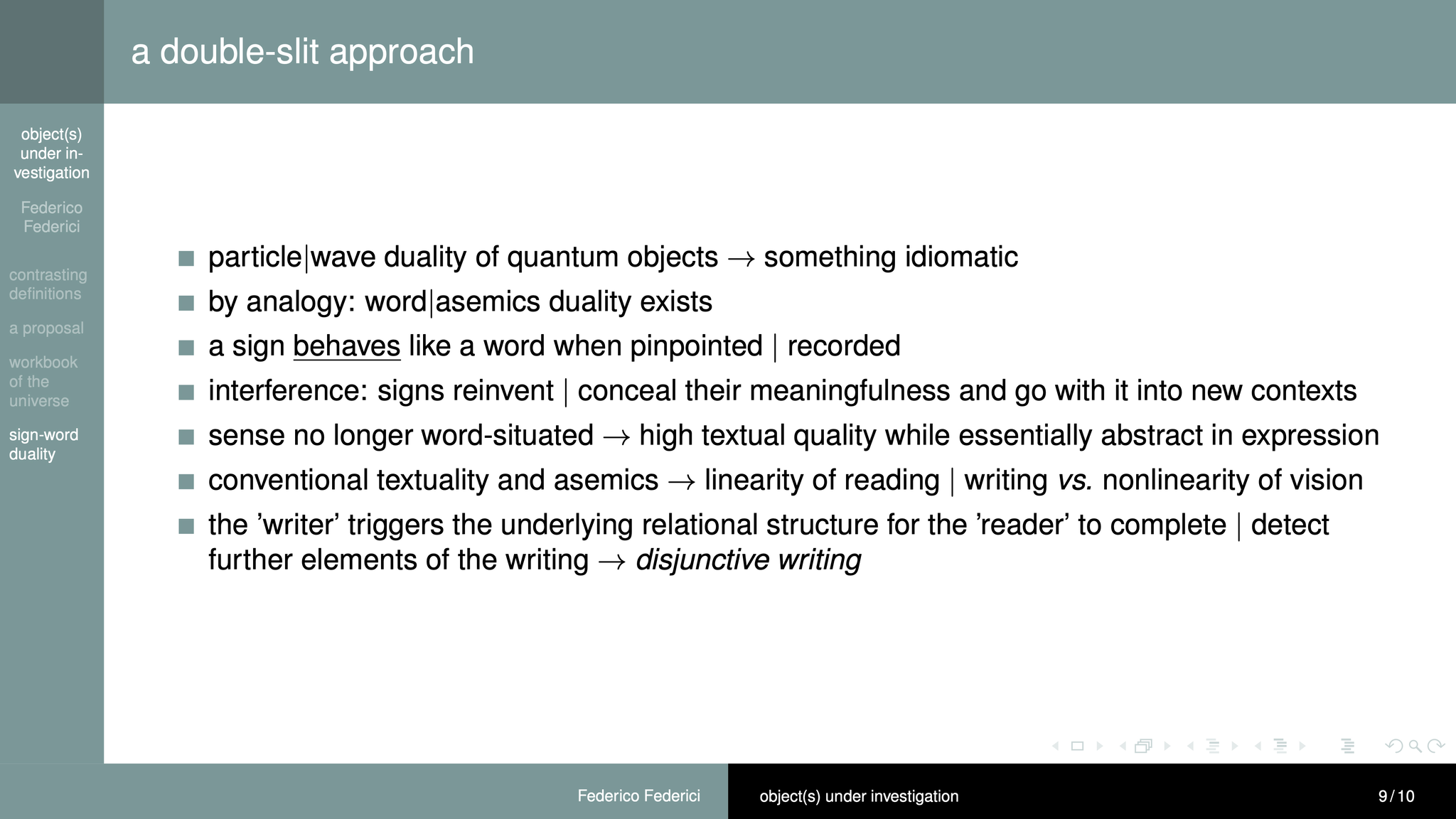
A sign exhibits a word-like behaviour when it is pinpointed, when one attempts to determine which code it refers to and shed light on its signification. As long as its intrinsic multiplicity remains unresolved, a sign behaves like a quantum object that tacitly chooses which slit to pass through.
The unsupervised superposition of many signs determines an interference pattern of sense.
A single sign, like a single electron, "knows," if not disturbed by signification, how to participate in an arrangement that maintains high textual quality, while being essentially abstract in expression. The "writer" (let's continue using this term for the artist working with a "textual" medium) triggers the underlying relational structure for the "reader" (to use another conventional term) to complete or detect further elements of the writing. This is a form of disjunctive writing, as both the writer and the reader independently contribute to defining the textual experience.
The relational structure is the true essence of the textual medium. It encompasses the metrics set by the printed, painted, typewritten, handwritten, or generative signs, combined with a variety of materials (papers, cardboards, plastic sheets, glues, etc.) that potentially enrich and complicate the linguistic stack.
Both the "writer" and the "reader" operate at an experimental level: the writer sets up the experiment and collects some preliminary data, which the reader interprets. However, the "writer" is, in turn, a "reader"—possibly the first—and their role is delicate, particularly in the asemic field. The writer must avoid disturbing the signs with excessive awareness. Their consciousness should be analytical before and after the process, not during the creation of each sign or word.
Asemic works evoke interference patterns—extended fields of sense, where elements of signification are not situated in words. They are seats of signs that reinvent or conceal their meaningfulness to deliver it into new contexts.
The combination of words and asemic signs introduces another level of complexity, as the linearity of writing and reading confronts the nonlinearity of vision. The interaction between strings of words or complete sentences and asemic components doubles the experience of a metric. The residual readability of the text, with its metrical content, and the spatial arrangement of words and asemic signs, add up to create a sort of hermeneutic pressure that the act of "reading" only partially releases.