Memorialisation and the Social Media Monument
Assunta Ruocco: How long have you been following ODOG?
Thisbe Nissen: I got on instagram in fall of 2015. I feel like I became aware of Our Days of Gold somewhat soon thereafter, but I honestly don't remember. I feel like i've gone through various phases with instagram over the years, and instagram itself has changed so much that consistency is difficult. It has changed for the worse, for me, in that i no longer regularly see my favorite feeds and instead see ads and reels and promotions and I get so frustrated that i'm using it very differently than I once did. Which is all to say that I don't see enough of Our Days of Gold - on any of its 3 pages. I feel like there was a time recently when I saw a gorgeous image in my feed, and it was one of yours, and it made me remember how much i used to see your posts and how long it had been. I need to put your pages on whatever list it is that ensures I'll see them - I've just gotten so tired of navigating IG's changes that it gets so hard to do anything. Sorry to complain, but thinking about it just raises my ire at instagram for basically ruining what was once such a pleasure for me.
AR: What kind of moment is it for you, when ODOG flashes onto your screen?
TN: When ODOG comes into view, I feel a little rush of happiness! like seeing an old friend! there's always something of a mystery to it--literally like getting one film still and trying to figure out where it might fit into the whole movie, you know? I feel a sense of intrigue, of wanting to know more about all of these people and their lives and relationships. Maybe you know that I'm a fiction writer in my "real" life, whatever that is, and I do a lot in my work and teaching with the idea of using fiction to capture a time and place, to evoke very specific visceral feelings and memories. ODOG always feels like a glorious evocation of a very particular time and place and feeling, and I can sense how steeped in poignancy the images are, even if i do not know the people in them, if that makes sense?
AR: What do you know about Cécile?
TN: So interesting that you ask about Cécile...I mean, I'm aware that the "characters" are usually indicated in their relationship to Cécile, but when I read the question I thought: you know, i don't feel like I've seen her for some time. I think somehow I see more of @ourdaysofgold_film than the other pages, for whatever algorithmic idiotic reason, and I think she hasn't been there so much lately. I know that at various times I have wondered if YOU are one of the characters in ODOG--I've certainly wondered whether they are real people, and are appearing under their real names, or of the whole thing is a fictional creation. I don't really have any idea who you actually are, or whether you're in it yourself or not. I think I may have wondered if you ARE Cécile, but then I also have some sense that maybe she's no longer alive, but I couldn't tell you where exactly that feeling comes from. Which is maybe to say that I don't know very much about Cécile, but I am intrigued by her and her world and would relish the chance to spend more time with all of her friends and family. I have wondered what the scope of your project is--whether there is a film, or a book, in the making, whether I will ever take the time to sit down and pore through what's on Instagram to try to see what sense of a larger, arcing narrative I might be able to glean. But i am someone who thinks in stories, and so it is the stories of the people in ODOG that intrigues me, along with the pure pleasure of the beauty of the images.
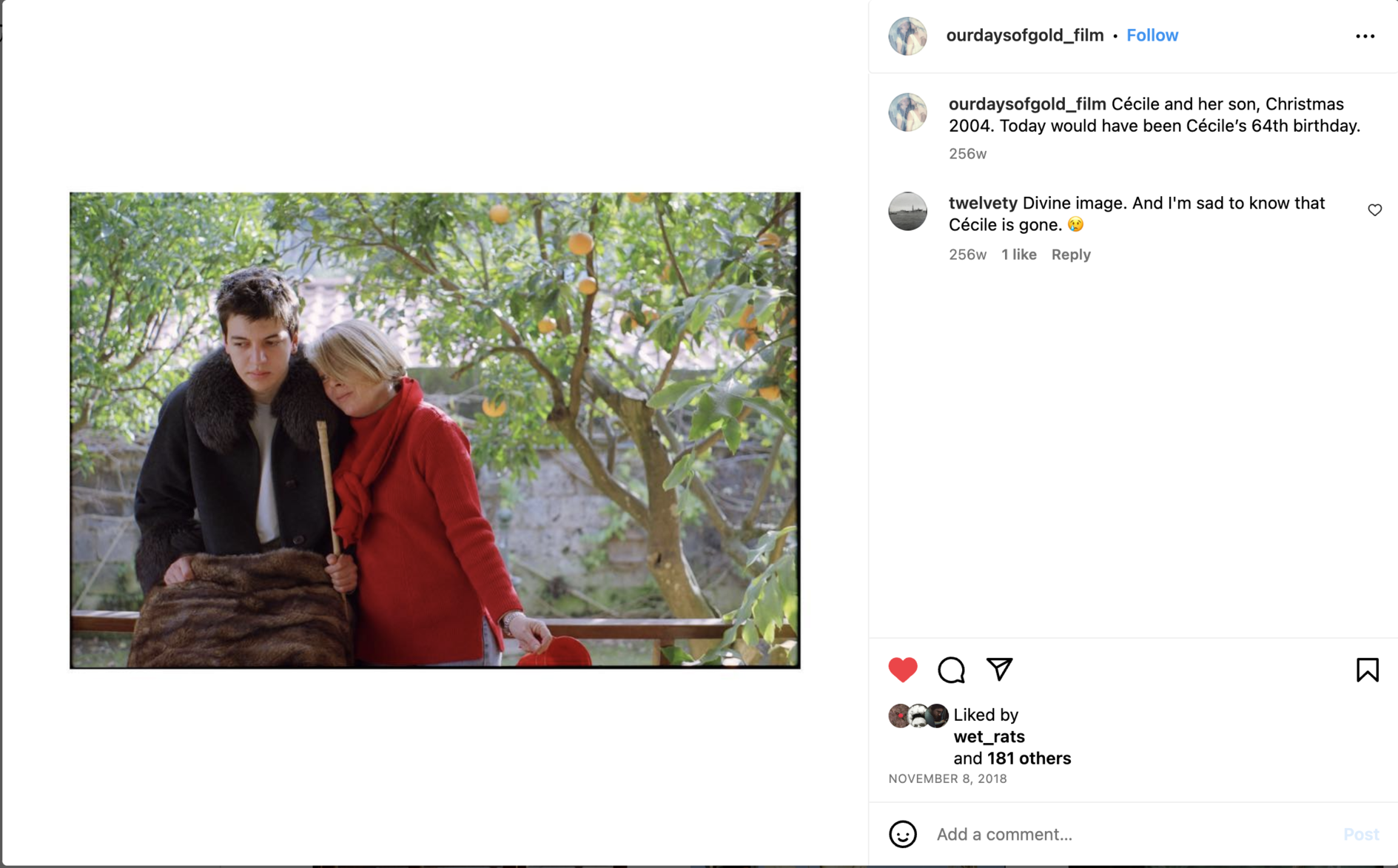
AR: The image making practice archived in ODOG, involving initially my brother and sister and my childhood friend, started in 2002 at the death of our grandparents and granduncle. A desire to inhabit some of the earlier generation’s spaces, clothes and possessions and imagine and restage aspects of their lives and times created the first impetus for the project, an example of what Rosy Martin describes as the ‘impetus to memorialisation at times of loss’ (Martin 2023 25). Later the practice started incorporating our own everyday experiences, for example, eating together on the terrace as a family, or going to the beach, and elements of image fabulation and ‘fictioning’ (Burroughs and O’Sullivan 2019) that elaborated on familial history through local mythology, Catholic iconography, personal fantasies and explorations of cross dressing. Rather than a traditional family album produced from the point of view of the mother, unconsciously providing evidence of her good mothering (Martin 2023 25) ODOG sheds an oblique look at the backstage of family life through both ‘documentary style’ and performative image making. The mother, Cécile, is at times spied upon in her daily chores, or in moments of rest, and other times she is invited to perform, and re-imagine herself cloaked and adorned in improvised costumes and borrowed jewellery.
We ‘make meaning’ of grief by ‘telling the story of our experiences to others’ (Hedke and Winslade 2017 15). And, as Anderstotter shows, the photographic archive’s relationship with memory, deprived as it is of multisensoriality, frustrates authenticity. The archive does not bring back memories but creates the potential for new narratives (Anderstotter 2023). Artist Moira Ricci in her series 20.12.53-10.08. 04 (2004-2014) uses Photoshop’s digital tools to intervene on, and reinsert herself within, her family album after the death of her mother, creating new experiences of familiar images, by disrupting the separation from the loved person effected by ‘History’, described by Barthes in Camera Lucida, when looking at photographs of his mother before he was born:
With regard to many of these photographs, it was History which separated me from them...I could read my non-existence in the clothes my mother had worn before I could remember her. There is a kind of stupefaction in seeing a familiar being dressed differently (Barthes 2020 77).
By inserting herself within the images through the medium of performance and photographic collage, and donning period outfits, hairstyles, bodily expressions, Ricci invests the inherited archive with new opportunities to encounter her mother, at a time when she wasn’t her mother yet.
ODOG, I would argue, also finds ways to go beyond memorialisation into the territory of fiction. Thisbe Nissen’s extensive video and audio recording at the beginning of this section, explores in depth and ‘in real time’ the speculative re-animation of the archive by a long time follower, disclosing the complexity of recollection and re-discovery of the archive by going through it all the way from the very beginning to the latest images shared at the time of her recording, in October 2023.
Cécile’s unexpected death has completely transformed how I interpret and understand my photography and video archive, turning it into a cache of material to be investigated and excavated in my search for reasons for her death. Even if the images do not all represent Cécile, they represent the world that she inhabited, transformed and constructed for herself and us, her children. A world of beauty, artifice and illusion, which is further emphasised by the use of costumes and playful rituals and actions. There is a sense in which the archive captures an objective truth about the world that Cécile inhabited, well beyond my own knowledge and understanding as the camera’s operator. The camera itself plays a role in, to some extent, generating the events it witnesses (Azoulay 2011); ‘photography has something to do with resurrection: might we not say of it what the Byzantines said of the image of Christ which impregnated St Veronica's napkin: that it was not made by the hand of man?’ (Barthes 2020 97). The photograph’s technical referentiality to what once was (Barthes 2020 97) liberate it from my partial and incomplete understanding of events at the time, its meanings and latent information are not limited to what I, myself, knew then, but contain something of the truth, which remains at once objective and indefinable. In such a context and given that the images ‘do not speak ‘(Barthes 2020 121), the potential interpretation of the images by others might be more relevant or interesting than my own.
This is where the archive’s anonymous public presentation acquires its significance. Users speculation and projections in comments, messages and more recent conversations, have given me the opportunity to experience Cécile from a different point of view, or imagine different possibilities and endings for her story, different interpretations, sometimes idealised, sometimes darker. Here are two examples:
In the photos I see the images of "Mother" and she is so beautiful, she appears to be humble and graceful, dramatic but also intense, and stressed, and sometimes proud and joyful, but then pensive and distraught...the human emotions we all understand and can see in each other, that we each go through. Probably what I believe I know about her is just a drop in the ocean, and to a certain extent that is also the spark for the curiosity I have in following ODOG, wanting to know a little more and complete the puzzle (Personal communication with Jason Hermens @jasonhermens, 10 October 2023)
So she has this very tight family, but her marriage broke down in a rather catastrophic way, and yes, she is sadly dead now. I recognize that at one point she needed immediate psychiatric care, but is there perhaps a sense in which she nonetheless typically ”kept going”, in spite of adversity – occasionally sweeping things under the rug? She loved her children – she still loves them, of course, wherever she is now – but doesn’t claim to own them. Now and then she may not have paid enough attention, not as much as better self would have wanted to, that is. Then again, to whom doesn’t that apply? And those are tired and perhaps not particularly helpful words, but I guess she was in important ways ”strong" and ”independent" (Linus Broström @linubrostrom, 11 October 2023).
These responses evidence the co-creation of meaning and narrative that ODOG affords to followers, who are willingly haunted by their own constructions of Cécile, maintained by my continued posting. When ODOG images appear on her screen, for Genevieve Meynard ‘it's almost a feeling of relief, apart from the aesthetic enjoyment, that it hasn't ended’. The durational staging of the archive as ODOG is not just ‘therapeutic’, and instrumental to my own return to normal levels of functioning and productivity as in the classic work of grief promoted by folk psychology (Hedke and Winslade 2017), but rather, in its potential as a digital public artwork, could be seen as a monument, in the sense of a constructed memorial, similar to a monumental tomb one happens upon during a walk in the cemetery or a visit to a church, a public display of grief, a place where a daily practice of remembering the dead can occur, and a complex aesthetic object, which may be encountered by anyone on a social media scroll. Artistic tributes to the dead can take many forms. Even though ‘modern society has renounced the monument’ (Barthes 1981/2020 113) Camera Lucida, Roland Barthes’s essay on photography, could be described as a monument to his mother (Compagnon 2016). Barthes explains in the opening paragraphs of Part 2 of Camera Lucida:
What I wanted – as Valery wanted, after his mother’s death – was to ‘write a little compilation about her, just for myself’ (perhaps I shall write it one day, so that, printed, her memory will last at least the time of my own notoriety) (Barthes 1981/2020).
If ODOG is an artfully constructed memorial for Cécile, however modest in scope, it isn’t just for me, or aimed at bringing her to the memory of the people who knew her in life, but rather, it exposes her and her world to a new audience of strangers. In relation to Nan Goldin’s images and slide shows memorialising her community of friends, Kaplan connects image sharing and Nancy’s concept of exposure to ‘the outside’:
When we engage in acts of sharing, we expose ourselves to each other and to the other. (Jean Luc) Nancy reminds us that to be exposed means to be posed in exteriority or to be in a relationship with the outside. Photography in its most popular portraitist variety is exactly this type of activity. An act of sharing where we are exposed to each other and to being-in-common when we expose ourselves to the camera lens. (Kaplan 2010)
Exposing and sharing intimate moments of Cécile’s life, and of the time when she was alive, to an audience of strangers and potential voyeurs is my extreme ploy to keep her memory alive. The monument that I am crafting with ODOG is not an obtuse empty sign of power which as a stand-in can be used to memorialise in order to forget (Young 1992). It is rather a durational construction that depends on the daily labour of digitising and sharing the archive to endure, and on the inclination of participants to engage with it over a long duration, and to willingly be haunted by Cécile’s viral ghost.
Instagram provides a temporal architecture or virtual space that becomes the host to my personal mourning architecture, similarly to how funerary chapels to the side of churches beckon the visitor to leave the main space and enter their narrative space of memorial and celebration of a particular dead. However, ODOG as a memorial, and public monument, is hidden, disguised within the flow of images that form the large analogue photography community. Through re-animating Cécile via daily posts, I want her to live, even just temporarily, in others’ imagination as a character in a story, the end of which they haven’t yet found out, ready to be re-imagined otherwise.