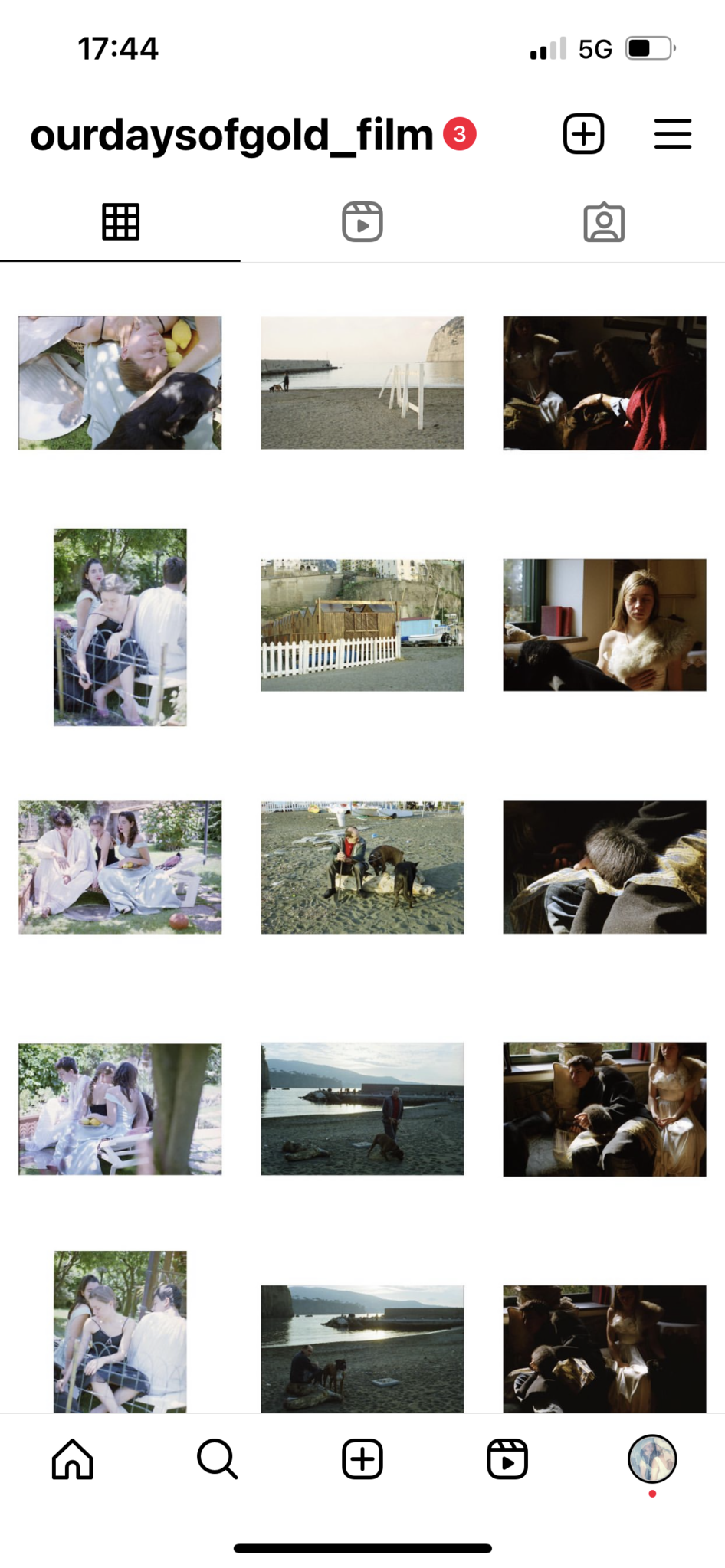
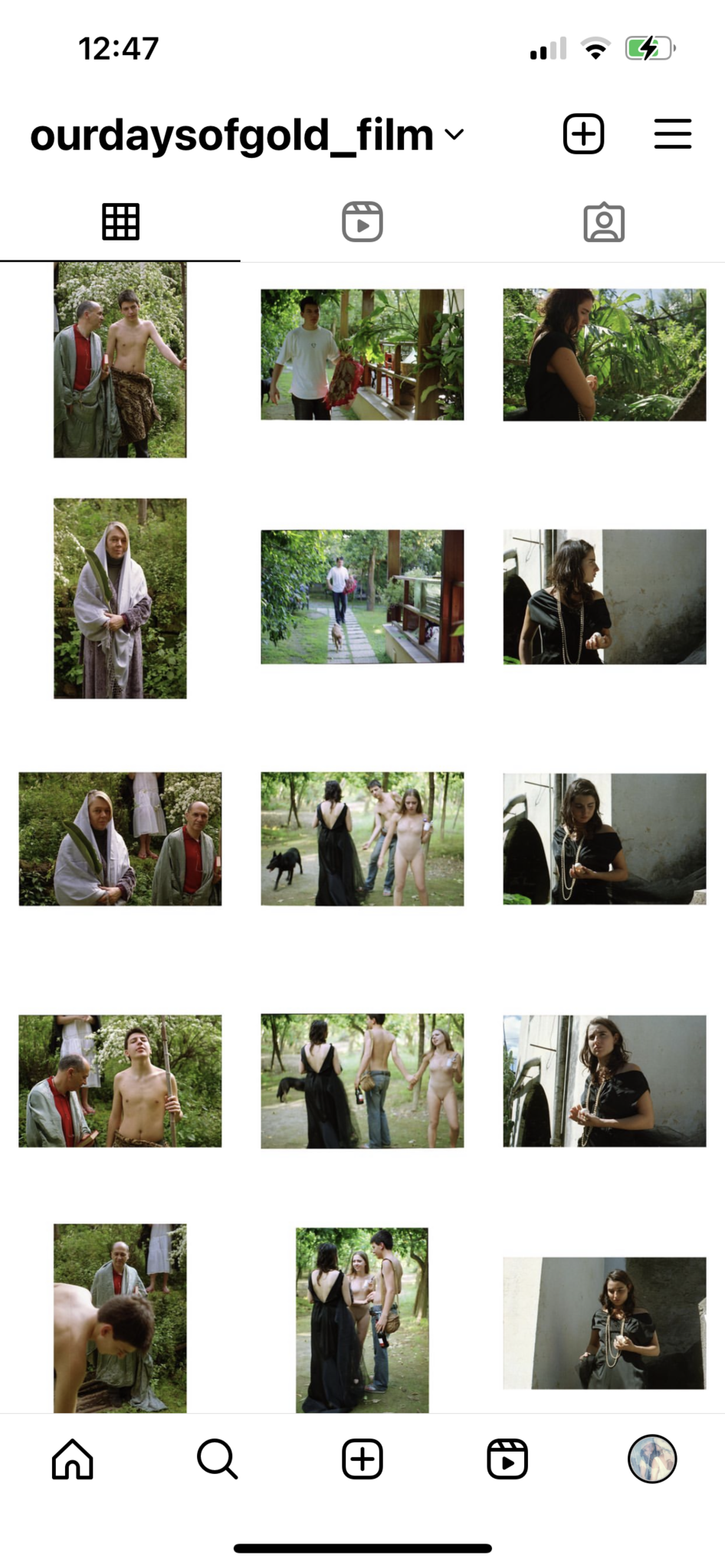
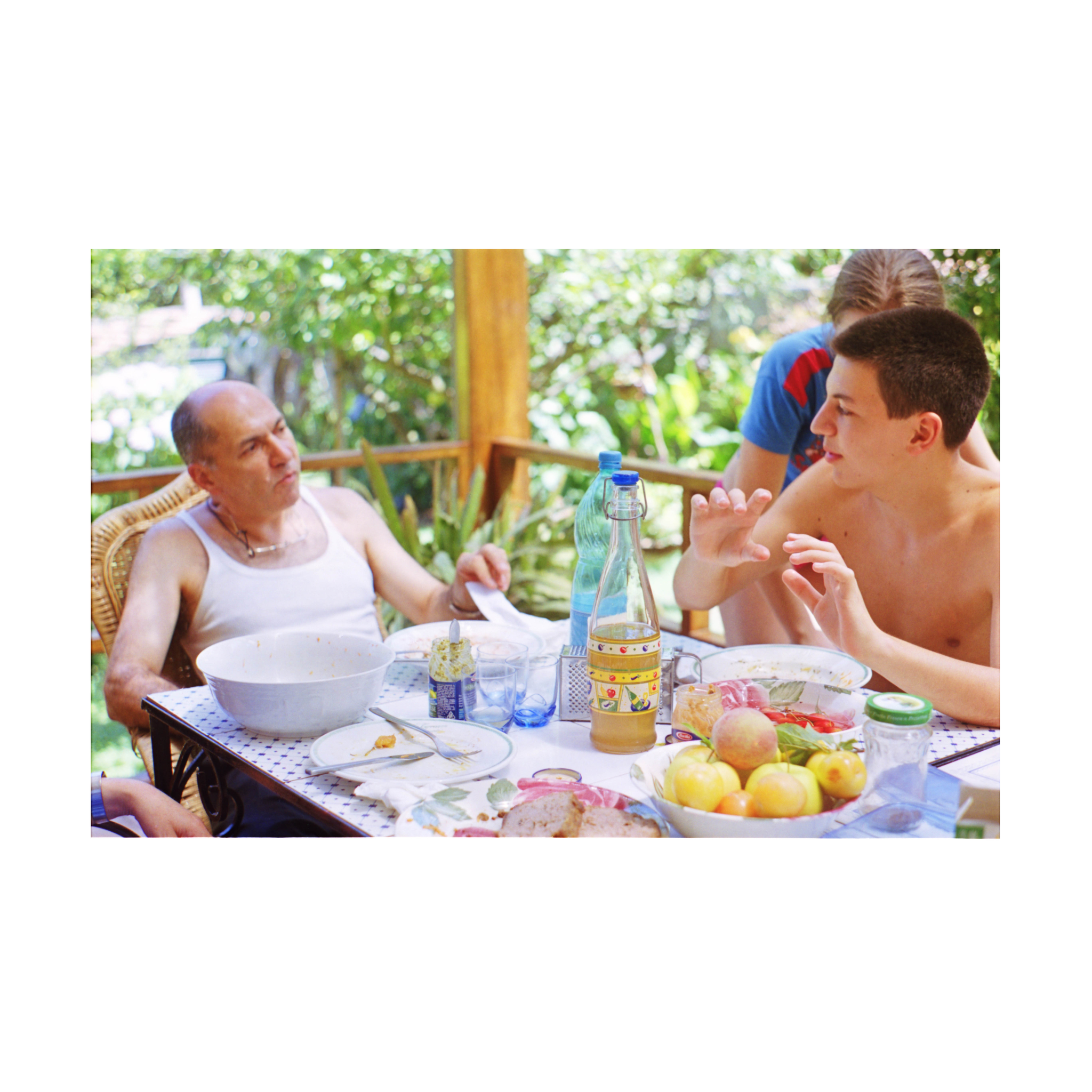
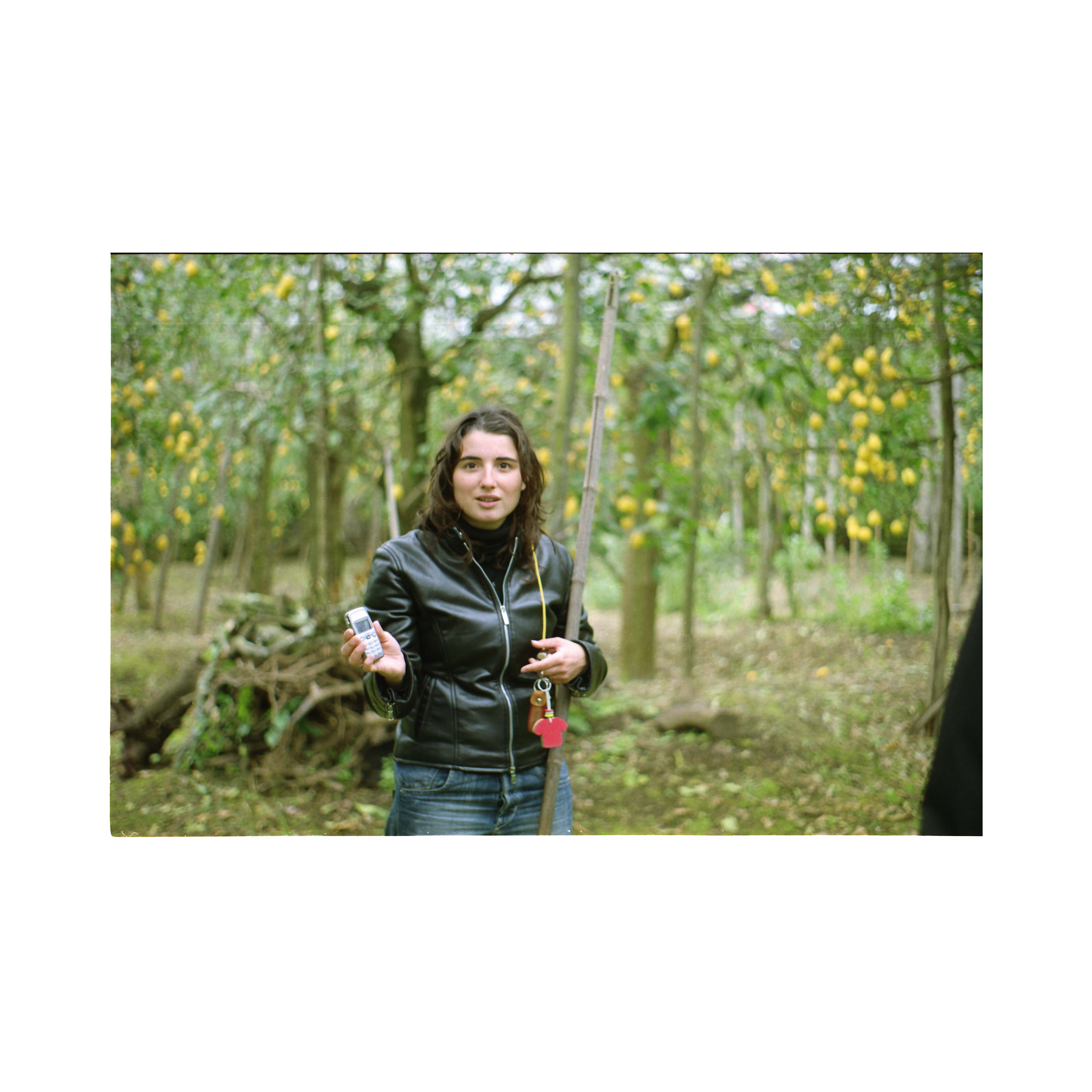
This exposition asks how authorship, memory, and narrative are co-constructed in a platform-native artwork under conditions of platform erosion. It also considers how these interrelations contribute to debates on distributed authorship and digital preservation, while introducing the concept of follower experience to foreground the temporal, situated experience of engaging with social media artworks. Our Days Of Gold is an ongoing artwork that has unfolded on Instagram since 2017. One image a day appears from a personal archive of analogue photographs taken in the early 2000s. While the photographs are drawn from a coherent personal collection, the work does not present a fixed narrative. A woman named Cécile recurs throughout, sometimes visible, sometimes absent, but always referenced by name in the captions. The same characters and spaces reappear in the images, accruing what one follower (@47n.120w) described as an “odd sense of comforting familiarity,” and what another (anonymous 4) called a “glimpse into a different world, one that feels familiar and foreign at the same time.” The project is
encountered through the interfaces of the Instagram feed and grid and increasingly depends on followers’ recollection. This dependency has intensified as updates to the platform’s layout and logic have disrupted the visibility and coherence of the work. Nevertheless, Our Days of Gold, (hereafter ODOG) continues to unspool through its daily rhythm, situated at the intersection of photographic indexicality—what Barthes (1981, p. 76) termed the “that-has-been”—and the iterative logic of the digital scroll.
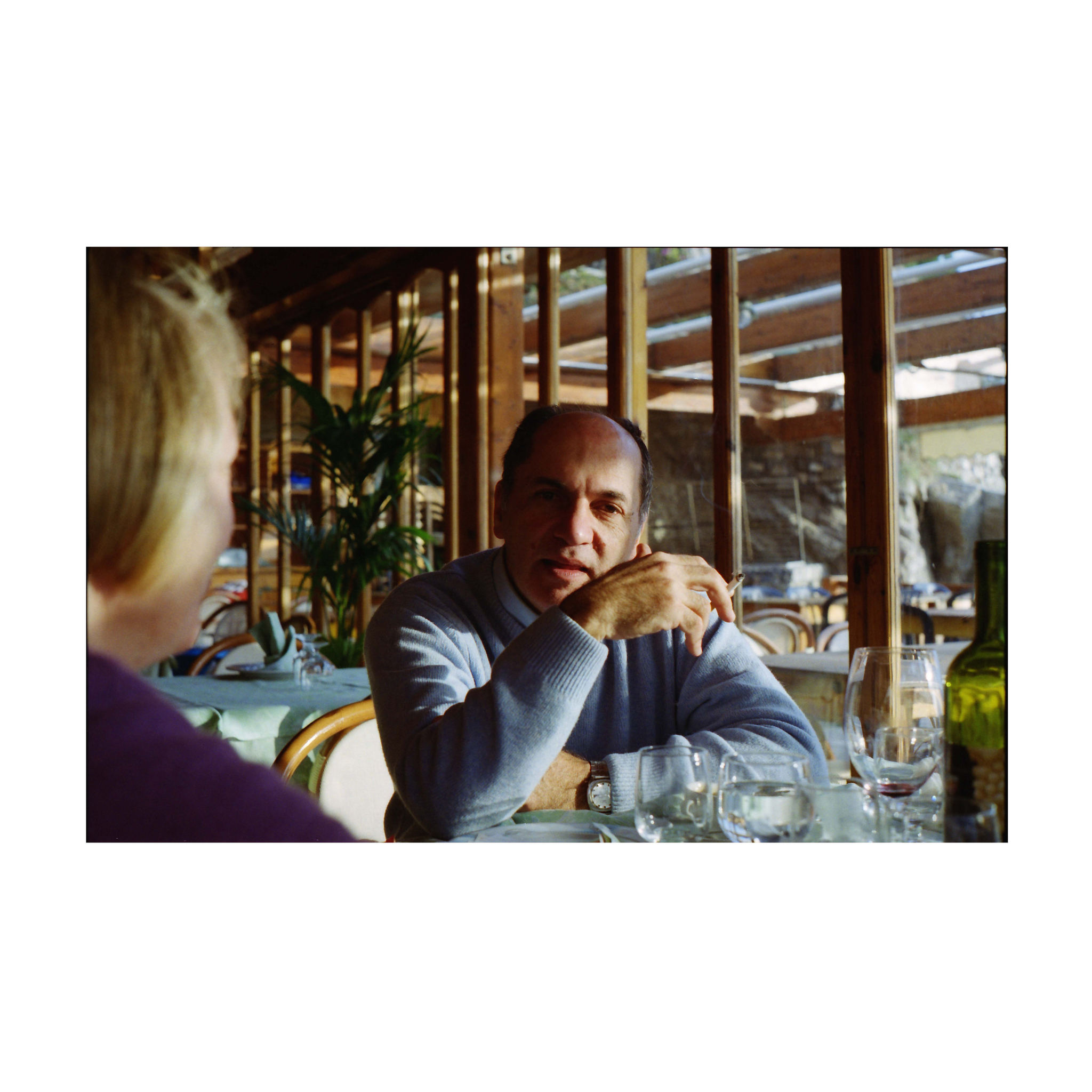
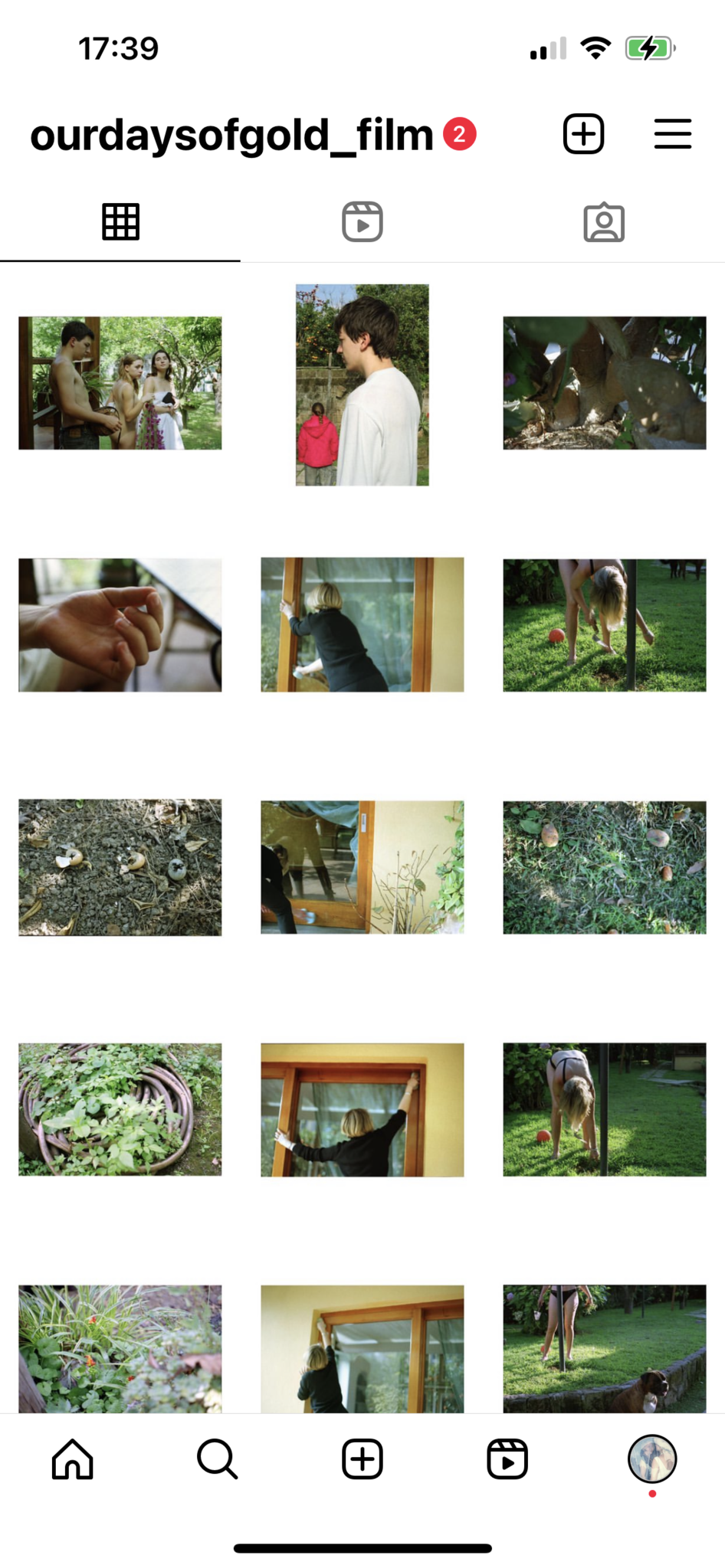
The exposition begins with a video by Frank Abbott—artist, long-term follower, and co-author. In the video, Abbott scrolls through a cluttered feed of reels, adverts, and unrelated content, voicing frustration as he searches for ODOG. “There’s so much… stuff,” he remarks, thumbing past distractions pushed by the algorithm. Eventually, he types the handle directly into the search bar, revealing the familiar grid. He recalls how the images first appeared in his feed as “film stills or analogue photographs,” with a tone “intriguing and quiet... not what you usually get on Instagram,” evoking the atmosphere of “an unmade or unseen Eric Rohmer movie.” Abbott’s difficulty locating the feed exemplifies a wider platform shift: followers have noted that Instagram’s algorithm deprioritises static images in favour of video and advertising, making the project harder to find. Where once ODOG circulated readily, it now relies on follower memory, intentional reconnection and
preservation. The exposition reveals ODOG as an open and incomplete elegy: not only for a person, Cécile, but for a platform that once enabled durational, relational practices. Whereas ‘Our Days of Gold: Love, Death, Instagram and the Photographic Archive’ (Ruocco, 2024) examined ODOG’s positioning within the tradition of the photographic archive and its durational unfolding on Instagram, this exposition shifts focus to follower experience, co-authorship with followers, and the effects of interface erosion. Here, follower experience names the embodied, durational, and infrastructural ways in which audiences encounter ODOG: not only through viewing images, but through the rhythms of scrolling, returning, commenting, and remembering. By situating follower experience alongside work on interactive and
participatory art, and on digital archives and social media, the exposition shows how followers’ gestures and interpretations are constitutive of the work.Through combining collaborative materials, follower voices, and analysis, the exposition develops a practice-led methodology for working with distributed authorship and explores how digital artworks persist within shifting infrastructures.
This triangulated methodological approach draws on three strands: comments and survey responses; screen recordings and narrations contributed by four long-term followers and co-authors; and engagement with a wide body of literature in media studies, literary theory, platform studies and artistic
research. Its layered form mirrors ODOG’s recursive logic: a main surface text provides a narrative thread, while screengrabs of follower comments, theoretical zoom-ins, and contextual elaborations open through footnote-style pop-ups. These paratexts are not supplementary but constitutive, enacting distributed authorship by involving readers in choosing their own pathways.
The exposition has been collaboratively designed and adapted to the shifting conditions of the platform. Following Cotter (2017), it resists subordinating artistic practice to academic templates, advancing a practice-led enquiry grounded in the contingencies of practice.
This approach sustains a materially engaged process where method evolves with the work. Within this framework, Sarah Robbins’ feminist account of distributed authorship as situated and collaborative (2003, p. 155) intersects with Melanie Feinberg’s analysis of infrastructural mediation. As Feinberg (2015, p. 59) observes, “composite texts… partially constitute the broader activities they appear to merely support,” foregrounding how informal, repeated, and seemingly peripheral interactions become central mechanisms of meaning-making. Contributions to ODOG remain variably legible, not only because of the platform’s algorithmic biases but also through the framing decisions made by the (anonymous) owner of the Instagram account—anonymous within the feed, yet identifying herself as Assunta Ruocco in contexts such as this exposition, public talks, and published writing. While ODOG’s remediation and dissemination are co-authored in many ways, its circulation beyond Instagram often begins with Ruocco’s initiative: she invites follower material into new contexts and determines its presentation across outputs, including public talks, publications, and this exposition. The project is therefore shaped by a form of distributed authorship that is dialogic and collaborative, while still sustained through Ruocco’s ongoing practice of collection, curation, and interpretation.
Authorship, in ODOG, is not confined to human agents. Instagram itself, through its shifting interface design, metrics of visibility, and algorithmic filtration, acts as a structural co-author. As Register et al. (2023) note, platforms mediate participation through structures of algorithmic precarity, producing uneven capacities for expression, legibility, and response. This condition is echoed in MacDowall and Budge’s (2022) account of Instagram as a cultural infrastructure: not a neutral host, but a co-constitutive force that materially shapes what can be seen, circulated, and remembered. In this sense, ODOG emerges through an entangled network of social attention, algorithmic modulation, and curatorial intent.
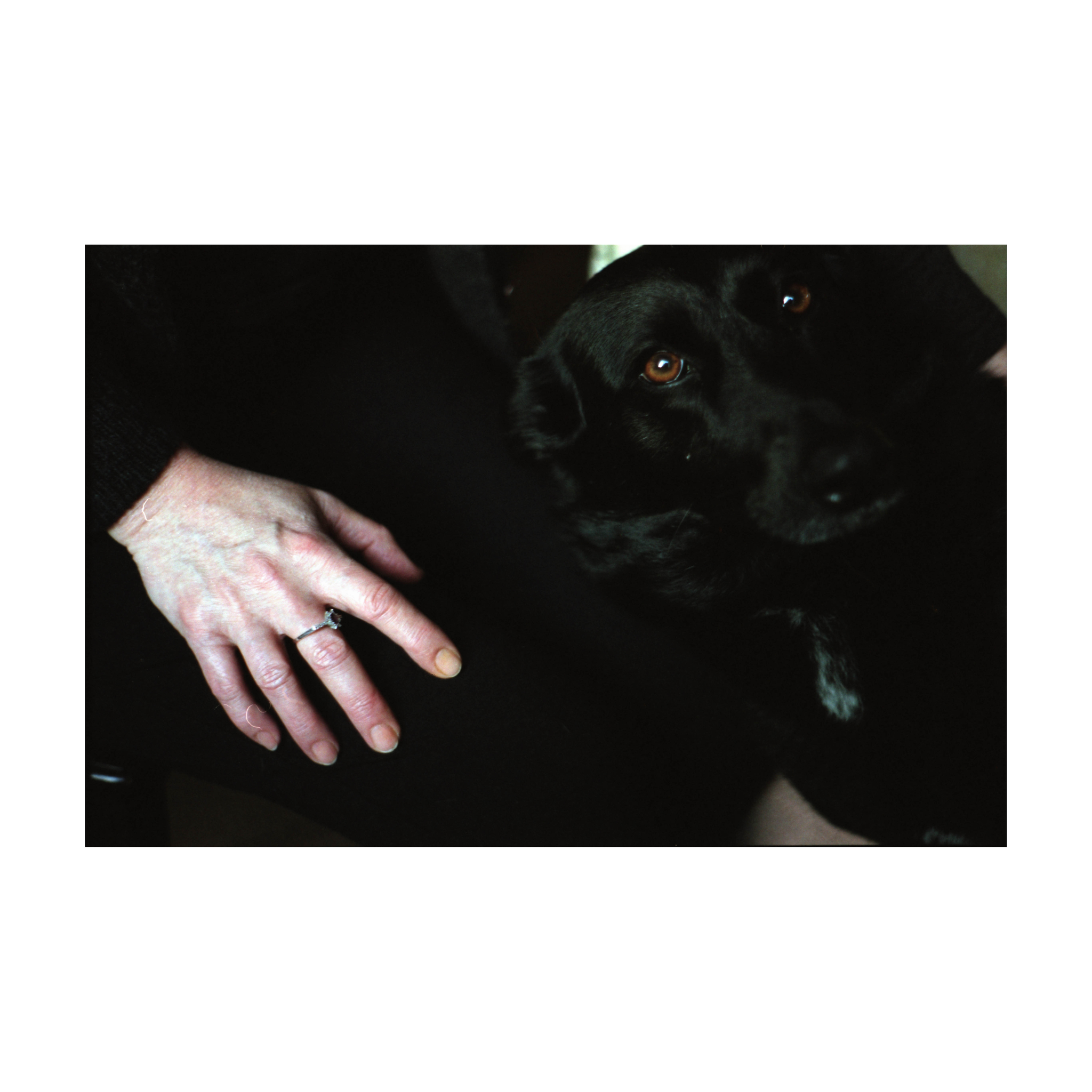
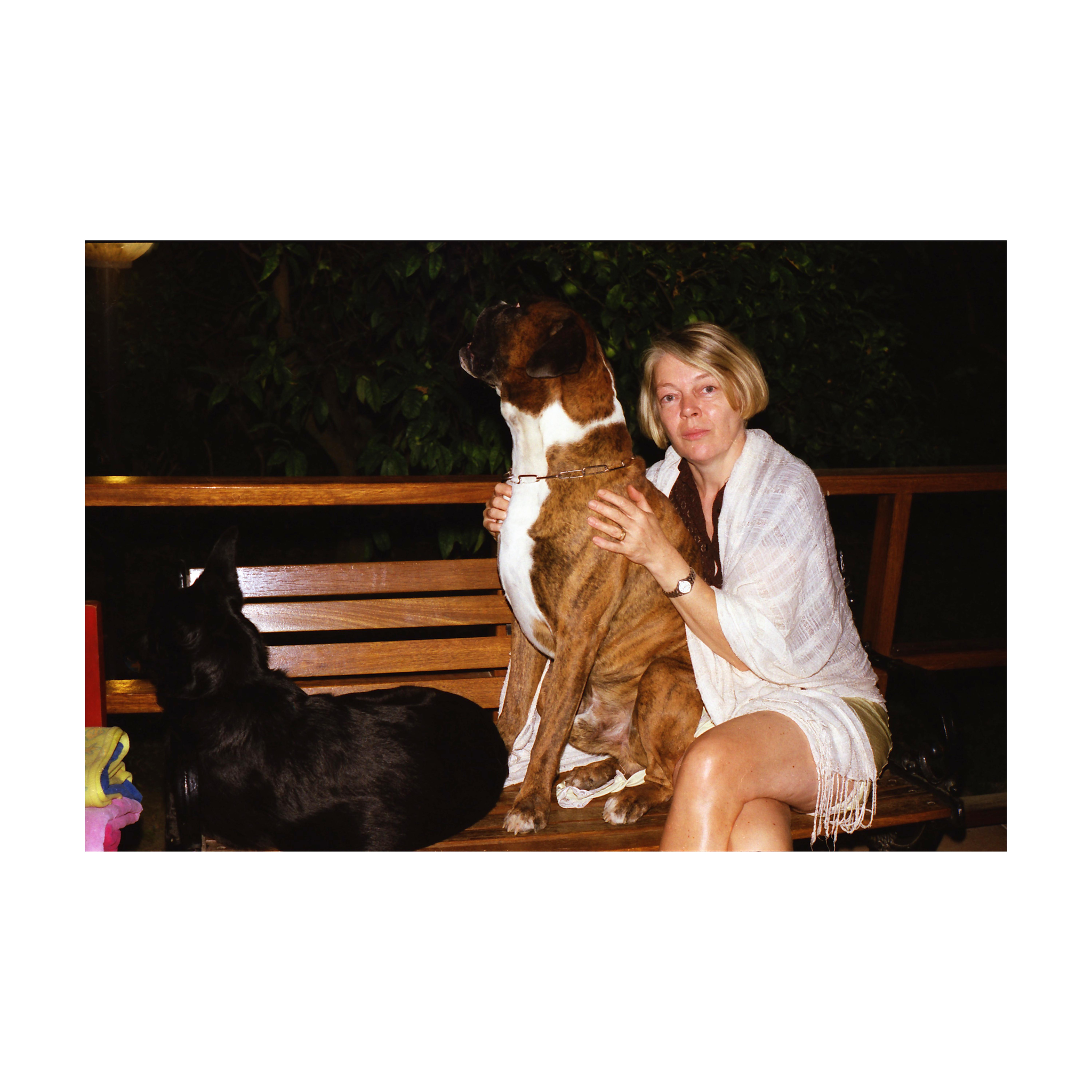
Rather than offering a closed or resolved story, ODOG unfolds in proximity to what Barthes (1974) terms the ‘writerly text,’ open to recomposition and readerly inscription. These distributed and infrastructural conditions inform the project’s polyphonic methodology grounded in productive opacity. Sarjoughian, Carroll, and Kennedy (2024) describe polyphony as “horizontal layering” that permits dissonance and interweaving rather than resolution. The approach resonates with Trinh T. Minh-ha’s concept of “speaking nearby” (1989), refusing mastery in favour of proximity, and with Saidiya Hartman’s “critical fabulation,” opening archival silences to ethical and affective possibility (2008). The recordings included here originated in summer and
autumn 2023, when Ruocco was preparing to present ODOG at the PARSE conference Powers of Love. She reached out to a small group of long-term followers, only one of whom, Nottingham-based artist Frank Abbott, she knew offline. Ruocco invited Abbott, along with Thisbe Nissen, Phil Nunnally, and Genevieve Maynard, and a few more, to create short screen recordings. These recordings were intended as illustrative material but became something more generative: Abbott and Nissen recorded voice-overs, narrating their perception of the work. Nunnally and Maynard contributed silent recordings that revealed through pacing and image selection, something of their individual navigational habits and relationship with ODOG. These variations became integral to understanding ODOG as a distributed artwork. This exposition has since evolved in collaboration with these four contributors. Their embedded voices constitute a polyphonic re-imagining of the work.
As Abbott later remarked in a conversation with Ruocco, the way each follower reads and recalls ODOG depends on their interface habits and personal rhythms. “That’s one of the aspects of this digital medium,” he noted, “people read it in different ways. Because they have different habits.” It is this collaborative divergence that underpins the methodological framework developed in the sections that follow.
Following this introduction, the exposition develops across three sections, each paired with a co-author’s video.
Platform Grief and Digital Erosion addresses how infrastructural changes to Instagram reshape ODOG’s visibility, casting scrolling itself as a mode of preservation.
Polyvocal Construction explores how follower voices and screen recordings co-narrate the work, foregrounding divergent habits of reading and remembering.
The Text-Generating Navigation Grid situates ODOG in relation to autofiction and distributed authorship, tracing how touch and navigation generate layered narratives.
The conclusion, Re-imagining ODOG from Platform to Palimpsest, reflects on the project’s persistence as a collaborative, infrastructural, and readerly system.

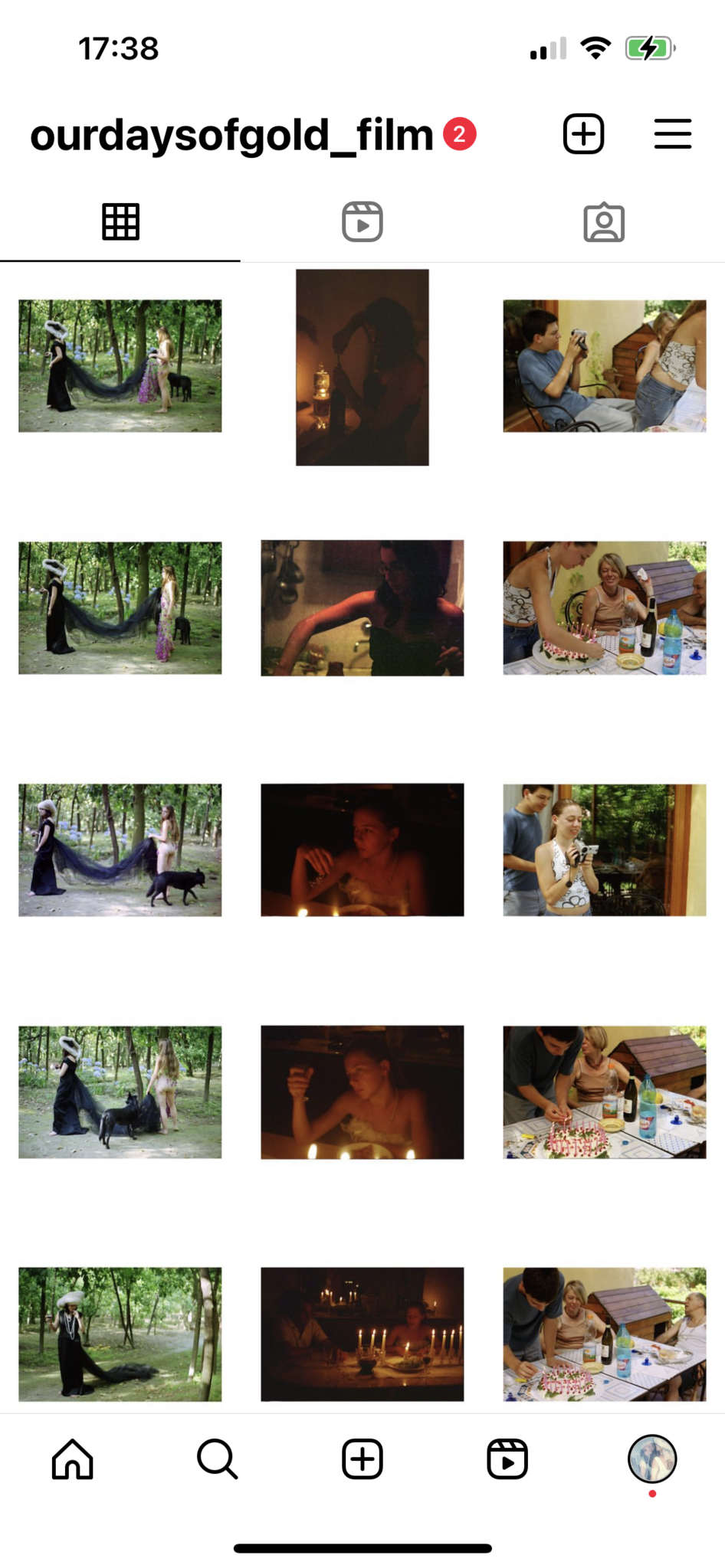
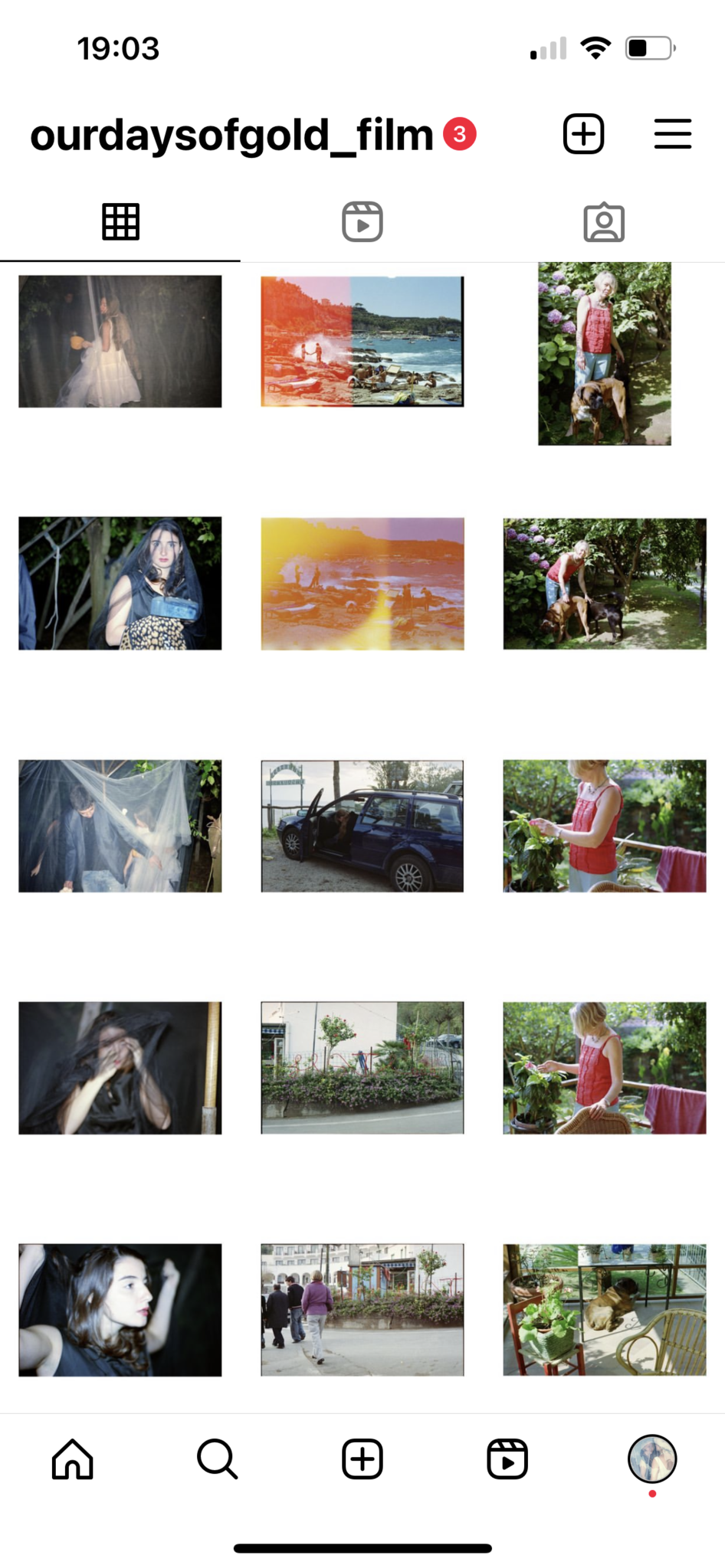
This section explores how changes to Instagram’s infrastructure have altered both the form and reception of ODOG. Since its inception in 2017, ODOG relied on the square image grid, white borders, and daily posting as structuring principles. These visual constraints allowed followers to experience the work as a serial, cumulative form.
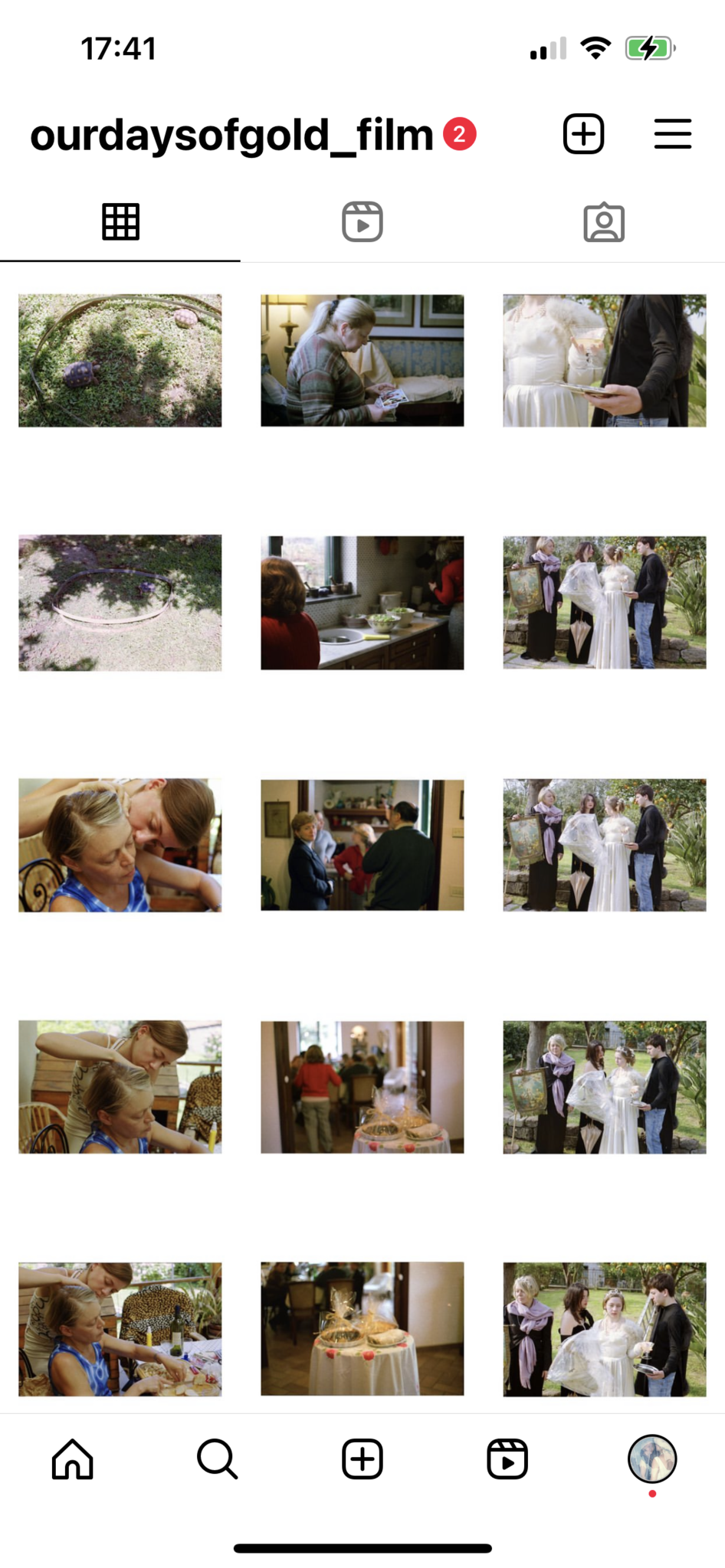
However, platform redesigns, including the shift to vertical video, algorithmic sorting, and de-prioritisation of still image-based content, have significantly disrupted this coherence (Abidin, Leaver and Highfield, 2020, p. 19; Grigoryan 2025; Peters, 2025; Steinberg, 2025).
The temporality of ODOG unfolds as a digital chronotope in Bakhtin’s sense: “the place where the knots of narrative are tied and untied” (Bakhtin, 1981, cited in Morris, 1994, p. 187). Here, the project reanimates past events by what Li and Huang describe as “splic[ing] them into new time-spaces for the creation of resemiotised communication” (2024, p.4), inviting a recursive, non-linear encounter with mourning and memory.
Beginning in 2019, after the introduction of Instagram algorithmic timeline (Abidin et al. 2020, pp. 18–19), many long-term followers began noticing that ODOG posts became less visible in their feeds, prompting a wave of disorientation and affective response. One follower remarked, “I haven’t seen your work in forever. Just pisses me off what IG does to our feeds!” (@realtorsguide, 2020), while another simply noted, “I’ve missed so many of your beautiful images” (@jokalinowski_, 2019). The sense of ODOG’s partial disappearance became increasingly widespread. A 2025 survey response from Tom Trevatt echoed this, stating, “They rarely do [appear], – Instagram isn’t great at pushing the content that I actually want to see.” @greenleafkatherine observed, “I do not see your posts and I am not sure if you
have been posting...” Similarly, Veronika Strange reflected, “It very rarely does [appear], but I do remember once it popped up and I found it unsettling.” These testimonies do not merely describe technical glitches but point to a deeper phenomenon: what photography theorist Jennifer Good, in a recent conversation with Assunta Ruocco has termed “platform grief”: the mourning of a prior modality of encounter that enabled consistent, durational engagement with slow media artworks. As co-author and long-time follower Thisbe Nissen writes, “I don’t see enough of Our Days of Gold… It just raises my ire at Instagram for basically ruining what was once such a pleasure for me.” These cumulative responses suggest that followers are not only missing specific posts, but also grieving a rhythm and relation afforded by the platform’s earlier logic.
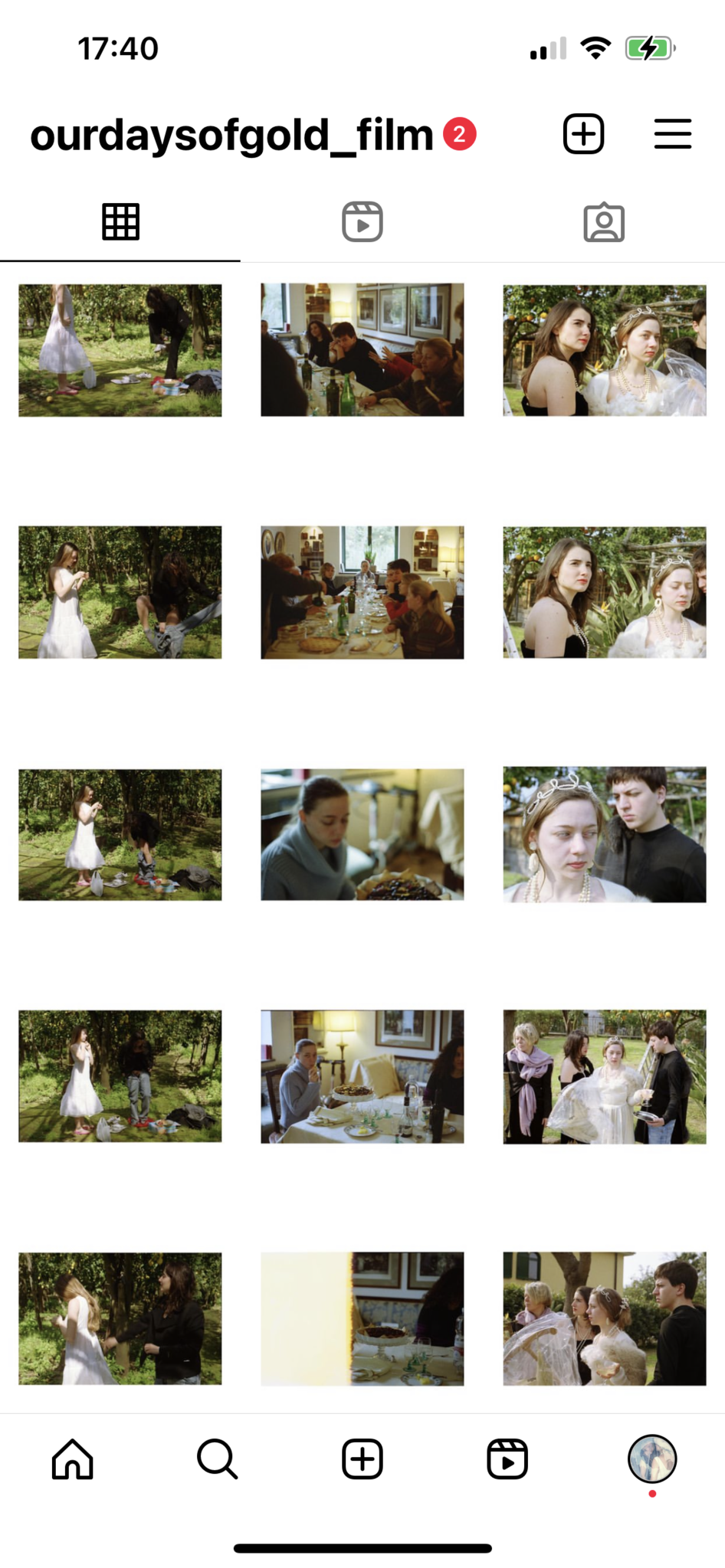
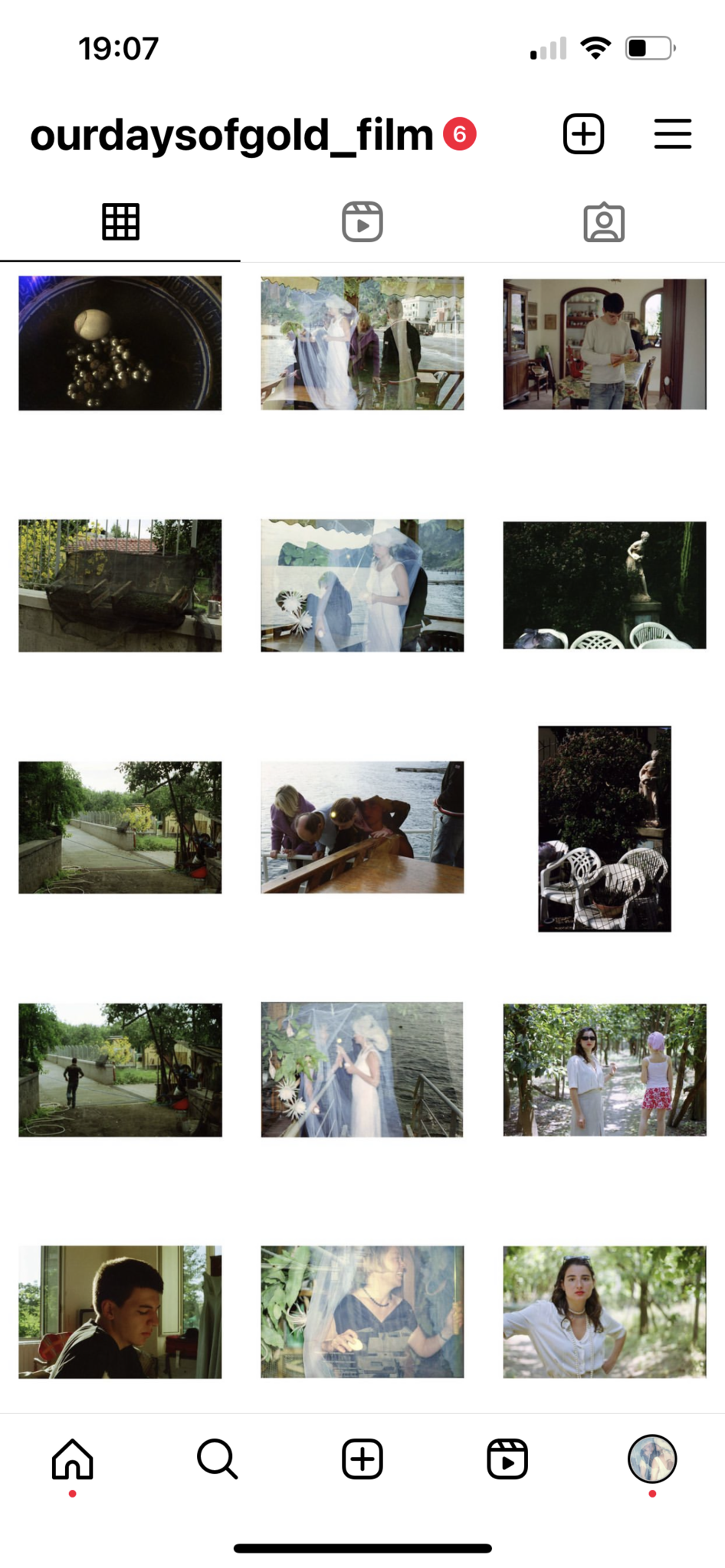
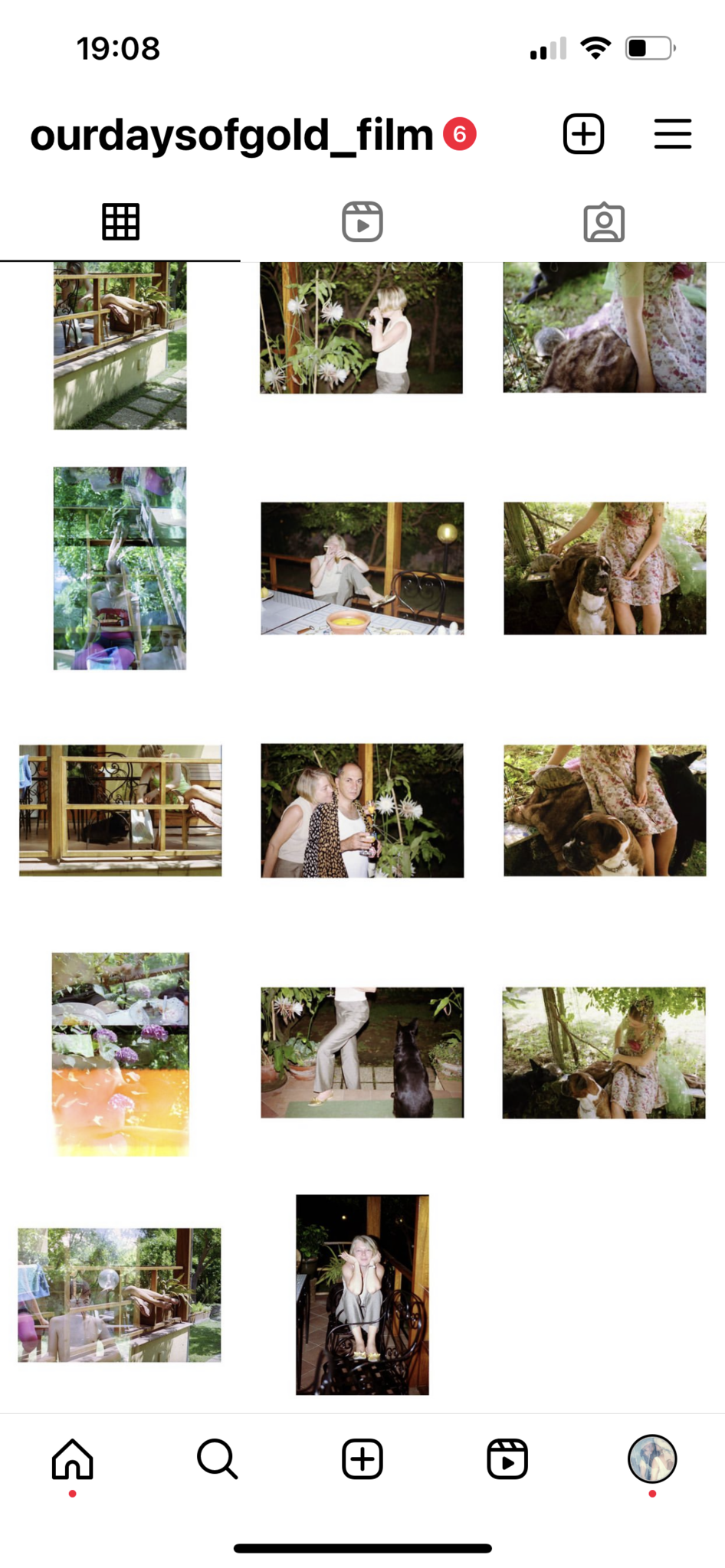
A major redesign in 2025 further diminished ODOG’s readability by introducing a default 4:5 portrait ratio and privileging vertical video, thereby undermining the square grid that once supported its triptych format (Grigoryan 2025; Adonis Media, 2025). Earlier iterations of the project preserved a distinctive visual rhythm by inserting white borders around rectangular images, ensuring equal spacing and enabling three parallel narratives to unfold across the grid. This spacing was retrospectively overwritten when Instagram reformatted the feed, splicing off the sides of the white-bordered squares and collapsing them into awkward proximity. Once carefully modulated
triptychs were rendered clumsy and compressed, eroding the legibility of the three parallel narratives. As noted by @dori_albagranzotto (2024), this pulsating grid format structured followers’ experience of the work, creating a recognisable narrative rhythm. Ruocco (2024) examined this pulsating grid at length, situating it in relation to art-historical precedents such as Richter’s Atlas and Warburg’s Mnemosyne. Here, however, the focus is on how subsequent interface redesigns fractured that rhythm, aligning with what MacDowall and de Souza (2017, p. 10) describe as a “wild archive,” a platform vernacular shaped by immediacy, saturation, and distraction.
These changes are not only visual but
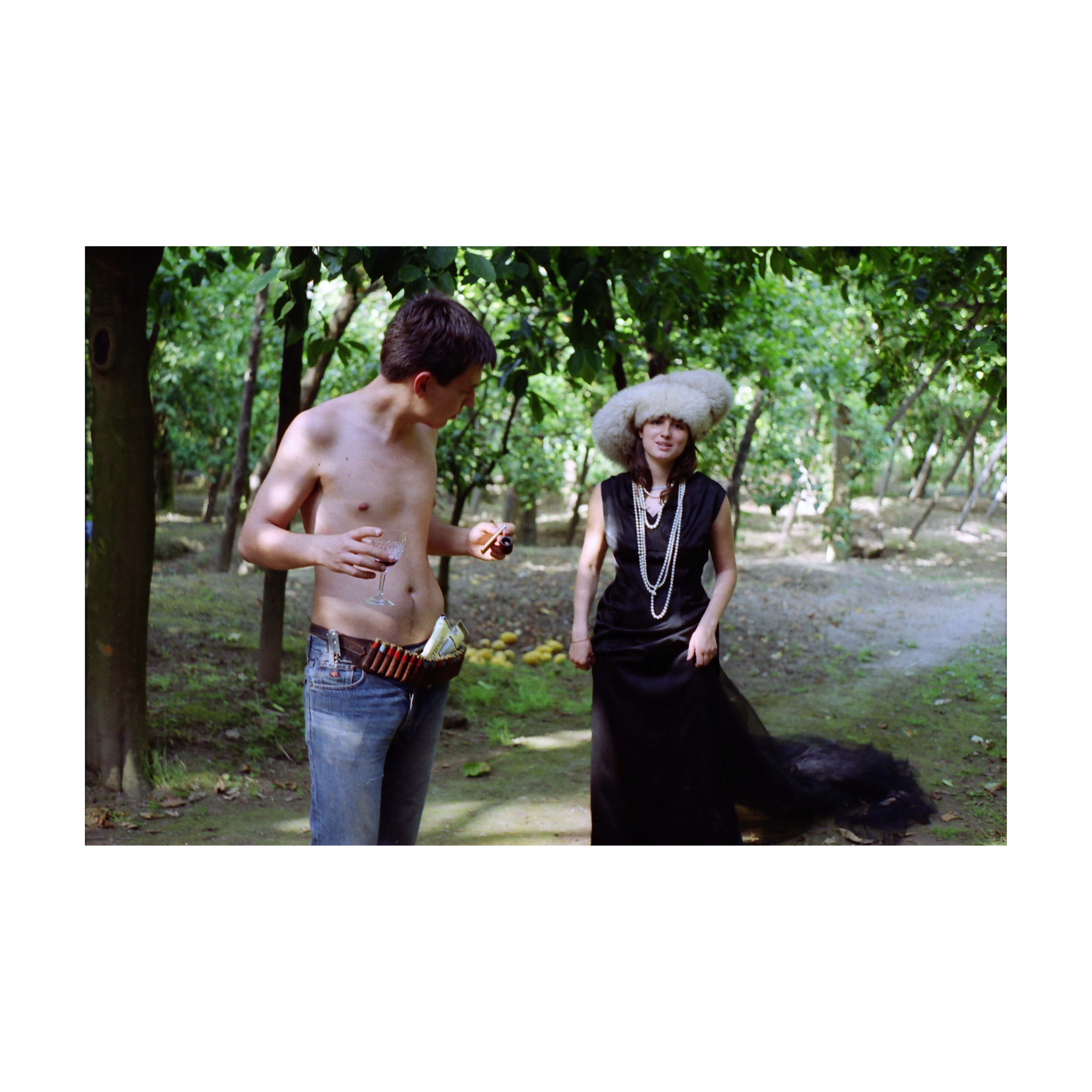
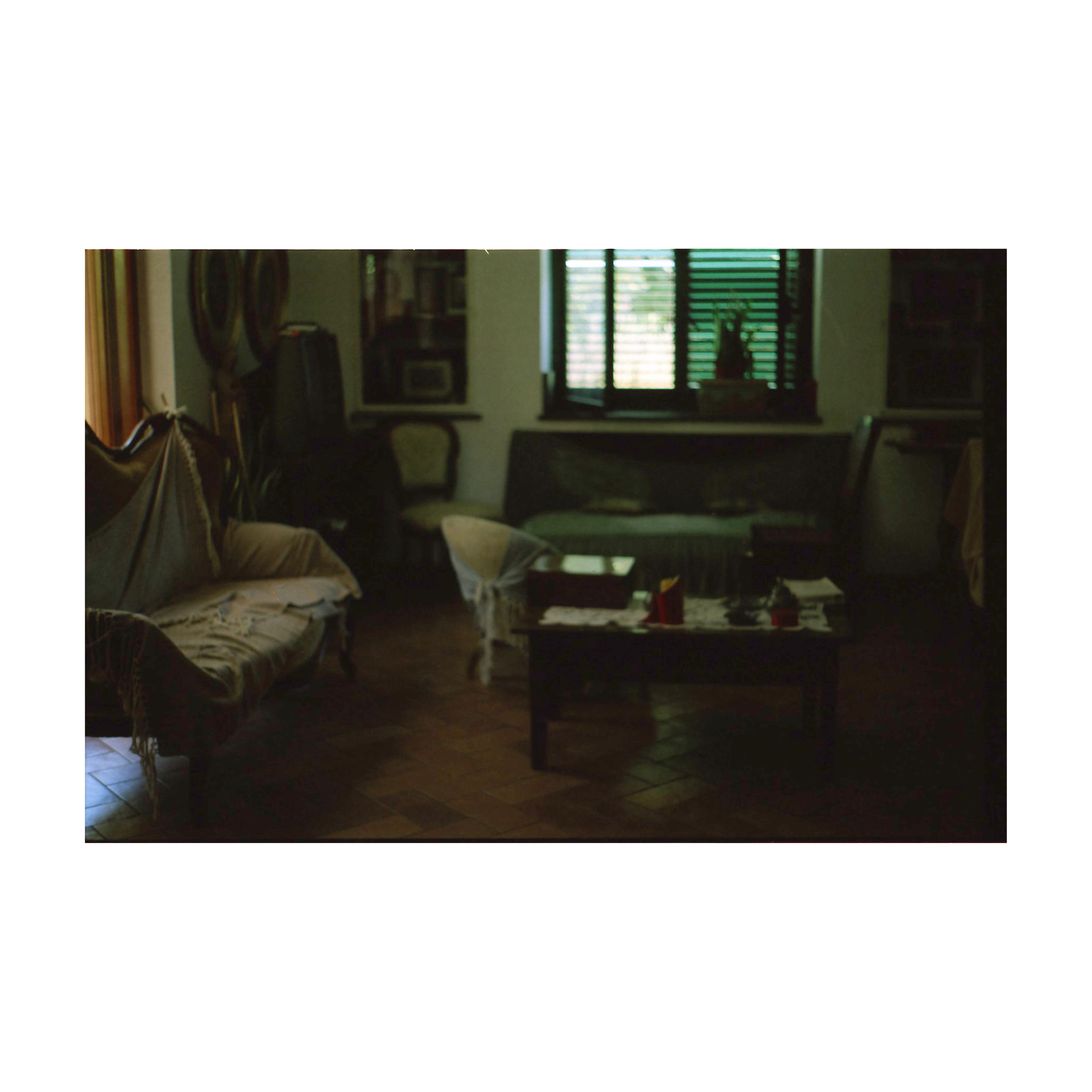
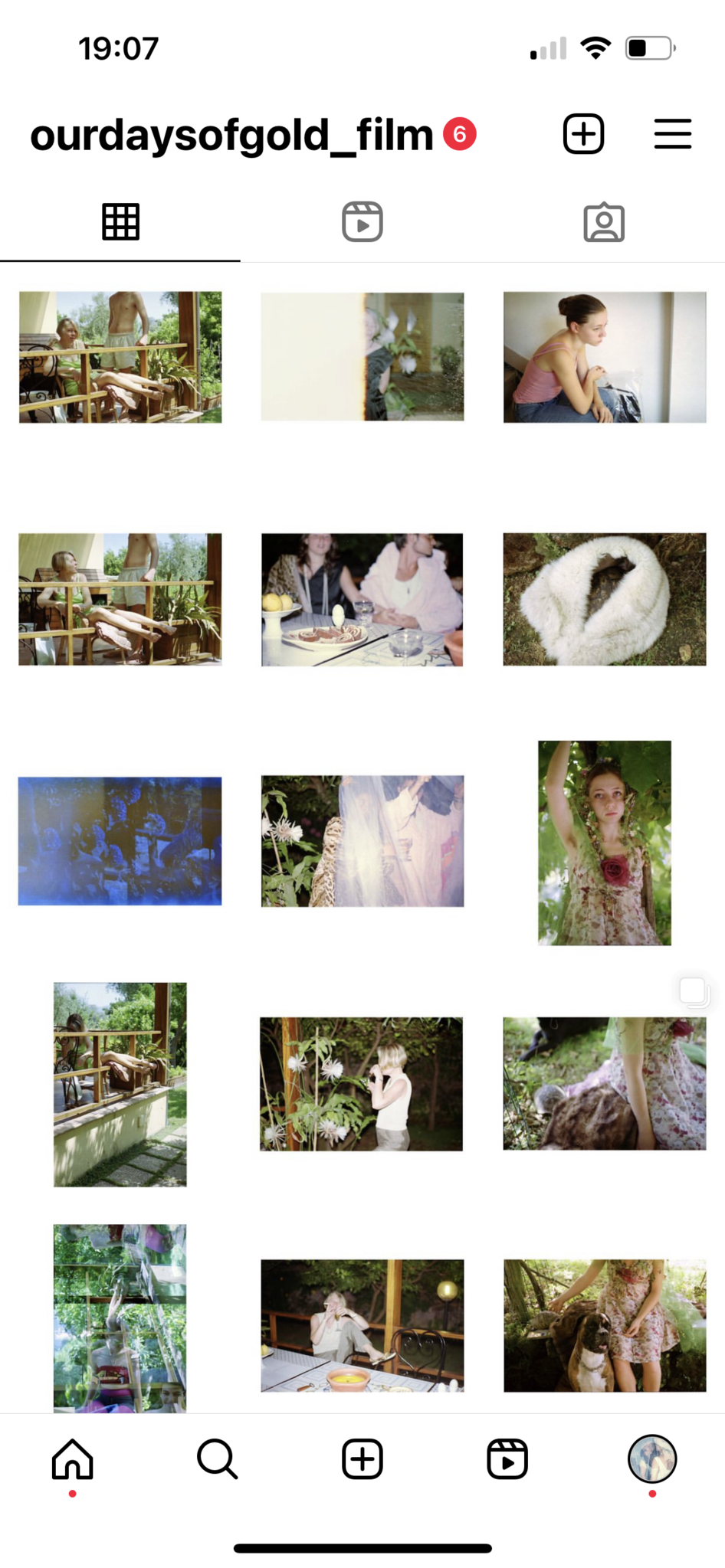
infrastructural: they affect what MacDowall and Budge (2022) describe as Instagram’s role as both an institution and an infrastructure shaping what is seen, circulated, and valued. Followers now navigate ODOG through memory, scrolling, and archival gestures, responding to what Register et al. (2023) call “algorithmic precarity,” the unpredictability of platform visibility and reach. Given the present interface, defined by verticality and instability, ODOG’s earlier coherence persists only through dispersed fragments such as screen recordings and screenshots: documentation that not only preserves but re‑becomes the artwork (Giannachi and Dekker 2023). As Bolter and Grusin argue, remediation operates under a “double logic”—the simultaneous drive toward immediacy and hypermediacy (1999, p. 5). ODOG is caught in this bind, its visual logic overwritten by the shifting conditions of its platform. Rather than merely registering this disruption, the present exposition remediates ODOG’s original spatial logic. By reinstating the white-bordered triptych format in its layout, it restores the sense of rhythm and spacing that once shaped the work, offering a counterpoint to Instagram’s current “baroque carousel” of overlapping content (McHugh, 2017, cited in MacDowall and Budge, 2024). In this way, the exposition functions both as analysis and as restoration, re-enacting the conditions that first sustained ODOG’s narrative coherence.
Screen recordings made by followers before
Instagram’s algorithmic shift have now acquired new significance. Originally created for the 2023 Powers of Love conference at Valand Academy, recordings by Frank Abbot, Phil Nunnally, Thisbe Nissen and Genevieve Maynard offered a way for Assunta Ruocco to present ODOG through the eyes of its followers. In retrospect, they have become the only testimony of the work’s original appearance. Genevieve Maynard’s screen recording and interview offer a particularly resonant example of how ODOG’s temporality has become increasingly fragile under platform erosion. She described the experience of seeing ODOG appear in her feed as “almost a feeling of relief… that it hasn't ended.” Her comment underscores not only a long-term investment in the work, but a recognition of its precarity.
“There's a sense of threat, or impending doom in the story, like thunderclouds on a summer's afternoon,” she notes, a metaphor that mirrors
the structural instability now shaping ODOG’s appearance online. “I'm never certain of the narrative… What could be of value here to me, the viewer? I don't know, and yet I keep looking.” Her refusal to seek resolution, paired with her continued attention, exemplifies how ODOG persists, maintained not by its infrastructure, but by followers attachment.
Giannachi and Dekker in Documentation as Art (2023) describe such user-led practices as part of an “expanded documentation” model, where documentation is not just archival, but
participatory and performative and becomes the art object in and of itself. Yet these practices also have unintended consequences: they also inadvertently capture the history of the platform itself.
This is not unique to ODOG. A similar example appears in Rhizome’s Webrecorder-based archive of Amalia Ulman’s Excellences
and , which preserved Instagram’s earlier five-image grid (Rhizome, n.d.).
These artefacts testify not just to artistic content but to interface history. They show how artworks are entangled with the platforms through which they circulate. In this way, ODOG becomes both an artwork and an elegy for a different kind of Instagram: one that, while never ideal, once supported slow engagement and relational presence. That platform logic is now gone, but through the preservation of followers experiences and memories, some traces remain.
ODOG’s followers often treat the feed as a serialized narrative. Anonymous 10 describes the experience as akin to “watching a film one frame at a time”. This cinematic metaphor reflects how the temporal structure of the posts, their slow release and visual continuity, lends itself to story co-construction.
“I started to believe that my interest isn't sourcing from simple curiosity about their past and present-day situations when I began to find myself imagining and believing my fictional stories about their lives…these photographs enabled me to write fictional stories and memories about them in my mind” writes Tolga Kardes. Despite the absence of a linear plot or explicit information, many followers build elaborate personal narratives around the recurring figures.
The videos by Frank Abbott, Genevieve Maynard, Thisbe Nissen, and Phil Nunnally included in this exposition illustrate the active, performative role that followers play within ODOG, by re-animating its content and taking on the role of witness and narrator.
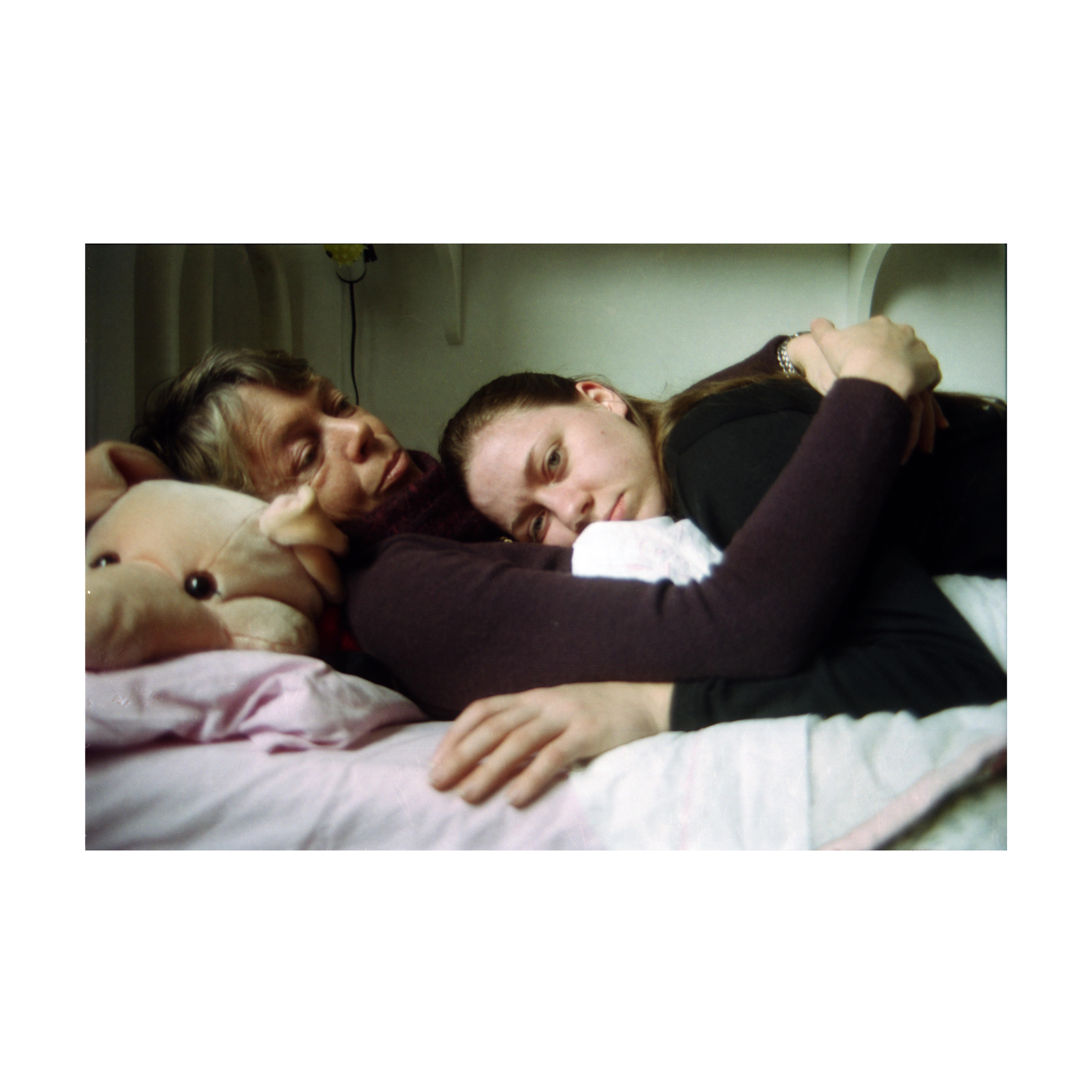
The scarcity of information — or “withdrawness,” as Niclas Östlind described it in a recent public conversation (Ruocco and Östlind, 2024) — creates a space for followers to fill in with their own associations, memories, and imagination.
Abbott’s reflections in the voice over for his video exemplify this interpretive mode. There “didn’t seem to be any rhyme nor reason to them beyond the fact that they all had a particular visual quality and a particular atmosphere… not pushy but quite intriguing and quiet.” They appeared “consistently” in his feed, “they seemed to be telling some kind of story about someone called Cécile and her family,” but it was a story whose contours remained suspended, punctuated by repetitions and subtle spatial shifts, “to a
room or a sort of orchard or… down by the beach”.
Bakhtin’s concept of polyphony, introduced earlier, is taken up again here in relation to follower accounts, where ODOG’s reception often evokes "a plurality of independent and unmerged voices and consciousnesses" (Bakhtin, 1984, p. 6). This polyphonic effect arises less from intentional design than from the affordances of the feed and the interpretive practices of followers, producing an assembly of perspectives that remain unresolved. In contrast to monologic narration, which seeks closure through a single voice, polyphony sustains meaning through coexisting perspectives that resist singular resolution (Bakhtin, 1984, p. 63).
ODOG’s meaning is not fixed by authorial intent but emerges from the friction and companionship of voices accumulating over time. It is difficult, if not impossible, for the poster to imagine the experience ODOG represents for followers who have been at the receiving end of the work. She has no access to the temporal rhythms, emotional investments, or habitual acts of attention through which ODOG is encountered. This gap is not a limitation but a generative feature: it affirms the interpretive autonomy of the viewer and positions Ruocco's role not as narrator, but as one contributor to a broader polyphonic system. As co-author Phil Nunnally reflects in a
conversation with Ruocco, the experience of following ODOG is not linear but rather recursive: “We’ve gotten to know Cécile and her children, but we don’t know how much of it is made up and how much is real... It doesn’t matter, because as long as you keep following the account, you can count on a new image, a new clue.”
This speculative mode of reception aligns with Alice Bell’s (2021) account of ontological resonance—“a prolonged response and aura of significance which is generated by perceived bidirectional ontological transfers between the actual world and a storyworld both during and after the experience” (p. 437). While Bell’s analysis is grounded in interactive fiction, her observations resonate with ODOG’s temporal and narrative form. The project does not present a coherent or immersive narrative world, but instead sustains a serial ambiguity, where characters and events remain suspended across time. A number of followers have described this ambiguity as a form of withholding. As @sophiemackfall put it, she liked “that it felt withholding, when everything around it was the opposite”. This withholding, the project’s mystery and reticence, functions as a condition for polyvocal re-imagining. By avoiding the construction of a coherent narrative that would lead inevitably to a conclusion, such as Cécile’s death, ODOG’s system intentionally leave space for followers to re-imagine the work in accordance with their own perceptions and associations. This
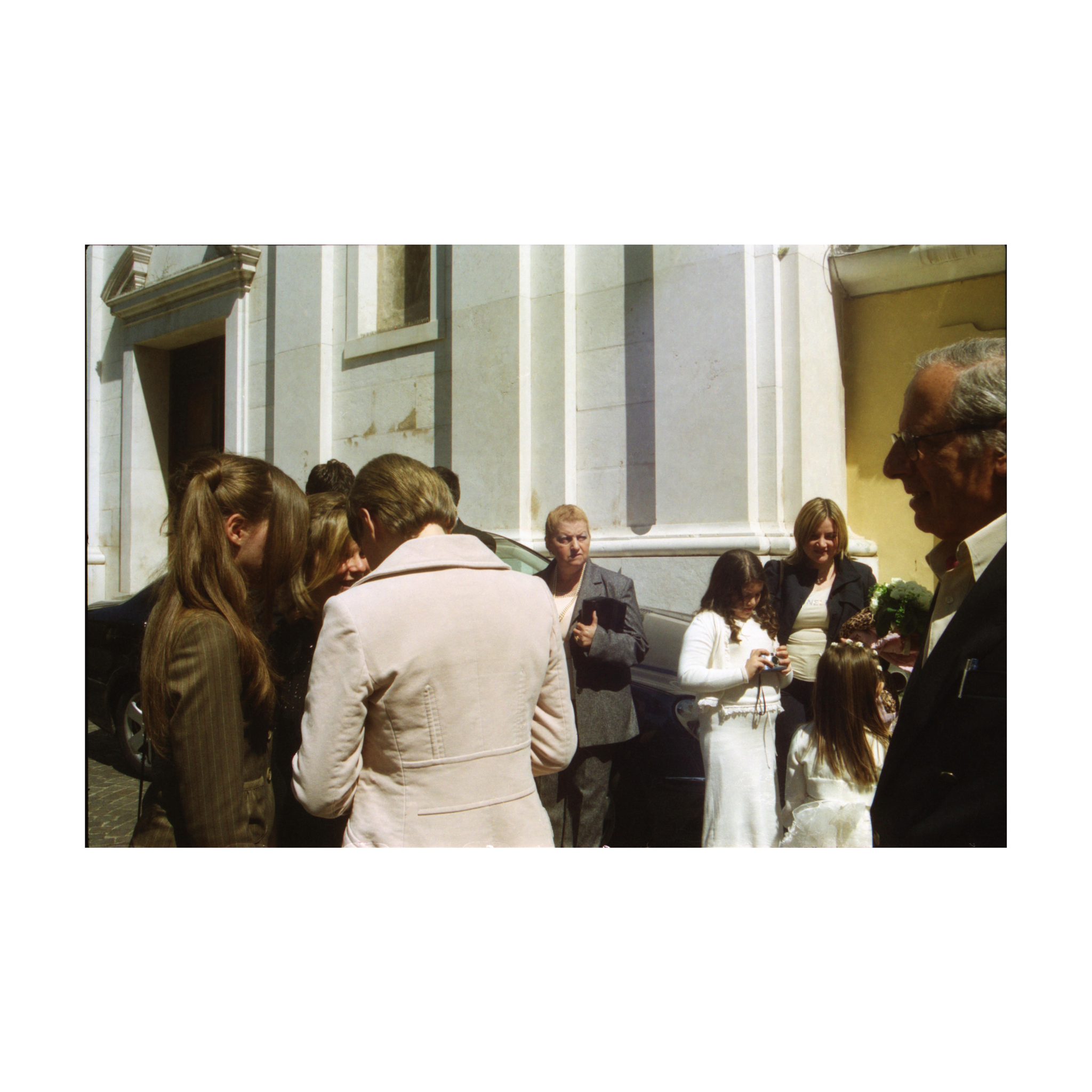
narrative suspension invites followers to inhabit the archive fragmentarily, rather than resolve it. In this sense, ODOG’s structure produces a mode of encounter in which narrative elements persist through accumulation and return, ever unresolved.
The temporal gaps between images are also the site where the news of Cécile’s sudden death is temporarily lost or suspended. This news — its slippage, resurfacing, and cyclical reiteration — would lose meaning in a vacuum; it only performs as such within a social context, in relation to other Instagram users. As ODOG’s images are encountered not only as a grid on the profile page but in fragmented, asynchronous flows across follower feeds and hashtags, the narrative gaps between them
take on shifting temporalities. These gaps are multifarious and uncontrollable, dependent on interface design, attention rhythms, and viewer memory. User interactions with ODOG and their reactions to moments like the announcement of Cécile’s death shaped the work’s evolving structure, particularly in its earlier years, before algorithmic changes made it less likely for the project to appear in followers’ feeds (Abidin et al., 2019, pp. 18-19).
An anonymous survey respondent noted: “All images contain narrative within themselves, but this account stood out because it felt like I was watching a film one frame at a time.” This sense of slow, serial unfolding situates ODOG in what Roland Barthes termed the texte scriptible — a “writerly text” that asks its
readers to fill the silences rather than decode a fixed meaning (Barthes, 1974: 5). As foreshadowed in the earlier discussion of ODOG as scriptible, this mode becomes most palpable in the followers’ accounts themselves.
Nunnally’s reflections in a conversation with Ruocco also speak to this layered and speculative engagement. “It’s unlike any other account I've seen,” he writes, “with its deliberate cadence, each frame in its share of the triptych almost imperceptibly different from the one that came before.” For Nunnally, this visual rhythm is not simply aesthetic, but narrative and relational: “we’ve gotten to know Cécile and her children, but we don’t know how much of it is made up and how much is real… it doesn’t matter.” The ambiguity is not a barrier but a condition of intimacy, a mode of following grounded in trust, temporal drift, and what he calls “the pace of the deep human breath.”
Such interpretive labour is often affective, speculative, and contradictory. Several followers responding to the online survey in 2025, expressed different beliefs about Cécile. “She had a son and a daughter… she sadly passed away,” wrote another anonymous survey respondent. Ron @nycdigital speculated on her emotional life, wondering “if her death was sudden or if the knowledge of impending death was the cause for tension in the family.” Some responses dwell on psychic states, such as Linus Broström’s: “She needed immediate psychiatric care… she was in
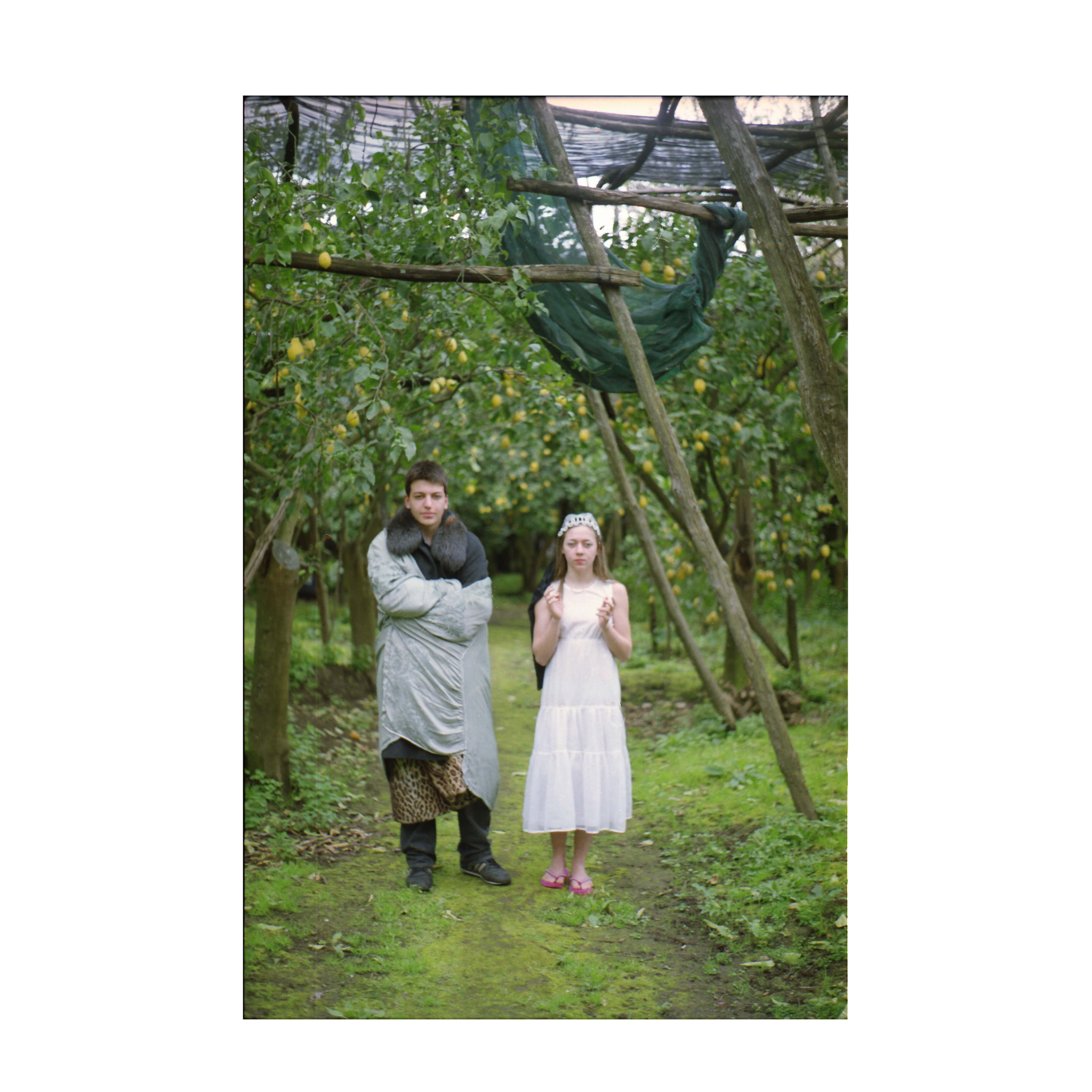
important ways ‘strong’ and ‘independent’”. These utterances resist certainty. They are affective inferences — emotionally driven interpretations formed not in search of narrative resolution, but in response to the work’s sustained mood and atmosphere.Crucially, these follower voices are not just coming from the online survey. On Instagram, they are inscribed visibly below @ourdaysofgold_film posts, enacting a palimpsestic layering of readerly interpretation underneath the captions. Across the platform, acts of narrative speculation appear. One follower wonders: “How is Cécile?” (@lucmee, April 15, 2019). A viewer links scenes across time: “What happened in summer 2005?”( @i.take.my.camera.everywhere 27 June 2018); “Thank God — now I finally know
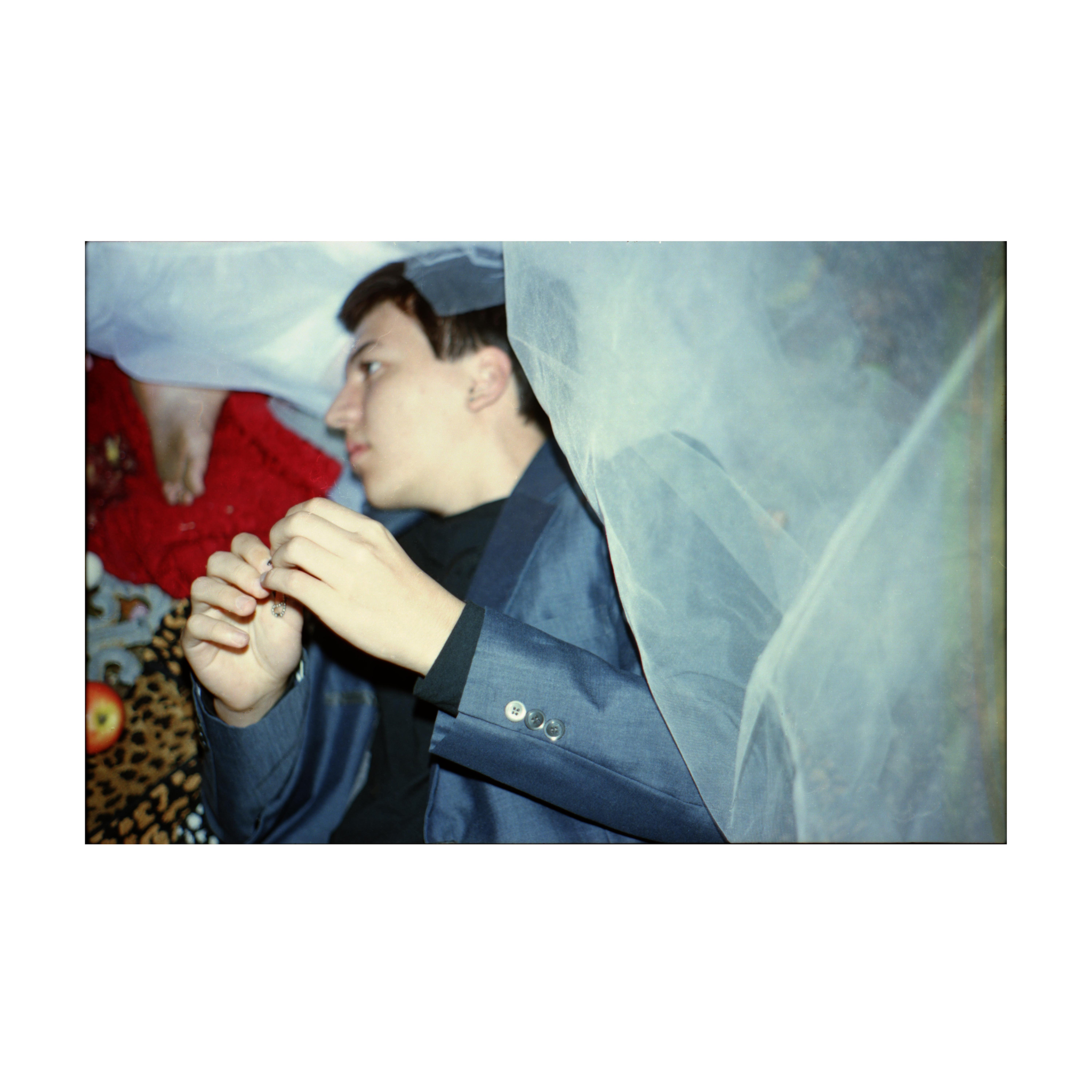
what happened in Summer 2005!!” (@i.take.my.camera.everywhere 20 July 2018). Others speculate on continuity, on loss, on family structure. One writes, “Still love this. Wondering how they are now?” (@kodakcarnet March 16 2018), as if the characters are suspended in unresolved time. These comments dialogic events —a discordant chorus that blurs the the border between audience and author, framing and framed, enacting what Fairey and Orton (2019) describe as photography’s potential to generate reflexive, participatory spaces of meaning. The work becomes palimpsestic: each post stratified with caption, comment, re-memory, and narrative suggestion. As @47n.120w puts it: “I don’t actually know what the project depicts or means, but the
feeling it evokes is strong. I suppose that’s why I don’t try to find out. The feeling is enough.” In this sense, ODOG functions not as a story told to its followers, but as a site of shared narration. This affective suspension — this return to @ourdaysofgold_film not to uncover truth but to keep looking — is what sustains ODOG. The work lives in its followers’ imaginations, circulating through comment threads, saved images, speculative memory, and partial knowing. It is less a concluded archive than a living, relational text, one whose meaning is always arriving, never settled. In this sense, ODOG operates as what Umberto Eco (1989) called an opera aperta — an “open work” that invites interpretation not as closure, but as collaboration, remaining open to ongoing acts of narrative completion by its viewers.
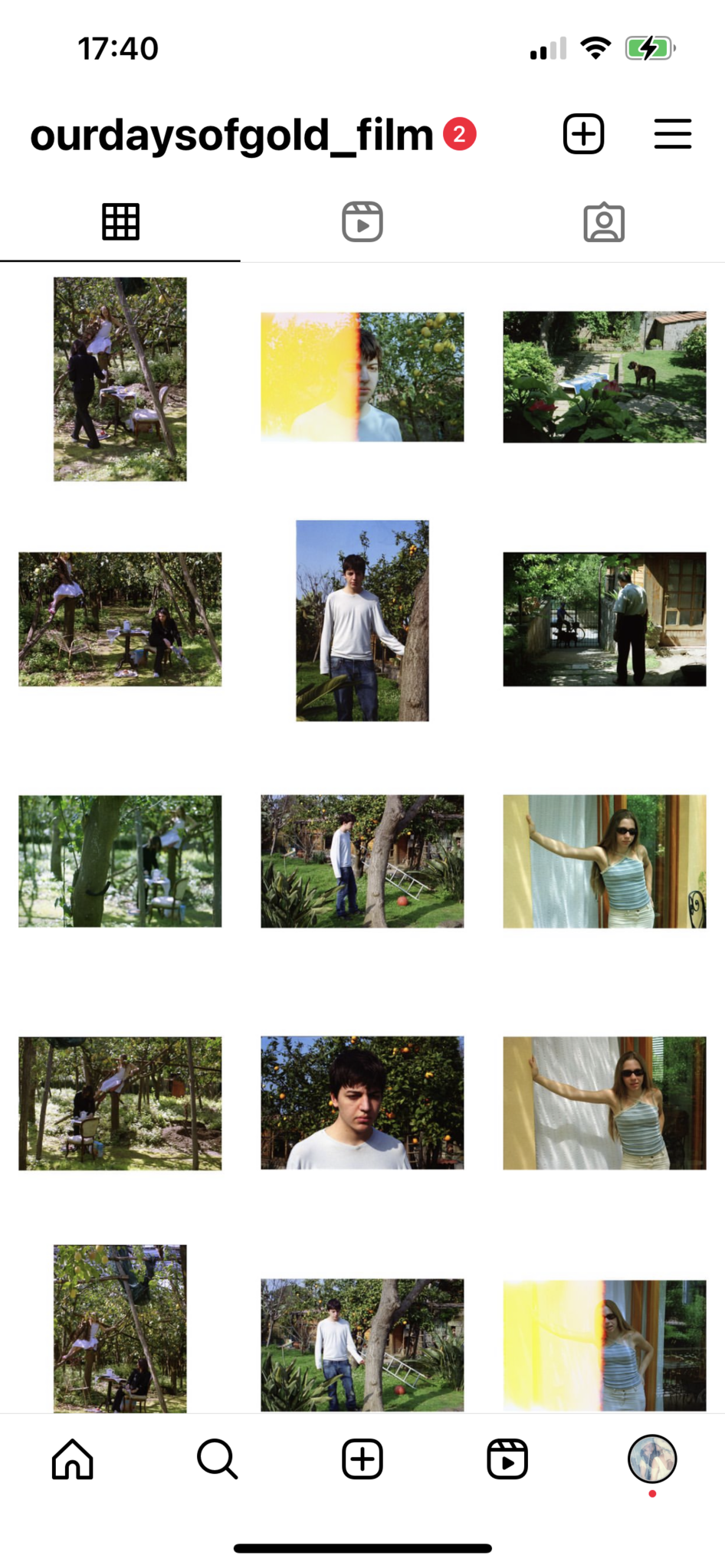
Thisbe Nissen: A Dialogic Interlude
The ambiguity and relational texture of ODOG arise not only from its interface and structure but from the interpretive encounters it invites. Fiction writer and long-time follower Thisbe Nissen contributed written reflections, shared in response to Ruocco's follower survey, before she produced her video recording also presented below. Her responses weave together memory, projection, and narrative speculation, and are presented here as part of the work’s ongoing dialogue, performing rather than describing the dynamics this exposition seeks to explore.
Assunta Ruocco: How long have you been following ODOG?
Thisbe Nissen: I got on Instagram in fall of 2015. I feel like I became aware of Our Days of Gold somewhat soon thereafter, but I honestly don't remember. I feel like I've gone through various phases with Instagram over the years, and Instagram itself has changed so much that consistency is difficult. It has changed for the worse, for me, in that I no longer regularly see my favorite feeds and instead see ads and reels and promotions and I get so frustrated that I'm using it very differently than I once did. Which is all to say that I don't see enough of Our Days of Gold—on any of its 3 pages. I feel like there was a time recently when I saw a gorgeous image in my feed, and it was one of yours, and it made me remember how much I used to see your posts and how long it had been. Sorry to complain, but thinking about it just raises my
ire at Instagram for basically ruining what was once such a pleasure for me.
AR: What kind of moment is it for you, when ODOG flashes onto your screen?
TN: When ODOG comes into view, I feel a little rush of happiness! Like seeing an old friend! There's always something of a mystery to it—literally like getting one film still and trying to figure out where it might fit into the whole movie, you know? I feel a sense of intrigue, of wanting to know more about all of these people and their lives and relationships. Maybe you know that I'm a fiction writer in my "real" life, whatever that is, and I do a lot in my work and teaching with the idea of using fiction to capture a time and place, to evoke very specific visceral feelings and memories. ODOG always feels like a glorious evocation of a very particular time and place and feeling, and I can sense how steeped in poignancy the images are, even if I do not know the people in them, if that makes sense?
AR: What do you know about Cécile?
TN: So interesting that you ask about Cécile... I mean, I'm aware that the "characters" are usually indicated in their relationship to Cécile, but when I read the question I thought: you know, I don't feel like I've seen her for some time. I think somehow I see more of @ourdaysofgold_film than the other pages, for whatever algorithmic idiotic reason, and I think she hasn't been there so much lately. I know that at various times I have wondered if YOU are one of the characters in ODOG--I've certainly
wondered whether they are real people, and are appearing under their real names, or of the whole thing is a fictional creation. I don't really have any idea who you actually are, or whether you're in it yourself or not. I think I may have wondered if you ARE Cécile, but then I also have some sense that maybe she's no longer alive, but I couldn't tell you where exactly that feeling comes from. Which is maybe to say that I don't know very much about Cécile, but I am intrigued by her and her world and would relish the chance to spend more time with all of her friends and family. I have wondered what the scope of your project is--whether there is a film, or a book, in the making, whether I will ever take the time to sit down and pore through what's on Instagram to try to see what sense of
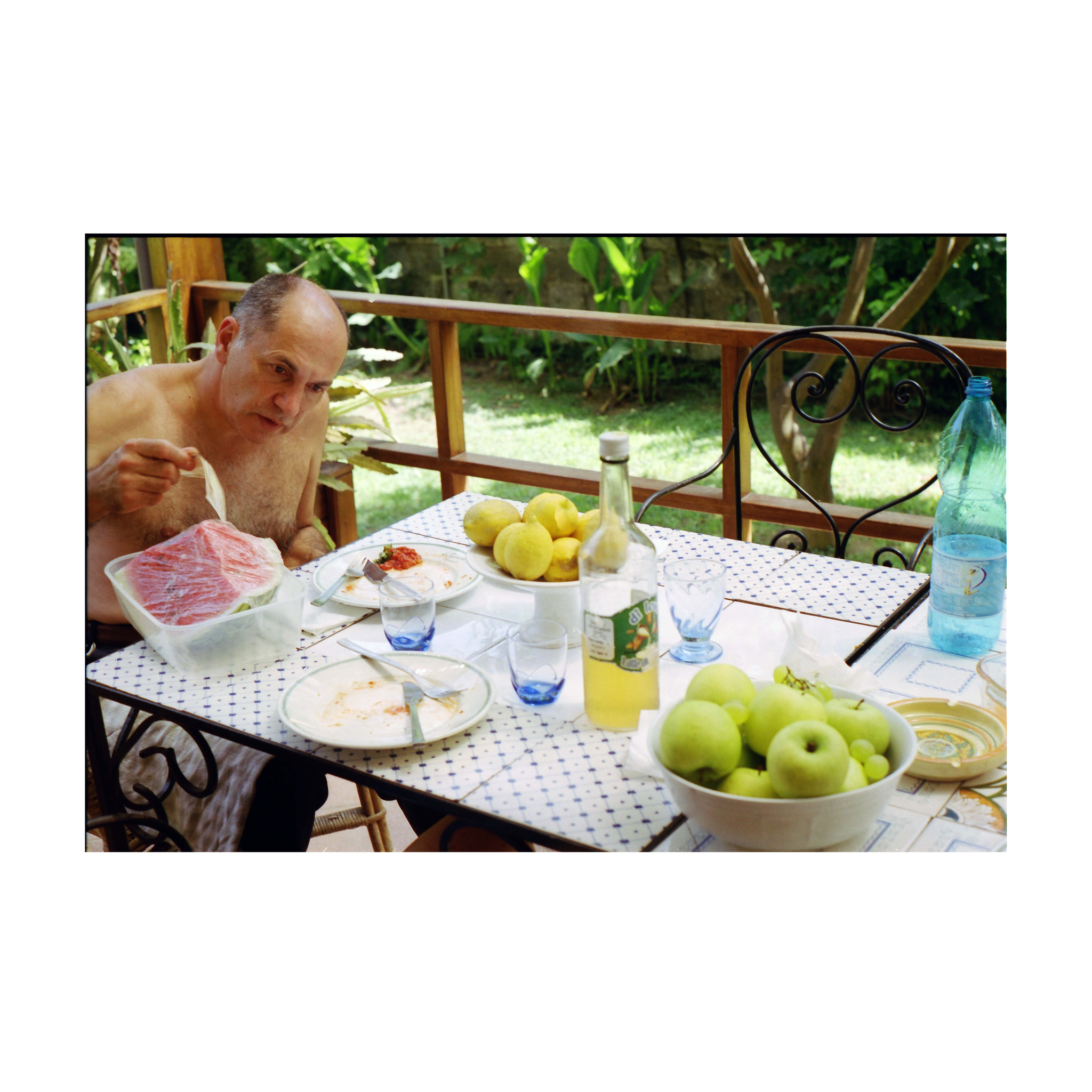
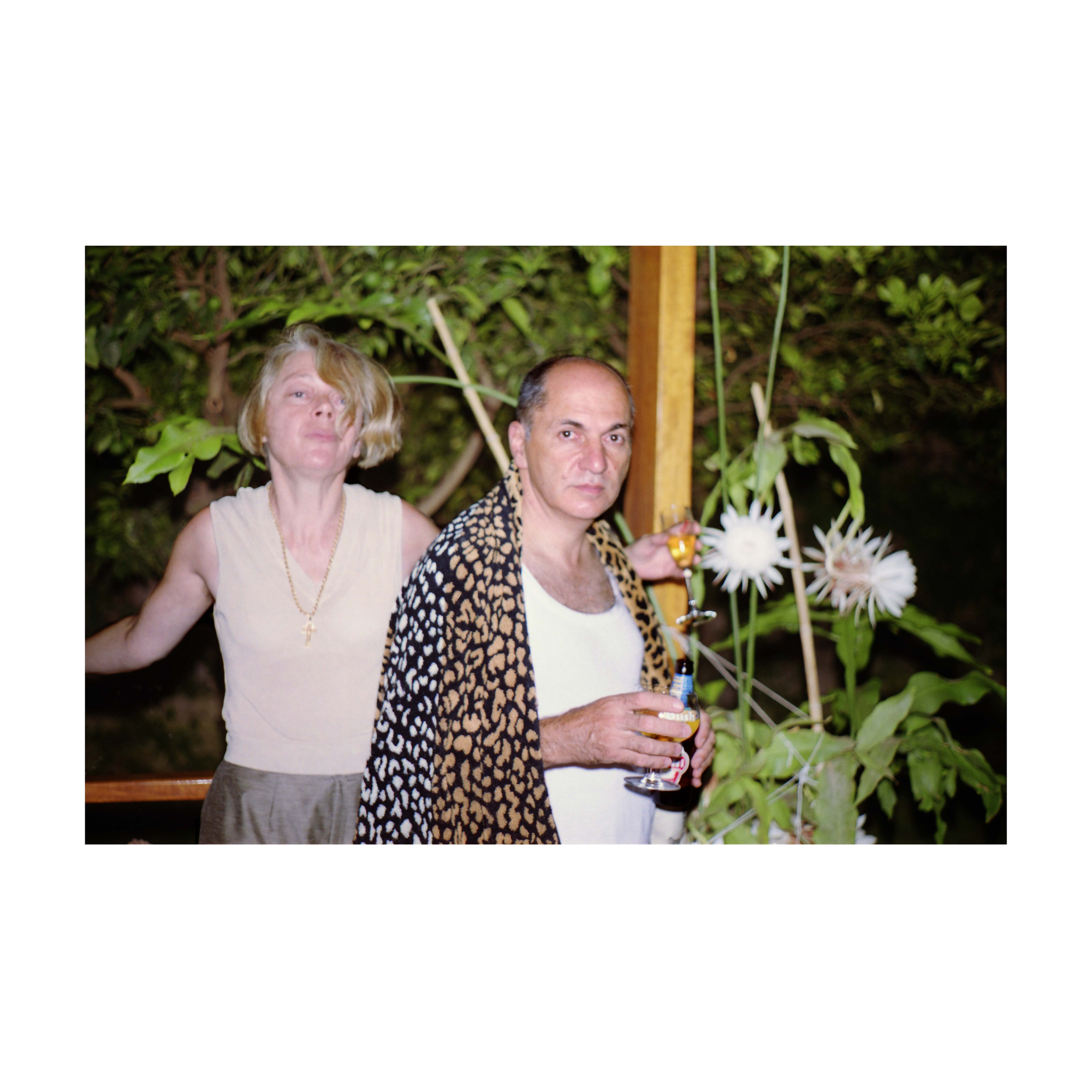
This final section of Re-imagining @ourdaysofgold_film explores how ODOG operates as a generative narrative system, shaped across time by followers’ interpretive labour as a palimpsestic and sedimented interface.
ODOG is a visual structure that continually produces writing around itself. For
much of its duration, this took the form of scattered comments, brief affective annotations that accumulated beneath the images. More recently, it has generated extended follower texts through the 2025 survey and through the screen-recorded contributions of Abbott, Maynard, Nissen, and Nunnally, which now form part of this exposition. These layers demonstrate that ODOG’s significance lies not only in what it shows, but in what it enables others to write.
Nissen’s extensive screen navigation and audio recording explores, in depth and in real time, the speculative re-imagination of the archive by a long-time follower. Moving sequentially through the archive — from the very first image to the most recent post at the time of recording, in
October 2023, her narration discloses the complexity of recollection and re-discovery.
As one long-time follower, @nicky_knack, observes: “Each image is a clue to an overarching narrative.”
ODOG’s recursive unfolding through follower attention reflects what Jacqueline Bolton identified as the work’s “generative” capacity to produce “different spaces online” around “an absence at the heart of it” (Ruocco and Östlind, 2024). Rather than asserting a fixed story, the project invites narrative through relational speculation, where repetition and recognition become modes of meaning-making.It is precisely this openness to the affective navigation of fragments—this opportunity for
readerly piecing-together in the presence of absence—that opens ODOG to literary analogy.
Follower @timedlapses makes this connection explicit: “I think I discovered ODOG around the same time I was reading a book by Sebald called The Emigrants and became interested because the photos gave me a Sebaldian feeling… behind a certain veneer of happiness you can feel a tragedy is about to happen.” This Sebaldian mode—of elliptical narrative, visual cue, and melancholic delay—suggests affinities with the aesthetics of autofiction, a genre that combines autobiographical and fictional elements to produce hybrid, experimental forms of life writing.
As explored in Ruocco (forthcoming b), autofiction increasingly functions not only as a literary category but also as a critical framework for analysing self-imaging practices across media, particularly where performance, photography, and digital self-narration converge. @timedlapses’s invocation of a “Sebaldian feeling” suggests this resonance, pointing toward a layered process of identification in which narrative meaning emerges through co-production. Maggie Nelson’s The Argonauts offers one example of narrative built through accumulation, where fragments, quotations, and situated impressions are woven into an intertextual montage. Nelson combines memoir, theory, and citation to create a sense of subjectivity formed through relational resonance (Nelson, 2015). While ODOG emerges from different conditions,
its integration of follower comments also creates a layered effect: comments function as compositional elements that work alongside images and captions. This exposition extends this logic by embedding follower voices in multiple ways, presenting narrative as an assemblage of perspectives. Rachel Cusk’s Outline (2014) similarly dissolves the stable self into a constellation of others, with the protagonist becoming a listener of stories, a technique echoed in the figure of Cécile, who accrues definition only through recurrence and proximity, and also, in Ruocco’s position as becoming the audience to other people’s stories about ODOG.
Annie Ernaux’s reframing of autofiction as collective memory, rather than personal confession, is also at play here (even if she doesn’t subscribe to the genre). In The Years
the first-person singular gives way to a communal “we,” (Ernaux, 2017 [2008]).
But unlike these literary models, ODOG’s autofictional effects do not emerge from authorial narration—they arise from cumulative readerly attention. As O’Sullivan argues, theory-fiction and adjacent hybrid
genres enact “collective enunciation,” foregrounding distributed subjectivities and modes of writing that are “from a scene and help call that scene forth” (2024, p. 28). The work is thus not autofiction in the literary sense, but distributed autofiction, where authorship circulates between creator and audience, coalescing through acts of viewing, captioning,
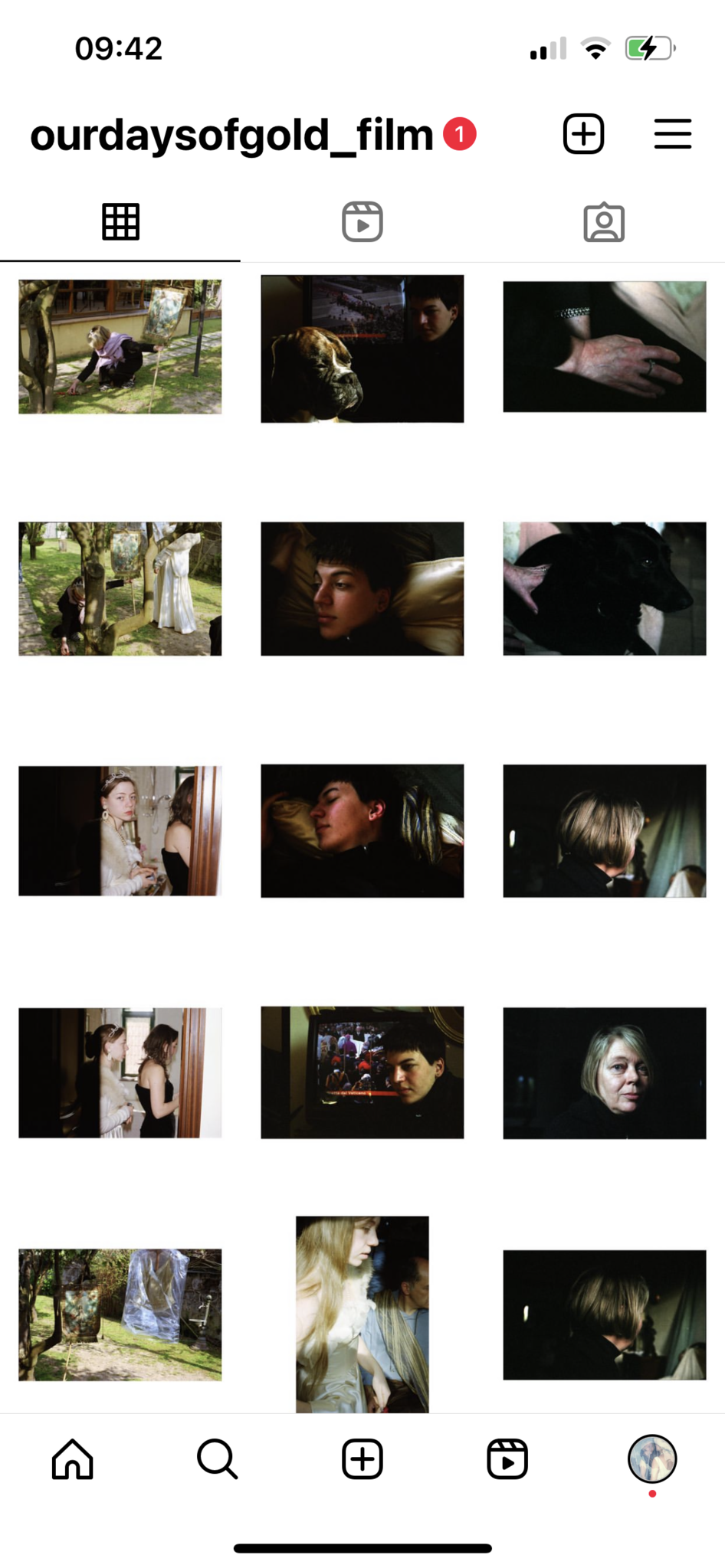
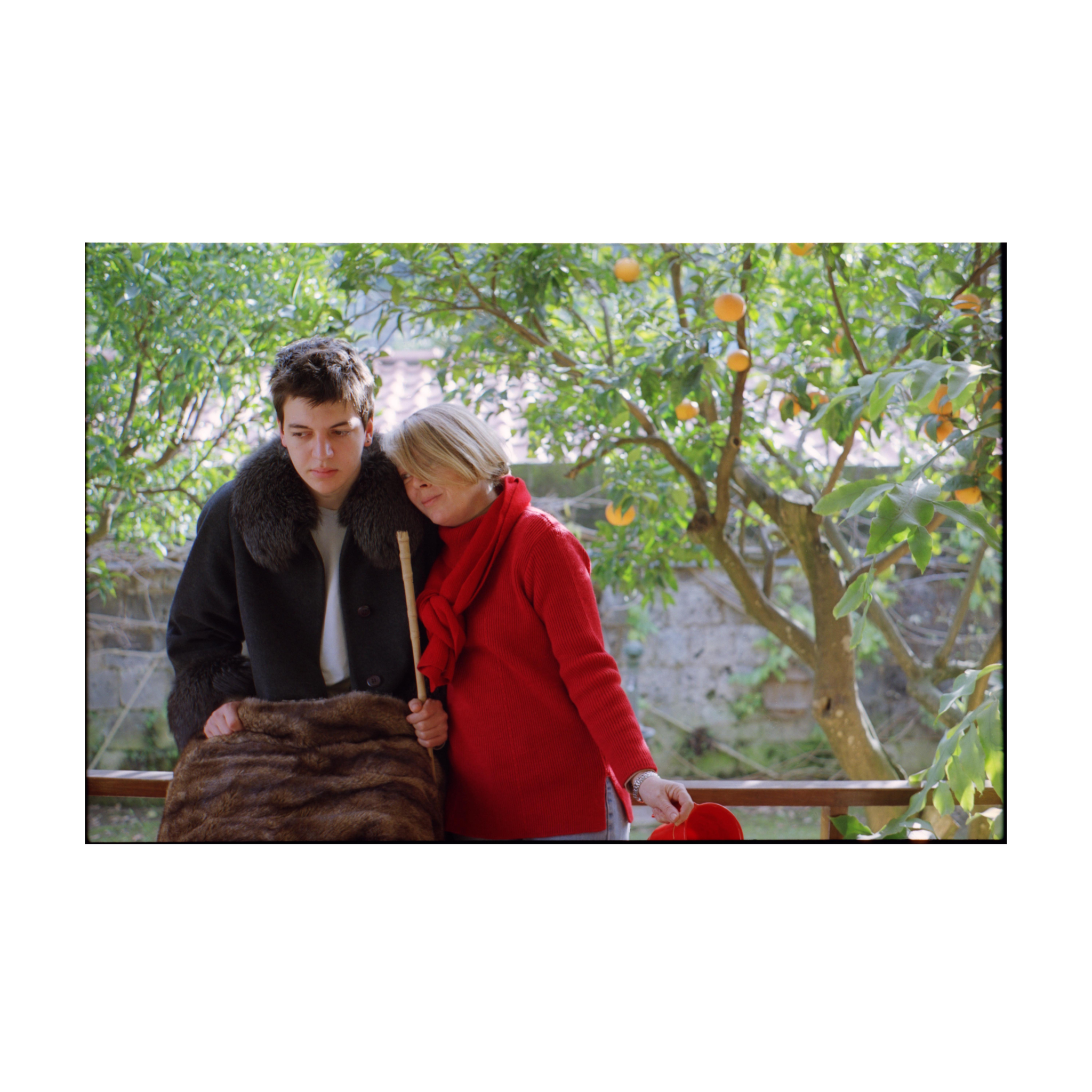
and recursive response.
This resonates with Ruocco's research on British artist Alison Lloyd, whose social media projects on @alisonclloyd and @romilly_crescent_docs reframe feminist self-representation as an artistic practice of auto-citation (Ruocco 2025). While both Lloyd’s and ODOG’s projects privilege duration over event and repetition over climax, Lloyd’s practice is explicitly anchored in autobiographical reclamation. In contrast, ODOG reactivates archival materials through strategies of anonymity and reticence, drawing affective charge from historical distance rather than personal presence. What aligns them, however, is the dialogic structure of address and reply and the important role of follower
conversations in creating meaning.
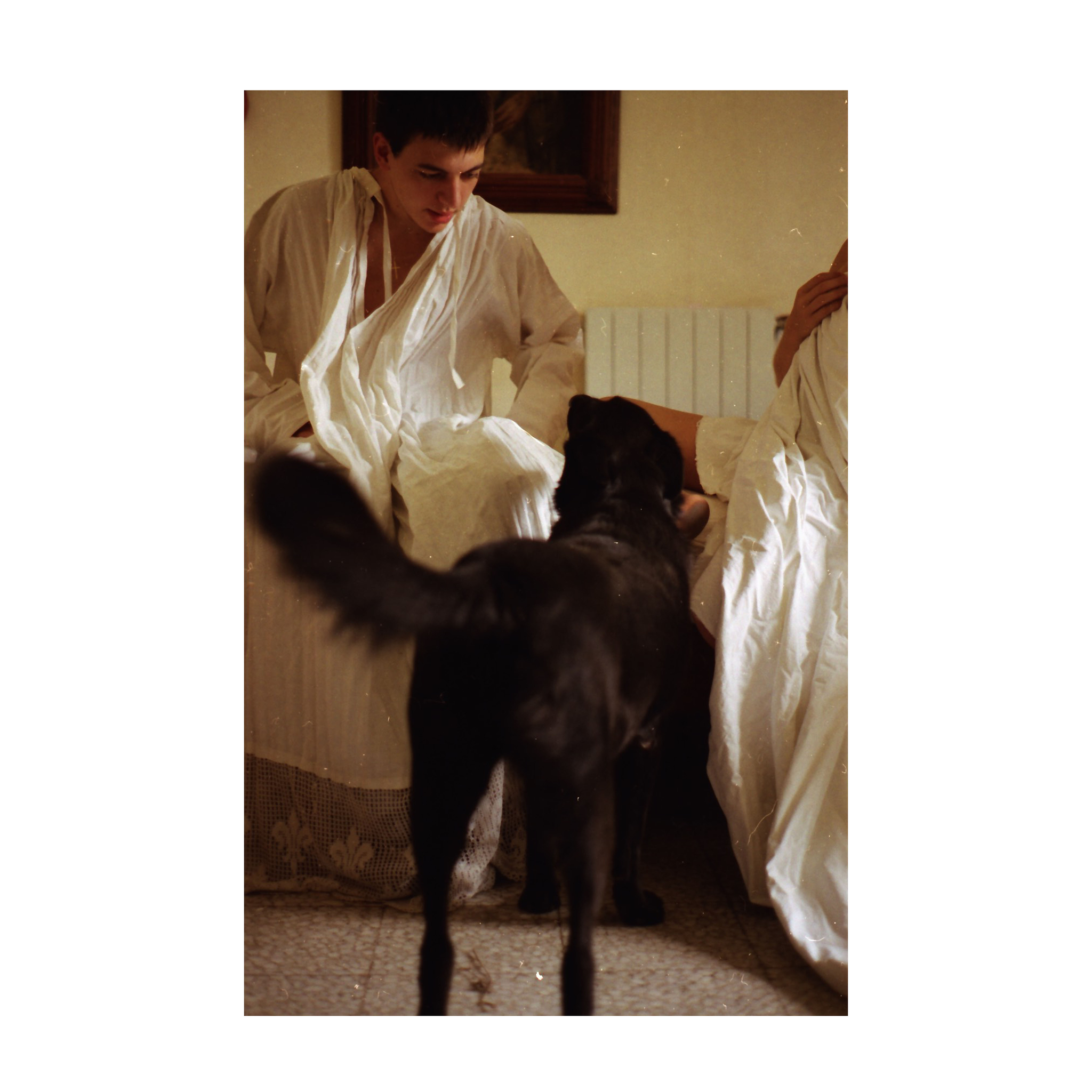
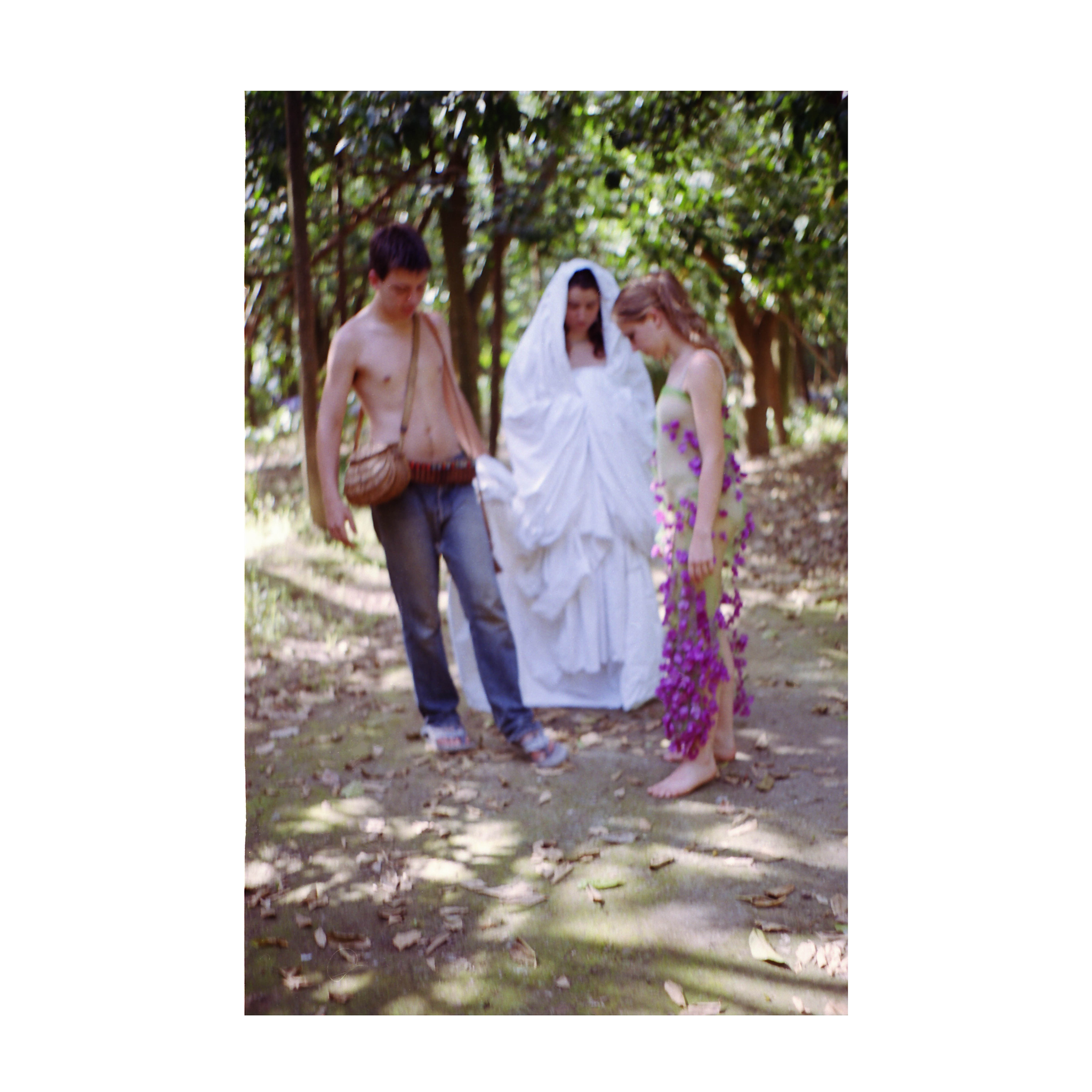
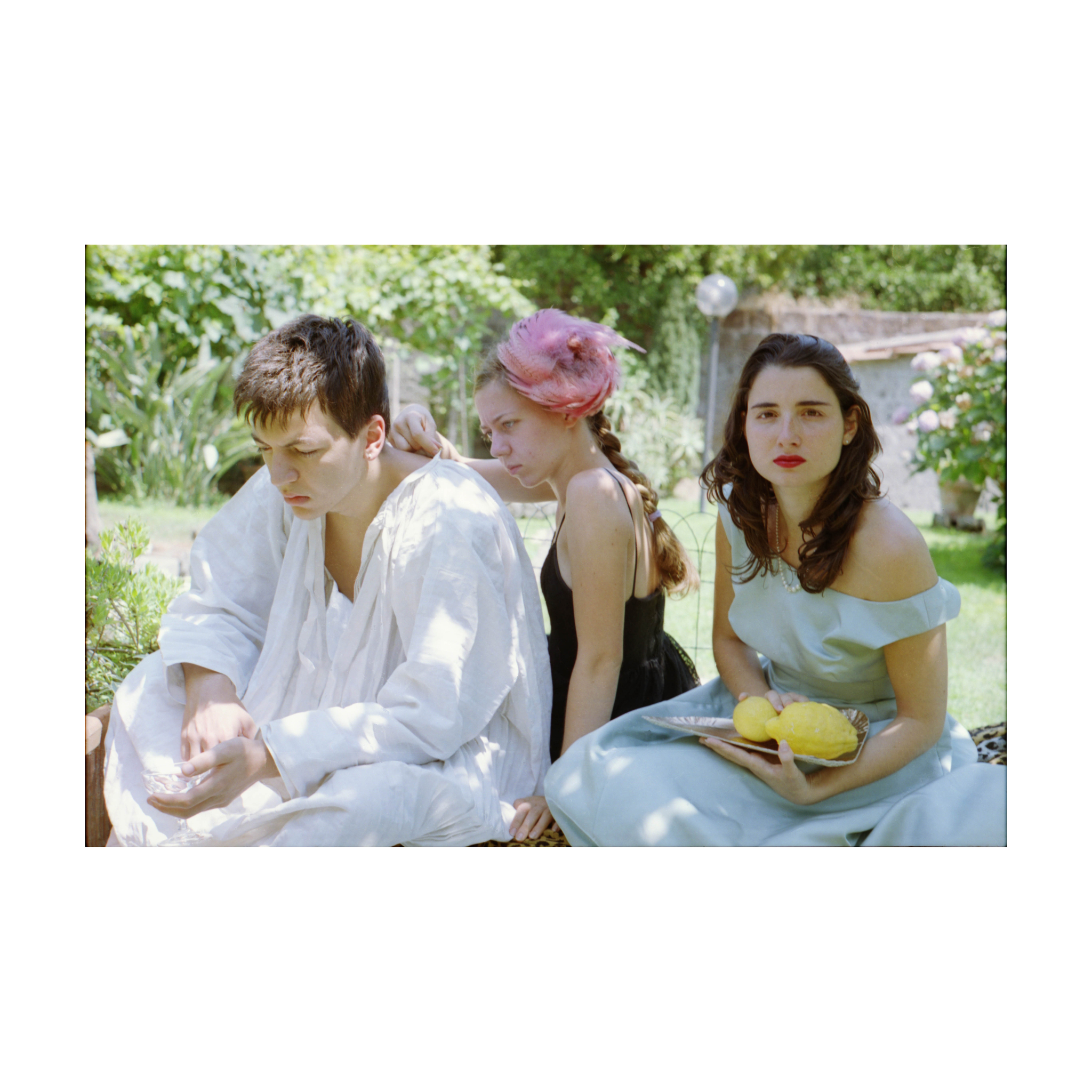
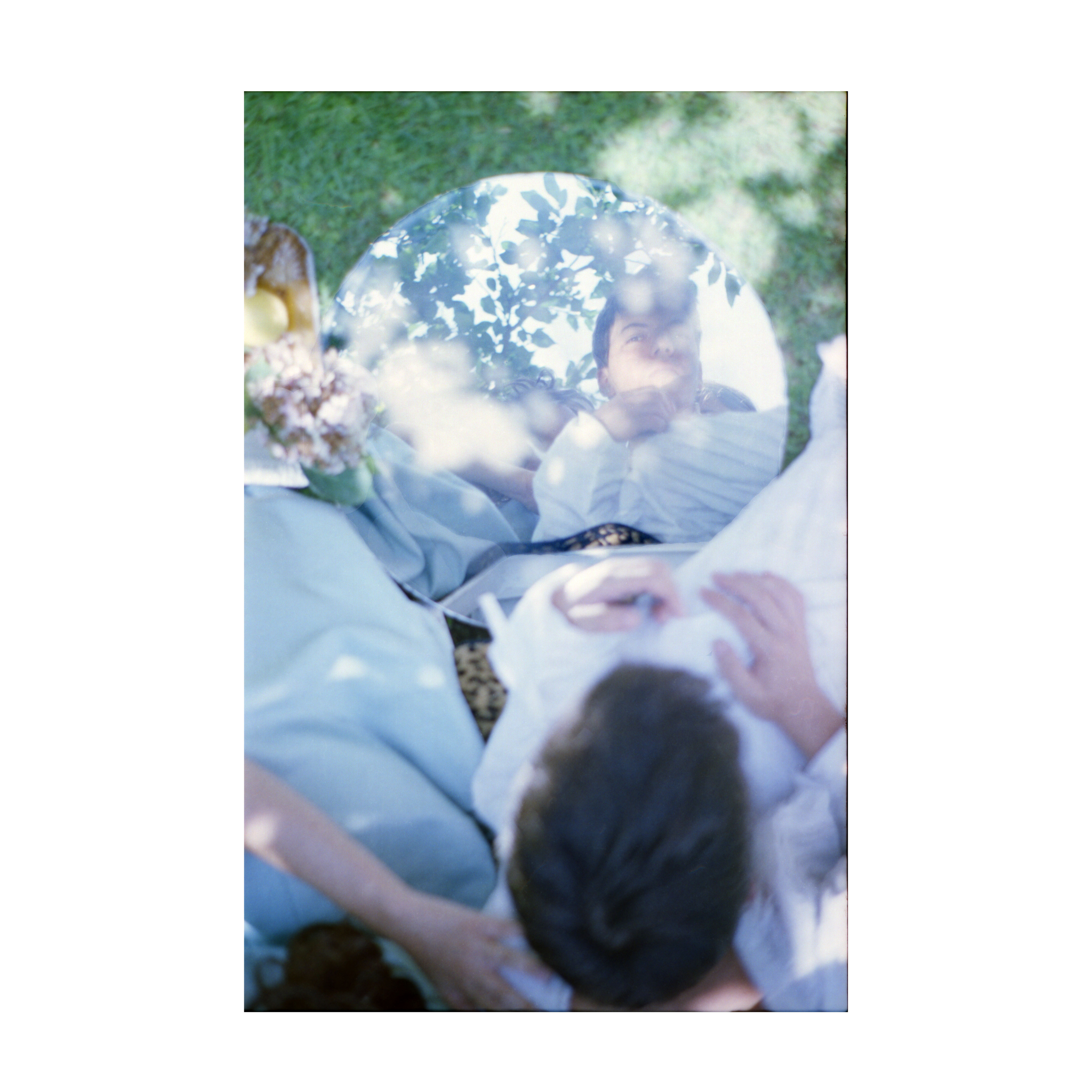
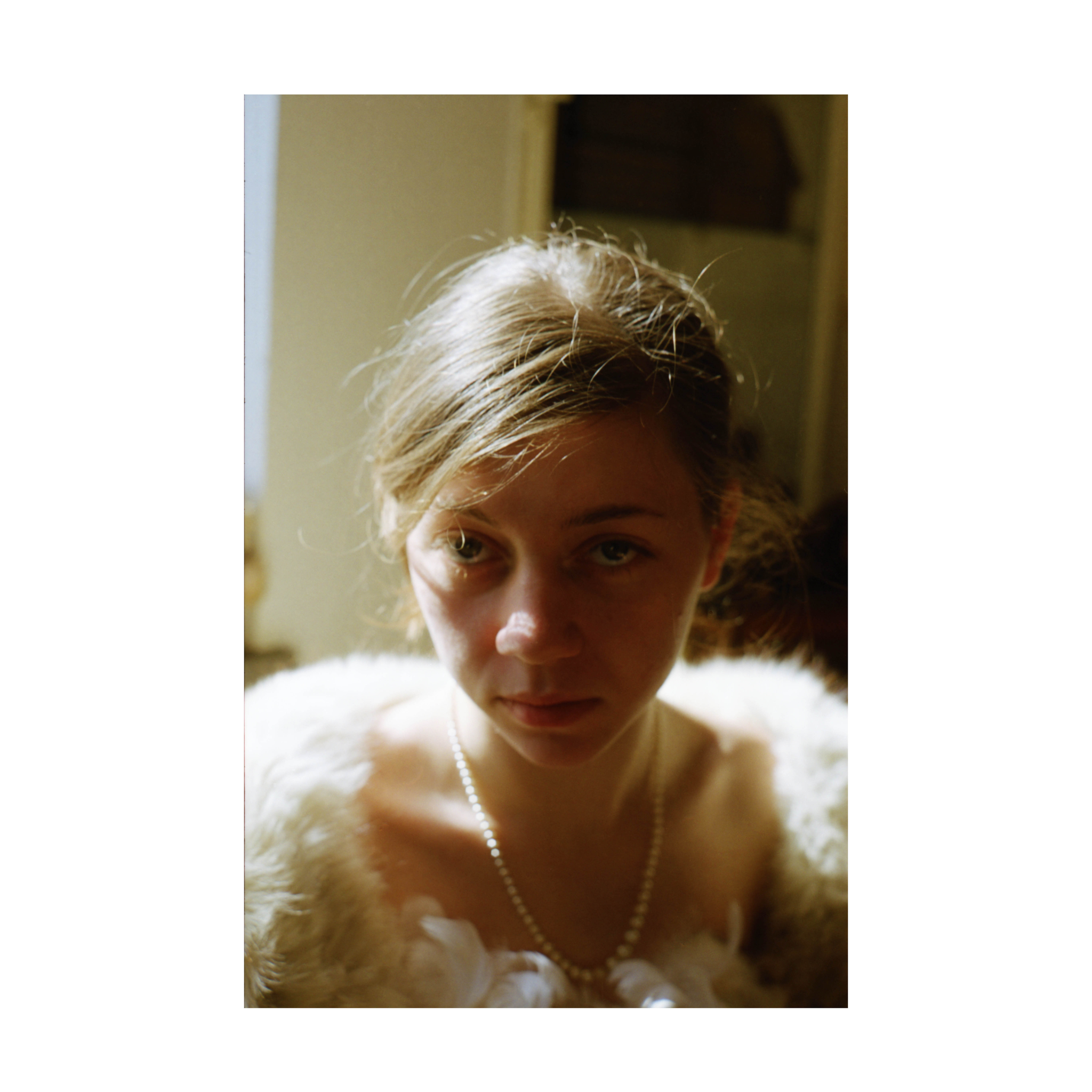
Yet autofictional structures in ODOG are not only retrospectively imposed by interpretation; they are embedded in the photographic corpus itself. From the early 2000s, the archive developed through roleplay, improvised performances, and fictionalised scenarios staged within domestic settings. Cécile, as the central figure, appears alternately in unguarded moments and in invited performances—draped in costumes, adorned with borrowed jewellery. In this sense, the archive is already a hybrid of documentary and fabulation, where the photographer acts as a narrator neither fully external nor entirely immersed. These dynamics align ODOG with autofictional and parafictional traditions,
recalling Claude Cahun’s performative self-staging, Amalia Ullman’s scripted online identity, and Alison Lloyd’s experimental photographs of self-presentation. Yet ODOG departs from the singular model of authorship that anchors these practices. Its autofictional effects are not the projection of an individual persona but the outcome of a collaborative, intergenerational rehearsal—what might be called a family fiction. Here, autofiction is multi-authored and durational, unsettling conventional subject positions and reframing the photographic act as a collective rather than individual endeavour This exposition also contributes to the unfolding These distributed autofictional practices set the conditions for ODOG’s accumulative unfolding, becoming,
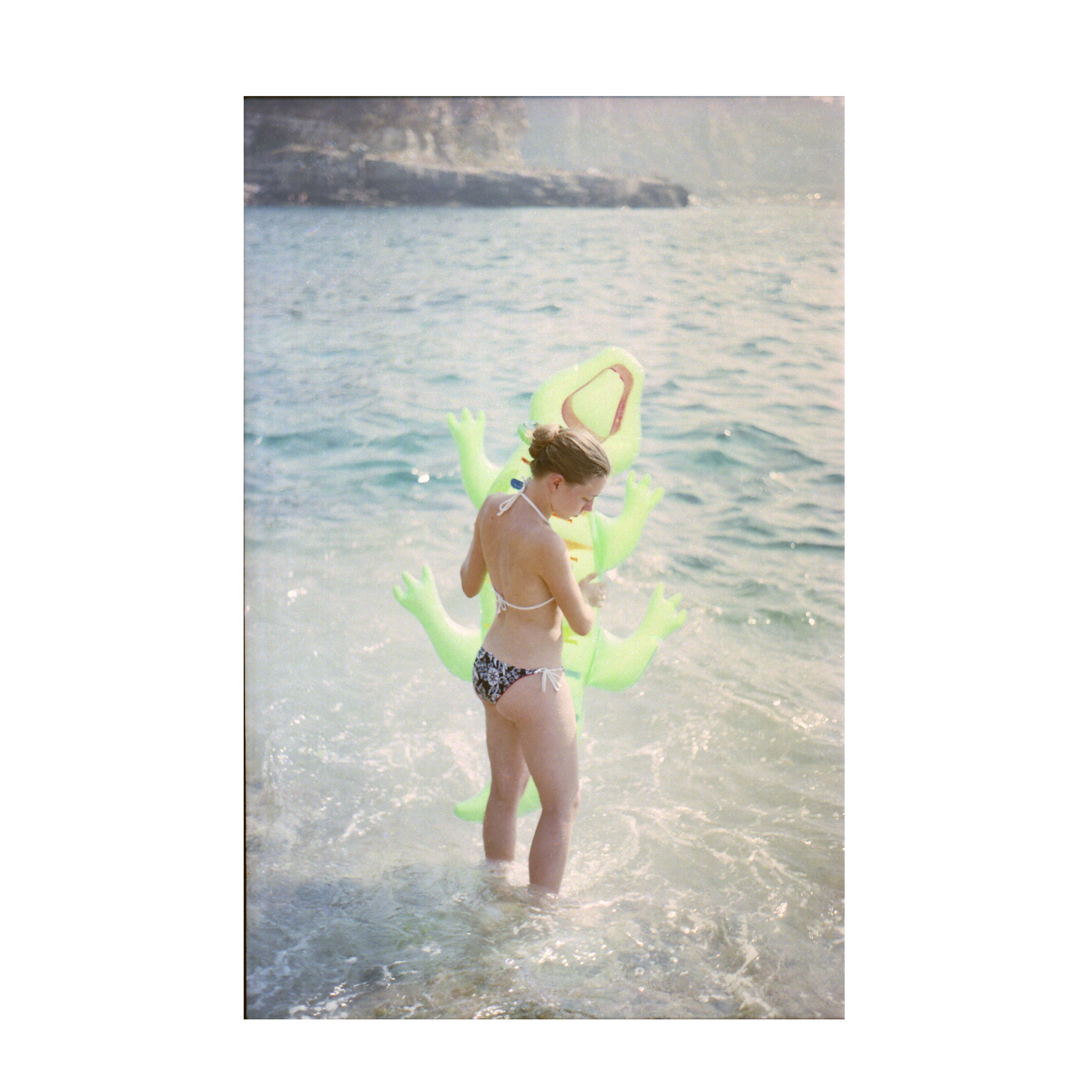
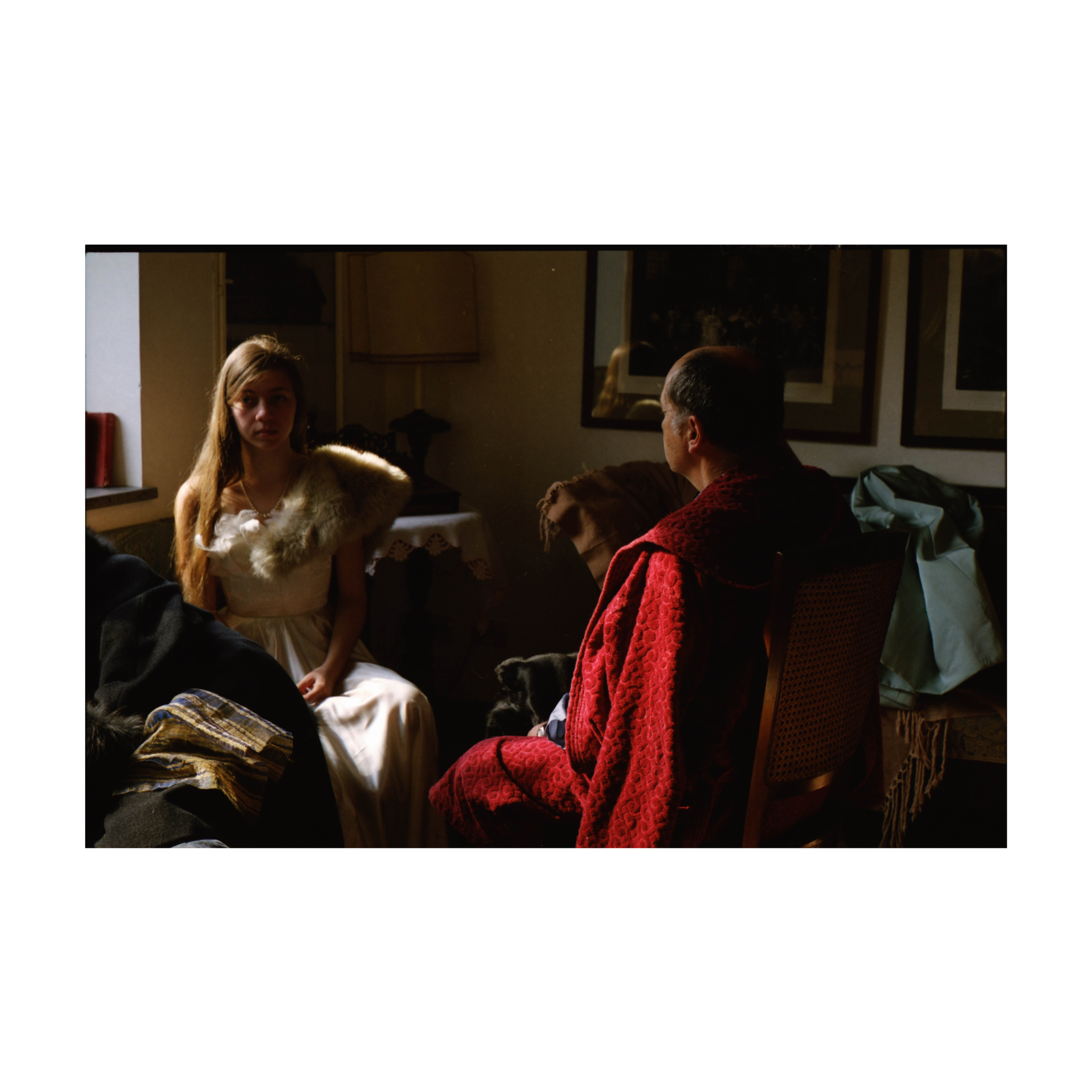
as Niclas Östlind suggested drawing on Bärtås (2010), a “work story” — not a fixed object but an ongoing narrative of processes, relations, and situated stagings through which the work comes into being. In this sense, the anonymous Instagram feed, the comments and survey texts, the co-authors’ recordings, the exhibitions, publications, and the scholarly and curatorial framings are not external additions but constitutive layers. Each new presentation — whether a performance lecture, an exhibition, or this exposition — reshapes ODOG by creating further writing, reframing its past, and generating new contexts for its reception. A work story, as Bärtås describes, gathers together the material, discursive, and performative elements that accrue around an artwork, producing something larger than the “original” work itself. ODOG, having taken the form of an anonymous Instagram account, performative presentations (PARSE 2023; ICPT 2024; Spectral Cinemas 2025), an artist book (Suite 11, with Michel Assenmaker, 2024), exhibitions (Italian Cultural Institute 2019, with Daniel T. Wheeler, TG Gallery 2024), and multiple strands of writing, continues to produce new insights in and through its evolving dissemination.
This exposition departs from parallel outputs that focused on the project’s origins in mourning and its positioning within the photographic archive (Ruocco, 2024; forthcoming a). Instead, it foregrounds the role of followers as co-authors and the
infrastructural shifts that have altered the legibility of the work on Instagram. It examines the project’s remediation through screen recordings, readerly responses, and acts of digital care, as well as the methodological implications of working within a platform in flux. In doing so, this exposition extends the work’s ongoing inquiry into authorship, visibility, and distributed memory, and articulates a contribution that is distinct in both focus and form.
Repetitively typing Cécile’s name every day under a new Instagram post felt meaningful for Ruocco, as she has discussed elsewhere (forthcoming a). The labour involved in switching to a French keyboard accents the poster’s intentional inscription of Cécile in her life as an everyday ritual countering the societal expectation of ‘moving on’ from grief. In this micro-gesture, the technical friction of inserting the diacritic into her English captions became a form of durational care, a minor resistance to erasure, inscribed in the very act of naming Cécile every day, that connects with the embodied nature of working with digital interfaces. This emphasis on touch resonates with the embodied practices of ODOG’s followers, whose gestures of scrolling, pausing, and returning likewise enact forms of narrative continuity. As such, the work persists not only through images and captions but through accumulated acts of touch — a tactile maintenance that sustains ODOG as both archive and interface. ODOG’s grid operates
less as a static archive and more as a surface of narrativisation: a site where meaning is incrementally composed through serial, embodied reception. As Dekker and Giannachi (2023) argue, digital archives are increasingly co-produced through
the interplay of artistic intent and audience interaction. In this context, touch is not merely a technical gesture but a condition of relational co-creation. As followers scroll, pause, tap, or return, they engage in a process that is both affective and compositional. These tactile acts contribute to the work’s unfolding temporality and meaning.
In this way, the ODOG grid operates as a text-generating navigation system: not a static image archive, but a dynamic structure where
meaning accrues through touch, repetition, and return. Scrolling becomes a form of engagement; captions function as prompts for interpretation.
Through these gestures, followers enact a form of distributed autofiction, which may not alwyas produce writing, yet sustains narrative continuity within their own evolving memories of the project echoing what Palmer (2019) identifies as the poetic affordance of photo-dialogue: a shared visual exchange grounded in iteration and relationality. Many of these contributions remain inaccessible to the poster, shaped in private over years of attention and return, and she only discovered some of them through the recent online survey.
ODOG continues as an Instagram feed. Its grid remains technically accessible, its images and captions still accumulating one at a time. But its visibility and visual coherence have shifted. Changes to Instagram’s infrastructure, the introduction of algorithmic ranking, and more recently of the 4/5 grid, have made the project
harder to locate, follow, and read as a unified whole yet followers continue to engage with it in layered ways, recognising images as they reappear in their feed, being transported into its unfolding world through the memories that accumulate, and, for some, deliberately navigating the grid to piece together narrative connections; its continued presence depends less on platform stability than on these acts of return: scrolling, remembering, recording, keeping it in mind. The work persists through acts of infrastructural and affective re-imagination.
This exposition traces how ODOG has shifted from a platform-native project to what might be described as a palimpsest—an artefact overwritten through layered re-
inscription. Its meaning no longer resides only in the Instagram grid but in the dispersed acts of re-imagination it provokes. By attending to these practices of recognition, navigation, and reactivation, the exposition develops a framework for understanding distributed autofiction within unstable digital infrastructures. Departing from earlier outputs that focused on ODOG’s origins in mourning and its positioning within art histories of the photographic archive (Ruocco, 2024; Ruocco forthcoming a), it situates follower experience as central to the work’s unfolding, showing how ODOG’s narrative expands through polyvocal contributions that generate new connections and possibilities. In analysing screen recordings, readerly and writerly responses, and distributed acts of remediation, the exposition articulates a distinct methodological contribution, foregrounding the entanglement of narrative form, platform infrastructures, and embodied practices of digital engagement.
Screen recordings by Frank Abbott, Genevieve Maynard, Thisbe Nissen, and Phil Nunnally do not document ODOG from the outside but rather they participate in its unfolding. Their recordings resist platform obsolescence by producing parallel traces, small but enduring monuments of looking, searching, recognising, and remembering. Their performative accounts of ODOG have unintentionally become the only trace of its previous appearance.
As Bakhtin argues, “There can be neither a first nor a last meaning; it always exists among
other meanings as a link in the chain of meaning” (Bakhtin, 1986: 146). Meaning in ODOG is not fixed but emerges as polyphonically as readerly reactivation. This shifting condition aligns with Magnus Bärtås’s (2010) formulation of the work story: not as the story an artwork tells, but as the layered narrative that forms around, through, and after it. Here, the focus is on transformation: how ODOG functions not simply as a record of mourning, but as a system for generating interpretive variation under shifting technical conditions.
Re-imagining ODOG in this sense is not an act of nostalgia but a response to infrastructural change. As the original platform degrades, new structures emerge: reader responses, paratextual commentaries, academic writing, surveys, and voice recordings remediate the work. Drawing on Bolter and Grusin’s (1999) understanding of remediation as refashioning rather than replacement of earlier media, ODOG rather than disappearing, migrates. Distributed acts of remediation have extracted ODOG from Instagram and placed it within new circuits of circulation and engagement, from offline screenings and situated presentations and, now, into a different digital context through its re-inscription in the Research Catalogue platform. Through this migration, ODOG becomes something else: a readerly system sustained by distributed autofiction, where follower experiences and polyvocal contributions generate ongoing
reconfigurations of the work.
This exposition enacts ODOG’s ongoing reconfiguration while also restoring aspects of
its earlier Instagram state, before the 4:3 interface shift fractured the legibility of the grid. It does not present ODOG as a stable object of study but performs the work’s current condition through its scrollable format, interwoven commentaries, and integration of follower voices. Design decisions emerged from collaborative conversations with Abbott and others, who emphasised the interface’s role as narrative structure. The vertical, phone-like layout recalls the experience of moving through ODOG’s posts in its original format while making that navigation newly legible in the present, materialising what Doreen Mende (2020) calls a “navigational ontology”— a way of knowing produced through embodied, situated engagements with the digital interface.
Such structural choices are methodological. They activate ODOG’s paratextual logic, enabling what Zapperi (2013) might term ‘archival reappearance’, where works persist by re-emerging in new situations under new constraints. In this sense, the exposition operates as both documentation and remediation: it sustains ODOG’s distributed autofiction by reactivating earlier modes of navigation and readerly connection within a new infrastructural context.
ODOG’s endurance on Instagram foregrounds an unresolved question: could the distributed
intimacy and readerly care it generates persist without the platform that enabled it? While ODOG resists the extractive logic of algorithmic optimisation, it remains entangled within the infrastructures it reclaims. As Frank Abbott observed, ODOG “diffuses anxiety”, offering a counterpoint to the rhythm of doomscrolling not through withdrawal but through a redirected, slower mode of digital attention. The project does not propose abandoning social media but asks how it might be inhabited differently: relationally, deliberately, and with the possibility of consolation.
To re-imagine ODOG, then, is not to stabilise it in a single form. The project remains accessible but circulates unevenly across posts, recordings, surveys, institutional framings, and
shared memory. This exposition is one iteration in that ongoing migration, extending ODOG into new infrastructures and contexts, including the Research Catalogue.
In this sense, ODOG operates as a digital palimpsest in which earlier traces persist and new narrative variants arise through ongoing acts of remediation and readerly reactivation. The project’s migration across interfaces, recordings, commentaries, and scholarly framings demonstrates how a platform-native artwork can generate its own research method, positioning follower experience and distributed autofiction as tools for understanding social media cultures under conditions of infrastructural instability.
This exposition makes that process available as a critical framework. In doing so, it establishes ODOG not only as a case study but as a methodological proposition: a practice-led approach that advances current debates on narrative forms, and the co-production of meaning in unstable digital environments.
Meanwhile, ODOG continues to unfold and keep company with its readers/co-authors whose re-imaginations give it its ever-shifting form.
References
Abidin, C., Leaver, T. and Highfield, T. (2020) Instagram: Visual Social Media Cultures. Cambridge: Polity Press.
Adonis Media (2025) Expert Cheat Sheet to Instagram’s Grid Update 2025. Available at: https://www.adonis.media/insights/expert-cheat-sheet-to-instagram-grid-update-2025 (Accessed: 25 August 2025).
Baharin, H. and Morrison, A. (2006) ‘Eliciting audience’s experience to improve interactive art installation’. In: Engage: Creativity and Cognition Conference. Sydney: Creativity & Cognition Studios Press. Available at: https://vbn.aau.dk/en/publications/eliciting-audiences-experience-to-improve-interactive-art-install (Accessed: 27 August 2025).
Allen, M. (2015) ‘The Screenshot Aesthetic’. In: Meredith, M. and Sample, H. (eds.) MOS: Selected Works. New York: Princeton Architectural Press, pp. 271–276.
Bilda, Z., Costello, B. & Amitani, S. (2006) ‘A collaborative analysis framework for evaluating interactive art experience’, CoDesign, 2(4), pp. 225–238 https://doi.org/10.1080/15710880601008026
Bakhtin, M.M. (1981/1986) The Dialogic Imagination: Four Essays. Ed. Michael Holquist, trans. Caryl Emerson and Michael Holquist. Austin: University of Texas Press.
Bakhtin, M. M. (1986) Speech Genres and Other Late Essays. Translated by V. W. McGee. Austin: University of Texas Press.
Bakhtin, M. M. (1984) Problems of Dostoevsky’s Poetics. Edited and translated by C. Emerson. Minneapolis: University of Minnesota Press.
Bal, M. (1997) Narratology: Introduction to the Theory of Narrative. 2nd ed. Toronto: University of Toronto Press.
Barad, K. (2007) Meeting the Universe Halfway: Quantum Physics and the Entanglement of Matter and Meaning. Durham, NC: Duke University Press.
Bärtås, M. (2010) You Told Me – work stories and video essays / verkberättelser och videoessäer. Gothenburg: University of Gothenburg. Available at: https://gupea.ub.gu.se/handle/2077/22325 (Accessed: 28 August 2025).
Barthes, R. (1981) Camera lucida: Reflections on photography (R. Howard, Trans.). Hill & Wang
Barthes, R. (1974) S/Z. Translated by R. Miller. Oxford: Blackwell. (Original work published 1970).
Bell, A. (2021) '“It All Feels Too Real”: Digital Storyworlds and Ontological Resonance', Style, 55(3), pp. 430–452. https://doi.org/10.5325/style.55.3.0430
Bishop, C. (2024) Disordered Attention: How We Look at Art and Performance Today. London: Verso.
Bolter, J. D. and Grusin, R. (1999) Remediation: Understanding New Media. Cambridge, MA: MIT Press.
Bourriaud, N. (1998) Relational Aesthetics. Dijon: Les presses du réel.
Butler, R., von Zinnenburg Carroll, K., Dohmen, R., Kennedy, S., Korporaal, A., Meyerding, M., Preisig, B., Sarjoughian, A., Sidogi, P. and Sözen, D. (2024) ‘Interlude 1: Crablike Collective Moves’, Third Text, 38(1–2), pp. 43–66. https://doi.org/10.1080/09528822.2024.2339144
Cocker, E. (2023) ‘Tactics for Not Knowing: Preparing for the Unexpected’, Artistic Research Does, 7. Porto: i2ADS
Compagnon, A. (1979) La seconde main, ou le travail de la citation. Paris: Seuil.
Cotter, L. (2017) ‘Reclaiming artistic research — first thoughts’, MaHKUscript: Journal of Fine Art Research, 2(1), pp. 1–6.. DOI: 10.5334/mjfar.30
Cusk, R. (2014) Outline. London: Faber & Faber.
Dillon, S. (2007) The Palimpsest: Literature, Criticism, Theory. London: Bloomsbury Academic.
@dori_albagranzotto. “When I go to your Instagram page…” Instagram. 17 April 2024. Available at https://www.instagram.com/p/C54D8ikIcoi/?igsh=Mnl1OHpjYWE0cWw2 (accessed 2024-05-13).
Eco, U. (1989) The Open Work. Cambridge, MA: Harvard University Press.
Ernaux, A. (2017) The Years. Translated by A. Winchester. London: Fitzcarraldo Editions. [Originally published in French as Les Années, 2008].
Espenschied, D. (2023) ‘In between performance and documentation’, in A. Dekker and G. Giannachi (eds.) Documentation as Art: Expanded Digital Practices. Abingdon: Routledge, pp. 172–184.
Jennings, S.C. (2016) ‘Co-Creation and the Distributed Authorship of Video Games’, in G. Kowert and T. Quandt (eds.) Examining the Evolution of Gaming and Its Impact on Social, Cultural, and Political Perspectives. Hershey, PA: IGI Global, pp. 120–145. DOI:10.4018/978-1-5225-0261-6.ch006
@jokalinoski (2019, May 12). I missed so many of your beautiful images [Instagram comment] Retrieved from https://www.instagram.com/p/BxXK0mSgRmH/?igsh=MWd0aDR6YTI3dmVwbw==
Fairey, T. and Orton, L. (2019) ‘Photography as Dialogue’, Photography and Culture, 12(3), pp. 299–305. DOI: 10.1080/17514517.2019.1669992
Feinberg, M. (2015) ‘Genres without Writers: Information Systems and Distributed Authorship’. In: Andersen, D. and Ma, L. (eds.) Genre Theory in Information Studies. Studies in Information, vol. 11. Bingley: Emerald Group Publishing Limited, pp. 43–66.
Fuchs, C. (2014) Digital Labour and Karl Marx. New York: Routledge.
Galey, A. (2023) ‘Introduction: Reconsidering Paratext as a Received Concept’, Games and Culture, 18(6), pp. 708–717. DOI:10.1177/15554120231184280
Gedin, A. (2011) I Hear Voices in Everything! Step by Step. Doctoral dissertation, Valand Academy of Fine Arts, University of Gothenburg. Art Monitor avhandling, nr. 23. English translation by Sarah Death, 2014.
Genette, G. (1997) Paratexts: Thresholds of Interpretation. Translated by J.E. Lewin. Cambridge: Cambridge University Press. https://doi.org/10.1017/CBO9780511549373
Giannachi, G. and Dekker, A. (2023) Documentation as Art: Expanded Digital Practices. Abingdon: Routledge.
Giannachi, G. (2023) ‘Documenting Hybrid Mixed Media Art Forms: The Role of the Audience’. In: van de Vall, R. and van Saaze, V. (eds.) Conservation of Contemporary Art. Studies in Art, Heritage, Law and the Market, vol. 9. Cham: Springer, pp. 217–233.
Glissant, É. (1997) Poetics of Relation. Trans. Betsy Wing. Ann Arbor: University of Michigan Press.
Godden, R. (1958) The Greengage Summer. London: Macmillan.
Goriunova, O. (2019) ‘The Digital Subject: People as Data as Persons’, Theory, Culture & Society, 36(6), pp. 125–145. https://doi.org/10.1177/026327641984040
Grigoryan, E. (2023) ‘Instagram Kills the Square Grid – How to Adapt to the New 4:5 Layout and Keep Your Feed Looking Cohesive’, Fstoppers. Available at: https://fstoppers.com/news/instagram-kills-square-grid-how-adapt-new-45-layout-and-keep-your-feed-looking-690705 (Accessed: 18 May 2025).
Halasek, K. (1992) A Pedagogy of Possibility: Bakhtinian Perspectives on Composition Studies. Carbondale: Southern Illinois University Press.
Hall, S. (1980) ‘Encoding/decoding’. In: Hall, S., Hobson, D., Lowe, A. and Willis, P. (eds.) Culture, Media, Language: Working Papers in Cultural Studies, 1972–79. London: Hutchinson, pp. 128–138. https://doi.org/10.4324/9780203381182
Harbison, I. (2015) The prosumer complex. PhD thesis. Goldsmiths, University of London.
Harbison, I. (2019) Performing Image. Cambridge, MA: The MIT Pres
Hartman, S. (2008) ‘Venus in Two Acts’, Small Axe, 12(2), pp. 1–14. https://doi.org/10.1215/-12-2-1
Hartman, S. (2019). Wayward Lives, Beautiful Experiments: Intimate Histories of Riotous Black Girls, Troublesome Women, and Queer Radicals. New York: W.W. Norton.
Hui, Y. (2016) On the existence of digital objects. Minneapolis: University of Minnesota Press.
Hui, Y. (2019) Recursivity and contingency. London: Rowman & Littlefield International.
@i.take.my.camera.everywhere (2018, June 27). What happened in summer 2005? [Instagram comment] Retrieved from https://www.instagram.com/p/Bkg1Lw7gyG3/
@i.take.my.camera.everywhere (2018, July 20). Thank God — now I finally know what happened in Summer 2005!! [Instagram comment] Retrieved from https://www.instagram.com/p/BljNVRmAcfC/
Inan, D.I., Hidayanto, A.N., Juita, R., Puteri, A.R., Romauli, I.P., Ramadhani, B.P.K. and Dwiputritaufik, T.A. (2022) 'Because follower experience matters: The continuance intention to follow recommendation of the influencer'. Human Behavior and Emerging Technologies, https://doi.org/10.1155/2022/3684192
Irish Museum of Modern Art (IMMA) (2016) What Is_? Participatory and Relational Art. Dublin: IMMA. Available at: https://imma.ie/what-is-participatory-and-relational-art/
Iser, W. (1978) The Act of Reading: A Theory of Aesthetic Response. Baltimore: Johns Hopkins University Press.
Jennings, S.C. (2016) ‘Co-creation and the distributed authorship of video games’. In: Ferdig, R.E. and Pytash, K.E. (eds.) Examining the evolution of gaming and its impact on social, cultural, and political perspectives. Hershey, PA: IGI Global, pp. 123–146. DOI:10.4018/978-1-5225-0261-6.ch006
@kodakcarnet (2018, March 16). Still love this. Wondering how they are now? [Instagram comment] Retrieved from
Kristeva, J. (1980) Desire in Language: A Semiotic Approach to Literature and Art. New York: Columbia University Press.
Li, C. and Huang, W. (2024) 'Online discourse and chronotopic identity work: A longitudinal digital ethnography on WeChat', Discourse, Context & Media, 56, 100817. DOI:10.1177/14614448241228809
@lucmee (2019, April 15). How is Cécile? [Instagram comment] Retrieved from https://www.instagram.com/p/BwQ0PKKAzX5/
Macdougall, D. [@derekmacdougall]. (2018, December 5). Algorithm is terrible. [Instagram comment] Retrieved from https://www.instagram.com/p/BrBWRIVgKYC/?igsh=YWx2aDhmcHFscWtr
MacDowall, L. & Budge, K. (2021) Art After Instagram: Art Spaces, Audiences, Aesthetics. New York: Routledge. https://doi.org/10.4324/9781003001799
MacDowall, L.J. and de Souza, P. (2018) ‘“I’d Double Tap That!!”: Street art, graffiti, and Instagram research’, Media, Culture & Society, 40(1), pp. 3–22. https://doi.org/10.1177/0163443717703793
Maclean, M. (1991) ‘Pretexts and Paratexts: The Art of the Peripheral’, New Literary History, 22(2), pp. 273–279. https://www.jstor.org/stable/469038.
Mende, D. (2018) ‘The Undutiful Daughter’s Concept of Archival Metabolism’, e‑flux journal, 92. Available at: https://www.e-flux.com/journal/92/215339/the-undutiful-daughter-s-concept-of-archival-metabolism/ (Accessed: 25 August 2025).
Mende, D. (2020) ‘The Code of Touch: Navigating Beyond Control, or, Towards Scalability and Sociability’, e-flux journal, 109. Available at: https://www.e-flux.com/journal/109/331193/the-code-of-touch-navigating-beyond-control-or-towards-scalability-and-sociability/ (Accessed: 25 May 2025).
Minh-ha, T.T. (1989) Woman, Native, Other: Writing Postcoloniality and Feminism. Bloomington: Indiana University Press.
Morris, P. (ed.) (1994) The Bakhtin Reader: Selected Writings of Bakhtin, Medvedev and Voloshinov. London: Edward Arnold.
Nelson, M. (2015) The Argonauts. Minneapolis: Graywolf Press.
Nihamel, N. [@nihamel]. (2017, September 8). For me this is a family novel…[Instagram comment]. Retrieved from https://www.instagram.com/p/BbZ2aFXgC6I/?igsh=MThuY2ZlMHlubDNjZA==
Okello, W. K., & Duran, A. (2021). ‘Here and There, Then and Now’: Envisioning a Palimpsest Methodology. International Journal of Qualitative Methods, 20. https://doi.org/10.1177/16094069211042233
O’Sullivan, S. (2024) On Theory-Fiction and Other Genres. Cham: Palgrave Macmillan.
Palmer, D. (2019) ‘Corresponding Associations: The Poetics and Limits of Photography as Dialogue’, Photography and Culture, 12(3), pp. 321–335. https://doi.org/10.1080/17514517.2019.1641281
Papacharissi, Z. (2015) Affective Publics: Sentiment, Technology, and Politics. Oxford: Oxford University Press. https://doi.org/10.1093/acprof:oso/9780199999736.001.0001
Peters, J. (2025) ‘Instagram profile grids are going to feature rectangles instead of squares’, The Verge, 18 January. Available at: https://www.theverge.com/2025/1/17/24346304/instagram-profile-grids-rectangles-squares (Accessed: 25 August 2025).
Purwandari, B., Ramadhan, A., Phusavat, K., Hidayanto, A.N., Husniyyah, A.F., Faozi, F.H., Wijaya, N.H. and Saputra, R.H., 2022. The effect of interaction between followers and influencers on intention to follow travel recommendations from influencers in Indonesia based on follower–influencer experience and emotional dimension. Information, 13(8), p.384. https://doi.org/10.3390/info13080384
@realtorsguide (2020, March 8). I haven’t seen your work in forever [Instagram comment] Retrieved from https://www.instagram.com/p/B9e7hUiH32X/?igsh=MW4ydWl1bWp1ZGZsNA%3D%3D
Register, Y., Qin, L., Baughan, A. & Spiro, E. S. (2023) ‘Attached to “The Algorithm”: Making Sense of Algorithmic Precarity on Instagram’, CHI Conference on Human Factors in Computing Systems. New York: ACM
Rhizome (n.d.) 'Excellences & Perfections: Preserving Social Media with Webrecorder', Google Arts & Culture. Available at: https://artsandculture.google.com/story/excellences-perfections-preserving-social-media-with-webrecorder-rhizome/owVRTPJVh-JgJw?hl=en (Accessed: 25 may 2025).
Robbins, S. (2003) ‘Distributed Authorship: A Feminist Case-Study Framework for Studying Intellectual Property’, College English, 66(2), pp. 155–171. https://doi.org/10.2307/3594264
Ruckenstein, M. (2023) The Feel of Algorithms. Oakland, CA: University of California Press.
Ruocco, A. (forthcoming a) ‘Our Days of Gold: A Performative Approach to Mourning and the Re-Animation of a Photographic Archive on Social Media’, in O’Connor, M. and Reflund, D. (eds.) Creative Ways of Grief. Abingdon: Routledge.
Ruocco, A. (2025) ‘#insertingherselfinarthistory: Alison Lloyd’s feminist auto-citation and social media’, in Orcutt, L. and Wooley, D. (eds.) Intersectional Selves: Feminist Self-Portraiture. MAI: Feminism & Visual Culture.
Ruocco, A. and Östlind, N. (2024) 'Research Conversation', online event organised by Jacqueline Bolton, Lincoln School of Creative Arts, University of Lincoln, 29 February
Sarjoughian, A., von Zinnenburg Carroll, K. and Kennedy, S. (2024) ‘Polyphony’, Third Text, 38(1–2), pp. 1–20. doi:10.1080/09528822.2024.2330831
Scourti, E. (2017) ‘The Outage’, in Shaw, J.K. and Reeves-Evison, T. (eds.) Fiction as Method. Berlin: Sternberg Press, pp. 119–161.
Sebald, W.G. (1996) The Emigrants. Translated by M. Hulse. London: Harvill Press.
Schneider, T. (2022) ‘How Instagram’s Pivot to Video Threatens to Collapse a Major Pillar of the Art-World Economy (and Other Insights)’, Artnet News, 5 April. Available at: https://news.artnet.com/market/gray-market-instagram-reels-2094576 (Accessed: 25 August 2025).
Steinberg, B. (2025) ‘All the changes coming to Instagram soon — as ‘TikTok refugees’ scramble’, New York Post, 21 January. Available at: https://nypost.com/2025/01/21/tech/all-the-changes-coming-to-instagram-soon-as-tiktok-refugees-scramble/
Vishmidt, M. (2018) Speculation as a Mode of Production: Forms of Value Subjectivity in Art and Capital. Leiden and Boston: Brill.
Zapperi, Giovanna. “Womanʼs Reappearance: Rethinking the Archive in Contemporary Art–Feminist. Perspectives.” Feminist Review, no. 105 (2013), pp. 21–47.