

You, Me, the Lakes and the Storm Water Drain
Authors: Naomi Zouwer, Affrica Taylor, The Lakes and The Storm Water Drain
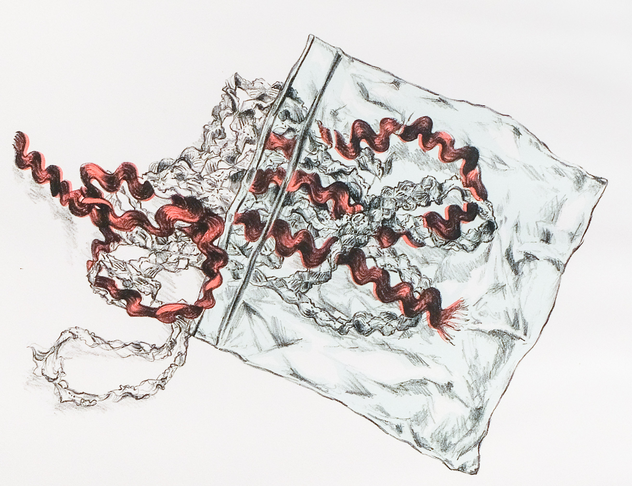
On a recent visit to Finland, I had a couple of transformative experiences in and on the lakes that made me think about belonging and memory in different ways. I am attuned to thinking about these two topics and have spent time working through them in my art practice, but my focus has always been on the relationships between humans and human-made objects. Through painting, drawing, printmaking, and textiles, my work investigates how objects hold and transmit stories of migration and belonging (Zouwer, 2020).
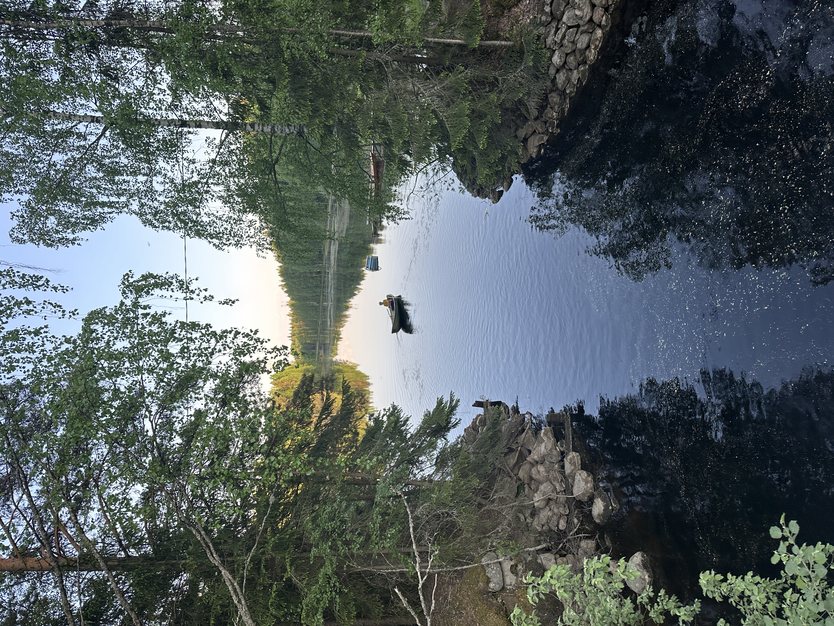
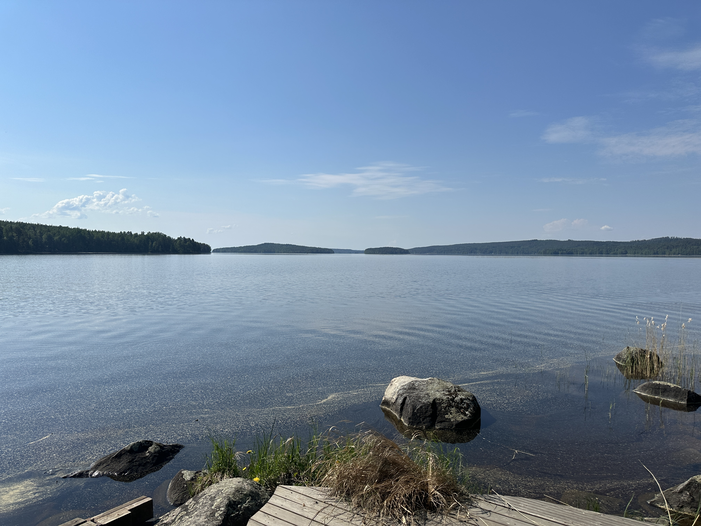
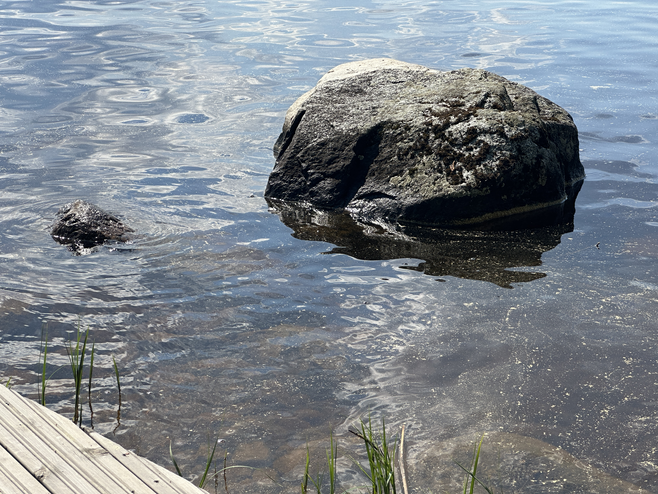
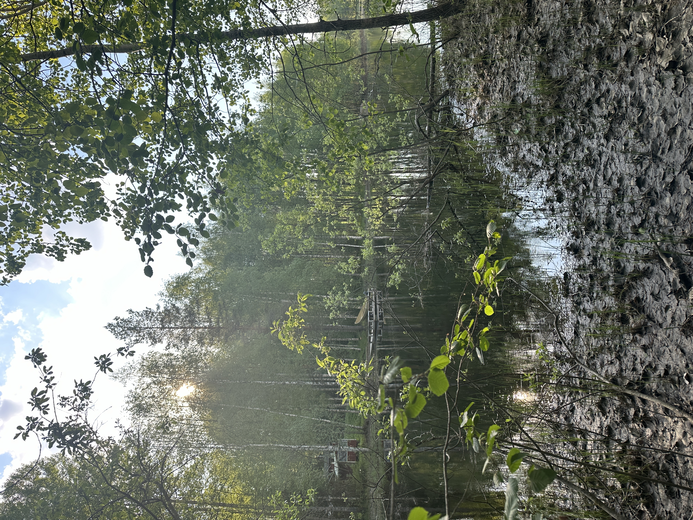
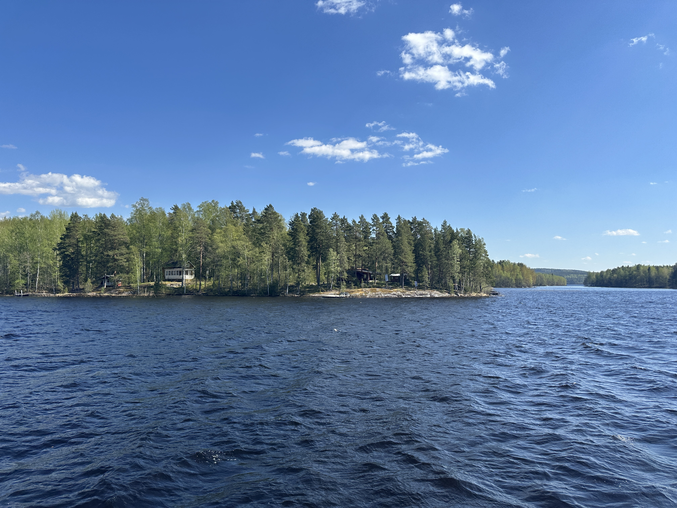
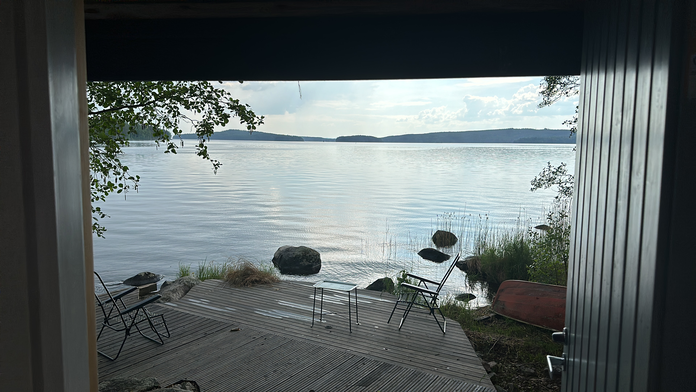
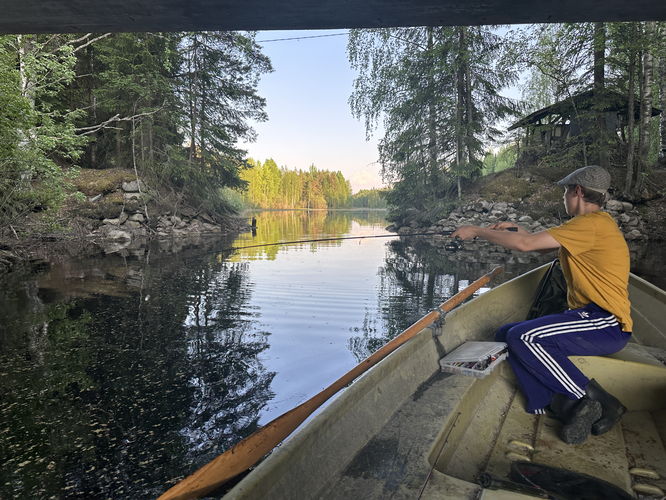
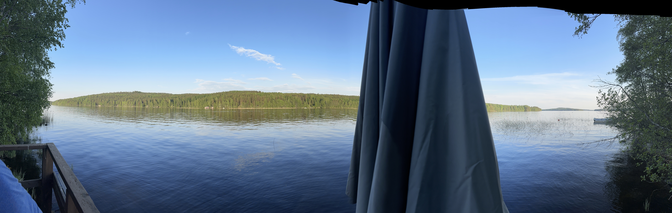
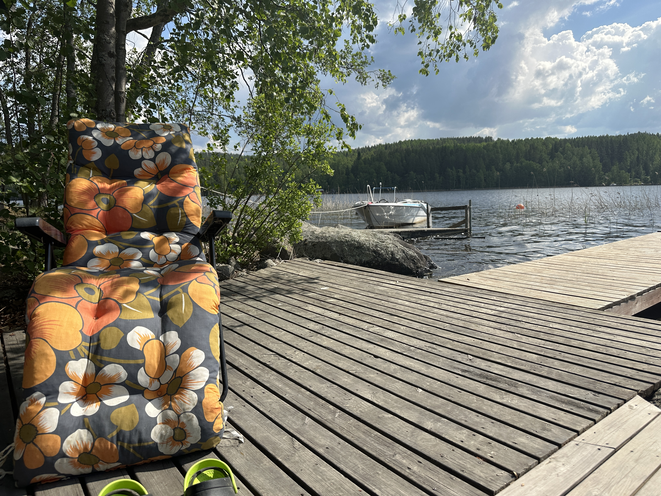
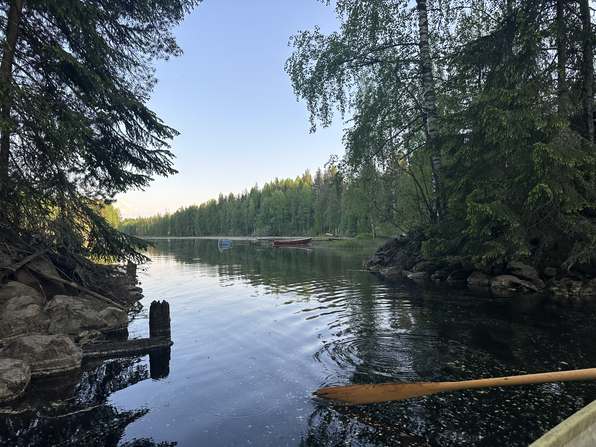
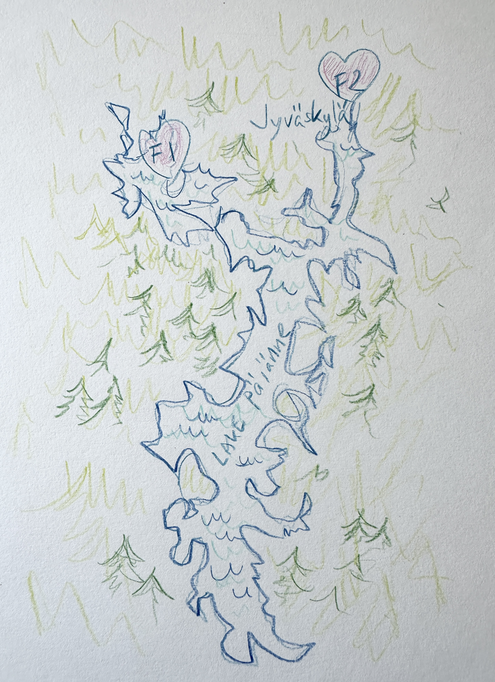
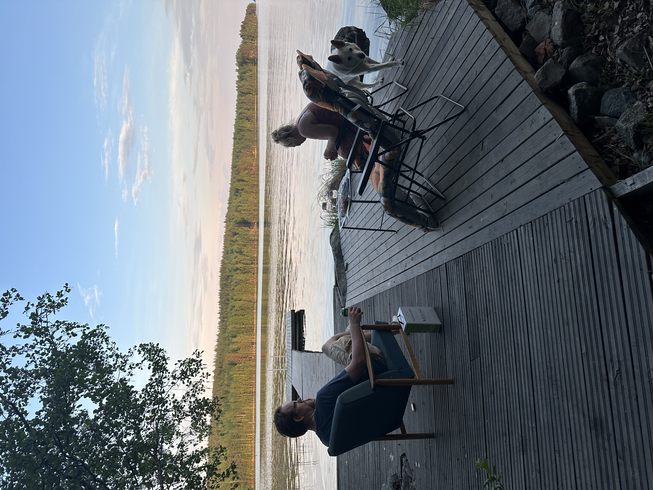
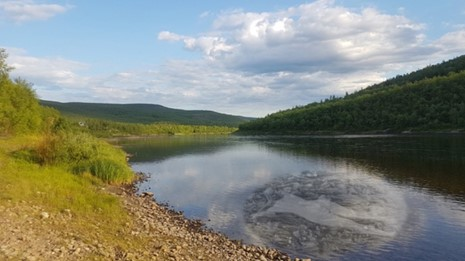
When floating in a boat on the lake on a summer evening near my friend's mökki (summer cottage) (see F1 on the map), I felt an overwhelming sense of contentment. I was on holiday, so this was to be expected. But then, days later, swimming in Lake Päijänne near another friend's mökki (see F2 on the map), submerged naked in the water, I felt something else—more inexplicable—a deep connection with the place. This watery experience took my thinking in a new direction.
I am a first-generation Australian of Finnish descent. My grandmother was born in Pello, and my grandfather was born in Karelia. My mother was born in Tampere. Recently, my mother did a DNA test that showed she is 99% Finnish. This made me think: her family, my family, had been swimming in and drinking this water for a long time before me. Was the water holding the memories of my ancestors and was my body holding memories of this lake? Did the lake's water body remember my DNA and did my DNA remember the lake?
Upon returning to Australia, my conversations with friends and colleagues kept turning to this idea of water memories. The more people I talked to, the more I realised that this phenomenon I experienced was indeed possible.
Indigenous ways of knowing and being are deeply intertwined with the Earth and our non-human kin. Hanna Guttorm writes about this from her Sámi perspective (2021). Using collage, she expresses her connection to the Teno River in Bárši. The captivating image of her body floating on the surface of this river shows her as she "swims, towards the stream..." (personal correspondence, 2024).
Judy Watson, an Indigenous artist from the 'running water' Waanyi people in the Gulf of Carpentaria in northern Australia, makes work about memory and 'the role of Country in bearing witness to past events' (Perkins, 2014). She describes "The carrying of water, the bubbling of springs' as a cyclical metaphor within my work" (Watson, cited in Martin-Chew, 2020). Judy sees all water bodies as connected: "I am the vessel, walking around, with the water within me, and then there’s osmosis within all of the other places that I go to. I always want to know what’s channelling through those places, lifting the cloak of history to reveal what’s beneath and reacting to the here and now" (cited in Martin-Chew, 2020).
I started to notice, there was water talk everywhere. I actually heard Judy Watson interviewed on ABC radio. She talked about a particular river that carried her ancestors' memories, and also about how water was integral to her lithography process (Browning 2024).
I hadn't thought about water having agency in the lithography process before, and now I was curious to be more mindful of it the next time I was in the studio. There were watery connections here, with me and the lakes in Finland and my lithography practice—what if I thought about this watery idea further? Where would it take me?
I met Affrica through an early childhood research project taking a Common Worlds Pedagogical (CWP) approach. It prompted me to think differently about children’s relations with the more-than-human world, and I wondered how it might sit with my artist-led pedagogical approach—a creative, participatory approach where artists guide students in meaning making through art (Pringle, 2009). There was so much to explore. So, when Affrica said, "I’d like to talk to you more, let’s have a coffee!" I was keen! I was curious to see how working alongside her might influence my art practice and pedagogy.
I am starting a lithograph at Megalo Print Studio this week. I am thinking about water as a collaborator… I might set up a camera and video the process, from grinding the stone to printing.
I (Naomi) am a cross-disciplinary artist, researcher, and arts educator based in Canberra/Kambri, Australia. My work is informed by the new materialisms.
As an artist pedagogue, I encourage connections—with people, places, and the world around us—through creative processes.
In my art practice, I work across drawing, printmaking, painting, and textile mediums, creating works that engage with cultural heritage, belonging, the call of personal objects and their social function.
In my teaching practice, I focus on exploring interdisciplinary, project-based learning beyond the classroom, particularly within museums, galleries, and outdoor environments. In these spaces, I promote and foster an artistic disposition that invites play and risk taking, where the outcomes are unknown. I encourage learners to navigate this uncertainty with curiosity and openness, and to embrace what Foley (2014) describes as having ‘comfort with ambiguity’.
I (Naomi) am a cross-disciplinary artist, researcher, and arts educator based in Canberra/Kambri, Australia. My art practice and artist-led pedagogical approach are informed by new materialist concepts.
As an artist pedagogue, I aim to connect people with each other, with place, and with the world around them through creative processes.
In my art practice, I work across drawing, printmaking, painting, and textile mediums, creating works that engage with ideas of cultural heritage, belonging, and the social role of personal objects.
In my teaching practice, I focus on exploring interdisciplinary, project-based learning beyond the classroom, particularly within museums, galleries, and outdoor environments.
In these spaces, I promote and foster artistic thinking. I do this through facilitating open-ended learning experiences that invite play and risk taking, where the outcomes are unknown. I encourage learners to navigate this uncertainty with curiosity and openness, and to embrace what Foley (2014) describes as having ‘comfort with ambiguity’
NZ: August 2. Murrumbidgee River, Uriarra Crossing.
Affrica and I have decided to start a creative collaboration. What that looks like, we don’t know yet, but it involves sharing ideas on creative processes and pedagogy. Since we are both thinking about water, we decided to go to Uriarra Crossing to sit by the Murrumbidgee River.
I have many childhood memories of the Murrumbidgee River. For a short time, I even lived quite close to it. I have always loved playing in the water—doing handstands, swimming, submerging my head and diving under. Affrica says she prefers walking along waterways and being near them, rather than in them. Affrica has her own connections with the Murrumbidgee, as the creek she used to live beside is a tributary to this river. It was an apt meeting place for us to discuss these ideas.
Affrica has introduced me to the work of feminist theorist, Astrida Neimanis (2012; 2017), on the hydrologics of water. We decided that this was a good text to underpin our creative collaboration. We started with Neimanis' modalities of water. We are both drawn to the notions of water as an 'archive' and the 'unknowability' of water.
Why Archive? That was an easy choice. According to Neimanis, "archive refers to water's material capacity for storage and memory" (2012, p.5), and this resonates with my experience in the lakes of Finland and the Murrumbidgee (which was gently moving past in the background as we chatted). I am drawn to collections and personal objects. Archives have long been an interest and a source of inspiration for my art practice.
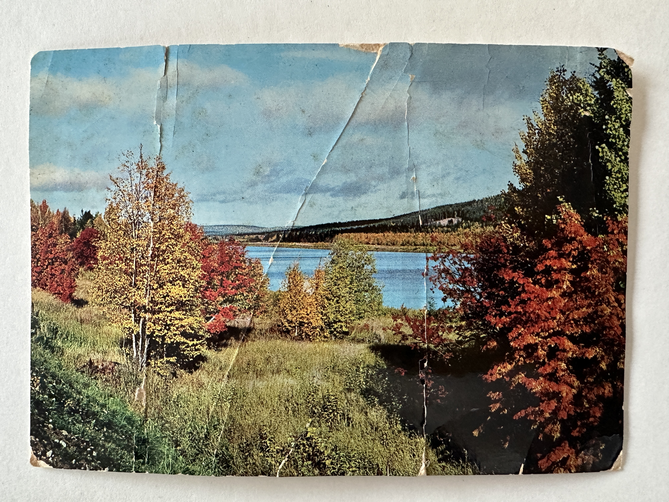
Another feminist theorist, Jane Bennett discusses the 'call of things', a phenomenon that both artists and hoarders are attuned to, where certain objects seem to ask us to pay attention to them (2011). I collect things that call to me. I draw from my archive of objects, many of which are ordinary items discarded by a family member, or worn or damaged in some way (Zouwer, 2019; 2020). I use these objects as inspiration, and sometimes I incorporate the actual object itself, such as this vintage postcard of a lake in Finland, which was gifted to me by a fellow artist for an exhibition 'Objects of empathy' (Toua 2019). The postcard has been on my bedroom wall ever since.
What is appealing about the unknowability of water, and how does this relate to my art practice and artist-led pedagogical approach? At this moment, I see a direct link to my creative process and 'unknowability'—it is like the creative process that comes from thinking with and through materials, where the outcome is 'unknown.' Artists are comfortable with this unknowing state, which can lead to creative breakthroughs or 'productive failure' (Creely et al. 2019; Pringle, 2009).
I am interested in how my art practice intersects with my teaching. I teach students how to embrace the creative habits of artists. Unknowability reminds me of 'comfort with ambiguity' or 'trusting the process' (Foley, 2014; Pringle, 2009). These are habits of the artist, and they are also seen in very young children (though they tend to decline as they get older, usually through schooling). How can we nurture these habits in children, and as they grow into adult learners? I need to ask Affrica about 'deschooling' and learning to think with the world, not about it. This sounds very similar to how I think with materials in my art practice.
The 'unknowability of water' as a state of mind means to me being spontaneous, open, and fluid, as opposed to fixed. These are dispositions I want to help cultivate in my students. I am a teacher of preservice teachers in a neoliberal climate, informed by Eurocentric knowledge systems and values, constrained by multiple layers of compliance. Within this structure, I aim to empower my students to see the value in unknowing—being open and learning with children and the more-than-human world.
In the context of pedagogy, Tulloch insists that "The entanglements between humans and the more-than-human world (meaning objects, phenomena, non-human animals, plants and relations therein) deserve our attention as teachers" (2024, p.142). Water reminds us that learning is never a solitary experience but always entangled with the world around us. In education, thinking with water involves embracing the fluid, unpredictable, and relational nature of learning.
NZ: August 15, Megalo Print Studio
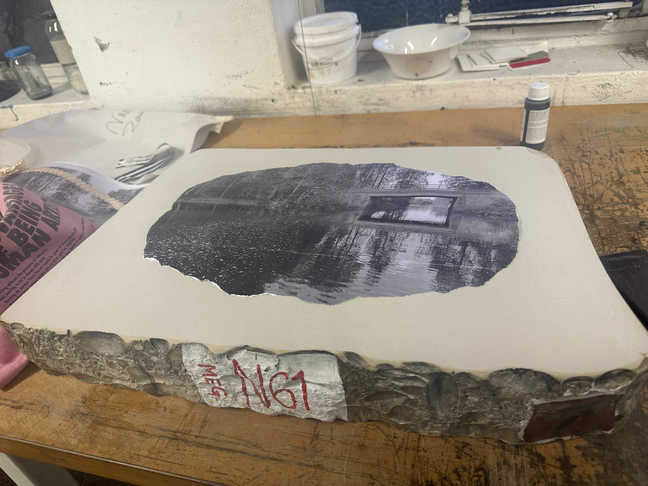
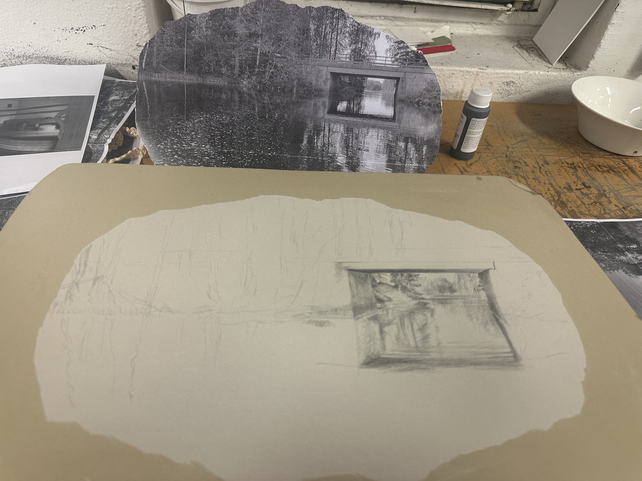
I started drawing on my stone tonight. I like to spend time thinking about what to draw because the lithography process is so time-consuming that you really need to plan. But what do I draw? Landscape vs. Still Life. I favour still life every time—objects and combinations of objects fascinate me. The endless compositional possibilities, the spaces in between, the textures, the colors. Landscape is a challenge for me. I have a photocopy of a photograph to work from—does this make it a still life, then, because I am working from an object... the photocopy?
Hanna Guttorm's collage of her naked body floating on the Teno River speaks to her personal relationship with the land, human, and non-human others. I find this deeply resonant, especially in relation to my own experience of feeling the presence of my ancestors in the waters of Lake Päijänne. I am still uncertain how to communicate this experience visually, so I begin to experiment with new ways of manipulating the images I have—tearing them from their rectangular confines, softening the borders, and allowing the images to take on a more fluid, vignette-like quality. This feels like the direction I need to explore.
I start to reflect on the summer evening floating in a boat on the lake near F1's mökki.
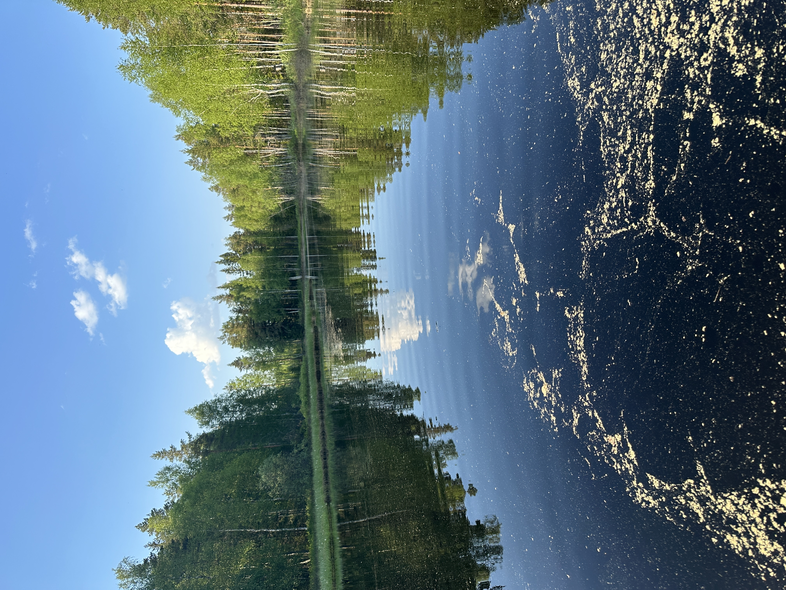
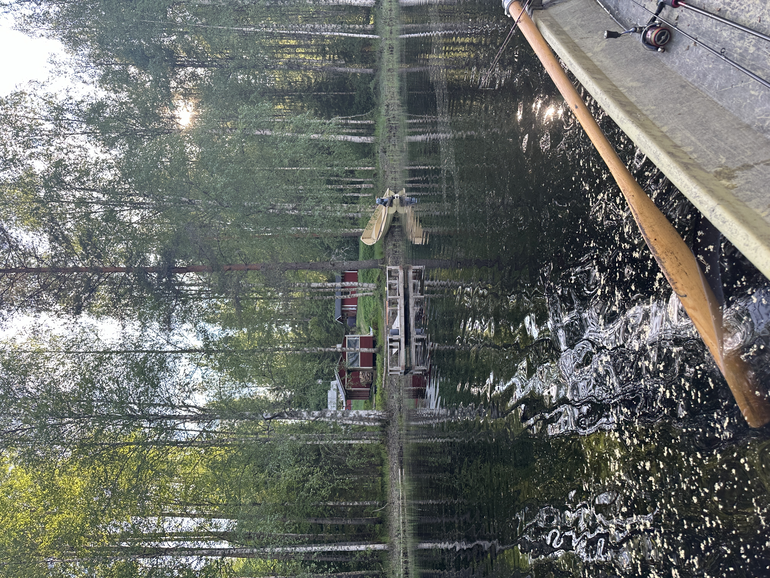
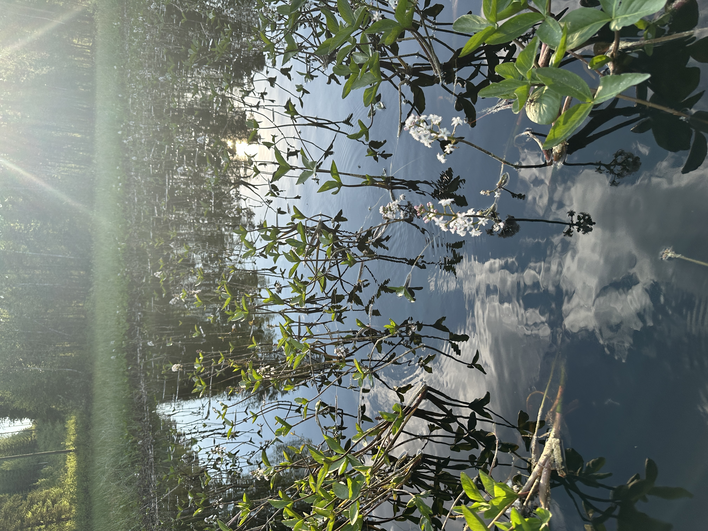
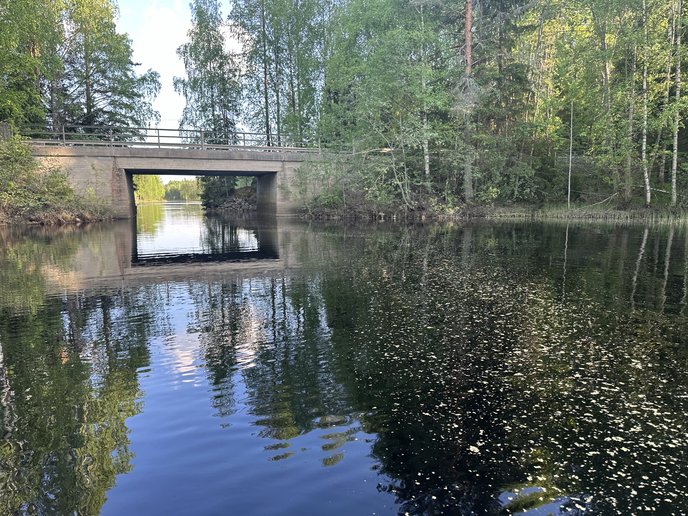
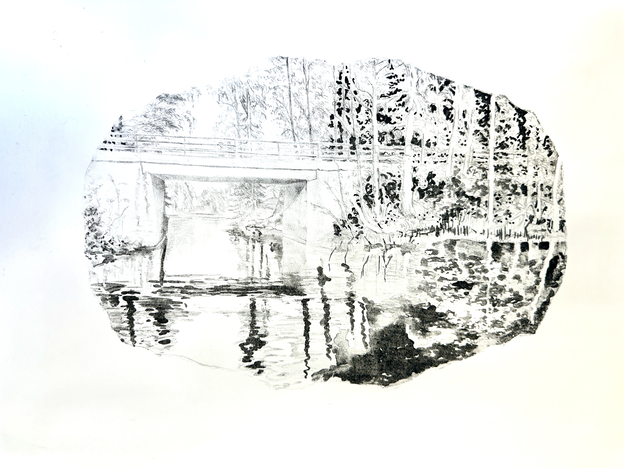
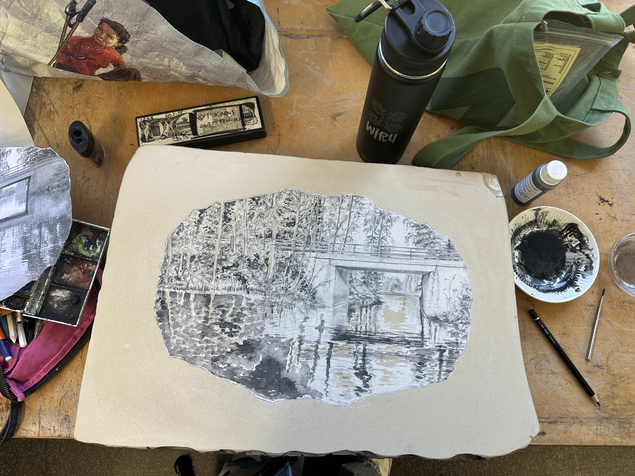
In May 2024, I took a group of Australian students on a study tour to Finland. After the tour ended, I was exhausted and looking forward to rejuvenating with my friends in Jyväskylä. My friend (F1), knowing I was desperate to experience Finnish culture in the forest, took me to her mökki. As soon as I got there, I went fishing with her son on the lake. I loved being on the lake—I was casting my hook but not catching anything, and that was fine with me. I was more excited about the action of casting and being in the small boat. I was wrapped up with a scarf so the mosquitoes wouldn’t get me—there are so many! But soon I stopped noticing them and just enjoyed being on the water, watching the light from the evening sun sparkle on the surface of the lake. Mostly, we were upstream in the sun. After a couple of hours, we started to make our way to the shore. We went under a sweet bridge. I was taken with the contrast of the geometric shapes and heaviness of the concrete bridge against the delicate birch leaves surrounding the lake. The debris floating on the water looked like lace. It was picturesque and different from Australian lakes. We fished until 9:30 p.m. It was still light, like 5 p.m. in the Australian summer.
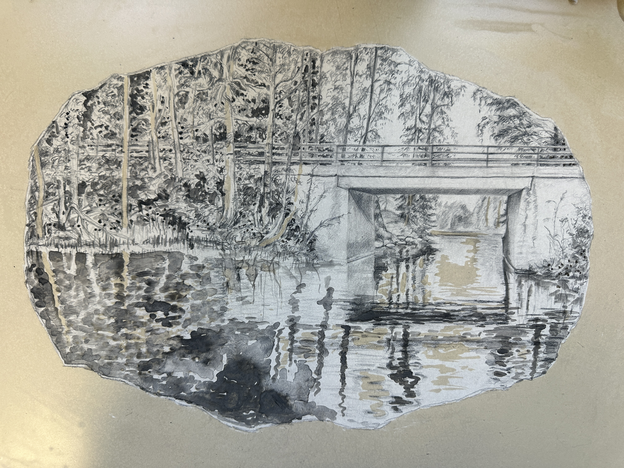
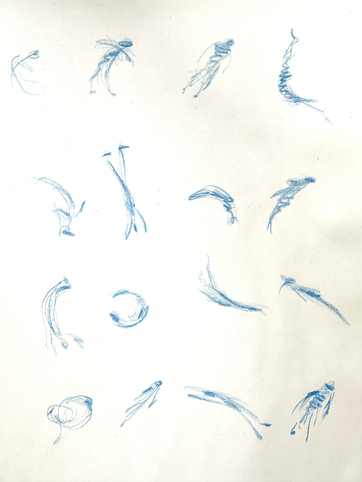
This lake experience is the subject of my lithograph. As I draw the image, I notice that I am struggling to draw the Finnish forest trees. My embodied memory of Australian forests inclines me to draw Eucalyptus trees (gums). I often get my students to make blind contour drawings. This is drawing without looking at the paper—it tunes your eyes into drawing what you see. It also encourages drawers to engage with the process and worry less about the finished drawing—the product. Affrica has tried this and I think she likes the results.
This idea of really looking makes me think of Affrica talking about how CWP is about observing and noticing. This also reminds me of the process of observational drawing and still life, which Norman Bryson says is “the depiction of those things which lack importance, the unassuming material base of life that ‘importance’ constantly overlooks” (1990, p.61). Affrica said something the other day about moving with the small, or perceived minor players, such as children. She talks about how "everyday encounters between assumed-to-be insignificant players might help us to refigure our place in an anthropogenically damaged world" (Taylor 2019, p.3). My drawings of simple everyday objects—and maybe this lake encounter—might encourage the viewer to consider their relations with others.
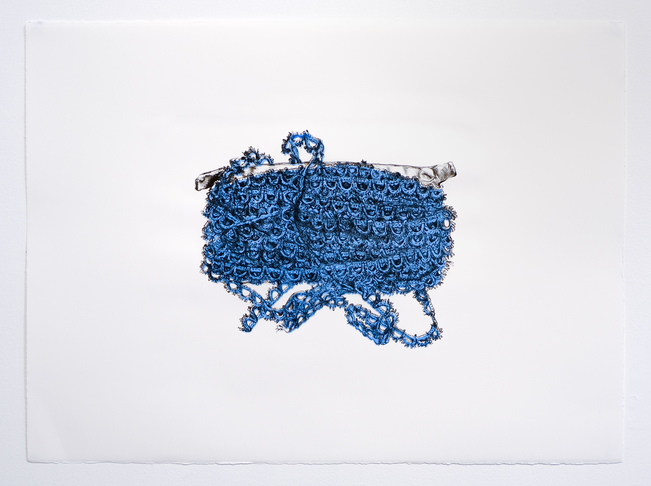
I made a series of lithographs using discarded sewing notions as my subjects. I must show Affrica...
Listen to our conversation about my blue lithograph. Affrica thought it was a lake! In my PhD, I made portraits of people with objects. Can I make landscapes with objects? Are objects my way of understanding the world (and people) around me?
NZ: September 29, Dickson Drains
Affrica and I met at the drains near my house today. We walked around the landscaped edge and found the ubiquitous graffiti. It really is in every drain in Canberra, and features in the spots that offer privacy, like in the drains under bridges. These are the places where young people like to hang out and make their mark - literally. They must be aware that they are entering a shared space that only they and water inhabit. I wonder if it's also a safe place for their creative expression.
Waterways, whether in the form of drains, rivers, or oceans, seem to serve as spaces for personal reflection. When my mother's parents took her back to live in Finland she was a teenager. She had lived for the previous 10 years in Australia. She found it so hard to assimilate into Finnish culture that she told her parents she would throw herself in the Tampere River if they didn't take her back to Australia. I have a mental image of my teenage mother standing on the bridge, alone, staring down into the swirling black water. I imagine she was thinking 'this is not the place for me'. When I told Affrica this story she said that my mother must have been thinking with water at that moment. I think she was too. This story speaks to how water can be both a boundary and a passageway—something to connect with, but also something that feels distant, unreachable, or threatening in times of emotional turbulence.
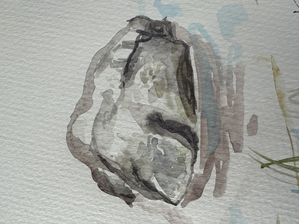
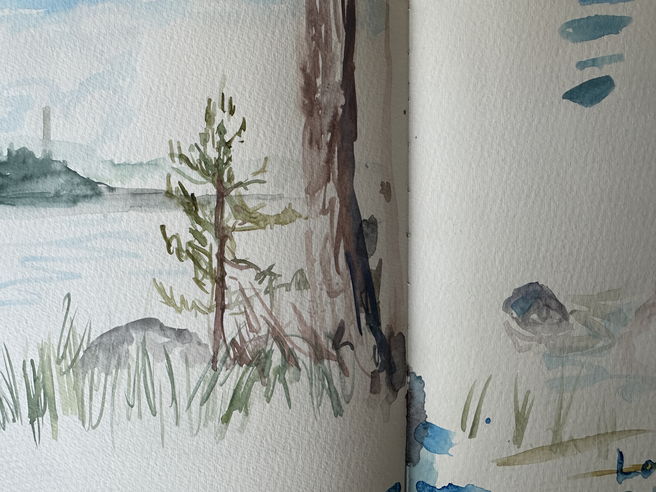
When I was in Finland, sitting by the edge of Lake Päijänne I took some water from the lake and used it to paint with my watercolours. I was looking at the macro view of the landscape initially but then a rock in the foreground kept calling to me. "Paint me, paint me!" it said. There is something in me that responds to the call of nearby objects and small things. It's like a magnetic attraction. Maybe it's something to do with the intra-active space between us? Well, maybe that's what theorist Karan Barad (2006) might say. For artist Lee Ufan, "the space around objects is as significant as the objects themselves". He elaborates by adding that he "values the power of emptiness to generate both harmony and tension between objects and people" (Ufan cited in AGNSW 2024).
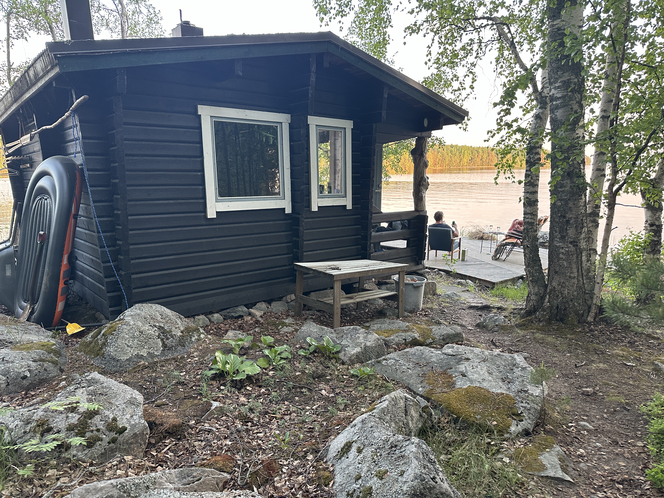
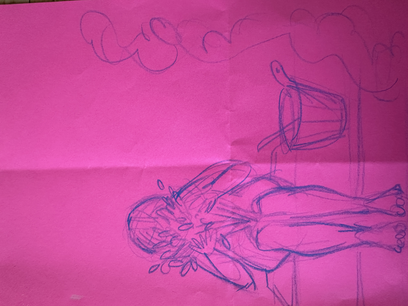
I am thinking of making an artwork about being in the sauna. I've already made a quick sketch on hot pink paper. The work will be something about proximity and water, the feel of the steam in my lungs, and the sensation of immersing my face in a thatch of freshly picked birch leaves or vihta dipped in water. There is an intimacy about being in the sauna—sweat on my body, steam in my lungs, whipping my skin with the vihta, and looking out at the distant view of the lake. This is not an unusual experience for Finns, but for me, it feels like a way of connecting with my ancestors.
In this way, the idea of space—whether the space between objects, or between my body and the environment—becomes central in my practice. It's not just the physical proximity or distance that matters. It's the way these spatial relationships create feelings of intimacy, tension, and connection. My art practice becomes a way to navigate and understand these shifting spaces.
NZ: October 10, Megalo Print Studio
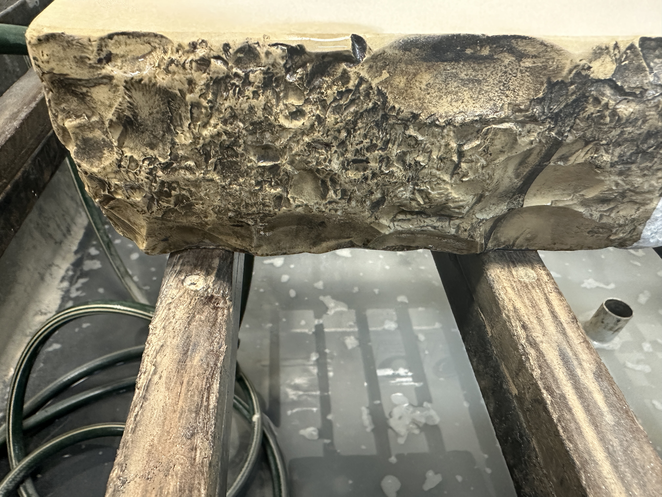
Today, I am back in the print studio. I'm working on my lithography and thinking about Judy Watson's reflections on the significance of working with water to her. This prompts me to be aware of my embodied interaction with the materials and to consider their agency in the making process. It is not just me doing the making.
I am also thinking about all the other lithographic artists who have had their own embodied relationships with stone and water. There's a tradition to this practice that I am proud to continue.
Stone lithography is an ancient technique that works on the repelling properties of water and grease. In the drawing and printing, there’s always a level of unpredictability. This is where the 'unknowability' comes in. Even after years of practice, you cannot fully control how the water will behave, how the tusche will react with the water and the stone, how the ink will settle, or how the image will emerge.
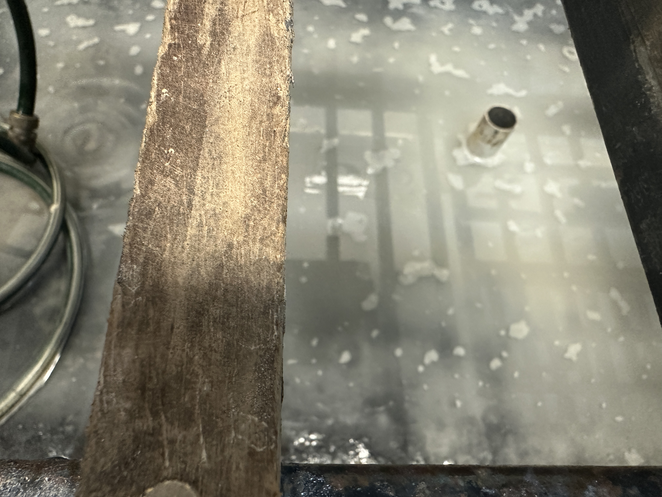
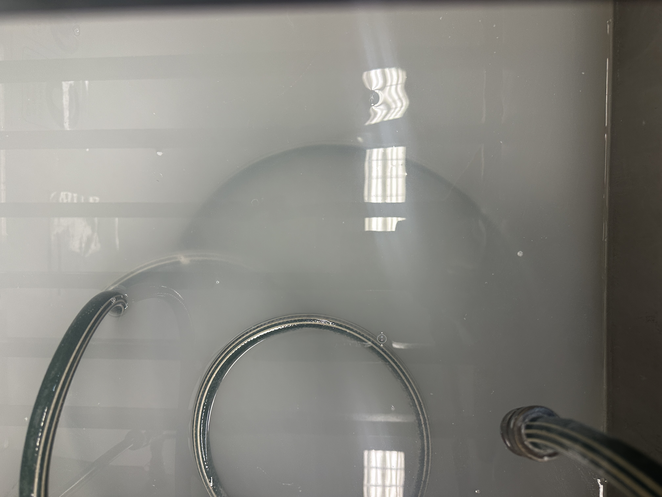
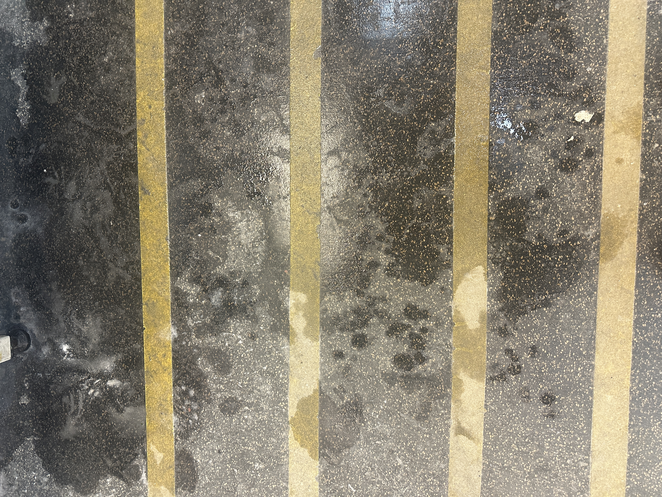
There are many steps involved in the process. First, I have to prepare the limestone, which is heavy (I need a machine to lift it) and precious (it’s from the Late Jurassic period and sometimes contains tiny fossils). Preparing the surface for drawing involves moving a levigator (a heavy metal disc) in a set pattern to ensure the limestone remains flat, using different grades of sand—starting with 80, moving to 120, and finishing with 200—until the stone is perfectly smooth and level. This process requires a lot of water, constantly wetting the stone and washing away the tiny grains as I go. The water runs continuously. The grains change in color, from silver to grey, and then become creamy as they mix with the limestone and water. Water becomes a key collaborator here, not only as a practical tool but also as a transformative force in the process.
The act of grinding the stone is rhythmic and physical, and I feel as though I am entering into a conversation or continuing a dialogue with the many lithographers who have come before me, doing this work for hundreds of years. I am aware that this is a practice not widely followed today, so I feel a sense of responsibility in keeping it alive.
Next, I draw on the limestone slab with a greasy crayon and paint my image with tusche (an ink mixed with water—the more water I add, the lighter the tone). The water here collaborates with the drawing process, affecting the fluidity and depth of the marks I make. 'Unknowability' is very present as the marks are made on the stone with tusche. The combination of water and grease on the stone creates a surface that’s both responsive and unpredictable.
The smooth limestone is silky and cold to the touch, unlike any other drawing surface. It’s a very sensory, tactile experience to draw on, and probably my favorite part of the process. During the drawing stage, it's important not to lean my hand on the stone, because the oils from my skin will transfer and affect the print.
I am happy with my drawing on the stone, but what the print will look like is still a bit of a mystery. I go into teaching a bit like this, I have a plan, but I also leave room for students to go their own way. Some people like more structure, particularly the student teachers. They struggle with 'trusting the process'. They want to know what 'success' looks like. I find very young children do not experience these kinds of struggles. They just make art without needing to control the process. How can we reconnect with that child inside of us?
NZ: November 7, Megalo Print Studio
As an extension of my considerations of water as archive, I've been thinking about archive as a repository of time—an accumulation of memories and experiences. And time, both fast and slow, is an influential factor in the creative process. How can I translate this into an artwork?
I printed a proof tonight, and it's not looking good... I rushed it. I needed to work up the layers of ink slowly on the stone and then proof the print on butcher's paper. Even though I know this, I just jumped straight to printing it on good paper! I still need to do the second etch, the process is not complete. There is hope that it will work yet, I need to take my time.
This experience makes me think about the significance of time when facilitating creative experiences for others. I like to create opportunities for children and adult learners to take their time with the creative process—to be able to sit with an idea for a while, to play with it, and to sleep on it. In schools, children are often under time constraints to finish work within an hour-long lesson or by grabbing bits of time over the course of a week. The pace of time influences how ideas develop and evolve in the creative process. And it's not just slow time. Sometimes it’s important to work quickly. Fast thinking and decision making can mirror the rapid flow of running water. It's dynamic and unpredictable. I do a lot of learning activities that are timed. This helps people ideate without judgment or self-criticism. The aim is to get all of the ideas out, even the bad ones. I was telling Affrica the other day how I needed to get an idea out of my body, just so I could see it to evaluate whether or not it was worth pursuing.
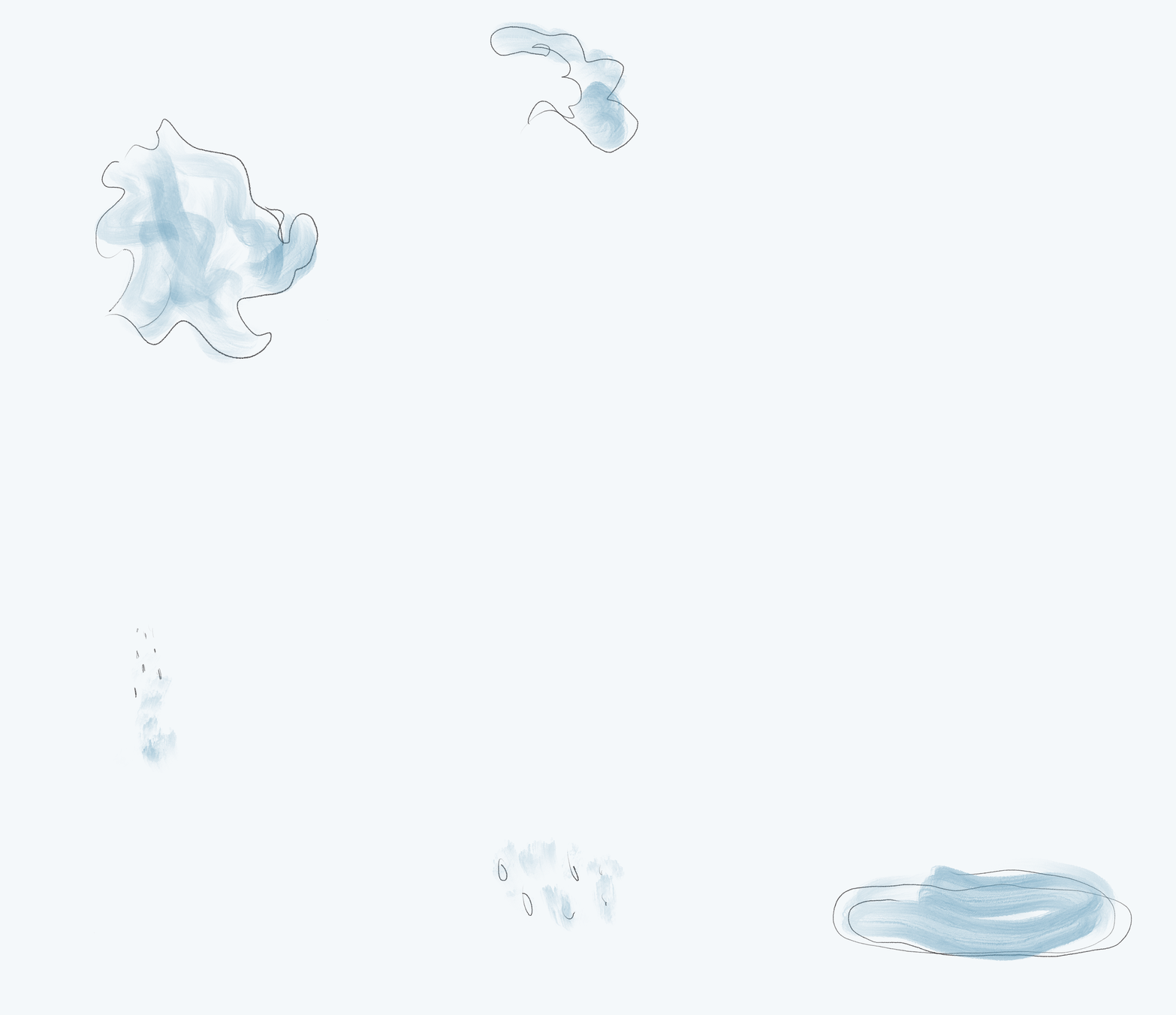
During the hours I've spent hours working on the lithograph of my fishing on the lake, I have also been thinking about how to visualise my swimming in the lake experience. I have been playing with a few ideas. Maybe a collection of naked swimming bodies in a grid (I did this with objects in my PhD work), watercolour bodies? Or an animation of water arising from the lake to the sky like a cloak, and then coming down again as rain? What I want to convey is more personal. It's something about the surface of the lake and what lies below in the water.
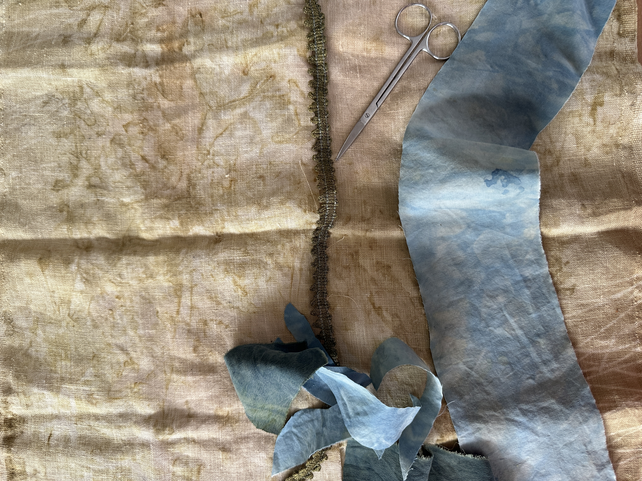
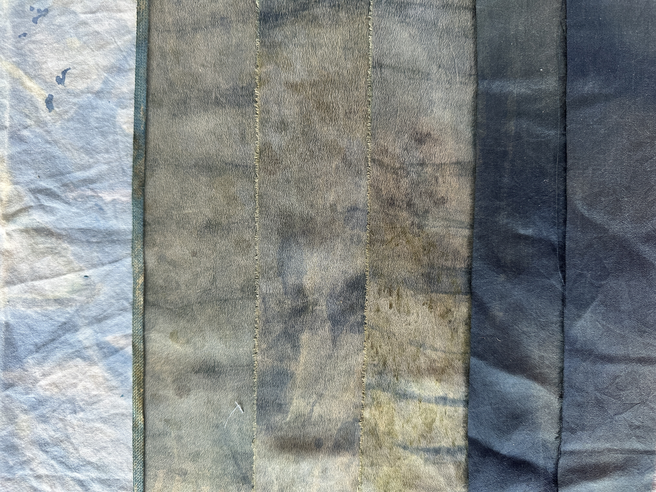
I have a friend who often raids my garden for Indigofera and Wattle to dye fabric. As a thank you, she gave me some silk ribbons, dyed with these plants, wrapped in a blue cloth (also dyed by her). The silk was soft and smooth, like the surface of the water, and the color was dark, like the deepest parts of the lake. Inspired by this, and chats to Affrica about stitching as an act of repair, makes me think of the textile work of Louise Bourgeois. She "spent a lifetime making art to process early-life trauma, and imbued the needle with magical properties" (Buckmaster-Dove, 2021, p.245). I decided to make a collage out of the fabric. I also decided to give myself a restricted amount of time (like I give my students). I gave myself an evening.
Done.
Reflecting on how Affrica noticed my tendency to enjoy being submerged under water, I now realise that this work is just a sketch, a maquette, and it needs to be scaled up to human size. When the viewer stands in front of it, I want it to engulf and hold them, like the watery body of the lake. Maybe it's a 'lake cloak' as Affrica calls it. I think that's the work I need to make, but it won't happen in time for this article.
Through this project with Affrica I have learned that, by consciously making art with water as an agentic collaborator, not positioning water as the passive subject of my lithography, the process of making art is never an exclusively human, solo practice. It cannot be created outside of generative human and more-than-human relations.
I (Affrica) am a retired environmental educator, trans-disciplinary scholar, ethnographer, and author across the fields of children's geographies, multispecies relations, and the environmental humanities. I've recently turned my hand to textile crafting as a creative and material means of exploring these same interests.
My proudest academic achievement was helping to establish and grow the Common Worlds Research Collective. This is an interdisciplinary network of researchers and pedagogues fostering recuperative ecological relations by learning with, not only about the other-than-human beings, entities and forces in our common worlds (Common Worlds Research Collective 2023).
A few years ago, I traded lifestyles and waterways. After spending most of the previous decade in an isolated mountain valley, I returned to live full time in Kambri/Canberra, on Ngunnawal Country. It was a challenge. I left behind a fecund mountain creek ecological community, rich with beauty and biodiversity and bursting with vitality. I moved into a high density housing precinct in an urban centre, beside a barren oval with a stormwater drain.
Before, when I lived in the valley, I walked everyday along the creek tracks. I followed wombat trails, spotted waterdragons sunning on rocks, watched ducks coming in to land in perfect formations, listened to the squabbles of squawking cockatoos, was soothed by the rhythms and contrapuntal tones of river-stones rolled by underwater currents, and so much more. For years, I communed with this creek, thought with it and wrote next to it. I cared for it and loved it. I felt I belonged there.
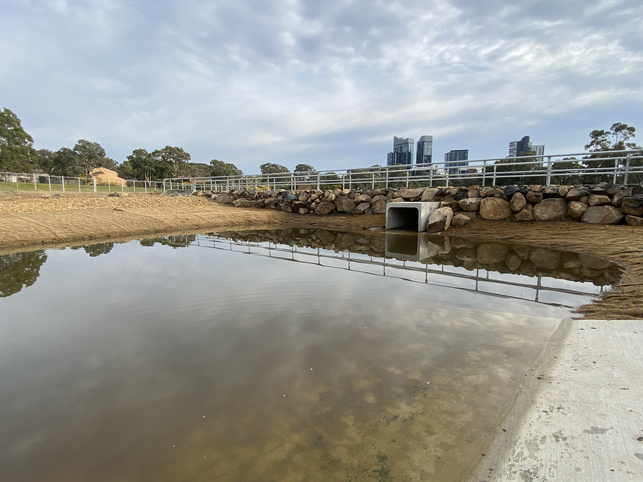
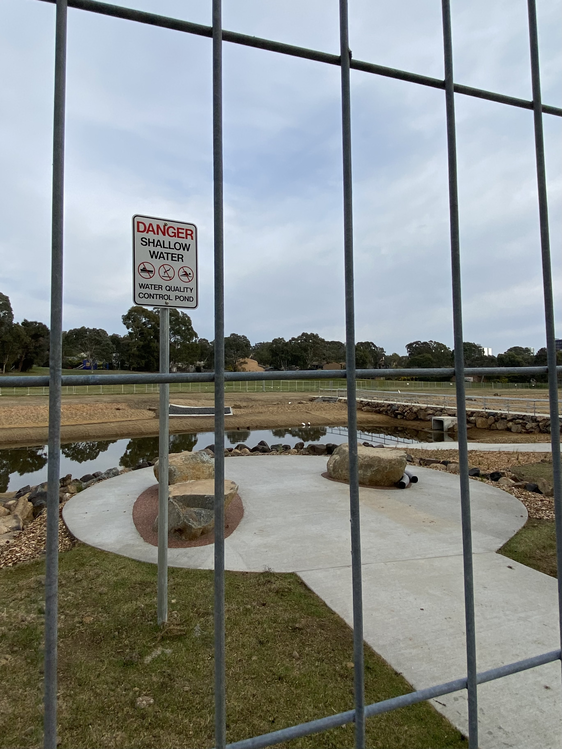
Now based in Belconnen, a town centre of Canberra, I take daily walks on the oval, behind the barrier fence surrounding a stormwater pond construction site. Instead of attuning to the creek's polyphonic pulses, I walk to the background hum of traffic, the punctuation of jackhammers, and the startle of sirens. Finding a sense of connection to this urban environment has been a big challenge. I mourn the mountain creek. Will I ever feel any sense of connection and belonging to this wounded place? Could I ever love a stormwater drain?
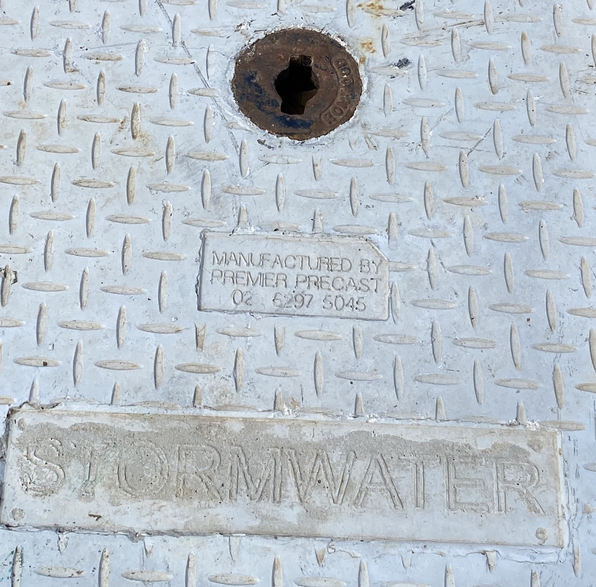
When I first arrived in Belconnen, there was nothing on the oval but a narrow concrete opening to an underground stormwater drain that I couldn't see or hear. I learnt there was once a little creek where the oval is now. It was infilled around 60 years ago and its waters channelled into the underground stormwater drain. Plans were afoot to re-surface the stormwater and re-direct it through a series of filtration ponds on the oval, to de-contaminate it before it empties into the lake down the hill.
After hearing a local Ngunnawal elder insist that water has memory and even Canberra’s concrete waterways never forget, I started to wonder if these stormwaters still hold memories of their past-life as a creek? Maybe the spirit of that little creek could re-surface with the stormwaters? Perhaps there is a glimmer of hope that I could build a sense of connection to it?
After months of heavy construction, the water is finally above ground, although still enclosed in steel and concrete. But at last I've met it and can get to know it. Hanging out with the over-engineered stormwater ponds does not elicit the same joy as hanging out with the pristine mountain creek, but I'm slowly finding ways to appreciate it. I'm learning to think with its watery resilience, practising the 'arts of noticing' (Tsing 2015; 2020) what possibilities for new life might emerge from these polluted waters, despite their concrete containment.
The practice of noticing, thinking and learning with other beings, entities and forces in the world around us is the mainstay of 'common worlding' pedagogies (Common Worlds Research Collective 2023; Instone & Taylor 2015; Pacini-Ketchabaw & Taylor 2015; Taylor 2017; Taylor 2020; Taylor, Zakharova & Cullen 2021; Wee Jasper Bush Salon 2021). I've been using these kinds of more-than-human collaborative practices for a long time now, and see them as fundamental to environmental education.
I met Naomi through an environmental research project at the University of Canberra that's using a Common Worlding Pedagogical approach. She's the arts educator on the project, and I'm an advisor to it. We discovered that we share very similar ideas about education and the significance of material relations, as well as a mutual interest in water, memory and belonging. We decided to collaborate on a new environmental artistic project exploring new forms of creative pedagogical engagement with water. Luckily we have complementary knowledge and skill sets. By collaborating with Naomi, I'm keen to learn how thinking like an artist might help me explore and express my interest in water-related ecological recuperation in more creative and material ways. The age-old women's craft of stitching and repair really appeals to me, so I want to work with textiles.
AT: August 2. Murrumbidgee River, Uriarra Crossing.
Today was our first get together to plan our creative water collaboration. It felt right to have met beside the Murrumbidgee River, and shared the affect of its flow. It matters to me that 'thinking with water' involves a real-life physical, relational and material encounter with real-life water bodies. It's not just a catchy metaphor. It's a pedagogical practice and the way I stay grounded.
The way I see it, our two-thirds water bodies are setting out to think with a couple of other water bodies—the Finnish lakes and the Belconnen stormwater drain. This four-way collaboration is an exciting opportunity to work across difference. As Anna Tsing points out: 'Collaboration means working across difference, which leads to contamination. Without collaborations, we all die' (Tsing 2015, p.28).
We've initiated this collaboration because our entangled, personal, lived, wet, and embodied relationships with our respective water bodies matter to us and afford creative pedagogical possibilities. From our different positionings, these possibilities are not necessarily the same. As a researcher/scholar/practitioner of common worlds methods and pedagogies, I see my relationship with the stormwater drain as inherently pedagogical and creative. It’s pedagogical, because I learn with and through my daily, embodied interactions with these waters. It’s creative, because something is always generated by this more-than-human relationship. By collaborating with Naomi, and witnessing her artist-led approach to pedagogy, I’m keen to glean additional possibilities from her creative pedagogical process. As a ‘more-than-human’ feminist scholar, I’m always looking for ways of challenging the ‘lofty’ ‘all-knowing’ positioning of ‘rational Man’ that pervades the academy. As far as I’m concerned, the more unconventional, creative, and collaborative ways of doing things, the better.
I've researched and written about river dialogues before (Taylor 2020), so I'm not suggesting all academic thought is to be avoided. It's more about recognising that it matters what thoughts you use to think other thoughts with - to paraphrase Donna Haraway (2016, p.118). There are plenty of feminist scholars whose collaborative thinking with other beings, forces, and entities has influenced mine. For instance, Donna Haraway's thinking with her dog Cayenne (Haraway 2008), Anna Lowenhaupt Tsing's thinking with mushrooms (Tsing 2015), Val Plumwood's thinking with a small stone (Plumwood 2007), Kathryn Yusoff's thinking with coal (Yusoff 2018), and Astrida Neimanis' thinking with water (Neimanis 2012; 2017). Their thoughts, as well as many other scholars in the fields of feminist posthumanism and new materialism, have inspired and influenced the development of Common Worlding Pedagogies (Common World Research Collective 2023; Taylor et al 2023; Pacini-Ketchabaw & Taylor 2015; Taylor & Pacini-Ketchabaw 2018; Taylor 2017a, 2017b).
Before we met today, we decided to read Astrida Neimanis' (2012) paper 'Thinking with water'. Reading her 'aqueous' thoughts at the river adds another layer to our pedagogical process. With the Murrumbidgee River flowing past us, we thought with the waterbodies that matter to us. At the same time, we thought through Astrida's thoughts on thinking with water. This layered process of thinking and learning along with nonhuman and human others is like the 'waves of diffraction', simultaneously material and semiotic, that Karen Barad draws from (Barad 2006).
So far, this rippling diffractive process has led us to a couple of the 'hydro-logics' that Astrida attributes to watery thought. The first of these is 'archive'. In Astrida's words: 'Archive refers to water's material capacity for memory and storage... as various oral traditions show, it is a literal container of story and history that serves collective cultural remembrances' (Neimanis 2012, p.5). We're both interested in exploring the possibilities of water-as-archive as the notion of water's stored memory directly relates to our lake and stormwater projects.
The second hydro-logic we're interested in working with is 'unknowability' (Neimanis 2012, p.5). Naomi tells me that 'unknowability' is already a key aspect of her artist-led pedagogy. The hook for me is Astrida's insistence that: 'Despite all of our dam-building, mega irrigation schemes, and cloud-seeding efforts, water will always elude our total control, and our efforts to fully "know" it' (Neimanis 2012, p.5). I've written about the conceits of geo-engineering a fraught irrigation dam downstream from my beloved creek (Wee Jasper Bush Salon 2021, p.167), so I'm now keen to apply similar thinking to the construction and reconstruction of the small-scale stormwater drainage system in my neighbourhood. How much 'control' do the engineers of these systems actually hold over these waters?
The original stormwater drains were built in the 1970s and functioned well as a drainage system for the new suburb. But they had other repercussions that eluded urban planners at the time. The drains also channeled run-off pollutants into the district lake, and from there further down the catchment to the Murrumbidgee River. It's become a big problem. This year, the filtration ponds have been built to clean the stormwater before it contaminates the lake. Although I'm very keen for it to succeed in this objective, I've started to wonder if and how this latest modification of the stormwater system might elude human control. I'll be looking for any signs of this on my daily walks around the ponds.
AT: September 14, Belconnen Home Craftroom
I'm not sure how long it'll take me to go with the flow, and stop trying to control the creative process. I'm definitely not there yet. Old habits die hard. Over the years I've developed a very structured approach to my academic writing. I'm used to working with framing concepts, and unpacking them in a systematic way, not sitting with the unknowability of the creative process that Naomi is comfortable with. That's one of the things I'm trying to learn through this collaboration. How to unschool my ordered habits of mind and loosen up a bit.
It doesn't help that the fence still keeps me at a distance from the stormwater. It's another barrier to creative inspiration. I can't sit beside it and think with it directly. I don't have the immersive waterbody memories that Naomi has with the lakes.
I'm spending most of my time scrolling through photos on my computer — collating them to visualise the layerings of the stormwater story. Photo collage is fun and easy. I quite like the one I ended up with. It features the dreamy stormwater on hessian again, sandwiched between concrete drains. But I'm still pondering how to move from photo to fabric, and ended up reverting to a concept map. Sigh. I'm almost too embarrassed to show it to Naomi. And then I stitched the concept words! Reverted back to my comfort zone. Am I actually capable of creative expression? Maybe I just need to get this compulsion to order out of my system before the real creative work begins?!?
AT: August 28, Belconnen Stormwater Ponds
I’ve taken some more photos of the filtration ponds. They're such a classic example of an over-engineered 'natural' landscape. It's been a bit disturbing to watch the huge amount of cement trucked in to form the paths and line the ponds — to contour, contain, and maintain the site. The ponds look so fortified and bounded now. And they are still ‘out of bounds’ to the public.
I've been keen to take a close look at what's happening at the edge — where stormwater meets concrete. Now that the water can spread out and breathe again, I'm wondering how long it'll take to regain enough energy to start eroding the artificial boundaries of the nature/culture divide.
The other morning, when there was no one else around, I found a gap in the barrier fence just big enough to squeeze through, and followed the ramp down to the waterline. I was hoping to spot some small signs that the stormwater had begun to etch its own story onto the concrete edifice, like the graffiti in the drains.
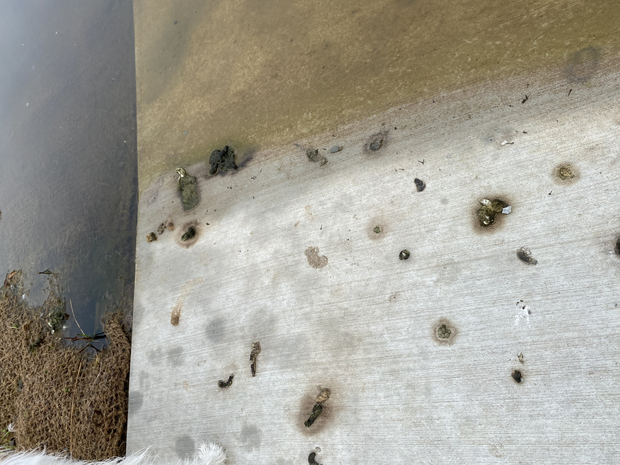
The first thing I noticed when I peered into the murky shallows was that the hessian matting that's been laid across the banks continues down into the water. It's covering the concrete base of the pond. The submerged matting is swelling, which magnifies the criss-cross patterning of its weave. This pattern weirdly echoes the fence's rectangular steel grids, but also counterposes them because it's soft, shaggy, uneven and pliable. It adds relief to the textural grounds of the underwater-scape. The matting is starting to harbour duck shit and trap feathers and grow algae. With the water's help, it's coming alive.
Noticing the possibility of new life emerging at the 'unruly edge' reminded me of Anna Tsing's (2015) resolve not to give up on 'the possibility of finding life in the capitalist ruins'. Following on from this hope, I appreciate the question she poses. 'How does a gathering become a "happening" ...?' Her answer is 'contamination'. She goes on to explain that all encounters contaminate - and she doesn't just mean human ones. They do this because 'they change who we are as we make way for others. As contamination changes world-making projects, mutual worlds - and new directions - may emerge' (Tsing 2015, p.27). Her insights help me reframe my thinking about what's happening here. Instead of only seeing this assemblage of murky water, concrete, duck shit, feathers and sodden hessian at the edge of the pond as a contaminated mess, and the result of yet another over-engineered human project, I can start to see it as the material precursor for change that's taking a different direction — a new kind of world in the making.
The photos I took from the water's edge also reaffirm the unexpected beauty of this 'contaminated' pond. The light was gentle that morning, and the reflections of cloudy sky on water gave it a blurry, milky sheen. For a murky pool, it looked quite serene and dreamy. Almost like a memory. I was pleased I managed to capture this mood in my photos. I'd like to try and transfer it onto fabric now. A challenge! I'll need Naomi's help.
AT: October 12 Belconnen Stormwater Ponds
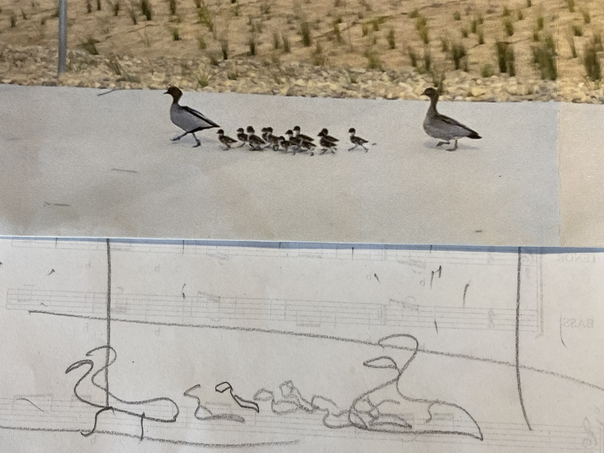
More cause to smile. Yesterday I passed a family of 14 ducks marching in single file along the concrete path next to the filtration ponds. I love the way ducks always move in formation. This time it was one parent at each end, and 12 brand new ducklings forming a straight line between them. Unlike me, they were inside the fence, in their home territory, and definitely in a hurry to get somewhere—probably to the safety of the overflow pipe between the ponds.
There was something about the way these fluffy little beings fitted in so neatly to the hard-edged ordered landscape, lined up with the rows of reeds, marched straight along the centre of the parallel pathway, that made their new-life belongings to these newly constructed drainage ponds seem so 'natural'. It was another mode of belonging to this stormwater landscape that I wasn't expecting to see. I won't be able to find creative inspiration from the drainage ponds now without thinking with the ducks.
After many iterations, my textile piece is starting to come together. I'm now stitching a palimpsest of contour map, murky water, milky reflections, reeds, ducks and steel barrier fence. In the final version, the fence is coming down!
AT: November 12, Belconnen Stormwater Ponds
I snuck back through the hole in the barrier fence this evening, on a whim, to submerge my just-completed textile piece in the filtration pond. It suddenly seemed important not only to think with the stormwater as collaborator, but also to make with it. I guess this is the creative impulse that Naomi talks about as following the energy and trusting the process.
I'm so glad I did. It was a sublime evening. The setting sun cast intense reflections in the darkening water, as the birds headed off to their nests and roosts, and the frogs came out in force (a very good sign for the water quality). Their loud croaks punctuated the hum of nearby peak-hour traffic. It's been a while since I'd been right beside the stormwater, and it was exciting to see that micro world making has been ongoing. There's lots of slimy green algae now, frog-egg scum and tadpoles. Only the duck family was missing.
Returning my stitched hessian work to the matted pond that inspired it was a satisfying completion to the cycle of our collaborative exchange. For me, it was a culminating moment of gratitude and connection. It drew me closer to this place. What was assumedly a creative work made by my hands alone, is now ours. It's the product of our two water bodies. And thanks to the curious young girl and her mother walking past who offered to help, I now have a video that captures this moment of return and completion. Another fortuitous part of the process.
The final photos I took also worked out really well, thanks to the unplanned opportunity to view our stormwater work in situ in the amazing evening light. In stark contrast to the flat dry piece I made back in my craft room, these photos capture a newly vitalised creative work that has relief again, as if it's absorbed the water memories of the mountain slopes of Ngunnawal Country. It's floating in the watery shadows. It's slimy, grimy and covered in mud—and it shines!
I've come home feeling quite elated, reflecting on this watery transformation as a small window into the creative pedagogical possibilities of Common Worlding. It's very personal of course, but for me, this collaborative and re-vitalised stormwater drain piece is like a mini-landscape of hope. It materialises the belief that I need to hold onto in these critical times of ecological unravelling, that repair and recuperation is still possible if we can learn how to re-make worlds together (Haraway 2008; 2016).
AT: August 23. Belconnen Oval
The stormwater filtration ponds are almost finished. All the heavy machinery has been taken offsite and rows of reeds are being planted in and around the ponds. It's a big job but essential for the filtration. Their roots will filter the high phosphate and nitrogen loads out of the stormwater before it runs into the lake.
I'm looking forward to the removal of the barrier fence so I can finally walk to the edge of the ponds and take a close look at the water. It's likely to be what Anna Tsing (2015) refers to as an 'unruly edge' where unexpected things gather and happen. I'm hoping to be surprised. Maybe I'll find a way to appreciate the stormwater's 'unknowability' (Neimanis 2012; 2017), or find some small indication that it's already starting to elude the control of its designers?
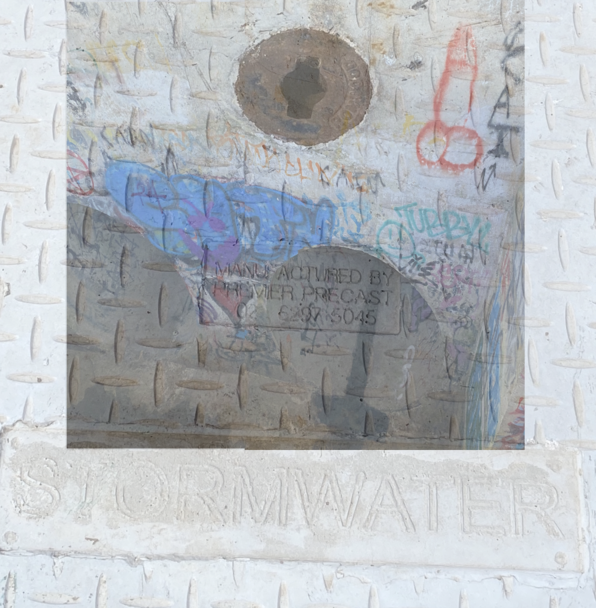
I did find something surprising some months ago, before the construction started. At the end of the oval there's a long, low concrete structure that drains run-off water into the underground pipes. I'd occasionally heard water trickling below, but couldn't see in, as the gap is very narrow and close to the ground. Eventually, I angled my phone just inside the lid and took a few photos that captured the image of a small stream of water moving through a concrete chamber at the junction of two large stormwater pipes. The photos also revealed something I hadn't expected to see. The walls of the chamber were covered in brightly coloured graffiti.
You can't see any of this from above ground, so it was like discovering that the barren oval I'd been walking across for the last few years was harbouring a secret vibrant underground culture. Of course, I'm aware of the subterranean world of worms, ants, and other earth-dwelling critters, but I'd never imagined that the hidden drains beneath my feet had been marked and claimed as an alt-space of human belonging.
The idea of place as palimpsest, written and overwritten by different stories from different times and different peoples is a concept and process I've been working with since my early days as a cultural geographer. I often think of the ways setter colonists have overwritten Indigenous stories of Country, and rendered them invisible. Re-presencing these stories has become an important aspect of Common Worlding Pedagogies (Nuxmalo 2021; Taylor et al 2021).
The gradual erasure of this waterway's Ngunnawal storylines and its reinscription by a series of non-Indigenous interventions has been on my mind as I've researched its settler history. The first of these was its mapping and naming as Emu Creek by late 19th Century pastoralists and geographers. Then came its re-charting into underground grids of suburban infrastructure by town planners in the 1970s. The 2023 filtration ponds' design and construction is the waterway's latest re-inscription. Each of these iterations has over-written and re-storied the waterway. Before I started poking around in the run-off drain it hadn't occurred to me that there was yet another overlay, a colourful subcultural story inscribed on the walls of the underground chamber.
It was a great find. As well as being a statement of reclaimed belonging, the graffiti is an artform of resistance and subversion. It defies the concrete order of the underground grid. Maybe these drains aren't so immutable after all? It's spurring me on to think about the non-human resistance stories these drains might also be harbouring. How might non-human stormwater constituents be resisting or exceeding human efforts to order and control? What sort of otherwise stories are they telling? In order to learn to love this stormwater drain, I need to believe it can still be re-storied.
In the meantime, I've started playing with photo collage as a way of resurfacing the story of underground resistance. If local youth can establish their belonging in the Belconnen stormwater drains, maybe I can too?
AT: October 4, Belconnon Home Craftroom
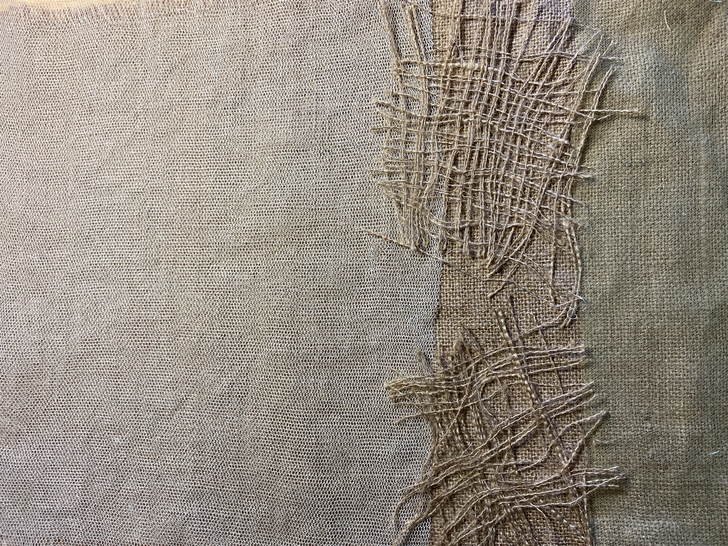
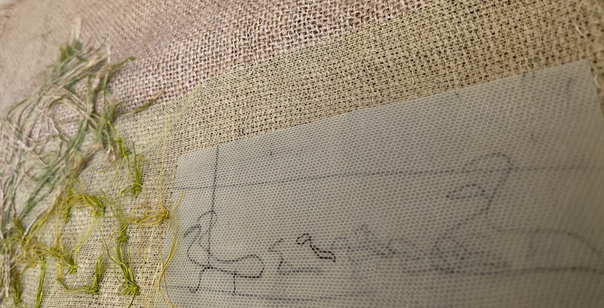
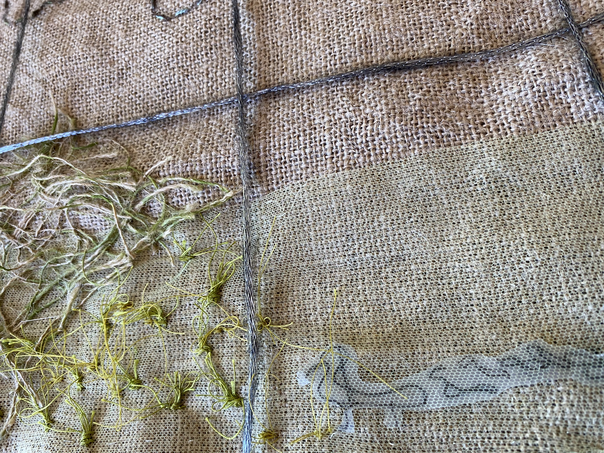
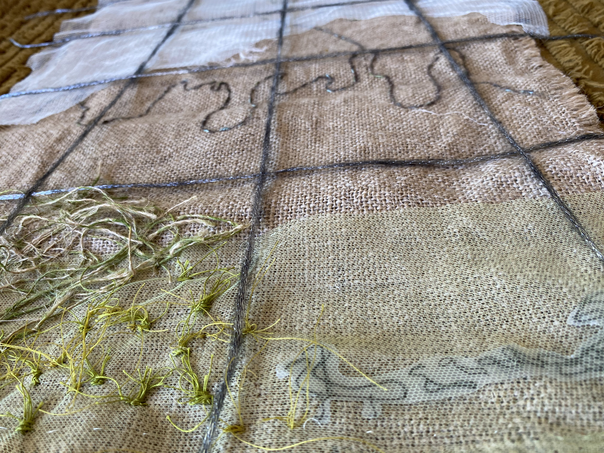
After my close-up encounters with the pond a while back, it's a bit of a no-brainer that I've settled on hessian grounds for my textile piece. It's not the easiest fabric to work with. It was quite stiff and spikey at first. Wetting it helped soften the fibres, like the matting in the pond. When I squeezed out the excess water the hessian became a 3D relief, reminiscent of the contoured landscape before it was flattened for urban development.
I started pulling out warp and weft threads and tugging the hessian sidewards to distort the grid. It was satisfying handling the malleable small pieces, loosening the weave, letting the air circulate. It felt like I'd begun prying open the fabric of the small world I'm crafting, perhaps even loosening up myself.
When I assembled the fabrics, it did feel like I'd managed to capture some of the serene and dreamy qualities of the photo collage. On a purely aesthetic level, it could be as good as it gets for this amateur handicrafter. But I want to keep going as I think I'm learning and I don't want to stop. I've also got a familiar urge to include more—more of the palimpsest of overwritten stories of place, more signs of the possibility of life emerging from the ruins and more gestures towards productive contamination (Tsing 2015). Somehow, I need to stitch more stories of my unfolding relationship with the stormwater drain onto the hessian grounds.
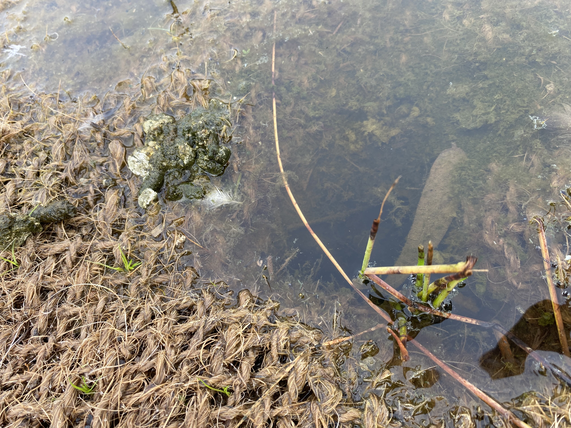
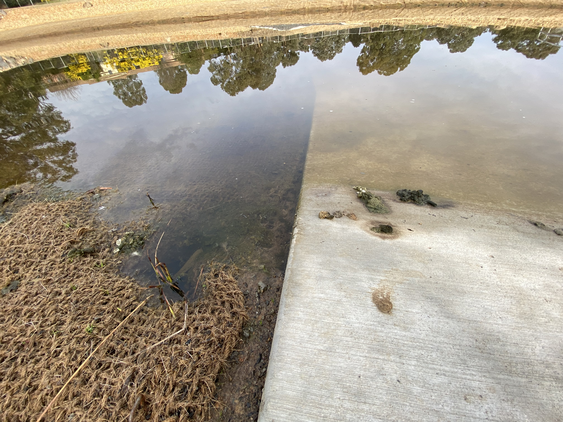
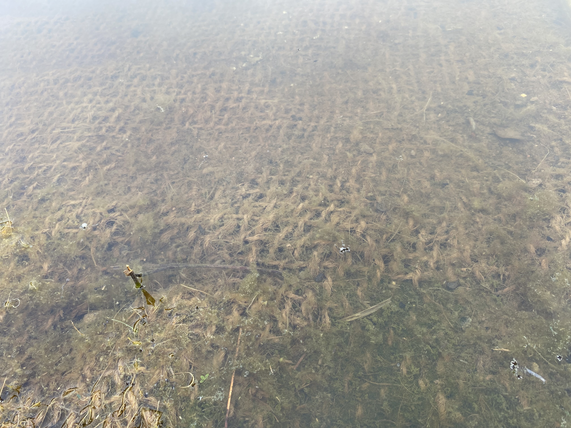
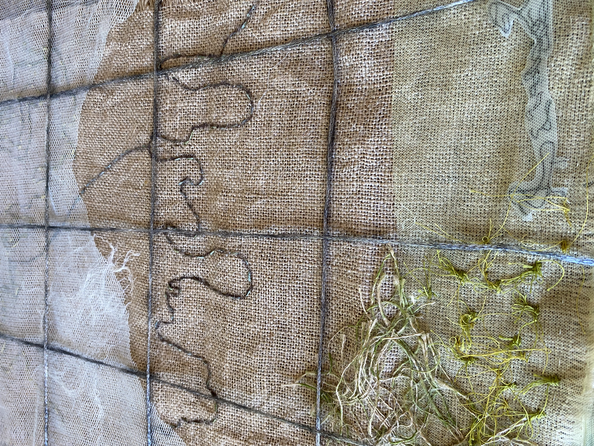
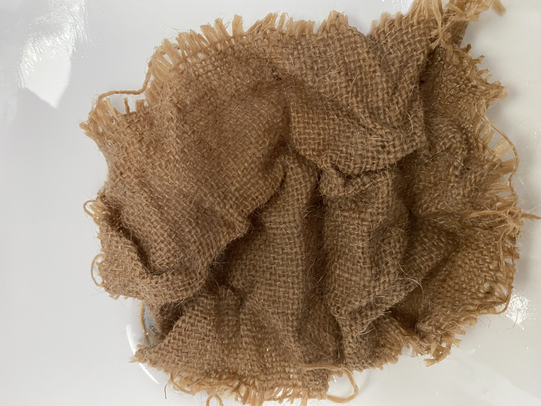
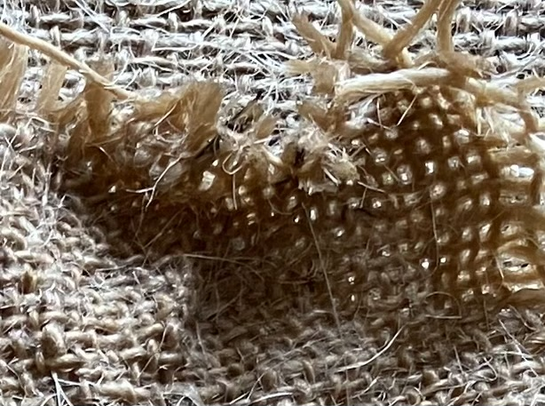
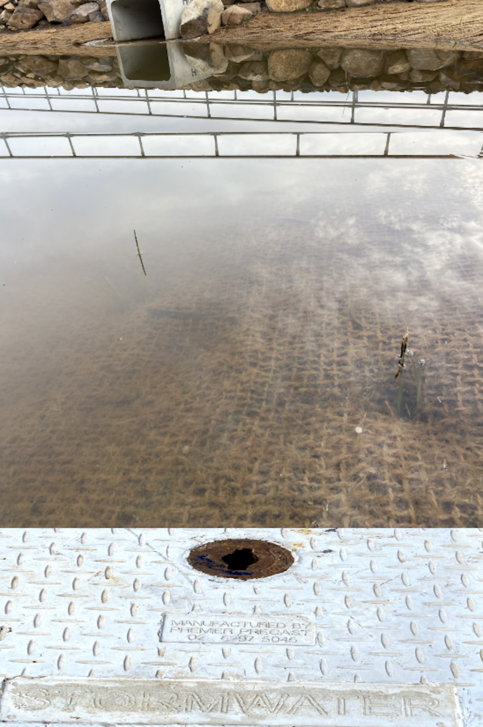
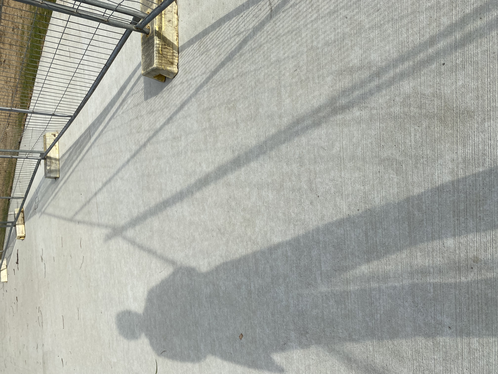
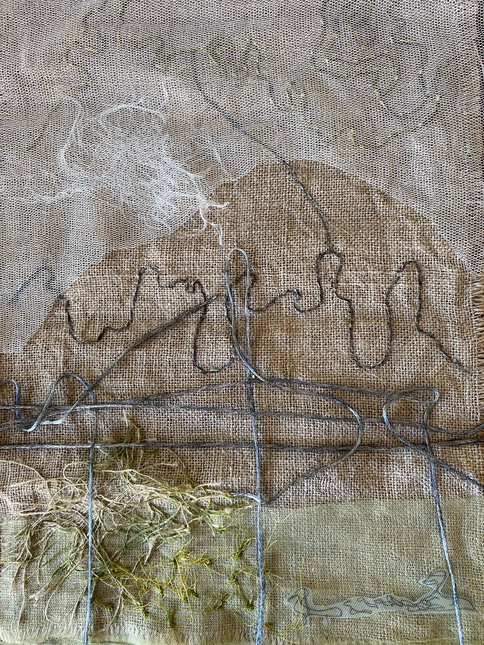
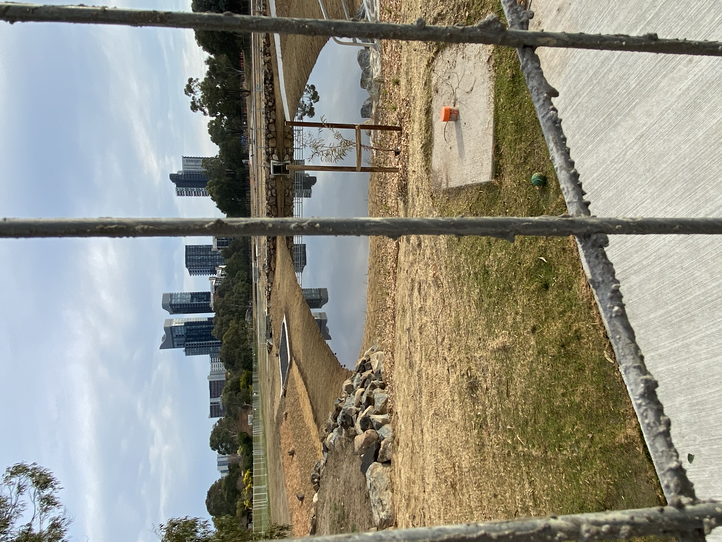
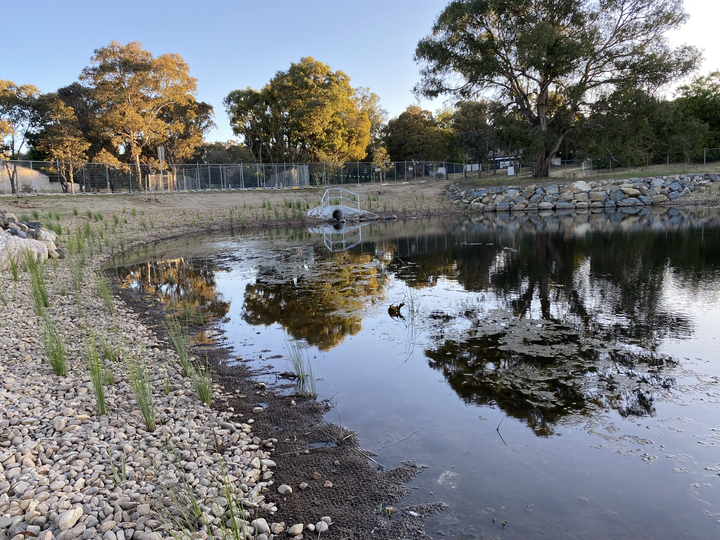
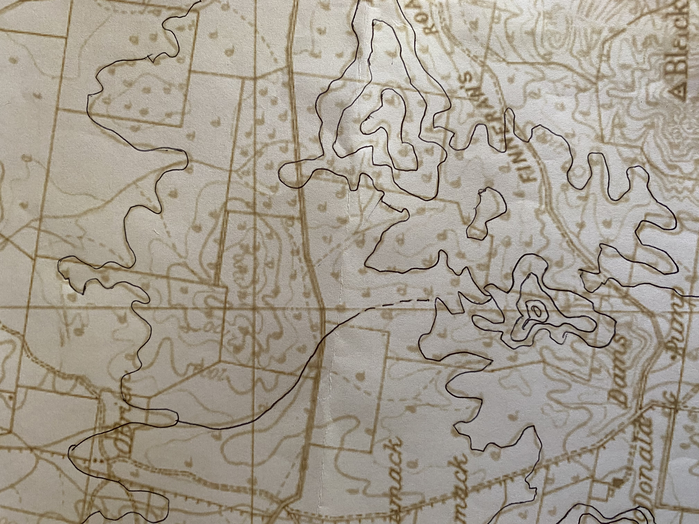
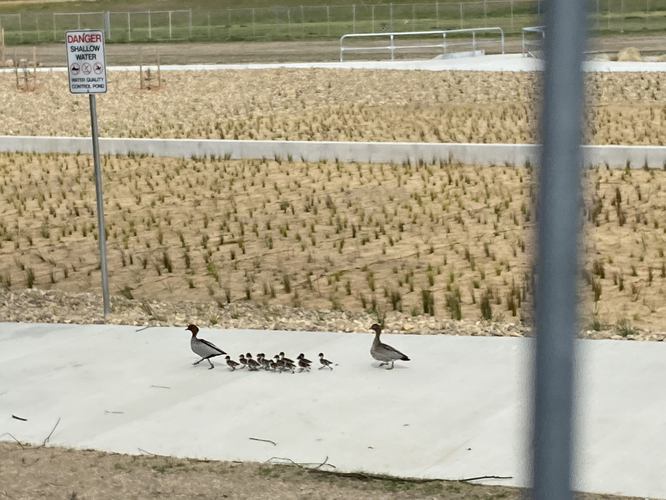
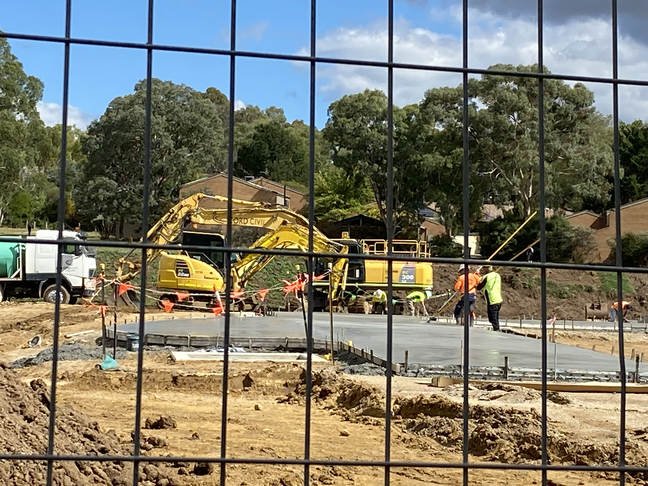
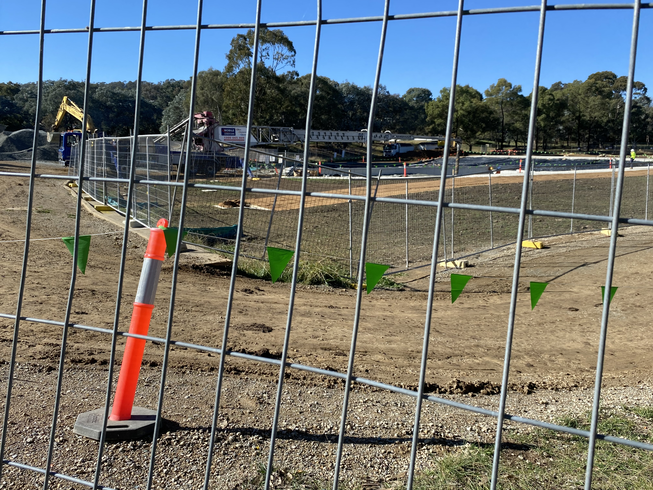
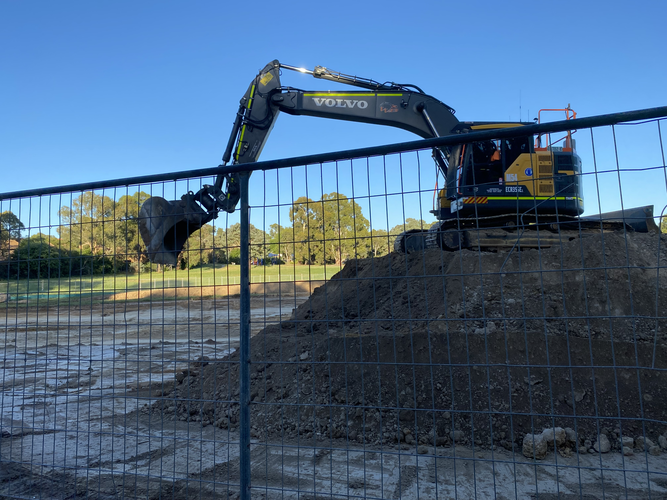
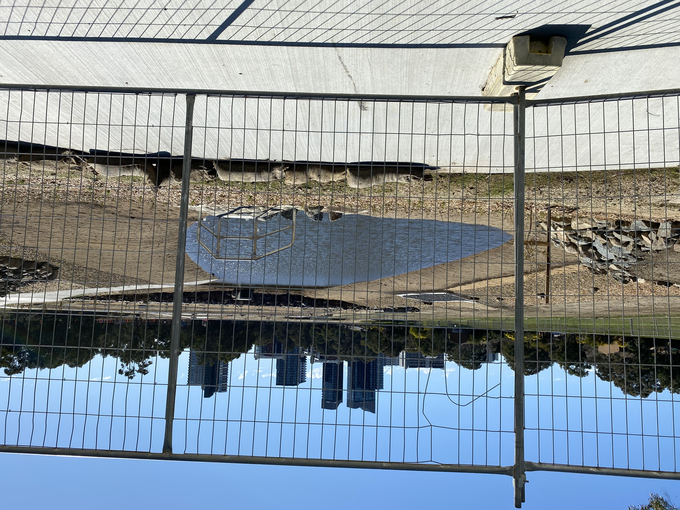
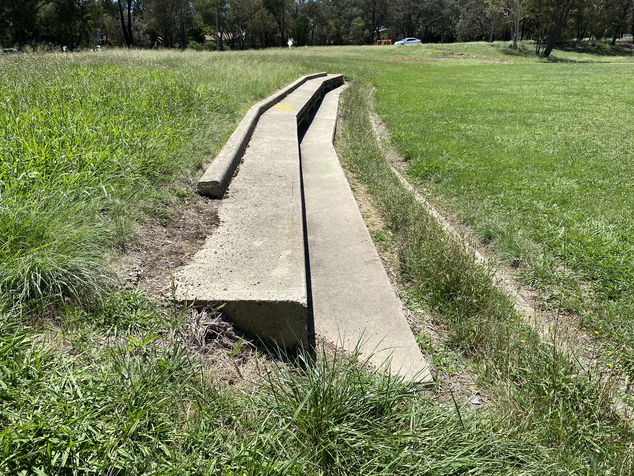
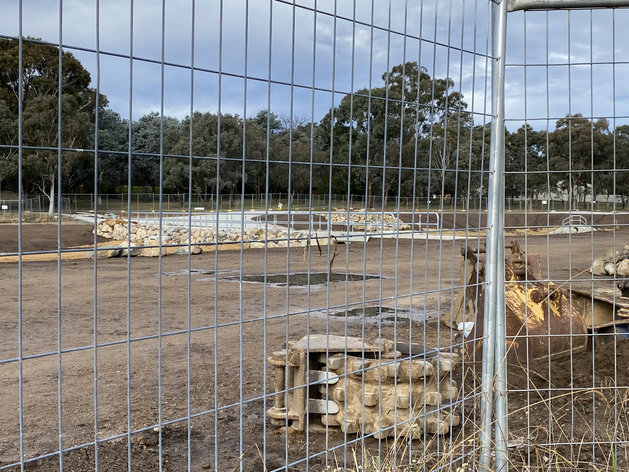
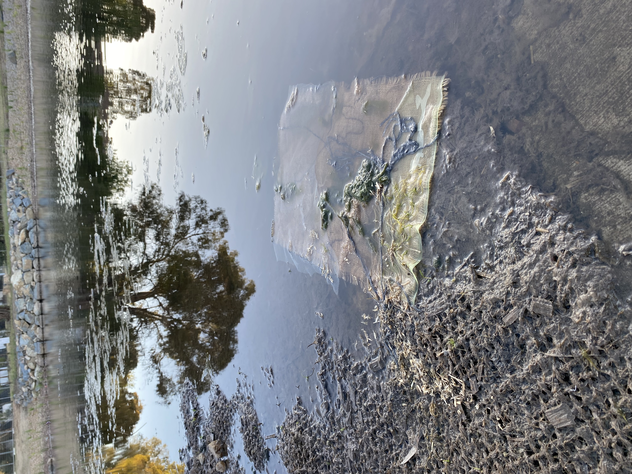
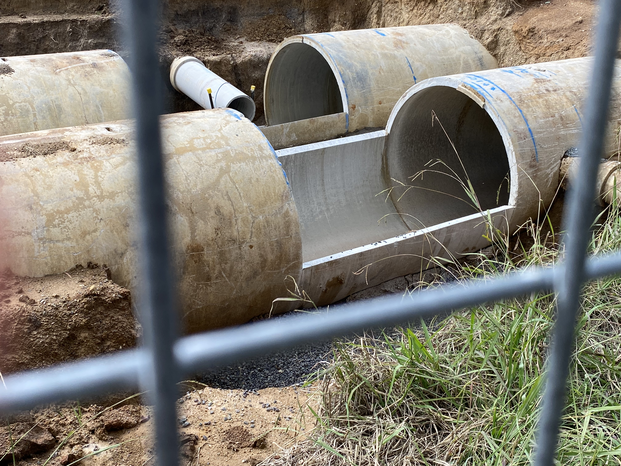
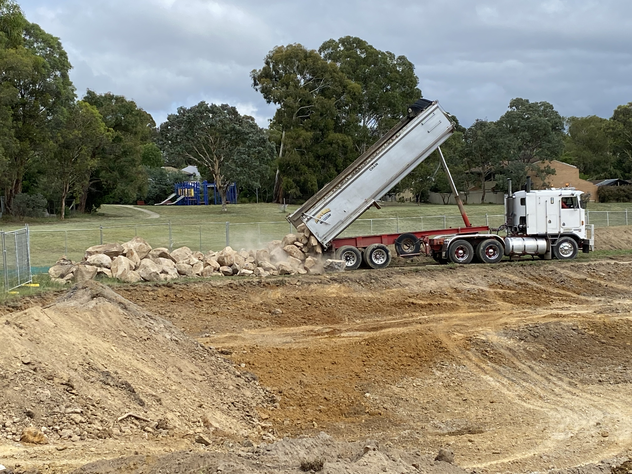
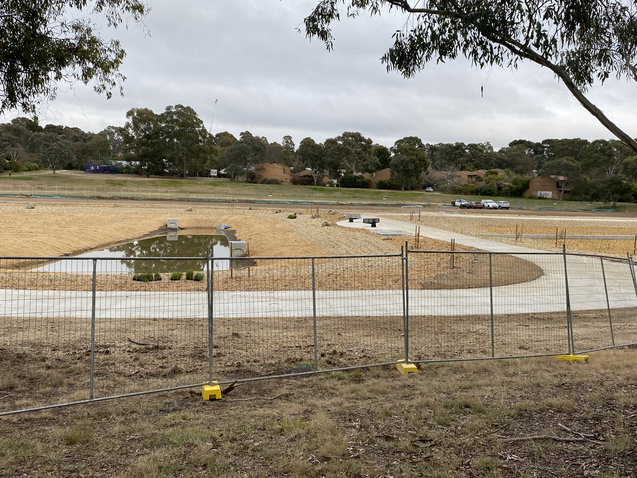
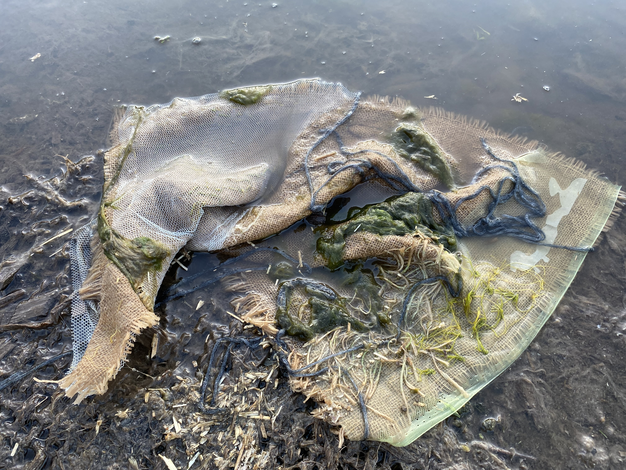
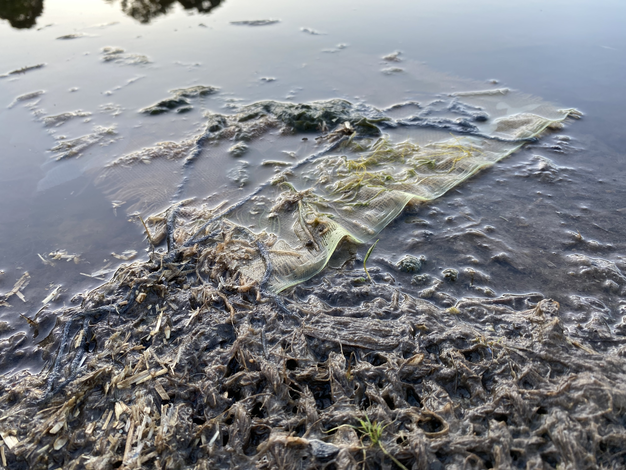
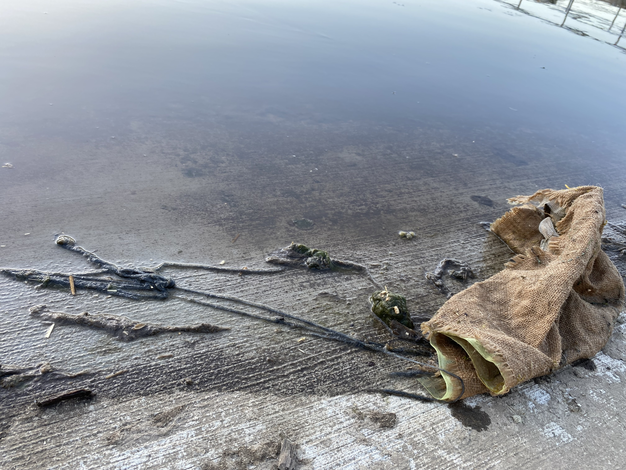
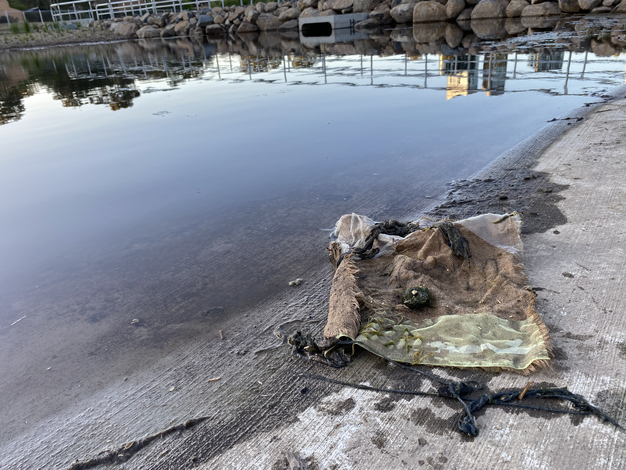
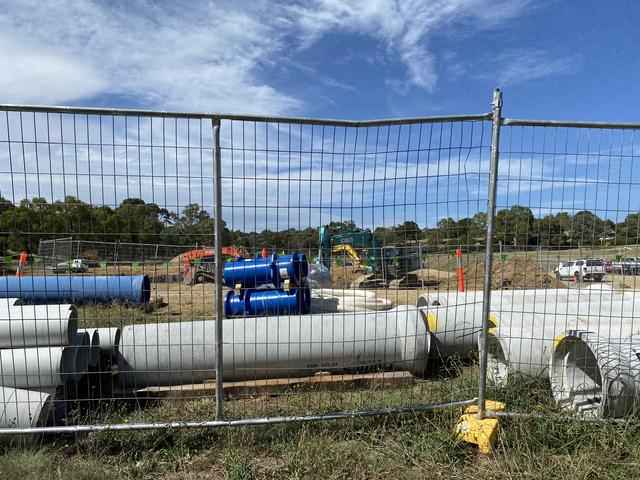
The storm water drain used to be Emu Creek, a small tributary to the Murrumbidgee River. Forty years ago its waters were channeled into an underground storm water drain feeding into Lake Ginninderra in the Australian Capital Territory. Now, the waters are back above ground again, seeping through the stormwater filtration ponds on Belconnen oval near Affrica's house.