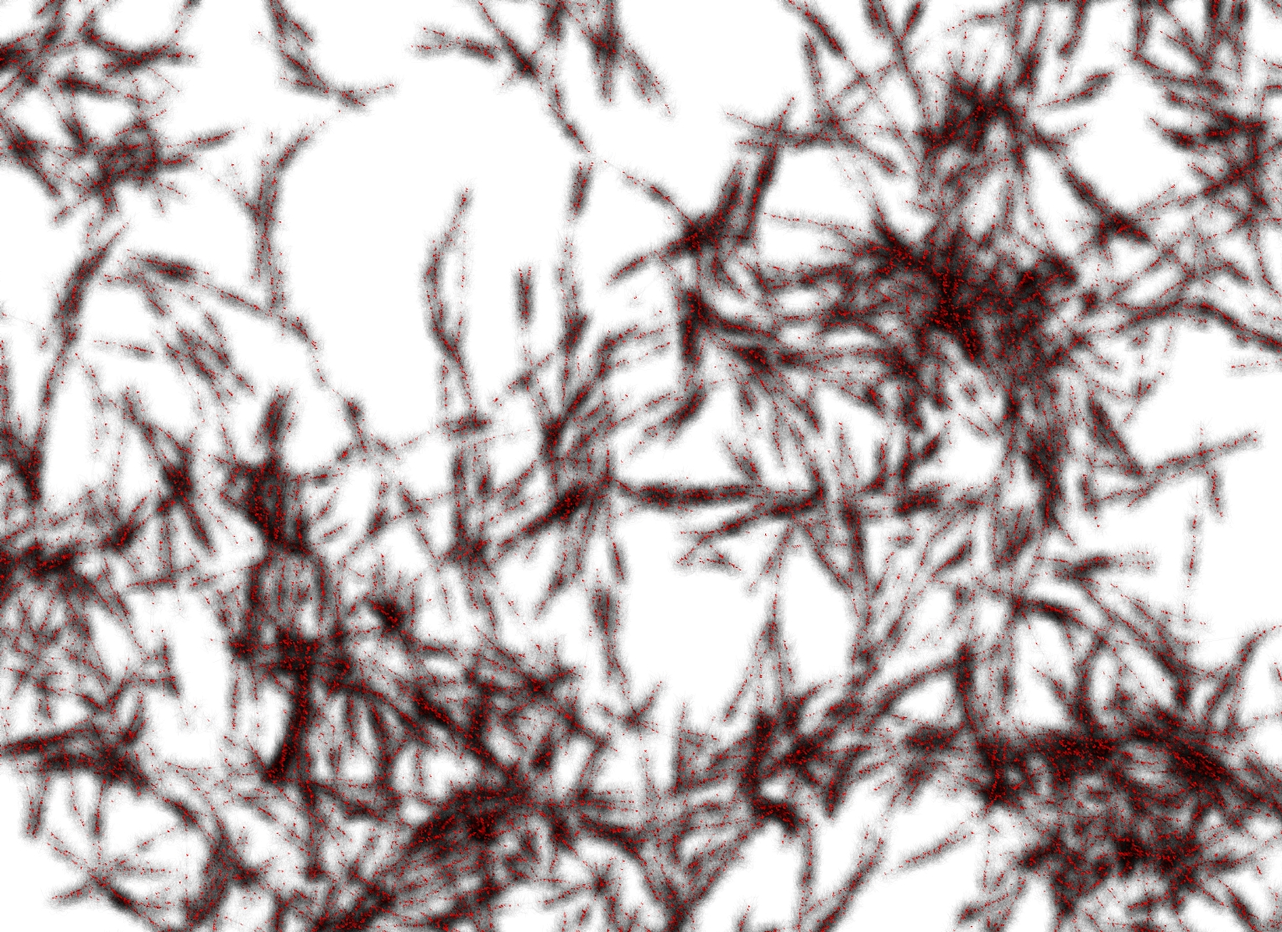
Sybaritic, the tarantula swings fly wings and beetle shells on its skeletal web. Once the sunlight has filtered through, the web on the ground is a polygon containing various triangles and curious gothic arches. Without a shout, without anger, the voluptuousness of the voracious spider adds angles and lines to the web of geometric lines that its shadow moves across the dust. Lepidoptera and chrysalises, dragonflies and termites, in the warp they find a metamorphosis that won't be the last, nothing is final in nature, living or deceased, alive or dead. The slight rustle of the web denounces the lust of the beast and the late afternoon breeze, which will take with it the idol on the ground but not the prototype in the corner and its dangers.
- contents
-
navigation
-
abstract
Throughout our artistic and artistic-research collaboration, we explore strategies to reflect on the experience of writing and drawing. Gestalt psychology often focuses on sensory phenomena, particularly in visual arts, which provide ample opportunities to test our Gestalt-forming abilities. However, much less attention has been given to Gestalt formation in linguistic media such as poetry, literature, or drama. The Gestalt potential of texts is vast, especially when we consider elements of form and rhetorical devices like alliteration, repetition, and metaphor (Bakhtin, 1991). These features structure language in ways that guide our perception of coherence and unity, echoing the principles of Gestalt in visual arts. In linguistic media, alliteration and repetition create rhythmic patterns similar to visual symmetry, while metaphor allows readers to form holistic images by linking disparate ideas. When reading a text, we assemble fragments of meaning, tone, and structure into a cohesive whole, much like how we organize visual elements into recognizable patterns. This active process shows that Gestalt principles can shape our understanding of both images and language. In our work, we experiment with micro-narratives paired with visual objects (Davis, Essays One, 2019) (Davis, Essays Two, 2021) to illustrate how each medium enhances the other. Text can illuminate visual objects, providing context and shaping interpretation, while visuals can add depth to text, grounding abstract concepts. A visual object might seem fragmented in isolation but gains coherence when accompanied by narrative. Conversely, a text’s impact is heightened by a visual that anchors or contrasts with it. This interaction taps into our brain’s innate drive for unity, revealing how text and image can mutually reinforce our Gestalt-forming abilities. The “hostile surfaces” of text and image create a tension that compels us to find connections, enriching our engagement with both (Jameson, 2024). Each medium acts as a Gestalt anchor, drawing out layers of meaning that would be inaccessible if each stood alone. REFERENCES: Bakhtin, M. (1991). The dialogic imagination: Four essays by M. Bakhtin. Austin: University of Texas Press. Davis, L. (2019). Essays One. New York: Farrar, Straus and Giroux. Davis, L. (2021). Essays Two. New York: Farrar, Straus and Giroux. Jameson, F. (2024). Mimesis, Expression, Construction: Fredric Jameson's Seminar on Aesthetic Theory. (O. Esanu, Ed.) London: Watkins Media Limited.
- Alexandra Abranches, Pedro Alegria - Hostile Surfaces - 2024
- Meta
- Comments
- Terms