Close to the place I stay when I’m in Athens, there is a branch of maybe the most popular coffee roasteries in Greece. They maintain their family business but have sold part of their commercial brand to nestle, so I thought they would be a good start for a discussion on coffee and empire. So I contacted them asking for a short meeting, explaining the context. But they didn’t reply to my email and, when I sent a second one, they declined my request. Luckily, Nikos loves exploring the city and discovering its hidden treasures. He said, “Why not ask at the Misseyiannis roastery?”. And I did, without knowing much about it and its history at that time. It is an old, highly authentic and low-profile family-ran coffee roastery in the center of Athens, with no commercial campaigns. I later learned that, among its customers, artists, scholars and politicians have been ordering their special blends there since 1914. Today it is the only roastery in Athens to receive small quantities of (the limited due to Empire) Yemeni and Cuban coffees.
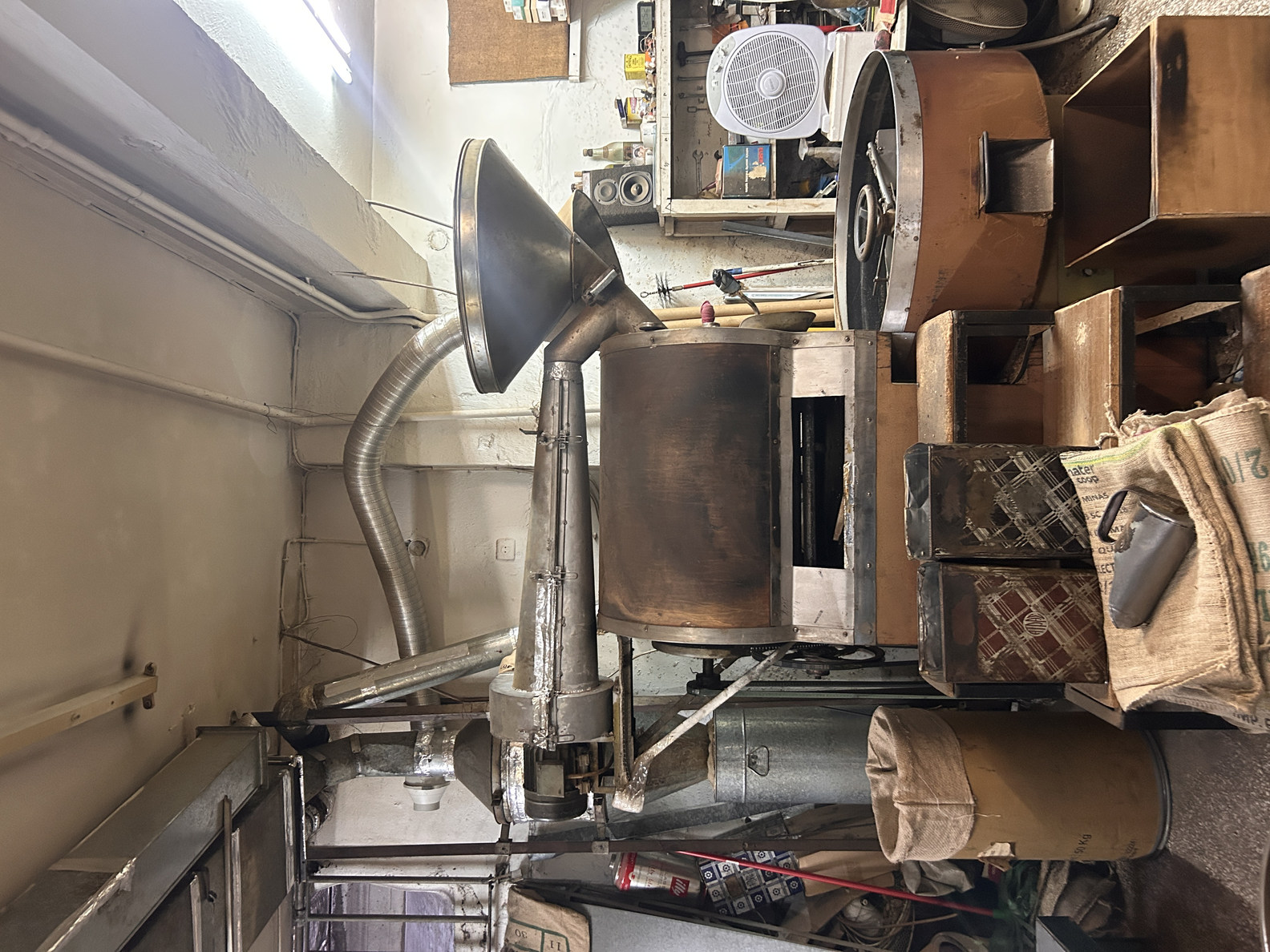
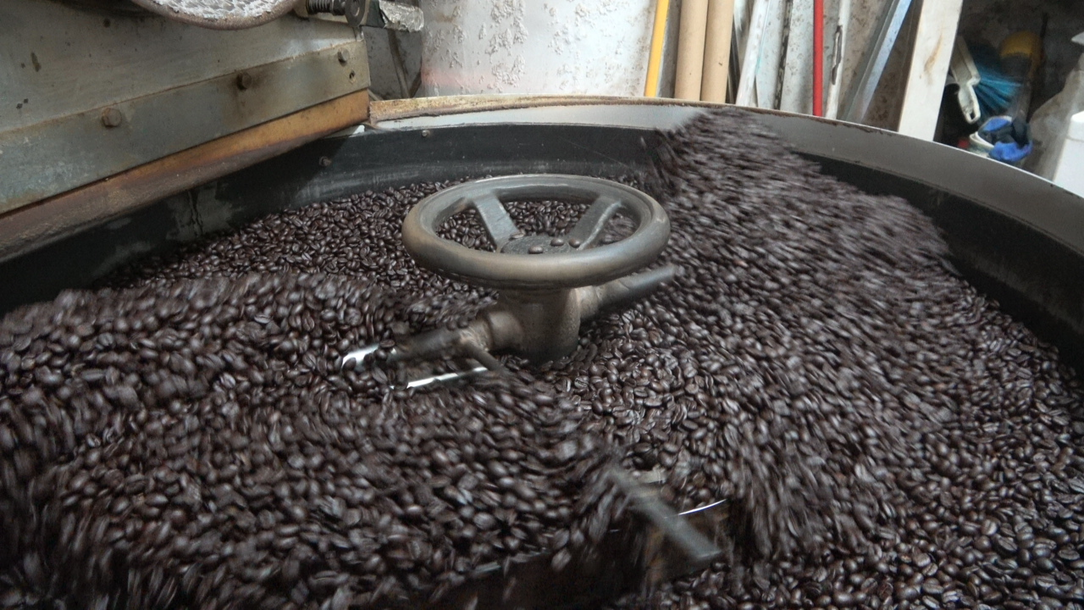
In my first visit, I met Thanasis and Vasilis, who have been working in the roastery since 1999 and 2012 respectively. They warmly welcomed us and my proposal, and the day after I met Mr Giorgos Misseyiannis, grandson of the first owner who had the same name. We had a short discussion on his Nameday, the 23rd of April, amidst numerous phone calls and gentle interruptions from people passing by and entering briefly to wish him, notifications for online orders, the sound of coffee roasting that Thanasis was performing in the basement and that of coffee grinding by Vasilis, who was caring for clients’ orders.
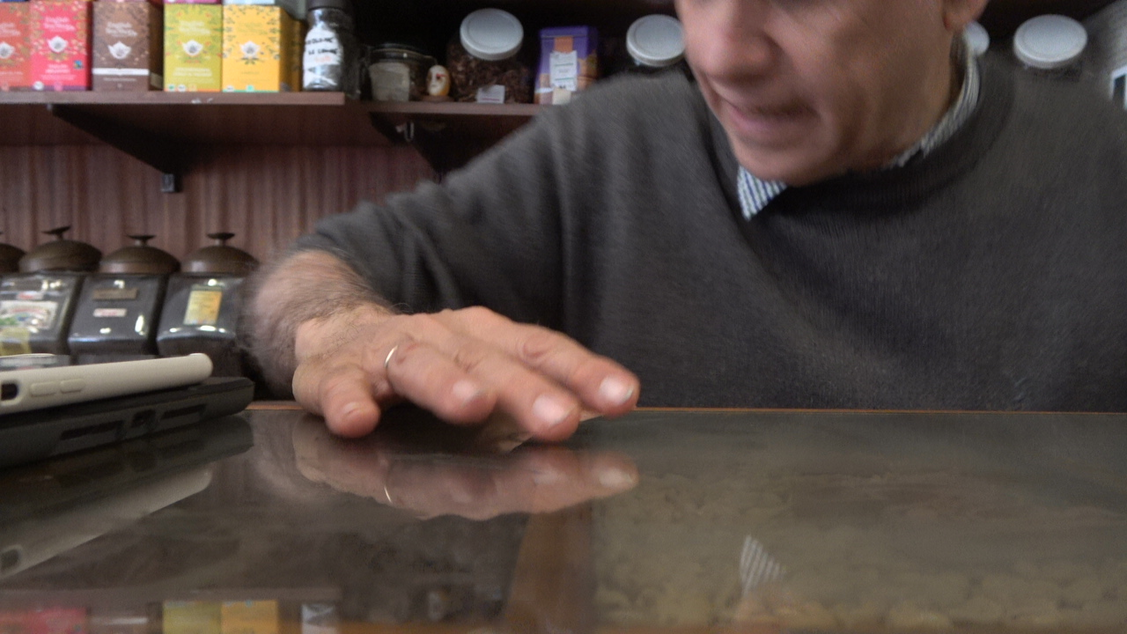
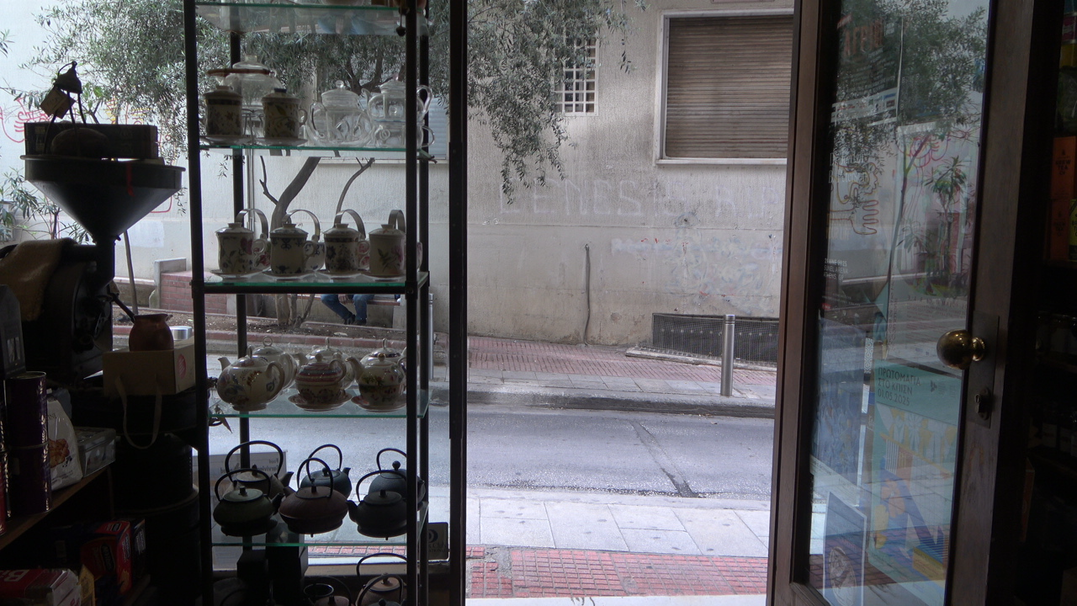
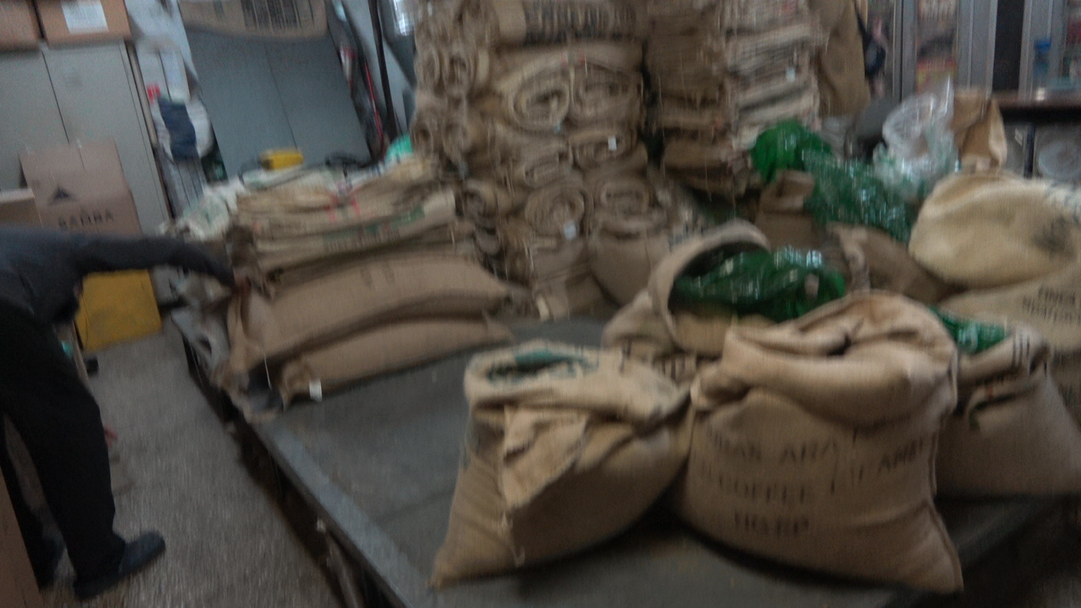
In spite of the imperial violence we witness daily in its multiple manifestations, despite the acknowledgement that too much blood surrounds (and) this “magical” cherry and the transcontinental colonialism, disguising, misleading, escalating, it felt honestly soothing to be inside this small shop where time has slowed down, where people spend part of their days together, sharing their own rituals with honesty, respect and care for each other. It felt like paricipating in small acts of resistance in times of constant and cruel change.
ES: I’m interested in the rituals surrounding this beverage, also in relation to the violence that exists around it, which we in principle don't perceive as consumers. I mean we don’t think about this every morning when preparing our coffee; that it started with(in) an empire, the Ottoman Empire, or the way it spread, passing, into the British Empire, through slavery, the displacement of people and cultures, up until today's situation.
GM: Also during Dutch colonialism, because the Dutch played a major role in the spread of coffee cultivation. And the French Empire too. These empires played a role in the dissemination of coffee. And let's not forget the Portuguese. When coffee finally arrived in Brazil, it was still under Portuguese control.
Coffee was discovered in Ethiopia. To be honest, I don't know if Ethiopia in the 15th century belonged to any empire. Ethiopia was often dependent on the Italians, but there wasn't an Italian empire at that time. Later, certainly, a large number of the first coffee consumers were Arabs. The Arabs then belonged to the Ottoman Empire — all of Arabia and of course Yemen, that produced coffee. Other areas of Arabia may not have produced, but they consumed it. The Arabs were the first to start drinking coffee. Through them, it spread to all regions of the Ottoman Empire, to Byzantium and Constantinople. Through this route, the Greeks also came to know it.
Although the Turks — meaning the people living in what is now Turkey — did drink coffee, they were not the most fervent, passionate coffee drinkers, especially if we speak about Eastern Turkey.
And exactly because it was an empire back then, and the Greeks came to know coffee through the Turks, that's why it was called “Turkish coffee.” And this name became internationally established — "Turkish coffee" — because its consumption began and spread through the Ottoman Empire. However, the Ottoman Empire was not a nation-state; it was multinational. It remained that way even after the Greek Revolution, essentially until the early 20th century, when it became a nation-state under Kemal Atatürk.
So Turks, if we can even speak of a "Turkish ethnicity," were not the most fervent coffee enthusiasts, but the empire was the space that allowed coffee consumption to flourish. And as a ritual, of course, even cup reading (fortune-telling) seems to have its roots there.
Among the regions of the empire, the most passionate coffee drinkers were the Lebanese and the Syrians. They drink black coffee infused with spices. The Egyptians, similarly. Meanwhile, in Saudi Arabia, from what I've heard, they drink a lighter coffee in a large cup, usually accompanied by a date. Yes, I’ve heard that from people who have traveled to Saudi Arabia and seen how the ritual is performed today. In contrast, as we said, the Mediterranean Arabs — the Lebanese, the Syrians — drink it in small cups, strong, often flavored with cardamom.
Europe came to know coffee through various channels. One of them, as they say, was after the siege of Vienna ended, when the Ottomans retreated and left behind some of their supplies. That’s how Austria developed its coffee tradition and the Viennese coffee house culture we know. Another way was through diplomatic channels — gifts from the Sultan to the King of France, and thus the French got to know coffee. And of course, the Dutch played their part too, being commercially minded; they took seeds and cultivated coffee in their colonies, mainly in Indonesia. That’s why the spread of coffee cultivation first went east — to India and Indonesia — and later to the West with what they call "discovery," meaning the colonization and conquest of the Americas by Europeans. Later, the French and Dutch cultivated coffee in their Caribbean colonies, starting, I believe, with Martinique.
There’s a legend about how coffee cultivation started in Brazil: the Brazilian ambassador in French Guiana supposedly had a love affair with the governor’s wife, who helped him "steal" coffee seeds and transfer them to Brazil, thus beginning Brazil’s coffee cultivation. Today, Brazil is, by far, the largest coffee-producing country in the world, even though it was one of the last to be introduced to coffee chronologically.
ES: Yes, and that brings us to today, where we go out for a coffee and don’t even think about the fact that it comes from the other side of the world and has undergone such a long journey.
GM: Yes. And now coffee has names that are a bit misleading — French coffee, Italian coffee, Greek coffee, American coffee. There’s no such coffee, meaning none is actually cultivated in France, Italy, Greece, or America — by "America" they mean the USA. Although, regarding the US, there’s an asterisk: coffee is cultivated in Hawaii, which is a US state. But in the continental US, coffee isn’t cultivated. Nor in Germany, of course, where they call it "German coffee," so the names are a little misleading. They refer to the method of preparation and consumption, not to the country of production.
ES: And the appropriation of a foreign product.
GM: Exactly, yes. Today we ask: is coffee Greek or Turkish? It obviously refers to the preparation method, but neither Greece nor Turkey actually produces coffee nowadays. At least modern Turkey doesn’t. In the old Ottoman territories, yes, there was production, but now there isn't.
ES: And beyond these traditions, beyond fortune-telling and talking about the future — where you spend all this time drinking your coffee and then reading the grounds — coffee is also heavily used in mourning, funerals, and memorials in all these areas that once belonged to the Ottoman Empire.
GM: Yes, yes, the so-called "coffee of consolation." It's very characteristic. It’s a means by which we participate in mourning. We remember those who have passed away.
Yes, Greek-style coffee in a small cup is a simple, modest drink. This simplicity, this austerity, reminds one of mourning clothes — the black we wear when we grieve. So it fits this sense of grief perfectly with its Doric, austere character.
ES: And the empowerment of a community, I think, both in mourning and in cup reading.
GM: Yes, that too. Both for the future and the past — sitting together, helping each other, participating collectively in mourning, sharing it.
We are at the final step before coffee becomes ready for preparation and consumption. We are processing the coffee from its raw form — it’s cleaned but raw — to the stage where it is roasted properly. Roasting is actually the most crucial processing stage. You start from something you wouldn’t imagine consuming — a greenish-yellow bean — and you end up with a black bean that you could even chew, it has taste. Then you grind it, etc. Roasting is the essential work, an art in itself. We do this process so that someone can take the coffee and prepare it fresh.
ES: Beyond family tradition and continuing it, what attracted you and keeps you in this work?
GM: What drew me was the magic of the product itself. Something you consume, drink, and it immediately changes your mood — that’s rare. There are very few foods or drinks that have such a strong, immediate effect. They make you functional when you weren’t, social when you weren’t. Well, alcohol too, but coffee is magical. So this magic is what attracted me. And secondly, the human connection through the product. A coffee roastery has a sociality that, say, a fruit store doesn’t have. There’s a relationship with people. And it’s a relationship that’s been built since 1914 with my grandfather. I took over the shop in 1997, so it had already been there 85 years. That relationship was built over decades.
People would come here not only to buy but also to chat. If you didn’t exchange a few words, what was the point? That’s the process. And I liked it. It suited my life, my character, what I wanted. It’s a personal relationship. It also demands a little initiative from the final consumer, the one preparing the coffee. This is true for Greek coffee in the briki and also for espresso. It’s a little ritual one does every morning, and we prepare their favorite blend for them. Only the capsules require no personal touch — and let’s not even mention the pollution they leave behind.
There are regulars who pass by and, before they even enter, their blend is already being prepared. They don't even need to order. We’ll talk about other things, not about the order — because we know it already. “The usual,” as they say.
In the old coffeehouses, they drank coffee made in the briki, the Greek style, and there were many different recipes. In the old coffee shops, they only drank this coffee cooked in the briki, the Greek way. There were so many recipes, so many different recipes, how many spoonfuls of coffee, how much sugar, how long to boil it, whether to serve it in a cup from a height, how many bubbles. There was a whole culture surrounding this 25 ml drink, and the càfètzi knew every recipe for every customer. Everyone wanted it their own way.
ES: For me it is also indicative that Thanasis and Vasilis have been working here for many years.
GM: That's how we all are, we generally like stability. In our profession, the coffee channel has not changed significantly with technology. When the coffee business generally took off in Greece, there were some importers who basically brought in coffee. Specialized importers who are still in business.
What has changed is that small coffee shops have become fewer and many large companies with central processing units have opened. In the 1960s and 1970s, there were many small businesses like ours. Now there are also industrial companies.
But the way we receive coffee beans hasn't changed much. Neither has communication or contact. We still have personal contact. We are one of the oldest, they know us from way back. Phone calls, market trends, what's going on, how are we doing, what are we getting, what are we not getting, etc.
ES: That's another interesting point. Who determines market trends? How does robusta become so fashionable at a certain time and why does it happen?
GM: Well, that's a matter of advertising. We don't influence the market, we're not big enough to influence it. We follow it. But through our personal contacts, we can offer advice and express our opinion. Now, for example, why robusta becomes popular at a certain point is a matter of advertising. Apropos, I was watching a Belgian film yesterday, and the main character drinks coffee and says, "Robusta! What do the intellectuals tell us? They say that Arabica is better, but this is real coffee." That's the logic of Nescafé. Because Nescafé is Robusta: drink something that's like gunpowder to perk you up. For me, that's not what I'm looking for.
We're Arabica people.