The current approach to generative AI in music (and AI in general) treats the world as if it were a computer: models trained on vast datasets in massive data centres with an enormous carbon footprint, producing simulations and representations of the real world (e.g. songs) that often still remain inferior to the original human output. This ‘more is less’ approach stands in a stark contrast to the original idea and fascination of generative systems in art and music[1]: that with only a few kilobytes of data and a small set of rules you could produce rather complex results, often far exceeding human output (a classic example of this being John Conway's cellular automaton The Game of Life). This ‘less is more’ approach (e.g. Symbolic AI) treated computers like they were part of the world, embedded in a greater ecosystem of human and more-than-human intelligences and cultures, great at executing certain things (calculating numbers, generating novelty) and not others (substituting artists, imitating life). This was of course mostly out of necessity, as computers were nowhere near as powerful and ‘intelligent’ as they are now, yet this less-is-more idea contained something far more potential, which the current AI development is only now beginning to grasp: computers as agential systems in greater networks of things, not models of the networks themselves.
It is in this regard that a broader, more relational and ecological (and less anthropocentric and technocentric) approach to artificial intelligence – such as in the work of artist, writer, and technologist James Bridle, known particularly for their work situating AI in greater ecological context[2] – is becoming increasingly relevant. It is this meshing of intelligences – environmental, human, artificial – that is of great interest also to my own work: a creative ecosystem where AI is only one of the actants in a more complex network of creative agencies; a tool operating in the background, not a monolith dominating a landscape. If all intelligence is ecological – entangled, relational, and of the world – and arising from interrelationships[3], as Bridle proposes, then there is no need to separate one form of intelligence (AI) from the rest of the world and regard it as ‘artificial’; instead of attempting to dominate the world by making abstract remote models of it, AI could become more like our “omnipresent, efflorescent and entangled” world, enmeshed in it, thus enabling us to better understand, relate to and coevolve with all the more-than-human intelligences populating the planet (2022).
In this essay, I will examine the challenges of generative AI in composing ‘new’ music. My focus will be on the commercial generative AI applications (AI music generators), as the hype and discourse (not to mention venture capital) surrounding ‘musical AI’ has largely centred around the development and use of such platforms. This is particularly true in the field of popular (electronic) music – my musical background – as well as those of computer science and the technology industry, where optimisation and reproducibility have been the key drivers for creativity – and for the concept of music.
My aim is to question this aesthetic. In this sense, my approach here will be philosophical rather than technological, situating the generative AI in music within a broader societal, cultural and environmental context. If AI and music (understood as normative practices) are majoritarian, molar and arborescent entities, then my approach will be Deleuzian: minoritarian, molecular and rhizomatic. By engaging with their fault lines, disassembling and reassembling their structures, and connecting them to the wider world, I aim to present an alternative way of thinking about AI and music – and AI in music – while proposing a possible future application.
The text is based on an unpublished (and unfinished) essay I wrote about AI and music in 2018, when the first commercial AI-generated pop albums appeared. I have revised the beginning of the original essay here (the first four paragraphs of the main chapter), as the reflections those albums generated at the time on the notion of creativity, originality and musicality as well as artistic practice are similar to those being debated in related academic and artistic discussions today; they also inform my current and future research-based artistic practice in the more transdisciplinary field of AI, music (world/global, electronic/experimental, contemporary/generative), sound art and sciences. By bringing the original essay to conclusion here, I intend to close this particular discussion and chapter in my life, that of popular (electronic) music and commercial AI music applications, and open up space for new possible musics, concepts and intelligent systems in art – new possible futures!
As my musical practice itself has always been one of reorientation toward the world and beyond the insular systems of music theory, technology and establishment/industry (Jauhiainen, 2019), my attempt to relocate the musical application of AI to the greater environment surrounding the computer, outside its (black) box of algorithmic models and training datasets, follows a similar path of reorientation – a line of flight to the outside and the cosmic, if you will, from majoritarian and molar structures and toward minoritarian and molecular becomings (see Deleuze & Guattari, 2004; Thornton, 2018). As Bridle contemplates, perhaps the issue with artificial intelligence has been that “we have been trying to entrap a brain within the machine, when the real brain – the oracle – is outside. The oracle is the world” (2022, Non-Binary Machines, para. 54), adding that “we’ve got everything inside out. We think all the activity is on the inside … but the real action is out in the world. That’s where everything arises and intra-acts” (2022, Non-Binary Machines, para. 54). And it is this oracle, both in a mythological and technological sense[4], that I shall be seeking in relation to AI-generated music; similarly, it is the intra-actions between various AI and environmental actants in regard to music composition that I shall be exploring and mapping in my research.
This essay introduces ‘a becoming-problem of the solution’ part of my research, and it will be revised as one of the chapters for my dissertation. A subsequent part, ‘a becoming-solution of the problem’[5], will be covered in the succeeding chapters of the dissertation: this will also include the ontological treatment of my research, incorporating discourses such as Assemblage Theory (e.g. Manuel DeLanda, Gilles Deleuze), Hyperobjects (Timothy Morton) and New Materialism/Posthumanism (Karen Barad, Rosi Braidotti) into the discussion. Similarly, my artistic work utilising the practical application of AI in music, as conceptually outlined here, will be presented, analysed and discussed in my dissertation only and not in this essay.
[4] Historically and mythologically, an oracle refers to an agency considered to provide wise and insightful counsel or prophetic predictions; computationally and technologically, it refers to a subroutine or a function that can solve a specific problem or access information in a way that is not directly accessible to the algorithm using it.
“What future is being imagined here? And what intelligence is at work?” (Bridle, 2022, Introduction, para. 16)
“The world is not like a computer. Computers – like us, like plants and animals, like clouds and seas – are like the world.” (Bridle, 2022, Non-Binary Machines, para. 20)
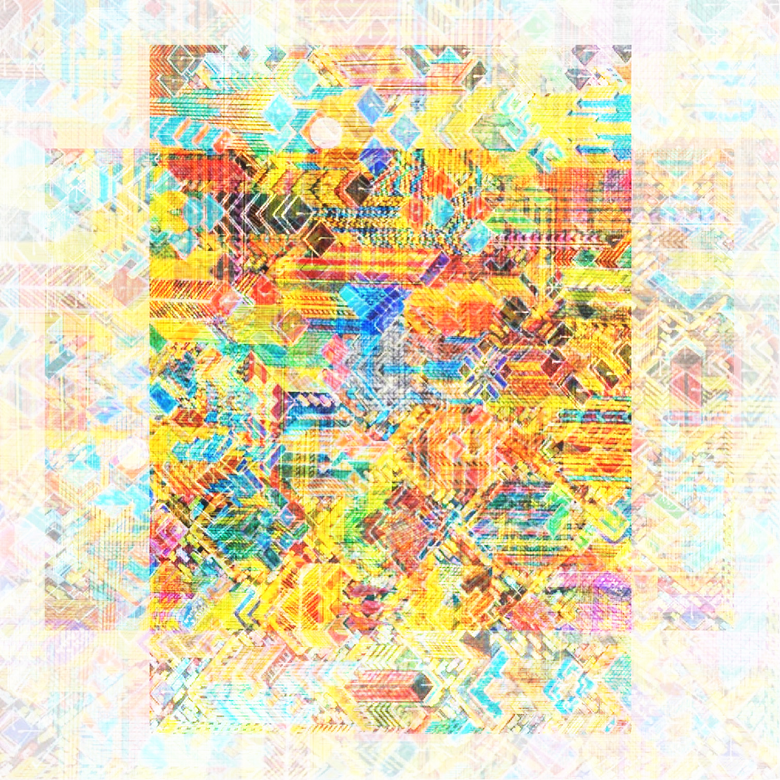
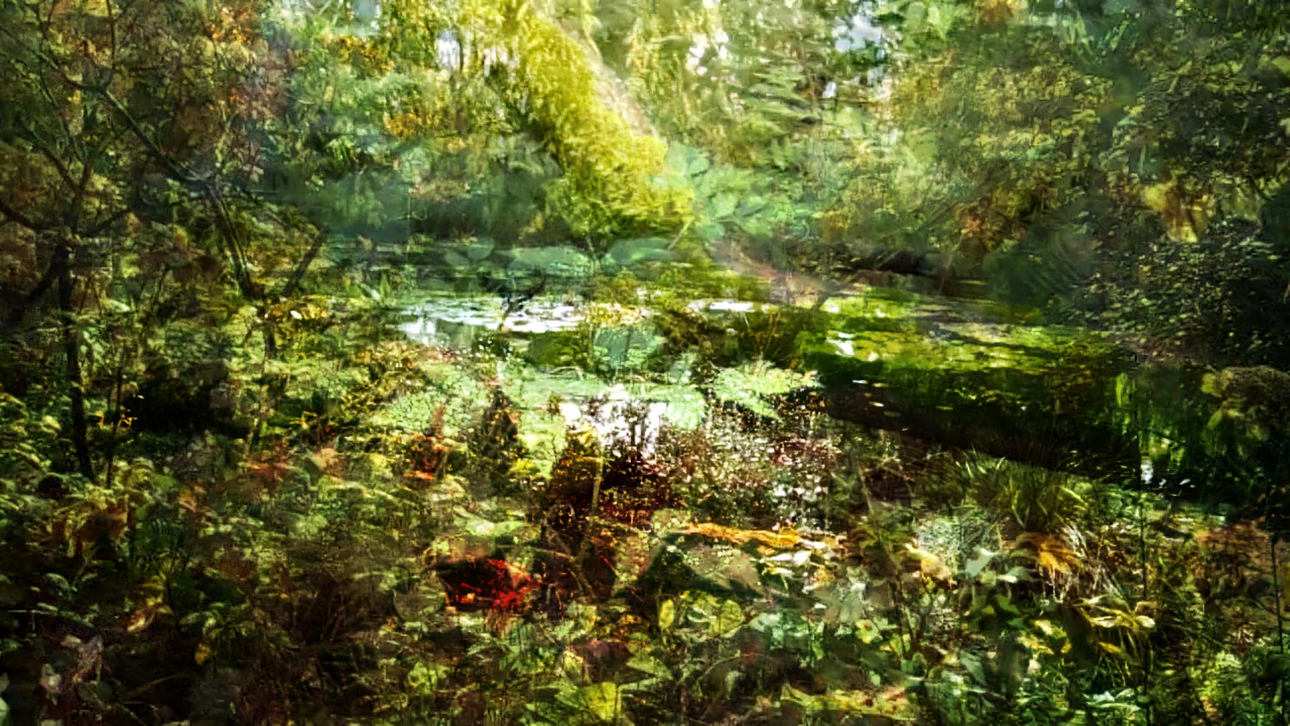
Terrestrial I (2023).
A visualisation for a site-specific algorithmic and environmental composition, performed at Vakiopaine, Jyväskylä FI, 9 September 2023.
Artwork by Ilpo Jauhiainen
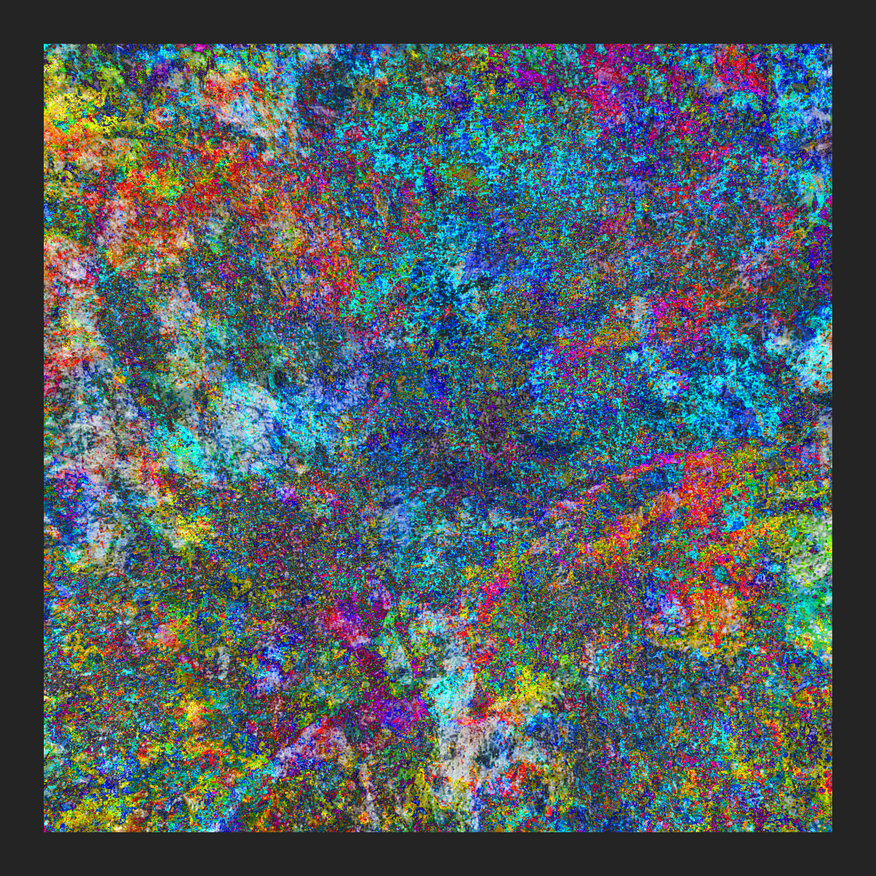
Geomusics I - III (2022).
A proposal for a generative environmental composition / musical system / sound and light installation.
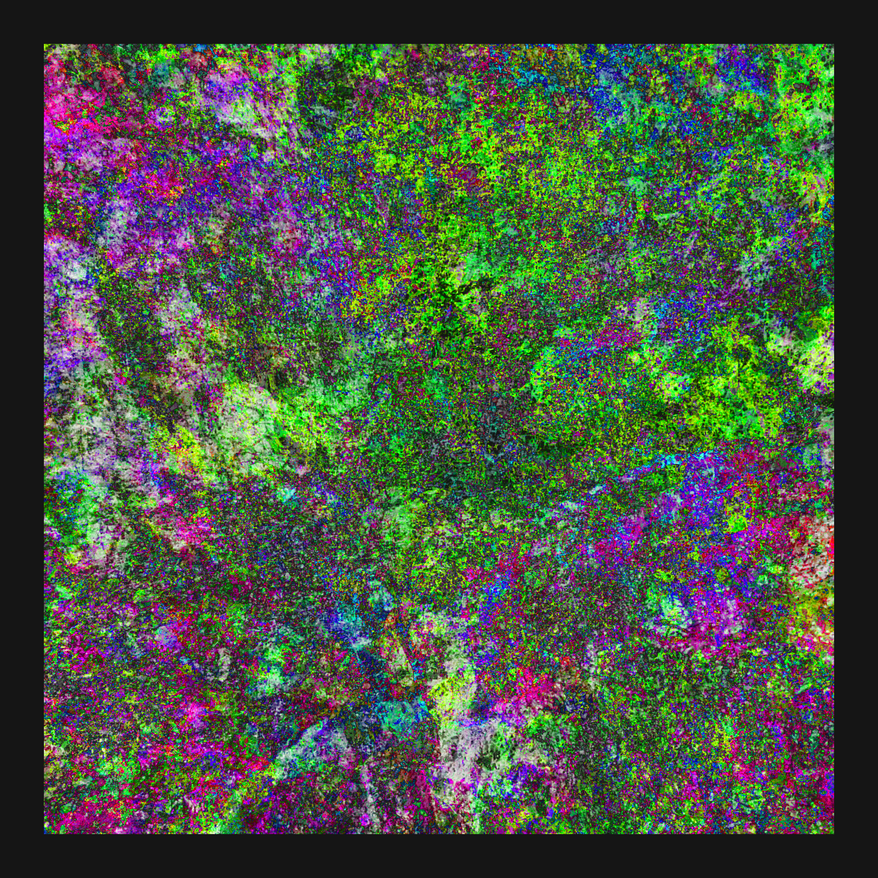
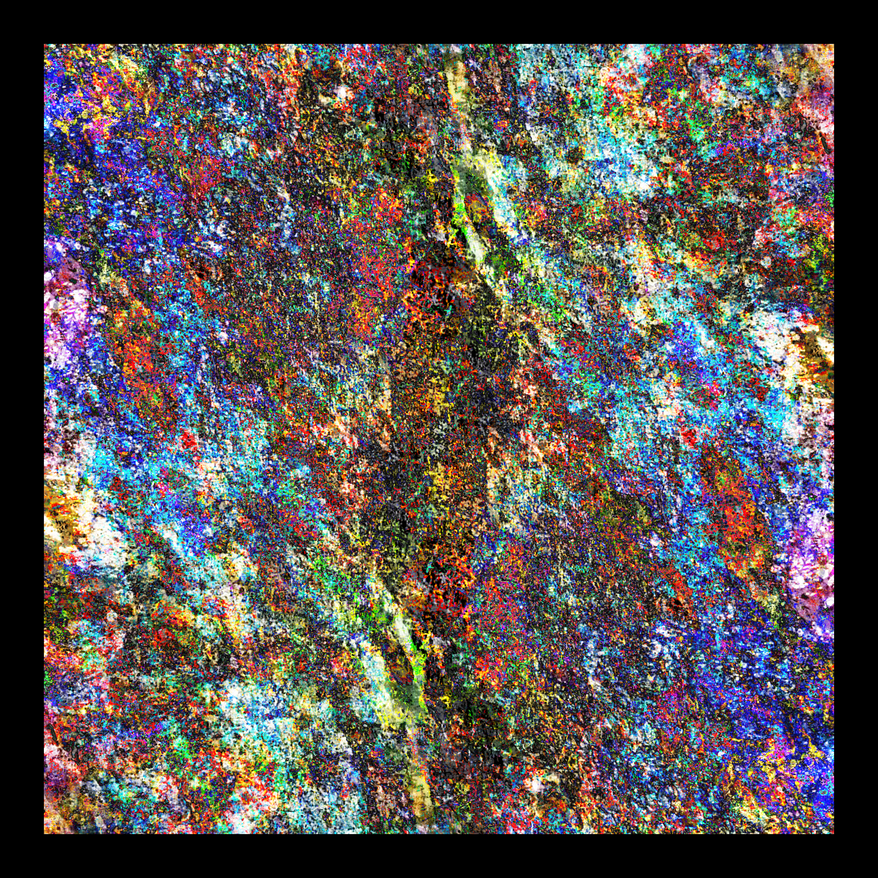
The images are made entirely of two photographs that I took in Marseille, France, in July 2021: one of a seabed by the harbour in Niolon, the other of a pine tree in a square in Le Panier neighbourhood. The composition, texture and the ensuing complexity of the images arise from those of the environment, of the two superimposed photographs, with only some additional colour grading by me. This is analogous to my approach to generative music and site-specific sound installations, in which the work is often derived from a given environment. In the past, this has often included the use of symbolic AI (e.g. probabilistic algorithms operating stochastic, procedural and rule-determined transformation processes); in the future, this will be realised with the help of a more advanced generative AI.
Artwork by Ilpo Jauhiainen