This exposition is published in the Proceedings of the 1st symposium Forum Artistic Research: listen for beginnings.
How to Facilitate Careful Listening and Non-Coercive Participation in Artistic Research?
LED Tickers and Love Letter Writing as Research Tools
Joonas Lahtinen
In this contribution based on my lecture performance at the symposium Listen for Beginnings, I introduce and outline possibilities that LED ticker displays and love letter writing can offer for facilitating careful listening and non-coercive participation in artistic research, and in research-driven artistic practice. My focus is on two projects that I was part of, in different yet cross-pollinating roles: as an advisor and collaborator in the artistic research project TACTICS for a COLLECTIVE BODY (2020–2022) led by the Belgium-based artist-researchers Renata Lamenza Epifanio and Stef Assandri at the AP Schools of Art Antwerp, and as the artist-initiator of the participatory installation LOVE LETTERS in the Kunstzelle, a former telephone booth turned into a gallery in the courtyard of the WUK cultural centre in Vienna (2023–2024). Before proceeding to discuss these projects, I briefly outline the key definitions with which I operate here: non-coercive participation, reading-as-listening, performativity of LED tickers, and the intra-active dimension of reading.
Non-coercive participation
As I have suggested elsewhere (Lahtinen 2015, 40; Lahtinen 2020, 20–22), I believe that crucial ideological currencies – such as assumptions regarding the human body and its capabilities, the senses, identity, freedom and work – and processes of exclusion and inclusion in participatory projects are not to be seen solely in their “goals” or “themes” but, often even more clearly, in the modes of participation that they employ. Each participatory project demands and rehearses specific bodily and communicative skills of the participants. Within the rationale of that project, certain skills and behavioural patterns appear as desirable by the project initiator(s), and some others as not.
The term “non-coercive participation” refers here to participatory artistic and research practices that are careful – or caring – in the sense that they leave room for different modes or “degrees” of participation, and in that they aim to take the potential processes of exclusion and coercion rooted in the practical decisions and material circumstances regarding the devising and realization of the project into account. Non-coercive participation always requires an openness, an attempt of the project initiator to have an offer that one may or may not accept without pressure or consequences. As I will show, this approach was crucial in both projects, TACTICS for a COLLECTIVE BODY, and LOVE LETTERS in the Kunstzelle.
Reading-as-listening and the performativity of LED tickers
I operate on the premise that reading can be considered as a form of listening and attending to the text and its contents. I draw here on Michelle Boulous Walker’s view (Boulous Walker 2017, xxi–xxii, 103–126), concisely summarized by Joanne Faulkner:
To see reading as a form of listening also involves a different temporal and spatial relation to texts than reading conceived in terms only of sight. Rather than occupying a superior and separate aspect that characterises its objects as discrete, encapsulated, and a-temporal, listening receives and organises phenomena sometimes simultaneously, according to complex rhythms that can slow down and speed up experience, and which registers in the spectral “voice” of the text traces of corporeality (such as breath, timbre, mood, relation to the reader, and gender). (Faulkner 2017, 230)
While tickers can easily be viewed as non-dialogical, intrusive means of one-way communication that we often encounter, for instance, in form of public transport and stock exchange displays, I suggest that tickers can be employed to facilitate – and manifest – reading-as-listening in Boulous Walker’s sense. Tickers highlight the performative and auditive qualities of text and reading, and can make the readers aware of their reading acts as bodily processes.
An LED ticker immediately catches our attention, our eyes wander to the moving lights, to the rather simple electronic on-and-off switching of LED diodes. We cannot just ignore the ticker, it may be difficult to concentrate on anything else. Indeed, you may become more affected by the ticker machine on the video snippet below than by the sentences surrounding it. You may try to make sense of the moving graphs on the ticker, of the interstices between single alphabetical characters that our perceptual apparatus automatically joins together to build words and, thus, meaning.1
Intra-active dimension of reading
In the acts of reading, agency takes place in – or as – a spatial and temporal relation between the reader and the medium through which the text is presented. Karen Barad’s notion of intra-action can shed light on this agential entanglement. To Barad, the “notion of intra-action recognizes that distinct agencies do not precede, but rather emerge through, their intra-action […] The ‘distinct’ agencies are only distinct in a relational, not an absolute, sense, that is, agencies are only distinct in relation to their mutual entanglement; they don’t exist as individual elements.” (Barad 2007, 33) Indeed, drawing on Barad, tickers can be viewed as highlighting the intra-active character of reading that, in this context, manifests in – or as – the active entanglement of the person engaging sensorially and cognitively with the text through the LED ticker, the specific medium of communication.
Careful listening and attentive dialogue in TACTICS for a COLLECTIVE BODY
Intra-activity is also crucial to what I define here as “careful listening” and that, as I will outline below, was facilitated in the project TACTICS for a COLLECTIVE BODY. The term refers to modes of listening that are, first, attentive to the contents of what is being said, yet, importantly, also allow for and encourage the reflection of the performative and “intra-active” dimensions inherent in the acts of listening, the agential entanglement of the person who is listening, the spatial, material and auditive conditions, and the (human or other) source of the speech or sound.
The key objectives of TACTICS for a COLLECTIVE BODY relevant in the context of this article were, first, to develop novel strategies for participatory performance practice, and, second, to experiment with new collective modes of working and communicating as a research team.2 From the very beginning of the research process, I and the project initiators Renata Lamenza Epifanio and Stef Assandri – who work with performance, visual arts, costumes and textiles and, as for Lamenza Epifanio, also dance – noticed that we share a keen interest in exploring informal, non-hierarchical dialogue, and our emotionally invested, at times passionate, ways of talking about participatory art and performativity with one another. We wished to embark on an attentive research dialogue that would acknowledge and cherish the embodied, subjective and, to a degree, affective dimensions of reading, talking, and discussing.
Love letters and the use of LED tickers turned out to be crucial not only for our internal communication, but also as one of the participatory strategies used in the immersive installation and sharing event Soup Session at de Wintertuin gallery space of the Royal Academy of Fine Arts Antwerp in May 2022, and in the final presentation of the research project and its results, PPP* evening, at the het bos art venue in Antwerp in September 2022.
The idea of love letter writing came up early in our research dialogue and led us to the question: to whom, to which theorist whose texts we had been working on and debated, would we – or, each of us – like to write a love letter? And, further, might it be productive for the research process to try to write a love letter to an idea, a concept, or a form of artistic practice?
Our love letter correspondence evolved from conventional paper letters sent via post, to incorporating other materials. For instance, Lamenza Epifanio and Assandri incorporated chocolate and textile elements in one of the letters in order to activate the non-visual senses and to evoke references to “romantic” imagery and gestures familiar from popular culture. This, in turn, inspired me to devise a letter for and with an LED ticker about intimacy, participation and the question of “liveness” in performance (see Fig. 1).
In the immersive installation Soup Session, the audience was first invited to listen to the fragmentary audio recording of the very first letter of our exchange read out loud by Lamenza Epifanio, Assandri and me, with the possibility of lying down on a fluffy and furry scenographic textile piece inviting them for an embodied and multisensory, even intimate, encounter with the letter. On the site, we had two small portable LED tickers, three microphones and a video projection, each showing a looped fragmentary text based on our past discussions. The event then continued with a sequence that we referred to as a “speech karaoke” (Fig. 2). Holding our microphones and having a looped ticker text to look at to read, Stef, Renata and I started to voice fragments of the texts into the microphones, without having rehearsed the act. We only had one principle that we had agreed on: to avoid speaking on top of one another. Renata left her spot first, and told the spectators that they might join the karaoke if they wished.
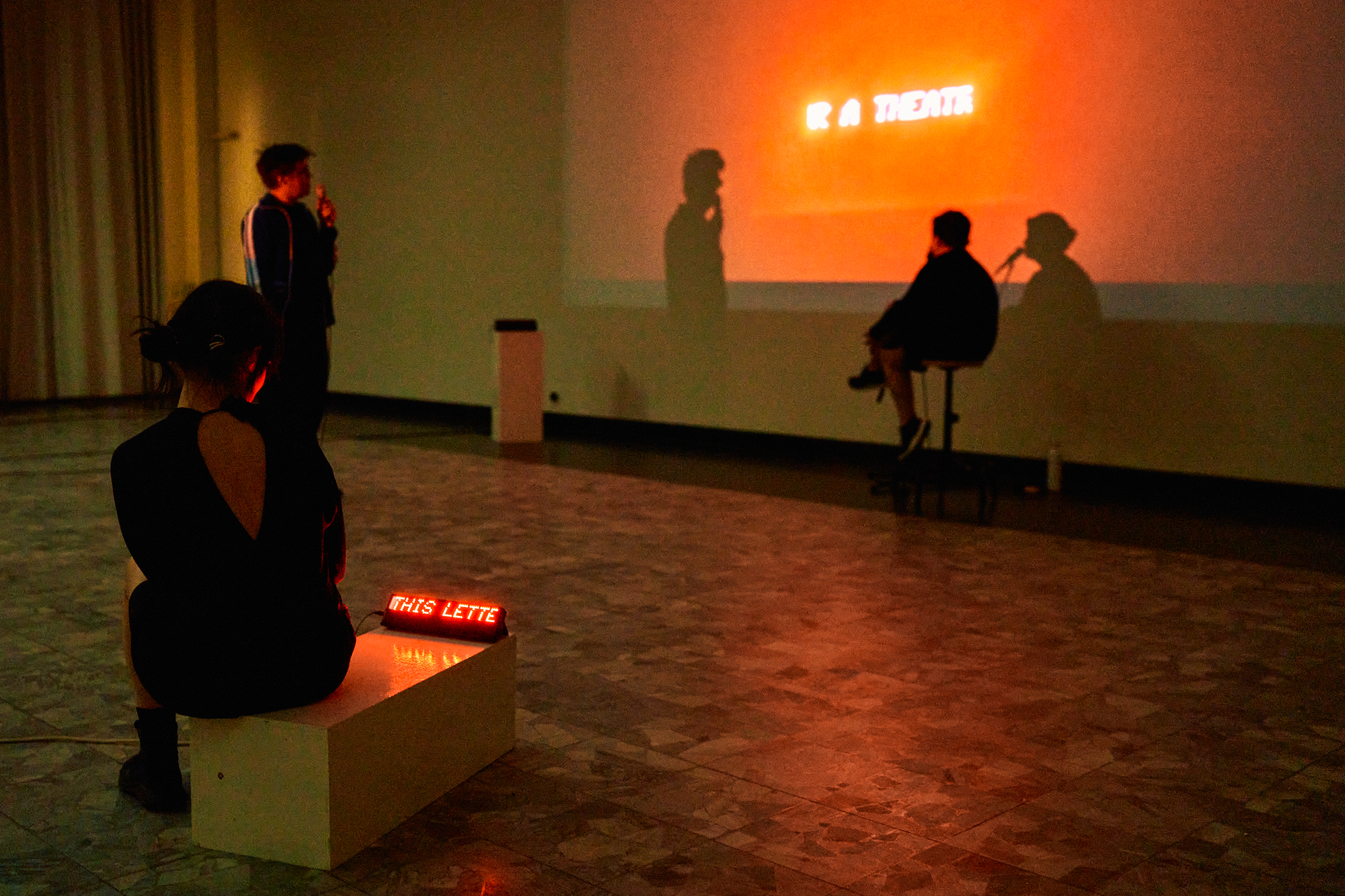
Our focus was not on who takes part in the karaoke experiment, that is, on the identities of the participants, nor on trying to encourage everyone to speak into the microphone. Instead, in the sense of non-coercive participation, the offer itself and what it might lead to, was our main point of interest. We wanted to test whether our setting and participatory strategy based on love letters and tickers would encourage the spectators to join the experiment or not, and, by extension, whether a sense of a collective effort – a shared situation of what I have termed above as “careful listening” – might form between all individuals present in the situation, including those who decided to remain in a conventional spectatorial position.
Little by little, a poetic, fragmentary and improvised tapestry of spoken fragments started to form in the karaoke situation, with changing participants reciting words, halves of sentences, and longer text parts as they wished, in an improvised manner. For the whole length of ten minutes, all of us in the situation – both those speaking into the microphone, and those who were listening – seemed to be fully attentive and alert to each other and to the voiced and displayed words and sentences, in an utmost careful manner.
As part of the final project presentation called PPP* evening (Fig. 3), Lamenza Epifanio and Assandri initiated a similar experiment, with a visibly concentrated atmosphere among the participants, again conveying a sense of careful collective voicing.
Open invitation policy and proto-political relevance of LOVE LETTERS in the Kunstzelle
LOVE LETTERS in the Kunstzelle (Fig. 4) can readily be described as a durational site-specific installation, and as a participatory experiment. The installation consisted of four LED tickers, each of them displaying thematic text fragments running non-stop for a three-month period: my personal letter to the US American artist Jenny Holzer whose LED based works since the 1980’s have had a profound impact on my own artistic practice and approach to the dynamics between text, space and performance; selected interview quotes by Holzer herself on writing, love, being an artist, and tickers as an artistic medium; statements and fragments of theoretical texts on the cultural history, contemporary discourses, and societal contextualization of love letter writing and fandom; and finally, short love letters and fan letters contributed to the installation by voluntary individuals who might here be referred to as “spectator-participants”, a term that I originally coined for performance analysis and that emphasizes the co-creative, active role of spectators in participatory projects (Lahtinen 2020, 15-20).3
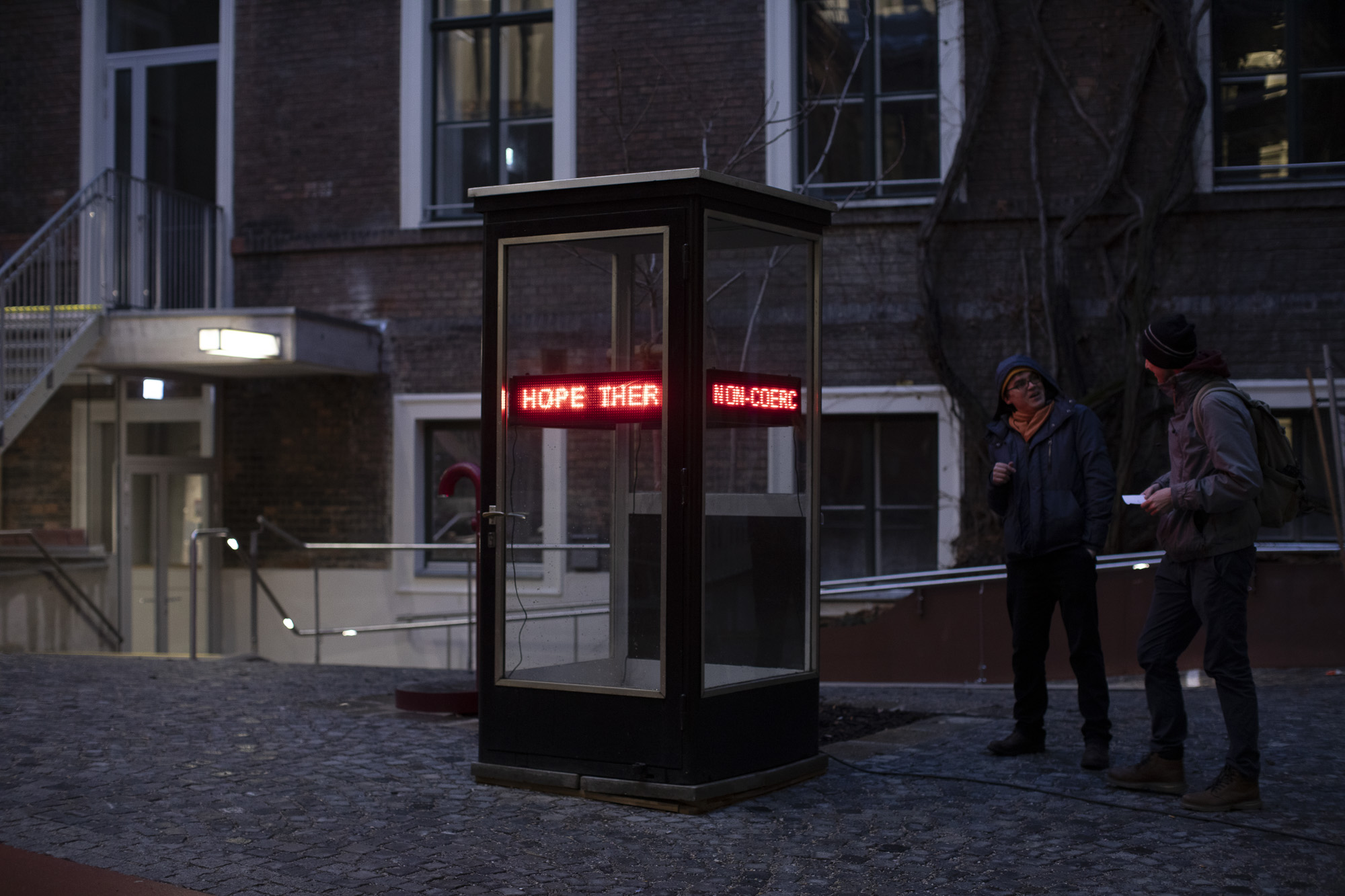
The Call for Participation was primarily distributed via institutional and personal websites and diverse social media channels, without having predefined target groups or aiming at demographic representativity.4 Drawing on the experiences I had gained through the participatory experiments within the frame of TACTICS for a COLLECTIVE BODY, also in this project, the focus was decidedly not on the identities of the participants but on the invitation itself and what it might lead to.
Love letters up to 500 characters could be shared with me via e-mail, in person at the opening night, or at one of the three “Meet & Greet” events on-site, at which the visitors could talk to me and the Kunstzelle curators Christine Baumann and Pablo Chiereghin informally, have a cup of tea, rum and cookies, and, if they wished, to feed their text in the installation with the help of the ticker programming application on my smartphone. At the “Meet & Greet” events, new texts were added to the installation.
Love letters can be seen as an accessible theme for a participatory art project. While the practice of love letter writing has a considerably long and varied history in different cultures and societies (Bunzel 2021; Butler 2019; Clarke 2020; Haas 2016; Shapiro 2007), one does not necessarily need to have knowledge about this historical dimension in order to understand what love letter writing entails. Many of us are familiar with the concept of love letters through Western popular culture and literature, and have personal experiences of emotional turbulence, anxieties and thrill related to strong feelings such as love, and to the difficulties in verbalising affective bodily sensations and desires through propositional language.5
The contents of the letters I received ranged from seemingly personal and autobiographical accounts of shared memories and moments with present or past partners, expressions of joy of decade-long friendships as well as poetic declarations of love and of being a fan of a specific artist, to humorous one-liner remarks that may or may not bear personal significance to the individuals who shared them. It was crucial for me to not assess the texts in terms of taste, that is, what I personally think would or would not be interesting inputs in the installation in artistic terms. Instead, metaphorically speaking, it was crucial to listen carefully, to give room for the diversity and multiplicity of voices and understandings of what the concept “love letter”, and love letter writing, mean to the partaking individuals.
Furthermore, the possibility of anonymity was important so as to let participants decide themselves not only on the contents but also on the parameters of identification regarding their inputs: the letters could be assigned with a signature – a few participants decided to sign their letter with their first name or a nickname – or be shared anonymously without any kind of personal reference (cf. Fig. 5). While I was prepared to receive and, subsequently, to censor texts containing problematic contents in terms of toxic, racist, or misogynous language, not a single text input included such contents. However, I needed to shorten a few very long texts that clearly exceeded the maximum limit of 500 characters communicated in the Call for Participation. In these cases, I obtained the approval of each sender before including the shortened and slightly edited texts into the installation.
All in all, I received texts in four languages: German, English, Italian and Spanish. After intensive pondering, I decided not to provide translations but to display the letter texts in the language they were handed in. On one hand, this decision may have rendered some of the texts less accessible for some visitors.6 On the other hand, when displayed on an LED ticker, the texts in different languages can be seen as rendering a multiplicity of voices and languages visible and sensible, thereby highlighting the performativity of different languages with their different rhythms, melodies, and length of words in Boulous Walker’s sense of reading-as-listening.
The installation could be viewed at different stages by dozens of passers-by who crossed the WUK courtyard daily, and one of the tickers could even be seen from the Währinger Straße connecting the Vienna city centre to Gürtel, a busy thoroughfare crossing several parts of the city.
While the focus of LOVE LETTERS in the Kunstzelle was on the experimentation with non-coercive – and non-confrontational – participatory strategies, the project can be seen as having (proto-)political currency. To my surprise, in numerous discussions I had in the “Meet & Greet” events, visitors emphasized strongly that, in their view, this project functioned as an antedote to “hate speech”,7 embodying and facilitating what might be called gentle, caring, and positive use of text in public space. Indeed, following Jacques Rancière and Davide Panagia, we might say that the project may have induced momentary breaks and ruptures in the prevailing “distribution of the sensible”8 regarding what information – what kinds of text, messages, statements, and wordings – are visible and sensible in public space in Vienna. The installation hinted at an alternative way of thinking about text, and textual presentation formats, in the contemporary cityscape dominated by the myriad of adverts and functional signage (cf. Fig. 6).
In this text, I have outlined how LED tickers and love letter writing can open up novel – careful and caring – perspectives on the dynamics of listening, reading and participation in the context of artistic research, and beyond. If we agree that listening and participation should be viewed as complex and diverse activities, we need ever more sensitivity to – as well as experimental research on and with – the practices that these terms are taken to describe.
Endnotes
- In my view, LED tickers affect us on a pre-personal, affective, uncontrollable level of bodily sensations. For a detailed discussion about my take on the role of affects in human perception and what I have referred to as the human perceptual apparatus, see Lahtinen 2020, 35–39, 205–208. I draw in this matter on Barad 2003; Hurley 2010; Massumi 2013; Panagia 2009; Pitts-Taylor 2016; Sullivan 2013.
- I wish to thank Renata Lamenza Epifanio and Stef Assandri for their insightful and inspiring comments in the writing process of this text. My role as an advisor and collaborator in the research project took place within the experimental collective formation “Researcher >1”, coined by Lamenza and Assandri, consisting of “artists, philosophers, performers, words, audience, designers, books and researchers” and representing “a call for collectiveness” within the research project. AP Arts, Researcher (>1); AP Arts, Tactics for a collective body. For further project details, see also AP Arts, PPP* evening; AP Arts, Renata Lamenza; Linktree, Stef Assandri.
- I invited Jenny Holzer to the Opening of LOVE LETTERS in the Kunstzelle via e-mail, with a slightly adapted text version of my letter to her, to be presented as part of the installation; I received a very kind reply note from Holzer’s studio. LOVE LETTERS in the Kunstzelle is part of my long-term and ongoing project LOVE LETTERS… that explores intimacy, love letters as a form of communication; (imagined) boundaries between the “private” and “public”; the idea and forms of “fandom”; the discourses on “liveness” and art historiography; politics of participation; and the materiality and performativity of the ticker as an artistic medium through installations, video works, performances, and discussions. The Opening Night of LOVE LETTERS in the Kunstzelle featured in the Vienna Art Week 2023 program and included an artist talk with the cultural theorist Elke Krasny. See Kunstzelle 2023; Vienna Art Week 2023.
- The Call for Participation can be read on the Kunstzelle website, see Kunstzelle 2023. The Call was distributed online via the Kunstzelle website, Vienna Art Week 2023 website, my website, and diverse Instagram and Facebook accounts. For a more detailed discussion about demographic representation and its problematic from a Rancièrean perspective and in the context of participatory performance practice, see Lahtinen 2020, 51–53, 218–220.
- The concepts “love” and “romantic love” are, of course, bound to specific cultural and social histories of emotions, see e.g. Ahmed 2005; Barclay and Holloway 2020.
- That said, there are free online translating programs and applications that provide translation drafts in seconds, without the need of registering or logging in; I assume that most of the visitors ultimately had the possibility of reading the texts in their preferred language.
- For a concise definition of hate speech, see e.g. United Nations 2023.
- For a detailed account of Rancière’s key term “distribution of the sensible” and its relation to the political currency of daily life, see Lahtinen 2020, 37–39; Panagia 2009, 6; Rancière 2011, 242.
References
- Ahmed, Sara. 2005. The Cultural Politics of Emotion. Routledge.
- AP Arts. n.d. “Tactics for a collective body”. Accessed 15.09.2024. https://www.ap-arts.be/en/research/tactics-collective-body.
- AP Arts, n.d. “PPP* Evening”. Accessed 15.09.2024. https://www.ap-arts.be/en/node/3767.
- AP Arts. n.d. “Renata Lamenza”. Accessed 15.09.2024. https://www.ap-arts.be/en/person/renata-lamenza.
- AP Arts, n.d. “Researcher (>1)”. Accessed 15.09.2024. https://www.ap-arts.be/index.php/en/person/researcher-1.
- Barad, Karen. 2003. “Posthumanist Performativity: Toward an Understanding of How Matter Comes to Matter.” Signs. Journal of Women in Culture and Society, 28:3, 801–831.
- Barad, Karen. 2007. Meeting the Universe Half-Way: Quantum Physics and the Entanglement of Matter and Meaning. Duke University Press.
- Barclay, Katie and Sally Holloway. 2020. “Interrogating Romantic Love.” Cultural and Social History, vol. 17, no. 3, 271–277. DOI: 10.1080/14780038.2019.1685839
- Boulous Walker, Michelle. 2017. Slow Philosophy: Reading Against the Institution. Bloomsbury.
- Bunzel, Wolfgang. 2021. “Nach Bohrer. Überlegungen zum ‚romantischen Brief‘.” In Die Geschichtlichkeit des Briefs. Kontinuität und Wandel einer Kommunikationsform, edited by Norman Kasper, Jana Kittelmann, Jochen Strobel and Robert Vellusig, 141–163. DOI: 10.1515/9783110712568-008.
- Butler, Alice. 2019. “Fan Letters of Love.” In Fandom as Methodology. A Sourcebook for Artists and Writers, edited by Catherine Grant and Kate Random Love. Goldsmiths Press, 149–164.
- Clarke, Andrea. 2020. Love Letters. Intimate Correspondence between Famous Lovers. British Library Publishing.
- Faulkner, Joanne. 2017. “Slow Reading and Philosophy’s Futures.” Review of Slow Philosophy. Reading against the Institution, by Michelle Boulous Walker. Parrhesia, number 28, 2017, 225–237.
- Haas, Olivia. 2016. “Epistolary Fiction. A Novel Affair.” Online research article. Smithsonian National Postal Museum. Accessed 15.09.2024. https://postalmuseum.si.edu/research-article/epistolary-fiction-themes/love-letters.
- Hurley, Erin. 2010. Theatre and Feeling. Palgrave Macmillan.
- Kunstzelle. 2023. “Joonas Lahtinen: Love Letters.” Accessed 15.09.2024. https://www.wuk.at/en/events/joonas-lahtinen-love-letters/.
- Lahtinen, Joonas. 2015. “How to address politics of the body in participatory performance? On the possibilities of sensory fields and collective body techniques as analytical tools.” Nordic Theatre Studies, 27:2, 36–47. Open access: https://tidsskrift.dk/nts/article/view/24249/21252 (accessed on 15.09.2024). DOI: 10.7146/nts.v27i2.24249.
- Lahtinen, Joonas. 2020. Making Sense of Perception and Power in Participatory Performance. Horizons of Change and Politics of the Sensible in Lois Weaver’s “What Tammy Needs to Know”, Tellervo Kalleinen and Oliver Kochta-Kalleinen’s “Complaints Choir”, and Claudia Bosse’s “dominant powers. was also tun?”. PhD diss., University of Helsinki. Open access PDF: http://hdl.handle.net/10138/320573 (accessed on 15.09.2024). URN: http://urn.fi/URN:ISBN:978-951-51-6419-3.
- Linktree, n.d. “Stefania Assandri.” Accessed 15.09.2024. https://linktr.ee/assandri.tif.
- Massumi, Brian. 2013. “Kräfte des Widerstands – Ideologie und Affekt.” Springerin, 2, 2013, 40–41.
- Panagia, Davide. 2009. The Political Life of Sensation. Duke University Press.
- Pitts-Taylor, Victoria. 2016. The Brain’s Body. Neuroscience and Corporeal Politics. Duke University Press.
- Rancière, Jacques. 2011. “Against an Ebbing Tide: An Interview with Jacques Rancière.” In Reading Rancière. Critical Dissensus, edited by Paul Bowman and Richard Stamp. Continuum, 238–251.
- Shapiro, Bill. 2007. Other People’s Love Letters. 150 Love Letters You Were Never Meant to See. Penguin Random House.
- Sullivan, Simon. 2013. “The Aesthetics of Affect: Thinking Art Beyond Representation.” In Visual Cultures as Objects and Affects, edited by Jorella Andrews and Simon Sullivan. Goldsmiths, University of London and Sternberg Press, 9–26.
- United Nations. 2023. “Understanding hate speech”. Accessed 15.09.2024. https://www.un.org/en/hate-speech/understanding-hate-speech/what-is-hate-speech.
- Vienna Art Week. 2023. “Joonas Lahtinen”. Accessed 15.09.2024. https://www.viennaartweek.at/en/program/joonas-lahtinen-love-letters.