The research project Bodies in resonating action (2020–2025) consists of four individual collaborations with four musicians and instruments of distinct nature and properties (double bass, contraforte, bass drum, voice) to assist exploring a wide range of possibilities in terms of interaction between the human body and the instrument’s body. Each of the four solo projects (Artefact 1-4) has a duration of at least one year of consistent and time-organised work with the performer, which results in a number of performances at different stages of the development. Each case study functions as both a laboratory for experimentation and a site for the gradual crystallisation of material. The concepts developed in each of the solo projects are applied and further researched in every next solo project in order to expand, refine, better understand and articulate the ideas by distributing work and reflection along a wider time span and making use of the different collaborator’s input. Presenting the work in progress in multiple performances as well as bringing two of the solos together in the same time and space,2 aims at observing the material in real live-performance time and in a variety of contexts, and also at the same time observing how the performer’s body and perception of themselves in relation to the material changes in these contexts and how their experience is continuously being reshaped.
The working process comprises multiple regular research sessions. All the sessions are documented (video and audio), and precisely transcribed, and specific elements are extracted in audio and/or video lists to better organise the thinking process and share with the collaborative musician to use as a memory and reflection tool. Some of the sessions include making deliberate, selective recordings of certain ideas, sounds or even performances of the whole performance outline or parts of it that have the purpose of identifying combination possibilities that shape the performing experience in terms of physicality. The exchange between composer and performer is initiated by a constantly renewed list of impulses by the composer that is being explored by means of improvisation and experimentation, followed by discussion and mutual observation. The main points of observation during this process are understanding, deconstructing and reconstructing already embodied technique, detecting the ways in which the performer deals with impulses given to them, identifying the physical or mental challenges and limitations as well as attempting to push beyond them, approaching new techniques and ideas. Throughout the experimentation period it is vital to keep track of how the musicians describe and express their experience, and how their perception within and outside of their body transforms through time and practice.
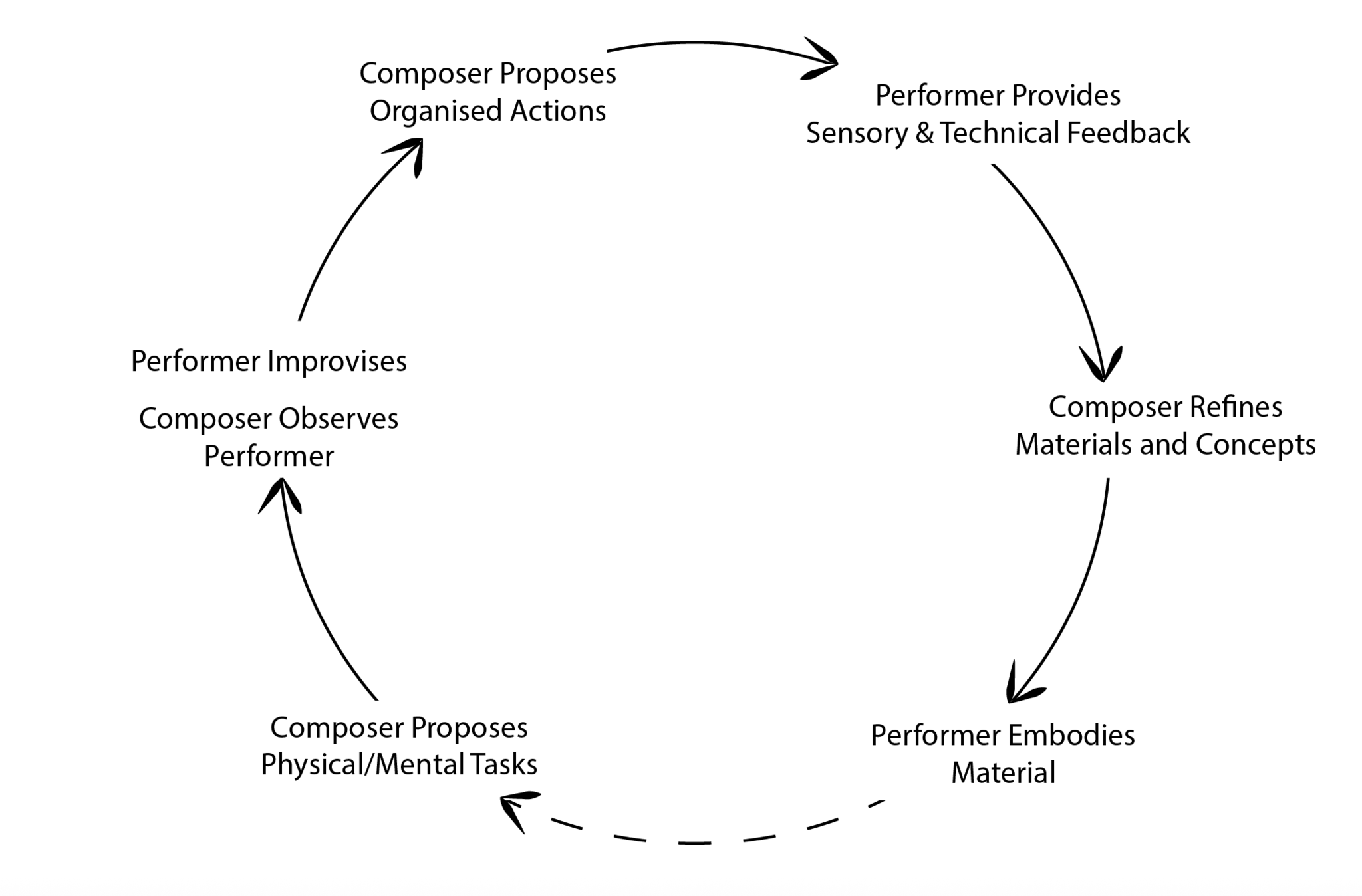
The collaboration with the musician involves a model of dialogue created to facilitate active thinking, critical reflection and mutual contribution. Given the distinct backgrounds and areas of expertise, the nature of each party’s input differs considerably. While the composer shapes the conceptual framework, reframes the focus by shifting the performer’s attention to new directions and devises the experiment to provoke novel interactions and sonic outcomes, the performer provides deep embodied technical knowledge and sensory feedback by articulating the sensations produced by actions. By testing proposed scenarios, they suggest ways of adapting technique and strategies of physical movement to meet the composer’s conceptual aim. The diagram in Fig. 1 shows the feedback loop that takes place in repetitive cycles.