Chapter 8 — Conclusions
Chapter 8 synthesizes the main findings of the dissertation by examining how the Iterative Feedback Model for Collaborative Composition (IFMCC) operated across the three case studies and how it reshaped compositional practice, performer agency, and understandings of authorship. Returning to the central research question—how the IFMCC structures interactions between composers and performers and how it influences compositional and performative outcomes—the chapter traces points of convergence and divergence between the projects and reflects on both anticipated and unexpected results.
A first group of findings concerns the compositional process. Across all cases, the IFMCC enabled a more flexible and responsive approach than conventional score-based models. Particularly in the phases of material generation and iterative restructuring, decision-making was redistributed: performers’ contributions did not simply “inform” the work but actively altered its architecture. Instead of composing in isolation and handing over a finished score, composition unfolded through cycles of proposal, response, reflection, and integration. This was especially evident in the non-linear and modular structures of I See You and Lieder aus der Fremde, where form remained open enough to accommodate change while still retaining identity.
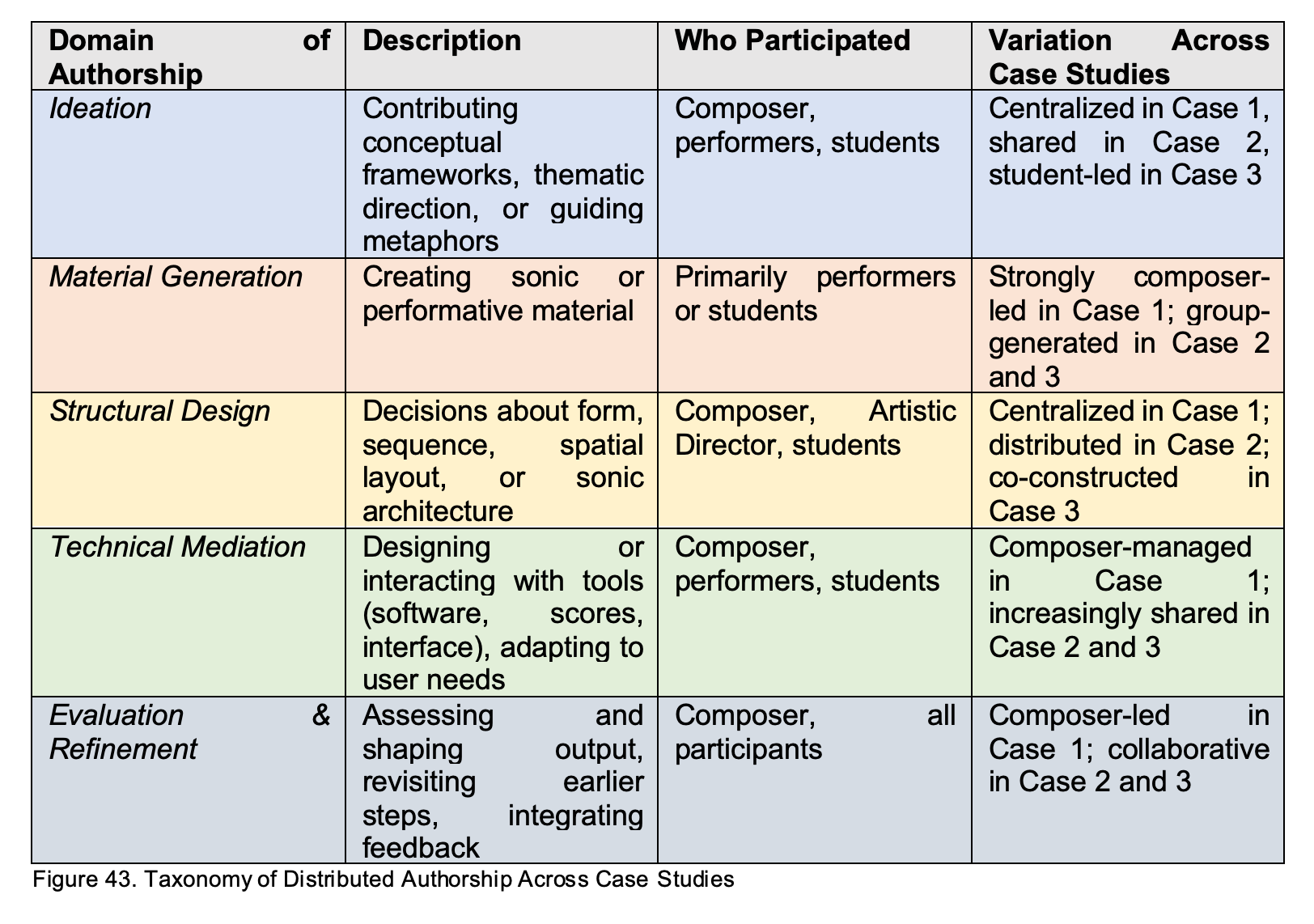
The chapter also shows how the model affected performer engagement and authorship. Early and sustained involvement increased performers’ sense of co-ownership and clarified the work’s aims, corroborating earlier research on collaborative creativity. To articulate these shifts, the dissertation proposes a taxonomy of distributed authorship that distinguishes between domains such as ideation, material generation, structural design, technical mediation, and evaluation. The case studies demonstrate how these domains were variously centralized or shared: in Case Study I, structural decisions remained largely composer-driven; in Case Study II, they were negotiated; in Case Study III, they became genuinely co-constructed. Authorship thus appears as a dynamic configuration of roles rather than a fixed property of a single individual.
A further strand of the chapter examines how the IFMCC leads to processual conceptions of the work. The compositions developed under this framework are not treated as closed artefacts but as evolving processes that carry traces of feedback loops, experimental sessions, and workshop interactions. The model does not reject structure; instead, it embeds coherence within iterative negotiation. In this sense, performance becomes a temporal manifestation of the process rather than a definitive endpoint. This aligns the dissertation with artistic research perspectives that understand works as documents of inquiry and with theories of group creativity in which structure and meaning emerge from distributed interaction.
Reflection and evaluation are recast as creative acts. Rather than occurring only after the fact, assessment is integrated into the process through feedback sessions, guided questions, blogs, and collective discussions. In several instances—particularly in the participatory pedagogical context of Case Study III—these reflective tools directly generated new material, altered interaction modes, or reshaped technical setups. Evaluation thus becomes a site of authorship: participants do not merely comment on a work but participate in reconfiguring it.
The chapter also addresses the broader impact and potential applications of the IFMCC. For composers, the model provides a structured yet adaptable roadmap for embedding collaboration into the core of compositional practice. For performers, it opens avenues for deeper participation in shaping structure, tools, and presentation. For educators and institutions, the case studies demonstrate how the model can support process-oriented projects in heterogeneous settings, where participants possess different levels of expertise. At the same time, the research invites institutions and commissioners to reconsider premiere-driven, product-oriented production models, arguing for more durational and revisitable forms of support.
Finally, Chapter 8 critically reflects on the limitations, risks, and open questions associated with the model. The redistribution of agency complicates traditional notions of the composer’s voice and raises practical questions about authorship, credit, and sustainability within Western Art Music institutions that still rely on fixed works and individual attribution. The IFMCC also demands time, trust, and resources—conditions that are not always available—and it cannot neutralize power asymmetries, even when it makes them more visible. The chapter acknowledges the emotional and professional challenges of embracing uncertainty and shared control, while arguing that this very tension is central to the model’s critical and artistic potential.
In conclusion, the dissertation proposes the IFMCC as a situated, adaptable framework rather than a universal solution: a way of structuring collaborative composition that foregrounds iterative feedback, negotiated authorship, and processual conceptions of the work. The final reflections point toward future applications of the model in other artistic, pedagogical, and institutional contexts, as well as toward further research on how distributed authorship and process-based practices can be sustained and recognized within existing cultural infrastructures.