I Love Listening to Music and Imagining Things Happening (2025)
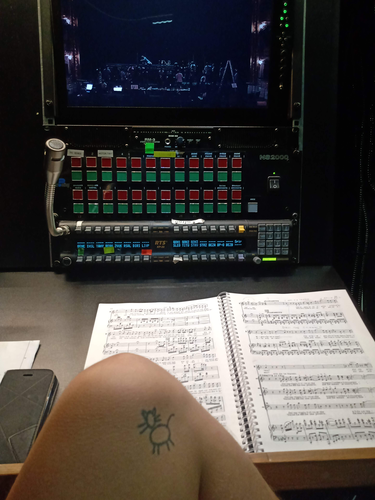
This exposition explores the paradox of rendering visible a research that seeks to remain unseen. It examines concealment, obfuscation, and selective disclosure as strategies of resistance and protection, questioning the ethics and politics of visibility in academic and artistic inquiry. Absence, silence, and ambiguity are explored as ways of invoking presence, challenging dominant paradigms of transparency and access, and proposing alternative modes of engaging with hidden or fugitive research. Central to this inquiry is the operatic prompter, an unseen presence that feeds lines to the performer, ensuring continuity while remaining hidden. The prompter’s role complicates the link between knowledge and articulation, shaping the performance without claiming authorship. Like other fugitive voices in history, the prompter embodies a marginal agency, whispering from the wings.
The Possibilities of Applying Elements of Czech Folk Theatre to Contemporary Street Performing Art (2025)
Michal Moravec, Vojtěch Balcar
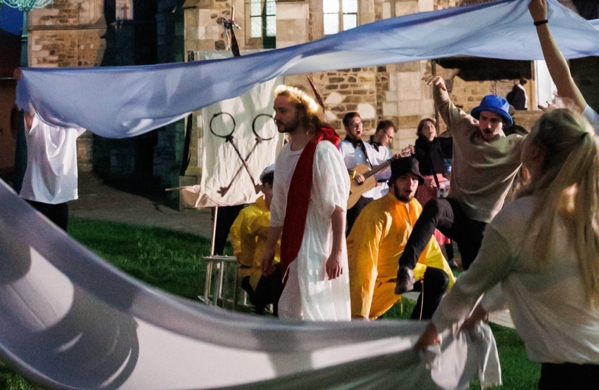
This exposition, entitled The Possibilities of Applying Elements of Czech Folk Theatre to Contemporary Street Performing Art, presents the process and conclusions of artistic research that explored the phenomenon of Baroque folk theatre performed in neighbourhood communities in the Czech countryside in the 18th and 19th centuries and the search for the application of its principles in today's theatre activity. For this research, in cooperation with the Diocesan Museum of Brno, two street productions were created in the vicinity of the Cathedral of Saints Peter and Paul in Brno to test the functionality of the means of folk theatre in today's context.
The exposition presents the initial considerations and methodology of the research, followed by a chapter-by-chapter description of the various theatrical principles in their historical context, how they were worked with in the investigated productions, and a summary of the benefits and problems uncovered. Finally, the major contributions of folk theatre to today's work are outlined, which were evident in two of the production forms. An essential part of this exposition is the audiovisual documentation of these two projects, which became the core of the practical artistic research.
Hands in the Digital Image: The Materiality of Tapestries in an Authorial Documentary Film (2025)
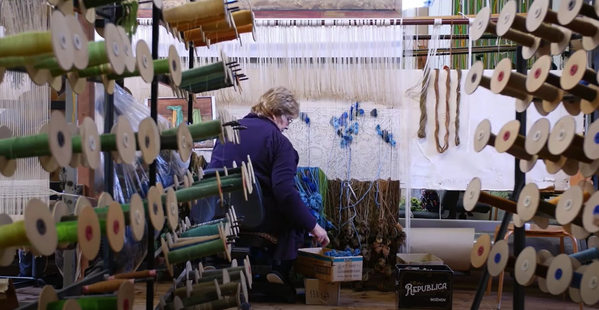
In this exposition, I invite you to the process of research carried out in the tapestry manufactory in Valašské Meziříčí. It aims to find out how to convey tapestries' craftsmanship, mediality and materiality through filming and post-production. The theme of transformation is essential: the transformation of the tapestry into a film image, but also the transformation of painting or graphics, which were the precursors of the tapestries woven in the manufactory. I am also looking for ways to use a primarily representational medium to achieve an effect of presence through materiality and corporeality. In my research, I interlace observational passages with stylized ones that emerge from a creative dialogue between the materiality of different media, artistic techniques, or post-production interventions. These methods can deepen not only the viewer's experience but also the documentary testimony and convey an almost tactile encounter with the filmed reality. Finally, based on practical experience, I distinguish working with materiality in film into three analytical cuts.
Paths of artistic research (2025)
The work Paths of artistic research is a collection of interviews with artistic researchers - Andrea Buršová, assistant professor at the Nika Brettschneiderová Dramatic Acting Department, Faculty of Drama, JAMU, Jiří Honzírek, director, manager of the Feste Theatre and PhD student at the Theatre Faculty, JAMU, Barbora Klímová, head of the Studio of Environmental Design at the FFA BUT, Lenka Klodová, head of the Studio of Body Design at the FFA BUT, Lucia Repašská, researcher at the Cabinet for Theatre and Drama Research, Theatre Faculty, JAMU, Hana Slavíková, head of the Studio of Radio and Television Dramaturgy and Scriptwriting, Theatre Faculty, JAMU, Pavel Sterec, artist and former head of the Intermedia Studio at the FFA, BUT, and Lenka Veselová, researcher at the Department of Theory and History of Art at the FFA, BUT and PhD student at the FFA, BUT. These are artists who have been associated with art colleges in Brno, specifically with the Faculty of Fine Arts of the BUT and the Theatre Faculty of the JAMU. Through interviews with the artists, the reader will learn under what circumstances they began to engage in artistic research, how they perceive it, what meanings they attribute to it and the purpose it serves for them. The selected group of artists is very diverse and their creative and research strategies are different, as are the purposes for which they use artistic research. The work does not aim to provide an exhaustive overview of the methods used in artistic research, but it does aim to show that there are many approaches to artistic research and to present the paths that have brought particular artists to artistic research.
manifesto (2025)
Tereza Strmisková, Silvia Diveky
With Future = NOW! A Youth Manifesto, a project co-funded by the European Union, Creative Europe Culture programme, we worked together with the young generation to form a cross section of art and activism about topics that are in the centre of their future concerns. We want to redefine forums of the 21st century through the help of artivism and performance arts practices, engage the audience in a site specific action and start discussion through the help of participatory practices. The project Future = NOW! urges all of us to really connect, not only on a local and national level, but also transnationally and cross-sectorally. The project is focusing on gender, environmental crisis and inclusivity. Throughout the project we built youth manifestos based on thorough research.
Resistance (2025)
Tereza Strmisková, Silvia Diveky
Understanding the complexities of current European society is impossible, especially for the younger generations, without knowing and understanding the complex historical developments and narratives. In most EU member states teaching history in the system of formal education is predominantly focused on national, if not patriotic history narratives. The consequence of this approach is that young people have a lack of knowledge about a wider, transnational and shared European history.