Dodona (or Dodone) in Epirus, Western Greece, is the oldest Hellenic Oracle. The first mention of the Oracle can be found in Homer, where the Dodona is referred to as an oracle of Zeus. In Iliad, Achilles pleas to the Dodonian Pelasgian Zeus “High Zeus, Lord of Dodona, Pelasgian, living afar off, brooding over wintry Dodona” for the wounded Patroclus. Odysseus visited Dodona to consult the ancient oak tree about his return to Ithaca. ([2], [6])
What was unique about the oracle of Dodona among all ancient Hellenic Oracles was that sound had a prominent role in the divination ceremony. The prophecy was given by priestesses and priests by interpreting sounds associated with the ancient ‘sounding oak’ at the site. Recent archaeological findings suggest that the sounds referenced in the ancient texts were not only the rustling of the oak leaves, as initially assumed. Instead, it is suggested that copper objects hung from the ancient tree and their sounds were at the centre of the sonic ceremony.
Is is understood that such was potentially the utility of a copper wheel found at the site (indexed as object 617 at the Archaeological Museum of Ioannina), which likely hung from the tree along with other metal items, potentially cymbals and 'lebetes' (λέβητες), bronze cauldrons ([2], [5]). The small copper wheel is believed to have been used as ‘iynx’ (ίυγγα), a metal object hanging by a thread that could make a harmonic sound, when it spun, wound up, and unwound by the wind, when struck or when many such objects stuck each other.
Spinning sounding objects were not uncommon in Ancient Greece. Iynx was also the name of an ancient children’s toy sonic toy. According to the description from the Acropolis Museum webpage (includes also video demonstration),
“the iynx was a children's toy in ancient Greece. It usually comprised a wooden or ceramic wheel with two holes through which the string would pass to make a double strand (see the instructions). The player would twist the string winding it so that when they pulled it at both ends, it would unwind, and the wheel would spin making a unique sound like the voice of a bird called an ...iynx, or as we know it today, a wag tail or wryneck."
https://acropolismuseumkids.gr/en/dimiourgo1/127-twist-pull-and-whizz-he-so-called-iynx.htm
Dodona was also known for the sound of the “bronze” (χαλκείον), a large gong in the form of a copper vessel vibrating at every breeze by a scourge held in the hand of a figure standing over it [9]. Strabo, a historian of the 1st century writes:
“In the temple there was a copper vessel with a statue of a man situated above it and holding a copper scourge. The scourge was threefold and wrought in chain fashion with bones strung from it; and these bones striking the copper vessel continuously when they were swung by the winds, would produce tones so long that anyone who measures the time from the beginning of the tone to the end could count to four hundred.“
https://penelope.uchicago.edu/Thayer/E/Roman/Texts/Strabo/7Fragments*.html#note472
The connection of sound with the practice of the oracular prediction is fascinating me for its potential connections to my own artistic research project. I had visited the Archeological site of Dodone for the first time in 2023. I was stricken and captivated by the solemnity of the site, which is still isolated and far from any city or village, with no buildings nearby, the ruins standing in the same landscape as they have had for millennia. I visited the archaeological site of Dodone again in the spring of 2025. I now wanted to record the sounds at the site and get ideas for a piece that would be based on the site and the sonic oracular ceremony.
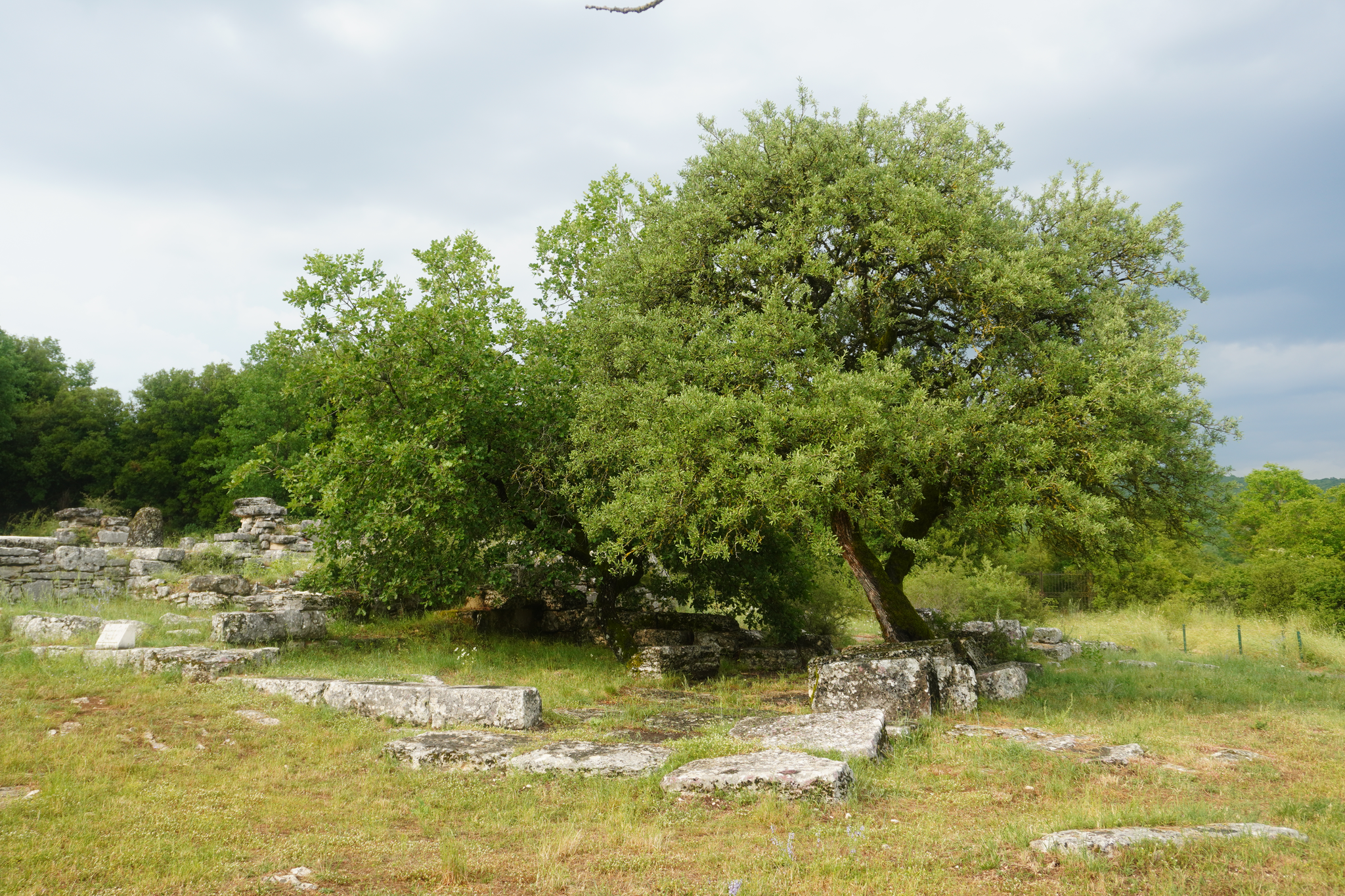
As I started my sound walk at the archeological site, I paid attention to sounds of birds and insects in my vicinity and sounds of sheep bells coming from further away. As hinted by Achilles in Iliad, there is a lot of wind at Dodone. In fact, I was warned that rain is very common at Dodone and, as there are no buildings closeby, the employees at the archaelogical site also warned of lighnings. Indeed, a few minutes in my sound walk the rain started. The sound of the rain falling on the thick oak tree leaves was interesting. Here is the recording of this part of my walk.
Inspired by the relationship between sound and language, the imagined sonic environment of Dodone’s ancient divination site and the oracle saying, I thought about multimodal language-audio models. These models can generate a new sound given a text prompt, or an audio file. Given an audio prompt, the model aims to, either suggest a plausible continuation of the input sound, or provide a sound that is similar to the input sound. These models are based on very deep architectures that require vast amounts of data and significant computational power for their training. The language-audio models are trained on pairs of audio-text data, where each datapoint includes an audio file (of duration around 10 seconds) and its respective text description.The state-of-the-art models of this type are commercial models. Open source text-sound multimodal models are research prototypes usually trained on generic music and audio in the public domain. These research models typically generate around 10 seconds of audio per prompt. For ethical reasons, I wish to work with open models to the extend possible, so I chose to work with such research models.
I found the idea of trying to imagine the oracular sonic site through the use of AI interesting. I wanted to prompt the model to get sounds that would be related to ones used for predicting the future. I first experimented with MusicGen but my experiments were not very successful, as the model is mostly trained on music. I realised that the language-audio models can be of several types, namely models that are trained on music, models that are trained on sound effects (including environmental sounds, foley and field recordings), models that are trained on speech and models that are trained on all of the above. After my failure with MusicGen, I tried a model from the same family of models that was trained only on sound effects, called AudioGen. The results were promising but this model is an older model and the generates sound of low fidelity.
I then started working with another architecture called AudioLDM2, which is a general purpose model trained with both music and sound effects datasets. This model had interesting results so then I started use it more systematically. When prompting, I generated 20 sounds for each prompt, so that I understand the range of possibilities for each prompt. Here I include some of my prompts and the respective generated sounds.
I aim to use these sounds in the creation of a large composition inspired by the site of Dodone. I started processing some of these sounds for this purpose using a new sound synthesis tool from GRM called Atelier. It includes multi-playhead samplers, filters and delay modules with multi-channel support. I include here some of the results of processing along with the respective source sounds.
Working with this model as a composer, one becomes aware of its limitations. The model has been trained on data that include only qualitative descriptions of the respective sounds. These types of models have not learned to distinguish the number of events in each sound, their duration, their pitch or density, or other attributes that would be relevant to me, as a composer. For example in the prompt above 'Small metal objects hanging from trees and moving slowly' the generated sound was a sound of very fast moving objects. Nevertheless, it was a very interesting sound, that I did not expect to get with this prompt. And in the end it was one of the sounds that I used for composing.