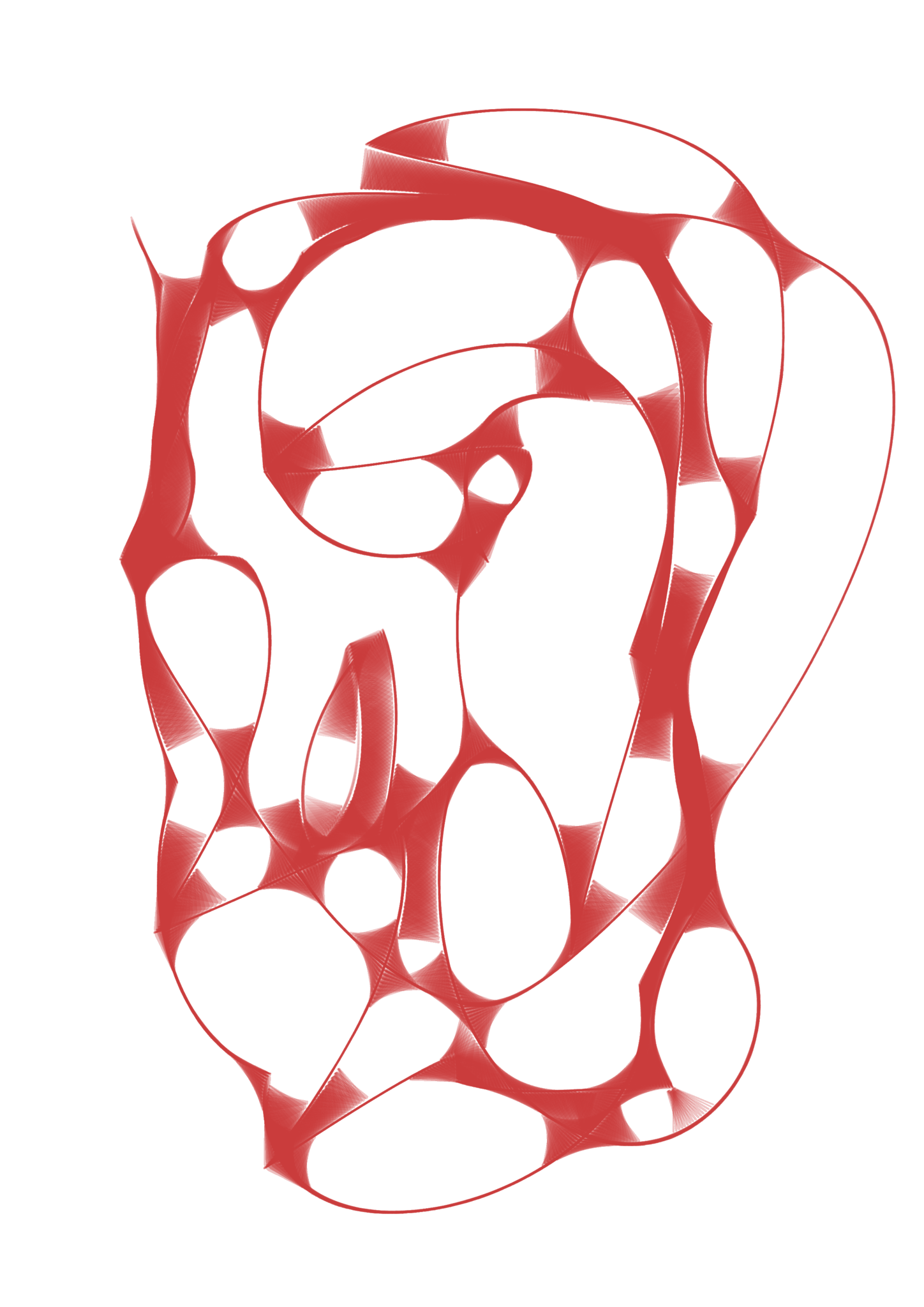
Memorylessness in probability theory and statistics is the property of a system in which the elapsed time can give no information about the remaining time. In a memoryless system, each new event can be considered as the first event, completely disregarding what came before it. After each event occurs, the process restarts in statistical terms and we cannot use information of the duration of previous events to make any inference about the duration of this new event. So information does not accumulate across events and the next event occurs as if no time has previously passed.
This is exactly how I experience the static, yet continuously developing system that emerges when navigating within a distinct state during an improvisational performance. In order to enter this place where the momentary interpolates with the ever-evolving one needs to focus on the duration and lifetime of each discrete gestural event, having the patience not to be influenced by the duration of previous events. A new event can be exactly the same or totally different as the one before it and there is no anticipation, no privileged moments, no buildup and no reward for waiting. The state can end at any time but it also while the potential of continuing infinitely. Memorylessness explicitly challenges the notion of Husserl’s protention, the mind’s ability of retaining past sounds in the consciousness thus anticipating the immediate future. Memorylessness is also closely related in that sense with narrative non-linearity (see the non-linearity dedicated text).
Memorylessness is a constraint on inference as it limits the events of past from being used and, as such, a constraint on expectation. Memorylessness in the compositional process could be reinforced either by deliberate repetition or deliberate absence of repetition altogether. Memorylessness is not a unique property of static improvisational states. It is a universal compositional tool that facilitates the creation of anti-teleological music, music which focuses on time as duration and not as a sequence. In anti-teleological music time is not directional and events do not aim at something. There is no accumulated meaning, no destination, no anticipation. It manifests with sparse events, non-expressivity and absence of gestural causality. In Morton Feldman’s music, for example, it presents itself through extremely long durations, exhaustive variations and flat dynamics. In John Cage’s 4’33”, it is the prolonged silence that interrogates expectation. In Eliane Radigue’s work, it emerges through a sole focus on the overtones. The detailed focus on overtones (what I will refer to in short as no fundamental) is essential in my own music, as it will become clear in later texts and using sound examples. In my practice I use extended techniques for the sole purpose of eliminating the fundamental frequencies and highlighting the overtones of the piano. The essence of memorylessness in my music is captured through the detailed and in-depth real time exploration of those overtones as they merge, compete, fluctuate and create subtle variations in their interaction with the piano soundboard, pedals, microphones and room.
In improvisational practices that are influenced by anti-teleological composers memorylessness can be realized by the explicit rejection of call-and-response, the absence of climaxes and dramatic arcs and the absence of gestural expressivity. Examples of this type of improvisation are the British improvisation group AMM, and representatives of the reductionist movement such as Axel Dörner, Toshimaru Nakamura, Andrea Neumann and Rhodri Davies. A particular influence to my improvised music aesthetics has been the album Exta by John Butcher, Thomas Lehn and John Tilbury.
The improvisation of this type avoids narrative, avoids soloist-accompaniment settings and conversational causality. To avoid conversational causality, it is quite common for each of the musicians to choose a very distinct sound event to explore and create variations on, one that is seemingly rhythmically unrelated and causally independent from the sounds of others. This approach creates a perception of parallel temporalities and gives rise to unexpected rhythmical relationships, while providing the listener the freedom to experience sonic relations though abstraction and imagination. This is a space that I am very interested in exploring when I improvise. Some characteristics of reductionism that are prominent in my music are use of extended techniques, exhausting one specific technique or area of the instrument for an extended period of time, quiet dynamics and pause/silence.