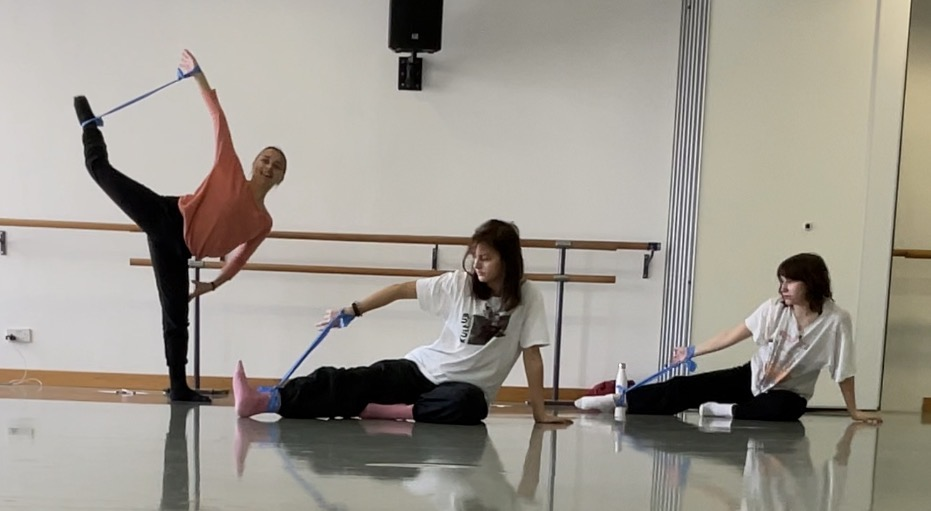
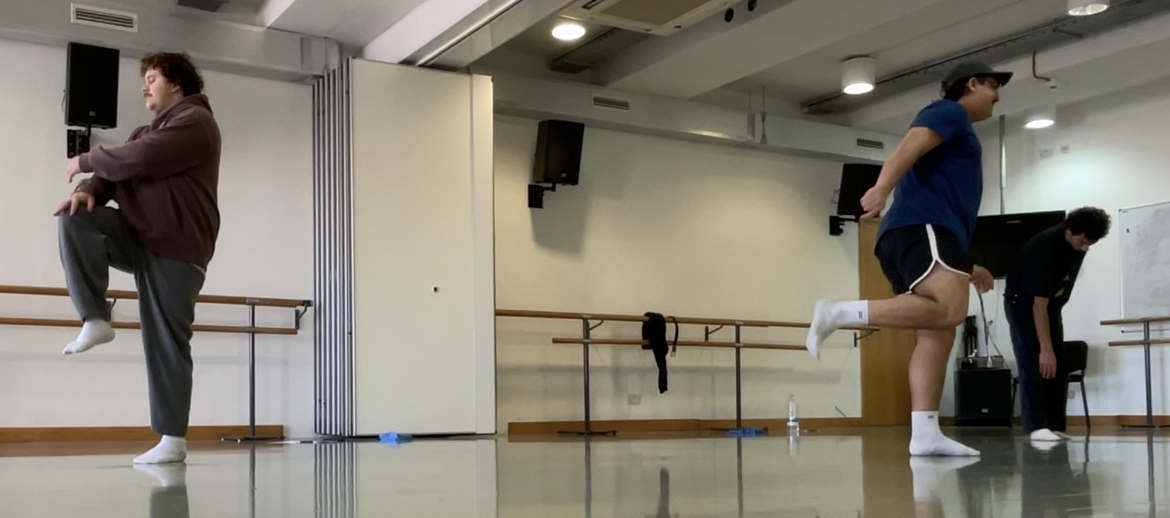
This research is situated within contemporary dance and somatic practices which engage with embodiment, limitation, and sensorial awareness. In particular, it draws inspiration from artistic and somatic approaches that deal with constraint not as restriction, but as a productive condition for perception, memory, and embodied inquiry.
Cecilia Carvalhal Braga de Andrade – It’s Natural (and Other Frictions) (2025)
Cecilia Carvalhal Braga De Andrade’s It’s Natural (and Other Frictions) explores the relationship with tension through resistant materials and wearable prosthetics, and the exposition of constructed-ness of gender identity. This foregrounds how limitation can generate new modes of movement and attention. Through the use of resistance and constrained movement settings, Andrade’s work invites performers to negotiate tension, effort, and adaptation, more than pursuing virtuosic movement outcomes.
This artistic approach informed my practice-as-research by framing restraint as a generative force. As opposed to the notion of overcoming limitation, the workshops embraced resistance as means of revealing habitual movement patterns, and embodied responses. Andrade’s work provided a practical and artistic reference for comprehending the ways in which restraint can heighten bodily awareness, redirecting the internal focus towards sensations, weight, tension, and effort.
Bonnie Bainbridge Cohen
Bonnie Bainbridge Cohen’s somatic practices, particularly those of Body-Mind Centering principles, also inform this research, through its emphasis on experiential anatomy, sensory listening, and embodied awareness. Bainbridge Cohen’s work prioritises first-person bodily experience and the cultivation of awareness through internal focusing, rather than externally imposed form.
This perspective influenced the design of the workshops, particularly with the use of body scan exercises, internal attention and awareness, and reflective documentation. The participants were not instructed toward achieving specific movement aesthetics, but rather, encouraging listening to internal sensation and bodily response, and further remembering the individual momentous sensations occurring. This somatic orientation supported an approach in which awareness emerged through and due to experience, which aligns with the research’s focus on body-mind connection.
Connection to My Practice
Building on these practical influences, this practice-as-research project was structured as a series of movement workshops, exploring the relationship between physical restraint and body-mind awareness. The practice prioritised consistency, preparation, repetition, and reflective engagement, aiming to foreground experimental knowledge.
Materials
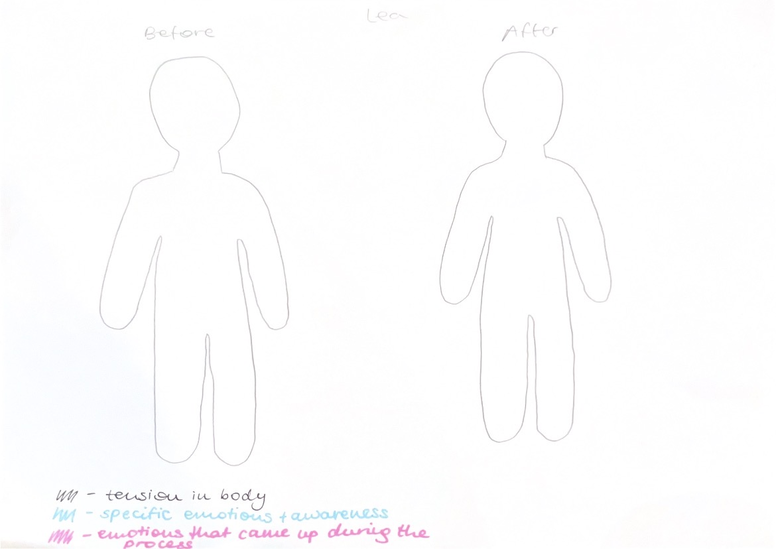
The primary material used within the workshops was a set of elastic resistance training bands, used to create physical restraint between different somatically-connected points in the body, along with the participants’ bodies themselves. The resistance bands functioned as temporary restraints, generating tension and forced connection, as well as resistance, while allowing for movement exploration. The additional materials used for documentation included writing tools, body-map diagrams, and video recording equipment, used to document each session.
Methods
Each workshop followed a consistent structure, which included a somatics-based body scan, guided improvisational tasks, restraint-based movement exploration, and multiple moments in between tasks, for reflection and documentation. The initial body scan was designed to attune participants to any internal sensations, and heightened awareness, while the guided improvisation tasks served as a means of familiarising the participants with specific movement tasks, prior to the introduction of restraint, in similar movement guided tasks.
It should be noted that, all of the tasks were given through verbal prompts, with no form of demonstration, and without reference to codified dance techniques. Furthermore, the same instructional language was applied to both participant groups, and in both workshop rounds. This methodological choice aimed to minimise any technical hierarchy between groups, and allow the participants’ individual movement histories to surface from the tasks, and influence any movement pathways observed.
Approach to Restraint and Reflection
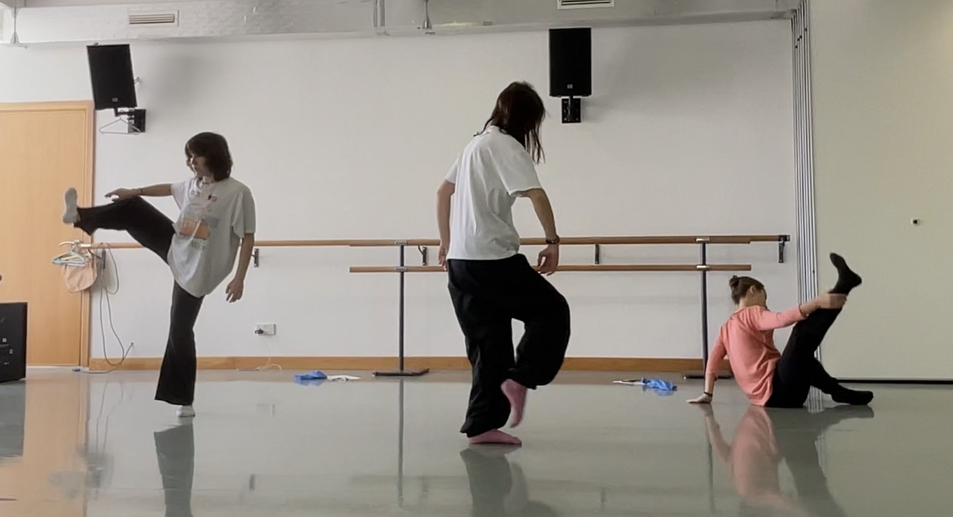
The physical restraint was introduced through resistance bands, by binding different body points, with specific points of connection, and varying across the different tasks. The participants were asked to move with the restraints applied, then remove them, and recreate the same movement pathways explored. This process focused on memory, habit, internal sensation, and body-mind awareness, allowing participants to reflect on how restraint shaped their movement choices and awareness.
Reflection was integrated throughout the workshops through written responses, body-mapping, and occasional group discussion, and these reflective practices supported the notion of embodied experience, forming a central component of the research methodology.
Practice Evolution
While the overall structure, and materials used, remained consistent across the workshops, the practice evolved through the integration of Andrea Olsen’s body story tasks in later sessions. This addition deepened participant engagement with movement history, and personal embodied narratives, reinforcing the research’s focus on how past experience shapes present awareness, and habitual movement patterns.